
- Buy Crypto
- Markets
- Futures
- Spot
- Copy Trade
 WE-Launch
Should You Rotate to Equities in 2026? A New Year Strategy from an Analyst

Original Title: The 2026 Gameplan
Original Author: 0XKYLE, Substack
Translation: Peggy, BlockBeats
Editor's Note:
As the structural changes in the crypto market gradually become apparent, this annual retrospective records a trader's mindset shift from "single-track faith" to "cross-market adaptation." The author, Kyle, is a research analyst at the Singapore-based crypto investment fund DeFiance Capital, with a long history of research in DeFi, Web3 games, and blockchain infrastructure.
In this article, he does not attempt to provide definitive answers but, from a buyside researcher and trader perspective, reviews the successes and failures of 2025 judgments and confronts a more realistic question: in an era dominated by retail investors, accelerated narratives, and changing reward structures, how should investors review, migrate, and reshape their investment frameworks.
The following is the original text:
It's that time of the year again. As 2025 comes to a close, I want to take this opportunity to look back on the journey I've been on. Since 2022, I have been writing these memos, so this will be the fourth annual retrospective I have published. It feels like just a while ago I started running this Substack, time really flies.
Over these four years of my writing, the cryptocurrency market has undergone earth-shattering changes. Bitcoin has surged from $16,000 at its low to $120,000 at its peak; the once "altcoin season" is now a thing of the past; the entire industry, once mocked after the FTX incident, has been embraced by major institutions worldwide.
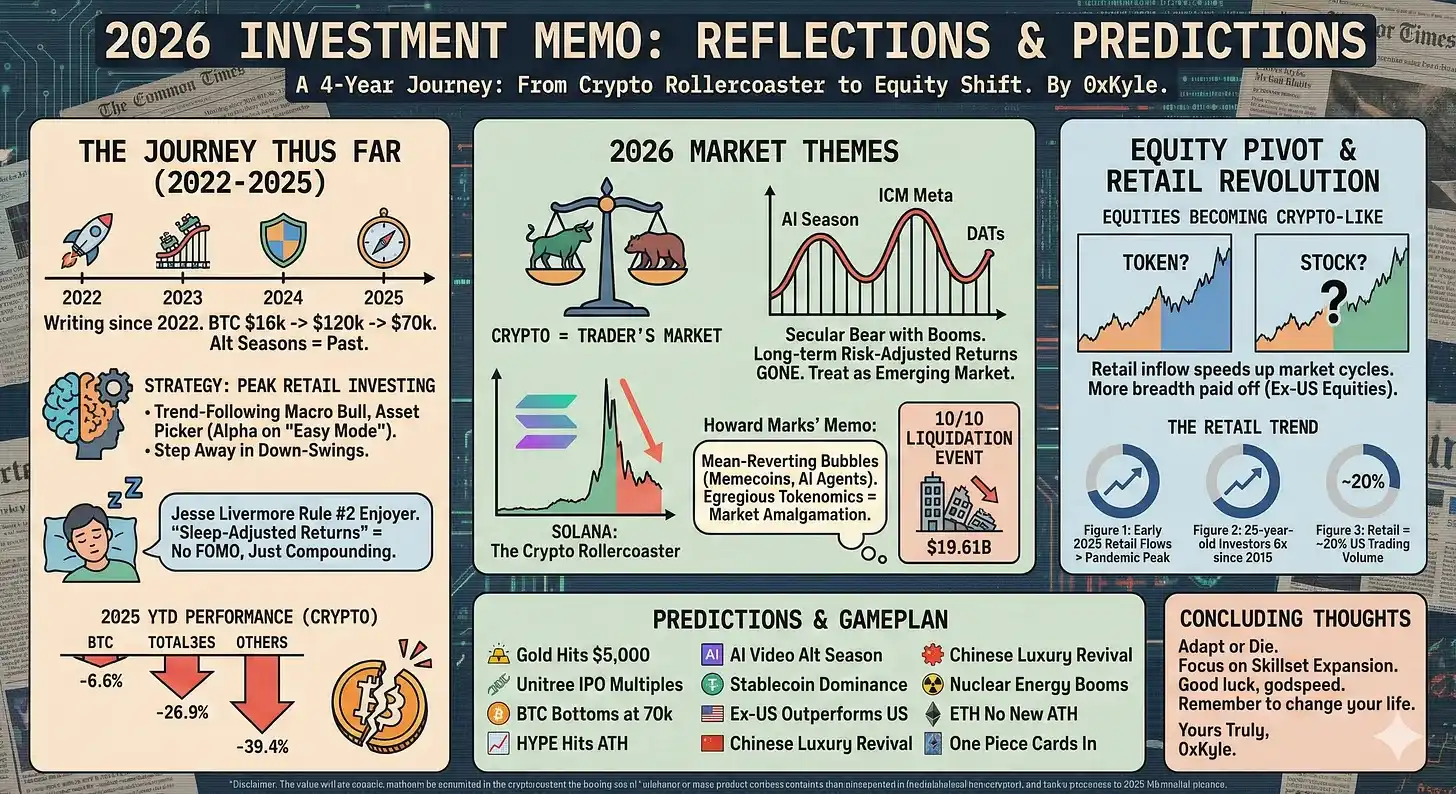
Amidst all these changes, my moneymaking strategy has not fundamentally changed. I do not attempt any complex or sophisticated operations. Essentially, my strategy can be divided into two parts: first, to follow the larger-scale macro bull market trend; second, to gain alpha through asset selection and properly allocate positions.
One could say my strategy represents a "pinnacle form of retail investment": when I judge that the bull market is weakening, and momentum is dissipating, I choose to exit; I only believe in gaining alpha in "simple mode" and decisively shut down this gameplay when the "hard mode" is activated. In other words, I am a faithful practitioner of Jesse Livermore's second principle—except for the shorting part, I do not short.
Jesse Livermore's Second Principle: Do not trade all year round, every day. Only trade when the market trend is clearly in a bull market or bear market. Trades should follow the overall market direction. If the market is rising, you should go long; if the market is falling, you should go short.
Being able to accept "average, or slightly above average" returns has allowed me to enjoy year-over-year compounded growth without sacrificing leisure time. This is also one of the reasons I believe this strategy is particularly suitable for lazy retail investors like me, somewhat akin to pursuing "returns adjusted for sleep time".
This strategy has an additional benefit—it has been especially helpful to me in this year's crypto market. Why is that? Because this year's average returns have been quite dismal: Bitcoin is down 6.6% year-to-date (YTD), TOTAL3ES is at -26.9%, and OTHERS have plummeted to -39.4%. The average YTD return of the top 500 altcoins is almost certainly negative. Therefore, learning to exit promptly during a downturn has helped me preserve a significant portion of gains that could have otherwise been "lost in vain".
Heading into 2026, I will largely continue with the same strategy—next, I will delve into the macro themes I believe will characterize 2026.
In the foreseeable future, the crypto market will resemble more of a trader's market
The crypto industry is currently in a structural bear market cycle, interspersed with phases of prosperity: the January 2025 AI rally, the May ICM Meta run, and the DATs from July to October. Throughout 2025, it was essentially a process of gradually realizing and being forced to confront a simple reality—the crypto assets no longer offer long-term, risk-adjusted excess returns; structurally, this industry is more akin to an "emerging market" due to a significant disconnect between capital formation mechanisms and shareholder value.
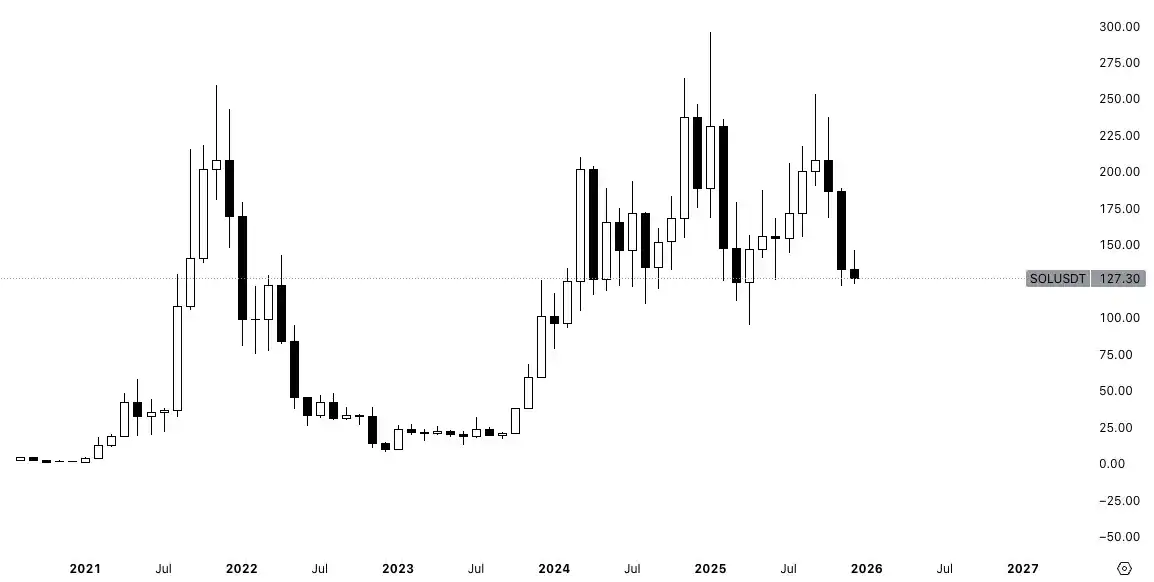
The price action chart of Solana, a top-ten crypto asset by market cap, almost entirely encapsulates all the challenges faced in crypto asset investing. Firstly, these assets are not compounding assets in the long term. They do not exhibit stable year-over-year growth like the "Big Seven Tech" (Mag 7); their price action is more reminiscent of a "rollercoaster ride". Although they have shown incredibly impressive gains—rising from around $8 post FTX crash to $296 a few months ago—Solana subsequently retraced by 50% from its peak, once again reaffirming a core assessment: these assets must be traded rather than held for the long term.
I still firmly believe that the crypto market will remain the only one capable of providing such astonishing returns in the foreseeable future in a relatively short period of time. However, at the same time, it will also experience an equally drastic fall. Therefore, I am highly skeptical about whether 99% of the assets in it can reach their all-time high (ATH) again in the future.
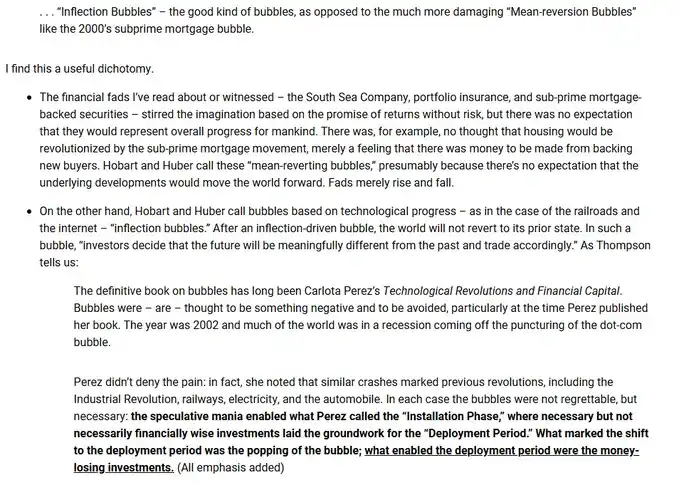
I resonate quite well with the set of mental models proposed by Howard Marks in his latest memo. The crypto market is full of such "mean-reverting" bubbles that are not built on any predictable foundation for underlying development. Meme coins are the most typical example—these assets exist almost purely to generate returns. Fundamentally, what value has Fartcoin or SPX6900 brought to the world? And many other narratives in the crypto market are mostly just dressing up meme coins, trying to pretend to be "valuable"—such as the so-called AI Agents.
What's even worse is that many tokens have almost dug their own graves, making the price trend inevitably a "roller coaster ride": firstly, a terribly flawed tokenomics model, leading to a large amount of supply being dumped into the market every month; secondly, the tokens themselves have almost no value capture mechanism; thirdly, the projects don't even have basic revenue, let alone being considered an investment-worthy "product."
The current market state is the result of the concentrated outbreak of these structural problems. All these issues culminated on October 10, when the crypto market saw a staggering $196.1 billion in liquidations, becoming the largest liquidation event in history (April 2021's $99.4 billion ranks second). Subsequently, what we have seen is essentially a typical end-of-cycle scene: prices moving down time and time again, continuously hitting new lows.
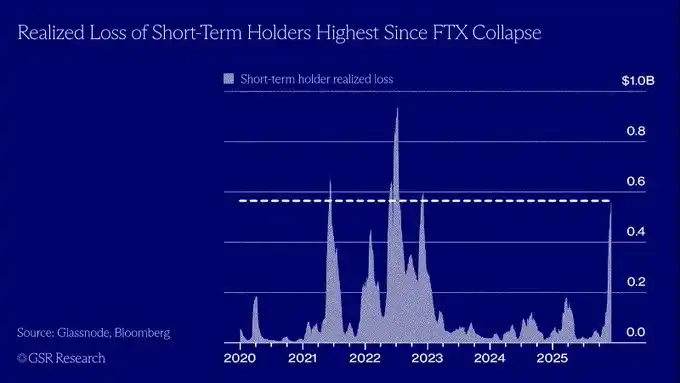
Therefore, I have begun to gradually shift my focus from the crypto market to traditional equity assets such as stocks. I believe that the crucial thing in 2026 is not to continue deepening into a particular niche but to become a generalist, not a specialist; to stay agile, not bound to a particular market or track.
Reviewing the performance of different indices in 2025 actually confirms this very well—it was a year where non-U.S. markets (ex-US equities) outperformed, and investors with a broader allocation perspective and more diversified exposures clearly obtained better returns.
Retail Investment is a long-term trend that is reshaping the traditional market structure
I believe that the trend of retail investment will only continue to expand. This is because investment has been highly "democratized," with retail investors from around the world joining in. The barrier to entry into this "movement" continues to decrease, allowing investable assets to truly globalize. Today, the tentacles of capital flow have spread to every corner of the world: a U.S. retail investor can use AI narratives to invest in Korean stocks; a Grab driver in Singapore can also invest in a publicly traded company in Poland, and so on.
From this perspective, this is actually a bearish factor for the crypto market. Cryptocurrency has long been seen as an "internet asset layer" open to anyone, anywhere. But when investment itself has become so accessible, why would retail investors choose to invest in value-thin, speculative digital assets rather than something that is almost "anything"?
That aside, retail investment's continued growth is already a fairly clear judgment, making it almost impossible to counterargue from a data perspective. However, what I really want to emphasize is the issue of "scale." Many may intuitively acknowledge that retail investors are entering the market in large numbers, but they underestimate the profound impact of more retail investors entering the market.
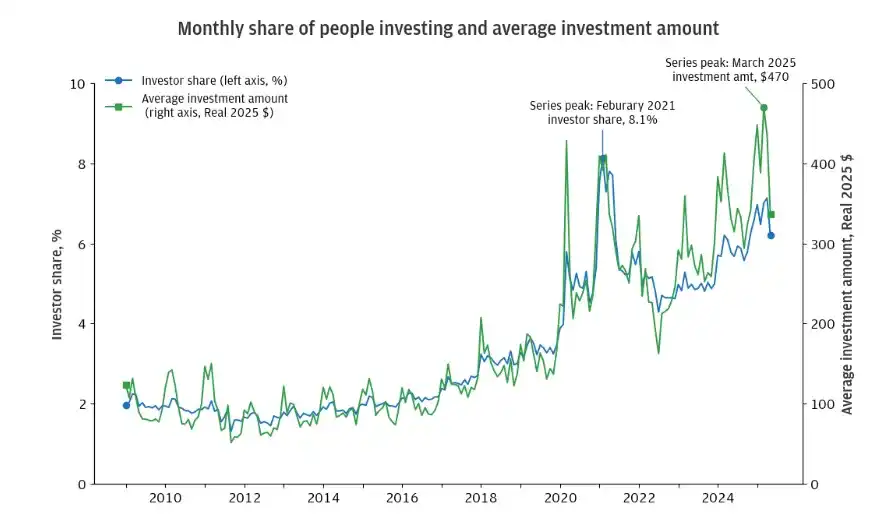
Figure 1: By early 2025, the scale of retail investor fund inflows is comparable to the peak during the pandemic in terms of the number of participants. In terms of the total amount of funds flowing into investment accounts, it has even exceeded the levels at that time.
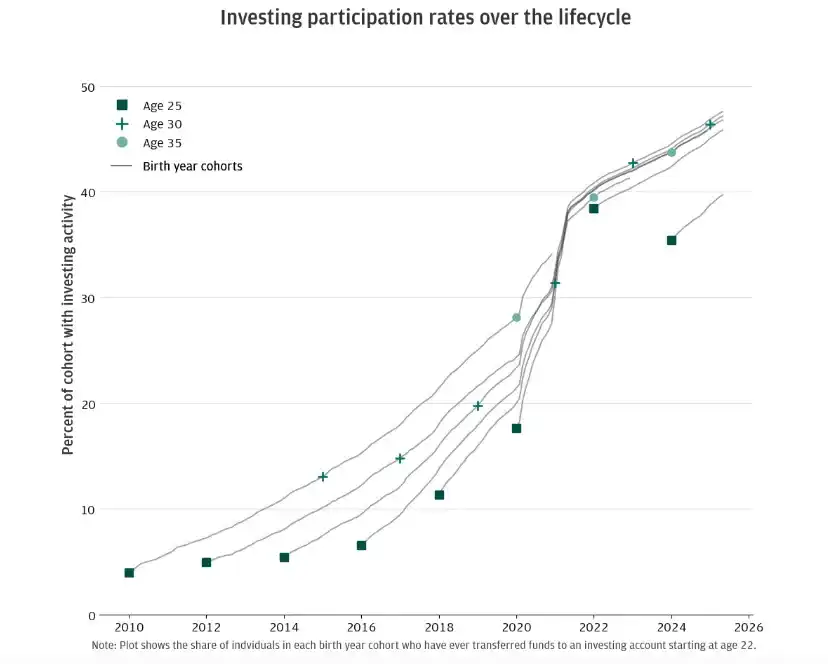
Figure 2: The number of 25-year-old participants in investment has reached a historic high, with participation rates increasing sixfold since 2015.
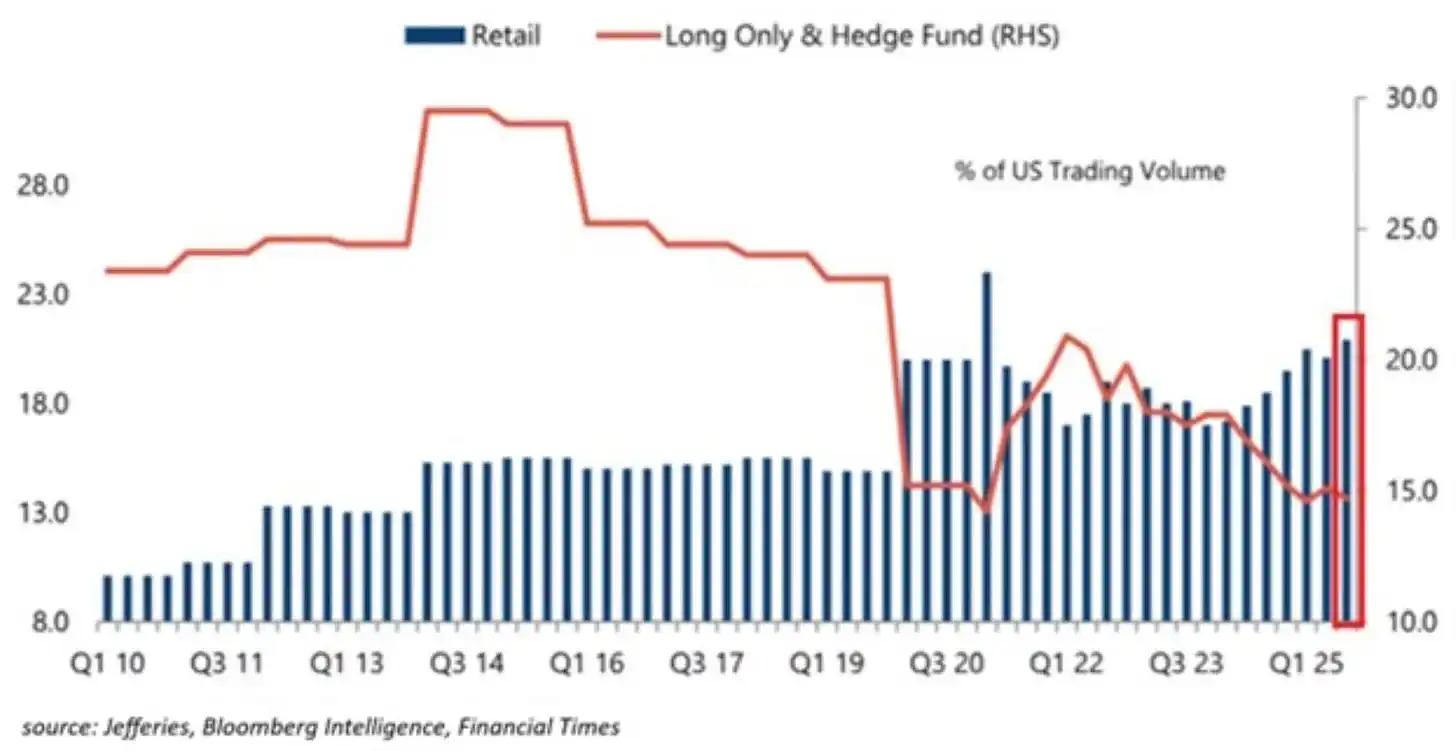
Figure 3: In the third quarter of 2025, retail investors accounted for approximately 20% of the trading volume in the U.S. stock market, marking the second-highest level in history. By comparison, during the same period, the combined percentage of all funds (including long-only, hedge funds, and quantitative funds) was 31%.
Fueled by retail investor inflows, the overall stock market is becoming more and more "crypto-like." One aspect I've always appreciated about the crypto market is its ability to "fast-forward" through an entire market cycle in a very short time — often going through the full stages of accumulation to distribution in just a few months, or even weeks. And now, I'm seeing similar signs in the stock market.
Take a look at the image below. Can you tell which one is a token and which one is a stock?
That's right, they are both stocks. While not all stocks exhibit this characteristic, it is undeniable that there are more and more aspects of the stock market that are becoming more "crypto-esque."
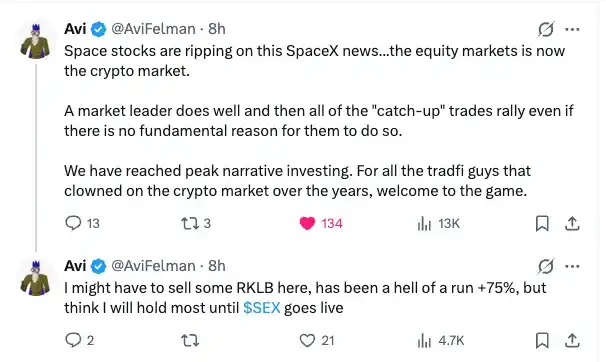
The world of the stock market is vast, and this is just one subtle trend shift that I have observed.
If You're in the Crypto Market, Consider Dabbling in Stocks
Against the backdrop of continuous decline in crypto market volatility, many people have started to turn to the stock market; there has also been a lot of discussion on the timeline, debating whether "traders from the crypto market" have any advantage in stock investing. My opinion is this: just because you come from crypto does not mean you naturally have an advantage in the stock market. Of course, some skills may indeed help with the transition — such as adaptability to high volatility environments — but ultimately, you still need to learn and adjust to truly adapt to the stock market.
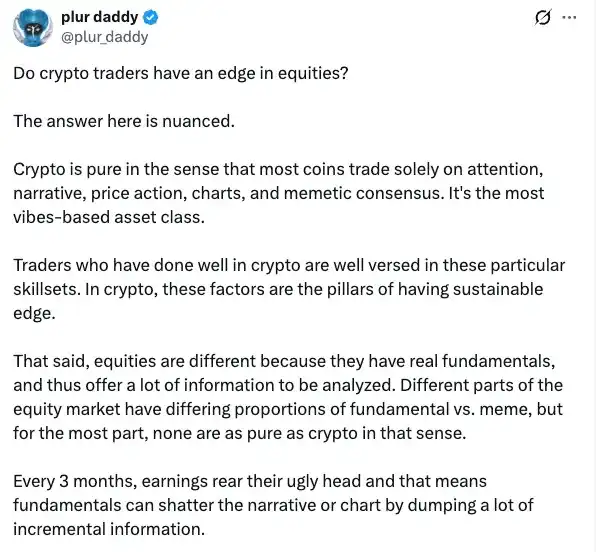
I myself am in the same boat. I do not claim to be good at stock investing; quite the opposite — when writing this on a Substack that I am acutely aware would be read by a hedge fund manager with decades of traditional market experience, I have a strong case of "impostor syndrome."
But this is not entirely meaningless. It is precisely because I believe that as retail participation continues to rise, market behavior will become more emotional and disorderly, that I further conclude: those seasoned crypto traders who have long been in the crypto market, primarily playing against retail, may still find some advantage. Take "narrative trading," for example. If you are sharp enough, it is entirely possible to capture multiple storylines that are driving returns this year — such as hyperscalers, space, storage, fintech, and so on.
Moreover, what other choice do I have? I am not counting on the crypto market to continue delivering hefty returns as it did in the past. I am faced with only two options: either to "trap" myself in one or two trades throughout the year that may not even happen but could potentially yield multiple returns, or to expand and upgrade my skill set.
TL;DR: Adapt or be extinct.
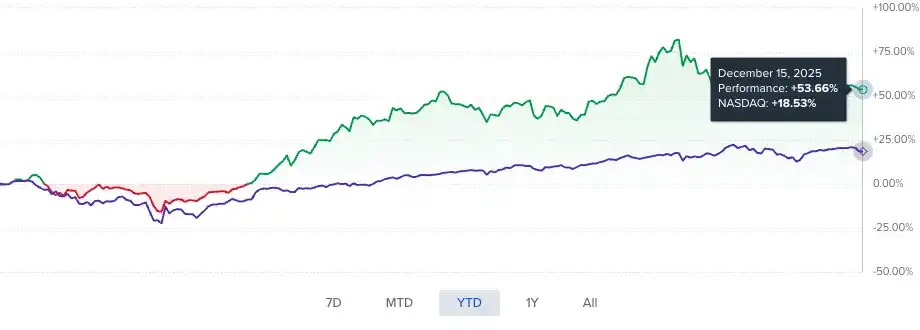
IBKR Profit/Loss Performance (less degen)
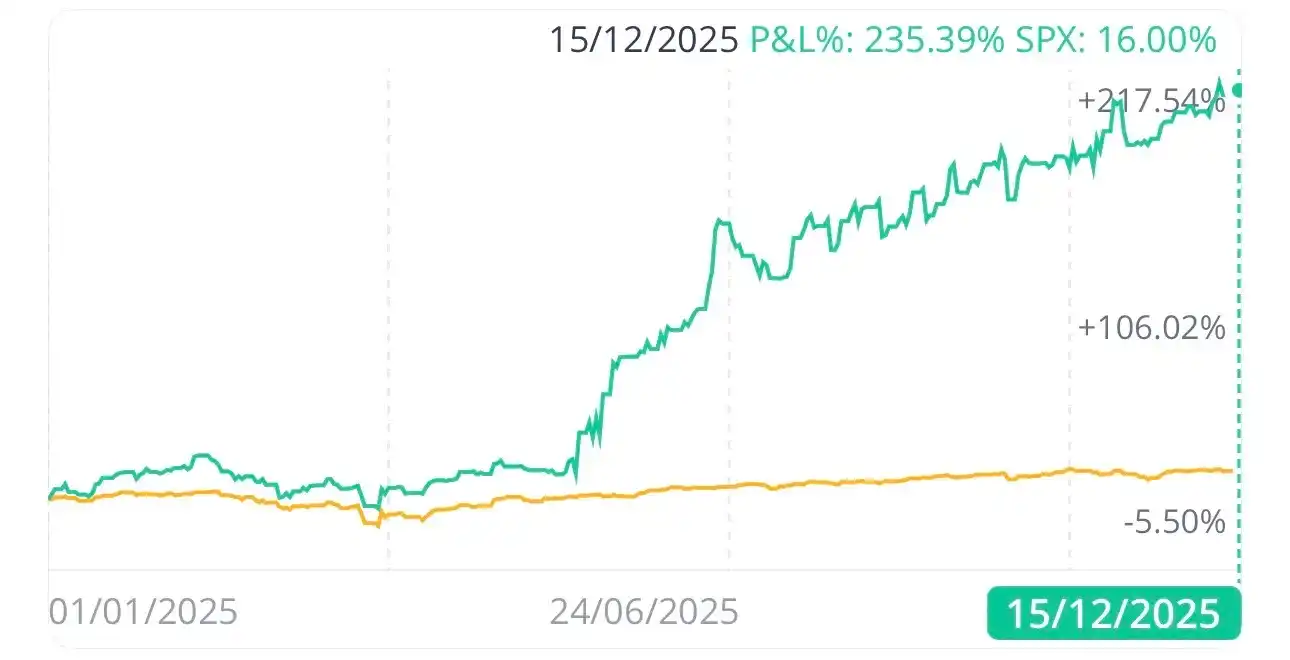
WeBull Profit/Loss Performance (more "degen")
Regardless, by my own standards, I consider my current performance to be decent. The above shows the year-to-date (YTD) return on my various investment portfolios. While it may sound somewhat self-righteous, I still want to further explain why I believe that, as a trader from the crypto market, my current performance is not accidental.
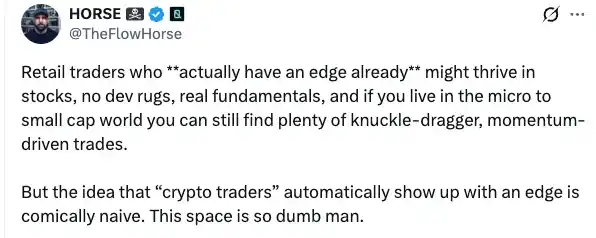
When I read this part, my initial reaction was, "Damn, isn't this talking about me?" But whatever, I'll keep preaching.
1. Seizing on a Strong Narrative Can Greatly Amplify Returns
Going back to the point I mentioned earlier, this is what I truly believe "crypto traders" excel at: identifying core narratives and building around them. Here are a few more examples:
Massive Scale Compute / Data Centers (IREN / HUT)
Aerospace (ASTS / RKLB / PL)
Financialization (HOOD / SOFI)
Storage (SNDK / SK Hynix)
Robot (TER)
Nuclear Energy (OKLO)
Quantum Computing (IONQ / QBTS)
Metals (Silver / Gold)
I am also working on improving my ability to identify themes ahead of time, but frankly, a large part of it is second-order thinking. Stock picking comes later, and after the emergence of AI, the information edge has been greatly diminished. Coupled with more and more retail investors entering the market, I believe narrative trading will once again become a significant force in the market.
2. Learn "what to trade"
I am well aware that I do not have an advantage in "trading the news" or "playing earnings reports." But honestly, if you pick the right table in this game, there is still a lot of alpha to capture.
Over the past 10 years, the crypto market has been such a table — overlooked by the mainstream, thus nurturing highly asymmetric returns. And now, with the rise of retail dominance, similar tables are starting to appear in the stock market: small to mid-cap (market cap below $100 billion) companies.
I have already started "working the floor" here, and it's really fascinating. You can see very familiar return curves, such as:
DAVE (up about 35x since 2023)
RKLB (up about 12x since September 2024)
I am still refining the process of finding these stocks, and I am still in the very early stages of workflow. But for now, this may be the table that suits me best to participate in.
3. Managing Volatility
One of the most commonly mentioned traits of cryptocurrency traders has indeed been helpful here. Unlike coins, these stocks have at least fundamentals — if you can stomach a 40% drawdown on a coin that "has yet to generate revenue," then you can certainly do the same for a company that actually has a business.
So far my biggest weakness
The irony is that what the crypto market has taught us is precisely "not to hold long-term" — and this has also become a double-edged sword.
After experiencing TRUMP, LUNA, and numerous events typical of cryptocurrency traders, I found my biggest weakness: selling immediately at the slightest sign of movement. To some extent, it's like PTSD; once I feel the price is "a bit high," I immediately start reducing my position, expecting a market-wide pullback like the one in February this year.
This is still something I'm working hard to "untrain."
Some Predictions
Not to be taken too seriously, these are just some things I think have a reasonable chance of happening.
1. Gold to Rise to $5000
I believe gold is in a structural bull market. In recent weeks, the performance of precious metals (gold, silver, platinum) has been very strong, and I currently see no reason for this trend to stop.
2. Unitree IPO Surges on First Day (2–4x)
In my view, robotics is one of the most disruptive applications of AI but is severely underrated. While the AI community is hyping new models and applications every day, the attention on robotics, a highly adjacent field, is noticeably lacking. Even though Figure's robotics release has received a lot of coverage, it still pales in comparison to the hype around general AI/sci-fi AI tech. I do believe Rewkang's assessment of robotics makes sense.
3. Bitcoin Bottoms Out Around $70,000
I think BTC is likely to bottom out soon—whether it can reach a new all-time high is a whole different question. Looking at the current trading structure, the downside risk is limited, but I also cannot see clearly where the catalyst for an upward move would come from.
4. HYPE Hits an All-Time High, While Other Altcoins Continue to Consolidate
For reference: My current holdings are a micro-cap project valued at less than $10 million and Shuffle. I no longer hold HYPE but am looking for a re-entry opportunity soon.
5. Hyperliquid is one of the Few Projects Exhibiting "High-Quality Altcoin" Characteristics
No high inflation; has a certain value capture/incentive alignment mechanism; product continues to grow quarterly, not just a flash in the pan
When 99% of altcoins are uninvestable, I expect funds to flow into one of the cleanest assets in this cycle.
There will be a round of on-chain/alt season, but the theme is AI video
It may sound contradictory to my previous predictions, but as I said—crypto is still the easiest place for short-term "mean reversion bubbles" to occur, such as May's ICM, which was a rally that lasted only 1–2 months. I believe these "mini pumps" will always exist; the key is to exit before everything collapses again.
6. Stablecoin Mass Adoption, CRCL Above $200
Currently, there is much discussion about stablecoins, and the infrastructure is also advancing, but we have yet to see a true "landing" moment for large banks. Tempo is still under construction, and major banks are preparing for this (but not fully ready yet). I believe 2026 will be a year where the dominance of stablecoins continues to strengthen.
One point I am conflicted about is: Trump and the world are in an interest rate reduction cycle, which is not favorable for stablecoin companies, but it may increase the speed of money circulation.
Non-U.S. stock indices continue to outperform U.S. stocks, which is self-evident.
7. Some Other Predictions
Resurgence of Chinese luxury consumer stocks (e.g., Pinduoduo and Lao Feng Xiang Gold)
A cooling of the AI bubble, with returns shifting to other sectors
Sustained strong performance in the nuclear energy sector
ETH unable to return to its all-time high
A decline in Pokémon card popularity, with One Piece cards taking the spotlight (especially against the backdrop of Pokémon's 30th anniversary)
Only MSTR and BMNR will survive in the DAT field
More token-level mergers and acquisitions in the crypto space
Efforts in crypto to tokenize stocks (after realizing in 2025 that the path from "token to stock" for DATs is not viable)
Takeoff of the crypto gambling track (Disclaimer: I hold Shuffle)
Continuation of the crypto bear market until 2026
2025 Action Plan Review
As a wrap-up, we will revisit the memorandum I released the previous year to see how those assessments played out.
1. My Macro Scenario Assessment
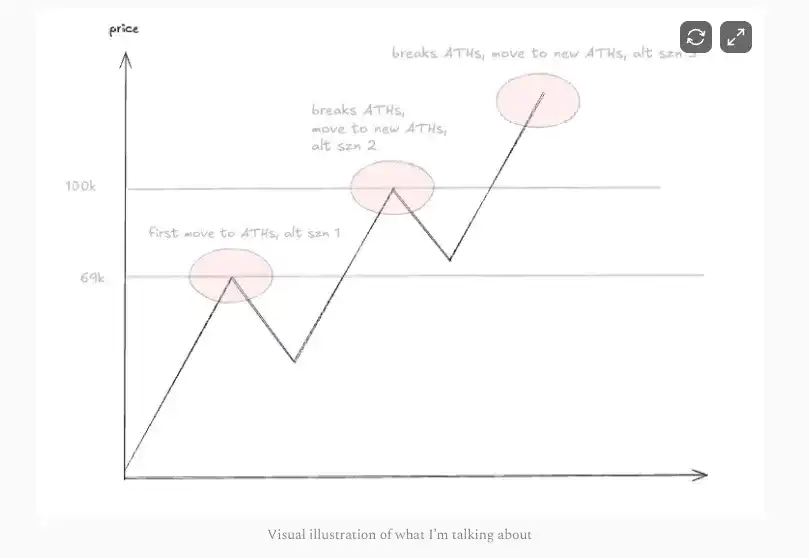
In my 2025 memorandum, I drew this chart and accompanied it with the following assessments:
BTC price increase, with a higher growth rate than in 2024
Altcoins: Primarily on the offensive, knowing when to switch to defense, but overall defense level lower than in 2024
Looking back, I can only say that part of it came true, but the overall prediction was not great because it did not consider "path dependence." We did indeed hit a new high in September, but look at where we are now. This point can only be considered to have barely passed.
2. AI
Yes, this theme still holds. But as the above tweet shows, we have already gone through several waves of rotation. If you've read my analysis on AI tokens (link omitted), I still believe the next wave is coming soon.
To be fair, this is more like a somewhat short-term judgment. What I said at the time did indeed happen — before they all fell by 99%. The ones I picked, ALCH / DIGIMON / AI16Z, all had very impressive performances, also completed before the subsequent -99%. This point counts as passed.
3. DeFi
Core targets: AAVE / ENA / Morpho / Euler / USUAL
Secondary direction: Stablecoins / Payment-related tokens
I can only say: average. Many of these targets have not hit a new high since January 25, and this combination overall was a poor choice. AAVE briefly hit a new high, but for a very short period; ENA and Euler basically peaked within the year after January 25; USUAL collapsed directly; the only winner was Morpho.
This point failed.
4. L1 Transactions
I know this segment will receive a lot of criticism, but my judgment at the time was: L1 transactions would make a strong comeback. Hype was the obvious choice, while Sui, in the process from $1 to $2 to $4, was heavily bearish in the market. I still believe that the L1 narrative itself is one of the directions that the market has overlooked, and the 10x trend of Hype is proof of this opportunity.
Core targets: SUI / Hype
Secondary targets: Abstract
The result is: a complete failure. SUI peaked around $4; as for Hype, although it did have a rally, the price has basically returned to January 2025 levels. And honestly, this target itself is a bit on the edge — it is more like a Perp DEX than an L1. In hindsight, I'm not sure what I was thinking at the time.
5. NFT Token & Gaming Coin
Main Picks: Pengu / Anime (Azuki) / Spellborne / Treeverse
Secondary Picks: Prime / Off the Grid (if launched) / Overworld
The only winner among these is Pengu, despite a 90% drop in January, followed by an 8x rally. More importantly, Pengu is the only NFT project that has truly gained mainstream attention.
However, the overall basket remains a failure.
6. Other Narratives
These are just directions that caught my attention, not necessarily bullish but interesting:
Data Tokens: Kaito / Arkm
Meme: Only like PEPE, others... well, mostly "rekt"
DePIN: PEAQ / HNT
Ordinals
Dino Forks: XRP, etc.
Old DeFi: CRV / CVX
I did not provide a definitive judgment at that time, so I will not comment on these.
7. Prediction Review
Prediction: DePIN will be adopted by a "serious company" in a "serious way," possibly through acquisition.
Not sure if this happened. Perhaps some readers can provide more information? I searched my memory, and I don't think it really happened.
Prediction: Binance, as a leading exchange, will lose market share, not to Hyperliquid, but to Bybit / OKX.
Not fully realized, but I will say that Binance's reputation and market position have indeed significantly declined, especially after 10/10.
Prediction: Metaverse tokens will receive a new lifeline with the breakthrough of VR.
Did not happen.
Prediction: ICOs will become hot again.
This prediction was very accurate. Coinbase's acquisition of Cobie's ICO platform for $375 million clearly indicates that ICOs have once again become a "trend."
Prediction: The ETH 2.0 upgrade will never come.
On this point, my prediction was correct.
Prediction: Sui to reach double digits (at least $10).
Haha, impossible.
Prediction: ETH ETF approval yield farming, leading to a new round of yield-bearing products and yield aggregators, similar to 2021.
This one actually came true.
Prediction: A heavyweight artist would use NFTs and tokens to engage with fans and provide incentives.
This did not happen.
Prediction: Bitcoin to $200,000.
I hope so too.
Prediction: More L1 CEOs/Founders will exit after Aptos.
Unfortunately, this did happen. Nowadays, we see more and more "departures," often accompanied by the classic meme: "vesting cliff has arrived."

Prediction: Base loses in on-chain competition, replaced by another L1; Solana maintains its lead.
As of now, I would say Base is still in a winning position alongside Solana.
Conclusion
Above all, this broadly summarizes my overall strategic layout as I enter 2026. I also anticipate that a significant portion of these assessments will undergo considerable changes over time, much like my 2025 action plan.
Good luck to all, smooth sailing to all, see you on the other side, ladies and gentlemen.
If you have earned enough income on this journey to change your life, remember—to truly change your life.
Regards,
0xKyle
You may also like

Is a Stablecoin Considered Cash? Accounting Standards for Stablecoins May Be Adjusted Post-Genius Bill

The US can't control Latin America, so they took out Maduro

BTC Returns to $93K as Fed Injects $160B to Rescue Market?

Solana Price Forecast: Wall Street Investor Scaramucci Highlights SOL as Leading Altcoin for 2026 – Could $1,000 be Reality?
Key Takeaways The price of Solana (SOL) has seen a recent rise, signaling a potential strong rebound. Anthony…

Solana Price Prediction: RWA Ecosystem Climbs to $873M in January 2026, Surging by 325% in One Year
Key Takeaways Solana’s RWA market has soared to $873 million as of January 2026, representing a 325% increase…

Best New Meme Coin to 100x in 2026 – January 2
Key Takeaways PEPENODE is positioned as the most promising new meme coin, expected to yield significant returns in…
Bitcoin Price Prediction: BTC Near $90,000 with Volume Spike – A $96,000 Surge Ahead?
Key Takeaways Bitcoin is trading near $89,900 as of today, with a 2% rise in the past 24…

XRP Price Forecast: Whales Accumulate $3.6 Billion, Is the Bottom Finally Here?
Key Takeaways Recent whale activity in the XRP market, amounting to $3.6 billion, suggests a potential bullish trend.…

Best Crypto to Buy Now 2 January – XRP, PEPE, Solana
Key Takeaways XRP is experiencing low supply on exchanges and is anticipated by analysts to surpass $8 in…

Hundreds of EVM Wallets Drained in Mysterious Attack
Key Takeaways: Hundreds of EVM-compatible crypto wallets have been compromised in a low-value, but widespread, exploitation attack. The…

US National Debt Climbs Over $38.5 Trillion as Bitcoiners Celebrate ‘Genesis Day’
Key Takeaways The U.S. national debt has reached an astronomical figure of $38.5 trillion, a worrying sign of…
Price Predictions 1/2: BTC, ETH, BNB, XRP, SOL, DOGE, ADA, BCH, LINK, ZEC
Key Takeaways: Bitcoin’s price is anticipated to break its tight range and possibly aim for a rally toward…

United States Strike on Venezuela: Bitcoin Price Downturn Unlikely According to Analysts
Key Takeaways Bitcoin’s value is not expected to significantly decline following the recent US military strike on Venezuela.…
Russia Tightens Crypto Mining Regulations Amid Global Digital Currency Developments
Key Takeaways Russia’s new legislative proposal aims to impose strict penalties on unregistered cryptocurrency mining, highlighting the government’s…

Wrench Attacks on Crypto Holders Rising and Growing ‘More Violent’
Key Takeaways Wrench attacks, specifically targeting cryptocurrency holders, are on the rise, showing increasing numbers and severity in…

Hut 8 Ends 2025 on a High Note Despite Challenges in the Bitcoin Mining Arena
Key Takeaways Hut 8 Mining has successfully navigated a challenging year by diversifying into AI and high-performance computing…

Can Solana Overcome Its Memecoin Reputation by 2026?
Key Takeaways Solana is striving to transcend its “memecoin chain” image by enhancing its infrastructure and attracting serious…

20 Crypto Executives Share Six Stablecoin Predictions for 2026
Key Takeaways Stablecoins are expected to become essential financial infrastructure by 2026, facilitating real-time settlements and expanding access…
Is a Stablecoin Considered Cash? Accounting Standards for Stablecoins May Be Adjusted Post-Genius Bill
The US can't control Latin America, so they took out Maduro
BTC Returns to $93K as Fed Injects $160B to Rescue Market?
Solana Price Forecast: Wall Street Investor Scaramucci Highlights SOL as Leading Altcoin for 2026 – Could $1,000 be Reality?
Key Takeaways The price of Solana (SOL) has seen a recent rise, signaling a potential strong rebound. Anthony…
Solana Price Prediction: RWA Ecosystem Climbs to $873M in January 2026, Surging by 325% in One Year
Key Takeaways Solana’s RWA market has soared to $873 million as of January 2026, representing a 325% increase…
Best New Meme Coin to 100x in 2026 – January 2
Key Takeaways PEPENODE is positioned as the most promising new meme coin, expected to yield significant returns in…


 App
App