
- Buy Crypto
- Markets
- Futures
- Spot
- Copy Trade
 WE-Launch
Best Crypto Futures Trading Platforms in October 2025

Key takeaways
- Choosing the right crypto futures exchange depends heavily on evaluating key aspects such as fee structures, platform usability, range of supported assets, and—most importantly—security measures.
- Trust and security are frequently the top priorities, especially since many exchanges also serve as custodians for users’ digital assets. Key features to look for include Proof-of-Reserves (PoR), two-factor authentication (2FA), and a proven operational track record.
- Regional accessibility is another essential factor. With crypto regulations evolving worldwide, many derivatives platforms limit services to specific countries, and some may only offer a narrow set of markets or trading pairs depending on the user’s location.
What is Crypto Futures Trading?
Crypto futures are derivative contracts that derive their value from an underlying digital asset, such as Bitcoin or Ethereum. Unlike spot trading, futures do not involve immediate transfer of the actual cryptocurrency. Instead, traders agree to buy or sell an asset at a predetermined price on a future date.
While the basic mechanics of futures trading may resemble spot trading, futures open the door to more sophisticated strategies—including leveraged positions and the ability to go long or short. This allows traders to speculate on price movements without owning the underlying asset. In today’s crypto markets, derivatives trading volume consistently surpasses that of spot markets.
Which Crypto Exchange Offers the Best Futures Trading?
Over the past ten years, the cryptocurrency exchange landscape has evolved from rudimentary trading websites into a sophisticated financial ecosystem. Leading platforms now offer advanced trading products coupled with robust security frameworks, serving not only as venues for spot and derivatives trading but also as gateways bridging digital assets with traditional finance.
Selecting a suitable futures trading platform requires careful evaluation, as each exchange offers distinct advantages in areas such as fee models, leverage options, and risk management tools. These differences can significantly influence trading outcomes, risk exposure, and overall user experience. The optimal choice varies by individual, reflecting diverse trading strategies, asset preferences, and risk tolerance levels.
In the assessment that follows, we examine key futures trading platforms based on critical factors including security protocols, product diversity, fee competitiveness, and interface design. This analysis aims to equip traders with the insights needed to identify the exchange that best aligns with their specific trading objectives and operational requirements.
1. WEEX
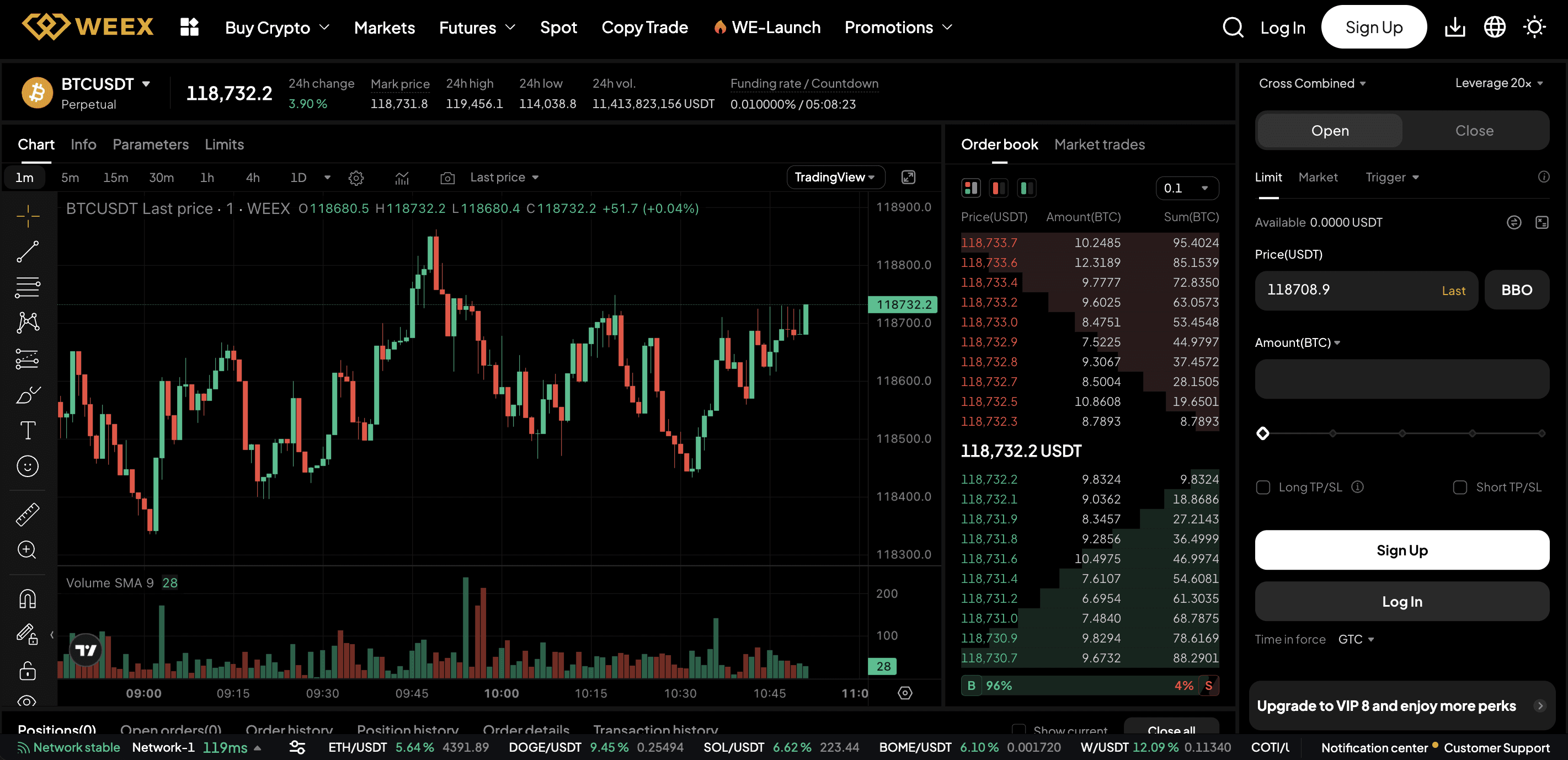
WEEX stands as an emerging force in the crypto derivatives landscape, establishing its presence through competitive trading conditions and user-centric features. The platform has built a reputation for providing reliable execution capabilities combined with an accessible trading environment suitable for both novice and experienced traders.
The exchange offers substantial leverage options reaching up to 400x across a diverse portfolio of 1700+ trading pairs. Its fee structure remains competitive at 0.02% for maker orders and 0.08% for taker orders. Among its standout features is an industry-leading commission rebate program that offers up to 90% rebates, distributing over $12 million in monthly commission payouts to its user base. The platform's interface design emphasizes simplicity and functionality, delivering an ad-free trading experience that eliminates distractions while maintaining comprehensive tool access.
WEEX demonstrates impressive liquidity metrics, currently ranking second industry-wide in critical depth measurements including order book density and narrow price spreads. The platform's BTC markets can comfortably accommodate transactions of at least 800 BTC within a minimal 0.01% price variance, showcasing robust market depth.
Also, WEEX Liquidity has earned recognition from authoritative platforms like Cryptorank, a testament to our robust market depth. This is exemplified by the ability to trade 800 BTC within a razor-thin 0.01% spread, a feature that directly contributes to lightning-fast, zero-lag trade execution and minimizes slippage for our users.
To master future trading, just read How to Trade Bitcoin Futures on WEEX and do your first future trading now!
Pros
- Easy-to-use interface
- Strong futures and copy trading features
- No KYC for basic use
- Competitive fees
- Transparent reserves and protection fund
Con
- No fiat withdrawals
2. MEXC
MEXC remains one of the largest crypto futures brokers for daily trading volume. It handles several billion dollars each day, providing futures trades with deep liquidity and tight spreads.
The platform offers perpetual futures, which rely on traditional order types but without expiration dates. Over 900 futures markets are listed, including the best meme coins like Pepe, Bonk, and Shiba Inu. MEXC supports linear and inverse contracts, and they settle in USDT or the underlying asset, respectively.
Leverage is available on all crypto futures, with large-cap pairs providing 500x multiples. The exchange reduces leverage limits on markets with weaker liquidity to help traders mitigate risk. The futures dashboard allows full customization, and users deploy drawing tools and technical indicators for real-time analysis.
Research shows that MEXC is one of the best crypto futures trading platforms for low fees. Traders pay just 0.01% per side on limits and 0.04% on markets.
New users register with an email address only and remain anonymous unless they withdraw more than 20,000 USDT daily, or 100,000 USDT monthly.
Pros
- Access over 900 perpetual futures markets
- Choose between linear and inverse contracts
- Pay a maximum futures trading commission of 0.04%
- No KYC when withdrawing under 20,000 USDT daily
Cons
- The platform operates offshore without regulation
- U.S. traders cannot access the exchange
3. Binance
Binance is a good option for traders who prefer traditional delivery futures over perpetuals. The tier-one exchange provides quarterly and bi-quarterly contracts for Bitcoin and Ethereum. These futures contracts, unlike perpetuals, do not incur funding fees. Traders may exit positions early, but they can also hold until the contract expiration date. This structure allows Binance users to trade futures with longer-term strategies.
Binance also caters to perpetual traders, with over 530 available markets. You can access the best altcoins, including Sui, Dogecoin, BNB, and Cardano, with leverage up to 125x.
The platform is known for its advanced trading tools, as Binance traders access multiple timeframes, indicators, deep order books, and automated bots. Accessibility includes desktop and mobile trading, ensuring futures traders monitor positions on the move.
Regarding fees, market makers get the lowest trading commissions of 0.018% per side. Takers pay more than double at 0.045%.
Pros
- Trade delivery futures with quarterly and bi-quarterly expirations
- Suitable for entering longer-term futures trades without funding fees
- Also supports over 530 perpetual markets
- The exchange boasts over 283 million users
Cons
- Delivery futures support Bitcoin and Ethereum only
- Restricts leveraged products in the U.S.
- Often relies on third-party gateways for fiat payments
4. OKX
OKX offers one of the most extensive derivative ecosystems, including a comprehensive range of cryptocurrencies, instruments, and contract types.
Day traders may prefer OKX's perpetual futures market, which covers over 290 digital assets. Users find their favorite coin or token through narrative filters like RWA, AI, meme coins, and Layer 1. Perpetual futures incur funding rates every eight hours, and only longs or shorts are charged.
The next option is delivery futures, with only daily and weekly markets available for Bitcoin and Ethereum. These contracts offer longer-term exposure without funding fees. OKX also supports crypto options for the two market leaders. Seasoned traders access fully-fledged options chains with multiple strike prices and expiration dates, while beginners use the Simple Options tool for an easier trading experience.
OKX's entry-level commission when trading futures via market orders is 0.05% per side. Market makers and those who meet 30-day volume milestones receive lower commissions.
Pros
- Access perpetuals, delivery futures, and options in one safe place
- High-level charting tools with 100+ technical indicators
- Heavily regulated in several global markets
Cons
- U.S. traders can access OKX spot trading but not futures products
- Delivery contracts support daily and weekly expirations only
- Strict onboarding process with enhanced KYC
5. Bybit
If you're looking for the best crypto futures trading platform for supported markets, Bybit is a top choice. With over 600 perpetual contracts, Bybit provides access to a wide range of digital assets. Alongside market leaders like Bitcoin, XRP, BNB, and Ethereum, users trade volatile meme coins such as Popcat, SPX6900, Brett, and Peanut the Squirrel. Traders also speculate on decentralized finance (DeFi) futures contracts, from Zora and Uniswap to Pendle, Aave, and Ondo.
Most futures markets trade with USDT, although select pairs also support USDC. Platform users also choose between linear and inverse contracts, depending on their risk tolerance and trading goals. Bybit offers leverage of up to 200x on major pairs, but these limits decline when trading more volatile markets.
The exchange's fee structure is competitive and transparent. Traders pay 0.02% or 0.055% per side when placing limit or market orders, respectively. The platform also charges a small 0.05% settlement fee.
Pros
- Gain exposure to over 600 digital assets via leveraged futures contracts
- Supports smaller-cap meme coins with high volatility
- Contract specifications include linear and inverse settlement
Cons
- The charting platform may be overwhelming for beginners
- Bybit is not available in the U.S. or the UK
- Its derivative markets are not approved by any regulators
Why Choose WEEX?
Founded in 2018, WEEX has rapidly grown into one of the most trusted crypto exchanges, serving over 6.2 million users across 130+ countries. With a strong emphasis on security, liquidity, and ease of use, WEEX provides over 1,700 trading pairs and up to 400× leverage for futures trading, making it a powerful option for both beginners and pro traders.
Which Crypto Futures Exchange is Right for Me?
With hundreds of crypto futures exchanges to choose from, identifying your best option can be difficult. Ultimately, your trading proficiency, country of residence, and risk tolerance will all play a major part in informing your decision, which will naturally differ from another trader’s.
Trading proficiency: Different venues cater to different trader niches — though most are accessible to all skill levels, some offer unique products or features that are purpose-built for beginners or pro traders. Related is the user experience the exchange provides. The ease with which you can navigate the platform is critical in capitalizing on trades. Traders just getting familiar with how to integrate futures trading into their crypto strategy will likely have a different workflow than a seasoned high-frequency trader capturing arbitrage opportunities. Choosing the best crypto futures exchange for you may depend on your overall proficiency and familiarity with crypto trading to begin with, before you find the platforms that have the right features that match your needs.
Country of residence: With ever-changing global regulations, platforms can rarely offer true global coverage without running afoul of legislation. The same exchange may often need to provide a completely different experience from one country to the next to remain compliant. It’s worth considering exchanges that are proactive and transparent on this front — namely, those that actively strive to obtain the required licenses and comply with regulations.
Risk tolerance: Trusting a third-party with your funds comes with an inherent risk that they could be lost. It’s impossible to engage with a custodial exchange fully trustlessly, though you should familiarize yourself with prospective platforms’ security commitments and the measures they take to reduce your risk. Look for exchanges that implement measures such as Proof-of-Reserves (POR) audits, SOC compliance, and 2FA. Consider their track record and any major security breaches they may have sustained historically.
Trade Now
Time after time, both new and seasoned futures traders turn to WEEX for its seamless trading experience, top-tier security, and diverse product lineup.
Join millions of users who trust WEEX to trade futures and stay ahead in the fast-evolving crypto market. Start now!
You may also like

Clover Finance (CLV) Price Prediction 2026-2028: Here’s the Analysis!
Clover Finance has recently returned to the spotlight after a sharp price rebound, sparking renewed interest from traders and long-term observers alike. As a result, many are now asking the same question, what does the future look like for CLV Coin?
In this article, we’ll explore the CLV Coin price prediction 2026-2028, backed by current price action, technical signals, and the long-term fundamentals of the Clover Finance ecosystem.
What is Clover Finance?Clover Finance is a blockchain infrastructure project built to operate within the Polkadot ecosystem. Its core proposition is to serve as a comprehensive operating system for decentralized applications, aiming to simplify cross-chain development. A key technical feature is its compatibility with the Ethereum Virtual Machine, which allows developers to port applications from Ethereum, potentially bridging activity between the two ecosystems.
What is Clover Finance (CLV)?CLV is the native utility token of the Clover network. Its functions are designed to be integral to network operations and governance, including:
Paying transaction fees.Staking to secure the network.Participating in on-chain governance votes.Funding ecosystem projects through its treasury.The token's long-term value is intrinsically linked to the adoption and active usage of the Clover network itself.
Read More: What is Clover Finance (CLV)? A Complete Guide
Clover Finance (CLV) Price OverviewRecent market activity for CLV highlights its profile as a small-market-capitalization cryptocurrency. It has experienced significant price volatility, characterized by sharp upward movements accompanied by spikes in trading volume. This pattern is typical of assets with lower liquidity, where market sentiment and speculative trading can lead to pronounced price swings in a short period.
Clover Finance (CLV) Price AnalysisThe recent price action can be attributed to several concurrent factors common in volatile crypto markets:
Technical Momentum Shifts: Following a period of downward or sideways movement, assets can experience strong rebounds driven by technical indicators. Metrics like a sharp rise in the Relative Strength Index can signal overbought conditions in the short term, often attracting momentum traders.Speculative Trading Volume: A sudden, dramatic increase in trading volume can amplify price movements. For small-cap tokens, this volume is often driven by speculative interest rather than fundamental news, making such rallies potentially fragile if the volume dissipates.Market Sentiment Rebalancing: After a prolonged period of negative price action, selling pressure can exhaust itself, creating conditions for a rebound even in the absence of major positive developments. This reflects a market recalibrating rather than a fundamental shift in value.Clover Finance (CLV) Price Prediction 2026-2028Providing a precise price prediction for any cryptocurrency over a multi-year horizon is highly speculative. For CLV, its trajectory will be determined by the interplay of three critical factors:
Project-Specific Execution: The primary driver will be the measurable growth and adoption of the Clover Finance ecosystem. Increases in developer activity, total value locked (TVL) within its DeFi applications, and meaningful technical upgrades are fundamental to sustaining value.Broader Market Cycles: The entire cryptocurrency market is subject to macroeconomic cycles. CLV's price will inevitably be influenced by these overarching bull or bear trends, regardless of its individual progress.Sector Competition: Developments within the broader cross-chain interoperability and Polkadot parachain ecosystem will create significant tailwinds or headwinds.Given these variables, a scenario-based outlook is more meaningful than fixed price targets:
Clover Finance (CLV) Price Prediction 2026: This period will test whether the project can translate its recent visibility into sustained ecosystem growth. Price action may remain volatile, reflecting the market's ongoing assessment of its long-term viability.Clover Finance (CLV) Price Prediction 2027-2028: By this stage, the project's path will be clearer. Success will depend on securing a durable niche within the competitive Layer-1 and cross-chain infrastructure landscape. Its price will increasingly correlate with tangible network utility metrics rather than speculative narratives.ConclusionThe future price of Clover Finance (CLV) is tied to the dual engines of its own ecosystem development and the unpredictable waves of the broader crypto market. While its recent performance underscores the volatility and potential of small-cap assets, a long-term perspective necessitates a focus on Clover Finance's fundamental progress in technology adoption and network usage. Investors should approach such assets with thorough research, a clear understanding of the high-risk profile, and an emphasis on monitoring on-chain fundamentals over short-term price movements.
Ready to trade cryptocurrencies?Join WEEX now—enjoy zero trading fees, smooth execution, and instant access. Sign up today and start trading in minutes.
Further ReadingCardano (ADA) Price Prediction for October 2025: Can $ADA Hit $1?
Solana Price Prediction: Can Solana Hit $1,000?
PancakeSwap (CAKE) Price Prediction: Can $CAKE Break $5?
Disclaimer: The opinions expressed in this article are for informational purposes only. This article does not constitute an endorsement of any of the products and services discussed or investment, financial, or trading advice. Qualified professionals should be consulted prior to making financial decisions.

Lighter (LIT) Price Prediction 2025–2030: How High Could LIT Go?
Lighter (LIT) enters the crypto market at a moment when speculation alone is no longer enough to sustain valuations. Liquidity is selective, narratives are scrutinized, and DeFi protocols are increasingly judged by what they deliver rather than what they promise.
As a newly launched Ethereum-based token, LIT currently operates in a data-scarce environment with no extended price history, no mature volume profile, and no algorithmic forecasts from major analytics platforms.
Yet, the absence of historical data does not make analysis impossible. It simply requires a different lens. Instead of extrapolating from charts that do not yet exist, this Lighter price prediction relies on scenario-based reasoning, protocol fundamentals, and comparative behavior observed in early-stage DeFi projects.
Looking ahead to 2025–2030, LIT’s trajectory will be shaped by adoption, token utility, and broader crypto market cycles. The question is not whether LIT can move sharply volatility is almost guaranteed but whether it can sustain value as the market matures.
What Is Lighter (LIT)?Lighter (LIT) is a decentralized trading infrastructure project built on the Ethereum blockchain. It aims to provide a non-custodial, capital-efficient environment for traders. The native LIT token is designed to serve as a core component of the ecosystem, with proposed utilities typically revolving around governance, protocol incentives, and aligning the interests of users and developers.
The project's launch context is notable. Emerging after periods of speculative excess, Lighter enters a market that increasingly prioritizes tangible utility and sustainable models over viral hype. This environment sets a higher bar for execution but also creates opportunity for projects that successfully address genuine inefficiencies in on-chain trading.
LIT Token Price Overview and Current Market ContextAs a newly launched asset, LIT is in a phase of initial price discovery. Its valuation can exhibit significant dispersion across different trading venues, a common characteristic for tokens establishing their initial market base. Notably, due to the lack of an extended trading history, mainstream analytics platforms do not provide formal long-term algorithmic forecasts for LIT. This data scarcity underscores that any forward-looking assessment must be framed as a set of probabilistic scenarios rather than definitive predictions.
Key Factors That Will Influence Lighter (LIT) Price (2025–2030)The long-term valuation of LIT will be determined by several interlinked factors:
Protocol Adoption and Utility: The primary driver will be the actual usage of the Lighter platform. Metrics such as consistent trading volume, total value locked, and fee generation are fundamental value indicators, far outweighing transient social media hype.Token Economic Design: The specific mechanisms governing LIT's utility—such as its role in fee capture, staking rewards, governance power, or supply dynamics (e.g., burns, buybacks)—will critically influence its supply-demand equilibrium.Ethereum Ecosystem Traction: As an Ethereum-based application, Lighter's growth is tied to the broader health and scalability of its underlying blockchain. Widespread Layer-2 adoption and lower transaction costs would serve as significant tailwinds.Broader Market Cycles: The crypto market's inherent cyclicality will be a major external force. LIT's ability to maintain development and community engagement through potential bear markets will be as crucial as its performance during bullish periods.Lighter (LIT) Price Prediction (2025–2030)Given the absence of historical precedent, a scenario-based framework is more appropriate than linear predictions.
Lighter (LIT) Price Prediction 2025: The Validation Phase: This period will focus on establishing initial product-market fit. Price action will likely be volatile, driven by launch momentum, early user metrics, and exchange listings. The market will be assessing the project's basic viability.Lighter (LIT) Price Prediction 2026–2027: The Differentiation Phase: By this stage, the initial speculative noise typically subsides. Projects that fail to demonstrate growing utility and a sustainable model often fade, while those with genuine traction begin to stabilize and build a more consistent valuation floor based on fundamentals.Lighter (LIT) Price Prediction 2028–2030: The Maturation Phase: In the long term, LIT's price will reflect its established position within the DeFi landscape. Outcomes will diverge significantly:Conservative Scenario: Limited adoption and niche usage could see the token trade primarily on speculation with modest valuations.Base Case Scenario: Steady growth as a functional trading platform with a dedicated user base could support a valuation reflecting its fee generation and utility.Bull Case Scenario: Should Lighter emerge as a widely adopted core piece of DeFi trading infrastructure, significant value accrual to the LIT token becomes plausible.ConclusionLighter (LIT) represents a nascent thesis in the competitive DeFi trading sector. Its current lack of historical data is not an anomaly but a starting condition. Consequently, its long-term price path is not a pre-determined chart to be read, but a narrative to be written by the project's execution.
Investors and observers should focus less on precise price targets and more on monitoring the fundamental drivers: user growth, protocol utility, and tokenomics efficiency. The project's ultimate value will be determined by its ability to transition from a promising concept to a sustainably used and economically viable protocol within the evolving Ethereum ecosystem. As with any early-stage project, engagement requires an understanding of the high-risk, high-reward paradigm and a commitment to ongoing fundamental analysis.
Ready to trade Lighter (LIT)?Join WEEX now—enjoy zero trading fees, smooth execution, and instant access. Sign up today and start trading in minutes.
Further ReadingWhat is Snowball (SNOWBALL)?What is Clover Finance (CLV)? A Complete GuideWhat Is MANYU? ManyuShiba Meme Coin ExplainedDisclaimer: The opinions expressed in this article are for informational purposes only. This article does not constitute an endorsement of any of the products and services discussed or investment, financial, or trading advice. Qualified professionals should be consulted prior to making financial decisions.

What is Snowball (SNOWBALL)?
In the rapidly evolving cryptocurrency landscape, meme coins continue to capture investor interest through viral narratives and community-driven momentum. $SNOWBALL emerged as a novel player in this arena, launching on December 18, 2025, via the Solana-based platform Pump.fun. It positions itself as the first token to utilize Pump.fun's creator fees for an automated and aggressive market-making mechanism. This represents an experimental blend of meme culture and structural safeguards.
Unlike traditional meme coins that depend primarily on hype and speculation, SNOWBALL aims to create a self-reinforcing "snowball effect." In this model, a portion of transaction fees is programmatically redirected to fund buybacks, enhance liquidity, and execute token burns. This built-in economic loop is designed to mitigate risks like developer exit scams ("rug pulls") by automating value redistribution back into the token's ecosystem.
$Snowball (SNOWBALL) is currently available for spot trading on WEEX, offering users a straightforward and accessible way to participate through a centralized exchange environment.
What is Snowball (SNOWBALL)?At its core, SNOWBALL addresses a persistent pain point in the meme coin ecosystem: developer accountability. In a market often characterized by anonymity and sudden exits, SNOWBALL's on-chain bot automates the use of transaction fees, ensuring verifiable transparency. The project gained notable traction shortly after launch, achieving a market capitalization around $10 million within four days, with 24-hour trading volumes surpassing $11 million even during a broader market cooldown. This rapid growth attracted significant attention from English-speaking crypto communities, signaling its reach beyond niche circles.
Sentiment on social platforms like X (formerly Twitter) reflects community enthusiasm, with users highlighting its innovative anti-rug features and potential for sustained organic growth. SNOWBALL positions itself not merely as a meme but as an experiment in designing a more resilient token model, blending internet culture with functional innovation.
Snowball Effect ExplainedThe "Snowball Effect" metaphor describes how small, initial actions can lead to progressively larger outcomes through a self-reinforcing cycle. Within cryptocurrency, this often applies to network growth and token liquidity. The Snowball project attempts to operationalize this concept at a protocol level by programmatically reinvesting a portion of transaction fees back into market activities. The proposed mechanism aims to create a feedback loop: increased trading volume generates more fees, which are then used to enhance market liquidity and visibility, theoretically supporting further trading activity.
How Omega Mode Works?A core feature of the project is "Omega Mode," a mechanism governing fee redistribution. According to its design, a percentage of transaction fees (referred to as creator fees) is automatically split between two primary functions:
Buy-and-Burn: One portion is used to purchase the token from the open market and subsequently remove it from circulation, a common deflationary tactic.Automated Market Making: The other portion is allocated to algorithmically provide liquidity and execute trades, aiming to tighten bid-ask spreads and sustain order book depth.This structure intends to combine scarcity generation through token burns with active liquidity provisioning, differentiating it from meme coins that rely solely on passive fee collection or external liquidity providers.
AI Driven Market Making NarrativeThe project frames its automated liquidity provisioning as "AI-driven market making." In practice, this involves algorithmic bots programmed to execute trades within set parameters. While professional market making is a complex field, the project's narrative centers on democratizing and automating basic liquidity support for its own token, reducing reliance on third-party services. This concept appeals to the current trend of automation and embedded financial logic within crypto projects, though its long-term efficacy in volatile meme coin markets remains untested.
Community Growth and Social MomentumSnowball's reported community growth to over 7,000 members is a significant metric in the meme coin sector, where success is heavily predicated on social traction and shared belief in a narrative. The project's clear, compound-growth story ("The Snowball Effect") provides a focused rallying point for community engagement. Consistent team updates regarding mechanisms like Omega Mode also contribute to maintaining visibility and a sense of active development, which are crucial for sustaining interest.
Snowball vs Traditional Meme CoinsTraditional meme coins predominantly derive value from viral cultural moments, influencer promotion, and speculative trading, often lacking inherent economic mechanisms. Snowball's differentiation lies in its attempt to embed a self-sustaining economic loop directly into its tokenomics. Rather than being purely dependent on external hype cycles, the project aims to use its own transaction volume to fuel ongoing market activity. This structural narrative may attract participants looking for meme coins with an additional layer of conceptual design.
Where Snowball Fits in the Current Meme Coin Cycle
In an increasingly saturated meme coin market, projects that offer a distinctive hook or mechanical twist can stand out. Snowball's core proposition of automated self-market making is a relatively clear and novel narrative that aligns with crypto-native themes of reflexivity and compounding. Its ability to maintain relevance will depend not just on this initial narrative, but on the demonstrable execution of its proposed mechanisms and its capacity to retain community engagement over time.
How SNOWBALL Trading Access Works?As a newly launched meme coin, Snowball ($SNOWBALL) is typically traded on decentralized exchanges (DEXs) within its native blockchain ecosystem (e.g., Solana or Ethereum, depending on its deployment). Access requires a self-custody wallet, the native blockchain token for gas fees, and interaction with a DEX interface. Potential traders must exercise caution: always verify the official token contract address from the project's primary channels to avoid scams, and be aware that liquidity may be thin and volatility extreme.
Should I Invest in SNOWBALL Memecoin?It is critical to recognize that Snowball, despite its innovative framing, remains a highly speculative meme coin. Key risks include:
Extreme Volatility: Price swings can be severe and rapid.Mechanical Execution Risk: The success of the "Omega Mode" and AI market making is unproven and may not function as intended.Volume Dependency: The buy-and-burn and market making mechanisms are entirely reliant on sustained, high trading volume, which may not materialize.Speculative Sentiment: The token's value is ultimately tied to community sentiment, which can shift unpredictably.Participation should be approached with the clear understanding that this is a high-risk asset, and one should only commit capital they are prepared to lose entirely.
ConclusionSnowball presents an interesting experiment within the meme coin genre by attempting to integrate automated, self-reinforcing market mechanics into its core design. The "Snowball Effect" narrative and its growing community indicate a successful initial marketing and conceptual phase. However, the long-term viability of such projects hinges on the practical execution of these mechanisms and the sustained collective belief of its holders. As with all meme coins, it represents a high-risk, sentiment-driven asset class where thorough personal research and stringent risk management are paramount.
Ready to trade $Snowball (SNOWBALL)?Join WEEX now—enjoy zero trading fees, smooth execution, and instant access. Sign up today and start trading in minutes.
Further ReadingWhat is WOJAK and Why WOJAK Is Trending Again?Why POPCAT Crashes? A Complete ExplanationWhat Is MANYU? ManyuShiba Meme Coin ExplainedDisclaimer: The opinions expressed in this article are for informational purposes only. This article does not constitute an endorsement of any of the products and services discussed or investment, financial, or trading advice. Qualified professionals should be consulted prior to making financial decisions.

What is POCHITA Coin? POCHITA Coin Price Prediction for 2026-2028
If you’re searching for what is POCHITA Coin and looking for a realistic POCHITA Coin price prediction, this article breaks it all down.
We’ll cover the story behind POCHITA, its roadmap, tokenomics, recent price movement, technical analysis, and long-term outlook through 2026–2028.
What is POCHITA?POCHITA Coin is a meme cryptocurrency launched on the Binance Smart Chain (BSC). It positions itself within a specific narrative lineage of dog-themed memes, claiming inspiration from predecessors like Cheems and Bonk, and aims to recapture a period of high activity for BSC-based meme tokens.
The project's core appeal is built on community-driven storytelling and nostalgia, rather than technological innovation or utility. It markets itself as a revival effort, seeking to leverage viral marketing and aggressive community engagement to gain traction.
POCHITA Coin RoadmapThe project's outlined development phases emphasize community growth and marketing intensity over technical milestones:
Phase 1: The Bark AwakensThis initial stage focused on launch activities: conducting a presale, locking liquidity pools, establishing its meme-centric narrative, launching on a Decentralized Exchange (DEX), and initiating community campaigns.
Phase 2: 2021 Season ReloadedThe subsequent phase aims to generate momentum through large-scale marketing, influencer collaborations, NFT integrations, and fostering a DAO-style community. The roadmap highlights a reliance on viral trends and speculative trading activity common to the meme coin sector.
POCHITA TokenomicsPOCHITA employs a straightforward tokenomic structure typical of many meme coins:
It implements a low transaction tax (e.g., 2% on buys and sells).The initial liquidity pool (LP) is locked to mitigate immediate "rug pull" risks.It has a fixed total supply.While these measures can encourage trading and provide initial security assurances, the long-term viability of such projects is predominantly driven by community sentiment and sustained market interest, rather than complex token mechanics.
POCHITA Coin Price Prediction for 2026-2028Providing a concrete price prediction for a meme coin like POCHITA over a multi-year horizon is highly speculative. Its long-term value is almost entirely contingent on two factors: the strength and longevity of its community, and the broader market's appetite for high-risk meme assets during future market cycles.
2026 Price Prediction: Price action will likely depend on the project's ability to maintain cultural relevance. In a best-case scenario with sustained viral engagement, it could see speculative rallies. Conversely, loss of community interest could lead to severe price depreciation.2027-2028 Price Prediction: By this period, the project's fate will be clearer. It may either solidify a niche community presence, potentially benefiting from renewed meme coin cycles, or fade into obscurity if unable to sustain engagement. Predictions are inherently unreliable and should be treated with extreme caution.ConclusionIn summary, POCHITA Coin is a speculative meme cryptocurrency that derives its value proposition from narrative and community sentiment rather than technical utility. While short-term analysis may indicate trading opportunities based on volatility patterns, any long-term price prediction is fraught with uncertainty due to the asset's inherent speculative nature.
Potential participants should conduct thorough personal research, understand the extreme risks associated with micro-cap meme coins, and only allocate capital they are prepared to lose entirely.
Ready to trade cryptocurrencies?Join WEEX now—enjoy zero trading fees, smooth execution, and instant access. Sign up today and start trading in minutes.
Further ReadingWhat is WOJAK and Why WOJAK Is Trending Again?Why POPCAT Crashes? A Complete ExplanationWhat is Purple Wojak (PURK)? A New Meme Coin with Stable PotentialDisclaimer: The opinions expressed in this article are for informational purposes only. This article does not constitute an endorsement of any of the products and services discussed or investment, financial, or trading advice. Qualified professionals should be consulted prior to making financial decisions.

What is Clover Finance (CLV)? A Complete Guide
If you’ve been following the Polkadot ecosystem or cross-chain DeFi projects, chances are you’ve come across Clover Finance and its native token, CLV. But for many newcomers, one big question still remains, what is CLV Coin, and why is it gaining attention in the crypto space?
In this article, we’ll break down everything you need to know about Clover Finance, what makes it unique, how the CLV token works, and a quick look at the current CLV price performance based on the latest market data.
What is Clover Finance?Clover Finance (often referred to as Clover) is a blockchain operating system built using Substrate, designed to integrate seamlessly into the Polkadot ecosystem. Its primary goal is not to offer a single service, but to provide a comprehensive, foundational infrastructure for both developers and end-users.
A key advantage of Clover is its full Ethereum Virtual Machine (EVM) compatibility. This allows developers to port and run Ethereum-based decentralized applications (dApps) efficiently on Substrate-based networks, effectively bridging the Ethereum and Polkadot ecosystems and simplifying cross-chain development. The project was founded in May 2020, with its mainnet launching in July 2021, marking its formal entry into the multi-chain arena.
Key Features of Clover Finance (CLV)Clover distinguishes itself as a multi-layered blockchain operating system rather than a single-purpose protocol. Its architecture comprises several integrated layers:
Storage Layer: For secure and efficient data handling.Smart Contract Layer: For executing application logic.DeFi Protocol Layer: For core financial services.eApp Layer: For deploying advanced decentralized applications.This holistic design supports complex, cross-chain functionalities while aiming to maintain a streamlined user experience. Other notable features include its cross-chain DeFi bridge for simplified asset movement, the introduction of "eApps" (external applications) for potentially higher performance, and a unique, flexible gas fee model. This model allows relayers to pay fees on users' behalf and employs an identity-based fee schedule that can lower costs for active network participants.
What is Clover Finance (CLV)?Clover Finance (CLV) is the native utility and governance token of the Clover Finance ecosystem. It serves multiple critical functions within the network:
Transaction Fees: Used to pay for network operations, with flexible payment options.Staking: Participants can stake CLV to help secure the network and earn rewards.Governance: Token holders can participate in on-chain voting to influence the protocol's future development.Funding & Development: The token is used to fund ecosystem projects through the treasury and to deploy smart contracts.This broad utility framework aims to embed CLV's value deeply within the platform's operations, extending its purpose beyond mere speculation.
Clover Finance (CLV) TokenomicsClover Finance has allocated its token supply to support long-term growth and ecosystem health. The distribution is focused on several key areas:
Ecosystem & Incentives: A significant portion is dedicated to ecosystem development and parachain offerings.Treasury & Staking: Substantial allocations are reserved for the project treasury and for staking rewards to secure the network.Team & Contributors: Allocations are designated for the founding team, early contributors, and community rounds.Initial Funding: Smaller portions were allocated to private, seed, and public sale investors.This structure emphasizes sustainability, community participation, and ongoing development.
ConclusionIn summary, CLV is the foundational token of Clover Finance, a blockchain operating system designed to streamline cross-chain application development and DeFi accessibility. By combining EVM compatibility, a multi-layered architecture, and a user-friendly gas model, Clover carves out a distinct niche in the Polkadot ecosystem. While the CLV token operates in a competitive and volatile segment of the market, its integral role in a protocol focused on solving cross-chain interoperability makes it a noteworthy project for those interested in the infrastructure layer of Web3.
Ready to trade cryptocurrencies?Join WEEX now—enjoy zero trading fees, smooth execution, and instant access. Sign up today and start trading in minutes.
Further ReadingWhat is WOJAK and Why WOJAK Is Trending Again?
Why POPCAT Crashes? A Complete Explanation
What Is MANYU? ManyuShiba Meme Coin Explained
Disclaimer: The opinions expressed in this article are for informational purposes only. This article does not constitute an endorsement of any of the products and services discussed or investment, financial, or trading advice. Qualified professionals should be consulted prior to making financial decisions.

Auto Earn vs. Staking: Which is Better for You?
WEEX Auto Earn is a digital asset growth tool launched by WEEX, supporting USDT. It allows users to deposit or withdraw funds flexibly with no lock-up period, while the system calculates and distributes daily interest automatically, enabling idle funds to generate continuous returns. With just one click to enable the feature, users can start earning from as little as 0.01 USDT.
Read More: What's WEEX Auto Earn and How to Use It?
What is Crypto Staking?Crypto Staking is the process of locking digital assets to support a Proof-of-Stake (PoS) blockchain network. By participating, users help validate transactions and maintain network security while earning rewards—without the energy-intensive mining required in Proof-of-Work systems like Bitcoin.
There are two main roles:
Validators run nodes and verify transactions, often requiring a significant stake (e.g., 32 ETH on Ethereum).Delegators contribute smaller amounts to validators and share in the rewards proportionally.Staking strengthens network security—the more assets are staked, the higher the cost to attack the chain. It offers a sustainable way for holders to grow their crypto while supporting the ecosystem's health and decentralization.
Core Advantages of WEEX Auto EarnFlexibility: Your Funds, Your Control. Unlike platforms like Binance Earn or Coinbase Rewards that often require locking funds for fixed terms, WEEX Auto Earn imposes no lock-up periods. You retain full control—deposit or withdraw anytime without penalties, making it ideal for traders and cautious savers alike.Accessibility: Start Small, Earn Now. While many competitors enforce minimum deposits ranging from $10 to $100 or more, WEEX Auto Earn lets you begin earning with as little as 0.01 USDT. This truly low barrier welcomes beginners and allows seasoned users to test the waters before committing larger sums.Ease of Use: One Click, Instant Activation. Forget complex onboarding steps, multiple confirmations, or navigating nested menus. With WEEX, enabling Auto Earn takes one click in the Assets section—no lengthy enrollment, no confusing settings. Interest starts accruing immediately, with rewards distributed automatically the following day.Auto Earn vs. Staking: Which is Better for You?If you prioritize flexibility, simplicity, and immediate liquidity, WEEX Auto Earn stands out as the more user-friendly and accessible choice—especially if you are new to earning passive income in crypto or prefer to keep your funds readily available.
Unlike traditional staking, which often involves locking assets for fixed periods, navigating validator selection, or meeting minimum deposit thresholds, WEEX Auto Earn allows you to start earning with just 0.01 USDT, withdraw at any time without penalties, and activate the feature instantly with one click. This makes it ideal for traders, cautious savers, or anyone who values control and convenience over potentially higher but less flexible staking returns.
Don't hesitate any longer. Sign up now and experience Auto Earn instantly, exclusively on WEEX.
Further ReadingWhat is WEEX Auto Earn and How to Participate? A Complete GuideWhat's WEEX Auto Earn and How to Use It?Why Choose WEEX Auto Earn?Disclaimer: The opinions expressed in this article are for informational purposes only. This article does not constitute an endorsement of any of the products and services discussed or investment, financial, or trading advice. Qualified professionals should be consulted prior to making financial decisions.
FAQQ1: What is the difference between Auto Earn and Staking?A: With Auto Earn, your funds are always available for trading or withdrawal. When using Flexible Staking, there is no bonding or unbonding period. Your funds will be immediately staked and unstaked.
Q2: Should I enable Auto Earn on WEEX?A: By turning on Auto Earn, you can generate earnings with no lock-up periods, and your funds are always accessible. It's the easy way to get more out of your crypto.
Q3: How does Auto Earn work?A: Auto Earn is an additional feature that enables you to earn crypto on every eligible asset in your account.
Q4: How profitable is WEEX Auto Earn?A: In early 2025, WEEX's flexible stablecoin products averaged 3.5% APR.

Best Crypto Exchange in 2026: What to Know Before You Trade
Venturing into the cryptocurrency space for the first time offers a mix of excitement and complexity. For newcomers, navigating the sheer number of available exchanges is often the first major hurdle—and selecting the right platform is essential for a secure, smooth, and educational start. As we look toward 2026, the industry continues to mature, influenced by evolving regulations, advanced trading features, and shifting user expectations.
This guide is designed to clarify the essential selection criteria, highlight leading platforms worth considering, and point out common pitfalls, empowering you to begin your trading journey on a solid foundation.
What is a Crypto Exchange?A cryptocurrency exchange is a platform that facilitates buying, selling, and trading digital assets. It allows users to purchase crypto with traditional currency (e.g., USD, EUR) or trade between different cryptocurrencies (such as Bitcoin for Ethereum).
Exchanges display real-time market prices and enable users to convert crypto back into fiat currency. Funds can be held as cash on the platform for future trades or withdrawn directly to a linked bank account.
CEX vs. DEX: Which Is Right for You?The decision between a centralized exchange (CEX) and a decentralized exchange (DEX) often comes down to a trade-off between convenience and control.
CEX advantages: Streamlined onboarding, higher liquidity, fiat currency support, faster execution, customer service, and advanced trading tools. The main drawback is that users do not hold their private keys—the exchange custodies funds.DEX advantages: Greater privacy, self-custody of assets, and typically no identity verification. However, DEXs often have lower liquidity, limited fiat options, and fewer sophisticated trading features.For most traders—especially beginners and those moving significant capital—a reputable CEX is generally recommended due to its liquidity, security frameworks, and regulatory compliance.
How to Choose the Best Crypto Exchange?Security and TrustThe safety of your assets should always be your number one priority. In 2025, cyber threats remain a major concern, making it essential to choose an exchange with robust security protocols. Look for platforms that offer:
Two-factor or multi-factor authentication (2FA/MFA)A high percentage of funds held in cold storageRegular and transparent proof-of-reserves auditsA clear track record in handling security incidentsSome exchanges also provide insurance against losses due to hacking, which is a strong indicator of a trustworthy platform.
Fees and Pricing TransparencyFees can significantly impact your returns, particularly for active traders. Platforms vary widely—some advertise zero trading fees or beginner promotions, while others embed costs in spreads or impose high withdrawal charges. Before signing up, carefully review:
Trading fees (maker/taker)Deposit and withdrawal chargesHidden costs or terms in the fee structureA transparent exchange will clearly outline all fees on their website. Avoid platforms that make it hard to find this information.
Asset SelectionFor access to a wide range of cryptocurrencies, Binance stands out with hundreds of listed tokens and frequent new additions. While DEXs can provide exposure to newer or more experimental assets, liquidity on such platforms may be limited.
User ExperienceFor those new to crypto, a simple and intuitive interface is essential. Leading platforms in 2025 cater to beginners with clean designs, straightforward onboarding, and integrated learning resources to build trading confidence—some even provide demo accounts for risk-free practice.
Key features to prioritize include:
Clean, uncluttered dashboard layoutsReliable mobile application supportResponsive customer support (e.g., chatbots, live agents)In-platform guides and tutorialsLiquidity and Trading VolumeLiquidity, which determines how easily an asset can be bought or sold at stable prices, is critical for efficient trading. It minimizes slippage—the gap between expected and actual trade prices. In 2025, high-liquidity leaders like Binance, Coinbase, and Kraken offered this advantage.
Strong liquidity also provides a buffer during market volatility. Trading on low-volume platforms increases risks like price manipulation or inability to exit positions smoothly.
Customer SupportWhen issues arise, responsive customer support is invaluable. Top exchanges in 2025 provide reliable access through 24/7 live chat, email, and detailed help centers. Additionally, check user reviews on platforms like Trustpilot and Reddit to gauge an exchange's real-world support reputation.
Fiat On-Ramps & WithdrawalsThe ability to deposit and withdraw local currency easily is crucial for many users. Kraken and Coinbase are notable for their support of multiple fiat currencies (USD, EUR, GBP, etc.) and varied payment methods, including bank transfers and card payments.
Conclusion: Which is the Best Crypto Exchange?Selecting the right cryptocurrency exchange in 2026 involves balancing factors such as liquidity, fees, security, user experience, and fiat access. While WEEX excels in different areas, your personal trading style, experience level, and geographic location will ultimately determine the best fit.
Don't hesitate—sign up now and start seamless trading, only on WEEX.
Further Reading5 Best Crypto Copy Trading Platforms in 2025Which Crypto Will Go 1000x in 2026?Which 2 Cryptocurrencies Will Hit $100 Billion Market Cap in Q1 2026?Disclaimer: The opinions expressed in this article are for informational purposes only. This article does not constitute an endorsement of any of the products and services discussed or investment, financial, or trading advice. Qualified professionals should be consulted prior to making financial decisions.
What is Bitcoin OTC and How to Buy BTC OTC With AED on WEEX Exchange?
Cryptocurrency Over-the-Counter (OTC) trading involves the direct exchange of digital assets between counterparties, operating outside of traditional public exchanges and visible order books. These transactions are typically arranged through specialized OTC desks, brokers, or peer-to-peer platforms that facilitate private negotiations and settlement.
One of the primary motivations for using OTC trading is the ability to execute large-volume orders without the market impact commonly seen on centralized exchanges. By agreeing on a price privately, institutional and high-net-worth traders can avoid significant price slippage and maintain greater control over trade execution.
In addition to reduced market impact, OTC platforms often support flexible settlement methods. Parties can arrange transactions using bank transfers, stablecoins, direct crypto swaps, or other agreed-upon mechanisms, allowing for customization based on liquidity needs, regulatory considerations, and counterparty preferences.
What is WEEX Crypto OTC Platform?WEEX Exchange has officially launched our WEEX OTC Quick Buy feature to help make fiat deposits more convenient and accessible. Enjoy more payment options with a secure, seamless.
WEEX Crypto OTC platform now supports 200+ trading pairs and multiple mainstream payment methods.
You can use Fiat to purchase cryptocurrencies anytime, anywhere on the WEEX Crypto OTC platform, and enjoy Quick Buy in just three steps.
Why Choose WEEX as Crypto OTC Exchange?Access over 200 major trading pairsMainstream payment methods accepted: Visa/Mastercard, Apple Pay, Google Pay, Bank Transfer, SEPA, PIXQuick Buy – completes your purchase in just three stepsCNY deposits supported via Alipay, WeChat Pay, and DingTalkNo KYC required for non-CNY depositsMultiple payment channels – automatically recommends the optimal option based on the currency pairWhether you're an institution, fund, miner, or high‑volume trader, WEEX OTC provides a professional, secure, and tailored gateway to execute large cryptocurrency trades efficiently and discreetly.
How to Buy Bitcoin OTC with AED via WEEX Exchange?Buy Bitcoin with AED via WEEX OTC (Web Version):Step 1: Select [AED] fiat currency and [BTC] crypto, then select the payment method.
Step 2: Input the AED payment amount, then click [Buy BTC] to submit info.
Step 3: Confirm the order info, we will redirect to the payment channel to complete the transaction.
Buy Bitcoin with AED via WEEX OTC (APP Version)Step 1: Click the [Deposit] and select the [Buy crypto], enter the OTC platform.
Step 2: Select [AED] fiat currency and [BTC] crypto.
Step 3: Input the AED payment amount, then click [Buy BTC] to submit info.
Step 4: Confirm the order info, we will redirect to the payment channel to complete the transaction.
FAQ about Crypto OTCHow does buying BTC OTC work?The OTC process protects privacy and stabilizes pricing for large trades: clients submit bulk Bitcoin orders, receive fixed quotes from the desk, and finalize deals upon mutual agreement.
What is OTC crypto exchange?OTC crypto exchange specializes in executing high-volume trades directly between counterparties away from public markets.
Is OTC crypto legal?Yes, OTC crypto trading is legal in most regions if compliant with regulations. Reputable exchanges follow KYC/AML procedures for transparent operations.
Does WEEX Exchange charge fees in OTC Trading?Weex Exchange charges different fees depending on the trading pair and payment method. It will automatically recommend the optimal payment method.
Follow WEEX on social media:
Instagram: @WEEX_ExchangeX: @WEEX_OfficialTiktok: @weex_globalYoutube: @WEEX_GlobalTelegram: WeexGlobal Group
Which 2 Cryptocurrencies Will Hit $100 Billion Market Cap in Q1 2026?
As the cryptocurrency market continues to mature, investors are increasingly focused on identifying assets poised to achieve major valuation milestones. One of the most significant markers of success and mainstream integration is a $100 billion market capitalization—a threshold that signifies substantial adoption, liquidity, and investor confidence.
With the market looking toward 2026, a pressing question emerges: which two cryptocurrencies are most likely to reach this milestone by the first quarter of that year? In this analysis, we’ll explore the contenders best positioned to cross into this elite tier and examine the factors that could propel them forward.
What does $100 Billion Milestone Mean?Before identifying potential candidates, it's important to understand what a $100 billion market cap truly represents. It reflects not only price appreciation but also widespread recognition, robust ecosystem development, and sustained utility. Achieving this level of valuation signals that a cryptocurrency has moved beyond speculative interest into the realm of globally significant digital assets.
Which 2 Cryptocurrencies Will Hit $100 Billion Market Cap in Q1 2026?While Bitcoin remains the undisputed leader in market capitalization, attention is shifting toward other networks with strong fundamentals and accelerating adoption. Based on current trajectories, ecosystem growth, and technological roadmaps, two assets stand out as the most probable to reach the $100 billion milestone in early 2026.
Ethereum (ETH)Ethereum is already the clear leader in smart contract platforms and decentralized application infrastructure. Its path to a $100 billion market cap is supported by several converging factors:
The full rollout of Ethereum 2.0 enhancements, which dramatically improve scalability, reduce energy consumption, and lower transaction costs, is expected to solidify its position as the foundational layer for Web3.Continued dominance in decentralized finance (DeFi), non-fungible tokens (NFTs), and institutional tokenization initiatives ensures sustained network activity and fee demand.Growing institutional adoption through ETFs, staking services, and enterprise blockchain integrations provides a steady inflow of capital and validation.Given these tailwinds, Ethereum reaching a $100 billion market capitalization in Q1 2026 is not only plausible but increasingly anticipated by analysts and investors alike.
Solana (SOL)Solana has distinguished itself as one of the fastest and most scalable smart contract platforms, positioning it as a serious contender for the $100 billion club. Key drivers for its growth include:
Exceptional throughput and low transaction fees, which have attracted a rapidly expanding ecosystem of developers, DeFi protocols, and consumer applications.Strategic partnerships and integrations across payments, gaming, and decentralized infrastructure, which broaden its utility beyond speculative trading.Ongoing network optimizations and a strong focus on user experience, making it accessible to both retail and institutional participants.If Solana maintains its current growth trajectory and continues to capture market share in key verticals, it is well-positioned to achieve a $100 billion valuation in the first quarter of 2026.
Why These Networks Are Poised for Growth
Several macro and ecosystem-specific factors support the potential of both Ethereum and Solana to reach this landmark valuation:
Expanding Real-World Use Cases: From decentralized finance and digital identity to supply chain management and content distribution, blockchain utility is moving beyond speculation. Both networks are at the forefront of these developments.Institutional Participation: Increasing involvement from regulated entities, including asset managers, banks, and corporations, provides stability, liquidity, and long-term credibility.Technological Evolution: Continuous upgrades in scalability, security, and interoperability enhance the value proposition of each network, supporting higher adoption and valuation over time.What's Next for Crypto Market?While market conditions are inherently unpredictable, Ethereum and Solana possess the technological foundations, community support, and real-world traction needed to sustain growth toward a $100 billion market cap. Investors and observers should monitor key developments such as protocol upgrades, regulatory clarity, and ecosystem expansion, which will play critical roles in shaping their paths forward.
ConclusionThe journey to a $100 billion market cap represents more than just price appreciation—it signifies maturation, trust, and functional relevance in the global economy. Ethereum and Solana are currently the strongest candidates to reach this milestone by Q1 2026, thanks to their leading roles in the ongoing evolution of decentralized technology. As the digital asset landscape continues to develop, these networks are likely to remain central to the narrative of blockchain adoption and value creation.
Ready to trade cryptocurrencies?Join WEEX now—enjoy zero trading fees, smooth execution, and instant access. Sign up today and start trading in minutes.
Further ReadingSolana vs Ethereum: Which Blockchain Is Better in 2025?What Is Ethereum(ETH) and How Does It Work?What Is Solana(SOL) and How Does It Work?Disclaimer: The opinions expressed in this article are for informational purposes only. This article does not constitute an endorsement of any of the products and services discussed or investment, financial, or trading advice. Qualified professionals should be consulted prior to making financial decisions.

Bitcoin Price History: How BTC Evolved From an Idea to a Six-Figure Asset?
As 2025 draws to a close, the Bitcoin market stands once more at a reflective crossroads. While daily price fluctuations dominate headlines, stepping back reveals a far broader narrative—one shaped by innovation, crises, resilience, and conviction.
To understand Bitcoin’s price journey through 2025 is to revisit how the world’s first decentralized digital asset evolved over more than sixteen years into a global financial phenomenon.
This retrospective look at BTC’s historical trends traces its path from an obscure cryptographic experiment to a six‑figure asset that has forever altered the landscape of finance.
The Ghost of Bitcoin’s Past (2009–2012)In 2009, Bitcoin had no market value. There were no exchanges, no price charts, and no institutional interest. BTC existed solely as an idea among cypherpunks, mined on personal computers and debated in online forums.
By 2010, Bitcoin finally gained a measurable price—still cheaper than a piece of gum. Mainstream curiosity first emerged in 2011, when Bitcoin experienced its first speculative bubble, followed by a brutal 90% collapse. By that Christmas, BTC had stabilized around $4, teaching early adopters their first lesson in volatility.
The year 2012 marked a turning point with Bitcoin’s first halving. The mechanics of supply shock began influencing price behavior, pushing BTC to about $13 by year‑end. This period also saw growing legitimacy, as entities like the WordPress Foundation started accepting Bitcoin payments.
Breaking the Sound Barrier (2013–2014)2013 was Bitcoin’s first truly explosive year. BTC surged from $13 to over $1,100, capturing global attention for the first time. It entered mainstream conversation—even appearing in Christmas‑dinner debates.
Regulatory pressure soon followed. China’s ban on financial institutions handling Bitcoin triggered a sharp correction, pulling prices back toward the $600 range.
The fallout continued into 2014, one of Bitcoin’s darkest chapters. The catastrophic collapse of Mt. Gox, then handling roughly 70% of Bitcoin trades, shattered confidence. Bitcoin spent that Christmas in a steady decline, testing the resolve of its earliest believers.
Quiet Accumulation and Growing Conviction (2015–2016)By 2015, Bitcoin traded for less than a new gaming console. While prices remained subdued, the ecosystem matured quietly. Developers kept building, and long‑term holders deepened their conviction.
In 2016, BTC nearly doubled year‑on‑year, approaching $1,000 by Christmas. Traders sensed something significant on the horizon, setting the stage for one of the most dramatic phases in Bitcoin’s history.
Mania and Collapse (2017–2019)2017 delivered Bitcoin’s first global frenzy. BTC neared $20,000 before correcting sharply to around $14,000 on Christmas Day. For newcomers, it was a stressful holiday; for long‑term holders, it validated years of patience.
The hangover arrived in 2018. After a year‑long slide, Bitcoin limped into Christmas near $3,800. Once again, mainstream media proclaimed Bitcoin “dead.”
By 2019, BTC had nearly doubled from its lows. Though euphoria was absent, stability returned—signaling that Bitcoin had survived yet another extinction narrative.
The Institutional Era and Market Shocks (2020–2023)In 2020, Bitcoin shattered its previous all‑time high just before the holidays, breaking $24,000. This time, the catalyst was different: institutional investors had arrived, cementing Bitcoin’s role as a macro asset.
Optimism faded in 2022 following the collapse of FTX. Prices retreated to 2020 levels, casting a shadow over holiday portfolios worldwide.
Sentiment shifted again in 2023. Speculation around a spot ETF fueled a strong recovery, pushing Bitcoin back above $40,000 and reigniting market confidence.
Bitcoin Price History: How BTC Evolved From an Idea to a Six-Figure Asset?Last year marked a historic milestone as Bitcoin decisively breached the psychological $100,000 barrier—the culmination of over a decade of development, adoption, and belief.
In 2025, Bitcoin reached a new all‑time high of $126,000 in October before cooling off. As the year closes, BTC trades sideways around $86,800. The market is caught between the euphoria of autumn and uncertainty about what 2026 may hold.
According to Galaxy CEO Mike Novogratz, reclaiming the $100,000 level could prove challenging in the near term. Yet surviving a year in which Bitcoin firmly entered six‑figure territory is itself a victory.
How Bitcoin’s Price Evolved: Lessons from Sixteen Years of BTCLooking back, Bitcoin’s price evolution tells a powerful story:
Volatility is not a flaw—it is a feature of growth.Every major crash has strengthened long‑term adoption.Each cycle has brought higher lows and broader participation.History shows that Bitcoin has repeatedly defied expectations. The road ahead remains uncertain, but BTC’s resilience is undeniable.
ConclusionAs we celebrate Christmas Eve and close another landmark year, one truth stands clear: Bitcoin is no longer an experiment. It is a proven asset class forged by history, innovation, and the unwavering belief of a global community. Whatever 2026 brings, Bitcoin’s story is far from over.
Ready to own your first Bitcoin? It's never too late. Sign up today and start trading seamlessly — all in one place, only on WEEX.
Further ReadingWhat is Bitcoin Halving ?How to Trade Bitcoin Futures on WEEX?What Is Bitcoin and How Does It Work?What is Bitcoin? A Simple Guide for Crypto BeginnersDisclaimer: The opinions expressed in this article are for informational purposes only. This article does not constitute an endorsement of any of the products and services discussed or investment, financial, or trading advice. Qualified professionals should be consulted prior to making financial decisions.

Elon Musk Calls Bitcoin “True Currency”: What It Means for BTC Markets
Elon Musk has once again stirred the crypto conversation, this time by calling energy the true currency.
The Tesla and SpaceX CEO shared this perspective on the social platform X while engaging in a discussion about money, energy, and artificial intelligence.
Although Musk did not explicitly mention Bitcoin in his statement, the cryptocurrency community was quick to draw a direct connection. Bitcoin has long been framed by its proponents as a form of "stored energy"—a digital asset whose security and issuance are fundamentally backed by real-world electricity and computational power.
As market participants closely monitor Musk’s public remarks, his latest comments have reignited a deeper debate about the nature of value itself, and what role Bitcoin might ultimately play in the future monetary system.
Why Elon Musk Calls Energy as True Currency?Musk’s perspective is grounded in principles of physics and resource economics. Energy is the fundamental input that powers all economic activity—from industrial production to data computation. In this framework, traditional currencies are seen merely as accounting tools to facilitate the transfer and measurement of energy over time and space.
Musk has been openly critical of fiat currency systems, highlighting their susceptibility to manipulation and unlimited issuance. Energy, on the other hand, cannot be created from nothing; its production requires tangible infrastructure, raw materials, and continuous input, imposing natural constraints that stand in contrast to the elasticity of government-issued money.
Proponents of Bitcoin argue that this energy-centric worldview aligns seamlessly with Bitcoin’s design. The mining process deliberately ties the creation of new bitcoins and the security of the network to substantial electricity consumption, thereby anchoring its economic cost in physical reality.
This conceptual link explains why Musk’s statements—even when not naming Bitcoin directly—often trigger speculation and discussion within crypto markets.
How Bitcoin Fits the Energy Narrative?Bitcoin is frequently described as monetized energy. The network’s transaction ledger is secured through a competitive mining process where participants expend electricity to solve cryptographic puzzles. As the price of Bitcoin rises, mining becomes more profitable, attracting greater computational power and further increasing energy consumption—which in turn enhances the network’s security.
Why Supporters Call Bitcoin Conserved Energy?This idea gained significant attention after earlier remarks from Musk describing Bitcoin as “based on energy” and contrasting it with fiat currencies that can be “printed at will.” Core arguments supporting this view include:
Bitcoin’s supply is algorithmically capped at 21 million coins.Mining difficulty automatically adjusts based on the total computational power dedicated to the network.The security of the blockchain scales directly with the amount of real-world energy utilized.Some investors interpret this as a more transparent and constrained monetary system. Critics, however, raise concerns about environmental sustainability and the long-term viability of an energy-intensive consensus mechanism. Regardless of stance, Musk’s commentary consistently brings this tension back into public discourse.
Market Reactions and Investor SentimentWhile Musk’s direct influence on crypto prices has moderated since the peak of the 2020–2021 market cycle, his statements continue to shape trader sentiment and media narratives. Bitcoin’s market movements often correlate as strongly with shifts in conceptual narrative—especially those tied to technology, energy, and macroeconomics—as with specific regulatory or institutional developments.
Why Markets Still Listen to Musk?Musk remains a uniquely influential figure at the intersection of technology, energy, and futurism. His companies, Tesla and SpaceX, are deeply engaged in energy innovation and large-scale infrastructure. Meanwhile, the explosive growth of artificial intelligence is dramatically increasing global electricity demand—a trend that indirectly highlights the themes of energy scarcity and allocation that underpin Bitcoin’s value proposition.
Some analysts believe this broader context reinforces Bitcoin’s long-term narrative as a scarce digital commodity backed by real-world resource expenditure. Musk’s recent allusion to AI as a potential “infinite money glitch” further fuels theoretical discussions about value in a digitized, energy-aware economy.
That said, Musk’s relationship with Bitcoin has been notably nuanced. After a period of overt support, his stance has become more measured, and he continues to express personal favor toward Dogecoin. This ambiguity leads markets to interpret rather than blindly follow his comments, adding a layer of narrative volatility without consistent directional pressure.
ConclusionElon Musk’s characterization of energy as the true currency may read as philosophical, but it resonates deeply with one of Bitcoin’s core value narratives. By framing monetary value in terms of fundamental physical resources, Musk indirectly reinforces the idea that Bitcoin represents a credible alternative to traditional fiat systems—not through direct endorsement, but through conceptual alignment.
For observers and participants in the crypto space, this underscores how Bitcoin’s market valuation is often propelled by ideological and narrative currents as much as by technical or on-chain metrics. As the digital asset landscape continues to mature, engaging with these foundational ideas remains essential for understanding Bitcoin’s potential role in a reimagined global economy.
Ready to trade Bitcoin?Join WEEX now—enjoy zero trading fees, smooth execution, and instant access. Sign up today and start trading in minutes.
Further ReadingHow to Trade Bitcoin Futures on WEEX?What Is Bitcoin and How Does It Work?If You Invested $1,000 in Bitcoin 10 years ago, Here’s How Much You’d Have NowBitcoin at $126,000: What's Next?Disclaimer: The opinions expressed in this article are for informational purposes only. This article does not constitute an endorsement of any of the products and services discussed or investment, financial, or trading advice. Qualified professionals should be consulted prior to making financial decisions.

Which Crypto Will Go 1000x in 2026?
Examining historical 1000x gainers reveals patterns centered on timing, narrative, and network effects rather than predictable fundamentals. Such extraordinary returns typically emerge from assets that started with low valuations, aligned with powerful cultural or technological shifts, and captured momentum at the right phase of a broader market cycle.
Bitcoin (BTC): Initially valued at pennies, Bitcoin introduced decentralized digital scarcity and established a new asset class. Its growth beyond 1000x was fueled by growing institutional trust, global adoption, and its evolution into a macroeconomic reserve asset over multiple cycles.Ethereum (ETH): Launched as a smart contract platform, Ethereum unlocked decentralized applications, DeFi, and NFTs. Early participants realized exponential gains as its ecosystem became the foundation for Web3 innovation.Dogecoin (DOGE): Originally created as a humorous experiment, Dogecoin leveraged community-driven virality and celebrity endorsement to achieve parabolic returns, demonstrating the power of meme culture in financial markets.Shiba Inu (SHIB): Starting with a micro-cap valuation, SHIB capitalized on meme coin mania and retail frenzy, delivering gains measured in tens of thousands of percent through exchange listings and expanding ecosystem narratives.Pepe (PEPE): A 2023 entrant with no functional utility, PEPE illustrated how internet-native memes can rapidly translate into speculative financial assets, briefly generating multi-billion-dollar valuations purely through social momentum.These cases underscore that 1000x outcomes are less about guarantees and more about early exposure, compelling storytelling, and favorable market psychology.
Top Cryptos With 1000x Potential in 2026Identifying tokens with 1000x potential requires a focus on the high-risk, high-reward segment of the market. The following assets represent speculative narratives that could attract extreme capital flows during aggressive bull phases. All projections are illustrative and assume optimal market conditions.
Bitcoin Hyper (HYPER): Positions as a Bitcoin Layer-2 solution aiming to extend functionality beyond store of value. Benefits from strong Bitcoin-centric narratives during BTC-led market cycles.Dogecoin (DOGE): As one of the most recognized cryptocurrencies globally, DOGE retains potential for resurgence driven by community loyalty, social media trends, and celebrity influence.Pepe (PEPE): A pure meme asset relying entirely on cultural virality and speculative momentum, historically capable of rapid multi-billion dollar valuation spikes.Shiba Inu (SHIB): Evolved from a meme token into an ecosystem with its own Layer-2 network, combining community scale with ongoing development to sustain speculative interest.These tokens are characterized by high volatility, narrative dependency, and sensitivity to broader market sentiment. Position sizing and exit planning are critical when engaging with such assets.
High-Growth Cryptos That Could Still Deliver Significant ReturnsNot all opportunities require extreme risk. Many investors achieve substantial returns through established projects with clearer fundamentals, growing adoption, and ecosystem maturity. While unlikely to deliver 1000x from current valuations, these assets can still produce strong performance in favorable market conditions.
Maverick Protocol (MAV): A decentralized exchange emphasizing capital efficiency for liquidity providers. Positioned to benefit from renewed DeFi activity and trading volume expansion in bull markets.Sui (SUI): A high-throughput Layer-1 blockchain focused on consumer applications like gaming and payments. Gains traction through developer adoption and scalability narratives.Aptos (APT): A scalable Layer-1 with institutional backing, increasingly associated with real-world asset tokenization and enterprise use cases.These projects represent a more balanced risk-return profile, appealing to investors seeking exposure to crypto growth with relatively stronger fundamental grounding.
Can These Cryptos Make You a Millionaire?The possibility exists, but it is contingent on specific and often unforgiving conditions. True millionaire-making outcomes typically require:
Exceptionally early entry before broad recognitionFavorable macro and market cycle timingDisciplined position management and profit-takingMost successful crypto wealth stories involve a portfolio approach, where one or two high-conviction winners offset other positions. Equally important is the discipline to secure gains—many paper millionaires fail to realize profits by holding through volatile downturns.
While the assets discussed could theoretically generate life-changing returns, achieving such results depends far more on strategy, risk management, and emotional control than on merely selecting the "right" token.
Conclusion: Which Crypto Will Give 1000x in 2026?There is no definitive answer, as 1000x returns are inherently unpredictable and historically rare. They tend to emerge from narratives that resonate deeply during specific market phases, often beginning as overlooked or dismissed ideas.
Investors should balance ambition with pragmatism: high-risk meme and narrative-driven tokens offer theoretical upside but come with extreme volatility and failure rates. More established projects provide growth potential with comparatively lower risk.
Ultimately, the search for exponential returns is less about prediction and more about preparation—staying informed, managing exposure, maintaining discipline, and recognizing that in crypto, timing and psychology often outweigh fundamentals in the short to medium term.
Further ReadingWhat Is Dogecoin and How Does It Work?What Is Ethereum and How Does It Work?What Is Shiba Inu and How Does It Work?Disclaimer: The opinions expressed in this article are for informational purposes only. This article does not constitute an endorsement of any of the products and services discussed or investment, financial, or trading advice. Qualified professionals should be consulted prior to making financial decisions.
What Is Audiera (BEAT)? Audiera (BEAT) Price Prediction 2025–2030
Audiera (BEAT) is a blockchain-native entertainment token powering the Audiera ecosystem—an interactive platform based on the iconic “Audition” dance game IP. Developed on BNB Chain, this token connects users with a music-centric metaverse where digital creativity meets Web3 infrastructure. Users can produce songs, interact with AI idols, and participate in dance gaming via a smart fitness mat, all while earning and trading in BEAT tokens.
The core product includes a mobile dance game, creator tools via the Creative Studio, NFT minting systems, and mini-dApps that bridge AI and physical gaming. BEAT isn’t just a gaming token—it’s a gateway into the future of interactive music-based entertainment, rewarding creators and players alike in a decentralized digital economy.
How Audiera (BEAT) Works?Audiera combines rhythm-based gameplay, artificial intelligence integration, and blockchain infrastructure to deliver a multi-layered interactive experience. At its core, the platform functions as a modern dance and rhythm game where players synchronize inputs with music tracks, competing in solo challenges, social rooms, and live events. Performance is measured by timing, accuracy, and consistency, with scoring tied directly to player skill.
Beyond traditional gameplay, Audiera incorporates several innovative layers:
AI-Powered Content Creation: Users can generate original music and choreography using integrated AI tools, enabling player-created content to be incorporated into gameplay or shared across the community.Virtual AI Companions: AI-driven characters serve as interactive guides, content generators, and social facilitators within the ecosystem.Multi-Platform Accessibility: The experience spans a full mobile game, lightweight social applications, and physical-compatible interfaces such as smart dance mats.Blockchain-Enabled Economy: While blockchain technology operates largely in the background, it enables verifiable ownership of in-game assets, transparent reward distribution, and attribution for user-generated content.This architecture allows Audiera to function not merely as a game but as a participatory ecosystem where gameplay, creativity, and community interaction continuously reinforce one another.
Audiera (BEAT) TokenomicsBEAT serves as the primary utility and incentive token within the Audiera ecosystem, facilitating gameplay rewards, content monetization, governance participation, and platform transactions. Deployed on BNB Smart Chain, BEAT benefits from fast finality and low fees, making it suitable for frequent microtransactions typical in gaming environments.
The token operates under a fixed maximum supply of 1 billion BEAT, with a significant portion allocated to long-term community incentives, ecosystem development, and content creator funds. Team and early contributor allocations are subject to extended vesting schedules to align long-term interests and mitigate sell pressure.
To support sustainable token economics, Audiera incorporates deflationary mechanisms such as periodic token buybacks and burns, funded through platform revenue streams including marketplace fees and premium subscriptions. This model aims to balance reward emissions with controlled supply reduction, fostering an economy driven by genuine engagement rather than pure speculation.
Audiera (BEAT) Price Prediction for 2025–2030At the time of analysis, BEAT is trading around $4.40, following a notable appreciation driven by early platform adoption, exchange listings, and growing interest in AI-integrated GameFi projects. Future price trajectories will largely depend on Audiera's ability to execute its roadmap, expand its user base, and maintain token utility within a competitive and evolving market.
The following scenarios outline potential price ranges under varying conditions of adoption and market sentiment:
Audiera (BEAT) Price Prediction 2025Assuming steady platform updates and sustained user engagement, BEAT could consolidate within a $5.00–$7.00 range, supported by controlled token circulation and incremental ecosystem growth.Audiera (BEAT) Price Prediction 2026With expanded creator participation and deeper platform integrations, BEAT may see gradual appreciation toward $7.00–$10.00, particularly if broader GameFi sentiment remains favorable.Audiera (BEAT) Price Prediction 2027–2028Should Audiera establish itself as a recognizable name in rhythm-based blockchain gaming, BEAT could trend toward $10.00–$18.00, driven by scaling user activity, enhanced token utility, and systematic supply management.Audiera (BEAT) Price Prediction 2029–2030In a long-term bullish scenario—where Audiera achieves sustained cultural relevance and ecosystem maturity—BEAT could approach $18.00–$25.00 or beyond, contingent on execution, market cycles, and the continued convergence of gaming, AI, and decentralized technologies.These predictions are speculative and intended to illustrate potential pathways rather than serve as financial guidance. Actual performance will be influenced by product execution, competitive dynamics, regulatory developments, and overall crypto market conditions.
ConclusionAudiera (BEAT) exemplifies the ongoing evolution of GameFi from simplistic "play-to-earn" models toward more immersive, creator-centric, and socially interactive ecosystems. By fusing rhythm gameplay with AI-generated content and blockchain-based ownership, the platform transforms a familiar entertainment genre into a participatory digital economy where users can play, create, and govern.
From a market perspective, Audiera represents a case study in sustainable incentive design, balancing token emissions with deflationary mechanisms and long-term vesting schedules. While its future trajectory will hinge on execution and adoption, the project offers a compelling vision of how gaming, artificial intelligence, and decentralized systems can converge to create new forms of community-driven entertainment. For observers and participants alike, Audiera stands as a noteworthy experiment in the next chapter of blockchain-enabled interactive media.
Ready to trade Audiera (BEAT)?Join WEEX now—enjoy zero trading fees, smooth execution, and instant access. Sign up today and start trading in minutes.
Further ReadingWhat Is Animecoin (ANIME)? A New Meme Coin With 100% PotentialIs This AI Token Worth It? Acet (ACT) Price AnalysisWhat Is Magma Finance (MAGMA) and How Does It Work?Disclaimer: The opinions expressed in this article are for informational purposes only. This article does not constitute an endorsement of any of the products and services discussed or investment, financial, or trading advice. Qualified professionals should be consulted prior to making financial decisions.

What Is Animecoin (ANIME)? A New Meme Coin With 100% Potential
Animecoin (ANIME) is a cryptocurrency launched in 2025, created to unite the global anime and manga community through blockchain technology. Positioned as a culture coin and linked to the Azuki NFT ecosystem, ANIME aims to empower fans and creators by fostering participation, ownership, and monetization in anime-inspired digital spaces.
ANIME functions as both a utility and governance token within its network. Holders can participate in decentralized governance by voting on key proposals and decisions. Additionally, ANIME serves as the gas token for Animechain—an Arbitrum Orbit L3 solution—and as a primary medium of exchange on the integrated platform Anime.com, enabling transactions for digital goods, content, and community activities.
Built on Ethereum and scaled through Arbitrum Layer-2 technology, ANIME operates with a fixed total supply of 10 billion tokens, of which approximately 6.8 billion are currently in circulation. As anime culture continues to influence digital entertainment, gaming, and creator economies, ANIME offers a structured, tokenized framework to support engagement, collaboration, and value creation within this rapidly expanding creative landscape.
How Animecoin (ANIME) Works?The Animecoin ecosystem is closely integrated with the Azuki intellectual property, which currently spans three primary NFT collections: Azuki, Elementals, and Beanz, with further IP expansion and content development planned for the future.
At its core, Anime.com serves as the ecosystem's flagship product—a social and interactive hub designed for the global anime community, akin to platforms like Discord in the gaming space. Complementing this is Animechain, an L3 blockchain built on Arbitrum Orbit technology, which uses ANIME as its native gas token. This design simplifies the user experience, especially for those new to Web3, by eliminating the need to manage multiple tokens and supporting gasless or sponsored transaction models for smoother onboarding.
As of January 2025, Anime.com has already generated significant traction, with a waitlist exceeding 3.3 million addresses and over 13.6 million NFTs minted across its platforms. A notable feature within the ecosystem is Animee, a customizable anime avatar and digital sticker system described as “Bitmoji for anime,” available on both mobile and desktop through Anime.com.
Animecoin (ANIME) TokenomicsANIME operates with a fixed total supply of 10 billion tokens, of which approximately 6.8 billion are currently in circulation. The remaining allocation is reserved for:
Ecosystem development and incentivesCommunity rewards and engagement programsStrategic partnerships and collaborationsTo promote sustainable growth and minimize inflationary pressure, token releases are structured to occur gradually over time. The ecosystem may also implement mechanisms such as token burning to periodically reduce circulating supply, thereby enhancing token scarcity and supporting long-term value appreciation for holders.
Why Is Animecoin (ANIME) Rising?Anime Coin has recently experienced a significant price increase, driven by its positioning at the convergence of two influential trends in the crypto space. The first is the momentum-driven nature of meme assets, where community engagement, social visibility, and narrative strength often fuel rapid price movements. The second is the expanding global influence of anime culture, which appeals to both traditional audiences and crypto-native communities, creating a natural bridge for cultural tokens.
Unlike many purely speculative meme coins, ANIME presents itself as a culture-focused asset linked to a broader creative ecosystem. The project aims to build a community-owned network centered around anime, allowing fans and creators to participate in value creation and distribution. This vision differentiates ANIME in a saturated meme token landscape and lends it a longer-term narrative beyond short-lived hype.
The growing visibility of the Animecoin ecosystem—including infrastructure like Animechain, consumer platforms such as Anime.com, and collaborations with established anime intellectual property holders—has also contributed to recent price appreciation. Involvement from recognized creators and brands has enhanced credibility, attracting interest from both anime enthusiasts and crypto traders.
Market activity further underscores this momentum. Increased trading volume, expanding wallet participation, and heightened social media engagement have collectively created upward price pressure. While volatility remains inherent to meme-influenced assets, ANIME’s combination of cultural resonance and tangible ecosystem development has provided a coherent narrative that supports sustained trader interest.
How Is Animecoin (ANIME) Behaving After the Recent Move?Following its notable rise, Anime Coin has demonstrated strong short-term momentum, supported by active trading and balanced participation from both buyers and sellers. The price action aligns with patterns commonly observed in narrative-driven tokens: an initial surge attracts attention, often followed by a period of consolidation as market participants assess sustainability and value.
Liquidity conditions have remained relatively stable, enabling entry and exit with minimal slippage—a crucial factor for fast-moving assets where illiquidity can quickly turn momentum into volatility. Consistent trading volume suggests that interest in ANIME is distributed among a broad base rather than concentrated among a few large holders.
This price behavior highlights how culturally themed tokens often trade more on sentiment and community participation than on traditional fundamental metrics. Anime's broad global appeal has translated into sustained engagement, extending beyond a short-lived speculative spike.
However, ANIME remains sensitive to shifts in market sentiment. Assets driven by narrative and social momentum can reverse direction rapidly, particularly when broader attention shifts to other trends. Traders should remain mindful that volatility is inherent to this asset class, and monitoring trading volume, liquidity depth, and overall market conditions is as important as following the underlying cultural narrative.
ConclusionAnimecoin (ANIME) recent performance illustrates how cultural narratives can drive substantial momentum in the cryptocurrency market. By blending meme coin dynamics with a cohesive, anime-centered ecosystem, ANIME has attracted a diverse range of participants, extending beyond short-term speculation.
While volatility remains a defining characteristic, the project's alignment with a passionate global subculture—supported by tangible ecosystem initiatives—has enabled it to sustain attention and trading activity beyond typical hype cycles. As with many community and narrative-driven tokens, long-term trajectory will depend on continued engagement, ecosystem execution, and the ability to translate cultural affinity into lasting participation.
Ready to trade cryptocurrencies?Join WEEX now—enjoy zero trading fees, smooth execution, and instant access. Sign up today and start trading in minutes.
Further ReadingWhat Is APRO (AT) and How Does It Work?What Is Quant (QNT)?What Is Momentum (MMT)?Disclaimer: The opinions expressed in this article are for informational purposes only. This article does not constitute an endorsement of any of the products and services discussed or investment, financial, or trading advice. Qualified professionals should be consulted prior to making financial decisions.

Will COCO Be the Next Big Dog Themed Meme Coin?
COCO has emerged as a dog-themed meme coin that emphasizes narrative momentum and emotional engagement over conventional utility or development roadmaps. Rather than positioning itself as a technically complex or product-driven project, COCO frames its identity around motion, persistence, and community-driven symbolism.
The project’s branding centers on a Border Collie mascot—a symbol of constant energy and instinctual action—which resonates strongly with traders during volatile market phases. By focusing on simplicity and repetition, COCO aligns with how meme culture spreads: through shared recognition, emotional connection, and participatory action rather than detailed technical narratives.
Structurally, COCO operates as a community-centric token on the Binance Smart Chain, with minimal claims about future functionality or ecosystem expansion. This stripped-down approach lowers entry barriers and allows the narrative to move rapidly across social platforms. Recent price activity has primarily been driven by growing visibility, social engagement, and speculative interest in early-stage meme coins rather than fundamental developments.
COCO Price AnalysisCOCO’s price dynamics reflect the typical patterns of meme-driven assets, where attention and narrative alignment often drive short-term momentum more than traditional fundamentals do.
Narrative-Driven Activity: Price movement correlates strongly with social engagement and community participation rather than technical milestones or partnership announcements.Volume and Visibility: Increased trading activity tends to amplify price changes, especially in early stages with relatively shallow liquidity and full circulating supply available.Volatility Expectations: Without underlying stabilizing mechanisms, COCO can experience sharp price swings. Periods of rapid appreciation are often followed by consolidation or retracement—a pattern consistent with meme token cycles.Trading Mindset: Participants in such assets generally operate with a momentum-based, short-term approach, responding to collective behavior rather than long-term value analysis.From an objective standpoint, COCO’s market behavior illustrates how meme tokens can generate traction through narrative transmission and social participation, independent of traditional valuation metrics. This does not negate trading opportunities but highlights the importance of risk awareness and disciplined execution in such environments.
ConclusionCOCO exemplifies a familiar archetype within the dog-themed meme coin ecosystem—prioritizing symbolism, community energy, and motion-driven messaging over technical depth or long-term roadmaps. Its recent visibility stems from effective narrative alignment and timing rather than underlying utility, making it a candidate for traders comfortable with momentum-based, sentiment-driven markets.
As with many meme tokens, COCO’s trajectory will likely remain tied to social dynamics and market sentiment. Participants should approach with clear expectations, acknowledging both the potential for rapid movement and the inherent volatility that accompanies narrative-driven assets.
Further ReadingWhat Is Dogecoin and How Does It Work?What Is Ethereum and How Does It Work?What Is Trump Memecoin and How Does It Work?What Is Shiba Inu and How Does It Work?Disclaimer: The opinions expressed in this article are for informational purposes only. This article does not constitute an endorsement of any of the products and services discussed or investment, financial, or trading advice. Qualified professionals should be consulted prior to making financial decisions.

What is RSI Divergence and How It Works?
RSI divergence occurs when an asset's price moves in one direction while its Relative Strength Index (RSI) moves in the opposite direction. This discrepancy between price action and underlying momentum often indicates potential trend weakening or a forthcoming reversal.
Traders use RSI divergence as an early signal that a prevailing trend may be losing strength, which can help identify potential market tops or bottoms. The concept is applicable across various timeframes and can assist in decisions to enter, exit, or adjust positions.
What is the RSI and How Is It Calculated?The Relative Strength Index (RSI) is a momentum oscillator that quantifies the magnitude and speed of price changes over a defined period—typically 14 periods. The index oscillates between 0 and 100.
In essence, RSI compares the average gains and losses over the selected period. A higher RSI (closer to 100) indicates stronger buying momentum, while a lower RSI (closer to 0) reflects stronger selling pressure. Levels above 70 are generally considered overbought, and levels below 30 are viewed as oversold—conditions that may precede price reversals.
Most modern trading platforms calculate RSI automatically, allowing traders to focus on interpretation rather than computation. Due to its clarity and adaptability, RSI is widely used across equities, forex, and cryptocurrency markets.
How to Define RSI Divergence?Divergence is identified when the price forms a new high or low that is not confirmed by a corresponding new extreme in the RSI.
Bullish Divergence: Price records a lower low, while RSI forms a higher low.Bearish Divergence: Price makes a higher high, while RSI makes a lower high.These patterns suggest underlying momentum is weakening, even if price action appears strong. Divergences do not guarantee reversals but increase the probability of a shift when observed within a broader technical context. Traders often use historical backtesting to assess the reliability of divergence signals in different market environments.
Types of RSI DivergenceRegular Bullish Divergence Occurs during a downtrend: price makes lower lows, but RSI forms higher lows. This signals decreasing selling pressure and may precede a bounce or trend reversal upward.Regular Bearish Divergence Appears in an uptrend: price reaches higher highs, while RSI makes lower highs. This indicates fading bullish momentum and can be used to prepare for short entries or exit long positions.Hidden Bullish Divergence Observed in an uptrend: price forms a higher low, but RSI prints a lower low. This suggests the underlying uptrend remains intact and a pullback may be ending.Hidden Bearish Divergence Seen in a downtrend: price makes a lower high, while RSI creates a higher high. This reinforces the ongoing downtrend and can be used to add or maintain short positions during retracements.Recognizing these variations helps traders align decisions with the prevailing market structure.
How to Spot RSI Divergence?Apply a 14-period RSI to your price chart.Identify significant highs and lows in both price and RSI.Draw trendlines connecting these extremes in each window.Look for opposing slopes between the price and RSI trendlines—this confirms divergence.Use breaks of key support/resistance or trendline violations as additional confirmation before acting on the signal.When Does RSI Divergence Work Best?RSI divergence tends to be more reliable on higher timeframes—such as daily or weekly charts—and after a sustained directional move. It is less effective during parabolic or extremely strong trends, where momentum and price may remain disconnected for extended periods.
Context is critical. Combining divergence with other confirming factors—such as key support/resistance levels, volume patterns, or candlestick formations—increases the robustness of the signal.
Common RSI Divergence PitfallsDivergence signals possible weakening, not certain reversal. Strong trends may consolidate before resuming.Signals can be invalidated if price continues to make new extremes despite RSI divergence.Lower timeframe divergences carry less weight and often indicate only short-term corrections within a larger trend.Overreliance on divergence without confluence from other indicators increases risk.General RSI Trading GuidelinesUse RSI alongside other technical tools to build a multi-factor view of market conditions.Analyze multiple timeframes to gauge the strength and scope of a potential reversal.Always define invalidation levels and employ stop-loss orders to manage risk.Trade in probabilities, not certainties—no signal guarantees success.Exercise patience: wait for confluence rather than entering solely on divergence.Consider intermarket dynamics, especially in crypto—Bitcoin’s trend often influences altcoin behavior.Base divergence analysis on closing prices rather than intra-candle wicks for clearer signals.Trading Strategies Using RSI Divergence
Reversal Strategy (Regular Divergence)Entry: After confirmation, such as RSI crossing a key level or price breaking a trendline.Stop-loss: Placed beyond the recent swing high/low.Take-profit: Set near previous support or resistance.Trend Continuation Strategy (Hidden Divergence)Entry: On a pullback within a prevailing trend, supported by hidden divergence.Confirmation: RSI crossing back above/below 50, or price resuming its trend direction.Real-World Example: Bitcoin in Late 2022
In November 2022, Bitcoin established a significant market bottom near $15,500. Analysis of the weekly chart revealed a clear bullish divergence: price made a lower low while RSI formed a higher low. This was accompanied by a volume spike at the lows—a common capitulation signal—before the market reversed into a new uptrend.
ConclusionRSI divergence is a valuable technical tool for identifying potential trend reversals and continuations. Regular divergences often flag trend changes, while hidden divergences support staying with the existing trend. By integrating these patterns into a structured trading plan—supported by risk management and additional technical confirmation—traders can enhance decision timing and trade with greater discipline. Remember, divergence alone does not assure success, but it provides probabilistic signals that can improve overall trading effectiveness when used thoughtfully.
Further ReadingWhen the Market is Down, What Should We Do?What Are Crypto Signals and How to Use them?Crypto Trading vs.Traditional Investment, What's the Difference?Disclaimer: The opinions expressed in this article are for informational purposes only. This article does not constitute an endorsement of any of the products and services discussed or investment, financial, or trading advice. Qualified professionals should be consulted prior to making financial decisions.

What is OASIS Coin? OASIS Price Analysis
OASIS is a gaming-centric cryptocurrency designed to serve as the foundational token for an evolving decentralized metaverse ecosystem. Centered on digital identity, virtual worlds, and interconnected experiences, the project describes itself as a “Galaxy of Gaming”—positioned not merely as an in-game currency but as an economic layer for a broader, persistent virtual universe.
Rather than launching a single standalone game, OASIS aims to establish a shared infrastructure where users can navigate across multiple gaming environments, own digital assets, and participate in community-driven virtual economies. This places it within the growing intersection of gaming, decentralized finance, and the metaverse, tapping into long-term narratives around digital ownership and immersive online interaction.
OASIS Token DetailsOASIS operates on the BNB Smart Chain (BSC), utilizing its low transaction fees and high throughput to support seamless gaming and trading activity. Key token specifications include:
Blockchain: BNB Smart ChainToken Standard: BEP-20Token Symbol: OASISTotal & Max Supply: 100,000,000 OASISCirculating Supply: 100,000,000 OASISContract Address: 0x1a4d41219c547f3a0ee36cf3d9e68f80699cf283With the entire supply already in circulation, the token carries no inflationary pressure from future token issuance, placing emphasis on organic demand and ecosystem adoption.
OASIS Use Case and Ecosystem VisionThe project envisions OASIS as a multi-purpose asset within a growing virtual universe, including:
Serving as a primary medium of exchange across interconnected gaming worldsEnabling digital identity and avatar customizationFacilitating cross-platform asset portability and utilitySupporting community-driven virtual economies and governanceWhile the full ecosystem is still in development, the vision aligns with a broader trend toward interoperable, player-owned gaming environments where tokens enable both utility and user participation.
OASIS TokenomicsOASIS employs a straightforward tokenomic structure centered on scarcity and demand-driven valuation:
Fixed maximum supply of 100 million tokensNo inflationary minting or programmed token burnsValue reliant on ecosystem growth, user adoption, and market sentimentDesigned to benefit from network effects as the metaverse expandsThis model can encourage price appreciation during phases of high demand but may also increase volatility in the absence of sustained usage or during broader market downturns.
OASIS Price AnalysisRecently, OASIS achieved a new all-time high, reflecting increased trading interest and positive momentum:
All-time high: ~$0.6773All-time low: ~$0.519624-hour range: $0.6547 – $0.677324-hour change: +3.35%The token has demonstrated a generally upward trajectory since early December, although daily moves remain subject to volatility.
OASIS Technical Price AnalysisFrom a chart perspective, OASIS is currently trading near the upper bounds of its recent range:
Price is testing the upper Bollinger Band around $0.68The middle Bollinger Band near $0.669 acts as dynamic near-term supportRSI readings near 74 suggest overbought conditionsMACD remains in positive territory but shows early signs of momentum decelerationThis technical profile indicates a bullish structure that may be vulnerable to a short-term correction or consolidation if buying pressure subsides.
Key Support and Resistance LevelsBased on recent price action, notable levels include:
Immediate resistance: ~$0.68Psychological resistance: $0.70Near-term support: ~$0.669 (middle Bollinger Band)Secondary support: ~$0.660A sustained hold above the middle Bollinger Band would support continued upward momentum, while a break below could signal a period of retracement or sideways movement.
Is OASIS safe to invest in?Yes, OASIS should be considered a high-risk investment for several reasons:
Execution of its metaverse vision remains unproven and reliant on future developmentThe gaming ecosystem is still conceptual in many respectsThe token recently entered overbought technical territorySentiment in the gaming/metaverse niche can shift rapidly based on broader market conditionsWhile the project’s narrative is compelling, its long-term value will depend on tangible adoption, engaging user experiences, and sustained community growth.
ConclusionOASIS represents an ambitious attempt to build a token-driven metaverse gaming ecosystem on the BNB Smart Chain. Its fixed supply, gaming-focused narrative, and recent technical strength have fueled a notable price advance to new all-time highs.
However, overbought signals and the project’s early-stage status warrant caution. For momentum traders, OASIS offers volatility and short-term opportunity; for long-term holders, its ultimate success will hinge on whether the envisioned “Galaxy of Gaming” materializes into an active, engaged, and economically vibrant virtual universe. As with many gaming and metaverse tokens, prudent risk management and realistic timeframe expectations are advised.
Ready to trade cryptocurrencies?Join WEEX now—enjoy zero trading fees, smooth execution, and instant access. Sign up today and start trading in minutes.
Further ReadingWhat Is APRO (AT) and How Does It Work?What Is Quant (QNT)?What Is Momentum (MMT)?Disclaimer: The opinions expressed in this article are for informational purposes only. This article does not constitute an endorsement of any of the products and services discussed or investment, financial, or trading advice. Qualified professionals should be consulted prior to making financial decisions.

What Is Magma Finance (MAGMA) and How Does It Work?
Magma Finance is a next-generation decentralized liquidity protocol developed on the Sui blockchain, designed to address long-standing inefficiencies in decentralized finance. Unlike conventional automated market makers (AMMs) that passively distribute liquidity across wide price ranges, Magma introduces an Adaptive Liquidity Market Maker (ALMM) system enhanced by an off-chain artificial intelligence engine. This architecture actively concentrates capital in the most frequently traded price zones, dynamically adjusting positions in response to real-time market activity.
The protocol tackles core DeFi challenges such as liquidity fragmentation, high slippage, and suboptimal capital utilization. By implementing adaptive liquidity “bins” and continuously rebalancing funds, Magma ensures that a higher proportion of deposited assets remain actively earning fees. Additionally, it incorporates variable swap fees that adjust based on market volatility—offering higher compensation to liquidity providers during turbulent periods while maintaining competitive rates in stable conditions.
Governance and incentive alignment are central to Magma’s design. The protocol employs a ve(3,3) tokenomics framework, encouraging users to lock their MAGMA tokens to gain voting rights and participate in fee sharing. This structure aims to foster long-term engagement and coordinated growth among stakeholders. Backed by significant venture funding and recognized within the Sui ecosystem, Magma positions itself not merely as another decentralized exchange, but as an intelligent liquidity coordination layer for the broader network.
How Magma Finance (MAGMA) Works?Magma Finance operates through an Adaptive Liquidity Market Maker (ALMM) that restructures liquidity provision into discrete, price-specific bins. Only one bin is active at any given time, concentrating trading activity to minimize slippage. An off-chain AI engine monitors market conditions and automatically reallocates liquidity to the most relevant price zones, ensuring capital remains productive without requiring manual intervention from users.
Liquidity Bins: Capital is segmented into fixed-price intervals, enabling near-slippage-free execution for trades within the same bin.AI-Driven Rebalancing: Machine learning algorithms continuously analyze trading patterns and volatility to optimize bin placement and capital efficiency.Dynamic Fee Mechanism: Transaction fees are adjusted in real time based on market conditions—higher during volatility to reward liquidity providers, lower during calm periods to attract volume.Cross-DEX Routing & MEV Mitigation: The protocol intelligently routes orders across Sui-based exchanges while implementing protections against front-running and sandwich attacks.Permissionless Market Creation: Users can permissionlessly launch new trading pairs, enhancing ecosystem composability and accessibility.Sui Network Foundation: Built on Sui’s high-throughput, low-latency blockchain, the protocol supports the rapid execution required for real-time liquidity management.Magma Finance (MAGMA) TokenomicsThe Magma Finance (MAGMA) token functions as the central governance and utility asset within the Magma Finance ecosystem. Holders can lock their tokens to receive veMAGMA—a non-transferable governance token that confers voting power, reward amplification, and a share of protocol fees. This ve(3,3) model is designed to incentivize long-term alignment and reduce speculative selling pressure.
MAGMA has a fixed total supply of 1 billion tokens. Liquidity providers and active participants earn oMAGMA—a redeemable claim token that can be converted into MAGMA via fee payment or transformed into veMAGMA at a preferential rate. This redemption mechanism delays sell pressure and encourages deeper user integration. Protocol emissions follow a predictable, decreasing schedule, aiming to balance incentive distribution with long-term token scarcity.
MAGMA Airdrop: Everything You Should KnowMagma Finance structured its airdrop to reward early contributors while encouraging sustained ecosystem participation. Eligible users—including testnet participants, referral program members, and community advocates—received oMAGMA, a redeemable claim token representing the right to acquire MAGMA at a discount. To convert oMAGMA into MAGMA, users must either pay a redemption fee or commit to locking tokens as veMAGMA, which offers a more favorable conversion rate.
This design intentionally delays token liquidity, reduces immediate sell-side pressure, and promotes long-term staking and governance involvement. The MAGMA token officially entered circulation on December 16, 2025, with the airdrop acting as a strategic onboarding tool rather than a one-time distribution event.
Magma Finance (MAGMA) Token Price PredictionMAGMA enters the market amid growing interest in AI-enhanced DeFi solutions and the expanding Sui blockchain ecosystem. In the short term, price dynamics will likely be influenced by speculative trading, initial circulating supply constraints, and overall market sentiment. With a significant portion of the total supply initially locked or subject to gradual emission, early scarcity could support price appreciation if demand outpaces available liquidity.
However, built-in economic mechanisms may help stabilize volatility over time. The oMAGMA redemption process moderates airdrop-related selling, while decreasing emission schedules aim to reduce inflationary pressure. Should the protocol attract meaningful trading volume and liquidity provider participation, demand for veMAGMA could increase as users seek governance influence and enhanced rewards. While price movement remains speculative, MAGMA’s tokenomics—combined with its technological differentiation and ecosystem positioning—provide a structured foundation for potential value sustainability beyond initial launch volatility.
ConclusionMagma Finance represents a paradigm shift in decentralized liquidity provision—moving from passive capital deployment to actively managed, AI-optimized market making. By integrating adaptive liquidity bins, dynamic fees, and a carefully designed ve(3,3) token model, the protocol seeks to enhance capital efficiency, reduce slippage, and align long-term participant incentives.
The true measure of success will depend on its ability to attract sustained trading activity, retain liquidity, and deliver consistent value to users. If successful, Magma could establish itself as a core liquidity infrastructure within the Sui ecosystem, while also posing a broader question to the DeFi industry: What becomes possible when liquidity is not just decentralized, but intelligent?
Further ReadingWhat Is APRO (AT) and How Does It Work?What Is Quant (QNT)?What Is Momentum (MMT)?Disclaimer: The opinions expressed in this article are for informational purposes only. This article does not constitute an endorsement of any of the products and services discussed or investment, financial, or trading advice. Qualified professionals should be consulted prior to making financial decisions.
Clover Finance (CLV) Price Prediction 2026-2028: Here’s the Analysis!
Clover Finance has recently returned to the spotlight after a sharp price rebound, sparking renewed interest from traders and long-term observers alike. As a result, many are now asking the same question, what does the future look like for CLV Coin?
In this article, we’ll explore the CLV Coin price prediction 2026-2028, backed by current price action, technical signals, and the long-term fundamentals of the Clover Finance ecosystem.
What is Clover Finance?Clover Finance is a blockchain infrastructure project built to operate within the Polkadot ecosystem. Its core proposition is to serve as a comprehensive operating system for decentralized applications, aiming to simplify cross-chain development. A key technical feature is its compatibility with the Ethereum Virtual Machine, which allows developers to port applications from Ethereum, potentially bridging activity between the two ecosystems.
What is Clover Finance (CLV)?CLV is the native utility token of the Clover network. Its functions are designed to be integral to network operations and governance, including:
Paying transaction fees.Staking to secure the network.Participating in on-chain governance votes.Funding ecosystem projects through its treasury.The token's long-term value is intrinsically linked to the adoption and active usage of the Clover network itself.
Read More: What is Clover Finance (CLV)? A Complete Guide
Clover Finance (CLV) Price OverviewRecent market activity for CLV highlights its profile as a small-market-capitalization cryptocurrency. It has experienced significant price volatility, characterized by sharp upward movements accompanied by spikes in trading volume. This pattern is typical of assets with lower liquidity, where market sentiment and speculative trading can lead to pronounced price swings in a short period.
Clover Finance (CLV) Price AnalysisThe recent price action can be attributed to several concurrent factors common in volatile crypto markets:
Technical Momentum Shifts: Following a period of downward or sideways movement, assets can experience strong rebounds driven by technical indicators. Metrics like a sharp rise in the Relative Strength Index can signal overbought conditions in the short term, often attracting momentum traders.Speculative Trading Volume: A sudden, dramatic increase in trading volume can amplify price movements. For small-cap tokens, this volume is often driven by speculative interest rather than fundamental news, making such rallies potentially fragile if the volume dissipates.Market Sentiment Rebalancing: After a prolonged period of negative price action, selling pressure can exhaust itself, creating conditions for a rebound even in the absence of major positive developments. This reflects a market recalibrating rather than a fundamental shift in value.Clover Finance (CLV) Price Prediction 2026-2028Providing a precise price prediction for any cryptocurrency over a multi-year horizon is highly speculative. For CLV, its trajectory will be determined by the interplay of three critical factors:
Project-Specific Execution: The primary driver will be the measurable growth and adoption of the Clover Finance ecosystem. Increases in developer activity, total value locked (TVL) within its DeFi applications, and meaningful technical upgrades are fundamental to sustaining value.Broader Market Cycles: The entire cryptocurrency market is subject to macroeconomic cycles. CLV's price will inevitably be influenced by these overarching bull or bear trends, regardless of its individual progress.Sector Competition: Developments within the broader cross-chain interoperability and Polkadot parachain ecosystem will create significant tailwinds or headwinds.Given these variables, a scenario-based outlook is more meaningful than fixed price targets:
Clover Finance (CLV) Price Prediction 2026: This period will test whether the project can translate its recent visibility into sustained ecosystem growth. Price action may remain volatile, reflecting the market's ongoing assessment of its long-term viability.Clover Finance (CLV) Price Prediction 2027-2028: By this stage, the project's path will be clearer. Success will depend on securing a durable niche within the competitive Layer-1 and cross-chain infrastructure landscape. Its price will increasingly correlate with tangible network utility metrics rather than speculative narratives.ConclusionThe future price of Clover Finance (CLV) is tied to the dual engines of its own ecosystem development and the unpredictable waves of the broader crypto market. While its recent performance underscores the volatility and potential of small-cap assets, a long-term perspective necessitates a focus on Clover Finance's fundamental progress in technology adoption and network usage. Investors should approach such assets with thorough research, a clear understanding of the high-risk profile, and an emphasis on monitoring on-chain fundamentals over short-term price movements.
Ready to trade cryptocurrencies?Join WEEX now—enjoy zero trading fees, smooth execution, and instant access. Sign up today and start trading in minutes.
Further ReadingCardano (ADA) Price Prediction for October 2025: Can $ADA Hit $1?
Solana Price Prediction: Can Solana Hit $1,000?
PancakeSwap (CAKE) Price Prediction: Can $CAKE Break $5?
Disclaimer: The opinions expressed in this article are for informational purposes only. This article does not constitute an endorsement of any of the products and services discussed or investment, financial, or trading advice. Qualified professionals should be consulted prior to making financial decisions.
Lighter (LIT) Price Prediction 2025–2030: How High Could LIT Go?
Lighter (LIT) enters the crypto market at a moment when speculation alone is no longer enough to sustain valuations. Liquidity is selective, narratives are scrutinized, and DeFi protocols are increasingly judged by what they deliver rather than what they promise.
As a newly launched Ethereum-based token, LIT currently operates in a data-scarce environment with no extended price history, no mature volume profile, and no algorithmic forecasts from major analytics platforms.
Yet, the absence of historical data does not make analysis impossible. It simply requires a different lens. Instead of extrapolating from charts that do not yet exist, this Lighter price prediction relies on scenario-based reasoning, protocol fundamentals, and comparative behavior observed in early-stage DeFi projects.
Looking ahead to 2025–2030, LIT’s trajectory will be shaped by adoption, token utility, and broader crypto market cycles. The question is not whether LIT can move sharply volatility is almost guaranteed but whether it can sustain value as the market matures.
What Is Lighter (LIT)?Lighter (LIT) is a decentralized trading infrastructure project built on the Ethereum blockchain. It aims to provide a non-custodial, capital-efficient environment for traders. The native LIT token is designed to serve as a core component of the ecosystem, with proposed utilities typically revolving around governance, protocol incentives, and aligning the interests of users and developers.
The project's launch context is notable. Emerging after periods of speculative excess, Lighter enters a market that increasingly prioritizes tangible utility and sustainable models over viral hype. This environment sets a higher bar for execution but also creates opportunity for projects that successfully address genuine inefficiencies in on-chain trading.
LIT Token Price Overview and Current Market ContextAs a newly launched asset, LIT is in a phase of initial price discovery. Its valuation can exhibit significant dispersion across different trading venues, a common characteristic for tokens establishing their initial market base. Notably, due to the lack of an extended trading history, mainstream analytics platforms do not provide formal long-term algorithmic forecasts for LIT. This data scarcity underscores that any forward-looking assessment must be framed as a set of probabilistic scenarios rather than definitive predictions.
Key Factors That Will Influence Lighter (LIT) Price (2025–2030)The long-term valuation of LIT will be determined by several interlinked factors:
Protocol Adoption and Utility: The primary driver will be the actual usage of the Lighter platform. Metrics such as consistent trading volume, total value locked, and fee generation are fundamental value indicators, far outweighing transient social media hype.Token Economic Design: The specific mechanisms governing LIT's utility—such as its role in fee capture, staking rewards, governance power, or supply dynamics (e.g., burns, buybacks)—will critically influence its supply-demand equilibrium.Ethereum Ecosystem Traction: As an Ethereum-based application, Lighter's growth is tied to the broader health and scalability of its underlying blockchain. Widespread Layer-2 adoption and lower transaction costs would serve as significant tailwinds.Broader Market Cycles: The crypto market's inherent cyclicality will be a major external force. LIT's ability to maintain development and community engagement through potential bear markets will be as crucial as its performance during bullish periods.Lighter (LIT) Price Prediction (2025–2030)Given the absence of historical precedent, a scenario-based framework is more appropriate than linear predictions.
Lighter (LIT) Price Prediction 2025: The Validation Phase: This period will focus on establishing initial product-market fit. Price action will likely be volatile, driven by launch momentum, early user metrics, and exchange listings. The market will be assessing the project's basic viability.Lighter (LIT) Price Prediction 2026–2027: The Differentiation Phase: By this stage, the initial speculative noise typically subsides. Projects that fail to demonstrate growing utility and a sustainable model often fade, while those with genuine traction begin to stabilize and build a more consistent valuation floor based on fundamentals.Lighter (LIT) Price Prediction 2028–2030: The Maturation Phase: In the long term, LIT's price will reflect its established position within the DeFi landscape. Outcomes will diverge significantly:Conservative Scenario: Limited adoption and niche usage could see the token trade primarily on speculation with modest valuations.Base Case Scenario: Steady growth as a functional trading platform with a dedicated user base could support a valuation reflecting its fee generation and utility.Bull Case Scenario: Should Lighter emerge as a widely adopted core piece of DeFi trading infrastructure, significant value accrual to the LIT token becomes plausible.ConclusionLighter (LIT) represents a nascent thesis in the competitive DeFi trading sector. Its current lack of historical data is not an anomaly but a starting condition. Consequently, its long-term price path is not a pre-determined chart to be read, but a narrative to be written by the project's execution.
Investors and observers should focus less on precise price targets and more on monitoring the fundamental drivers: user growth, protocol utility, and tokenomics efficiency. The project's ultimate value will be determined by its ability to transition from a promising concept to a sustainably used and economically viable protocol within the evolving Ethereum ecosystem. As with any early-stage project, engagement requires an understanding of the high-risk, high-reward paradigm and a commitment to ongoing fundamental analysis.
Ready to trade Lighter (LIT)?Join WEEX now—enjoy zero trading fees, smooth execution, and instant access. Sign up today and start trading in minutes.
Further ReadingWhat is Snowball (SNOWBALL)?What is Clover Finance (CLV)? A Complete GuideWhat Is MANYU? ManyuShiba Meme Coin ExplainedDisclaimer: The opinions expressed in this article are for informational purposes only. This article does not constitute an endorsement of any of the products and services discussed or investment, financial, or trading advice. Qualified professionals should be consulted prior to making financial decisions.
What is Snowball (SNOWBALL)?
In the rapidly evolving cryptocurrency landscape, meme coins continue to capture investor interest through viral narratives and community-driven momentum. $SNOWBALL emerged as a novel player in this arena, launching on December 18, 2025, via the Solana-based platform Pump.fun. It positions itself as the first token to utilize Pump.fun's creator fees for an automated and aggressive market-making mechanism. This represents an experimental blend of meme culture and structural safeguards.
Unlike traditional meme coins that depend primarily on hype and speculation, SNOWBALL aims to create a self-reinforcing "snowball effect." In this model, a portion of transaction fees is programmatically redirected to fund buybacks, enhance liquidity, and execute token burns. This built-in economic loop is designed to mitigate risks like developer exit scams ("rug pulls") by automating value redistribution back into the token's ecosystem.
$Snowball (SNOWBALL) is currently available for spot trading on WEEX, offering users a straightforward and accessible way to participate through a centralized exchange environment.
What is Snowball (SNOWBALL)?At its core, SNOWBALL addresses a persistent pain point in the meme coin ecosystem: developer accountability. In a market often characterized by anonymity and sudden exits, SNOWBALL's on-chain bot automates the use of transaction fees, ensuring verifiable transparency. The project gained notable traction shortly after launch, achieving a market capitalization around $10 million within four days, with 24-hour trading volumes surpassing $11 million even during a broader market cooldown. This rapid growth attracted significant attention from English-speaking crypto communities, signaling its reach beyond niche circles.
Sentiment on social platforms like X (formerly Twitter) reflects community enthusiasm, with users highlighting its innovative anti-rug features and potential for sustained organic growth. SNOWBALL positions itself not merely as a meme but as an experiment in designing a more resilient token model, blending internet culture with functional innovation.
Snowball Effect ExplainedThe "Snowball Effect" metaphor describes how small, initial actions can lead to progressively larger outcomes through a self-reinforcing cycle. Within cryptocurrency, this often applies to network growth and token liquidity. The Snowball project attempts to operationalize this concept at a protocol level by programmatically reinvesting a portion of transaction fees back into market activities. The proposed mechanism aims to create a feedback loop: increased trading volume generates more fees, which are then used to enhance market liquidity and visibility, theoretically supporting further trading activity.
How Omega Mode Works?A core feature of the project is "Omega Mode," a mechanism governing fee redistribution. According to its design, a percentage of transaction fees (referred to as creator fees) is automatically split between two primary functions:
Buy-and-Burn: One portion is used to purchase the token from the open market and subsequently remove it from circulation, a common deflationary tactic.Automated Market Making: The other portion is allocated to algorithmically provide liquidity and execute trades, aiming to tighten bid-ask spreads and sustain order book depth.This structure intends to combine scarcity generation through token burns with active liquidity provisioning, differentiating it from meme coins that rely solely on passive fee collection or external liquidity providers.
AI Driven Market Making NarrativeThe project frames its automated liquidity provisioning as "AI-driven market making." In practice, this involves algorithmic bots programmed to execute trades within set parameters. While professional market making is a complex field, the project's narrative centers on democratizing and automating basic liquidity support for its own token, reducing reliance on third-party services. This concept appeals to the current trend of automation and embedded financial logic within crypto projects, though its long-term efficacy in volatile meme coin markets remains untested.
Community Growth and Social MomentumSnowball's reported community growth to over 7,000 members is a significant metric in the meme coin sector, where success is heavily predicated on social traction and shared belief in a narrative. The project's clear, compound-growth story ("The Snowball Effect") provides a focused rallying point for community engagement. Consistent team updates regarding mechanisms like Omega Mode also contribute to maintaining visibility and a sense of active development, which are crucial for sustaining interest.
Snowball vs Traditional Meme CoinsTraditional meme coins predominantly derive value from viral cultural moments, influencer promotion, and speculative trading, often lacking inherent economic mechanisms. Snowball's differentiation lies in its attempt to embed a self-sustaining economic loop directly into its tokenomics. Rather than being purely dependent on external hype cycles, the project aims to use its own transaction volume to fuel ongoing market activity. This structural narrative may attract participants looking for meme coins with an additional layer of conceptual design.
Where Snowball Fits in the Current Meme Coin Cycle
In an increasingly saturated meme coin market, projects that offer a distinctive hook or mechanical twist can stand out. Snowball's core proposition of automated self-market making is a relatively clear and novel narrative that aligns with crypto-native themes of reflexivity and compounding. Its ability to maintain relevance will depend not just on this initial narrative, but on the demonstrable execution of its proposed mechanisms and its capacity to retain community engagement over time.
How SNOWBALL Trading Access Works?As a newly launched meme coin, Snowball ($SNOWBALL) is typically traded on decentralized exchanges (DEXs) within its native blockchain ecosystem (e.g., Solana or Ethereum, depending on its deployment). Access requires a self-custody wallet, the native blockchain token for gas fees, and interaction with a DEX interface. Potential traders must exercise caution: always verify the official token contract address from the project's primary channels to avoid scams, and be aware that liquidity may be thin and volatility extreme.
Should I Invest in SNOWBALL Memecoin?It is critical to recognize that Snowball, despite its innovative framing, remains a highly speculative meme coin. Key risks include:
Extreme Volatility: Price swings can be severe and rapid.Mechanical Execution Risk: The success of the "Omega Mode" and AI market making is unproven and may not function as intended.Volume Dependency: The buy-and-burn and market making mechanisms are entirely reliant on sustained, high trading volume, which may not materialize.Speculative Sentiment: The token's value is ultimately tied to community sentiment, which can shift unpredictably.Participation should be approached with the clear understanding that this is a high-risk asset, and one should only commit capital they are prepared to lose entirely.
ConclusionSnowball presents an interesting experiment within the meme coin genre by attempting to integrate automated, self-reinforcing market mechanics into its core design. The "Snowball Effect" narrative and its growing community indicate a successful initial marketing and conceptual phase. However, the long-term viability of such projects hinges on the practical execution of these mechanisms and the sustained collective belief of its holders. As with all meme coins, it represents a high-risk, sentiment-driven asset class where thorough personal research and stringent risk management are paramount.
Ready to trade $Snowball (SNOWBALL)?Join WEEX now—enjoy zero trading fees, smooth execution, and instant access. Sign up today and start trading in minutes.
Further ReadingWhat is WOJAK and Why WOJAK Is Trending Again?Why POPCAT Crashes? A Complete ExplanationWhat Is MANYU? ManyuShiba Meme Coin ExplainedDisclaimer: The opinions expressed in this article are for informational purposes only. This article does not constitute an endorsement of any of the products and services discussed or investment, financial, or trading advice. Qualified professionals should be consulted prior to making financial decisions.
What is POCHITA Coin? POCHITA Coin Price Prediction for 2026-2028
If you’re searching for what is POCHITA Coin and looking for a realistic POCHITA Coin price prediction, this article breaks it all down.
We’ll cover the story behind POCHITA, its roadmap, tokenomics, recent price movement, technical analysis, and long-term outlook through 2026–2028.
What is POCHITA?POCHITA Coin is a meme cryptocurrency launched on the Binance Smart Chain (BSC). It positions itself within a specific narrative lineage of dog-themed memes, claiming inspiration from predecessors like Cheems and Bonk, and aims to recapture a period of high activity for BSC-based meme tokens.
The project's core appeal is built on community-driven storytelling and nostalgia, rather than technological innovation or utility. It markets itself as a revival effort, seeking to leverage viral marketing and aggressive community engagement to gain traction.
POCHITA Coin RoadmapThe project's outlined development phases emphasize community growth and marketing intensity over technical milestones:
Phase 1: The Bark AwakensThis initial stage focused on launch activities: conducting a presale, locking liquidity pools, establishing its meme-centric narrative, launching on a Decentralized Exchange (DEX), and initiating community campaigns.
Phase 2: 2021 Season ReloadedThe subsequent phase aims to generate momentum through large-scale marketing, influencer collaborations, NFT integrations, and fostering a DAO-style community. The roadmap highlights a reliance on viral trends and speculative trading activity common to the meme coin sector.
POCHITA TokenomicsPOCHITA employs a straightforward tokenomic structure typical of many meme coins:
It implements a low transaction tax (e.g., 2% on buys and sells).The initial liquidity pool (LP) is locked to mitigate immediate "rug pull" risks.It has a fixed total supply.While these measures can encourage trading and provide initial security assurances, the long-term viability of such projects is predominantly driven by community sentiment and sustained market interest, rather than complex token mechanics.
POCHITA Coin Price Prediction for 2026-2028Providing a concrete price prediction for a meme coin like POCHITA over a multi-year horizon is highly speculative. Its long-term value is almost entirely contingent on two factors: the strength and longevity of its community, and the broader market's appetite for high-risk meme assets during future market cycles.
2026 Price Prediction: Price action will likely depend on the project's ability to maintain cultural relevance. In a best-case scenario with sustained viral engagement, it could see speculative rallies. Conversely, loss of community interest could lead to severe price depreciation.2027-2028 Price Prediction: By this period, the project's fate will be clearer. It may either solidify a niche community presence, potentially benefiting from renewed meme coin cycles, or fade into obscurity if unable to sustain engagement. Predictions are inherently unreliable and should be treated with extreme caution.ConclusionIn summary, POCHITA Coin is a speculative meme cryptocurrency that derives its value proposition from narrative and community sentiment rather than technical utility. While short-term analysis may indicate trading opportunities based on volatility patterns, any long-term price prediction is fraught with uncertainty due to the asset's inherent speculative nature.
Potential participants should conduct thorough personal research, understand the extreme risks associated with micro-cap meme coins, and only allocate capital they are prepared to lose entirely.
Ready to trade cryptocurrencies?Join WEEX now—enjoy zero trading fees, smooth execution, and instant access. Sign up today and start trading in minutes.
Further ReadingWhat is WOJAK and Why WOJAK Is Trending Again?Why POPCAT Crashes? A Complete ExplanationWhat is Purple Wojak (PURK)? A New Meme Coin with Stable PotentialDisclaimer: The opinions expressed in this article are for informational purposes only. This article does not constitute an endorsement of any of the products and services discussed or investment, financial, or trading advice. Qualified professionals should be consulted prior to making financial decisions.
What is Clover Finance (CLV)? A Complete Guide
If you’ve been following the Polkadot ecosystem or cross-chain DeFi projects, chances are you’ve come across Clover Finance and its native token, CLV. But for many newcomers, one big question still remains, what is CLV Coin, and why is it gaining attention in the crypto space?
In this article, we’ll break down everything you need to know about Clover Finance, what makes it unique, how the CLV token works, and a quick look at the current CLV price performance based on the latest market data.
What is Clover Finance?Clover Finance (often referred to as Clover) is a blockchain operating system built using Substrate, designed to integrate seamlessly into the Polkadot ecosystem. Its primary goal is not to offer a single service, but to provide a comprehensive, foundational infrastructure for both developers and end-users.
A key advantage of Clover is its full Ethereum Virtual Machine (EVM) compatibility. This allows developers to port and run Ethereum-based decentralized applications (dApps) efficiently on Substrate-based networks, effectively bridging the Ethereum and Polkadot ecosystems and simplifying cross-chain development. The project was founded in May 2020, with its mainnet launching in July 2021, marking its formal entry into the multi-chain arena.
Key Features of Clover Finance (CLV)Clover distinguishes itself as a multi-layered blockchain operating system rather than a single-purpose protocol. Its architecture comprises several integrated layers:
Storage Layer: For secure and efficient data handling.Smart Contract Layer: For executing application logic.DeFi Protocol Layer: For core financial services.eApp Layer: For deploying advanced decentralized applications.This holistic design supports complex, cross-chain functionalities while aiming to maintain a streamlined user experience. Other notable features include its cross-chain DeFi bridge for simplified asset movement, the introduction of "eApps" (external applications) for potentially higher performance, and a unique, flexible gas fee model. This model allows relayers to pay fees on users' behalf and employs an identity-based fee schedule that can lower costs for active network participants.
What is Clover Finance (CLV)?Clover Finance (CLV) is the native utility and governance token of the Clover Finance ecosystem. It serves multiple critical functions within the network:
Transaction Fees: Used to pay for network operations, with flexible payment options.Staking: Participants can stake CLV to help secure the network and earn rewards.Governance: Token holders can participate in on-chain voting to influence the protocol's future development.Funding & Development: The token is used to fund ecosystem projects through the treasury and to deploy smart contracts.This broad utility framework aims to embed CLV's value deeply within the platform's operations, extending its purpose beyond mere speculation.
Clover Finance (CLV) TokenomicsClover Finance has allocated its token supply to support long-term growth and ecosystem health. The distribution is focused on several key areas:
Ecosystem & Incentives: A significant portion is dedicated to ecosystem development and parachain offerings.Treasury & Staking: Substantial allocations are reserved for the project treasury and for staking rewards to secure the network.Team & Contributors: Allocations are designated for the founding team, early contributors, and community rounds.Initial Funding: Smaller portions were allocated to private, seed, and public sale investors.This structure emphasizes sustainability, community participation, and ongoing development.
ConclusionIn summary, CLV is the foundational token of Clover Finance, a blockchain operating system designed to streamline cross-chain application development and DeFi accessibility. By combining EVM compatibility, a multi-layered architecture, and a user-friendly gas model, Clover carves out a distinct niche in the Polkadot ecosystem. While the CLV token operates in a competitive and volatile segment of the market, its integral role in a protocol focused on solving cross-chain interoperability makes it a noteworthy project for those interested in the infrastructure layer of Web3.
Ready to trade cryptocurrencies?Join WEEX now—enjoy zero trading fees, smooth execution, and instant access. Sign up today and start trading in minutes.
Further ReadingWhat is WOJAK and Why WOJAK Is Trending Again?
Why POPCAT Crashes? A Complete Explanation
What Is MANYU? ManyuShiba Meme Coin Explained
Disclaimer: The opinions expressed in this article are for informational purposes only. This article does not constitute an endorsement of any of the products and services discussed or investment, financial, or trading advice. Qualified professionals should be consulted prior to making financial decisions.
Auto Earn vs. Staking: Which is Better for You?
WEEX Auto Earn is a digital asset growth tool launched by WEEX, supporting USDT. It allows users to deposit or withdraw funds flexibly with no lock-up period, while the system calculates and distributes daily interest automatically, enabling idle funds to generate continuous returns. With just one click to enable the feature, users can start earning from as little as 0.01 USDT.
Read More: What's WEEX Auto Earn and How to Use It?
What is Crypto Staking?Crypto Staking is the process of locking digital assets to support a Proof-of-Stake (PoS) blockchain network. By participating, users help validate transactions and maintain network security while earning rewards—without the energy-intensive mining required in Proof-of-Work systems like Bitcoin.
There are two main roles:
Validators run nodes and verify transactions, often requiring a significant stake (e.g., 32 ETH on Ethereum).Delegators contribute smaller amounts to validators and share in the rewards proportionally.Staking strengthens network security—the more assets are staked, the higher the cost to attack the chain. It offers a sustainable way for holders to grow their crypto while supporting the ecosystem's health and decentralization.
Core Advantages of WEEX Auto EarnFlexibility: Your Funds, Your Control. Unlike platforms like Binance Earn or Coinbase Rewards that often require locking funds for fixed terms, WEEX Auto Earn imposes no lock-up periods. You retain full control—deposit or withdraw anytime without penalties, making it ideal for traders and cautious savers alike.Accessibility: Start Small, Earn Now. While many competitors enforce minimum deposits ranging from $10 to $100 or more, WEEX Auto Earn lets you begin earning with as little as 0.01 USDT. This truly low barrier welcomes beginners and allows seasoned users to test the waters before committing larger sums.Ease of Use: One Click, Instant Activation. Forget complex onboarding steps, multiple confirmations, or navigating nested menus. With WEEX, enabling Auto Earn takes one click in the Assets section—no lengthy enrollment, no confusing settings. Interest starts accruing immediately, with rewards distributed automatically the following day.Auto Earn vs. Staking: Which is Better for You?If you prioritize flexibility, simplicity, and immediate liquidity, WEEX Auto Earn stands out as the more user-friendly and accessible choice—especially if you are new to earning passive income in crypto or prefer to keep your funds readily available.
Unlike traditional staking, which often involves locking assets for fixed periods, navigating validator selection, or meeting minimum deposit thresholds, WEEX Auto Earn allows you to start earning with just 0.01 USDT, withdraw at any time without penalties, and activate the feature instantly with one click. This makes it ideal for traders, cautious savers, or anyone who values control and convenience over potentially higher but less flexible staking returns.
Don't hesitate any longer. Sign up now and experience Auto Earn instantly, exclusively on WEEX.
Further ReadingWhat is WEEX Auto Earn and How to Participate? A Complete GuideWhat's WEEX Auto Earn and How to Use It?Why Choose WEEX Auto Earn?Disclaimer: The opinions expressed in this article are for informational purposes only. This article does not constitute an endorsement of any of the products and services discussed or investment, financial, or trading advice. Qualified professionals should be consulted prior to making financial decisions.
FAQQ1: What is the difference between Auto Earn and Staking?A: With Auto Earn, your funds are always available for trading or withdrawal. When using Flexible Staking, there is no bonding or unbonding period. Your funds will be immediately staked and unstaked.
Q2: Should I enable Auto Earn on WEEX?A: By turning on Auto Earn, you can generate earnings with no lock-up periods, and your funds are always accessible. It's the easy way to get more out of your crypto.
Q3: How does Auto Earn work?A: Auto Earn is an additional feature that enables you to earn crypto on every eligible asset in your account.
Q4: How profitable is WEEX Auto Earn?A: In early 2025, WEEX's flexible stablecoin products averaged 3.5% APR.


 App
App