Data Analysis How Much Does Raydium Really Rely on pump.fun?

Original Title: "Data Analysis: How Dependent Is Raydium on pump.fun?"
Original Author: Azuma, Odaily Planet Daily
The mainstream DEX protocol on Solana, Raydium (RAY), experienced a sharp decline today, directly triggered by pump.fun seemingly testing its own AMM liquidity pool. The market speculates that this move may lead to future pump.fun ecosystem tokens not being pooled on Raydium after breaking out of the "seed round," but instead being directly diverted to the pump.fun protocol, resulting in a reduction in Raydium's trading volume, corresponding revenue, and buyback amount.
Logic Behind RAY's Decline (Readers familiar with the relevant logic can skip this section)
Let's briefly outline the relationship between Raydium and pump.fun.
As the current leading meme token launchpad platform on Solana, the issuance of pump.fun's token goes through two stages: "seed round" and "public round." After the token is issued, it will first enter the "seed round" trading phase, which relies on pump.fun's protocol's own Bonding Curve for matching transactions. When the trading volume reaches $69,000, it will then enter the "public round" trading phase, at which point liquidity will migrate to Raydium, where a pool will be created and trading will continue.
Next, let's look at Raydium and RAY.
Currently, Raydium charges a 0.25% fee per transaction, with 0.22% allocated to Raydium's liquidity providers (LP) and 0.03% used for RAY buyback and ecosystem support. In summary, Raydium's trading volume will indirectly affect RAY's price through fee revenue.
So the current situation is that if pump.fun builds its own AMM, liquidity will no longer migrate to Raydium in the future, thereby reducing the latter's trading volume, fees, and consequently affecting RAY's value performance.
How Dependent Is Raydium on pump.fun?
Today, there has already been a lot of analysis in the market on the above points. However, it seems that no one has carefully examined how much Raydium relies on pump.fun in terms of trading volume. Therefore, we queried some data sources on Defillama and Dune, and the conclusion is shown in the following figure.
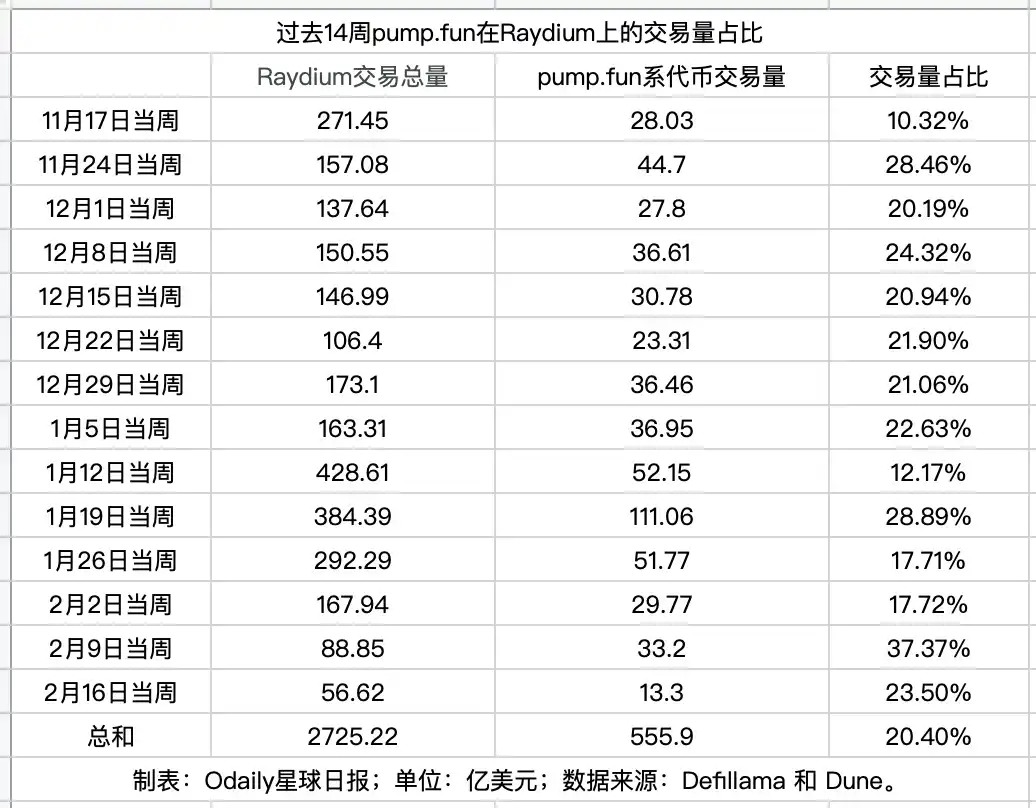
As can be seen from the above chart, in the past 14 weeks, the trading volume of the pump.fun token on Raydium has generally accounted for around 20%. This means that if pump.fun does indeed redirect trading volume from Raydium in the future through its own AMM (excluding autonomous liquidity migration activities due to uncertain platform fee rate differences), Raydium is expected to experience around a 20% reduction in trading volume.
Oversold?
Turning back to the market situation, OKX data shows that RAY dropped to a low of $2.82 today, corresponding to a decrease of over 30% (the data was delayed, but in hindsight, there was indeed some overselling at that time). The current price has gradually recovered to $3.15, representing a 25.43% decrease.
Considering that SOL also experienced a 5.8% decrease, RAY's current decline is basically within a reasonable range, meaning that the market has preemptively priced in pump.fun's frontrunning behavior.
Let's end with a quote from Fluid COO DMH:
“RAY's plummet once again proves to us that ‘distribution >>> tech.’ Both the traditional world (Microsoft) and the crypto space (Metamask) have countless examples showing that if you have a large enough user base, your product isn't that important.”
Potrebbe interessarti anche

Come trovare il giusto equilibrio tra rischio e rendimento nei rendimenti DeFi?

Tesi Ethereum di Tom Lee: Perché l'uomo che ha chiamato l'ultimo ciclo sta raddoppiando su Bitmine
Tom Lee sta emergendo come uno dei sostenitori più influenti di Ethereum. Da Fundstrat a Bitmine, la sua tesi su Ethereum combina rendimento di staking, accumulazione di tesoreria e valore della rete a lungo termine. Ecco perché “Tom Lee Ethereum” è diventata una delle narrazioni più viste delle criptovalute.
Naval sale personalmente sul palco: La storica collisione tra persone comuni e capitale di rischio

a16z Crypto: 9 grafici per comprendere l'andamento delle stablecoin

Smentita de "La fine delle criptovalute" di Yang Haipo

Un asciugacapelli può guadagnare $34.000? Interpretare il paradosso della riflessività dei mercati di previsione

Fondatore di 6MV: Nel 2026 è arrivato il "punto di svolta decisivo" per gli investimenti nelle criptovalute

Abraxas Capital conia 2,89 miliardi di USDT: Un aumento di liquidità o solo più arbitraggio di stablecoin?
Abraxas Capital ha appena ricevuto $2,89 miliardi di USDT appena coniati da Tether. Si tratta di un'iniezione di liquidità rialzista per i mercati crypto, o è solo affari come al solito per un gigante dell'arbitraggio di stablecoin? Analizziamo i dati e il probabile impatto su Bitcoin, altcoin e DeFi.
Un VC del mondo crypto ha detto che l'IA è troppo pazza e che è molto conservatore

Dopo essere stato escluso da PayPal, Musk punta a tornare sul mercato delle criptovalute
La Storia Evolutiva degli Algoritmi di Contratto: Un Decennio di Contratti Perpetui, il Sipario Non è Ancora Caduto

Notizie oggi sugli ETF Bitcoin: gli afflussi di $2,1 miliardi segnalano una forte domanda istituzionale di BTC
Le notizie sugli ETF Bitcoin hanno registrato afflussi per $2,1B in 8 giorni consecutivi, segnando una delle più forti serie di accumuli recenti. Ecco cosa significano le ultime notizie sugli ETF Bitcoin per il prezzo del BTC e se il prossimo livello di breakout è di $80K.

Michael Saylor: L'inverno è finito: ha ragione? 5 punti chiave (2026)
Michael Saylor ha twittato ieri "L'inverno è finito". È breve. È audace. E la notizia ha fatto parlare tutto il mondo delle criptovalute.
Ma ha ragione? Oppure si tratta solo dell'ennesimo CEO che si autocelebra?
Analizziamo i dati. Cerchiamo di essere neutrali. Vediamo se il ghiaccio si è davvero sciolto.

L'app WEEX Bubbles è ora disponibile e offre una panoramica immediata del mercato delle criptovalute
WEEX Bubbles è un'app autonoma progettata per aiutare gli utenti a comprendere rapidamente i complessi movimenti del mercato delle criptovalute attraverso un'intuitiva visualizzazione a bolle.

Il co-fondatore di Polygon Sandeep: Scrittura dopo l'esplosione della catena del ponte di catena

Aggiornamento Maggiore sul Web: 10+ Stili di Grafico Avanzati per Approfondimenti di Mercato
Per fornire strumenti di analisi più potenti e professionali, WEEX ha lanciato un aggiornamento importante ai suoi grafici di trading web, ora supportando fino a 14 stili di grafico avanzati.
Notiziario del mattino | Aethir si aggiudica un contratto aziendale da 260 milioni di dollari con Axe Compute; New Fire Technology acquisisce il team di trading di Avenir Group; il volume di scambi di Polymarket superato da Kalshi

Powell: Abbiamo un Periodo Transitorio per Lavorare sull’Inflazione
Jerome Powell, candidato alla presidenza della Federal Reserve, ha detto che non crede nella “forward guidance” e che…
Come trovare il giusto equilibrio tra rischio e rendimento nei rendimenti DeFi?
Tesi Ethereum di Tom Lee: Perché l'uomo che ha chiamato l'ultimo ciclo sta raddoppiando su Bitmine
Tom Lee sta emergendo come uno dei sostenitori più influenti di Ethereum. Da Fundstrat a Bitmine, la sua tesi su Ethereum combina rendimento di staking, accumulazione di tesoreria e valore della rete a lungo termine. Ecco perché “Tom Lee Ethereum” è diventata una delle narrazioni più viste delle criptovalute.
Naval sale personalmente sul palco: La storica collisione tra persone comuni e capitale di rischio
a16z Crypto: 9 grafici per comprendere l'andamento delle stablecoin
Smentita de "La fine delle criptovalute" di Yang Haipo
Un asciugacapelli può guadagnare $34.000? Interpretare il paradosso della riflessività dei mercati di previsione