
- Buy Crypto
- Markets
- Futures
- Spot
- Copy Trade
 WE-Launch
<h1>The $3 Billion Valuation: Phantom’s Growth Anxiety and Cross-Chain Breakthrough</h1>

Original Article Title: "The Hidden Risks Behind Web3 Super Unicorn Phantom"
Original Author: zhou, ChainCatcher
The 2025 crypto wallet market is witnessing a brutal battle for market share.
As the meme coin craze fades, high-frequency trading users are flocking in droves to wallet platforms with lower fees and stronger incentives. Faced with the closed-loop ecosystem of these trading platforms, the survival space for independent players is constantly shrinking.
Against this backdrop, Phantom's performance has attracted attention. Earlier this year, with a $1.5 billion funding round, it propelled its valuation to $30 billion. Since the fourth quarter, the project has successively launched its own stablecoin CASH, a prediction market platform, and a crypto debit card, attempting to find new growth points beyond the trading business.
$30 Billion Valuation, From Solana Roots to Multi-Chain Expansion
Looking back at Phantom's history, in 2021, the Solana ecosystem was just taking off, and on-chain infrastructure was still immature. Traditional crypto wallets like MetaMask mainly supported the Ethereum ecosystem, lacking compatibility with other chains, and having certain shortcomings in user experience.
Usually, when creating a wallet, users need to manually copy down a 12 or 24-word seed phrase. Once the key is lost, the assets will be permanently unrecoverable, making many potential users feel cumbersome and at high risk.
Phantom's three founders had previously worked at 0x Labs (an Ethereum DeFi infrastructure project) for many years. They seized this opportunity, chose to start from Solana, and built a wallet with a simple interface and intuitive operation. Their core innovation lies in optimizing the backup process: providing various simple methods such as email login, biometrics, and encrypted cloud backup to assist in replacing manual seed phrase copying, greatly reducing the entry barrier for newcomers.
In April 2021, the Phantom browser extension version was launched, and within a few months, the user base exceeded one million, becoming the preferred choice for Solana users. According to RootData, in July of the same year, while still in the testing stage, Phantom secured a $9 million Series A funding round led by a16z. In January 2022, Paradigm led a $109 million Series B round, reaching a valuation of $1.2 billion. Until early 2025, Paradigm and Andreessen Horowitz once again led a $1.5 billion funding round, pushing its valuation to $30 billion.
The Billion Valuation: Phantom’s Growth Anxiety and Cross-Chain Breakthrough" src="https://image.theblockbeats.info/file_v6/20251219/dadc2be1-cc8c-4e1d-8623-2a0a755450ef.png?x-oss-process=image/quality,q_50/format,webp" alt="" data-href="" style=""/ >
As its scale expanded, Phantom subsequently embarked on a multi-chain strategy, supporting multiple public chains including Ethereum, Polygon, Bitcoin, Base, and Sui, aiming to shed the label of being a "Solana-only wallet." However, currently Phantom still does not natively support the BNB Chain. Previously, some users criticized Phantom for supporting ETH but not BNB Chain, leading to missed airdrop opportunities.
The Joys and Concerns of 2025
2025 was a year of both joy and concern for Phantom: on one hand, there was rapid growth at the user and product level, and on the other hand, the transaction volume share was significantly eroded by exchange platform-associated wallets.
Specifically, user growth was a bright spot. Phantom's monthly active users increased from 15 million at the beginning of the year to nearly 20 million by the end of the year, with growth rates among independent wallets leading the way, especially with significant user growth in emerging markets like India and Nigeria.
At the same time, Phantom's custody asset size surpassed $25 billion, with a weekly income of $44 million at its peak. Its annual revenue once surpassed that of MetaMask, and currently, Phantom's cumulative revenue is approaching $570 million.
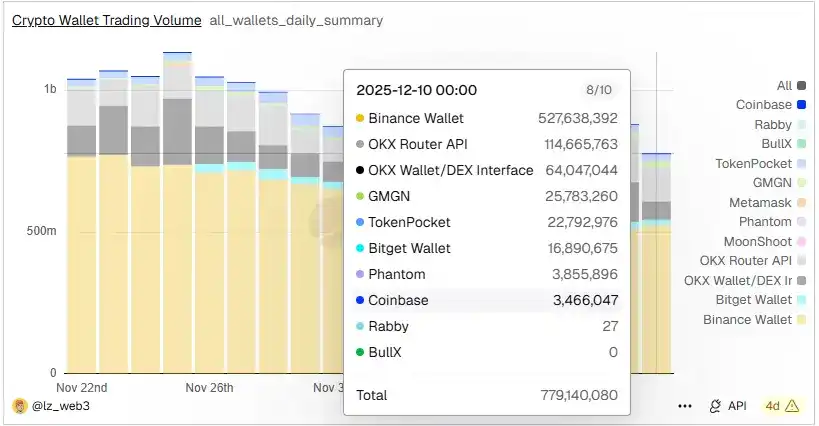
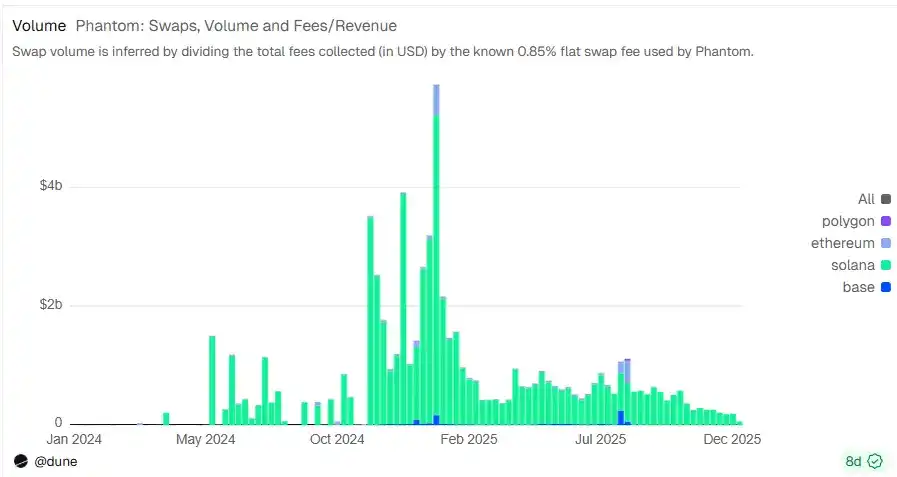
However, concerns on the transaction volume side were also highlighted. According to Dune Analytics data, Phantom's share in the overall on-chain swap market dropped from nearly 10% at the beginning of the year to 2.3% in May, further shrinking to only 0.5% by the end of the year. Exchange platform-associated wallets have attracted a large number of high-frequency traders with advantages in fees, speed of listing new tokens, and substantial airdrop subsidies. Currently, Binance Wallet accounts for nearly 70%, while OKX (wallet + routing API) combined make up over 20%.
The market's greater concern about Phantom lies in its deep integration with Solana. Data shows that 97% of Phantom's swap transactions occur on Solana, while Solana's Total Value Locked (TVL) has dropped over 34% from its peak of $13.22 billion on September 14th to the current six-month low of $8.67 billion. This has directly impacted Phantom's core trading metrics.
Facing these pressures, Phantom is investing resources in new products, attempting to open up a second growth curve.
On the product front, Phantom has introduced a series of differentiated features:
· In July, it integrated Hyperliquid perpetual contracts, driving approximately $1.8 billion in trading volume in just around 16 days, generating nearly $930,000 in revenue through a rebate mechanism (builder codes);
· In August, it further solidified coverage of niche trading needs by acquiring the meme coin monitoring tool Solsniper and the NFT data platform SimpleHash;
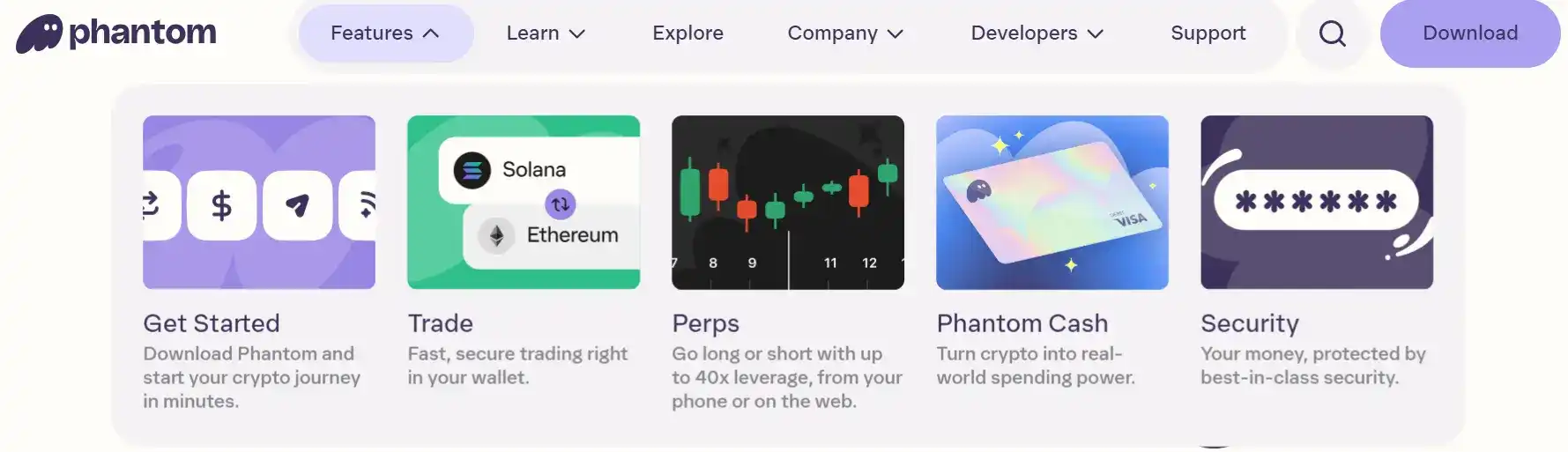
· By the end of September, the native stablecoin CASH was launched, with a supply quickly exceeding $100 million. In November, the transaction peak exceeded 160,000 transactions. Its core competitive advantage lies in fee-free P2P transfers and complementary lending rewards;
· In December, the Phantom Cash debit card was launched in the United States, enabling users to directly swipe for purchases using on-chain stablecoins and compatible with mainstream mobile payments such as Apple Pay and Google Pay;
· On December 12, the announcement of a prediction market platform was made, integrating the Kalshi prediction market into the wallet. It is currently open to eligible users;
· Simultaneously, a free SDK, "Phantom Connect," was launched, allowing users to seamlessly access different web3 applications with a single account, further reducing the onboarding threshold for developers and users.
Among these, the most noteworthy are the debit card and the CASH stablecoin. Phantom seeks to solve the "last mile" problem of cryptocurrency consumption through them.
Phantom CEO Brandon Millman has publicly stated that in the short term, there will be no coin issuance, IPO, or self-built chain. All efforts are focused on refining the product to make the wallet a financial tool that even ordinary people can use. He believes that the endgame of the wallet race is not about which one has the largest trading volume but about who first brings cryptocurrency into everyday payments.
However, the road to cryptocurrency payment's "last mile" is not easy. Phantom is not the first independent non-custodial wallet to launch a debit card.
Prior to this, in Q2 of 2025, MetaMask had already partnered with Mastercard, Baanx, and CompoSecure to launch the MetaMask Card, supporting real-time conversion of cryptocurrency for fiat currency consumption. It was rolled out in various regions such as the EU, the UK, and Latin America. MetaMask's card has broader coverage, an earlier launch, but is limited by the Ethereum and Linea networks, with higher fees and slower speeds. Users have provided feedback that it is "convenient but used infrequently."
On the other hand, Phantom's debit card started relatively late, currently only being rolled out in a small area of the United States, and its actual usage still needs to be observed. In theory, leveraging Solana's low-fee advantage, it may be more competitive in fee-sensitive emerging markets. However, there is still a significant gap compared to the MetaMask Card in terms of global coverage and merchant acceptance.
As for stablecoins, if CASH cannot establish a sustainable network effect, it may also follow the footsteps of other wallet-native stablecoins, such as MetaMask's native stablecoin mUSD. After its launch, the supply quickly exceeded $100 million, but in less than two months, it dropped to around $25 million.
Conclusion
With the fading of the meme trend, trading volume is no longer a reliable moat, and independent wallets must return to the essence of financial services.
Overall, Phantom integrates Hyperliquid perpetual contracts and Kalshi prediction markets on the transaction side to retain advanced users. On the consumption side, it bets on the CASH stablecoin and debit card, attempting to make on-chain assets truly part of daily life.
This dual-track driving force of "transaction derivatives + consumer payments" is Phantom's self-redemption in the wallet race under the squeeze of the Matthew Effect. It is not only seeking a second growth curve but also defining the endgame of an independent wallet.
You may also like

Trend Research Quietly Becomes One of Ethereum’s Largest Whales with Major ETH Acquisition
Key Takeaways Trend Research has acquired 46,379 ETH, boosting their total holdings to about 580,000 ETH. The company,…

Aave’s $10M Token Purchase Raises Concerns Over Governance Power
Key Takeaways: Aave founder Stani Kulechov’s $10 million AAVE token purchase sparks debates over governance power concentration. Concerns…

Web3 and DApps in 2026: A Utility-Driven Year for Crypto
Key Takeaways The transition to utility in the crypto sector has set a new path for 2026, emphasizing…
How to Evaluate a Curator?

December 24th Market Key Intelligence, How Much Did You Miss?

Base's 2025 Report Card: Revenue Grows 30X, Solidifies L2 Leadership

From Aave to Ether.fi: Who Captured the Most Value in the On-Chain Credit System?

Venture Capital Post-Mortem 2025: Hashrate is King, Narrative is Dead

DeFi Hasn't Collapsed, So Why Has It Lost Its Allure?

Are Those High-Raised 2021 Projects Still Alive?

NIGHT, with a daily trading volume of nearly $10 billion, is actually coming from the "has-been" Cardano?
Aave Community Governance Drama Escalates, What's the Overseas Crypto Community Talking About Today?

Key Market Information Discrepancy on December 24th - A Must-See! | Alpha Morning Report

2025 Token Postmortem: 84% Peak at Launch, High-Cap Project Turns into a "Rug Pull" Epicenter?
Polymarket Announces In-House L2, Is Polygon's Ace Up?

Ether pumps to outsiders, dumps in-house. Can Tom Lee's team still be trusted?

Coinbase Joins Prediction Market, AAVE Governance Dispute - What's the Overseas Crypto Community Talking About Today?
Over the past 24 hours, the crypto market has shown strong momentum across multiple dimensions. The mainstream discussion has focused on Coinbase's official entry into the prediction market through the acquisition of The Clearing Company, as well as the intense controversy within the AAVE community regarding token incentives and governance rights.
In terms of ecosystem development, Solana has introduced the innovative Kora fee layer aimed at reducing user transaction costs; meanwhile, the Perp DEX competition has intensified, with the showdown between Hyperliquid and Lighter sparking widespread community discussion on the future of decentralized derivatives.
This week, Coinbase announced the acquisition of The Clearing Company, marking another significant move to deepen its presence in this field after last week's announcement of launching a prediction market on its platform.
The Clearing Company's founder, Toni Gemayel, and the team will join Coinbase to jointly drive the development of the prediction market business.
Coinbase's Product Lead, Shan Aggarwal, stated that the growth of the prediction market is still in its early stages and predicts that 2026 will be the breakout year for this field.
The community has reacted positively to this, generally believing that Coinbase's entry will bring significant traffic and compliance advantages to the prediction market. However, this has also sparked discussions about the industry's competitive landscape.
Jai Bhavnani, Founder of Rivalry, commented that for startups, if their product model proves to be successful, industry giants like Coinbase have ample reason to replicate it.
This serves as a reminder to all entrepreneurs in the crypto space that they must build significant moats to withstand competition pressure from these giants.
Regulated prediction market platform Kalshi launched its research arm, Kalshi Research, this week, aimed at opening its internal data to the academic community and researchers to facilitate exploration of prediction market-related topics.
Its inaugural research report highlights Kalshi's outperformance in predicting inflation compared to Wall Street's traditional models. Kalshi co-founder Luana Lopes Lara commented that the power of prediction markets lies in the valuable data they generate, and it is now time to better utilize this data.
Meanwhile, Kalshi announced its support for the BNB Chain (BSC), allowing users to deposit and withdraw BNB and USDT via the BSC network.
This move is seen as a significant step for Kalshi to open its platform to a broader crypto user base, aiming to unlock access to the world's largest prediction market. Furthermore, Kalshi also revealed plans to host the first Prediction Market Summit in 2026 to further drive industry engagement and development.
The AAVE community recently engaged in heated debates around an Aave Improvement Proposal (AIP) titled "AAVE Tokenomics Alignment Phase One - Ownership Governance," aiming to transfer ownership and control of the Aave brand from Aave Labs to Aave DAO.
Aave founder Stani Kulechov publicly stated his intention to vote against the proposal, believing it oversimplifies the complex legal and operational structure, potentially slowing down the development process of core products like Aave V4.
The community's reaction was polarized. Some criticized Stani for adopting a "double standard" in governance and questioned whether his team had siphoned off protocol revenue, while others supported his cautious stance, arguing that significant governance changes require more thorough discussion.
This controversy highlights the tension between the ideal of DAO governance in DeFi projects and the actual power held by core development teams.
Despite governance disputes putting pressure on the AAVE token price, on-chain data shows that Stani Kulechov himself has purchased millions of dollars' worth of AAVE in the past few hours.
Simultaneously, a whale address, 0xDDC4, which had been quiet for 6 months, once again spent 500 ETH (approximately $1.53 million) to purchase 9,629 AAVE tokens. Data indicates that this whale has accumulated nearly 40,000 AAVE over the past year but is currently in an unrealized loss position.
The founder and whale's increased holdings during market volatility were interpreted by some investors as a confidence signal in AAVE's long-term value.
In this week's top article, Morpho Labs' "Curator Explained" detailed the role of "curators" in DeFi.
The article likened curators to asset managers in traditional finance, who design, deploy, and manage on-chain vaults, providing users with a one-click diversified investment portfolio.
Unlike traditional fund managers, DeFi curators execute strategies automatically through non-custodial smart contracts, allowing users to maintain full control of their assets. The article offered a new perspective on the specialization and risk management in the DeFi space.
Another widely circulated article, "Ethereum 2025: From Experiment to Global Infrastructure," provided a comprehensive summary of Ethereum's development over the past year. The article noted that 2025 is a crucial year for Ethereum's transition from an experimental project to global financial infrastructure. Through the Pectra and Fusaka hard forks, Ethereum achieved significant reductions in account abstraction and transaction costs.
Furthermore, the SEC's clarification of Ethereum's "non-securities" nature and the launch of tokenized funds on the Ethereum mainnet by traditional financial giants like JPMorgan marked Ethereum's gaining recognition from mainstream institutions. The article suggested that whether it is the continued growth of DeFi, the thriving L2 ecosystem, or the integration with the AI field, Ethereum's vision as the "world computer" is gradually becoming a reality.
The Solana Foundation engineering team released a fee layer solution called Kora this week.
Kora is a fee relayer and signatory node designed to provide the Solana ecosystem with a more flexible transaction fee payment method. Through Kora, users will be able to achieve gas-free transactions or choose to pay network fees using any stablecoin or SPL token. This innovation is seen as an important step in lowering the barrier of entry for new users and improving Solana network's availability.
Additionally, a deep research report on propAMM (proactive market maker) sparked community interest. The report's data analysis of propAMMs on Solana like HumidiFi indicated that Solana has achieved, or even surpassed, the level of transaction execution quality in traditional finance (TradFi) markets.
For example, on the SOL-USDC trading pair, HumidiFi is able to provide a highly competitive spread for large trades (0.4-1.6 bps), which is already better than the trading slippage of some mid-cap stocks in traditional markets.
Research suggests that propAMM is making the vision of the "Internet Capital Market" a reality, with Solana emerging as the prime venue for all of this to happen.
The competition in the perpetual contract DEX (Perp DEX) space is becoming increasingly heated.
In its latest official article, Hyperliquid has positioned its emerging competitor, Lighter, alongside centralized exchanges like Binance, referring to it as a platform utilizing a centralized sequencer. Hyperliquid emphasizes its transparency advantage of being "fully on-chain, operated by a validator network, and with no hidden state."
The community widely interprets this as Hyperliquid declaring "war" on Lighter. The technical differences between the two platforms have also become a focal point of discussion: Hyperliquid focuses on ultimate on-chain transparency, while Lighter emphasizes achieving "verifiable execution" through zero-knowledge proofs to provide users with a Central Limit Order Book (CLOB)-like trading experience.
This battle over the future direction of decentralized derivatives exchanges is expected to peak in 2026.
Meanwhile, discussions about Lighter's trading fees have surfaced. Some users have pointed out that Lighter charged as much as 81 basis points (0.81%) for a $2 million USD/JPY forex trade, far exceeding the near-zero spreads of traditional forex brokers.
Some argue that Lighter does not follow a B-book model that bets against market makers, instead anchoring its prices to the TradFi market, and the high fees may be related to the current liquidity or market maker balance incentives. Providing a more competitive spread for real-world assets (RWA) in the highly volatile crypto market is a key issue Lighter will need to address in the future.
The Secret Centralization Landscape of Stablecoin Payments: 85% of Transaction Volume Controlled by Top 1000 Wallets
Trend Research Quietly Becomes One of Ethereum’s Largest Whales with Major ETH Acquisition
Key Takeaways Trend Research has acquired 46,379 ETH, boosting their total holdings to about 580,000 ETH. The company,…
Aave’s $10M Token Purchase Raises Concerns Over Governance Power
Key Takeaways: Aave founder Stani Kulechov’s $10 million AAVE token purchase sparks debates over governance power concentration. Concerns…
Web3 and DApps in 2026: A Utility-Driven Year for Crypto
Key Takeaways The transition to utility in the crypto sector has set a new path for 2026, emphasizing…
How to Evaluate a Curator?
December 24th Market Key Intelligence, How Much Did You Miss?
Base's 2025 Report Card: Revenue Grows 30X, Solidifies L2 Leadership
Popular coins
Latest Crypto News


Customer Support:@weikecs
Business Cooperation:@weikecs
Quant Trading & MM:[email protected]
VIP Services:[email protected]
 App
App