

ArkStream Capital: The Year 2025 Will Be the Crypto Inflection Point with Old Money Coming In

Original Article Title: "ArkStream Capital: Crypto Breakthrough Year, Embracing the 2025 Carnival"
Original Article Author: ArkStream Capital
2024 was a year of great turbulence in the cryptocurrency industry, marked by many significant events. At the beginning of the year, the approval of a Bitcoin spot ETF injected strong momentum into the market, and by the end of the year, the price of Bitcoin surged past the $100,000 mark, reaching a new all-time high. During this period, we witnessed the Bitcoin halving, approval of an Ethereum spot ETF, the hype around the TON/Telegram ecosystem, the surge in on-chain transactions, a USD interest rate cut, Trump's reelection, the revival of value investing, the rise of new AI Agents, and the birth of DeSci. These countless classic moments are truly worth remembering.
As we bid farewell to 2024, we stand at a new starting point, eagerly looking forward to 2025. The upcoming interest rate cuts, loose monetary policies, friendly regulatory environment, and positive attitude towards cryptocurrency all suggest that 2025 may herald a raging bull market. We anticipate that in this year, the price of Bitcoin is likely to reach a new high, aiming for $200,000 per coin. Meanwhile, looking at Bitcoin Dominance data from past bull markets, the current Bitcoin Dominance remains around 57%, indicating that altcoin Dominance has not yet peaked. We predict that in 2025, altcoins are likely to see a significant structural market rally. By then, Bitcoin's Dominance may fall to below 50%, possibly even around 45%. At the same time, established cryptocurrency projects such as Ethereum, Solana, and XRP are expected to break their all-time highs. In an environment of overall abundant liquidity, whether it's Bitcoin or altcoins, including DeFi, RWA, Meme, AI-related projects, and public chains, the total market capitalization of the entire cryptocurrency industry is highly likely to break new records.
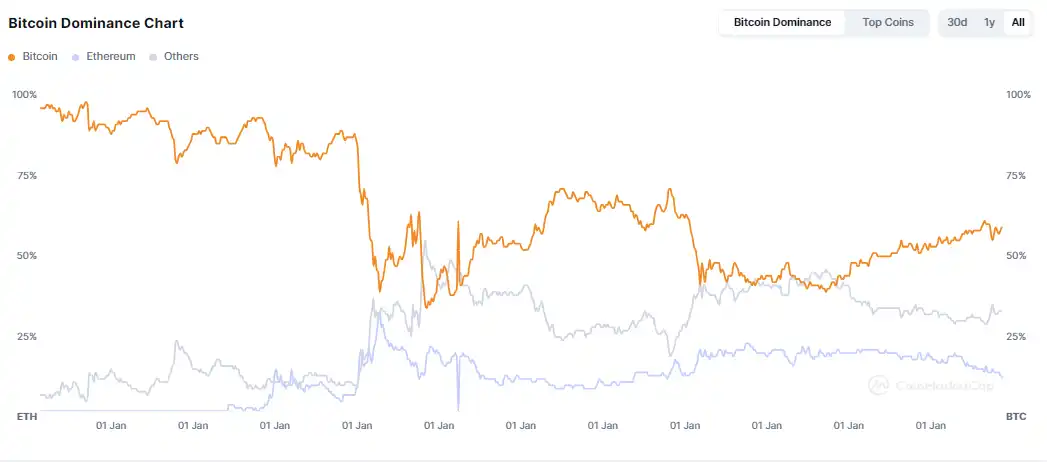
https://coinmarketcap.com/charts/bitcoin-dominance/
Of course, as market capitalization and prices surge significantly, we firmly believe that the cryptocurrency industry will take greater strides in technology and innovation, deeply integrating with the new era's policy environment and monetary trends. Whether in finance, social, or artificial intelligence, we are looking forward to cryptocurrency playing a more extensive role in reshaping the world and contributing more power.
Bitcoin and Its Ecosystem: The Continuous Journey of Mining and Building
With the continuous inflow of Bitcoin ETF, MicroStrategy's crazy leveraged Bitcoin purchases with no selling, and the possible Bitcoin national strategic reserve plan during the Trump administration, the market outlook for Bitcoin is becoming increasingly promising. With its fixed total supply and halving of block rewards leading to low inflation, and the monetary easing policies during the interest rate reduction cycle providing further impetus, Bitcoin is poised for a bright future. A convergence of many factors suggests that by 2025, Bitcoin will not only hover around the $100,000 mark but is likely to strive for a higher market cap. Often referred to as "digital gold," Bitcoin's market cap ratio to gold has steadily risen from 2% to over 10% today, with the ratio in 2024 soaring from 5% directly to 10%. Considering these bullish factors, it is expected that the Bitcoin-to-gold market cap ratio will further increase to 15% to 20%. This means that the price of Bitcoin is expected to reach $150,000 to $200,000 per coin.
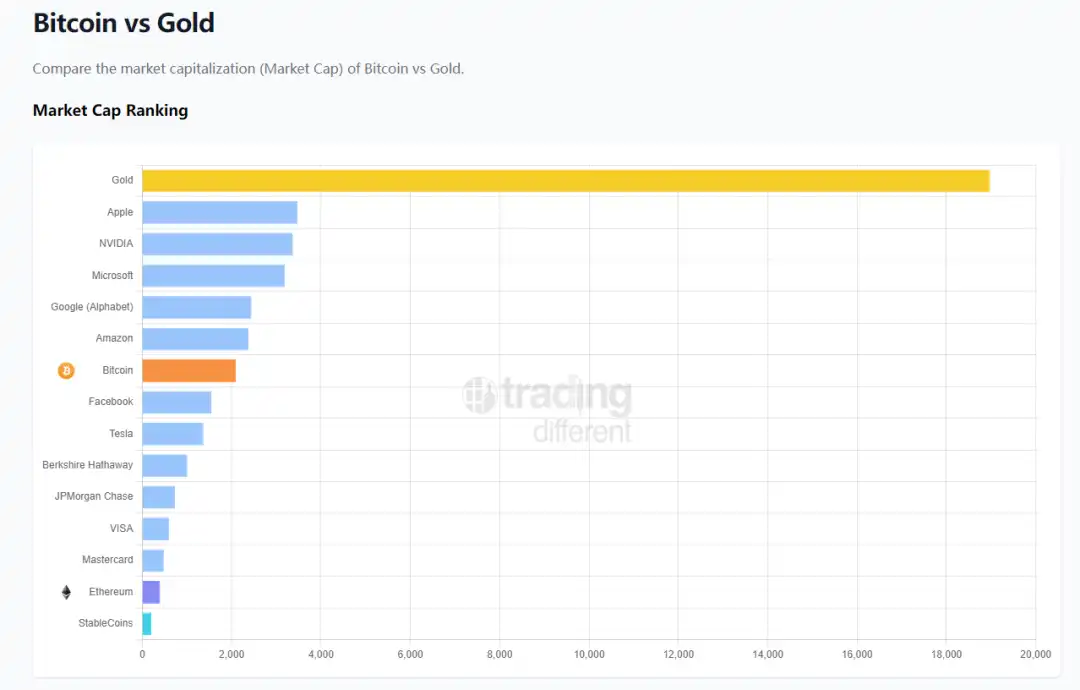
https://tradingdifferent.com/dashboard/bitcoin-vs-gold
https://ingoldwetrust.report/chart-gold-bitcoin-marketcap/?lang=en
Despite Bitcoin demonstrating a strong influence, its ecosystem projects are still in the early stages of development. Among the top one hundred projects in terms of market capitalization, only Stacks has stood out, with most other Bitcoin ecosystem projects ranking relatively lower. Currently, Bitcoin's market cap is around $2 trillion, while the total market cap of its ecosystem projects accounts for only 0.5% to 1% of Bitcoin's market cap, translating to $10 billion to $20 billion. Such a low ratio indicates that the Bitcoin ecosystem is like a treasure mountain that has not been fully developed, harboring enormous potential wealth and infinite opportunities. We anticipate that as ecosystem development progresses and resources increase, this ratio is expected to significantly increase from the current 0.5% to 1% to 2% or even 3%. This means that the total market cap of the Bitcoin ecosystem is poised to reach $50 billion to $60 billion.
Looking back at 2023, the rise of inscriptions sparked widespread attention and a craze for the Bitcoin ecosystem. Subsequently, in the first half of 2024, the Bitcoin ecosystem witnessed the first significant peak. During this period, the influx of capital and development resources showed a rapid momentum, with numerous projects emerging and launching one after another. Projects such as Stacks, Merlin Chain, Bounce Bit, Solv, Babylon, UniSat / Fractal, RGB, Nervos, Bitlayer, and Mezo were particularly noteworthy, each showcasing their abilities within the Bitcoin ecosystem and injecting strong momentum into its prosperity. Furthermore, as the Bitcoin halving event approached cyclically, the block rewards gradually decreased, posing higher demands for the maintenance of the Bitcoin network. To meet this demand, miners will have to more actively participate in ecosystem development to ensure the robust operation of the entire network.
Despite the relatively slow pace of decentralization, the continuous injection of capital and development resources, along with the urgent need for network maintenance, are driving the Bitcoin ecosystem forward. As the price of Bitcoin reaches new highs, the ecosystem inevitably requires more liquidity to maintain its vitality. In key technological areas, technologies such as OP_CAT and BitVM are gradually emerging, laying a solid foundation for the future development of the Bitcoin ecosystem. Looking ahead, after a year or two of construction period, we have reason to believe that the achievements of these projects will gradually emerge in 2025, and some key Bitcoin network technologies are expected to be truly applied, further pushing the Bitcoin ecosystem towards a more mature, stable, and prosperous new stage.
Traditional Finance Digitization: Embracing Digital Assets Fully
With the rapid development of encryption technology, the traditional financial system is undergoing a profound transformation, and digital assets are gradually moving from the periphery to the mainstream, becoming an undeniable part of the global financial system. The personal IP Meme coin issued by Trump, although to some extent has impacted the price system of past coins and projects in the industry, as a former US president, his family's every move in the cryptocurrency field undoubtedly has a huge influence. This influence is not only reflected in market sentiment fluctuations but also in the profound impact on the traditional financial system. Trump's Meme coin, as a new type of digital asset, despite its entertainment and speculative nature, the trend it represents cannot be ignored: traditional finance is accelerating its embrace of digital assets, and this trend will profoundly change the landscape of the financial industry.
In the future, the US government is expected to introduce more clear and friendly cryptocurrency regulatory policies, thus creating a more favorable environment for the development of digital assets. For example, the US may expedite the compliance process for cryptocurrency exchanges or introduce more policies that support blockchain technology innovation. As more traditional financial institutions and investors enter the cryptocurrency field, the price fluctuations of digital assets and the correlation with the traditional financial market are continuously strengthening. For example, the price trend of Bitcoin has shown some level of correlation with traditional assets such as US stocks. This deep integration will further drive the encryption process of the traditional financial system, making digital assets an indispensable part of the global financial system. In the future, we may see more traditional financial institutions launching their own cryptocurrency products or applying blockchain technology to existing financial services. With more public participation and more traditional financial institutions joining, the application of cryptocurrency in the financial field will become more widespread and profound. This trend will not only change the landscape of the financial industry but also inject new vitality into the global economy. The future of traditional finance digitization is full of challenges but also opportunities, and all of this is just the beginning.
AI Agent: The Next Evolution of Intelligent Agents
By 2025, the AI Agent sector is expected to experience explosive growth, potentially surpassing the DeFi summer of 2020 in terms of hype. Similar to the DeFi wave of that year, the development of AI Agents has also gone through a process from initial exploration to rapid rise. In the first phase, AI Agents attracted significant attention and funding through innovative applications in areas such as automated trading and intelligent analysis. However, as the market quickly heated up, the sector also experienced a period of consolidation, with some projects experiencing pullbacks due to technical or market factors. Nevertheless, the long-term development of AI Agents continues to be highly anticipated. In 2025, OpenAI introduced a new generation reasoning model called o3, with its powerful reasoning capabilities and performance close to Artificial General Intelligence (AGI), injecting new momentum into the development of AI Agents. The o3 model excelled in tasks such as mathematics and programming, being able to reason through a "private thought chain," further enhancing the level of intelligence of AI Agents. Additionally, the application scenarios of AI Agents continue to expand, from DeFi to DAO governance, demonstrating significant potential in optimizing trading decisions, enhancing user experience, and improving governance efficiency.
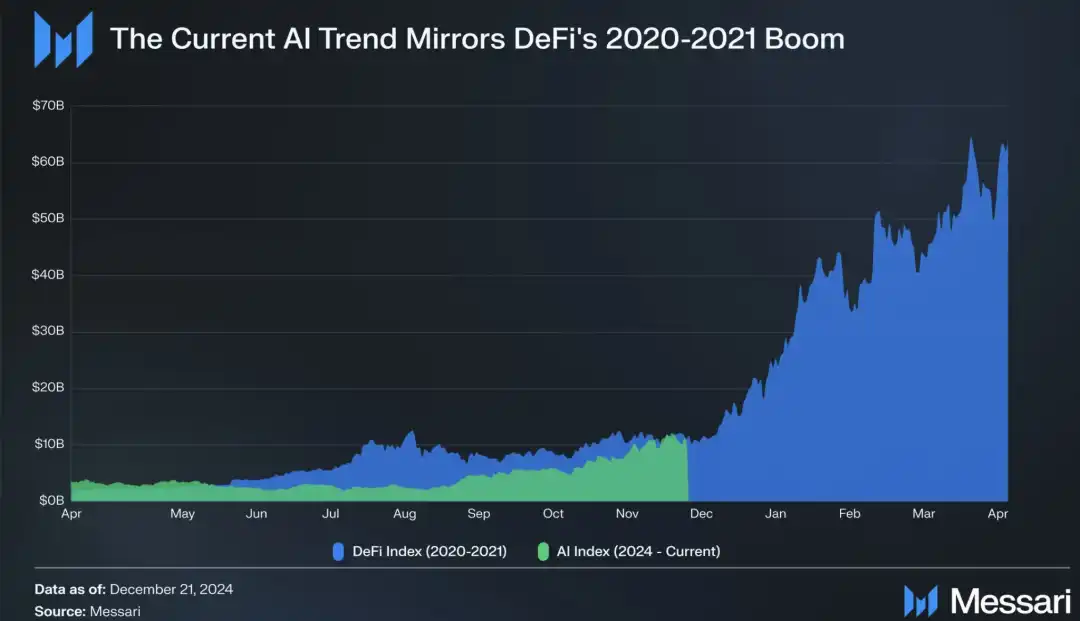
https://x.com/MessariCrypto/status/1874104196800405935
In the new cycle, AI Agents have evolved from being mere tools for traditional AI models to becoming the core driving force of the community ecosystem, transcending the limitations of a single "tool attribute." Today, its development model is guided by "community orientation," focusing on the growth of AI Agents themselves and the construction of the ecosystem, as if building a fully robotic autonomous community.
Under the "community-oriented" model, ai16z and Virtuals stand out as two major representatives. Virtuals has built a complete AI Agent creation and token issuance platform similar to the "Apple system," establishing a closed-loop ecosystem. ai16z, on the other hand, focuses on open-source frameworks and decentralized governance. Both have distinctive features in technical architecture, tokenomics, and market strategy, precisely meeting different user needs.
Currently, the AI Agent market is mainly divided into two major project categories: the "technical support layer" and the "scenario implementation layer." The "technical support layer" is dedicated to providing AI Agents with underlying technology and infrastructure support, while the "scenario implementation layer" focuses on applying AI Agents to specific business scenarios to realize their practical value. As the infrastructure gradually matures and saturates, the coordinated development of infrastructure and applications will become the core theme of the next stage, driving the field towards a period of deep integration. ArkStream points out that the current momentum of AI Agents is evident, with FOMO emotions driving various funds to pour in, attempting to get a piece of the action. This rapid expansion has led to a proliferation of projects, but currently, no single project has a market capitalization exceeding 10 billion. This stage can be seen as the "early stage" of the Web3 AI Agent track, characterized by its time orientation: market participants generally hold speculative attitudes, rushing to enter at the fastest speed possible.
ArkStream Capital predicts that the "Second Stage" will arrive in 2025, shifting the market focus to product quality, leading to a major reshuffle where low-quality, opportunistic projects will be swiftly eliminated by mainstream funds. With the continuous iterative upgrades of traditional AI technology, ArkStream Capital remains optimistic about the overall outlook of the field. The current level of heat is enough to demonstrate its potential for development, and it is expected that the first batch of AI Agent projects with market capitalization surpassing one hundred billion will soon become a significant milestone in the industry's development. The market capitalization of the current AI Agent has already entered the range of 150 billion to 200 billion USD and has shown strong growth momentum in the past few months, with a market cap increase of over 30% in the past week alone. With the ongoing maturity of the technology and widespread market acceptance, AI Agent is expected to become one of the most promising sectors in 2025. Its market capitalization is expected to continue to grow rapidly, potentially reaching 500 billion USD or even higher by 2025. This growth trend is not only benefiting from the advancement of AI technology but also from its extensive application and implementation in multiple fields.
https://www.cookie.fun/
RWA and Stablecoins: A Financial Bridge with Boundless Opportunities
RWA covers a wide range of asset classes, including stablecoins, private loans, US Treasury bonds, commodities, and stocks, among others. Among these assets, stablecoins, due to their uniqueness and importance, can be considered a separate track. For non-stablecoin RWA, due to the complexity of asset standardization and imperfect policy regulations, the scale is relatively smaller, so we will focus on the stablecoin field.
In the cryptocurrency market, since 2018, USD-pegged stablecoins have played a critical role. They not only serve as the base currency for trading but also act as shadow USD assets, actively involved in various scenarios such as transfer payments. As of December 1, 2024, the total market capitalization of stablecoins has increased to 1.93 trillion USD, a year-on-year growth of 48%. Taking the on-chain daily transfer volume as an example, the current daily transfer volume remains in the high range of 250 billion to 300 billion USD, even during market downturns, the data has not dropped below 100 billion USD. In terms of trading volume, according to industry data from CoinMarketCap, the monthly trading volume in November reached 60 trillion USD, indicating that stablecoins account for 30% of the industry's trading volume in centralized exchanges. This ratio does not yet include on-chain stablecoin trading volume, meaning the actual share may be even higher. In addition to issuance, trading, and transfer volume as the three core indicators, stablecoins have also introduced stable income assets such as US Treasury bonds as underlying assets, providing stable and sustainable income, bringing positive externalities to the industry, further promoting the connectivity and integration of Web3 with the real world.
In the stablecoin market, various types of stablecoins have gradually emerged as market demand has increased, including fiat-backed stablecoins, decentralized collateralized stablecoins, algorithmic stablecoins, and more. Among them, fiat-backed stablecoins have already taken the majority of the market share and the market size continues to grow. However, due to the emerging trading demand in the market, decentralized stablecoins have been exploring new paths. In this regard, Ethena has emerged as a leader, with Ethena's issuance of USDe, a synthetic dollar, occupying a prominent position in the DeFi space with its innovative financial solution. A key feature of USDe is the adoption of an advanced Delta hedging strategy to maintain its peg to the dollar, setting it apart from traditional stablecoins. In just over a year, the issuance of USDe has steadily grown, successfully withstanding the downturns in the market in Q2 and Q3, and is now ranked third, following only USDT and USDC, and is once again entering a phase of rapid growth.
ArkStream Capital believes that stablecoins play a crucial role in the cryptocurrency industry in navigating bull and bear cycles, with strong growth momentum that shows no signs of slowing down. Whether in payments or trading, all key metrics of stablecoins are expected to continue growing. With the arrival of a bull market, the issuance of stablecoins will expand alongside industry growth, with its market capitalization expected to double and surpass $400 billion. In this trend, decentralized stablecoins, with their advantages in transparency, decentralization, and yield, are significantly superior to traditional stablecoins and are poised to capture more market share. It is projected that the market share of decentralized stablecoins will increase from the current $20 billion to over $60 billion, accounting for over 15% of the entire stablecoin market in the future. Ethena, as a leader in the decentralized stablecoin space, has built various innovative stablecoin products around USDe, such as USDtb and iUSDe. Through collaboration with traditional financial and asset management institutions, these products further drive the market penetration of decentralized stablecoins.
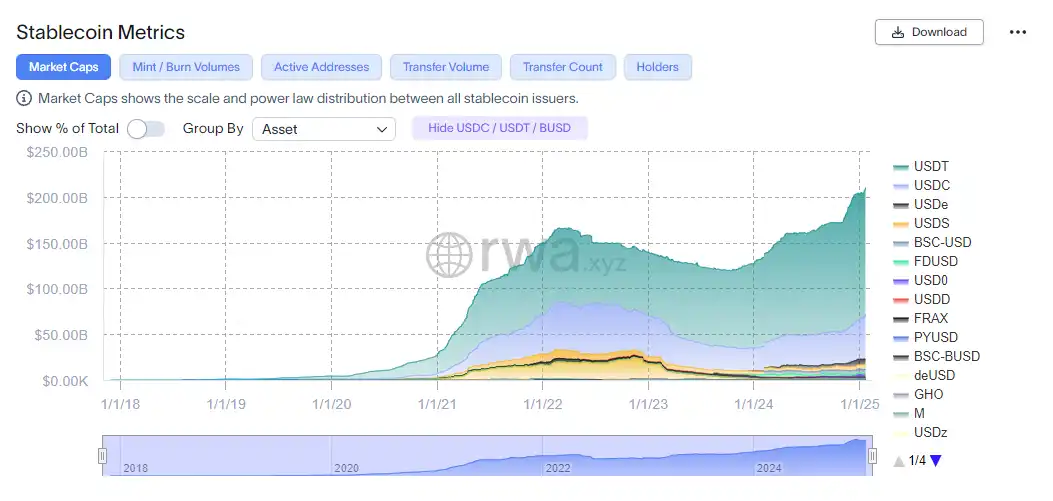
https://app.rwa.xyz/stablecoins
DeFi: A Pillar of Continuous Development and Prosperity
By 2025, the DeFi sector is poised to see unprecedented development opportunities. With the gradual relaxation of regulatory policies in the United States, the formal entry of a large amount of traditional financial institution funds has significantly enhanced the industry's liquidity. With the surge of capital, the Total Value Locked (TVL) in the DeFi sector is expected to soar rapidly, potentially surpassing the previous high and heading towards $200 billion, becoming a shining pinnacle in the crypto finance field. Moreover, user activities in lending, DEX, and the stablecoin market are also expected to significantly increase, with the number of daily active addresses and active funds reaching new levels, thereby driving another milestone in asset appreciation in the DeFi ecosystem. Meanwhile, major exchanges are vigorously promoting the popularity of Web3 wallets, which have undergone significant improvements in user experience, greatly reducing the operational barriers and enabling more users to easily participate in the DeFi ecosystem.
Furthermore, the on-chain economy's activity has seen a significant increase due to various on-chain events organized by a multitude of DeFi projects in collaboration with exchanges. These events have not only attracted a large number of participants but have also further promoted the prosperity and development of the on-chain ecosystem. Against this backdrop, DeFi has gradually moved away from its reliance on traditional finance or exchanges, presenting a new development situation. In this new era, DeFi's development is no longer limited to traditional functions such as DEX, lending, and staking. In the future, DeFi will focus more on new key metrics such as Daily Active Users (DAU) and capital activity. DeFi protocol product design will also closely revolve around users' core needs, such as security, usability, and optimizing user experience.
In the past, DeFi successfully attracted a large number of on-chain natives, and with the support of Web3 wallets, more and more users are entering the on-chain space, continuously expanding the scale of on-chain natives. We believe that by 2025, the entire industry will witness breakthroughs in various on-chain data metrics. It is worth noting that the boundary between DeFi and CeFi is gradually blurring, and the trend of their integration is becoming more apparent. Liquidity flowing between CeFi and DeFi has significantly increased, and this bidirectional interaction has injected more vitality into the entire financial ecosystem. Meanwhile, the diversification and innovation of wallet products continue to stimulate user engagement, injecting new momentum into the industry. It can be foreseen that in the future, DeFi will embrace a more open and inclusive posture to welcome broader development opportunities.
Meme: A Vivid Interpretation of the Attention Economy
In 2024, Meme underwent significant growth and evolution, especially in terms of total market capitalization, trading activity, thematic diversity, and exchange support. From October to early December, the total market cap of Meme coins experienced a significant increase, reaching a historic high, and trading volume also surged. The market witnessed the emergence of various new types of Meme coins, including AI Agent-themed Meme coins (GOAT, ACT), art BAN linked to Sotheby's art auctions, squirrel PNUT related to Trump and Elon Musk, and CHILLGUY, which attracted a large number of TikTok fans. The rise of these emerging Memes has not only injected vitality into the market, spurred on-chain liquidity flow but has also attracted a significant number of new investors to the market, contributing to the prosperity and development of the Meme and crypto industry.
Compared to emerging Memes, traditional Memes such as DOGE, PEPE, and WIF have also performed strongly in the market. In particular, PEPE and WIF successfully landed on Robinhood in November 2024, highlighting not only North American compliant exchanges' recognition of Memes but also further expanding the market influence of these established Memes.
Based on the data from the Meme track over the past year, as of the end of 2023, the number of Meme coins in the top 500 by market capitalization was extremely limited, mainly including a few such as DOGE, SHIB, BONK, PEPE, FLOKI, and ELON, while the majority of Meme coins had lower market values. However, by the end of 2024, the number of Meme coins in the top 500 by market capitalization had significantly increased to 48, accounting for close to 10% of the total, with a total market capitalization of approximately $104.7 billion and a 24-hour trading volume of up to $7.4 billion. All these indicate that Meme coins' recognition and market consensus are continuously expanding.
Especially in the fourth quarter, Memes became the focus of the cryptocurrency market, attracting a lot of attention from investors. With the return of the value investing trend in November, some funds started to flow out of Memes, but some newly listed popular Memes quickly debuted on mainstream exchanges such as Binance and Upbit due to their strong market performance and large user base. Although the insufficient market relay funds led to significant pullbacks from the highs for these Memes, ArkStream Capital believes that this pullback is a perfect reflection of the market's attention economy, indicating that the inflow and outflow of funds in Memes will undergo significant changes with fluctuations in market attention. Many Memes experienced rapid market value growth to $1 billion or even higher in a short period; therefore, experiencing pullbacks and time validation is reasonable. Meanwhile, some emerging sectors, such as DeSci (Decentralized Science), are attracting attention and resources in the form of Memes. Compared to traditional scientific funding methods, this approach is more flexible and efficient, able to quickly gather global funding support for innovative and forward-looking scientific projects, providing timely financial security. Furthermore, Memes as carriers of DeSci can also stimulate public interest and engagement in scientific research, creating a positive research atmosphere and promoting the transformation and application of research results.
Of particular note, the newly elected U.S. President Trump issued a Meme token named after himself (TRUMP), which undoubtedly attracted a lot of attention and funds from outsiders. Unlike traditional financial products, TRUMP completely bypassed centralized exchanges, relying on the power of the blockchain and the community to achieve a market capitalization of hundreds of billions of dollars in a short time. This model not only sets an example for celebrities and businesses entering the cryptocurrency field but also demonstrates the strong potential of decentralized finance. As a highly influential political figure, any action by Trump could have a profound impact on the market. The release of the TRUMP token not only drove the explosive growth of the Meme track but also may have a chain reaction on the entire cryptocurrency industry.

Therefore, ArkStream Capital believes that the prosperity of Memes in the industry is not a temporary phenomenon. Serving as a bridge between Gen Z and the Web3 world, Memes are expected to continue to exist and inject emotion and value into the market due to their easy-to-understand and engaging nature. With the successful launch of the Trump Meme, future Memes will deepen their integration with traditional celebrities and well-known companies, further expanding their influence and market potential. Therefore, ArkStream Capital is actively seeking opportunities to establish a presence in the Meme sector. The focus is on two main areas: first, portals that provide token information and trading data, as well as Bot products that offer trading convenience and custom strategies, and new Meme launch platforms like Pump Fun, which are core infrastructure in the Meme sector with actual sustainable revenue streams; second, Memes are gradually becoming a means of issuing assets that embody fairness. Many projects with real value are exploring the use of Memes to attract users. They embrace the concept of organic growth, with low market value openings, representing a relatively healthy growth approach that also reflects the active exploration and innovation of primary market projects in the Meme space.
猜你喜歡
穩定幣驅動全球B2B支付革新,如何打破工作流程瓶頸釋放兆市場潛力?
這些新創公司正在無需資料中心的情況下建立先進AI模型
CEX與Wallet之後,OKX入局支付
科學平權運動:DeSci的萬億美元知識經濟重建革命
Sentient深度研報:獲8,500萬美元融資,建置去中心化AGI新範式
加密項目為何札堆發卡?一場Web3與現實世界的通行權之爭
專訪Virtuals聯創empty:AI 創業不需要大量資金,Crypto是答案之一
今年 2 月,Base 生態中的 AI 協議 Virtuals 宣布跨鏈至 Solana,然而加密市場隨後進入流動性緊縮期,AI Agent 板塊從人聲鼎沸轉為低迷,Virtuals 生態也陷入一段蟄伏期。
三月初,BlockBeats 對 Virtuals 共同創辦人 empty 進行了一次專訪。彼時,團隊尚未推出如今被廣泛討論的 Genesis Launch 機制,但已在內部持續探索如何透過機制設計激活舊資產、提高用戶參與度,並重構代幣發行與融資路徑。那是一個市場尚未復甦、生態尚處冷啟動階段的時間點,Virtuals 團隊卻沒有停下腳步,而是在努力尋找新的產品方向和敘事突破口。
兩個月過去,AI Agent 板塊重新升溫,Virtuals 代幣反彈超 150%,Genesis 機製成為帶動生態回暖的重要觸發器。從積分獲取規則的動態調整,到專案參與熱度的持續上升,再到「新代幣帶老代幣」的機制閉環,Virtuals 逐漸走出寒冬,並再次站上討論焦點。
值得注意的是,Virtuals 的 Genesis 機制與近期 Binance 推出的 Alpha 積分系統有一些相似之處,評估用戶在 Alpha 和幣安錢包生態系統內的參與度,決定用戶 Alpha 代幣空投的資格。用戶可透過持倉、交易等方式獲得積分,積分越高,參與新項目的機會越大。透過積分系統篩選使用者、分配資源,專案方能夠更有效地激勵社群參與,提升專案的公平性和透明度。 Virtuals 和 Binance 的探索,或許預示著加密融資的新趨勢正在形成。
回看這次對話,empty 在專訪中所展現出的思路與判斷,正在一步步顯現其前瞻性,這不僅是一場圍繞打新機制的訪談,更是一次關於“資產驅動型 AI 協議”的路徑構建與底層邏輯的深度討論。
BlockBeats:可以簡單分享一下最近團隊主要在忙些什麼?
empty:目前我們的工作重點主要有兩個部分。第一部分,我們希望將 Virtuals 打造成一個類似「華爾街」的代理人(Agent)服務平台。設想一下,如果你是專注於 Agent 或 Agent 團隊建立的創業者,從融資、發幣到流動性退出,整個流程都需要係統性的支援。我們希望為真正專注於 Agent 和 AI 研發的團隊,提供這一整套服務體系,讓他們可以把精力集中在底層能力的開發上,而不用為其他環節分心。這一塊的工作其實也包括了與散戶買賣相關的內容,後面可以再詳細展開。
第二部分,我們正在深入推進 AI 相關的佈局。我們的願景是建立一個 AI 社會,希望每個 Agent 都能聚焦自身優勢,同時透過彼此之間的協作,實現更大的價值。因此,最近我們發布了一個新的標準——ACP(Agent Communication Protocol),目的是讓不同的 Agent 能夠相互互動、協作,共同推動各自的業務目標。這是目前我們主要在推進的兩大方向。
BlockBeats:可以再展開說說嗎?
empty:在我看來,其實我們面對的客戶群可以分為三類:第一類是專注於開發 Agent 的團隊;第二類是投資者,包括散戶、基金等各種投資機構;第三類則是 C 端用戶,也就是最終使用 Agent 產品的個人用戶。
不過,我們主要的精力其實是放在前兩大類──也就是團隊和投資人。對於 C 端用戶這一塊,我們並不打算直接介入,而是希望各個 Agent 團隊能夠自己解決 C 端市場的拓展問題。
此外,我們也認為,Agent 與 Agent 之間的交互作用應該成為一個核心模式。簡單來說,就是未來的服務更多應該是由一個 Agent 銷售或提供給另一個 Agent,而不是單純賣給人類使用者。因此,在團隊的 BD 工作中,我們也積極幫助現有的 AI 團隊尋找這樣的客戶和合作機會。
BlockBeats:大概有一些什麼具體案例呢?
empty:「華爾街」說白了就是圍繞資本運作體系的建設,假設你是一個技術團隊,想要融資,傳統路徑是去找 VC 募資,拿到資金後開始發展。如果專案做得不錯,接下來可能會考慮進入二級市場,例如在紐約證券交易所上市,或是在 Binance 這樣的交易所上幣,實現流動性退出。
我們希望把這一整套流程打通-從早期融資,到專案開發過程中對資金的靈活使用需求,再到最終二級市場的流動性退出,全部覆蓋和完善,這是我們希望補齊的一條完整鏈條。
而這一部分的工作和 ACP(Agent Communication Protocol)是不同的,ACP 更多是關於 Agent 與 Agent 之間交互標準的製定,不直接涉及資本運作系統。
BlockBeats:它和現在 Virtuals 的這個 Launchpad 有什麼差別呢?資金也是從 C 端來是嗎?
empty:其實現在你在 Virtuals 上發幣,如果沒有真正融到資金,那就只是發了一個幣而已,實際是融不到錢的。我們目前能提供的服務,是透過設定買賣時的交易稅機制,從中提取一部分稅收回饋給創業者,希望這部分能成為他們的現金流來源。
不過,問題其實還分成兩塊。第一是如何真正幫助團隊完成融資,這個問題目前我們還沒有徹底解決。第二是關於目前專案發行模式本身存在的結構性問題。簡單來說,現在的版本有點像過去 Pumpfun 那種模式——也就是當專案剛上線時,部分籌碼就被外賣給了外部投資人。但現實是,目前整個市場上存在著太多機構集團和「狙擊手」。
當一個真正優秀的專案一發幣,還沒真正觸達普通散戶,就已經被機構在極高估值時搶購了。等到散戶能夠接觸到時,往往價格已經偏高,專案品質也可能變差,整個價值發行體係被扭曲。
針對這個問題,我們希望探索一種新的發幣和融資模式,目的是讓專案方的籌碼既不是死死握在自己手裡,也不是優先流向英文圈的大機構,而是能夠真正留給那些相信專案、願意長期支持專案的普通投資者手中。我們正在思考該如何設計這樣一個新的發行機制,來解決這個根本問題。
BlockBeats:新模式的具體想法會是什麼樣子呢?
empty:關於資金這一塊,其實我們目前還沒有完全想透。現階段來看,最直接的方式還是去找 VC 融資,或是採取公開預售等形式進行資金募集。不過說實話,我個人對傳統的公開預售模式並不是特別認同。
在「公平發售」這件事上,我們正在嘗試換一個角度來思考-希望能從「reputation」出發,重新設計機制。
具體來說,就是如果你對整個 Virtuals 生態有貢獻,例如早期參與、提供支持或建設,那麼你就可以在後續購買優質代幣時享有更高的優先權。透過這種方式,我們希望把資源更多留給真正支持生態發展的用戶,而不是由短期套利的人主導。
BlockBeats:您會不會考慮採用類似之前 Fjord Foundry 推出的 LBP 模式,或者像 Daos.fun 那種採用白名單機制的模式。這些模式在某種程度上,和您剛才提到的「對生態有貢獻的人享有優先權」的想法是有些相似的。不過,這類做法後來也引發了一些爭議,例如白名單內部操作、分配不公等問題。 Virtuals 在設計時會考慮借鏡這些模式的優點,或有針對性地規避類似的問題嗎?
empty:我認為白名單機制最大的問題在於,白名單的選擇權掌握在專案方手中。這和「老鼠倉」行為非常相似。專案方可以選擇將白名單名額分配給自己人或身邊的朋友,導致最終的籌碼仍然掌握在少數人手中。
我們希望做的,依然是類似白名單的機制,但不同的是,白名單的獲取權應基於一個公開透明的規則體系,而不是由項目方單方面決定。只有這樣,才能真正做到公平分配,避免內幕操作的問題。
我認為在今天這個 AI 時代,很多時候創業並不需要大量資金。我常跟團隊強調,你們應該優先考慮自力更生,例如透過組成社區,而不是一開始就想著去融資。因為一旦融資,實際上就等於背負了負債。
我們更希望從 Training Fee的角度去看待早期發展路徑。也就是說,專案可以選擇直接發幣,透過交易稅所帶來的現金流,支持日常營運。這樣一來,專案可以在公開建設的過程中獲得初步資金,而不是依賴外部投資。如果專案做大了,自然也會有機會透過二級市場流動性退出。
當然最理想的情況是,專案本身能夠有穩定的現金流來源,這樣甚至連自己的幣都無需拋售,這才是真正健康可持續的狀態。
我自己也常在和團隊交流時分享這種思路,很有意思的是,那些真正抱著「搞快錢」心態的項目,一聽到這種機制就失去了興趣。他們會覺得,在這種模式下,既無法操作老鼠倉,也很難短期套利,於是很快就選擇離開。
但從我們的角度來看,這其實反而是個很好的篩選機制。透過這種方式,理念不同的專案自然會被過濾出去,最後留下的,都是那些願意真正建立、和我們價值觀契合的團隊,一起把事情做起來。
BlockBeats:這個理念可以發展出一些能夠創造收益的 AI agent。
empty:我覺得這是很有必要的。坦白說,放眼今天的市場,真正擁有穩定現金流的產品幾乎鳳毛麟角,但我認為這並不意味著我們應該停止嘗試。事實上,我們每天在對接的團隊中,有至少一半以上的人依然懷抱著長遠的願景。很多時候,他們甚至已經提前向我們提供了 VC 階段的資金支持,或表達了強烈的合作意願。
其實對他們來說想要去收穫一個很好的社區,因為社區可以給他們的產品做更好的回饋,這才是他們真正的目的。這樣聽起來有一點匪夷所思,但其實真的有很多這樣的團隊,而那種團隊的是我們真的想扶持的團隊。
BlockBeats:您剛才提到的這套「AI 華爾街」的產品體系-從融資、發行到退出,建構的是一整套完整的流程。這套機制是否更多是為了激勵那些有意願發幣的團隊?還是說,它在設計上也考慮瞭如何更好地支持那些希望透過產品本身的現金流來發展的團隊?這兩類團隊在您這套體系中會不會被區別對待,或者說有什麼機制設計能讓不同路徑的創業者都能被合理支持?
empty:是的,我們 BD 的核心職責其實就是去鼓勵團隊發幣。說得直接一點,就是引導他們思考發幣的可能性和意義。所以團隊最常問的問題就是:「為什麼要發幣?」這時我們需要採取不同的方式和角度,去幫助他們理解背後的價值邏輯。當然如果最終判斷不適合,我們也不會強迫他們推進。
不過我們觀察到一個非常明顯的趨勢,傳統的融資路徑已經越來越難走通了。過去那種融資做大,發幣上所的模式已經逐漸失效。面對這樣的現實,很多團隊都陷入了尷尬的境地。而我們希望能從鏈上和加密的視角,提供一套不同的解決方案,讓他們找到新的發展路徑。
BlockBeats:明白,我剛才其實想表達的是,您剛剛也提到,傳統的 AI 模式在很大程度上仍然依賴「燒錢」競爭。但在 DeepSeek 出現之後,市場上一些資金體積較小的團隊或投資人開始重新燃起了信心,躍躍欲試地進入這個領域。您怎麼看待這種現象?這會不會對目前正在做 AI 基礎研發,或是 AI 應用層開發的團隊產生一定的影響?
empty:對,我覺得先不談 DeepSeek,從傳統角度來看,其實到目前為止,AI 領域真正賺錢的只有英偉達,其他幾乎所有玩家都還沒有實現盈利。所以其實沒有人真正享受了這個商業模式的成果,大家也仍在探索如何面對 C 端打造真正有產出的應用。
沒有哪個領域像幣圈一樣能如此快速獲得社群回饋。你一發幣,用戶就會主動去讀白皮書的每一個字,試試你產品的每個功能。
當然,這套機制並不適合所有人。例如有些 Agent 產品偏 Web2,對於幣圈用戶而言,可能感知不到其價值。因此,我也會鼓勵做 Agent 的團隊在 Virtuals 生態中認真思考,如何真正將 Crypto 作為自身產品的差異化要素加以運用與設計。
BlockBeats:這點我特別認同,在 Crypto 這個領域 AI 的迭代速度確實非常快,但這群用戶給予的回饋,真的是代表真實的市場需求嗎?或者說這些回饋是否真的符合更大眾化、更具規模性的需求?
empty:我覺得很多時候產品本身不應該是強行推廣給不適合的使用者群體。例如 AIXBT 最成功的一點就在於,它的用戶本身就是那群炒作他人內容的人,所以他們的使用行為是非常自然的,並不覺得是在被迫使用一個無聊的產品。 mass adoption 這個概念已經講了很多年,大家可能早就該放棄這個執念了。我們不如就認了,把東西賣給幣圈的人就好了。
BlockBeats:AI Agent 與 AI Agent 所對應的代幣之間,究竟應該是什麼樣的動態關係?
empty:對,我覺得這裡可以分成兩個核心點。首先其實不是在投資某個具體的 AI Agent,而是在投資背後經營這個 Agent 的團隊。你應該把它理解為一種更接近創投的思路:你投的是這個人,而不是他目前正在做的產品。因為產品本身是可以快速變化的,可能一個月後團隊會發現方向不對,立即調整。所以,這裡的「幣」本質上代表的是對團隊的信任,而不是某個特定 Agent 本身。
第二則是期望一旦某個 Agent 產品做出來後,未來它能真正產生現金流,或者有實際的使用場景(utility),從而讓對應的代幣具備賦能效應。
BlockBeats:您覺得有哪些賦能方式是目前還沒看到的,但未來可能出現、值得期待的?
empty:其實主要有兩塊,第一是比較常見的那種你要使用我的產品,就必須付費,或者使用代幣支付,從而間接實現對代幣的「軟銷毀」或消耗。
但我覺得更有趣的賦能方式,其實是在獲客成本的角度思考。也就是說,你希望你的用戶同時也是你的投資者,這樣他們就有動機去主動幫你推廣、吸引更多用戶。
BlockBeats:那基於這些觀點,您怎麼看 ai16z,在專案設計和代幣機制方面,似乎整體表現並不太樂觀?
empty:從一個很純粹的投資角度來看,撇開我們與他們之間的關係,其實很簡單。他們現在做的事情,對代幣本身沒有任何賦能。從開源的角度來看,一個開源模型本身是無法直接賦能代幣的。
但它仍然有價值的原因在於,它像一個期權(call option),也就是說,如果有一天他們突然決定要做一些事情,比如推出一個 launchpad,那麼那些提前知道、提前參與的人,可能會因此受益。
開發者未來確實有可能會使用他們的 Launchpad,只有在那一刻,代幣才會真正產生賦能。這是目前最大的一個問號——如果這個模式真的跑得通,我認為確實會非常強大,因為他們的確觸達了大量開發者。
但我個人還是有很多疑問。例如即使我是使用 Eliza 的開發者,也不代表我一定會選擇在他們的 Launchpad 上發幣。我會貨比三家,會比較。而且,做一個 Launchpad 和做一個開源框架,所需的產品能力和社群運作能力是完全不同的,這是另一個重要的不確定性。
BlockBeats:這種不同是體現在什麼地方呢?
empty:在 Virtuals 上我們幾乎每天都在處理客服相關的問題,只要有任何一個團隊在我們平台上發生 rug,即使與我們沒有直接關係,用戶也會第一時間來找我們投訴。
這時我們就必須出面安撫用戶,並思考如何降低 rug 的整體風險。一旦有團隊因為自己的代幣設計錯誤或技術失誤而被駭客攻擊、資產被盜,我們往往需要自掏腰包,確保他們的社群至少能拿回一點資金,以便專案能夠重新開始。這些項目方可能在技術上很強,但未必擅長代幣發行,結果因操作失誤被攻擊導致資產損失。只要涉及「被欺騙」相關的問題,對我們來說就已經是非常麻煩的事了,做這些工作跟做交易所的客服沒有太大差別。
另一方面,做 BD 也非常困難。優秀的團隊手上有很多選擇,他們可以選擇在 Pumpfun 或交易所上發幣,為什麼他們要來找我們,那這背後必須要有一整套支援體系,包括融資支援、技術協助、市場推廣等,每個環節都不能出問題。
BlockBeats:那我們就繼續沿著這個話題聊聊 Virtuals 目前的 Launchpad 業務。有一些社群成員在 Twitter 上統計了 Virtuals Launchpad 的整體獲利狀況,確實目前看起來獲利的項目比較少。接下來 Launchpad 還會是 Virtuals 的主要業務區嗎?還是說,未來的重心會逐漸轉向您剛才提到的「AI 華爾街」這條路徑?
empty:其實這兩塊本質上是一件事,是一整套體系的一部分,所以我們必須繼續推進。市場的波動是很正常的,我們始終要堅持的一點是:非常清楚地認識到我們的核心客戶是誰。我一直強調我們的客戶只有兩類——團隊。所以市場行情的好壞對我們來說並不是最重要的,關鍵是在每一個關鍵節點上,對於一個團隊來說,發幣的最佳選擇是否依然是我們 Virtuals。
BlockBeats:您會不會擔心「Crypto + AI」或「Crypto AI Agent」這一類敘事已經過去了?如果未來還有一輪多頭市場,您是否認為市場炒作的焦點可能已經不再是這些方向了?
empty:有可能啊,我覺得 it is what it is,這確實是有可能發生的,但這也屬於我們無法控制的範圍。不過如果你問我,在所有可能的趨勢中,哪個賽道更有機會長期保持領先,我仍然認為是 AI。從一個打德撲的角度來看,它仍然是最優選擇。
而且我們團隊的技術架構和底層能力其實早已搭建完成了,現在只是順勢而為而已。更重要的是,我們本身真的熱愛這件事,帶著好奇心去做這件事。每天早上醒來就有驅動力去研究最新的技術,這種狀態本身就挺讓人滿足的,對吧?
很多時候,大家不應該只看產品本身。實際上很多優秀的團隊,他們的基因決定了他們有在規則中勝出的能力——他們可能過去在做派盤交易時,每筆規模就是上百萬的操作,而這些團隊的 CEO,一年的薪資可能就有 100 萬美金。如果他們願意出來單幹項目,從天使投資或 VC 的視角來看,這本質上是用一個很划算的價格買到一個高品質的團隊。
更何況這些資產是 liquid 的,不是鎖倉狀態。如果你當下不急著用錢,完全可以在早期階段買進一些優秀團隊的代幣,靜靜等待他們去創造一些奇蹟,基本上就是這樣一個邏輯。
第16週鏈上數據:結構性供需失衡加劇,數據揭⽰下⼀輪上漲的堅實藍圖?
a16z領投2500萬美元,0xMiden要在你手機裡跑一條隱私鏈
Sui Q1進階報告:BTCfi基建崛起、借貸協議爆發與執行分片未來
上線Binance Alpha,你的HAEDAL空投值多少錢?
盤點10大新興Launchpad平台,誰能完成Pump.fun的顛覆?
GoRich正式上線:鏈上交易零門檻,新手也能抓住100x Meme幣
4月29日市場關鍵情報,你錯過了多少?
「打新帶老」:Genesis Launch如何用積分制重建AI Agent打新邏輯?
專訪AllianceDAO合夥人qw:Crypto創業家正逃向AI,90%的Crypto+AI都是偽命題
AI賽道重拾熱度,全面整理潛力專案與市場炒作邏輯


 App
App