

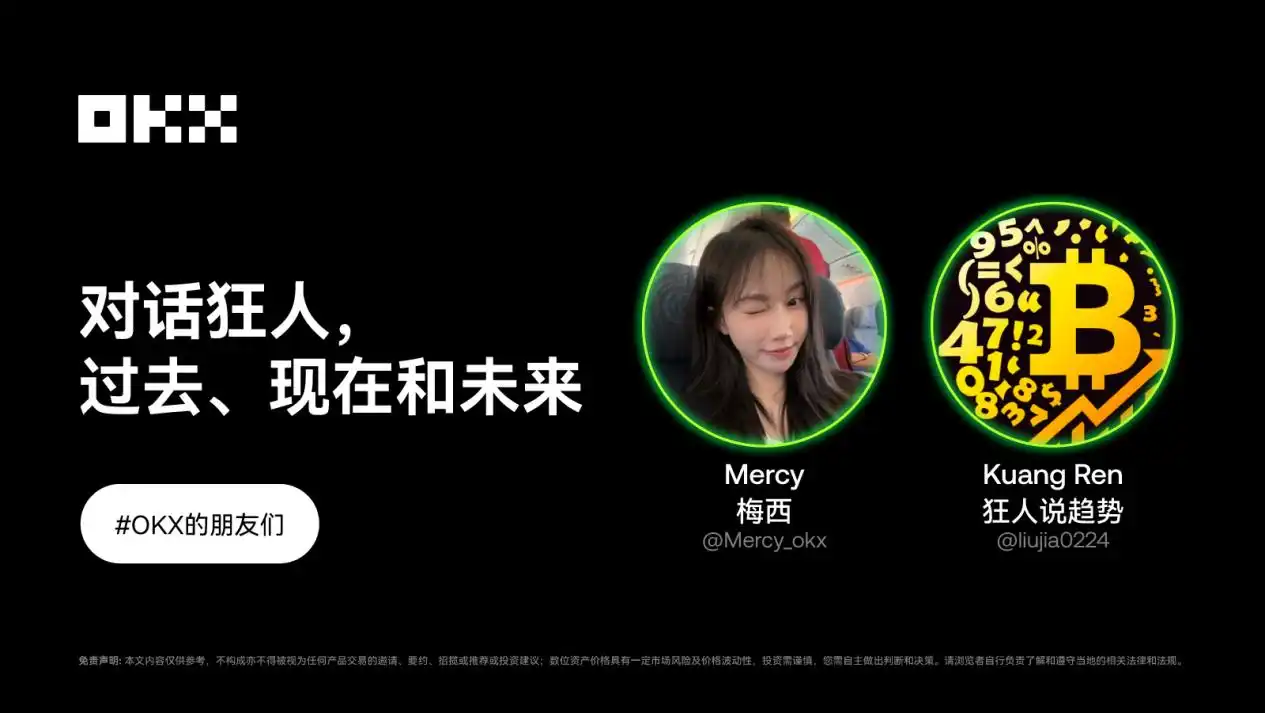
OKX Friends Session 9 | In Conversation with a Visionary, Reflections on the Past, Present, and Future

Introduction
The cryptocurrency world is stirring once again. Do you still remember the "Madman" of the crypto circle in 2017, @liujia0224?
That individual who diligently posted daily, with a "responsible, focused, sincere" attitude, guiding countless traders in the cryptocurrency world as the "Digital Currency Trend Madman".
This public account used to be a daily must-read for Bitcoin traders. Whenever an article was released, it instantly garnered over 100,000 views, serving as the cryptocurrency world's "weather report," accurately predicting the ups and downs of cryptocurrencies such as Bitcoin, Litecoin, and Ethereum.
On social media, he was once a top-tier presence, known to all. His whale group had such a high threshold that it was jaw-dropping to enter (rumored to start at 10 Bitcoins). Those who could join the group were either wealthy or influential, making it an implicit symbol of status.
However, after several rounds of bull and bear markets, the domain of Key Opinion Leaders (KOLs) shifted towards YouTube and Twitter, and rumors of the "Madman" leaving the circle surfaced multiple times. Now, as the cryptocurrency world stirs once again, what is that former "Madman" who once dominated the crypto world doing?
This is an "OKX Friends" series interview. This series aims to explore the professional stories, industry insights, and lessons of KOLs from different backgrounds for the learning reference of novice users. This interviewee is Mercy, @Mercy_okx. Welcome to follow along~
Body
Article Guide:
Chapter 1: Madman's Words—The Past
Chapter 2: Madman's Words—The Present, The Future
Chapter 3: Madman's Words—Advice for Newcomers
Chapter 1: Madman's Words—The Past
1. Why did you enter the circle? The first time you knew about BTC, it was only around 600 RMB?
Mercy, hello, everyone, I am very happy to have this space with OKX Friends. Let me briefly introduce myself first. I have a Master's degree in Finance. I have worked in several large financial institutions, including securities firms, trust companies, and insurance companies, so I have a deep understanding of various financial products and financial derivatives.
I started trading stocks in 2008 and fell in love with trading at that time. Of course, when I was young, I also experienced all the accidents that every trader must go through, such as margin calls and losing all my hard-earned profits made over several years in just a few days. That year, the stock market circuit breaker happened.
While trading stocks, I also enjoyed exploring new trading targets. It was in 2013 when I dabbled in precious metals trading, collectible coin trading, and Bitcoin. The most impressive to me was Bitcoin. At that time, a cryptocurrency exchange had just been established and was heavily promoted on Baidu. They were offering 0.1 Bitcoin for free upon registration. The first time I saw the price of Bitcoin, it was over 600 RMB. During the month I participated in trading, Bitcoin surged from 600 to 8000 RMB, marking the rapid bull market of 2013. I did not invest much during that period as my main focus was on A-shares, but I still managed to earn 100,000 RMB. However, as the price fell, I kept trying to buy the dip, and in the end, there wasn't much of that money left.
But it planted the seed of my passion for Bitcoin trading. Bitcoin trading has three advantages over A-shares: first, no trading fees; second, 24/7 trading; and third, instant settlement. For someone who loves trading, these three points are truly heavenly. However, Bitcoin entered a bear market in 2014 and 2015, with minimal volatility, coinciding with a bull market in A-shares, so my attention shifted away from Bitcoin.
By 2016, the A-share market was bearish, and I once again thought about Bitcoin. I realized that if I couldn't forget about it, why not try working at an exchange? With my years of experience in A-shares and cryptocurrency trading, I smoothly entered the exchange as an analyst.
From then on, I embarked on my cryptocurrency journey, or as we say now, entered the crypto industry.
2. Why start a WeChat public account? How did it become the top self-media in the crypto circle?
Starting a WeChat public account was a coincidence. At that time, WeChat public accounts were very popular, representing the beginning of the era of self-media. I also liked to try new things. I casually started writing on Huobi, and the content was all about finance, not cryptocurrency. With zero followers initially, the second article had over 2.5 million views, showing me the power of WeChat public accounts. So, I thought if I could share my years of stock trading experience in the crypto circle, wouldn't that be a strategic move?
As expected, due to sufficient expertise, my follower count quickly surpassed the few analysts at that time, and I consistently held the top position on the rankings until the public account was banned five years later.
Regarding community building, I didn't particularly focus on it because running the public account already required a lot of effort. I interacted with the community solely through the comments section of the public account. Through writing on the public account, I received continuous positive feedback, maintained a daily update for over 6 years, with 5 of those years on the public account. The eccentric style of the community naturally developed.
The process of content output has been quite bumpy. 2017 was a year of the most rapid fan growth, as the money-making effect was in full swing, and many trading websites had a large number of copycat beneficial effects. By the second half of 2018, the market suddenly cooled down, falling into silence. The things I wrote were no longer read, users kept losing money, and every day was filled with curses. It made me somewhat question life. At that time, almost 90% of the industry's major KOLs had called it quits, but I chose to persist because I believe Bitcoin still has a future. I believe blockchain is the technology of the future. As the founder of blockchain, Bitcoin's future is bright.
It was also in that year that I continuously recharged everyone's faith, talking about Bitcoin's future, telling everyone that Bitcoin would replace gold and was more likely to become a strategic reserve for countries, becoming the world's global currency. Ultimately, it will be priced in Satoshis, with 1 Bitcoin equaling one hundred million Satoshis. Even today, I still think this way.
Until 2021, the market once again saw the dawn. My fans were ecstatic. They said, "Luckily, you held on at that time because you made millions, changed lives." There were countless such stories. At that time, I felt I had truly succeeded. I not only changed myself but also changed those who were willing to believe in me. But looking back later, I realized it was just catching the right trend. If these efforts had been put into the A-share market, it might have been difficult to change lives to such an extent. So, the choice is greater than the effort.
Chapter 2: The Madman's Words — Now and Future
1. How will the U.S. treating cryptocurrency as a national asset reserve affect the crypto market in the short and long term?
First, let's talk about the short-term impact. Trump's policy is a bullish landing but bearish policy. Why do I say that? Because the market's expectation for a strategic reserve was to drive the U.S. government to buy Bitcoin with real money. However, Trump's policy ended up seizing assets to create a Bitcoin strategic reserve. Therefore, in the short term, it was clearly below expectations, and the market reacted to this news by directly selling and showing a waterfall-like response.
Looking at the long term, the significance of the U.S. strategic reserve is enormous. First, the U.S. dollar is the world's most important currency. Previously, world sovereign states only reserved dollars and gold. Now that Bitcoin is included in the U.S.'s strategic reserve, it means that Bitcoin will be recognized by the world in the future. Even though the U.S. is not buying now, if other countries want to include it in their strategic reserves, it is clearly necessary to buy to increase holdings. Logically, it is similar to the Grayscale Bitcoin Trust back then—it can only buy, not sell, but the volume may be hundreds or thousands of times that of Grayscale. Therefore, the expected long-term price and boost to the price are clearly visible.
Currently, we need to pay attention to which country will be the second to propose a strategic reserve. I believe that it won't be too long before countries follow one after another.
In addition to being a store of value, from a monetary perspective, the deeper significance of incorporating Bitcoin into strategic reserves is Bitcoin's liquidity. Bitcoin is more easily circulated compared to gold, easier to carry, and can even be taken anywhere in the world by simply remembering the private key in your mind, free from any national currency restrictions. This is a functionality that no current currency or gold possesses. If such a currency were to become a global currency, it would mean that billions of people would have a small amount of Bitcoin in their wallets for circulation and payments. The era of a unified global currency would arrive, and at that time, Bitcoin would serve as the value anchor, with all goods fluctuating around Bitcoin. However, this may be the ultimate form.
We just need to understand that until the ultimate form arrives, the price of Bitcoin is not considered high at any point. This process will continuously drive up the price of Bitcoin. As for how many years it will take, I believe there is still a long way to go. My attitude towards Bitcoin is a long-term bull market. The industry is far from complete, and innovation has just begun. Bitcoin is meant to be left to the next generation.
2. Currently, all the benefits promised by Trump have been realized. What other news could drive the market further up, or do you think the market has already turned bearish?
In the short term, indeed all the benefits have been realized, and there are no new policies to look forward to. The only hope we have for the rest of the year is that the Fed could implement QE again in the second half of the year to increase market liquidity. Based on the series of operations since Trump took office, Trump is creating an artificial economic crisis to pressure the Fed to inject liquidity. So, we are currently in the midst of this man-made crisis, feeling uncomfortable is completely normal. However, we need to have a deeper understanding of the word 'crisis,' as there is opportunity in crisis. Each crisis washes away a large number of weak long positions, but ultimately, the market will rebound. Those who dare to add positions in the pit will ultimately achieve great results. Since we know that Trump is creating a crisis, the pit will eventually be filled back up. It's just a matter of how deep the pit will be dug, requiring more of our contemplation.
Regarding the bull and bear markets, focusing solely on Bitcoin, I believe we are still in a bull market. Currently, both on-chain data and fund situations do not align with bear market logic. It is more likely that we are in a pullback phase of the bull market. In previous bull markets, pullbacks have often been in the range of 30-40%. So, if we trace back from $110,000, the approximate low point of the pullback should be around $66,000-$77,000. The market has already touched this range, but whether it has hit the bottom or not, we can consider the trend of the US stock market as well. The US stock market has seen three consecutive weeks of large bearish candles on the weekly chart, with a drop of over 10%. This level of retracement often does not end quickly. In past crises, a 10% drop in the US stock market is just the beginning, with a 20% drop providing a possible buying opportunity, and a 30% drop being a stable win. Therefore, I personally think that $77,000 for Bitcoin is most likely not the bottom of this retracement. In the short term, $77,000 is a strong support level. Therefore, with the oversold rebound of the US stock market, it is highly likely to touch above $90,000. For short to medium-term swing traders, selling above $90,000, waiting for a correction, and then buying back may be a good choice.
Overall, Bitcoin does not yet meet the criteria for a bear market, but the probability of a further pullback is high, making it a situation for selling high and buying low.
In the long run, I believe the following factors will drive Bitcoin to new heights:
First, the Federal Reserve's re-release of liquidity, as previously discussed.
Second, the globalization of Bitcoin's strategic reserves, with follow-ups from various countries' strategic reserves, will bring tremendous incremental value to Bitcoin.
Third, and most importantly, if mainland China legalizes cryptocurrency, it will be a huge catalyst. In terms of purchasing power, no country can compete with the Chinese people. The general public has money in their pockets but lacks good investment options. The stock market has been around 3000 for over a decade, with continuous expansions but no real growth, leading to significant losses. Nowadays, even the real estate market is not very promising. With the end of the demographic dividend, real estate has also been in a bear market for over ten years.
So, if this really happens, trillions of dollars could flow in within minutes, easily doubling Bitcoin's price. However, if China opens up, it will definitely not open up to the current cryptocurrency exchanges but will likely create a Chinese version of an ETF. Transactions and trading will be limited within the country, with no withdrawals allowed, but the price will be anchored to Bitcoin globally. In other words, they will build their own pool, conduct hedging activities overseas, as after all, the foreign exchange wall cannot collapse; this is the foundation of the economy.
3. Which sectors are worth watching in the future, and what types of projects may generate new alpha returns?
Alright, I'll mention a few sectors that I believe have good opportunities for everyone to consider.
1. RWA: Real-world asset tokenization, a broad and impactful concept. It can first integrate with DeFi and traditional finance. DeFi is already mature enough in the cryptocurrency world. If blockchain technology can be combined with the traditional market, the potential is limitless. For example, tokenized bonds can be used for collateralized loans, and tokenized equities can greatly increase market liquidity, providing significant assistance to the future economic environment. Additionally, splitting real estate ownership using tokens to gain future income and growth, as well as tokenizing art ownership, are examples of virtualizing real-world assets. In conclusion, specific opportunities for implementation are visible, but the step of asset on-chain requires endorsement from traditional large institutions.
2. AI: Artificial Intelligence speaks for itself, being the hottest topic today and a sector that can continuously innovate in the future. The integration of AI and blockchain mainly manifests in AI algorithms. AI requires large amounts of data for machine learning, and blockchain conveniently protects data privacy, even transforming data into a valuable transmission, enabling the evolution of centralized AI towards a more secure decentralized form. Currently, apart from some simple AI agents, most are still in the concept hype stage, far less practical than centralized AI. However, there will always be bubbles; the market seeks dreams, leading to speculative expectations.
3. Public Blockchain: This is a recurring topic, with every bull market cycle seeing a hype around public blockchains. During each cycle, a few new chains are also hyped up, but the alpha often lies in these new chains rather than the old ones — this is the logic of standing on the shoulders of giants. Before the convergence of thousands of chains into one, public blockchains will continue to iterate, constantly breaking the blockchain's "impossible triangle" until they catch up with the current internet transmission speed and cost.
4. Payment: Cross-border payments play a crucial role in the global integration process. Traditional finance is known for its slow settlement and high costs. The advantages of using blockchain for payments are evident, but these pitfalls have mostly been occupied by stablecoins like USDT and USDC. Looking ahead in the payments sector, what we need to focus on is the integration of payments with smart contracts. For example, some IoT devices can earn data value through data transmission. Furthermore, there are blockchain projects aiming to replace the banking systems in regions such as South America, Africa, and Southeast Asia. In many underdeveloped regions, a large number of blockchain projects are being used to replace the banking system because the cost of opening a bank account is too high for the poor. For instance, my household helper was previously paid in fiat currency, but the traditional financial system she used for settlement was slow, cumbersome, and incurred high fees. Later, I taught her to use an exchange, settle in a stablecoin, and then convert to the local currency, which was more convenient and incurred lower fees.
5. MEME: The MEME coin trend has passed, but this phenomenon will not end. Low-cost, high-return P2P gambling will always exist in the casino because it aligns with the gambling mentality. In the future, celebrities and brands may also issue their own tokens on the blockchain, which could open up more possibilities. For example, tokens could be used to exchange for company goods. The current hype is only the most basic form, and eventually, MEME will be empowered, whether it is in terms of brand value or consensus value.
From a sectoral perspective, the overall logic is to hype new projects rather than old ones. The future significant opportunities will still lie in new projects. About 90% of old projects cannot escape the fate of each round being lower than the previous one. After all, for most project teams, the easiest way to make money is to launch a new project rather than trying to save those old projects with scattered tokens.
4. Traditional Financial Institutions Are Entering the Crypto Space. In your opinion, which crypto assets will these massive funds allocate to? Where will the funds flow in the future?
Looking at traditional capital, we can consider four directions: strategic reserves, ETFs, Grayscale, and Trump funds.
The types of tokens in the US strategic reserve, such as BTC, ETH, SOL, XRP, etc., are likely to be the first assets traditional institutions will allocate to when entering the crypto space. For most traditional institutions, they do not understand the crypto space at all. They invest blindfolded with the investors' money — they allocate just for the sake of allocation. Those projects that may go to zero are absolutely off-limits for these institutions. With the endorsement of strategic reserves, traditional funds won't have to bear the blame anymore.
Another issue is the future approval status of major ETFs in the United States. Currently, only BTC has been approved. ETH, SOL, XRP, LTC, and others are in preparation.
The allocation of Grayscale Trust represents the direction and expectations of early institutional investors in the U.S. crypto sphere. Currently, Grayscale Trust's single-asset trusts include BTC, ETH, BCH, ETC, LTC, SOL, LINK, MANA, FIL, BAT, LPT, XLM, ZEC, and ZEN.
Finally, there is the Trump Crypto Fund, which also serves as an important reference benchmark. Currently, it holds BTC, ETH, TRX, LINK, AAVE, ENA, MOVE, ONDO, and SEI.
Chapter 3: Madman's Advice - Advice for Newcomers
1. For newcomers who have just entered the cryptocurrency field, what advice do you have for them? How should they start learning and gaining experience?
For newcomers, the current cryptocurrency market has a high barrier to entry compared to when we first entered the market. It's not as simple as buying and selling anymore. You need some foundation to get in. Over the years, the crypto sphere has spawned many different variations, especially in terms of on-chain content. It can be said that what traditional finance had has been copied over, and what traditional finance lacked, the crypto sphere has innovated itself. This requires a significant amount of financial knowledge, a strong blockchain background, and an understanding of the internet.
Trading non-stop 24/7 can be exhausting for newcomers. Therefore, for newcomers, it's essential to first understand the entire framework of the crypto sphere, such as secondary market trading, primary market analysis or macro analysis, exchange-related businesses, on-chain explorations, DeFi, etc. Newcomers need to focus on specific areas, fully master a certain area, accumulate experience through practice, talk to industry veterans more, and learn from their experiences, especially the pitfalls others have encountered, as they are the most valuable asset for newcomers.
Lastly, rapid learning is key. Only by running faster than others can you have the opportunity to achieve great results.
2. In the market trading process, what common misconceptions or traps do newcomers need to avoid?
Regarding trading, I have been in the market for almost 20 years, which is probably longer than many young folks in the space have been alive. I'm not that old, I just started trading while in school. I've encountered many pitfalls over the years. I believe the most important thing is to adjust your mindset. I often say in my tweets that trading is a marathon, not a 50m sprint. Don't expect to get rich overnight; instead, think long-term. As long as you're alive, opportunities will always be there. Therefore, I focus more on asset allocation, how to ensure stable annual growth of assets, which are risky assets, which are cash assets, which are assets for preserving value, and how to allocate based on your risk preferences.
If your current assets are not yet abundant, work hard in this industry, first figure out how to make money, and don't solely focus on trading for quick riches. I have seen too many get rich quick schemes, only to eventually give everything back to the market. Many times, the money earned was based on luck and lost through a lack of skill.
Another important point is not to take out loans or use money that affects your daily life for trading, as this will impact the most crucial aspect of your trading: mindset. Once your mindset is compromised, all your actions will distort. If you realize your mindset is not in the right place, immediately stop trading, take a break, and then start afresh.
If you engage in leverage, always remember to set a stop-loss before entering each position. This is key to survival. If you cannot adhere to this rule, please do not engage in futures or leveraged trading.
3. How do you suggest newcomers establish their own analysis framework and model? Are there any practical tools or methods you can recommend?
Regarding trading, I believe the most important thing is not just reading books but actually starting, allowing yourself to experience failure, accepting every stop-loss, acknowledging your imperfections, and even stupidity at times. Learn to respect the market first. Therefore, my advice is to start with very little money, experiment, make mistakes, identify your issues in trading, and then work on resolving them to find a trading method that suits you.
Once you have accepted your failures, you can start learning some theoretical knowledge, understand indicators, and observe the candlestick patterns to grasp their operational rules. Here, I recommend a few books that I find quite helpful in trading: "Wyckoff Method," "Japanese Candlestick Charting Techniques," "Reminiscences of a Stock Operator," "Turtle Trading Rules," "Stop-Loss."
Ultimately, by combining various types of knowledge, you can increase the success rate of your market judgments. Trading is not a simple path; it is a system. It is difficult to obtain the correct result from a single indicator. Even after all these years, I am still continuously improving and learning. Trading is a path of hard work and dedication. Therefore, if there is a better way to make money, I suggest not choosing this path. It is a risky path to wealth, with most people living mediocre lives. Those who can achieve stable returns are already rare. Most of the time, I feel that success in trading requires some inborn talent, or rather, whether your personality is suitable for trading. The key is to find a way that suits you to earn money.
Conclusion
Mercy is honored to have invited the legendary trader to share his insights. "Responsible, focused, sincere" are the qualities I deeply perceive from the teacher. In the dull market conditions, I hope everyone can gain something and regain confidence from his sincere and profound insights!
Finally, Mercy has excerpted a quote from the recommended book by the trader - "Reminiscences of a Stock Operator" to share with everyone:
「There's nothing new on Wall Street because speculation is as old as the hills. Whatever happens in the stock market today has happened before and will happen again in the future.」
Risk Warning and Disclaimer
This article is for reference only. It represents the author's views and not those of OKX. It is not intended to provide (i) investment advice or recommendations; (ii) an offer or solicitation to buy, sell, or hold digital assets; or (iii) financial, accounting, legal, or tax advice. We do not guarantee the accuracy, completeness, or usefulness of this information. Holding digital assets (including stablecoins and NFTs) involves high risk and may experience significant price volatility. You should carefully consider whether trading or holding digital assets is suitable for you based on your financial conditions. For your specific situation, please consult with your legal/tax/investment professionals. Please take responsibility for understanding and complying with relevant local laws and regulations.
This article is a contributed submission and does not represent the views of BlockBeats.
猜你喜歡

揭秘Movement做市商拋售醜聞:秘密合約、影子顧問和隱藏的中間人
穩定幣驅動全球B2B支付革新,如何打破工作流程瓶頸釋放兆市場潛力?
5月2日關鍵市場資訊差,一定要看! |Alpha早報
這些新創公司正在無需資料中心的情況下建立先進AI模型
CEX與Wallet之後,OKX入局支付
Sei生態再創里程碑,美國首支SEI ETF申請提交
RWA永續產品危機:為什麼GLP模式註定撐不住RWA永續?
科學平權運動:DeSci的萬億美元知識經濟重建革命
Sentient深度研報:獲8,500萬美元融資,建置去中心化AGI新範式
加密項目為何札堆發卡?一場Web3與現實世界的通行權之爭
專訪Virtuals聯創empty:AI 創業不需要大量資金,Crypto是答案之一
今年 2 月,Base 生態中的 AI 協議 Virtuals 宣布跨鏈至 Solana,然而加密市場隨後進入流動性緊縮期,AI Agent 板塊從人聲鼎沸轉為低迷,Virtuals 生態也陷入一段蟄伏期。
三月初,BlockBeats 對 Virtuals 共同創辦人 empty 進行了一次專訪。彼時,團隊尚未推出如今被廣泛討論的 Genesis Launch 機制,但已在內部持續探索如何透過機制設計激活舊資產、提高用戶參與度,並重構代幣發行與融資路徑。那是一個市場尚未復甦、生態尚處冷啟動階段的時間點,Virtuals 團隊卻沒有停下腳步,而是在努力尋找新的產品方向和敘事突破口。
兩個月過去,AI Agent 板塊重新升溫,Virtuals 代幣反彈超 150%,Genesis 機製成為帶動生態回暖的重要觸發器。從積分獲取規則的動態調整,到專案參與熱度的持續上升,再到「新代幣帶老代幣」的機制閉環,Virtuals 逐漸走出寒冬,並再次站上討論焦點。
值得注意的是,Virtuals 的 Genesis 機制與近期 Binance 推出的 Alpha 積分系統有一些相似之處,評估用戶在 Alpha 和幣安錢包生態系統內的參與度,決定用戶 Alpha 代幣空投的資格。用戶可透過持倉、交易等方式獲得積分,積分越高,參與新項目的機會越大。透過積分系統篩選使用者、分配資源,專案方能夠更有效地激勵社群參與,提升專案的公平性和透明度。 Virtuals 和 Binance 的探索,或許預示著加密融資的新趨勢正在形成。
回看這次對話,empty 在專訪中所展現出的思路與判斷,正在一步步顯現其前瞻性,這不僅是一場圍繞打新機制的訪談,更是一次關於“資產驅動型 AI 協議”的路徑構建與底層邏輯的深度討論。
BlockBeats:可以簡單分享一下最近團隊主要在忙些什麼?
empty:目前我們的工作重點主要有兩個部分。第一部分,我們希望將 Virtuals 打造成一個類似「華爾街」的代理人(Agent)服務平台。設想一下,如果你是專注於 Agent 或 Agent 團隊建立的創業者,從融資、發幣到流動性退出,整個流程都需要係統性的支援。我們希望為真正專注於 Agent 和 AI 研發的團隊,提供這一整套服務體系,讓他們可以把精力集中在底層能力的開發上,而不用為其他環節分心。這一塊的工作其實也包括了與散戶買賣相關的內容,後面可以再詳細展開。
第二部分,我們正在深入推進 AI 相關的佈局。我們的願景是建立一個 AI 社會,希望每個 Agent 都能聚焦自身優勢,同時透過彼此之間的協作,實現更大的價值。因此,最近我們發布了一個新的標準——ACP(Agent Communication Protocol),目的是讓不同的 Agent 能夠相互互動、協作,共同推動各自的業務目標。這是目前我們主要在推進的兩大方向。
BlockBeats:可以再展開說說嗎?
empty:在我看來,其實我們面對的客戶群可以分為三類:第一類是專注於開發 Agent 的團隊;第二類是投資者,包括散戶、基金等各種投資機構;第三類則是 C 端用戶,也就是最終使用 Agent 產品的個人用戶。
不過,我們主要的精力其實是放在前兩大類──也就是團隊和投資人。對於 C 端用戶這一塊,我們並不打算直接介入,而是希望各個 Agent 團隊能夠自己解決 C 端市場的拓展問題。
此外,我們也認為,Agent 與 Agent 之間的交互作用應該成為一個核心模式。簡單來說,就是未來的服務更多應該是由一個 Agent 銷售或提供給另一個 Agent,而不是單純賣給人類使用者。因此,在團隊的 BD 工作中,我們也積極幫助現有的 AI 團隊尋找這樣的客戶和合作機會。
BlockBeats:大概有一些什麼具體案例呢?
empty:「華爾街」說白了就是圍繞資本運作體系的建設,假設你是一個技術團隊,想要融資,傳統路徑是去找 VC 募資,拿到資金後開始發展。如果專案做得不錯,接下來可能會考慮進入二級市場,例如在紐約證券交易所上市,或是在 Binance 這樣的交易所上幣,實現流動性退出。
我們希望把這一整套流程打通-從早期融資,到專案開發過程中對資金的靈活使用需求,再到最終二級市場的流動性退出,全部覆蓋和完善,這是我們希望補齊的一條完整鏈條。
而這一部分的工作和 ACP(Agent Communication Protocol)是不同的,ACP 更多是關於 Agent 與 Agent 之間交互標準的製定,不直接涉及資本運作系統。
BlockBeats:它和現在 Virtuals 的這個 Launchpad 有什麼差別呢?資金也是從 C 端來是嗎?
empty:其實現在你在 Virtuals 上發幣,如果沒有真正融到資金,那就只是發了一個幣而已,實際是融不到錢的。我們目前能提供的服務,是透過設定買賣時的交易稅機制,從中提取一部分稅收回饋給創業者,希望這部分能成為他們的現金流來源。
不過,問題其實還分成兩塊。第一是如何真正幫助團隊完成融資,這個問題目前我們還沒有徹底解決。第二是關於目前專案發行模式本身存在的結構性問題。簡單來說,現在的版本有點像過去 Pumpfun 那種模式——也就是當專案剛上線時,部分籌碼就被外賣給了外部投資人。但現實是,目前整個市場上存在著太多機構集團和「狙擊手」。
當一個真正優秀的專案一發幣,還沒真正觸達普通散戶,就已經被機構在極高估值時搶購了。等到散戶能夠接觸到時,往往價格已經偏高,專案品質也可能變差,整個價值發行體係被扭曲。
針對這個問題,我們希望探索一種新的發幣和融資模式,目的是讓專案方的籌碼既不是死死握在自己手裡,也不是優先流向英文圈的大機構,而是能夠真正留給那些相信專案、願意長期支持專案的普通投資者手中。我們正在思考該如何設計這樣一個新的發行機制,來解決這個根本問題。
BlockBeats:新模式的具體想法會是什麼樣子呢?
empty:關於資金這一塊,其實我們目前還沒有完全想透。現階段來看,最直接的方式還是去找 VC 融資,或是採取公開預售等形式進行資金募集。不過說實話,我個人對傳統的公開預售模式並不是特別認同。
在「公平發售」這件事上,我們正在嘗試換一個角度來思考-希望能從「reputation」出發,重新設計機制。
具體來說,就是如果你對整個 Virtuals 生態有貢獻,例如早期參與、提供支持或建設,那麼你就可以在後續購買優質代幣時享有更高的優先權。透過這種方式,我們希望把資源更多留給真正支持生態發展的用戶,而不是由短期套利的人主導。
BlockBeats:您會不會考慮採用類似之前 Fjord Foundry 推出的 LBP 模式,或者像 Daos.fun 那種採用白名單機制的模式。這些模式在某種程度上,和您剛才提到的「對生態有貢獻的人享有優先權」的想法是有些相似的。不過,這類做法後來也引發了一些爭議,例如白名單內部操作、分配不公等問題。 Virtuals 在設計時會考慮借鏡這些模式的優點,或有針對性地規避類似的問題嗎?
empty:我認為白名單機制最大的問題在於,白名單的選擇權掌握在專案方手中。這和「老鼠倉」行為非常相似。專案方可以選擇將白名單名額分配給自己人或身邊的朋友,導致最終的籌碼仍然掌握在少數人手中。
我們希望做的,依然是類似白名單的機制,但不同的是,白名單的獲取權應基於一個公開透明的規則體系,而不是由項目方單方面決定。只有這樣,才能真正做到公平分配,避免內幕操作的問題。
我認為在今天這個 AI 時代,很多時候創業並不需要大量資金。我常跟團隊強調,你們應該優先考慮自力更生,例如透過組成社區,而不是一開始就想著去融資。因為一旦融資,實際上就等於背負了負債。
我們更希望從 Training Fee的角度去看待早期發展路徑。也就是說,專案可以選擇直接發幣,透過交易稅所帶來的現金流,支持日常營運。這樣一來,專案可以在公開建設的過程中獲得初步資金,而不是依賴外部投資。如果專案做大了,自然也會有機會透過二級市場流動性退出。
當然最理想的情況是,專案本身能夠有穩定的現金流來源,這樣甚至連自己的幣都無需拋售,這才是真正健康可持續的狀態。
我自己也常在和團隊交流時分享這種思路,很有意思的是,那些真正抱著「搞快錢」心態的項目,一聽到這種機制就失去了興趣。他們會覺得,在這種模式下,既無法操作老鼠倉,也很難短期套利,於是很快就選擇離開。
但從我們的角度來看,這其實反而是個很好的篩選機制。透過這種方式,理念不同的專案自然會被過濾出去,最後留下的,都是那些願意真正建立、和我們價值觀契合的團隊,一起把事情做起來。
BlockBeats:這個理念可以發展出一些能夠創造收益的 AI agent。
empty:我覺得這是很有必要的。坦白說,放眼今天的市場,真正擁有穩定現金流的產品幾乎鳳毛麟角,但我認為這並不意味著我們應該停止嘗試。事實上,我們每天在對接的團隊中,有至少一半以上的人依然懷抱著長遠的願景。很多時候,他們甚至已經提前向我們提供了 VC 階段的資金支持,或表達了強烈的合作意願。
其實對他們來說想要去收穫一個很好的社區,因為社區可以給他們的產品做更好的回饋,這才是他們真正的目的。這樣聽起來有一點匪夷所思,但其實真的有很多這樣的團隊,而那種團隊的是我們真的想扶持的團隊。
BlockBeats:您剛才提到的這套「AI 華爾街」的產品體系-從融資、發行到退出,建構的是一整套完整的流程。這套機制是否更多是為了激勵那些有意願發幣的團隊?還是說,它在設計上也考慮瞭如何更好地支持那些希望透過產品本身的現金流來發展的團隊?這兩類團隊在您這套體系中會不會被區別對待,或者說有什麼機制設計能讓不同路徑的創業者都能被合理支持?
empty:是的,我們 BD 的核心職責其實就是去鼓勵團隊發幣。說得直接一點,就是引導他們思考發幣的可能性和意義。所以團隊最常問的問題就是:「為什麼要發幣?」這時我們需要採取不同的方式和角度,去幫助他們理解背後的價值邏輯。當然如果最終判斷不適合,我們也不會強迫他們推進。
不過我們觀察到一個非常明顯的趨勢,傳統的融資路徑已經越來越難走通了。過去那種融資做大,發幣上所的模式已經逐漸失效。面對這樣的現實,很多團隊都陷入了尷尬的境地。而我們希望能從鏈上和加密的視角,提供一套不同的解決方案,讓他們找到新的發展路徑。
BlockBeats:明白,我剛才其實想表達的是,您剛剛也提到,傳統的 AI 模式在很大程度上仍然依賴「燒錢」競爭。但在 DeepSeek 出現之後,市場上一些資金體積較小的團隊或投資人開始重新燃起了信心,躍躍欲試地進入這個領域。您怎麼看待這種現象?這會不會對目前正在做 AI 基礎研發,或是 AI 應用層開發的團隊產生一定的影響?
empty:對,我覺得先不談 DeepSeek,從傳統角度來看,其實到目前為止,AI 領域真正賺錢的只有英偉達,其他幾乎所有玩家都還沒有實現盈利。所以其實沒有人真正享受了這個商業模式的成果,大家也仍在探索如何面對 C 端打造真正有產出的應用。
沒有哪個領域像幣圈一樣能如此快速獲得社群回饋。你一發幣,用戶就會主動去讀白皮書的每一個字,試試你產品的每個功能。
當然,這套機制並不適合所有人。例如有些 Agent 產品偏 Web2,對於幣圈用戶而言,可能感知不到其價值。因此,我也會鼓勵做 Agent 的團隊在 Virtuals 生態中認真思考,如何真正將 Crypto 作為自身產品的差異化要素加以運用與設計。
BlockBeats:這點我特別認同,在 Crypto 這個領域 AI 的迭代速度確實非常快,但這群用戶給予的回饋,真的是代表真實的市場需求嗎?或者說這些回饋是否真的符合更大眾化、更具規模性的需求?
empty:我覺得很多時候產品本身不應該是強行推廣給不適合的使用者群體。例如 AIXBT 最成功的一點就在於,它的用戶本身就是那群炒作他人內容的人,所以他們的使用行為是非常自然的,並不覺得是在被迫使用一個無聊的產品。 mass adoption 這個概念已經講了很多年,大家可能早就該放棄這個執念了。我們不如就認了,把東西賣給幣圈的人就好了。
BlockBeats:AI Agent 與 AI Agent 所對應的代幣之間,究竟應該是什麼樣的動態關係?
empty:對,我覺得這裡可以分成兩個核心點。首先其實不是在投資某個具體的 AI Agent,而是在投資背後經營這個 Agent 的團隊。你應該把它理解為一種更接近創投的思路:你投的是這個人,而不是他目前正在做的產品。因為產品本身是可以快速變化的,可能一個月後團隊會發現方向不對,立即調整。所以,這裡的「幣」本質上代表的是對團隊的信任,而不是某個特定 Agent 本身。
第二則是期望一旦某個 Agent 產品做出來後,未來它能真正產生現金流,或者有實際的使用場景(utility),從而讓對應的代幣具備賦能效應。
BlockBeats:您覺得有哪些賦能方式是目前還沒看到的,但未來可能出現、值得期待的?
empty:其實主要有兩塊,第一是比較常見的那種你要使用我的產品,就必須付費,或者使用代幣支付,從而間接實現對代幣的「軟銷毀」或消耗。
但我覺得更有趣的賦能方式,其實是在獲客成本的角度思考。也就是說,你希望你的用戶同時也是你的投資者,這樣他們就有動機去主動幫你推廣、吸引更多用戶。
BlockBeats:那基於這些觀點,您怎麼看 ai16z,在專案設計和代幣機制方面,似乎整體表現並不太樂觀?
empty:從一個很純粹的投資角度來看,撇開我們與他們之間的關係,其實很簡單。他們現在做的事情,對代幣本身沒有任何賦能。從開源的角度來看,一個開源模型本身是無法直接賦能代幣的。
但它仍然有價值的原因在於,它像一個期權(call option),也就是說,如果有一天他們突然決定要做一些事情,比如推出一個 launchpad,那麼那些提前知道、提前參與的人,可能會因此受益。
開發者未來確實有可能會使用他們的 Launchpad,只有在那一刻,代幣才會真正產生賦能。這是目前最大的一個問號——如果這個模式真的跑得通,我認為確實會非常強大,因為他們的確觸達了大量開發者。
但我個人還是有很多疑問。例如即使我是使用 Eliza 的開發者,也不代表我一定會選擇在他們的 Launchpad 上發幣。我會貨比三家,會比較。而且,做一個 Launchpad 和做一個開源框架,所需的產品能力和社群運作能力是完全不同的,這是另一個重要的不確定性。
BlockBeats:這種不同是體現在什麼地方呢?
empty:在 Virtuals 上我們幾乎每天都在處理客服相關的問題,只要有任何一個團隊在我們平台上發生 rug,即使與我們沒有直接關係,用戶也會第一時間來找我們投訴。
這時我們就必須出面安撫用戶,並思考如何降低 rug 的整體風險。一旦有團隊因為自己的代幣設計錯誤或技術失誤而被駭客攻擊、資產被盜,我們往往需要自掏腰包,確保他們的社群至少能拿回一點資金,以便專案能夠重新開始。這些項目方可能在技術上很強,但未必擅長代幣發行,結果因操作失誤被攻擊導致資產損失。只要涉及「被欺騙」相關的問題,對我們來說就已經是非常麻煩的事了,做這些工作跟做交易所的客服沒有太大差別。
另一方面,做 BD 也非常困難。優秀的團隊手上有很多選擇,他們可以選擇在 Pumpfun 或交易所上發幣,為什麼他們要來找我們,那這背後必須要有一整套支援體系,包括融資支援、技術協助、市場推廣等,每個環節都不能出問題。
BlockBeats:那我們就繼續沿著這個話題聊聊 Virtuals 目前的 Launchpad 業務。有一些社群成員在 Twitter 上統計了 Virtuals Launchpad 的整體獲利狀況,確實目前看起來獲利的項目比較少。接下來 Launchpad 還會是 Virtuals 的主要業務區嗎?還是說,未來的重心會逐漸轉向您剛才提到的「AI 華爾街」這條路徑?
empty:其實這兩塊本質上是一件事,是一整套體系的一部分,所以我們必須繼續推進。市場的波動是很正常的,我們始終要堅持的一點是:非常清楚地認識到我們的核心客戶是誰。我一直強調我們的客戶只有兩類——團隊。所以市場行情的好壞對我們來說並不是最重要的,關鍵是在每一個關鍵節點上,對於一個團隊來說,發幣的最佳選擇是否依然是我們 Virtuals。
BlockBeats:您會不會擔心「Crypto + AI」或「Crypto AI Agent」這一類敘事已經過去了?如果未來還有一輪多頭市場,您是否認為市場炒作的焦點可能已經不再是這些方向了?
empty:有可能啊,我覺得 it is what it is,這確實是有可能發生的,但這也屬於我們無法控制的範圍。不過如果你問我,在所有可能的趨勢中,哪個賽道更有機會長期保持領先,我仍然認為是 AI。從一個打德撲的角度來看,它仍然是最優選擇。
而且我們團隊的技術架構和底層能力其實早已搭建完成了,現在只是順勢而為而已。更重要的是,我們本身真的熱愛這件事,帶著好奇心去做這件事。每天早上醒來就有驅動力去研究最新的技術,這種狀態本身就挺讓人滿足的,對吧?
很多時候,大家不應該只看產品本身。實際上很多優秀的團隊,他們的基因決定了他們有在規則中勝出的能力——他們可能過去在做派盤交易時,每筆規模就是上百萬的操作,而這些團隊的 CEO,一年的薪資可能就有 100 萬美金。如果他們願意出來單幹項目,從天使投資或 VC 的視角來看,這本質上是用一個很划算的價格買到一個高品質的團隊。
更何況這些資產是 liquid 的,不是鎖倉狀態。如果你當下不急著用錢,完全可以在早期階段買進一些優秀團隊的代幣,靜靜等待他們去創造一些奇蹟,基本上就是這樣一個邏輯。
第16週鏈上數據:結構性供需失衡加劇,數據揭⽰下⼀輪上漲的堅實藍圖?
a16z領投2500萬美元,0xMiden要在你手機裡跑一條隱私鏈
Sui Q1進階報告:BTCfi基建崛起、借貸協議爆發與執行分片未來
川普次子的加密生意經
SignalPlus宏觀分析:關稅撕裂的M2敘事與TradFi式FOMO的回歸
上線Binance Alpha,你的HAEDAL空投值多少錢?


 App
App