

ArkStream Capital: 2024 Q4 Quarterly Report

Original Article Title: "ArkStream Capital: 2024 Q4 Quarterly Report"
Original Source: ArkStream Capital
Industry Overview
On December 5th, Bitcoin broke through the $100,000 mark, creating history as anticipated by the market. At this historic moment, the global financial industry turned its attention here. Bitcoin's new high is a milestone in the cryptocurrency field, significantly demonstrating the expanded influence and increased recognition of the cryptocurrency market, while also foreshadowing enormous growth potential in the future. This not only marks the realization of ArkStream Capital's long-standing beliefs and expectations but also symbolizes the validation of faith in the entire cryptocurrency industry. Within the industry, whether it is the primary market with risks and opportunities, the efficient and diversified secondary market, or the vibrant on-chain ecosystem, all were energized by Bitcoin's breakthrough, leading to a strong performance in the market in the fourth quarter.
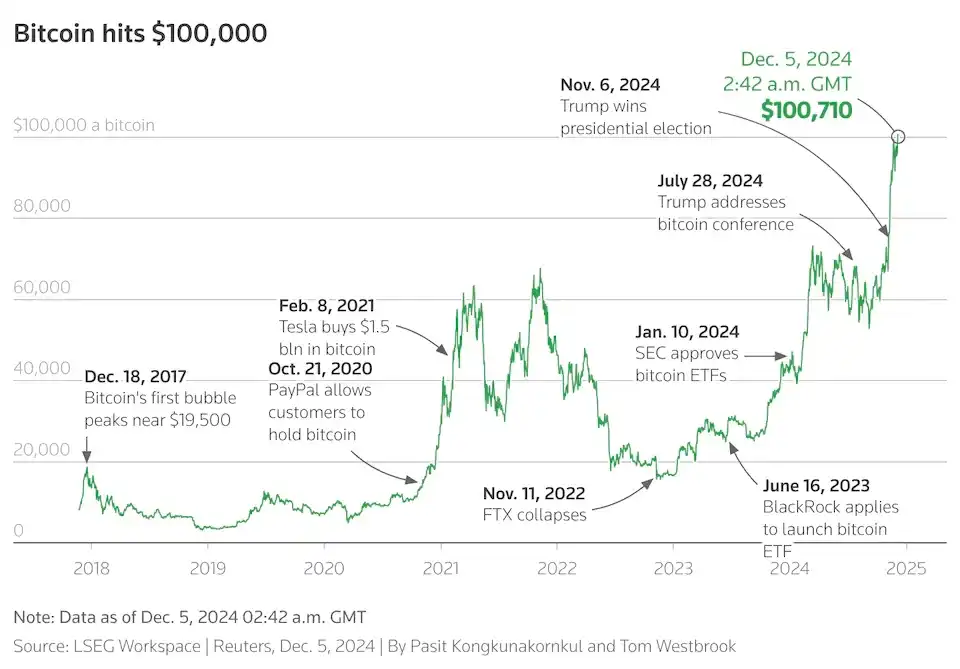
Bitcoin Price Chart, Source: LSEG Workspace
Bitcoin's successful crossing of the $100,000 milestone has benefited from various factors. The most crucial boost came from the macro environment's interest rate cut expectations and Trump's win in the U.S. presidential election.
The Federal Reserve's two interest rate cuts in this quarter had a profound impact on the market, further stirring up the market. The rate cuts, on one hand, reduced borrowing costs, stimulating investors to seek higher-yielding assets, leading to more funds flowing into the cryptocurrency market. On the other hand, the rate cuts also improved market liquidity, helping to support asset prices. In addition, the stablecoin market benefited from the macro interest rate cuts, reaching a historic high in issuance scale, significantly increasing market liquidity and reigniting market vitality. ArkStream Capital expects that with the implementation of quantitative easing policies in 2025, liquidity will further strengthen, cryptocurrency assets will see significant gains, and the market will further expand.
During the U.S. presidential campaign, Trump clearly expressed support for the development of Bitcoin and the cryptocurrency field, making a series of positive commitments. Specifically, he proposed to establish a national strategic Bitcoin reserve, plans to incorporate Bitcoin into the national financial strategic framework, and ensure the government holds a certain amount of Bitcoin. Furthermore, Trump promised to take proactive measures in regulatory policies and support for startups to promote the healthy development of the crypto sector. After a successful election, Trump took two important actions to support the development of the cryptocurrency field: first, he nominated Paul Atkins, an advisor with deep experience in the cryptocurrency field, to serve as SEC chairman. Secondly, he established a new position of White House Director of Artificial Intelligence and Cryptocurrency Affairs, appointing former PayPal executive and an expert in big data and cryptocurrency, David Sacks, to this role.
World Liberty Financial (WLFI), a project led by the Trump family, is committed to providing users with a more equitable, efficient, and secure financial service by blending innovative financial solutions with blockchain technology, integrating DeFi. WLFI has actively invested in and collaborated in key areas such as lending, RWA, and stablecoins. The partnership between WLFI and Aave offers a mature and reliable lending protocol platform and integrates new types of stablecoin assets like Ethena's sUSDe, expanding the types of collateral assets and enriching funding sources. Additionally, according to Spot On Chain data, since November 2024, WLFI's main wallet address has made significant purchases of mainstream crypto assets such as ETH, cbBTC/wBTC, LINK, AAVE, ENA, and ONDO. This has drawn close market attention to WLFI's asset movements and sparked enthusiasm for investing in WLFI's partner DeFi projects, especially those that bring actual returns from deep collaboration. A notable example is WLFI's collaboration with Ethena in mid-December 2024, where Ethena's yield-bearing stablecoin sUSDe was integrated into WLFI's lending platform's collateral asset system, adding stablecoin deposit sources to WLFI's lending platform. Upon the announcement of the partnership, the ENA token saw a price increase of over 10% in a short period, underscoring the market's recognition of WLFI's influence.
Following Trump's reelection, MicroStrategy significantly increased its investment in Bitcoin. According to recent data, the company added nearly 150,000 bitcoins in Q4 2024, spending close to $13.5 billion with an average cost of approximately $90,000 per bitcoin. In comparison, the total net assets of Bitcoin spot ETFs increased from around $600 billion at the end of Q3 to nearly $1.1 trillion at the end of Q4, with new fund inflows reaching $500 billion, and MicroStrategy's purchases alone accounting for nearly 25% of all Bitcoin spot ETF net inflows. Furthermore, MicroStrategy plans to propose up to $21 billion in equity financing and $21 billion in bond issuance through a special shareholder meeting to continue investing in Bitcoin. MicroStrategy's CEO, Michael Saylor, is also actively pushing for more traditional giants to invest in Bitcoin, such as Microsoft, despite Microsoft shareholders voting against the related proposal. The market is both eager and concerned about MicroStrategy's continued buying behavior, anticipating its collaboration with traditional giants to drive the development of the crypto industry and new highs for Bitcoin, while also fearing potential black swan events leading to market turmoil.
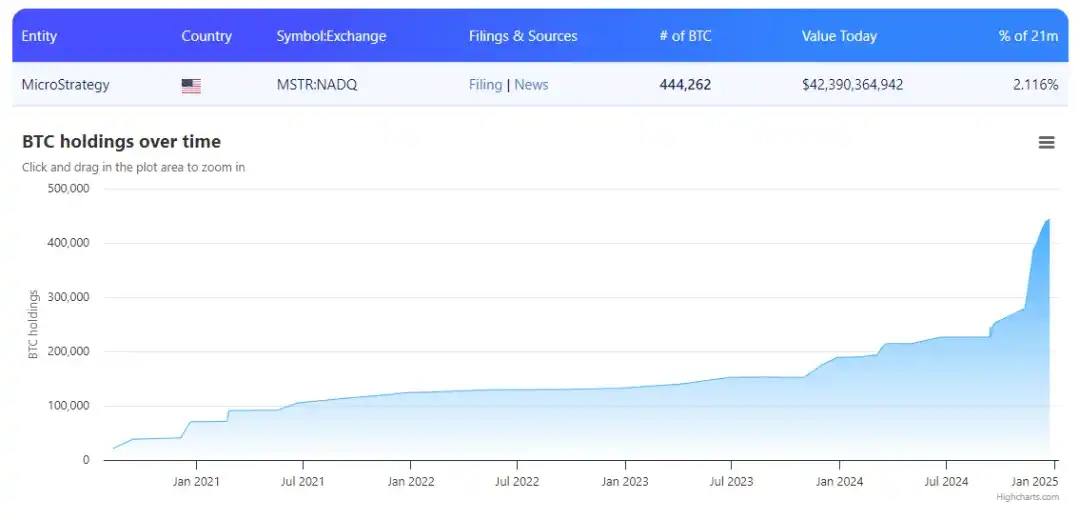
MicroStrategy's BTC Holdings, Source: https://treasuries.bitbo.io/microstrategy/
Within the cryptocurrency market, due to the market's focus once being concentrated on Bitcoin itself and on-chain speculative memes, value investing focused on infrastructure development and application implementation almost fell into a pessimistic low. However, with the November political environment stabilizing, value investing began to see the dawn of recovery. The value of DeFi, infrastructure, emerging public chains, and other sectors is gradually being re-recognized by the market. Patient investors have begun to receive stable returns, and value investing is once again receiving attention. Looking at specific projects, the popularity of projects like Ethena and Usual reflects the market's preference for RWA and stablecoins strengthening. Additionally, protocols like Curve, with their low slippage characteristics in stablecoin swaps, have also performed well. Foundational strong projects that conducted Token Generation Events (TGE) this quarter, such as HypeLiquid and Morpho, as well as projects that focus on product application implementation, such as Virtuals, have shown strong performance at both the data level and in terms of their token prices reaching new highs. These trends indicate a return to value investing, with innovation still being one of the core driving forces of the cryptocurrency industry's development, and attention and funds are shifting to these areas.
However, everything has two sides. Recently, primary market fundraising activities have shown a declining trend in both quantity and amount, which has become disconnected from the secondary market's trends. Moreover, projects that have fundraised in the past two years are now facing a queue to list on top-tier exchanges, while second-tier exchanges continue to suffer from insufficient liquidity. In addition, the recent surge in on-chain speculation and the market's anti-traditional venture capital sentiment during the early Q4 has adversely affected the pricing of projects post-listing, further squeezing the investment return space. In the process of transitioning to the secondary market, primary market projects not only face the challenge of a liquidity window but also encounter fierce competition on the same track and limited exchange resources. These factors have compounded, leading primary market investment and fundraising activities into unprecedented challenges.
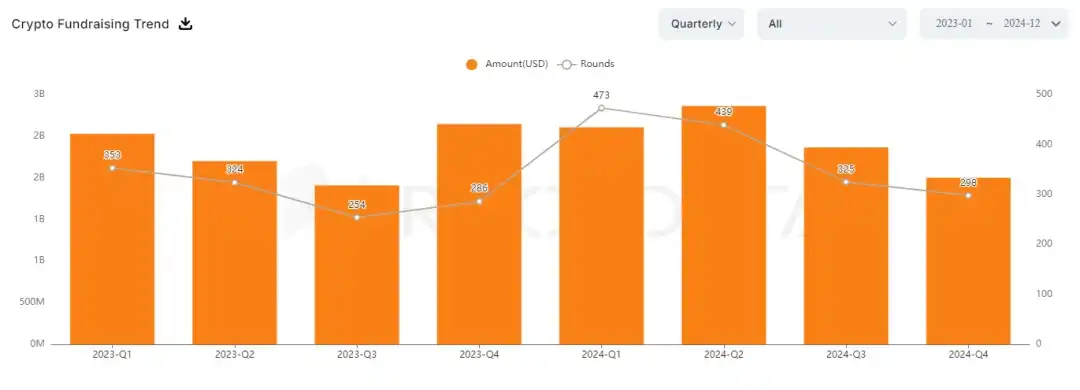
Quarterly Primary Market Financing, Source: https://www.rootdata.com/
In the secondary market, to pursue returns surpassing that of Bitcoin, one would typically seek investment opportunities in the altcoin market. However, in the tough market environment of Q2 and Q3, despite Bitcoin maintaining a high price, many fundamentally sound altcoins performed poorly. This indicates that timing is crucial. Even if the fundamentals of the asset are strong, if the entry timing is wrong, one might face unfavorable entry prices or long-term capital costs. Furthermore, the secondary market also needs to address challenges such as position management and risk control, as a slight misstep could lead to fund withdrawals or losses. Therefore, while secondary market trading strategies do not need to consider token listings and liquidity issues, they still have to deal with challenges such as target selection and timing. Overall, the secondary market's strategy has lower determinacy, higher risk-reward ratio, and challenges in scaling up capital.
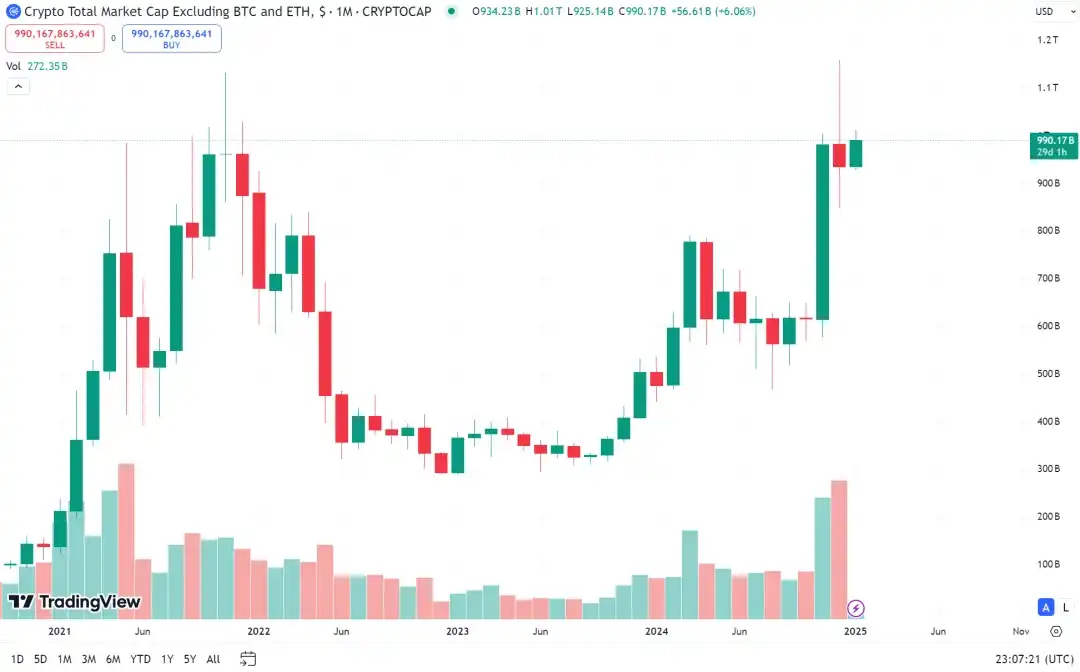
Altcoin Market Performance, Source: https://www.tradingview.com/symbols/TOTAL3/
Focus Track
DeFi
In 2024, the DeFi sector saw a strong resurgence. As a key force driving industry disruption in the previous cycle, DeFi continued to receive widespread recognition within the industry. Meanwhile, with the rise of BTC and altcoin ETFs, as well as the potential for significant inflows of funds at the U.S. policy level, the growing demand from new users for lending, DEX, and stablecoin trading has provided significant potential for the steady increase in DeFi's Total Value Locked (TVL) and asset size.
The post-election market trend has preliminarily validated this. According to DeFiLlama's data, from November 6 to December 15, the incremental capital brought in by new and existing investors and the increase in lending demand propelled DeFi's TVL from $870 billion to $1.3 trillion, a surge of over 50%.
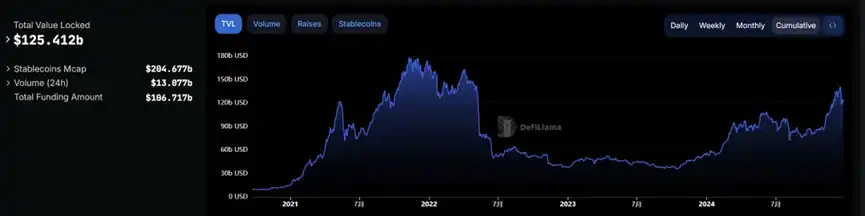
DeFi TVL, Source: https://defillama.com/
The lending track, as a cornerstone of the DeFi sector, particularly excelled in Q4 of 2024. The TVL of the decentralized lending market has reached $55 billion, surpassing the previous cycle's peak of $51.2 billion. AAVE consistently maintained its market-leading position this quarter, holding over 40% market share and controlling nearly 70% of the DeFi lending market with an active loan volume managed between $7-8 billion. Aave's TVL growth was mainly driven by several factors: first, improvements in the post-U.S. election market sentiment prompted investors to seek higher yields, leading to increased lending demand; second, in a "easy money" market, investor interest in leverage trading enhanced further driving lending activities. Data shows that as a core lending asset, the Ethereum (ETH) supply's Annual Percentage Yield (APY) increased from 1.8% in early September to 2.5% in mid-December, while the supply APYs for stablecoins USDT and USDC rose from 3% and 4% to highs of 15% and 17% respectively, indicating a significant increase in market demand for high-yield assets. Meanwhile, the Loan-to-Value (LTV) ratio increased from $7.5 billion in early September to $16 billion in mid-December, demonstrating a significant expansion in lending volume. Currently, Aave's TVL has reached approximately $21 billion, surpassing the previous cycle's peak of $19 billion by about 11%; the token price stands at $370, still with around 80% room to rise from the previous cycle's high of $665. The expected further decrease in US bank lending rates is likely to drive more funds into the DeFi lending market, boosting Aave's TVL.
As a newcomer project listed in Q4 2024, Morpho has inherited the advantages of top-tier lending protocols in terms of security and credibility. At a time when the market is witnessing a resurgence in lending demand, Morpho quickly attracted a significant amount of liquidity. Morpho Blue is Morpho's lending layer, allowing the creation of independent markets without permission, catering to diverse risk appetites and use case requirements in the market. Designed based on the Morpho Blue protocol, MetaMorpho enables different types of lenders to create vaults in MetaMorpho without permission, customize risk exposure, and allocate deposits inside to one or more Morpho Blue markets.
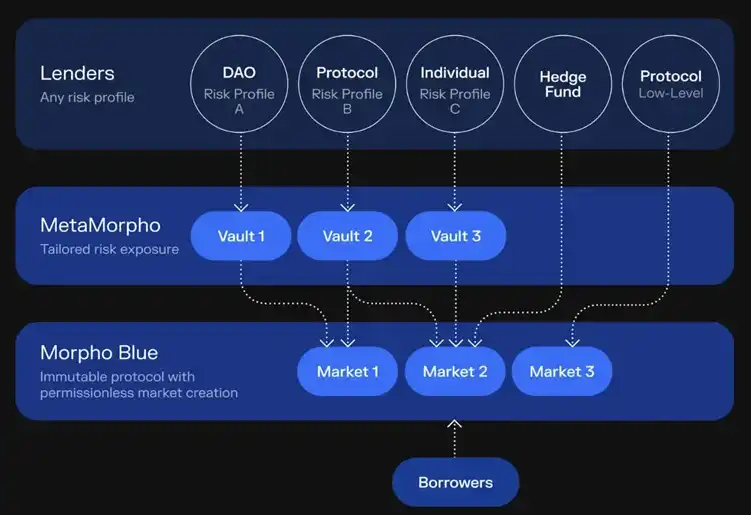
Morpho Architecture, Source: https://docs.morpho.org/
Designs like Morpho's provide efficient interest solutions for stablecoin and stablecoin-like whale holders, meeting their demand for a secure and high-yield investment. Additionally, Morpho rewards lenders with Morpho tokens as an incentive, boosting the Net Annual Percentage Yield (Net APY) to 110%-120% of the base APY. Morpho integrates rewards from emerging stablecoin protocols such as Usual and ENA, further enhancing the platform's attractiveness and providing users with more diversified revenue opportunities. At its Token Generation Event (TGE), Morpho had a market cap of only $50 million. However, as the market gradually recognized the excellence of its products, investors in the secondary market showed strong confidence in Morpho, driving its market cap to $4.6 billion in Q4. As of now, Morpho's Total Value Locked (TVL) has reached $32 billion. Considering the continued demand for DeFi lending in the market and Morpho's ability to innovate and optimize its product in a fiercely competitive environment, its growth trend is expected to continue in the future. This case of Morpho illustrates that even in a mature DeFi track, protocol layer innovations based on user demand still have significant room for growth.
In terms of trading and liquidity services, decentralized exchanges (DEXes) remain a key pillar of the DeFi ecosystem. Curve's primary value lies in providing ultra-low slippage exchange depth for stable assets, meeting the fast and low-cost swapping needs between various stablecoins. However, Curve's founder previously engaged in leveraged trading using CRV and was liquidated due to a token price drop, causing its market value to slump and its value to be underestimated. According to DefiLlama data, at the beginning of Q4 2024, Curve's TVL was only $20 billion, growing to $25 billion by the end of the quarter, with a relatively limited increase. However, the stablecoin market remained active during this quarter, with Tether alone issuing an additional $3 billion USDT from October 30 to November 14, while the inclusion of emerging stablecoins such as sUSDe, USDe, USD 0, and popular Real-World Asset (RWA) stablecoin protocols significantly increased the trading volume. This is reflected in transaction fees and revenue, with Curve's monthly fee income at around $1.5 million, still showing significant growth potential compared to the historical high of $11.5 million in January 2022, but with some improvement from the earlier period. Its token price has risen from a low point of $0.23 in September-October 2024 to around $1, representing a 330% increase, but still has room for growth compared to the previous peak of $6.4.
Hyperliquid is an innovative decentralized platform focused on efficient perpetual contract trading, utilizing an order book trading mechanism. It offers perpetual contracts and spot trading, achieving a low-latency, high-throughput trading environment on Layer 1 chain. The platform consists of the consensus layer HyperBFT and the execution layer RustVM. HyperBFT is a consensus algorithm based on a modified LibraBFT that can support up to 2 million TPS. Through continuous optimization, Hyperliquid can now provide a seamless trading experience comparable to centralized exchanges. Its HIP-1 mechanism allows for the deployment of native tokens and an on-chain spot order book, reducing risk and latency; the HIP-2 mechanism (Permanent Liquidity Commitment) differs from the traditional AMM model by dynamically adjusting liquidity based on market conditions. Furthermore, with no KYC requirement and low fees, Hyperliquid is an ideal choice for arbitrageurs. Compared to GMX, which relies on Chainlink oracles, Hyperliquid eliminates concerns about oracle data manipulation or issues. Unlike dYdX, which also uses an order book, Hyperliquid is not constrained by performance limitations, avoiding network congestion and slippage due to transaction confirmation times. Additionally, Hyperliquid enhances community confidence and engagement through the airdrop of the HYPE token to incentivize participation in its ongoing development.
Through the HIP-1 and HIP-2 mechanisms, Hyperliquid maintains a significant Open Interest (OI) in contracts, with key trading pairs including ETH-USD, BTC-USD, SOL-USD, and more. Currently, in the perpetual contract DEX space, Hyperliquid's trading volume accounts for over 50%, establishing it as the clear market leader. According to data from Coinalyze and CVI.Finance, its Open Interest is approximately 10% of Binance's. In December 2024, Hyperliquid generated around $30 million in USDC revenue, with an annualized revenue exceeding $3.6 billion, trailing only Ethereum, Solana, and Polkadot. The price of the HYPE token has surged from its debut at $3 to over $30, nearly a 10x increase within a month, further solidifying its position as a market leader. While Hyperliquid's market capitalization is still below that of other L1 and L2 platforms, its annualized revenue-to-circulating market cap ratio is significantly ahead.
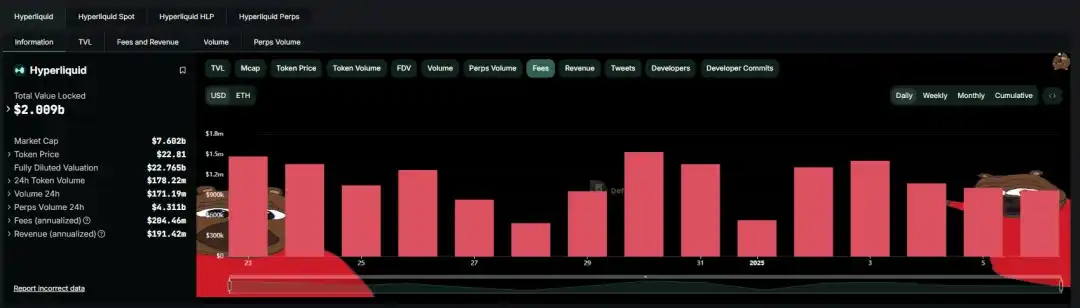
Hyperliquid Revenue, Source: https://defillama.com/protocol/hyperliquid?tvl=false&fees=true&groupBy=daily
Overall, the recovery of the DeFi sector in Q4 2024 was mainly driven by products offering real yields, with product usability and security being key competitive advantages. For example, Aave and Morpho attracted a large number of users in the lending space by providing reliable and efficient services. Curve continued to play a significant role in stablecoin exchanges, meeting the market's demand for fast and low-cost transactions. Additionally, emerging decentralized exchanges like Hyperliquid quickly rose in derivative trading, further enriching the DeFi ecosystem. Web3 wallets from major exchanges also continued to attract users into the DeFi ecosystem, driving growth in the space. In general, DeFi steadily expanded in lending, DEX, and stablecoin interactions, and its future large-scale outbreak will benefit from policy support and ongoing innovation.
RWA and Stablecoins
RWA covers a wide range of asset classes, including stablecoins, private credit, US Treasuries, commodities, and stocks. Among these assets, stablecoins, due to their uniqueness and importance, can be seen as a separate track. For non-stablecoin RWA, due to the complexity of asset standardization and incomplete regulatory frameworks, the scale is relatively small, so we will focus on the stablecoin field.
In the cryptocurrency market, since 2018, USD-pegged stablecoins have played a critical role. They not only serve as the base currency for trading but also act as shadow USD assets, active in various scenarios such as transfer payments. As of December 1, 2024, the total market capitalization of stablecoins has increased to $1.93 trillion, a 48% year-on-year growth. Taking the on-chain daily average transfer volume as an example, the current daily transfer volume remains in the high range of $250 billion to $300 billion, and even in market downturn periods, this data has not fallen below $100 billion. In terms of trading volume, referring to CoinMarketCap's industry data, the monthly trading volume in November reached $6 trillion, indicating that stablecoins account for 30% of the industry's trading volume in centralized exchanges. This ratio does not yet include on-chain stablecoin trading volume, meaning the actual share may be even higher. In addition to circulation, trading volume, and transfer volume as the three core indicators, stablecoins have also introduced stable income assets such as US Treasuries as underlying assets, providing stable and sustainable returns, bringing positive externalities to the industry, further promoting the interconnection and integration of Web3 and the real world.
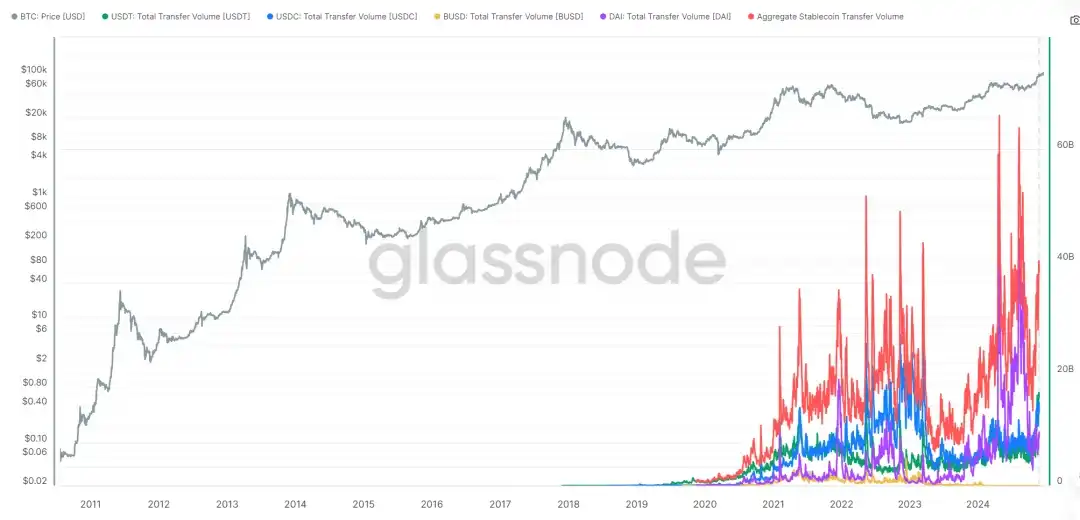
Stablecoin Daily Trading Volume, Source: https://studio.glassnode.com/charts/usd-transfer-volume
In the stablecoin market, as market demand grows, various types of stablecoins have gradually emerged, including fiat-backed stablecoins, decentralized collateralized stablecoins, algorithmic stablecoins, and more. Among them, fiat-backed stablecoins have taken the majority of the market share and the market size continues to grow. However, due to the emerging trading demands in the market, decentralized stablecoins have been exploring new paths.
Among them, Ethena has emerged as a standout, with Ethena's issuance of USDe, a synthetic dollar, occupying a place in the DeFi field with its innovative financial solution. The distinguishing feature of USDe is its use of an advanced Delta hedging strategy to maintain its peg to the dollar, setting it apart from traditional stablecoins. In just over a year, the issuance scale of USDe has steadily grown, successfully withstanding the downturn in the market in Q2 and Q3, and it has now risen to third place, behind only USDT and USDC, re-entering a phase of rapid growth.
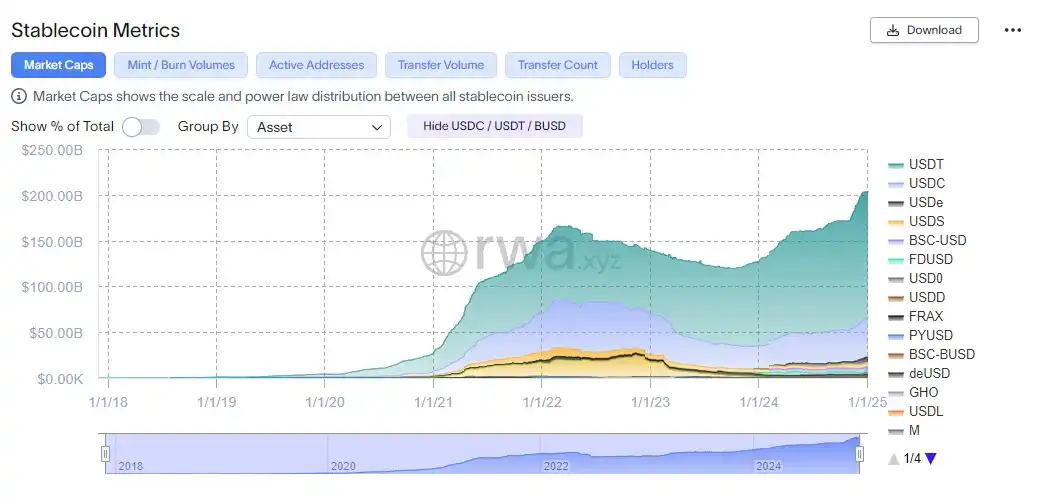
Stablecoin Data, Source: https://app.rwa.xyz/stablecoins
In addition, leveraging BlackRock, the world's largest asset management company, Ethena has issued a new institutional-grade stablecoin, USDtb. As a product independent of USDe, USDtb provides users with a new option with distinct risk characteristics. Its presence allows USDe to more effectively address market challenges, especially during negative interest rate periods. Ethena can close USDe's hedging position and reallocate assets to USDtb to mitigate associated risks, strengthening the overall system's stability and risk resilience.
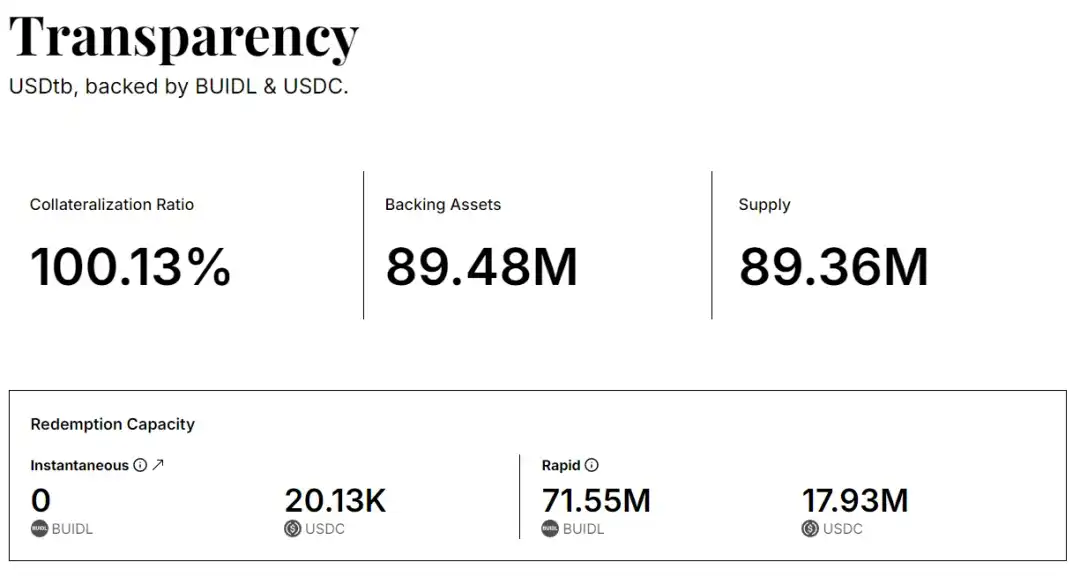
USDtb Data, Source: https://usdtb.money/transparency
Apart from Ethena, USD 0 issued by Usual is also noteworthy. This stablecoin introduces RWA as underlying support, deeply integrating the stability of traditional financial instruments with DeFi's transparency, efficiency, and composability. USD 0, with its permissionless, compliant framework, directly channels real returns from RWA to the community users, showcasing the competitiveness of the new type of stablecoin in the market. The emergence of these innovative stablecoins not only enriches market diversity but also provides users with more choices and investment opportunities.
ArkStream Capital believes that stablecoins play a crucial role in the crypto industry by navigating through market bull and bear cycles. The momentum of stablecoins will not stop, and various data indicators of stablecoins in both the payment and trading sectors will continue to grow. Decentralized stablecoins significantly outperform traditional stablecoins in terms of transparency, decentralization, and yield, making them worthy of long-term attention and investment. Currently, Ethena has shown its dominance, while Usual is actively trying to expand its market share. In the future, decentralized stablecoins will not only grow along with the entire sector but also have enormous potential to capture more market share from the traditional centralized stablecoin market.
AI Agent
In Q4 2024, the AI Agent sector in the crypto industry experienced unprecedented attention and rapid growth. AI Agents have evolved from being mere auxiliaries to traditional AI models to becoming the core driving force of the community ecosystem, shedding their singular "tool attribute" positioning. During this quarter, whether it be ai16z and ELIZA on the Solana chain or VIRTUAL and AIXBT on the Base chain, their market capitalization has multiplied several times due to the market's enthusiasm. Meanwhile, traditional AI Agents in the industry have shown relatively subdued performance. In the transition from old to new, the positioning of AI Agents has changed. Previously, AI Agents in the crypto market were mainly used to assist in the update and iteration of existing products, such as FET and OLAS, focusing more on the combination of blockchain and AI model training or building practical application scenarios such as workflow assistance and emotional companionship (similar to the original intention of humans creating robots to assist in daily life). However, the current development model has shifted from being "product-oriented" to "community-oriented," focusing more on the growth of the AI Agent itself and the construction of the ecosystem (similar to creating a fully robotic autonomous community).
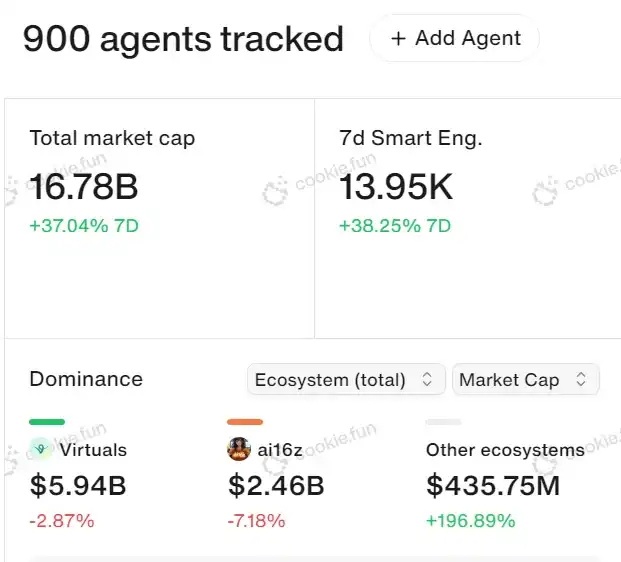
AI Agent Market Cap and Share, Source: https://www.cookie.fun/
In the current "community-oriented" development model, ai16z and Virtuals are undoubtedly the two most prominent representative projects. According to the latest data from Cookie.fun, the overall market capitalization of AI Agents has reached nearly $16.7 billion, with a growth rate of nearly 37% in the final week of Q4 2024. The combined market capitalization of ai16z and Virtuals accounts for nearly 50% of the AI Agent market share. ai16z is essentially a decentralized DAO that uses AI for investment management. Its core component is the open-source AI Agent framework ElizaOS, which is used to create, deploy, and manage AI Agents. Under this framework, there are two core applications: ai16z and degenai. ai16z is a governance token, and holders can participate in voting on investment proposals and fund distribution. degenai is a self-trading AI Agent chatbot that acts as an AI trader in ai16z, allowing users to interact with degenai and influence its trading decisions.
Similar to the ElizaOS framework, the Virtuals Protocol is committed to advancing the AI agent field. Its predecessor, the gaming guild Path DAO, underwent a strategic transformation in 2023 and rebranded as the Virtuals Protocol. By launching the fun.virtuals platform, the Virtuals Protocol enables users to easily build and deploy their own AI agents and supports one-click deployment functionality. Virtuals provides a full AI agent creation and token issuance platform similar to the "Apple system," forming a closed-loop ecosystem. a16z emphasizes open-source frameworks and decentralized governance, both of which have their own unique features in technical architecture, tokenomics, and market strategy to meet the needs of different users.
At the forefront of the wave, we have to mention the memes of the GOAT and ACT AI agents. Although they themselves have no practical utility, they were the first to break the traditional AI agent's single technological positioning, combining it with meme culture, quickly attracting the attention of users and capital. Subsequently, the market's pursuit of AI agents shifted from pure memes to infrastructure projects dominated by future narratives. Virtuals introduced its unique IAO (Initial Agent Offering) model, combining "AI agent functionality + Token + Meme," propelling it to new heights. In the Virtuals ecosystem, these AI agents not only have tools like virtual personalities and value analysis but also play a role as memes. In the cryptocurrency industry, AI agents are no longer just service providers but have become core players in the ecosystem, serving as the primary drivers of user interaction and community ecosystem development.
Currently, the AI agent market is mainly divided into two major types of projects: one is the "technical support layer," focusing on providing underlying technology and infrastructure support for AI agents; the other is the "scenario implementation layer," dedicated to applying AI agents to specific business scenarios to realize their practical application value.
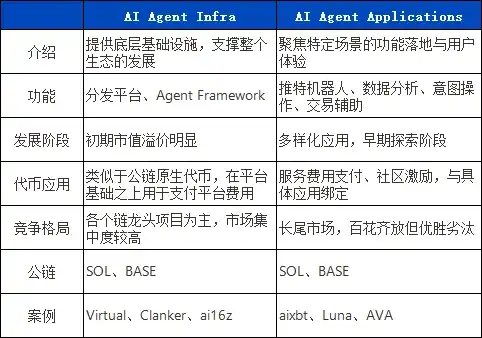
In the rapid development and evolution of AI agents, their development trajectory is similar to the early hype of the blockchain industry. For example, distribution platforms such as Virtuals, vvaifu, Zerebro, and frameworks like ElizaOS, ARC, Swarms, the current competitive landscape resembles the early Layer 1 public chain competition. According to the theory of time machines, it can be inferred that, compared to application-oriented projects, AI agent infrastructure projects attract more attention from mainstream market funds in terms of survival cycle and market cap due to their strategic importance, enjoying a premium due to scarcity.
With the maturation and saturation of infrastructure, the collaborative development of infrastructure and applications will become the core theme of the next stage, driving the field into a period of deep integration. Unlike traditional project development, AI Agent applications focus more on post-Roadmap and TGE, continuously driving ecosystem innovation and development through pre-market validation and mechanisms such as ecosystem tokens or associated tokens, achieving several-fold growth in overall market value within this quarter. With the emergence of the wealth effect, an increasing number of new projects are coming to the forefront, showcasing significant potential in various subfields, including market analysis, on-chain operations, and intent execution. For example, Aixbt's Twitter bot can answer user questions online 24/7 and provide real-time market analysis, serving as an AI version of an analytical opinion leader; AVA focuses on the social sphere, offering emotional companionship and personalized services through AI virtual personalities; CGPT integrates functions such as trading, market analysis, and NFT generation to become a comprehensive AI Agent tool.
ArkStream believes that the current enthusiasm in this race is obvious, with funds of all kinds pouring in under the driving force of FOMO, trying to get a piece of the pie. This rapid expansion pattern has led to a proliferation of projects like mushrooms after the rain, but currently, no single project has a market value exceeding tens of billions. This stage can be considered the "early stage" of the Web3 AI Agent track, characterized by a time-oriented approach: market participants generally hold a speculative mindset and are eager to enter the track at the fastest speed.
ArkStream Capital predicts that the "second stage" is on the horizon, shifting the market's focus to product quality, followed by a great reshuffle—low-quality, speculative projects will be quickly eliminated by mainstream funds. With the continuous iterative upgrades of traditional AI technology, ArkStream Capital remains optimistic about the prospects of the entire track. The current level of heat is sufficient to indicate its potential development space, and it is expected that the first batch of AI Agent projects with a market value exceeding tens of billions will soon become a significant milestone in the industry's development.
Meme
Over the past three months, Meme has experienced significant growth and evolution, especially in total market value, trading activity, thematic diversity, and exchange support. From October to early December, the total market value of Meme coins has grown significantly, reaching a historic high, and trading volume has also surged. The market has witnessed the emergence of various new types of Meme coins, including AI Agent-related Memes (GOAT, ACT), art BAN linked to Sotheby's art auctions, squirrel PNUT related to Trump and Elon Musk, and CHILLGUY attracting a large number of TikTok fans, among others. The rise of these emerging Memes has injected vitality into the market, spurred on-chain liquidity, attracted a large number of new investors to enter the market, and contributed to the prosperity and development of the Meme and crypto industries.
Compared to emerging Memes, traditional Memes such as DOGE, PEPE, and WIF have also shown strong performance in the market. In particular, PEPE and WIF successfully landed on Robinhood in November 2024, highlighting not only the recognition of Memes by North American compliant exchanges but also further expanding the market influence of these established Memes.
Combining the relevant data of the Meme sector from the past year, as of the end of 2023, the number of Memes in the top 500 market cap was extremely limited, mainly including a few such as DOGE, SHIB, BONK, PEPE, FLOKI, and ELON, with most Memes having a lower market cap. However, by the end of 2024, the number of Memes in the top 500 market cap had significantly increased to 48, accounting for nearly 10%, with a total market cap reaching around $104.7 billion and a 24-hour trading volume of up to $7.4 billion. All of these indicate that the acceptance and market consensus of Memes are continuously breaking through.
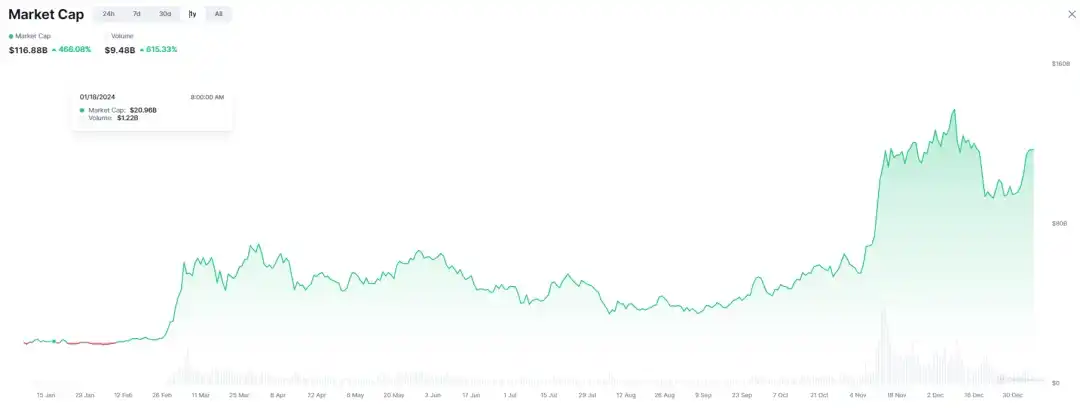
Meme Sector Market Cap, Source: https://coinmarketcap.com/view/memes/
Especially in this quarter, Memes have become the focus of the cryptocurrency market, attracting a lot of investors' attention. With the return of the value investment trend in November, some funds began to flow out of Memes, but some newly listed popular Memes quickly listed on mainstream exchanges such as Binance and Upbit due to their good market performance and large user base. Although the lack of market relay funds caused these Memes to experience significant pullbacks from their highs, ArkStream Capital believes that this pullback is a perfect reflection of market attention economics, indicating that the flow of funds in and out of Memes will undergo significant changes with market attention fluctuations. Many Memes quickly grew their market cap to over $1 billion in a short period of time, so experiencing a pullback and time validation is reasonable.
ArkStream believes that the prosperity of Memes in the industry is not just a temporary phenomenon. As a bridge connecting Gen Z and the Web3 world, with their easy-to-understand and engaging features, Memes are expected to continue to exist and bring emotion and value to the market. Therefore, ArkStream Capital actively seeks opportunities to invest in the Meme sector. In particular, it focuses on and invests in two main areas: portals that provide token information and trading data, as well as Bot products that provide trading convenience and custom strategies, and new Meme launch platforms like Pump Fun. These are core infrastructures in the Meme sector that have sustainable revenue potential; Memes are gradually becoming a means of fair asset issuance, and many projects with actual value support are trying to adopt the Meme form to attract users. They follow the concept of organic growth, with low market cap openings, which is a relatively healthy growth model and reflects the active exploration and innovation of primary market projects in the Meme space.
Project Investment

Ethena
Project Introduction
Ethena, as an innovator in the DeFi space, is committed to providing a variety of stable and scalable crypto-native currency solutions. Its first stablecoin is the crypto-native synthetic dollar USDe, with the core innovation being the use of a Delta hedging strategy to hold a mix of crypto mainstream assets in spot and corresponding short positions to maintain intrinsically stable value. This design does not rely on the traditional banking system infrastructure's USD assets. As a result, USDe not only compares favorably in stability with USD-backed stablecoins like USDC and USDT, but also significantly improves capital efficiency and returns. The second stablecoin, USDtb, was jointly developed with the RWA sector's reputable institution Securitize, leveraging BlackRock's BUIDL to connect traditional financial products such as the dollar, short-term US Treasuries, and repurchase agreements to create a digital dollar supported by real-world asset-backed stable yields. USDtb not only has the advantages of high liquidity, low risk, and stable returns but also achieves transaction transparency and settlement efficiency through Web3 technology. These two stablecoins, USDe and USDtb, expand Ethena's presence in the stablecoin market and enhance the overall robustness and credibility of Ethena's stablecoin solution through synergies.
Why Invest in Ethena
Ethena's vision is to reshape the cryptocurrency system to bridge DeFi, CeFi, and TradFi and foster the prosperity of the next generation of Internet finance. Its first stablecoin, USDe, has achieved deep integration in several key DeFi areas, including the money market, derivative market leveraging collateral, stablecoin infrastructure, interest rate swap agreements, and spot AMM DEX. In the exchange sector, Ethena's liquidity pools support both existing centralized and decentralized trading platforms and help emerging exchanges overcome liquidity challenges in the early stages, becoming a market-leading provider of depth and off-exchange liquidity. In TradFi, Ethena's USDe is highly favored for its unique yield, integrating real yields from two billion-dollar-scale crypto assets, with its yield weakly negatively correlated with traditional financial rates, and the underlying assets are custodyed by TradFi-recognized custodians. USDe provides large investors with a convenient way to access excess returns in the cryptocurrency market through a single asset.
The ENA token plays a key role in the Ethena ecosystem, serving as a governance token that gives holders the right to participate in key decisions, such as electing Risk Committee members and shaping policy direction, as well as providing the opportunity to stake and become an sENA holder to earn additional rewards. As ENA is set to be used as a voting tool for the Ethereal derivatives exchange in the future, its importance in the Ethena development roadmap is becoming increasingly prominent. These functionalities not only solidify ENA's position as a core part of the Ethena protocol but are also crucial for maintaining the protocol's decentralized governance and incentivizing user participation. In terms of liquidity, ENA has shown outstanding performance on major exchanges, with trading volume consistently ranking at the top. This not only demonstrates the market activity of the Ethena protocol but also indicates its broad market recognition and acceptance.
Through deep collaboration with major exchanges, Ethena has implemented a series of hedging strategies to address sudden market events in derivative markets such as futures contracts, ensuring the stability and security of USDe. Additionally, the use of USDe as a trading pair base currency is gradually being implemented, thanks to Ethena's efforts to increase liquidity to mitigate risks. Resource-wise, Ethena has partnered with several top global market makers, providing liquidity and market depth, further enhancing the market adaptability and resilience of USDe.
ArkStream Capital believes that in the stablecoin field, the competitive landscape is far from being determined. While USDT and USDC hold a leading position, emerging competitors have the full ability to challenge their market dominance. The key is to select stablecoin protocols with unique mechanisms that can stably anchor value, increase market capitalization, and expand use cases. Just as DEX now accounts for 10% of CEX trading volume, decentralized financial products are rapidly capturing market resources due to their verifiability and convenience. It is expected that by 2025, decentralized stablecoins represented by Ethena will continue to grow in market size, reaching a 10% market share, equivalent to $200 billion. Additionally, Ethena will become a key financial tool for the implementation of Trump's policies. The implementation of Trump's policies will also drive Ethena's strategic position in the rejuvenation of the U.S. economy and the reshaping of global finance, becoming a key support for the domestic and global digital financial landscape.

TRex
Project Introduction
TRex aims to build a publisher network focused on gaming and entertainment content projects within the blockchain industry. Its goal is to guide project teams through high-quality, scalable, and sustainable development, providing them with support in various aspects such as resource connection, tokenomic design, strategic consulting, and marketing. Taking the recently hatched two-game projects as examples: Legend of Arcadia and Last Odyssey, both have attracted over 100,000 active users. Legend of Arcadia is a multichain card game that accounts for 7% of the total trading volume on X Layer; while Last Odyssey is an MMOSLG strategy game that holds 1.2% of the total trading volume on opBNB.
Why Invest in TRex
Leveraging the strong EVG ecosystem, TRex has a significant advantage in terms of funding and resources. EVG is one of the most successful Web3 project incubators and investment firms in the Asia-Pacific region, with investments and incubations including well-known enterprises and funds such as Celestia, Wormhole, Berachain, Animoca Brands, The Sandbox, Yuga Labs, and Kraken. Furthermore, TRex has established a deep partnership with Animoca Brands. The Sandbox, under Animoca, as a pioneer in the metaverse space, has gained widespread recognition from traditional internet and luxury brands, demonstrating Animoca's excellent incubation capabilities. Both EVG and Animoca are institutions in the Asia-Pacific region with rich resources, solid strength, and extensive experience in the Web3 field, with team members largely from traditional financial backgrounds in Hong Kong. With these advantages, TRex can adopt a high-quality, scalable, and sustainable strategy to provide comprehensive support to project teams, including resource matching, tokenomics design, strategic consulting, and marketing.
Additionally, ArkStream Capital has observed that the trend of continuous development in gaming within the Ton ecosystem and the entertainment content application trend are becoming increasingly evident, whether it be the Web3 game fund launched by traditional gaming giant Nexon or Sony's plan to launch a Layer 1 blockchain. From the Web2 game "Black Myth: Wukong" to the popularity of Taptap games on the blockchain, the market's recognition and demand for such applications are continually growing. It is foreseeable that in the near future, more developers and project teams will actively engage in this field. TRex's one-stop, customizable issuance and incubation services will help project teams develop projects at a lower cost and access higher-quality resources, undoubtedly providing strong support for the project's development.
ArkStream believes that with its outstanding track record and high-caliber team background, TRex has garnered support from multiple senior experts in the Web2, Web3 gaming, and TMT industries. The platform's planned publisher network and expanding ecosystem make TRex a high-quality project with investment value. As blockchain applications diversify and scale, the TRex network and its platform token are expected to become an indispensable component of the GameFi sector.
Research Report
ArkStream Capital: Why We Invested in Ethena After Trump's Victory
ArkStream Capital: The Meme Craze | A New Battlefield for VCs – Opportunity or Trap?
ArkStream Capital: How PayFi Unlocks a New Chapter in Crypto Payments
猜你喜歡
穩定幣驅動全球B2B支付革新,如何打破工作流程瓶頸釋放兆市場潛力?
5月2日關鍵市場資訊差,一定要看! |Alpha早報
這些新創公司正在無需資料中心的情況下建立先進AI模型
CEX與Wallet之後,OKX入局支付
RWA永續產品危機:為什麼GLP模式註定撐不住RWA永續?
科學平權運動:DeSci的萬億美元知識經濟重建革命
Sentient深度研報:獲8,500萬美元融資,建置去中心化AGI新範式
加密項目為何札堆發卡?一場Web3與現實世界的通行權之爭
專訪Virtuals聯創empty:AI 創業不需要大量資金,Crypto是答案之一
今年 2 月,Base 生態中的 AI 協議 Virtuals 宣布跨鏈至 Solana,然而加密市場隨後進入流動性緊縮期,AI Agent 板塊從人聲鼎沸轉為低迷,Virtuals 生態也陷入一段蟄伏期。
三月初,BlockBeats 對 Virtuals 共同創辦人 empty 進行了一次專訪。彼時,團隊尚未推出如今被廣泛討論的 Genesis Launch 機制,但已在內部持續探索如何透過機制設計激活舊資產、提高用戶參與度,並重構代幣發行與融資路徑。那是一個市場尚未復甦、生態尚處冷啟動階段的時間點,Virtuals 團隊卻沒有停下腳步,而是在努力尋找新的產品方向和敘事突破口。
兩個月過去,AI Agent 板塊重新升溫,Virtuals 代幣反彈超 150%,Genesis 機製成為帶動生態回暖的重要觸發器。從積分獲取規則的動態調整,到專案參與熱度的持續上升,再到「新代幣帶老代幣」的機制閉環,Virtuals 逐漸走出寒冬,並再次站上討論焦點。
值得注意的是,Virtuals 的 Genesis 機制與近期 Binance 推出的 Alpha 積分系統有一些相似之處,評估用戶在 Alpha 和幣安錢包生態系統內的參與度,決定用戶 Alpha 代幣空投的資格。用戶可透過持倉、交易等方式獲得積分,積分越高,參與新項目的機會越大。透過積分系統篩選使用者、分配資源,專案方能夠更有效地激勵社群參與,提升專案的公平性和透明度。 Virtuals 和 Binance 的探索,或許預示著加密融資的新趨勢正在形成。
回看這次對話,empty 在專訪中所展現出的思路與判斷,正在一步步顯現其前瞻性,這不僅是一場圍繞打新機制的訪談,更是一次關於“資產驅動型 AI 協議”的路徑構建與底層邏輯的深度討論。
BlockBeats:可以簡單分享一下最近團隊主要在忙些什麼?
empty:目前我們的工作重點主要有兩個部分。第一部分,我們希望將 Virtuals 打造成一個類似「華爾街」的代理人(Agent)服務平台。設想一下,如果你是專注於 Agent 或 Agent 團隊建立的創業者,從融資、發幣到流動性退出,整個流程都需要係統性的支援。我們希望為真正專注於 Agent 和 AI 研發的團隊,提供這一整套服務體系,讓他們可以把精力集中在底層能力的開發上,而不用為其他環節分心。這一塊的工作其實也包括了與散戶買賣相關的內容,後面可以再詳細展開。
第二部分,我們正在深入推進 AI 相關的佈局。我們的願景是建立一個 AI 社會,希望每個 Agent 都能聚焦自身優勢,同時透過彼此之間的協作,實現更大的價值。因此,最近我們發布了一個新的標準——ACP(Agent Communication Protocol),目的是讓不同的 Agent 能夠相互互動、協作,共同推動各自的業務目標。這是目前我們主要在推進的兩大方向。
BlockBeats:可以再展開說說嗎?
empty:在我看來,其實我們面對的客戶群可以分為三類:第一類是專注於開發 Agent 的團隊;第二類是投資者,包括散戶、基金等各種投資機構;第三類則是 C 端用戶,也就是最終使用 Agent 產品的個人用戶。
不過,我們主要的精力其實是放在前兩大類──也就是團隊和投資人。對於 C 端用戶這一塊,我們並不打算直接介入,而是希望各個 Agent 團隊能夠自己解決 C 端市場的拓展問題。
此外,我們也認為,Agent 與 Agent 之間的交互作用應該成為一個核心模式。簡單來說,就是未來的服務更多應該是由一個 Agent 銷售或提供給另一個 Agent,而不是單純賣給人類使用者。因此,在團隊的 BD 工作中,我們也積極幫助現有的 AI 團隊尋找這樣的客戶和合作機會。
BlockBeats:大概有一些什麼具體案例呢?
empty:「華爾街」說白了就是圍繞資本運作體系的建設,假設你是一個技術團隊,想要融資,傳統路徑是去找 VC 募資,拿到資金後開始發展。如果專案做得不錯,接下來可能會考慮進入二級市場,例如在紐約證券交易所上市,或是在 Binance 這樣的交易所上幣,實現流動性退出。
我們希望把這一整套流程打通-從早期融資,到專案開發過程中對資金的靈活使用需求,再到最終二級市場的流動性退出,全部覆蓋和完善,這是我們希望補齊的一條完整鏈條。
而這一部分的工作和 ACP(Agent Communication Protocol)是不同的,ACP 更多是關於 Agent 與 Agent 之間交互標準的製定,不直接涉及資本運作系統。
BlockBeats:它和現在 Virtuals 的這個 Launchpad 有什麼差別呢?資金也是從 C 端來是嗎?
empty:其實現在你在 Virtuals 上發幣,如果沒有真正融到資金,那就只是發了一個幣而已,實際是融不到錢的。我們目前能提供的服務,是透過設定買賣時的交易稅機制,從中提取一部分稅收回饋給創業者,希望這部分能成為他們的現金流來源。
不過,問題其實還分成兩塊。第一是如何真正幫助團隊完成融資,這個問題目前我們還沒有徹底解決。第二是關於目前專案發行模式本身存在的結構性問題。簡單來說,現在的版本有點像過去 Pumpfun 那種模式——也就是當專案剛上線時,部分籌碼就被外賣給了外部投資人。但現實是,目前整個市場上存在著太多機構集團和「狙擊手」。
當一個真正優秀的專案一發幣,還沒真正觸達普通散戶,就已經被機構在極高估值時搶購了。等到散戶能夠接觸到時,往往價格已經偏高,專案品質也可能變差,整個價值發行體係被扭曲。
針對這個問題,我們希望探索一種新的發幣和融資模式,目的是讓專案方的籌碼既不是死死握在自己手裡,也不是優先流向英文圈的大機構,而是能夠真正留給那些相信專案、願意長期支持專案的普通投資者手中。我們正在思考該如何設計這樣一個新的發行機制,來解決這個根本問題。
BlockBeats:新模式的具體想法會是什麼樣子呢?
empty:關於資金這一塊,其實我們目前還沒有完全想透。現階段來看,最直接的方式還是去找 VC 融資,或是採取公開預售等形式進行資金募集。不過說實話,我個人對傳統的公開預售模式並不是特別認同。
在「公平發售」這件事上,我們正在嘗試換一個角度來思考-希望能從「reputation」出發,重新設計機制。
具體來說,就是如果你對整個 Virtuals 生態有貢獻,例如早期參與、提供支持或建設,那麼你就可以在後續購買優質代幣時享有更高的優先權。透過這種方式,我們希望把資源更多留給真正支持生態發展的用戶,而不是由短期套利的人主導。
BlockBeats:您會不會考慮採用類似之前 Fjord Foundry 推出的 LBP 模式,或者像 Daos.fun 那種採用白名單機制的模式。這些模式在某種程度上,和您剛才提到的「對生態有貢獻的人享有優先權」的想法是有些相似的。不過,這類做法後來也引發了一些爭議,例如白名單內部操作、分配不公等問題。 Virtuals 在設計時會考慮借鏡這些模式的優點,或有針對性地規避類似的問題嗎?
empty:我認為白名單機制最大的問題在於,白名單的選擇權掌握在專案方手中。這和「老鼠倉」行為非常相似。專案方可以選擇將白名單名額分配給自己人或身邊的朋友,導致最終的籌碼仍然掌握在少數人手中。
我們希望做的,依然是類似白名單的機制,但不同的是,白名單的獲取權應基於一個公開透明的規則體系,而不是由項目方單方面決定。只有這樣,才能真正做到公平分配,避免內幕操作的問題。
我認為在今天這個 AI 時代,很多時候創業並不需要大量資金。我常跟團隊強調,你們應該優先考慮自力更生,例如透過組成社區,而不是一開始就想著去融資。因為一旦融資,實際上就等於背負了負債。
我們更希望從 Training Fee的角度去看待早期發展路徑。也就是說,專案可以選擇直接發幣,透過交易稅所帶來的現金流,支持日常營運。這樣一來,專案可以在公開建設的過程中獲得初步資金,而不是依賴外部投資。如果專案做大了,自然也會有機會透過二級市場流動性退出。
當然最理想的情況是,專案本身能夠有穩定的現金流來源,這樣甚至連自己的幣都無需拋售,這才是真正健康可持續的狀態。
我自己也常在和團隊交流時分享這種思路,很有意思的是,那些真正抱著「搞快錢」心態的項目,一聽到這種機制就失去了興趣。他們會覺得,在這種模式下,既無法操作老鼠倉,也很難短期套利,於是很快就選擇離開。
但從我們的角度來看,這其實反而是個很好的篩選機制。透過這種方式,理念不同的專案自然會被過濾出去,最後留下的,都是那些願意真正建立、和我們價值觀契合的團隊,一起把事情做起來。
BlockBeats:這個理念可以發展出一些能夠創造收益的 AI agent。
empty:我覺得這是很有必要的。坦白說,放眼今天的市場,真正擁有穩定現金流的產品幾乎鳳毛麟角,但我認為這並不意味著我們應該停止嘗試。事實上,我們每天在對接的團隊中,有至少一半以上的人依然懷抱著長遠的願景。很多時候,他們甚至已經提前向我們提供了 VC 階段的資金支持,或表達了強烈的合作意願。
其實對他們來說想要去收穫一個很好的社區,因為社區可以給他們的產品做更好的回饋,這才是他們真正的目的。這樣聽起來有一點匪夷所思,但其實真的有很多這樣的團隊,而那種團隊的是我們真的想扶持的團隊。
BlockBeats:您剛才提到的這套「AI 華爾街」的產品體系-從融資、發行到退出,建構的是一整套完整的流程。這套機制是否更多是為了激勵那些有意願發幣的團隊?還是說,它在設計上也考慮瞭如何更好地支持那些希望透過產品本身的現金流來發展的團隊?這兩類團隊在您這套體系中會不會被區別對待,或者說有什麼機制設計能讓不同路徑的創業者都能被合理支持?
empty:是的,我們 BD 的核心職責其實就是去鼓勵團隊發幣。說得直接一點,就是引導他們思考發幣的可能性和意義。所以團隊最常問的問題就是:「為什麼要發幣?」這時我們需要採取不同的方式和角度,去幫助他們理解背後的價值邏輯。當然如果最終判斷不適合,我們也不會強迫他們推進。
不過我們觀察到一個非常明顯的趨勢,傳統的融資路徑已經越來越難走通了。過去那種融資做大,發幣上所的模式已經逐漸失效。面對這樣的現實,很多團隊都陷入了尷尬的境地。而我們希望能從鏈上和加密的視角,提供一套不同的解決方案,讓他們找到新的發展路徑。
BlockBeats:明白,我剛才其實想表達的是,您剛剛也提到,傳統的 AI 模式在很大程度上仍然依賴「燒錢」競爭。但在 DeepSeek 出現之後,市場上一些資金體積較小的團隊或投資人開始重新燃起了信心,躍躍欲試地進入這個領域。您怎麼看待這種現象?這會不會對目前正在做 AI 基礎研發,或是 AI 應用層開發的團隊產生一定的影響?
empty:對,我覺得先不談 DeepSeek,從傳統角度來看,其實到目前為止,AI 領域真正賺錢的只有英偉達,其他幾乎所有玩家都還沒有實現盈利。所以其實沒有人真正享受了這個商業模式的成果,大家也仍在探索如何面對 C 端打造真正有產出的應用。
沒有哪個領域像幣圈一樣能如此快速獲得社群回饋。你一發幣,用戶就會主動去讀白皮書的每一個字,試試你產品的每個功能。
當然,這套機制並不適合所有人。例如有些 Agent 產品偏 Web2,對於幣圈用戶而言,可能感知不到其價值。因此,我也會鼓勵做 Agent 的團隊在 Virtuals 生態中認真思考,如何真正將 Crypto 作為自身產品的差異化要素加以運用與設計。
BlockBeats:這點我特別認同,在 Crypto 這個領域 AI 的迭代速度確實非常快,但這群用戶給予的回饋,真的是代表真實的市場需求嗎?或者說這些回饋是否真的符合更大眾化、更具規模性的需求?
empty:我覺得很多時候產品本身不應該是強行推廣給不適合的使用者群體。例如 AIXBT 最成功的一點就在於,它的用戶本身就是那群炒作他人內容的人,所以他們的使用行為是非常自然的,並不覺得是在被迫使用一個無聊的產品。 mass adoption 這個概念已經講了很多年,大家可能早就該放棄這個執念了。我們不如就認了,把東西賣給幣圈的人就好了。
BlockBeats:AI Agent 與 AI Agent 所對應的代幣之間,究竟應該是什麼樣的動態關係?
empty:對,我覺得這裡可以分成兩個核心點。首先其實不是在投資某個具體的 AI Agent,而是在投資背後經營這個 Agent 的團隊。你應該把它理解為一種更接近創投的思路:你投的是這個人,而不是他目前正在做的產品。因為產品本身是可以快速變化的,可能一個月後團隊會發現方向不對,立即調整。所以,這裡的「幣」本質上代表的是對團隊的信任,而不是某個特定 Agent 本身。
第二則是期望一旦某個 Agent 產品做出來後,未來它能真正產生現金流,或者有實際的使用場景(utility),從而讓對應的代幣具備賦能效應。
BlockBeats:您覺得有哪些賦能方式是目前還沒看到的,但未來可能出現、值得期待的?
empty:其實主要有兩塊,第一是比較常見的那種你要使用我的產品,就必須付費,或者使用代幣支付,從而間接實現對代幣的「軟銷毀」或消耗。
但我覺得更有趣的賦能方式,其實是在獲客成本的角度思考。也就是說,你希望你的用戶同時也是你的投資者,這樣他們就有動機去主動幫你推廣、吸引更多用戶。
BlockBeats:那基於這些觀點,您怎麼看 ai16z,在專案設計和代幣機制方面,似乎整體表現並不太樂觀?
empty:從一個很純粹的投資角度來看,撇開我們與他們之間的關係,其實很簡單。他們現在做的事情,對代幣本身沒有任何賦能。從開源的角度來看,一個開源模型本身是無法直接賦能代幣的。
但它仍然有價值的原因在於,它像一個期權(call option),也就是說,如果有一天他們突然決定要做一些事情,比如推出一個 launchpad,那麼那些提前知道、提前參與的人,可能會因此受益。
開發者未來確實有可能會使用他們的 Launchpad,只有在那一刻,代幣才會真正產生賦能。這是目前最大的一個問號——如果這個模式真的跑得通,我認為確實會非常強大,因為他們的確觸達了大量開發者。
但我個人還是有很多疑問。例如即使我是使用 Eliza 的開發者,也不代表我一定會選擇在他們的 Launchpad 上發幣。我會貨比三家,會比較。而且,做一個 Launchpad 和做一個開源框架,所需的產品能力和社群運作能力是完全不同的,這是另一個重要的不確定性。
BlockBeats:這種不同是體現在什麼地方呢?
empty:在 Virtuals 上我們幾乎每天都在處理客服相關的問題,只要有任何一個團隊在我們平台上發生 rug,即使與我們沒有直接關係,用戶也會第一時間來找我們投訴。
這時我們就必須出面安撫用戶,並思考如何降低 rug 的整體風險。一旦有團隊因為自己的代幣設計錯誤或技術失誤而被駭客攻擊、資產被盜,我們往往需要自掏腰包,確保他們的社群至少能拿回一點資金,以便專案能夠重新開始。這些項目方可能在技術上很強,但未必擅長代幣發行,結果因操作失誤被攻擊導致資產損失。只要涉及「被欺騙」相關的問題,對我們來說就已經是非常麻煩的事了,做這些工作跟做交易所的客服沒有太大差別。
另一方面,做 BD 也非常困難。優秀的團隊手上有很多選擇,他們可以選擇在 Pumpfun 或交易所上發幣,為什麼他們要來找我們,那這背後必須要有一整套支援體系,包括融資支援、技術協助、市場推廣等,每個環節都不能出問題。
BlockBeats:那我們就繼續沿著這個話題聊聊 Virtuals 目前的 Launchpad 業務。有一些社群成員在 Twitter 上統計了 Virtuals Launchpad 的整體獲利狀況,確實目前看起來獲利的項目比較少。接下來 Launchpad 還會是 Virtuals 的主要業務區嗎?還是說,未來的重心會逐漸轉向您剛才提到的「AI 華爾街」這條路徑?
empty:其實這兩塊本質上是一件事,是一整套體系的一部分,所以我們必須繼續推進。市場的波動是很正常的,我們始終要堅持的一點是:非常清楚地認識到我們的核心客戶是誰。我一直強調我們的客戶只有兩類——團隊。所以市場行情的好壞對我們來說並不是最重要的,關鍵是在每一個關鍵節點上,對於一個團隊來說,發幣的最佳選擇是否依然是我們 Virtuals。
BlockBeats:您會不會擔心「Crypto + AI」或「Crypto AI Agent」這一類敘事已經過去了?如果未來還有一輪多頭市場,您是否認為市場炒作的焦點可能已經不再是這些方向了?
empty:有可能啊,我覺得 it is what it is,這確實是有可能發生的,但這也屬於我們無法控制的範圍。不過如果你問我,在所有可能的趨勢中,哪個賽道更有機會長期保持領先,我仍然認為是 AI。從一個打德撲的角度來看,它仍然是最優選擇。
而且我們團隊的技術架構和底層能力其實早已搭建完成了,現在只是順勢而為而已。更重要的是,我們本身真的熱愛這件事,帶著好奇心去做這件事。每天早上醒來就有驅動力去研究最新的技術,這種狀態本身就挺讓人滿足的,對吧?
很多時候,大家不應該只看產品本身。實際上很多優秀的團隊,他們的基因決定了他們有在規則中勝出的能力——他們可能過去在做派盤交易時,每筆規模就是上百萬的操作,而這些團隊的 CEO,一年的薪資可能就有 100 萬美金。如果他們願意出來單幹項目,從天使投資或 VC 的視角來看,這本質上是用一個很划算的價格買到一個高品質的團隊。
更何況這些資產是 liquid 的,不是鎖倉狀態。如果你當下不急著用錢,完全可以在早期階段買進一些優秀團隊的代幣,靜靜等待他們去創造一些奇蹟,基本上就是這樣一個邏輯。
第16週鏈上數據:結構性供需失衡加劇,數據揭⽰下⼀輪上漲的堅實藍圖?
a16z領投2500萬美元,0xMiden要在你手機裡跑一條隱私鏈
Sui Q1進階報告:BTCfi基建崛起、借貸協議爆發與執行分片未來
川普次子的加密生意經
SignalPlus宏觀分析:關稅撕裂的M2敘事與TradFi式FOMO的回歸
上線Binance Alpha,你的HAEDAL空投值多少錢?
門羅幣市值一天暴增15億美元背後,為何駭客不再喜歡比特幣?
盤點10大新興Launchpad平台,誰能完成Pump.fun的顛覆?


 App
App