

ArkStream Capital: The Power Play of WLFI's CEX-DEX Convergence

Original Article Title: "ArkStream Capital: The Power Play of WLFI and CEX-DEX Integration"
Original Source: ArkStream Capital
Industry Overview
At the beginning of 2025, the cryptocurrency market kicked off amidst a complex mix of optimism and uncertainty. The industry had high hopes for the new year: the potential benefits of the Federal Reserve's shift in monetary policy, the second wave of the AI tech revolution, and the "crypto-friendly" regulatory framework promised by the new U.S. government were all seen as catalysts for industry breakthroughs. However, as the dust settled in the first quarter, the market presented a stark picture of "macro narrative volatility and micro innovation incubation."
The global macroeconomy became the core variable driving market sentiment, with the Federal Reserve struggling to balance inflation concerns and recession risks. The unexpected speculation of a recession interest rate cut in March briefly boosted risk appetite but failed to offset the liquidity panic triggered by the bursting of the U.S. stock market bubble. While the Trump administration fulfilled its election promises by advancing Bitcoin national strategic reserves, digital asset strategic reserves, and enacting the "Digital Asset Regulatory Clarity Act," unlocking structural tailwinds for the industry, the simultaneous presence of policy benefits and lax SEC enforcement intensified the industry's debate over the "compliance transformation cost."
Bitcoin experienced a 30% deep retracement after surpassing the $100,000 historical high in January, exposing the market's profit-taking on the "halving narrative." The altcoin market showed overall subdued performance, but the emergence and delivery of products such as RWAs and user onboarding injected fundamental innovation momentum into the industry. Notably, exchanges like Binance accelerated their DEX ecosystem expansion, facilitating seamless user access to DeFi and other dApps through on-chain liquidity aggregation and account abstraction technology. For the first time, CEX users were allowed to directly trade DEX assets within their accounts, marking a paradigm shift towards "centralization and decentralization integration" that may become a key inflection point for the next cycle of growth and disruption.
Macroeconomic Environment and Impacts
In the first quarter of 2025, the U.S. macroeconomic environment had a profound and complex impact on the cryptocurrency market. For the cryptocurrency market, starting from ETF approval through BTC spot trading, the overall correlation between the crypto market and the U.S. stock market strengthened further, with the Nasdaq's trend to some extent directly determining the direction of the cryptocurrency market. Although BTC was once dubbed "digital gold" in its early years, the cryptocurrency market now leans more towards being a risk asset rather than a safe haven asset, making it more susceptible to market liquidity. ArkStream will continue to monitor trends in the macroeconomy in the future.
At the core of macroeconomics lies the balance between inflation and economic strength, with market trading being based on future expectations: if inflation is too high or the economy is overly robust, the Federal Reserve will tend to postpone interest rate cuts, which is unfavorable for the capital markets; conversely, if the economic performance is too weak, it may pose a risk of recession, which is also detrimental to market confidence and capital flows. Therefore, macroeconomics needs to find a delicate balance between strength and weakness to provide a favorable environment for the capital markets. The DOGE sector's massive layoffs of government agency staff directly led to an increase in the unemployment rate. Meanwhile, Trump's tariff policy, by directly raising prices of affected goods and the costs in related service industries, has exacerbated inflationary pressures and raised the possibility of a U.S. economic recession.
This series of policies has increased market instability, leading to greater volatility in the capital markets. Considering the significant gains brought by the 2024Q4 election season and the potential for substantial market retracements due to short-term market volatility, ArkStream Capital scaled back its investment plans in the 2025Q1 quarter, focusing more time and effort on exploring OTC strategies and expanding channels.
However, considering that such policies may not be merely economic control measures, but rather part of the Trump administration's efforts to increase bargaining chips in political negotiations with other countries, or deliberately create chaos to achieve specific political and economic goals, such as compelling the Federal Reserve to swiftly implement emergency defensive rate cuts by manufacturing signs of economic recession. This would be aimed at achieving a win-win situation in alleviating the U.S. national debt issue and stimulating economic growth and market performance. We still have a positive outlook on the subsequent cryptocurrency market performance.
In the first quarter, the cryptocurrency market showed a high sensitivity to macroeconomic data. The following is a monthly analysis of the market performance in January, February, and March.
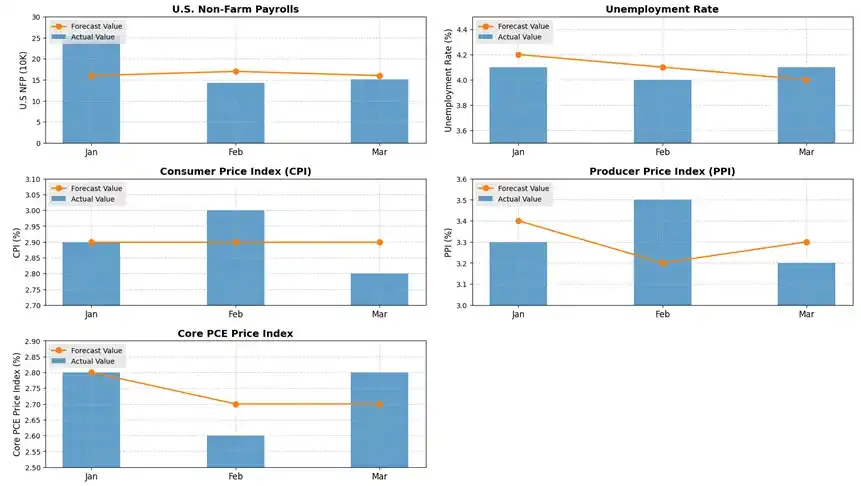
In January, U.S. macroeconomic data was overall strong, but the market reaction was relatively stable. On January 10, the December seasonally adjusted non-farm payrolls data was released, with an expected value of 160,000 and an actual value of 256,000, significantly exceeding market forecasts; on the same day, the December unemployment rate was 4.1%, lower than the expected 4.2%, further confirming the strong economic performance. On January 14, the December PPI year-on-year rate was 3.3%, slightly lower than the expected 3.4%, seen as a signal that short-term inflationary pressures have eased.
However, on January 15, the December non-seasonally adjusted CPI year-on-year rate was 2.9%, meeting expectations but showing a 0.2% increase from the previous month, starting to raise concerns in the market about rising inflation and delayed rate cuts. On January 31, the December core PCE data came in at 2.8%, as expected, and did not significantly disrupt market expectations. Overall, the data for January did not cause significant fluctuations in the cryptocurrency market, as the strong job market and stable inflation data kept asset prices like BTC relatively stable.
Entering February, the cryptocurrency market experienced significant volatility due to the disparity between macroeconomic data and expectations. On February 7, the January seasonally adjusted nonfarm payrolls data was released as 143,000, below the expected 170,000; on the same day, the January unemployment rate was 4.0%, lower than the expected 4.1%. The unclear performance of the job market exacerbated short-term market uncertainty. On February 12, the January non-seasonally adjusted CPI year-on-year rate was announced as 3.0%, higher than the expected 2.9%. With inflation continuing to rise and exceeding expectations, market confidence in rate cuts plummeted. Traders generally bet that rate cuts during the year might only occur once in December, which dealt a significant blow to market sentiment. Following the data release, BTC plummeted by 2500 points within 15 minutes, resulting in a 2.66% drop.
The next day, the January PPI year-on-year rate was revealed to be 3.5%, surpassing the expected 3.2%, further intensifying concerns about a downward revision in rate cut expectations. This was seen as the catalyst for the weakening of buying pressure. Over the following two weeks, BTC dropped by around 20%, plummeting by 20,000 points. It wasn't until February 28 that the January core PCE price index was published as 2.6%, below expectations, that the market stabilized and formed a bottom. It is worth noting that the weakness in the financial and medical services sectors in the PPI data had already provided an early signal for the PCE's decline.
In March, overall improvements in macroeconomic data led to a slight recovery in market sentiment, but the unexpectedly strong performance of the core PCE once again triggered volatility. On March 7, the February seasonally adjusted nonfarm payrolls data was released as 151,000, slightly below the anticipated 160,000; on the same day, the February unemployment rate stood at 4.1%, higher than the expected 4.0%, indicating a slight softness in the job market. On March 12, the February non-seasonally adjusted CPI year-on-year rate was announced as 2.8%, lower than the expected 2.9%; and on March 13, the February PPI year-on-year rate was revealed to be 3.2%, slightly below the expected 3.3%.
This series of data indicates that the economy is running on a solid foundation, inflationary pressures have eased somewhat, and the rate cut process is expected to accelerate. Influenced by this, the cryptocurrency market saw a brief rebound in the following 10 days. However, on March 28, the year-on-year PCE price index for February was reported as 2.5%, meeting expectations, but the core PCE year-on-year rate was 2.8%, higher than the anticipated 2.7%. In the 10 hours leading up to the data release, the market experienced a significant decline due to concerns about the core PCE beating expectations, demonstrating a continued sensitivity to inflation data.
In summary, during the first quarter of 2025, U.S. macroeconomic data had a significant and fluctuating impact on the cryptocurrency market. January saw a strong economy but a subdued market reaction, February witnessed higher-than-expected inflation leading to a sharp drop in rate cut expectations and a substantial BTC decline, and March's economic data improvement drove a brief recovery, yet the higher-than-expected core PCE brought about another downturn. Trump's tariff policy, by exacerbating inflationary pressures, increased market uncertainty and may become a crucial factor compelling the Fed to adjust its policies. Looking ahead, the cryptocurrency market's trajectory will continue to heavily rely on macroeconomic data and the Fed's policy direction. Investors need to closely monitor the dynamics of inflation and employment data to accurately grasp market trends.
Trump Administration's Cryptocurrency Policy and Impact
Trump signed an executive order in March 2025, calling for the establishment of a strategic Bitcoin reserve funded primarily by about 200,000 bitcoins (valued at around $18 billion) seized in criminal or civil forfeitures, and prohibiting the government from selling the bitcoins in the reserve. This action aimed to elevate Bitcoin to a "sovereign reserve asset," enhance its legitimacy and liquidity, and promote the United States' leadership in the digital asset space. While Bitcoin's price surged over 8% in the short term and market confidence increased, the market quickly realized that the reserve relied solely on seized assets with no additional purchase plans, causing the price to plummet.
In the long run, this move may prompt other countries to follow suit, pushing Bitcoin to become an international reserve asset. Additionally, a range of non-Bitcoin digital assets may also have the potential to be included in digital asset reserves. This signifies the transformation of cryptocurrencies from marginal assets to strategic tools of nations. Although the short-term market response was disappointing, its long-term impact could reshape the global financial system: on one hand, driving Bitcoin to become a mainstream reserve asset, and on the other, intensifying sovereign nations' competition in the digital finance sector.
In terms of regulation, Trump, after taking office, pushed for the dismissal of SEC Chairman Gary Gensler and established a cryptocurrency asset task force, clarifying the standards for distinguishing between security and non-security tokens and terminating lawsuits against companies like Coinbase. Furthermore, he repealed the contentious accounting standard SAB 121, alleviating the financial burden on businesses. The regulatory environment significantly relaxed, leading to accelerated entry of institutional investors; traditional financial institutions such as banks were allowed to engage in cryptocurrency custody services, driving the industry's compliance process. This series of regulatory policies, through deregulation, framework restructuring, and legislative advancement, has transformed the ecosystem of the U.S. cryptocurrency and financial industries. In the short term, the policy's dividends may accelerate technological innovation and capital inflows; however, in the long term, vigilance is needed against systemic risks and the complexity of global regulatory gamesmanship. The realization of policy effects in the future will depend on multiple variables, including judicial challenges, economic cycles, and political maneuvering.
In terms of stablecoin development, the Trump administration established a federal regulatory framework for stablecoins, allowing stablecoin issuing institutions to access the Federal Reserve's payment system and explicitly prohibiting the issuance of a central bank digital currency (CBDC) by the Federal Reserve to preserve the innovation space of private cryptocurrencies. The application of stablecoins in cross-border payments accelerated, expanding the path for the internationalization of the U.S. dollar; the market share of private stablecoins expanded, deepening integration with the traditional financial system.
Regarding tariff policies, in February 2025, Trump signed the "Reciprocal Trade and Tariff Memorandum," requiring the tariff rates of the United States' trading partners to be consistent with the United States and imposing tariffs on countries implementing value-added tax systems. This memorandum is a landmark document for adjusting U.S. trade policy, aimed at reducing the U.S. trade deficit, addressing trade inequality and imbalances. Subsequently, Canada, Mexico, the EU, and others quickly took retaliatory measures, leading to the first spiral increase in global tariff barriers. On April 2, 2025, Trump signed an executive order on retaliatory tariffs, further detailing and implementing the policy direction in the February memorandum. The order aimed to reduce the U.S. trade deficit, promote reshoring of manufacturing, and protect the U.S. economy and national security by requiring higher retaliatory tariffs on countries with the largest trade deficits with the United States. This move triggered swift retaliatory actions from the main affected countries, with China taking corresponding measures promptly, formally plunging the economic and trade relations between the two sides into a phase of serious discord and friction.
Under such tariff policies, global trade costs are bound to increase, and the scale of international trade may shrink. Production costs surge, supply chain restructuring accelerates, and corporate investment willingness declines. Most crucially, the United States will have to face the pressure of import-driven inflation. The Federal Reserve's monetary policy finds itself in a dilemma, with rate cut expectations being postponed. The tariff policy also forces companies to shift production to countries like Mexico in Latin America, but issues with domestic infrastructure and labor scarcity in the U.S. hinder the reshoring of manufacturing. Industries relying on global supply chains such as automotive and electronics are severely impacted, multinational corporations face increased profit pressure, and the stock prices of U.S. tech giants experience a pullback.
Emerging markets face challenges in undertaking the industrial chain transfer and are unable to completely fill the demand gap left by the U.S. The trade war has also weakened the trust in the U.S. dollar as the international trade settlement currency, leading to a decline in ten-year Treasury bond prices and a corresponding rise in yields. Behind this is also the Trump administration's consideration to reduce debt expenses and borrowing costs, prompting some countries to begin exploring a path to de-dollarization. In the financial markets, global financial markets, including U.S. stocks, A-shares, Nikkei, etc., have generally experienced significant declines, with market liquidity facing immense pressure.
Trump's cryptocurrency policy, through regulatory easing and strategic reserves, has short-term market confidence and capital inflows, but long-term vigilance is needed against risks of hash rate centralization and policy reversals. While the tariff policy is named "America First," it has led to the fragmentation of the global trade system, raised inflation, exacerbated economic recession expectations, and forced funds to move from risk assets to safe-haven assets like gold. These two major policies together highlight the contradictions and power struggles within the U.S. during the transition between the digital economy and the physical economy.
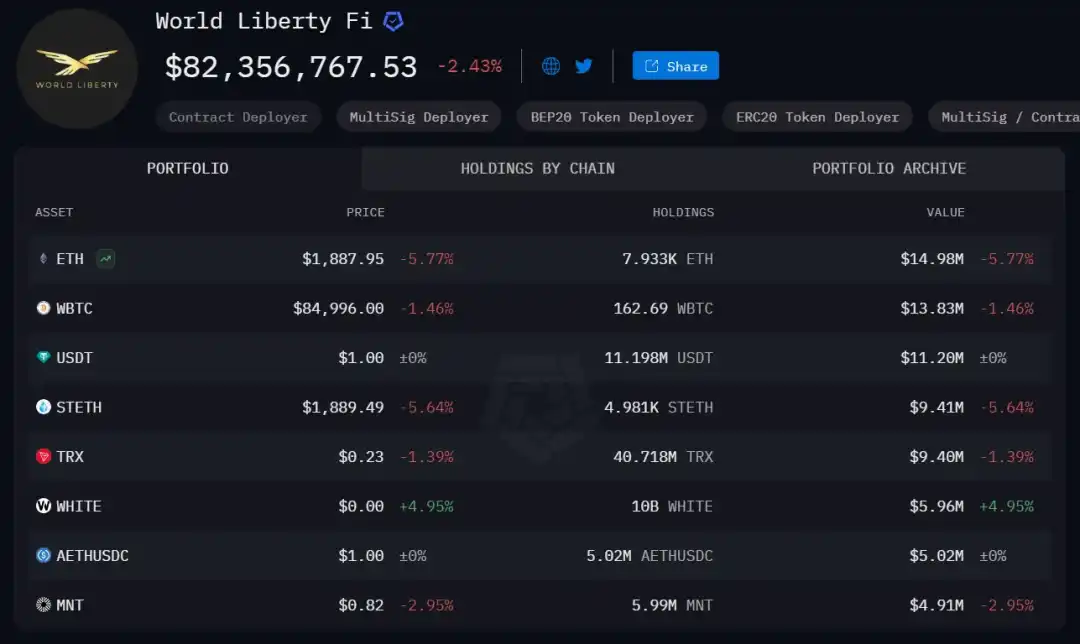
The DeFi project World Liberty Financial (WLFI) supported by the Trump family, launched in 2024, has had a multidimensional impact on the cryptocurrency industry with its political background and capital operation. WLFI is seen as a "litmus test" for the Trump administration's crypto-friendly policy, and its asset allocation and strategic partnerships are interpreted by the market as a "presidential selection portfolio," attracting investors to follow suit. Short-term actions may exacerbate the market's reliance on the "political narrative" and drive price fluctuations of specific tokens, necessitating long-term vigilance against policy reversals. Additionally, WLFI's USD1 stablecoin released in March 2025 emphasizes compliance and institutional-grade custody. If successfully integrated into cross-border payments and the DeFi scene, it may weaken the market share of existing stablecoins, while advancing the digitization of the dollar and cementing the U.S.'s dominant position in the global financial system.
Furthermore, WLFI's operation benefits from the Trump administration's policy adjustments, providing a compliance template for similar projects, lowering industry compliance thresholds, attracting traditional financial institutions to participate in the crypto business, but potentially leading to market bubbles due to regulatory arbitrage.
In terms of long-term strategic value, WLFI is heavily invested in various cryptocurrencies such as BTC, ETH, AAVE, ONDO, and ENA, echoing the "Strategic Crypto Reserve" policy promoted by the Trump administration. This positioning may attract more capital to cryptocurrency assets, thereby driving digital asset reserves to become a core narrative in the next cycle. At the same time, WLFI's operating model has provided a "government-business collaboration" reference case for other projects, potentially leading to more politically backed crypto projects in the future. However, a balance between compliance and decentralization principles is necessary.
In summary, WLFI's impact on the cryptocurrency industry has a double-edged sword effect. On the one hand, it accelerates the compliance process through political empowerment, promotes the integration of DeFi and institutional capital, and explores the global application of the USD stablecoin. On the other hand, relying on policy dividends may lead to market bubbles, opaque distribution of benefits may trigger a trust crisis, and poor project execution may become a negative industry example. In the future, it is crucial to focus on WLFI's product implementation progress, the market acceptance of USD1, and the role of the Trump administration's policy consistency in supporting it.
Integration of CEX and DEX
As key entry points into the crypto world, trading platforms and Web3 wallets play a significant role. Users often start their crypto journey on mainstream trading platforms by using fiat currency to top up their assets, engage in cryptocurrency trading, lending, financial activities, or interact with various dApps using Web3 wallets on different blockchains. In the past, the boundary between the two was clear. Due to the high entry barrier and educational cost of Web3 wallets, ordinary users mostly begin their Web3 journey on trading platforms. Centralized trading platforms retain users by offering more mature and widely available services compared to decentralized dApps. Especially by 2025, trading platform businesses are more mature than the previous cycle, with Binance announcing in 2024 that its user base reached 200 million, doubling compared to the previous cycle. In contrast, native Web3 On-Chain users, constrained by various factors, have a daily on-chain activity of only about 10% of centralized trading platforms.
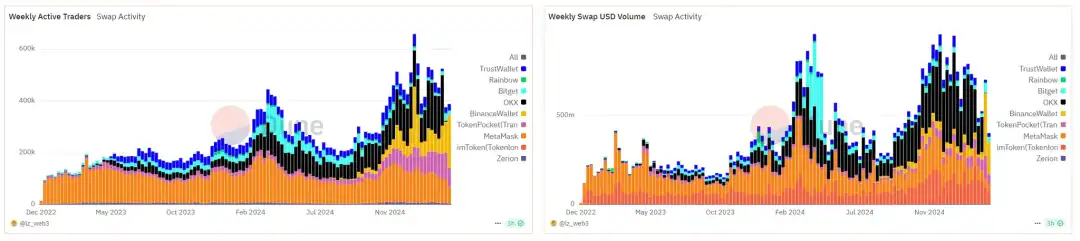
Since 2023, trading platforms have entered the Web3 Wallet product market, leveraging the accumulation and precipitation of assets managed in their trading platform wallets. Among them, OKX Wallet has attracted numerous users at the product level, successfully engaging a large number of users through outstanding user experience in asset management, on-chain interaction, and transaction optimization. CEXs utilize their advantages in the trading platform wallet module, such as building different public chain RPCs, to create more comprehensive and superior wallet products, attracting and retaining users. However, OKX Wallet fundamentally has no significant difference from traditional Web3 wallets; it is merely a more advanced and convenient multi-chain wallet that does not break the usage barrier of native Web3 wallets.
The Binance Web3 Wallet is closely integrated with the trading platform account, initially supporting fast transfers between on-platform assets and Web3 wallets to reduce security concerns for users using Web3 wallets, providing protection from the exchange platform. Additionally, the Binance Web3 ecosystem has launched multiple rounds of IDOs aimed at ordinary users in collaboration with mainstream DEXs, attracting more on-platform users to participate and learn about on-chain knowledge. Furthermore, its latest wallet feature allows on-platform users to directly purchase Alpha series on-chain assets, enabling the direct purchase of on-chain assets from within a CEX, thereby breaking the traditional boundaries between CEXs and DEXs.
Data Source: Dune, https://dune.com/lz_web3/wallet-war
Unlike mainstream CEX-dominated Web3 Wallets, native crypto projects in the wallet space can focus on the practical and urgent needs of on-chain users. Leveraging years of experience in MPC and account abstraction technology, Particle Network identified the unified account demand driven by cross-chain transactions and introduced UniversalX. This product integrates wallet and trading platform functionalities, effectively addressing the challenges of transferring and trading different chain assets, helping users easily manage assets and conduct efficient transactions in a multi-chain environment. With this innovative product, Particle Network has gained a good reputation and widespread recognition in the market.
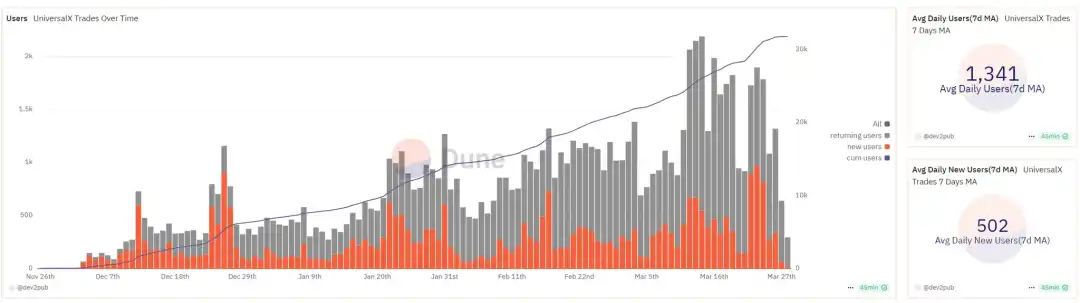
Data Source: Dune
The fusion of CEXs and DEXs is not only a technical innovation but also a milestone in the cryptocurrency market's transition from "oppositional fragmentation" to "collaborative symbiosis." This transformation, while improving efficiency and inclusivity, has also brought about new challenges in regulation, security, and governance. In the future, whoever can better balance centralized efficiency with decentralized asset security and autonomy will lead the evolution of the next-generation financial infrastructure.
Project Investment

SOON
Project Introduction
Soon, through the removal of the governance voting mechanism, enhancing dApps efficiency, integrating a data availability layer, and introducing a fraud-proof mechanism, has restructured and introduced its proprietary Solana Virtual Machine — Soon SVM. This provides an efficient and high-performance scaling solution for mainstream blockchains such as Bitcoin and Ethereum. Building on this foundation, Soon has launched InterSOON to support interoperability between different chains, integrating Jump's high-performance Solana client Firedance. Soon will launch its own SVM network SOON based on the SVM framework and deploy it on multiple public chains such as Bitcoin, Ethereum, TON, and BSC. Through InterSOON, providing internal liquidity pools and interoperability features, Soon achieves seamless asset and data transfers between different blockchains.
Why Invest in Soon
In the current flourishing blockchain ecosystem, the pursuit of high performance has always been a core driving force behind technological innovation. Existing fraud-proof Rollup layer 2 solutions cleverly separate the execution layer from the data availability layer, allowing different components to focus on their respective tasks and laying a solid foundation for improving overall performance. With the increasing maturity of technologies such as EigenDA and Celestia DA, a high-performance execution layer becomes particularly crucial. Among the many projects exploring a high-performance execution layer, projects like Monad and MegaETH focus on the development of a high-performance EVM, while Movement achieves a breakthrough through MoveVM. For Solana, which carries a significant on-chain daily active user base and transaction volume, its SVM has also been a highly successful choice for the execution layer.
However, the native SVM previously had some limitations, such as lack of DA integration support, relatively low efficiency, and inability to accommodate fraud proofs, making it difficult to directly use as an execution layer. Soon astutely identified this pain point and, through the development of Decoupled SVM, successfully added fraud-proof support to the SVM, achieved efficient DA integration, optimized Merkle technology, significantly enhanced security and scalability, and maintained consistency with Ethereum's MPT (Merkle Patricia Trie). This demonstrates Soon's profound technical strength and establishes its position in the high-performance blockchain arena, bringing new technological possibilities and application scenarios to the Solana ecosystem and the entire blockchain industry.
Looking back on the multi-cycle development history of blockchain, Solana has built a large and robust ecosystem thanks to its resilience. Sufficient on-chain funds and numerous active users have provided a solid foundation for Solana's continuous development. As a key component of Solana, SVM is not only the core of its technical architecture but also a symbol of the Solana ecosystem.
Building on SVM, the Soon project can provide extension support for other public chains, unlock more on-chain funds, and attract excellent projects from the Solana ecosystem to build on it. For developers, Soon's high-performance SVM execution layer and mature DA integration solution will significantly reduce development complexity, enhance development efficiency, allowing them to focus more on innovative application development, further enriching the SVM ecosystem, and driving the entire blockchain industry forward.
The development speed of the Soon team is impressive, achieving significant milestones in a mere six months from project initiation. During this time, they not only successfully launched the SOON Devnet and Testnet but also smoothly launched the Mainnet and svmBNB. This series of rapid and solid progress fully demonstrates the team's outstanding development capabilities. Additionally, Soon's Co-builders Round has attracted many well-known project founders to participate, such as Anatoly Yakovenko, co-founder of Solana Labs, and Mustafa AI-Bassam, co-founder of Celestia. This is not only a high recognition of Soon's technical solution but also a strong endorsement of its future development.
Soon upholds a community-centric tokenomics concept, integrating community at the core of the project's development. This concept deeply binds the Soon token with the user community, enabling the community's power, demands, and the project's growth to synergize. In the blockchain industry, the community is one of the project's most valuable assets. An active and loyal community can bring sustained attention, financial support, and valuable feedback to the project. When community members actively participate in project governance, ecosystem development, and other activities, their efforts will influence the project's direction and value.
ArkStream Capital's strategic investment in Soon is a key step in ArkStream Capital's strategic positioning in the Solana ecosystem and SVM field. ArkStream Capital believes that the prosperity of Solana and its SVM ecosystem is one of the undeniable trends in the blockchain industry. ArkStream Capital looks forward to close cooperation with Soon to jointly promote the continuous innovation and development of blockchain technology, and to help the SVM ecosystem move towards a more prosperous future.
Research Reports
ArkStream Capital: 4 Strategic Upgrades Behind Particle: https://mp.weixin.qq.com/s/X5GbpL_yOsnAYtAT9PC6Bw
ArkStream Capital: Crypto's Watershed Year, Embracing the 2025 Carnival: https://mp.weixin.qq.com/s/BSU6CeTZB_dXgvCGX9WbPw
Event Hosting and Participation
Offline Events
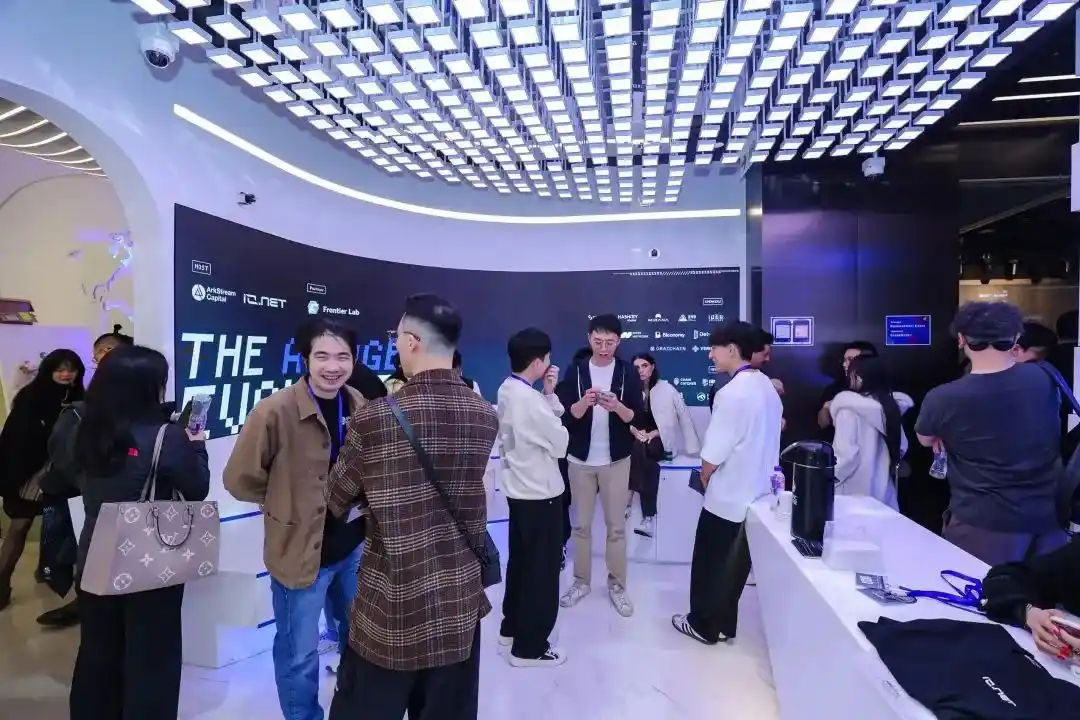
Hosted【Hong Kong Consensus】The AI Agent Evolution: https://mp.weixin.qq.com/s/lSw-4YJqTxYXitIY2C6AXg
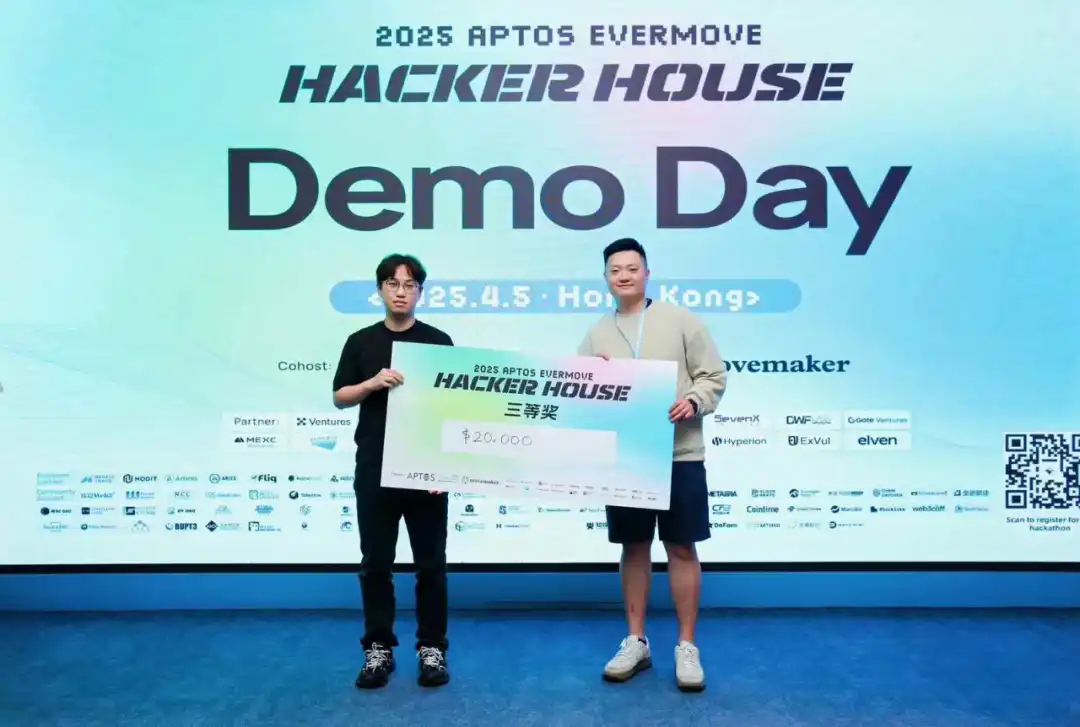
Served as a judge at Aptos' Movemaker Community's【Hacker House Demo Day】: https://x.com/MovemakerCN/status/1903080919780692029
Engaged in discussions on the future of VC with funds like Spartan, Galaxy, Maelstrom, Reciprocal, and others

Online Event
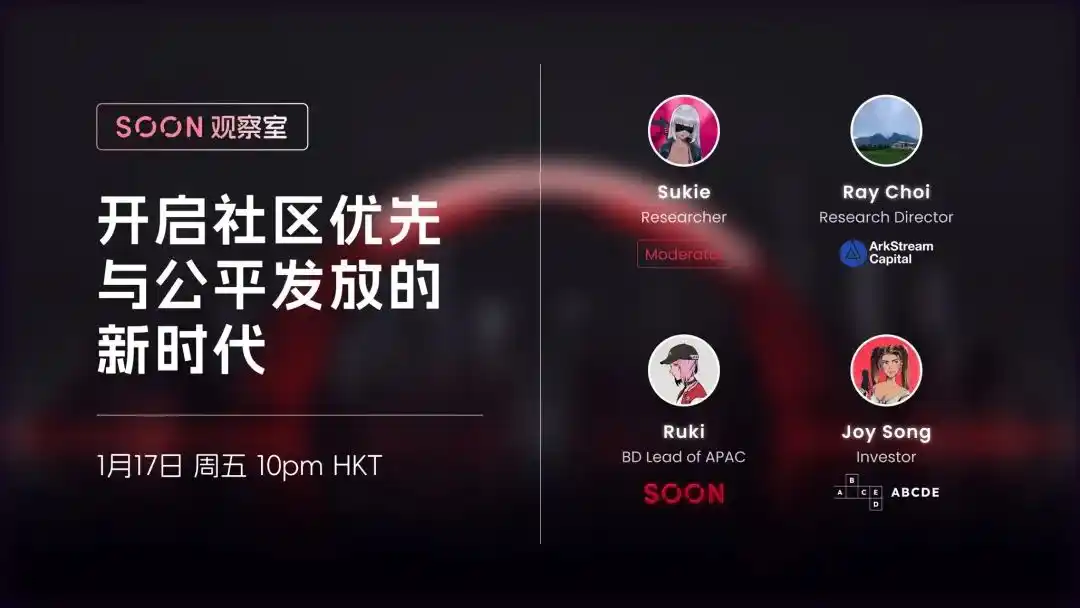
Participated as a guest in SOON's AMA [Initiating a New Era of Community-First and Fair Distribution]: https://x.com/soon_svm/status/1879911091456901512
猜你喜歡

穩定幣驅動全球B2B支付革新,如何打破工作流程瓶頸釋放兆市場潛力?
這些新創公司正在無需資料中心的情況下建立先進AI模型
CEX與Wallet之後,OKX入局支付
RWA永續產品危機:為什麼GLP模式註定撐不住RWA永續?
科學平權運動:DeSci的萬億美元知識經濟重建革命
Sentient深度研報:獲8,500萬美元融資,建置去中心化AGI新範式
專訪Virtuals聯創empty:AI 創業不需要大量資金,Crypto是答案之一
今年 2 月,Base 生態中的 AI 協議 Virtuals 宣布跨鏈至 Solana,然而加密市場隨後進入流動性緊縮期,AI Agent 板塊從人聲鼎沸轉為低迷,Virtuals 生態也陷入一段蟄伏期。
三月初,BlockBeats 對 Virtuals 共同創辦人 empty 進行了一次專訪。彼時,團隊尚未推出如今被廣泛討論的 Genesis Launch 機制,但已在內部持續探索如何透過機制設計激活舊資產、提高用戶參與度,並重構代幣發行與融資路徑。那是一個市場尚未復甦、生態尚處冷啟動階段的時間點,Virtuals 團隊卻沒有停下腳步,而是在努力尋找新的產品方向和敘事突破口。
兩個月過去,AI Agent 板塊重新升溫,Virtuals 代幣反彈超 150%,Genesis 機製成為帶動生態回暖的重要觸發器。從積分獲取規則的動態調整,到專案參與熱度的持續上升,再到「新代幣帶老代幣」的機制閉環,Virtuals 逐漸走出寒冬,並再次站上討論焦點。
值得注意的是,Virtuals 的 Genesis 機制與近期 Binance 推出的 Alpha 積分系統有一些相似之處,評估用戶在 Alpha 和幣安錢包生態系統內的參與度,決定用戶 Alpha 代幣空投的資格。用戶可透過持倉、交易等方式獲得積分,積分越高,參與新項目的機會越大。透過積分系統篩選使用者、分配資源,專案方能夠更有效地激勵社群參與,提升專案的公平性和透明度。 Virtuals 和 Binance 的探索,或許預示著加密融資的新趨勢正在形成。
回看這次對話,empty 在專訪中所展現出的思路與判斷,正在一步步顯現其前瞻性,這不僅是一場圍繞打新機制的訪談,更是一次關於“資產驅動型 AI 協議”的路徑構建與底層邏輯的深度討論。
BlockBeats:可以簡單分享一下最近團隊主要在忙些什麼?
empty:目前我們的工作重點主要有兩個部分。第一部分,我們希望將 Virtuals 打造成一個類似「華爾街」的代理人(Agent)服務平台。設想一下,如果你是專注於 Agent 或 Agent 團隊建立的創業者,從融資、發幣到流動性退出,整個流程都需要係統性的支援。我們希望為真正專注於 Agent 和 AI 研發的團隊,提供這一整套服務體系,讓他們可以把精力集中在底層能力的開發上,而不用為其他環節分心。這一塊的工作其實也包括了與散戶買賣相關的內容,後面可以再詳細展開。
第二部分,我們正在深入推進 AI 相關的佈局。我們的願景是建立一個 AI 社會,希望每個 Agent 都能聚焦自身優勢,同時透過彼此之間的協作,實現更大的價值。因此,最近我們發布了一個新的標準——ACP(Agent Communication Protocol),目的是讓不同的 Agent 能夠相互互動、協作,共同推動各自的業務目標。這是目前我們主要在推進的兩大方向。
BlockBeats:可以再展開說說嗎?
empty:在我看來,其實我們面對的客戶群可以分為三類:第一類是專注於開發 Agent 的團隊;第二類是投資者,包括散戶、基金等各種投資機構;第三類則是 C 端用戶,也就是最終使用 Agent 產品的個人用戶。
不過,我們主要的精力其實是放在前兩大類──也就是團隊和投資人。對於 C 端用戶這一塊,我們並不打算直接介入,而是希望各個 Agent 團隊能夠自己解決 C 端市場的拓展問題。
此外,我們也認為,Agent 與 Agent 之間的交互作用應該成為一個核心模式。簡單來說,就是未來的服務更多應該是由一個 Agent 銷售或提供給另一個 Agent,而不是單純賣給人類使用者。因此,在團隊的 BD 工作中,我們也積極幫助現有的 AI 團隊尋找這樣的客戶和合作機會。
BlockBeats:大概有一些什麼具體案例呢?
empty:「華爾街」說白了就是圍繞資本運作體系的建設,假設你是一個技術團隊,想要融資,傳統路徑是去找 VC 募資,拿到資金後開始發展。如果專案做得不錯,接下來可能會考慮進入二級市場,例如在紐約證券交易所上市,或是在 Binance 這樣的交易所上幣,實現流動性退出。
我們希望把這一整套流程打通-從早期融資,到專案開發過程中對資金的靈活使用需求,再到最終二級市場的流動性退出,全部覆蓋和完善,這是我們希望補齊的一條完整鏈條。
而這一部分的工作和 ACP(Agent Communication Protocol)是不同的,ACP 更多是關於 Agent 與 Agent 之間交互標準的製定,不直接涉及資本運作系統。
BlockBeats:它和現在 Virtuals 的這個 Launchpad 有什麼差別呢?資金也是從 C 端來是嗎?
empty:其實現在你在 Virtuals 上發幣,如果沒有真正融到資金,那就只是發了一個幣而已,實際是融不到錢的。我們目前能提供的服務,是透過設定買賣時的交易稅機制,從中提取一部分稅收回饋給創業者,希望這部分能成為他們的現金流來源。
不過,問題其實還分成兩塊。第一是如何真正幫助團隊完成融資,這個問題目前我們還沒有徹底解決。第二是關於目前專案發行模式本身存在的結構性問題。簡單來說,現在的版本有點像過去 Pumpfun 那種模式——也就是當專案剛上線時,部分籌碼就被外賣給了外部投資人。但現實是,目前整個市場上存在著太多機構集團和「狙擊手」。
當一個真正優秀的專案一發幣,還沒真正觸達普通散戶,就已經被機構在極高估值時搶購了。等到散戶能夠接觸到時,往往價格已經偏高,專案品質也可能變差,整個價值發行體係被扭曲。
針對這個問題,我們希望探索一種新的發幣和融資模式,目的是讓專案方的籌碼既不是死死握在自己手裡,也不是優先流向英文圈的大機構,而是能夠真正留給那些相信專案、願意長期支持專案的普通投資者手中。我們正在思考該如何設計這樣一個新的發行機制,來解決這個根本問題。
BlockBeats:新模式的具體想法會是什麼樣子呢?
empty:關於資金這一塊,其實我們目前還沒有完全想透。現階段來看,最直接的方式還是去找 VC 融資,或是採取公開預售等形式進行資金募集。不過說實話,我個人對傳統的公開預售模式並不是特別認同。
在「公平發售」這件事上,我們正在嘗試換一個角度來思考-希望能從「reputation」出發,重新設計機制。
具體來說,就是如果你對整個 Virtuals 生態有貢獻,例如早期參與、提供支持或建設,那麼你就可以在後續購買優質代幣時享有更高的優先權。透過這種方式,我們希望把資源更多留給真正支持生態發展的用戶,而不是由短期套利的人主導。
BlockBeats:您會不會考慮採用類似之前 Fjord Foundry 推出的 LBP 模式,或者像 Daos.fun 那種採用白名單機制的模式。這些模式在某種程度上,和您剛才提到的「對生態有貢獻的人享有優先權」的想法是有些相似的。不過,這類做法後來也引發了一些爭議,例如白名單內部操作、分配不公等問題。 Virtuals 在設計時會考慮借鏡這些模式的優點,或有針對性地規避類似的問題嗎?
empty:我認為白名單機制最大的問題在於,白名單的選擇權掌握在專案方手中。這和「老鼠倉」行為非常相似。專案方可以選擇將白名單名額分配給自己人或身邊的朋友,導致最終的籌碼仍然掌握在少數人手中。
我們希望做的,依然是類似白名單的機制,但不同的是,白名單的獲取權應基於一個公開透明的規則體系,而不是由項目方單方面決定。只有這樣,才能真正做到公平分配,避免內幕操作的問題。
我認為在今天這個 AI 時代,很多時候創業並不需要大量資金。我常跟團隊強調,你們應該優先考慮自力更生,例如透過組成社區,而不是一開始就想著去融資。因為一旦融資,實際上就等於背負了負債。
我們更希望從 Training Fee的角度去看待早期發展路徑。也就是說,專案可以選擇直接發幣,透過交易稅所帶來的現金流,支持日常營運。這樣一來,專案可以在公開建設的過程中獲得初步資金,而不是依賴外部投資。如果專案做大了,自然也會有機會透過二級市場流動性退出。
當然最理想的情況是,專案本身能夠有穩定的現金流來源,這樣甚至連自己的幣都無需拋售,這才是真正健康可持續的狀態。
我自己也常在和團隊交流時分享這種思路,很有意思的是,那些真正抱著「搞快錢」心態的項目,一聽到這種機制就失去了興趣。他們會覺得,在這種模式下,既無法操作老鼠倉,也很難短期套利,於是很快就選擇離開。
但從我們的角度來看,這其實反而是個很好的篩選機制。透過這種方式,理念不同的專案自然會被過濾出去,最後留下的,都是那些願意真正建立、和我們價值觀契合的團隊,一起把事情做起來。
BlockBeats:這個理念可以發展出一些能夠創造收益的 AI agent。
empty:我覺得這是很有必要的。坦白說,放眼今天的市場,真正擁有穩定現金流的產品幾乎鳳毛麟角,但我認為這並不意味著我們應該停止嘗試。事實上,我們每天在對接的團隊中,有至少一半以上的人依然懷抱著長遠的願景。很多時候,他們甚至已經提前向我們提供了 VC 階段的資金支持,或表達了強烈的合作意願。
其實對他們來說想要去收穫一個很好的社區,因為社區可以給他們的產品做更好的回饋,這才是他們真正的目的。這樣聽起來有一點匪夷所思,但其實真的有很多這樣的團隊,而那種團隊的是我們真的想扶持的團隊。
BlockBeats:您剛才提到的這套「AI 華爾街」的產品體系-從融資、發行到退出,建構的是一整套完整的流程。這套機制是否更多是為了激勵那些有意願發幣的團隊?還是說,它在設計上也考慮瞭如何更好地支持那些希望透過產品本身的現金流來發展的團隊?這兩類團隊在您這套體系中會不會被區別對待,或者說有什麼機制設計能讓不同路徑的創業者都能被合理支持?
empty:是的,我們 BD 的核心職責其實就是去鼓勵團隊發幣。說得直接一點,就是引導他們思考發幣的可能性和意義。所以團隊最常問的問題就是:「為什麼要發幣?」這時我們需要採取不同的方式和角度,去幫助他們理解背後的價值邏輯。當然如果最終判斷不適合,我們也不會強迫他們推進。
不過我們觀察到一個非常明顯的趨勢,傳統的融資路徑已經越來越難走通了。過去那種融資做大,發幣上所的模式已經逐漸失效。面對這樣的現實,很多團隊都陷入了尷尬的境地。而我們希望能從鏈上和加密的視角,提供一套不同的解決方案,讓他們找到新的發展路徑。
BlockBeats:明白,我剛才其實想表達的是,您剛剛也提到,傳統的 AI 模式在很大程度上仍然依賴「燒錢」競爭。但在 DeepSeek 出現之後,市場上一些資金體積較小的團隊或投資人開始重新燃起了信心,躍躍欲試地進入這個領域。您怎麼看待這種現象?這會不會對目前正在做 AI 基礎研發,或是 AI 應用層開發的團隊產生一定的影響?
empty:對,我覺得先不談 DeepSeek,從傳統角度來看,其實到目前為止,AI 領域真正賺錢的只有英偉達,其他幾乎所有玩家都還沒有實現盈利。所以其實沒有人真正享受了這個商業模式的成果,大家也仍在探索如何面對 C 端打造真正有產出的應用。
沒有哪個領域像幣圈一樣能如此快速獲得社群回饋。你一發幣,用戶就會主動去讀白皮書的每一個字,試試你產品的每個功能。
當然,這套機制並不適合所有人。例如有些 Agent 產品偏 Web2,對於幣圈用戶而言,可能感知不到其價值。因此,我也會鼓勵做 Agent 的團隊在 Virtuals 生態中認真思考,如何真正將 Crypto 作為自身產品的差異化要素加以運用與設計。
BlockBeats:這點我特別認同,在 Crypto 這個領域 AI 的迭代速度確實非常快,但這群用戶給予的回饋,真的是代表真實的市場需求嗎?或者說這些回饋是否真的符合更大眾化、更具規模性的需求?
empty:我覺得很多時候產品本身不應該是強行推廣給不適合的使用者群體。例如 AIXBT 最成功的一點就在於,它的用戶本身就是那群炒作他人內容的人,所以他們的使用行為是非常自然的,並不覺得是在被迫使用一個無聊的產品。 mass adoption 這個概念已經講了很多年,大家可能早就該放棄這個執念了。我們不如就認了,把東西賣給幣圈的人就好了。
BlockBeats:AI Agent 與 AI Agent 所對應的代幣之間,究竟應該是什麼樣的動態關係?
empty:對,我覺得這裡可以分成兩個核心點。首先其實不是在投資某個具體的 AI Agent,而是在投資背後經營這個 Agent 的團隊。你應該把它理解為一種更接近創投的思路:你投的是這個人,而不是他目前正在做的產品。因為產品本身是可以快速變化的,可能一個月後團隊會發現方向不對,立即調整。所以,這裡的「幣」本質上代表的是對團隊的信任,而不是某個特定 Agent 本身。
第二則是期望一旦某個 Agent 產品做出來後,未來它能真正產生現金流,或者有實際的使用場景(utility),從而讓對應的代幣具備賦能效應。
BlockBeats:您覺得有哪些賦能方式是目前還沒看到的,但未來可能出現、值得期待的?
empty:其實主要有兩塊,第一是比較常見的那種你要使用我的產品,就必須付費,或者使用代幣支付,從而間接實現對代幣的「軟銷毀」或消耗。
但我覺得更有趣的賦能方式,其實是在獲客成本的角度思考。也就是說,你希望你的用戶同時也是你的投資者,這樣他們就有動機去主動幫你推廣、吸引更多用戶。
BlockBeats:那基於這些觀點,您怎麼看 ai16z,在專案設計和代幣機制方面,似乎整體表現並不太樂觀?
empty:從一個很純粹的投資角度來看,撇開我們與他們之間的關係,其實很簡單。他們現在做的事情,對代幣本身沒有任何賦能。從開源的角度來看,一個開源模型本身是無法直接賦能代幣的。
但它仍然有價值的原因在於,它像一個期權(call option),也就是說,如果有一天他們突然決定要做一些事情,比如推出一個 launchpad,那麼那些提前知道、提前參與的人,可能會因此受益。
開發者未來確實有可能會使用他們的 Launchpad,只有在那一刻,代幣才會真正產生賦能。這是目前最大的一個問號——如果這個模式真的跑得通,我認為確實會非常強大,因為他們的確觸達了大量開發者。
但我個人還是有很多疑問。例如即使我是使用 Eliza 的開發者,也不代表我一定會選擇在他們的 Launchpad 上發幣。我會貨比三家,會比較。而且,做一個 Launchpad 和做一個開源框架,所需的產品能力和社群運作能力是完全不同的,這是另一個重要的不確定性。
BlockBeats:這種不同是體現在什麼地方呢?
empty:在 Virtuals 上我們幾乎每天都在處理客服相關的問題,只要有任何一個團隊在我們平台上發生 rug,即使與我們沒有直接關係,用戶也會第一時間來找我們投訴。
這時我們就必須出面安撫用戶,並思考如何降低 rug 的整體風險。一旦有團隊因為自己的代幣設計錯誤或技術失誤而被駭客攻擊、資產被盜,我們往往需要自掏腰包,確保他們的社群至少能拿回一點資金,以便專案能夠重新開始。這些項目方可能在技術上很強,但未必擅長代幣發行,結果因操作失誤被攻擊導致資產損失。只要涉及「被欺騙」相關的問題,對我們來說就已經是非常麻煩的事了,做這些工作跟做交易所的客服沒有太大差別。
另一方面,做 BD 也非常困難。優秀的團隊手上有很多選擇,他們可以選擇在 Pumpfun 或交易所上發幣,為什麼他們要來找我們,那這背後必須要有一整套支援體系,包括融資支援、技術協助、市場推廣等,每個環節都不能出問題。
BlockBeats:那我們就繼續沿著這個話題聊聊 Virtuals 目前的 Launchpad 業務。有一些社群成員在 Twitter 上統計了 Virtuals Launchpad 的整體獲利狀況,確實目前看起來獲利的項目比較少。接下來 Launchpad 還會是 Virtuals 的主要業務區嗎?還是說,未來的重心會逐漸轉向您剛才提到的「AI 華爾街」這條路徑?
empty:其實這兩塊本質上是一件事,是一整套體系的一部分,所以我們必須繼續推進。市場的波動是很正常的,我們始終要堅持的一點是:非常清楚地認識到我們的核心客戶是誰。我一直強調我們的客戶只有兩類——團隊。所以市場行情的好壞對我們來說並不是最重要的,關鍵是在每一個關鍵節點上,對於一個團隊來說,發幣的最佳選擇是否依然是我們 Virtuals。
BlockBeats:您會不會擔心「Crypto + AI」或「Crypto AI Agent」這一類敘事已經過去了?如果未來還有一輪多頭市場,您是否認為市場炒作的焦點可能已經不再是這些方向了?
empty:有可能啊,我覺得 it is what it is,這確實是有可能發生的,但這也屬於我們無法控制的範圍。不過如果你問我,在所有可能的趨勢中,哪個賽道更有機會長期保持領先,我仍然認為是 AI。從一個打德撲的角度來看,它仍然是最優選擇。
而且我們團隊的技術架構和底層能力其實早已搭建完成了,現在只是順勢而為而已。更重要的是,我們本身真的熱愛這件事,帶著好奇心去做這件事。每天早上醒來就有驅動力去研究最新的技術,這種狀態本身就挺讓人滿足的,對吧?
很多時候,大家不應該只看產品本身。實際上很多優秀的團隊,他們的基因決定了他們有在規則中勝出的能力——他們可能過去在做派盤交易時,每筆規模就是上百萬的操作,而這些團隊的 CEO,一年的薪資可能就有 100 萬美金。如果他們願意出來單幹項目,從天使投資或 VC 的視角來看,這本質上是用一個很划算的價格買到一個高品質的團隊。
更何況這些資產是 liquid 的,不是鎖倉狀態。如果你當下不急著用錢,完全可以在早期階段買進一些優秀團隊的代幣,靜靜等待他們去創造一些奇蹟,基本上就是這樣一個邏輯。
第16週鏈上數據:結構性供需失衡加劇,數據揭⽰下⼀輪上漲的堅實藍圖?
a16z領投2500萬美元,0xMiden要在你手機裡跑一條隱私鏈
Sui Q1進階報告:BTCfi基建崛起、借貸協議爆發與執行分片未來
川普次子的加密生意經
SignalPlus宏觀分析:關稅撕裂的M2敘事與TradFi式FOMO的回歸
盤點10大新興Launchpad平台,誰能完成Pump.fun的顛覆?
懂王簽字後,美國哪些州在「乖乖」推進比特幣戰略儲備法案?
GoRich正式上線:鏈上交易零門檻,新手也能抓住100x Meme幣
4月29日市場關鍵情報,你錯過了多少?
PENGU觸底反彈發拉漲360%,胖企鵝如何靠IP行銷迎第二春?


 App
App