

Farcaster Metamorphosis: a16z Spends $180M to Demolish Web3 Social

ABCDE has announced the cessation of new project investments and the suspension of fundraising for its second fund, triggering another round of "VC is dead" lamentation on Crypto Twitter. However, in the previous cycle, VCs shone brightly, relying on storytelling to inflate valuations, packaging each PowerPoint presentation as the future of the internet.
As the decentralized social media leader Farcaster, which has raised a total of $180 million in two bull markets, undoubtedly embodies the VC narrative. However, Farcaster's answer is gradually becoming clear—not betting on "decentralized imagination" anymore but on "assetization execution." Farcaster is not a failed product but rather another narrative collapse in the crypto world. VCs have realized they do not possess the ability to reshape the world; they were merely cashing out of a pre-funded valuation story.
From Farcaster to Warpcast and Back to Farcaster
Recently, Dan, the co-founder of the Farcaster protocol, announced that the team is considering renaming the current official client app, known as Warpcast, back to Farcaster and simultaneously adjusting its web domain to farcaster.xyz. This move aims to simplify the brand system and address the confusion between the protocol and the application for new users.
In 2021, Farcaster was launched as a desktop product, which later transformed into a mobile and web application in 2023 under the name Warpcast. Although the initial renaming was intended to make it easier for other developers to build their own clients based on the protocol if the client (Warpcast) and the protocol itself (Farcaster) had different names, this vision did not materialize as anticipated. According to feedback from the team, in reality, the vast majority of users still register accounts and access the protocol through Warpcast.
In May of last year, BlockBeats analyzed the Farcaster ecosystem, noting that the front-end application Warpcast held the core features of the Farcaster protocol, such as private messaging and channels. The ecosystem exhibited a significant Matthew effect, with unofficial clients struggling to survive in the margins and identifying pain points of Warpcast for feature development. Nevertheless, applications like Supercast and Tako adopted differentiation strategies to build their social platforms.
Related Reading: "No Opportunity on Farcaster anymore?"
Today, the Farcaster team officially announced the rebranding of the Warpcast frontend to Farcaster, somewhat betraying the frontend application developers who chose the Farcaster protocol.
In fact, this renaming operation is just a small reflection of Farcaster's transformation. Since last October, the Farcaster protocol has made adjustments in product updates, strategic positioning, personnel changes, and more.
One detail is that after this, developer meetings will no longer distinguish between "Farcaster topics" and "Warpcast updates" but will focus on specific overall issues such as Growth, Direct Cast, reducing registration costs, Hub stability, FIP governance, and identity systems.
However, in terms of user stickiness, Farcaster has so far failed to overcome the typical cold start platform problem. According to Dune data, since open registration in the second half of 2023, its DAU/MAU ratio has long hovered around 0.2, briefly reaching 0.4 in early 2024 due to DEGEN's popularity surge, then quickly falling back.
The DAU/MAU ratio refers to the ratio of daily active users to monthly active users, used to measure the number of days users interact with the application per month. A ratio approaching 1 indicates higher user activity, while a ratio below 0.2 suggests weak application virality and interactivity.
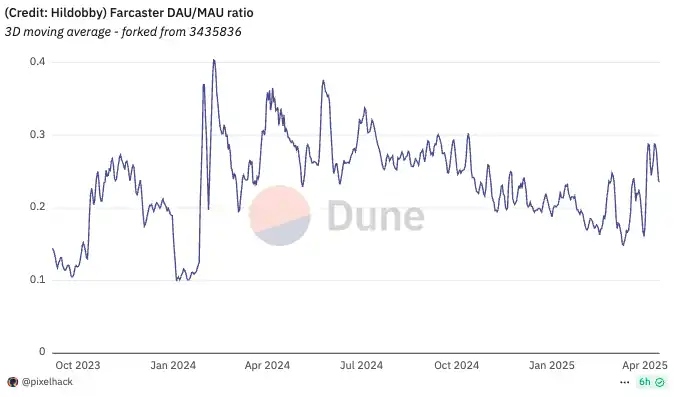
In contrast, early Web2 community products such as Reddit or Mastodon have maintained a stable DAU/MAU ratio in the range of 0.25 to 0.3. Even smaller-scale, more niche social apps like Discord servers often maintain an active ratio above 0.3. Farcaster's data shows that despite its high relevance in the Crypto community, user usage habits have not truly been established, with active users mainly concentrated among a few heavy creators and on-chain natives, without forming a sustainable content consumption and social loop.
Creating Content? Creating Assets? Farcaster Has No Answer
In the initial product logic, Farcaster attempted to build a decentralized social graph through content tools, where the once promising Channel (similar to topic groups) was the core unit carrying communities and traffic in this graph. However, the incentive effect of assets far surpassed the self-organizing ability of content, leading to a shift in product logic.
Abandoned Channel
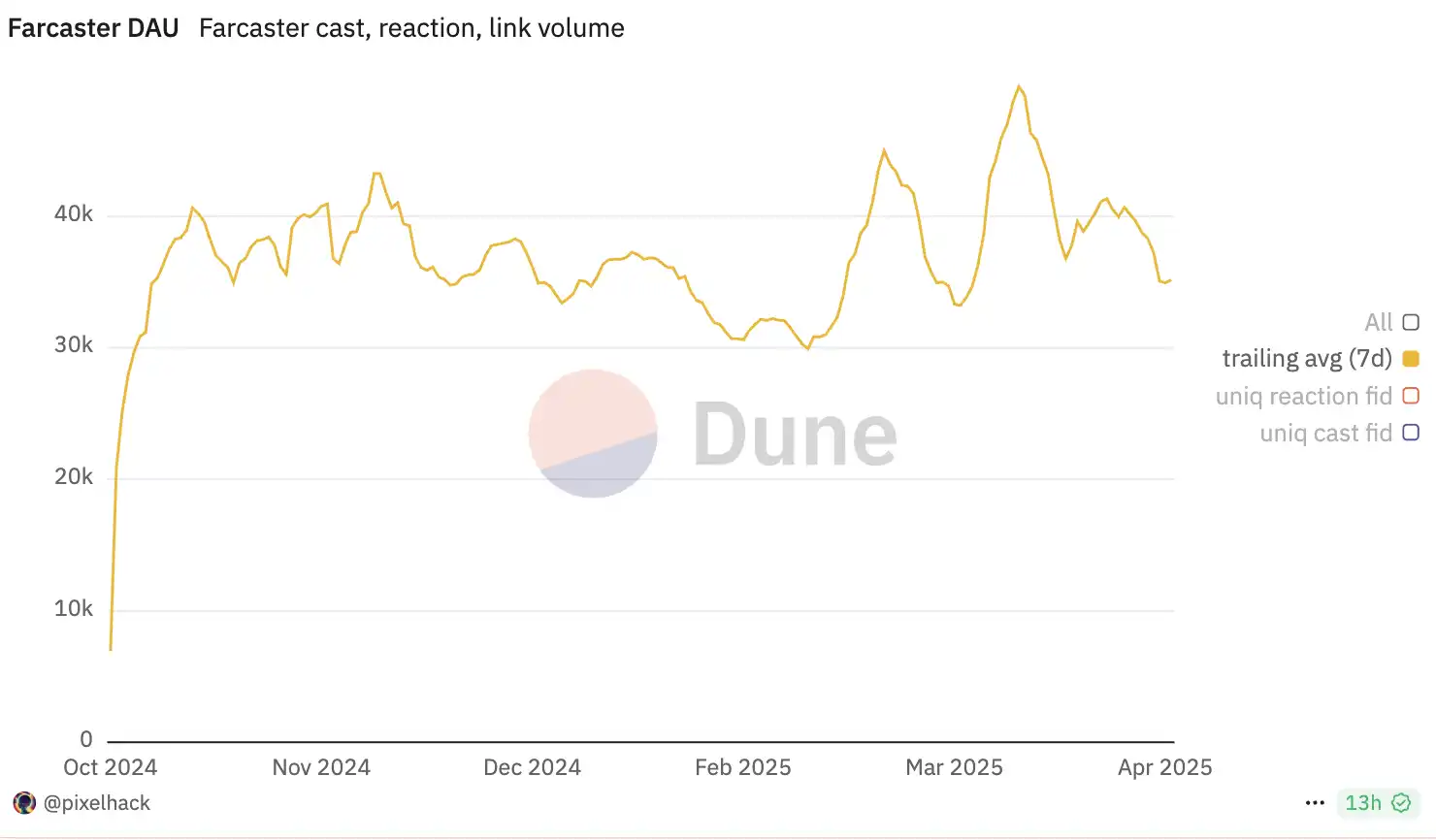
In February 2024, the social token $DEGEN rose to fame in the Warpcast channel named Degen, becoming a key driver of Farcaster's mainstream adoption. At that time, Farcaster had only opened network registration four months prior, with daily active users surpassing 30,000. With the $DEGEN token fermenting and other similarly popular channel tokens like Higher emerging, Farcaster's daily active users peaked at 70,000.
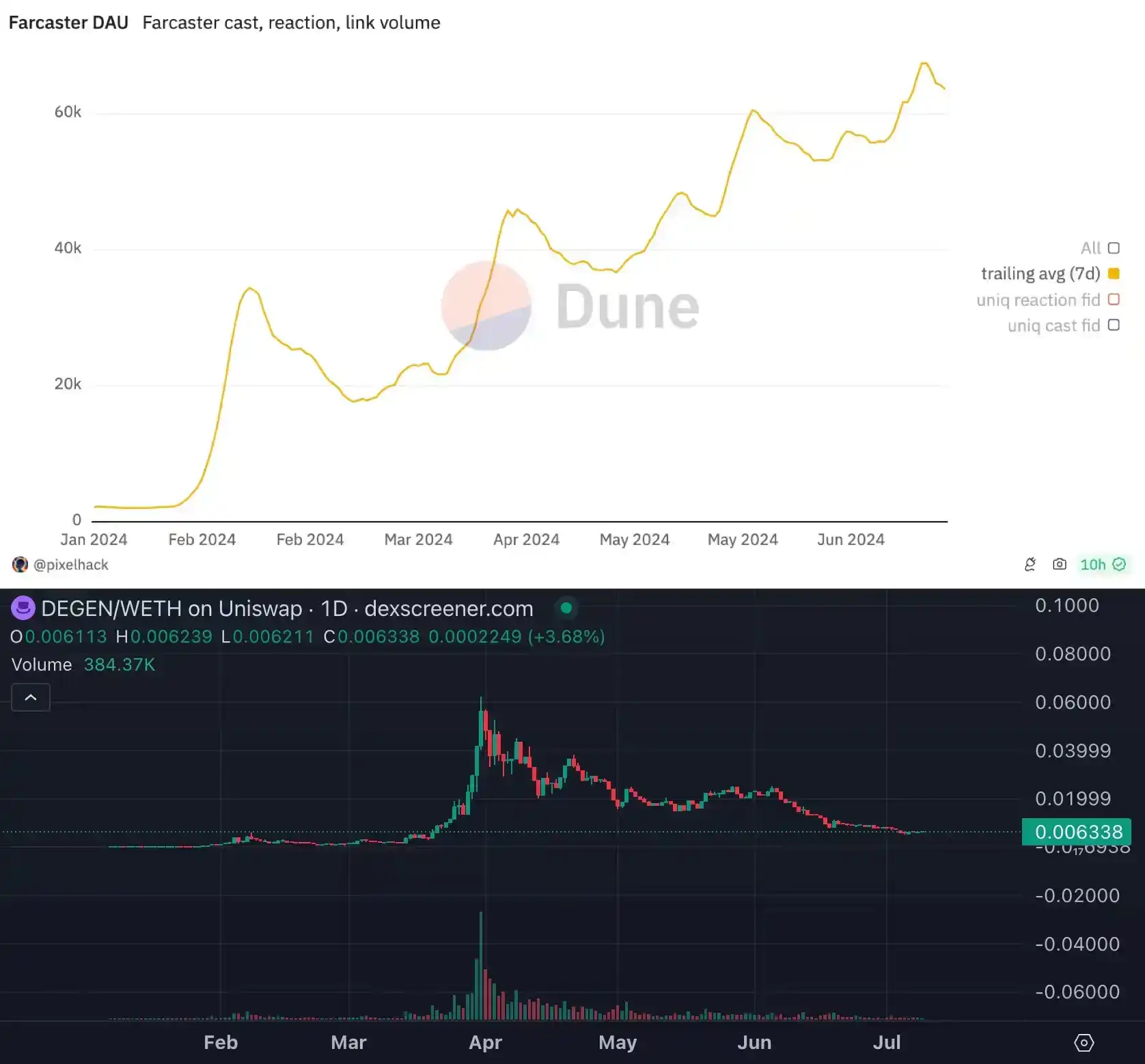
The Farcaster team realized that channels were a vehicle to bring people, attention, and liquidity together. Farcaster's founder, Dan, saw this as a key difference from centralized social media platforms like Twitter, allowing small communities to exist within a broader social graph. Although just a feature of Warpcast, the plan was for full decentralization, where channels could enhance user engagement and create a more intimate social experience by fostering these small, focused communities.
Thus, the team established the core development focus of channels, creating various concepts around it, including channel host rights, channel ownership, and even projects and clients centered around channels. Dan even urged users not to squat on channel names to later sell them to brands, referencing a past incident involving the podcast show Bankless and a user squabble over channel names.
However, this approach did not last long. In July 2024, Farcaster Protocol's network scalability bottleneck became apparent. During a developer conference, the team announced a pause in the decentralization of channels to rethink the implementation path.
When responding to users asking why they couldn't speak in certain topic channels, Dan stated that channels would not bring any additional distribution bonuses. Although there had been attempts in the past, the results were unsatisfactory. He said, "Channels are suitable for community operation but not for discussing a specific topic. We won't recommend them to new users." Historical data showed that channels had a limited impact on user growth, and due to limited resources, the Farcaster team had no immediate plans to add new features to channels.
On the product priority list, Mini App and Wallet took precedence, shifting Farcaster from a content- and social graph-centric social protocol to a transaction-focused protocol, as the latter could attract more native users in the crypto space.
Built-in Wallet Exacerbates Monopoly
In a podcast, Farcaster co-founder Dan shared his latest understanding of the "User" concept: users who only register an account and engage lightly, although superficially increasing activity levels, the true value to the network comes from wallet users who hold cryptocurrency assets and are willing to engage on-chain. This refined user cognition directly influenced the team's product strategy on the wallet system.
By the end of November 2024, Farcaster began exploring the integration of a tradable wallet within the application to facilitate on-chain transactions. The goal is to increase on-chain interaction frequency to enhance ecosystem stickiness and monetization potential. In fact, each Warpcast user already has a "Farcaster Wallet" created by default at registration, which binds user identity for logging into Warpcast and Frames, but since it is only stored locally on the phone, its functionality leans towards authentication and signature rather than fund movement.
In contrast, the newly launched "Warpcast Wallet" is a wallet that can send and receive assets, which users can generate at registration and use for token deposits, exchanges, transfers, and on-chain interaction.
The timing of integrating the tradable wallet by Farcaster is hard not to associate with the emergence of Clanker.
Clanker is an AI Token Issuer on Warpcast, where users can post and tag Clanker to release tradable tokens on Uniswap. Its official token $CLANKER surged 20x in November last year, making Base and Warpcast competitive with Solana in the AI concept space. Also, due to the wealth effect of $CLANKER, Farcaster's daily active users reached a new high since last summer.
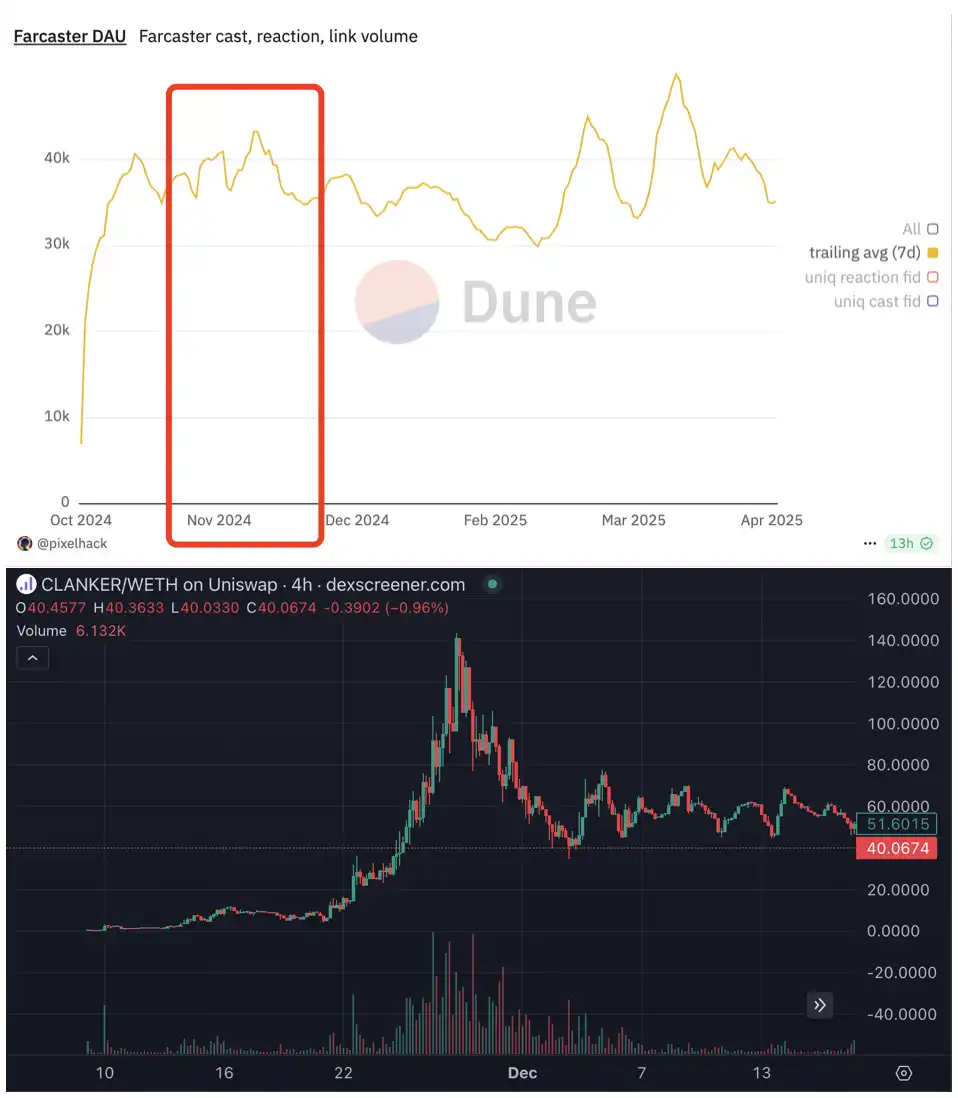
Unlike the fate of $DEGEN, as another breakout target from Warpcast, $CLANKER received attention and support from the team and the core community from the beginning. However, in this process, the Agent, DEX, consumer wallet, etc., all benefited from this asset issuance frenzy, but Warpcast did not receive any economic return.
Clanker's success made the team realize that if more on-chain interactions are to occur within the Farcaster ecosystem, relying solely on open protocols and third-party integrations is not enough; they must have a native tradable wallet system, thus giving rise to the Warpcast Wallet.
From a product design perspective, the role played by the Warpcast Wallet is to act as a bridge between user social interactions and on-chain activities—users can complete transactions, tip, or claim airdrops by simply clicking on Frame without needing to switch interfaces or connect an external wallet. This "social meets financial" product logic makes Farcaster more like a "Singapore" of the crypto world—having a small user base but high wallet activity and per capita funds.
According to the official documentation, users are required to pay a 0.85% fee when using the Warpcast Wallet, with 0.15% going to the 0x Protocol providing transaction routing, and the remaining 0.70% going directly to Warpcast's revenue. Data from Dune shows that since its launch, the revenue curve of the Farcaster protocol has been steadily rising, providing initial validation of the feasibility of the embedded wallet as a monetization path.
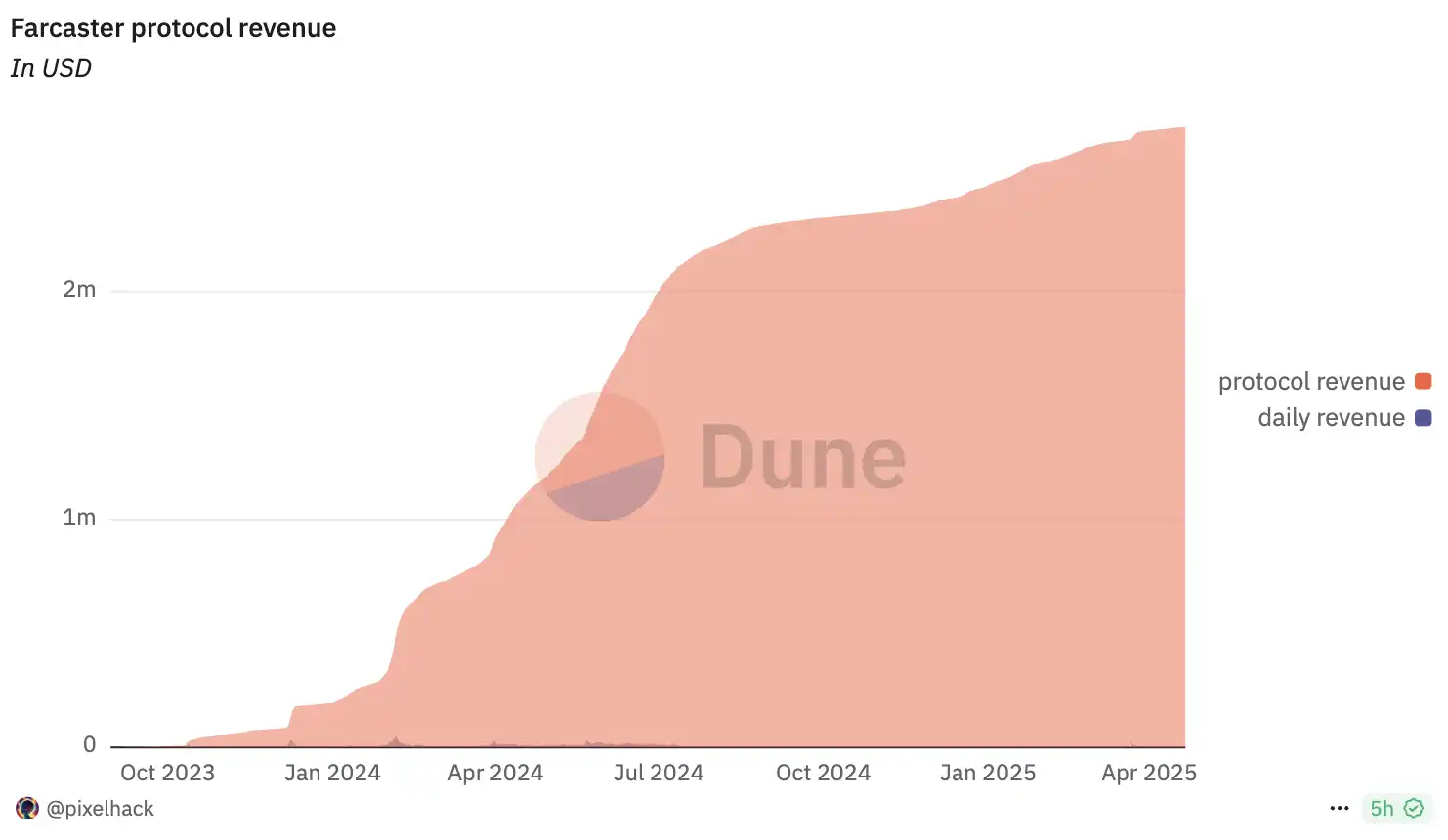
However, it is worth noting that the Warpcast embedded wallet is not written into the protocol layer. Additionally, with the intention of renaming the Warpcast client to Farcaster, BlockBeats has learned that some Farcaster developers believe the protocol is becoming increasingly centralized and monopolistic.
The Greatest Innovation is Just a "WeChat Mini Program"
With the introduction of the embedded wallet, Farcaster has made further progress towards becoming an asset-oriented social application. The official statement mentioned that one of the purposes of launching the wallet was to attract developers to build applications based on the Frame framework and thereby drive the integration of transaction activities and content distribution.
Frame was first introduced in early 2024 as a lightweight application standard running on top of the Farcaster protocol, allowing developers to embed small programs into social clients. When a user clicks on Frame, developers can identify their wallet address and push content to them or trigger interactive operations. However, as the overall popularity of Farcaster has declined, the use of Frame has also shown a clear downward trend.
To address this situation, Farcaster launched Frame v2 at the end of 2024. The new version supports the development of applications with HTML, CSS, and JavaScript that provide a near-native experience. Developers can deploy products quickly using the Mini App SDK without having to go through the app store approval process. Frame v2 not only enhances interaction complexity but also deeply integrates with the embedded wallet, further strengthening transactional attributes, making the overall experience more akin to a WeChat Mini Program.
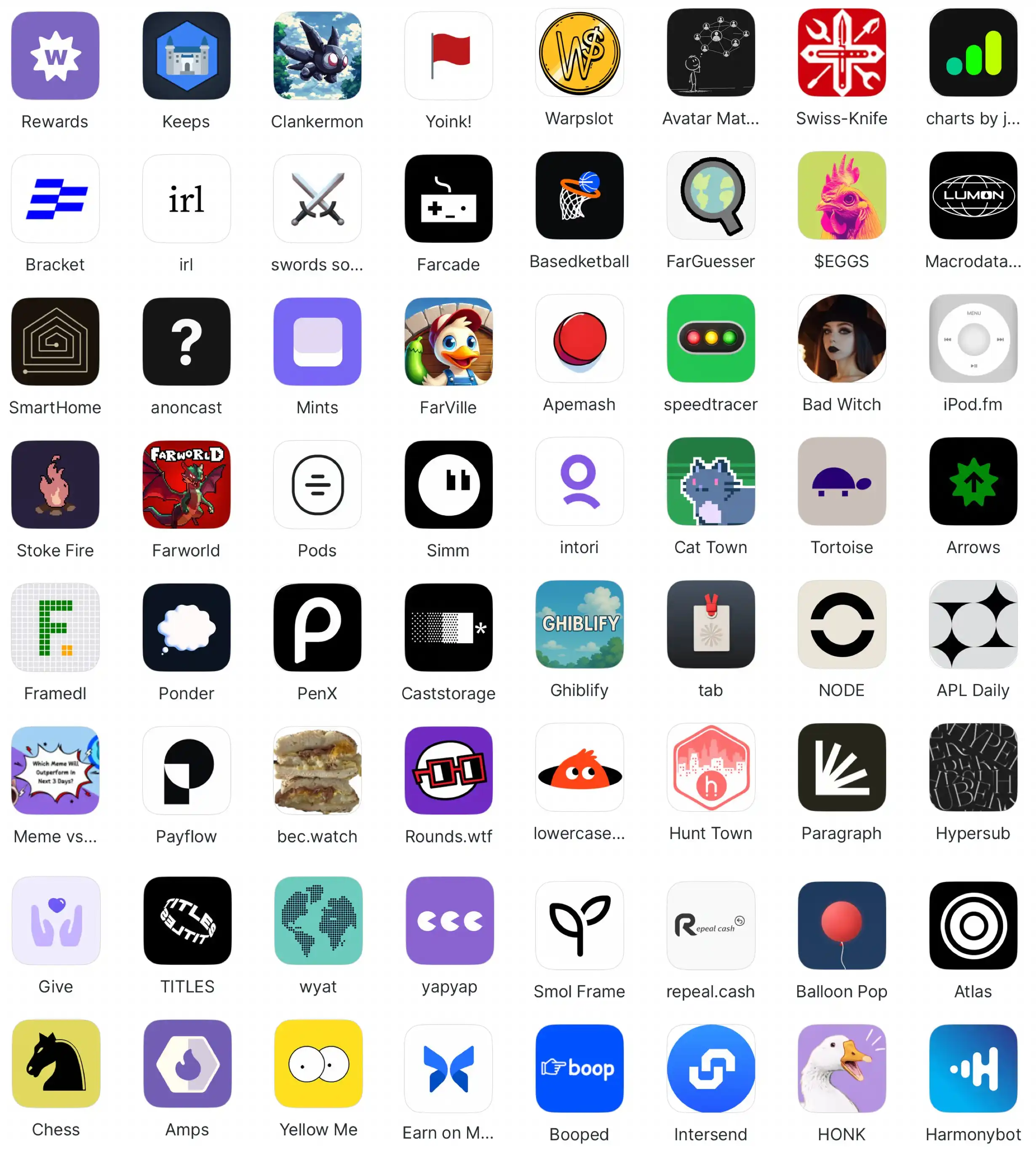
In March 2025, Linda Xie, co-founder of Scalar Capital and Bountycaster, joined the Farcaster team to lead developer relations, with a focus on advancing the development and promotion of Frame. Simultaneously, Farcaster launched the "Airdrop Plan," encouraging developers to build applications using Frame v2 and reach users through asset airdrops. While not an official token airdrop, this mechanism effectively drove user growth. In mid-March, Farcaster's daily active users briefly exceeded 40,000, reaching a milestone.
In early April 2025, Farcaster officially renamed Frame to Mini App and positioned it alongside the Wallet in the bottom navigation bar of the Warpcast client.
Currently, a set of lightweight applications supporting on-chain interactions have been integrated into Warpcast, with Mini App now a key part of the ecosystem. However, from user growth data, it is evident that Mini App's user acquisition capabilities have not been significantly leveraged, and its long-term impact is still under observation.
The Disappearance of "Web3" and the Decline of Silicon Valley Titans
In fact, Farcaster's transformation is not unique; it simply was the first to expose the structural dilemma of the entire Web3 social track—a scenario where open protocols struggle to achieve user scale, content distribution fails to drive engagement, and ultimately, platforms revert to the asset-driven reality.
Do We Really Need a "Decentralized Social Platform"?
From $DEGEN to $CLANKER, almost every time Farcaster gained traction, it was closely tied to assets. What truly propelled the surge in daily active users was not the protocol's evolution or the client's innovation but rather repeated wealth effects driven by tokens. This recurring pattern reveals a core fact: Farcaster is not "unused" but rather "only used when there is a profit to be made." These platforms indeed fulfill a certain market demand, but their role is not that of a social network but rather an asset distributor.
This is not by chance but rather the inevitable outcome of the long-standing misalignment between crypto narratives and real-world usage.
In 2020, BlockBeats wrote in an article titled "The World Hates Current Social Media" that decentralization and protocolization may be the only way for social products to break free from the "platform dilemma." In the face of increasing content censorship and platform monopolies, open protocols carry people's hopes for a "new social order."
Back then, Twitter was seen as a typical failure of protocol: it briefly opened its API, encouraged developers to build an ecosystem, but eventually returned to the old path of being an advertising platform with data monopolies. The original ambition of Farcaster was to "not become the second Twitter," claiming to be centered around an open protocol to connect developers, users, and assets, realizing a co-constructed, mutually beneficial decentralized social network.
However, three years later, Farcaster's replication was not of Twitter's initial protocol ideal but rather its later platform logic. Dan, who once urged everyone to "build their own client based on the protocol," now personally announced that the client is also called Farcaster, intertwining "protocol" and "product" significantly.
This shift in product, looking for Product/Market Fit (PMF), is rational at the surface, even a realistic compromise, but it also indicates that the so-called "open ecosystem" in the implementation process has quietly been misappropriated as a narrative tool for user growth. The developers' role is not truly supported but used to tell a story. Like when Twitter closed its API years ago, the developer ecosystem is only temporary fuel for driving the platform into a closed loop.
Over three years, Farcaster has proven one thing: In the Crypto context, a social protocol cannot fundamentally form the ecosystem we expected in 2020. Not because no one developed clients, but because no one used them. Not because it was not decentralized enough, but because decentralization was not a concern for users at all.
Today, SocialFi, like GameFi, has to some extent been labeled on the death track. Not long ago, a certain Key Opinion Leader (KOL) criticized the founder of a decentralized social application, saying, "After so long doing traffic, your fans are not as high as an ordinary individual KOL like me. What skills do you have? What have you done with your 2M funding? It's not as profitable as my SOL wallet." While it is a wry smile, it also can't help but reflect that the era of infrastructure built on narratives has ended, and the valuation systems of all VC projects are being reconstructed.
Crypto is Not the "Next Internet"
However, a16z is the biggest advocate of this narrative. Having invested early in Twitter, Facebook, and other social media, when the investment behemoth encounters decentralized social products, it naturally cannot ignore their presence. As a Google executive once said, "They're like a lunatic, aggressively intervening in every transaction."
The full name of a16z is Andreessen Horowitz, derived from the surnames of the two founders, Marc Andreessen and Ben Horowitz, established in 2009. As a famous software catcher, nearly all of the most prominent companies in the Internet field have been hit: Facebook, Twitter, Airbnb, Okta, Github, Stripe, etc. Their investment strategy combines early sensitivity and growth-stage decisiveness, being able to invest in Instagram in the seed round, enter Github in the Series A competition, and lead the Series G investment in Roblox with $150 million.
Its keen foresight and aggressive investment style are exemplified in its layout in the crypto field. When Coinbase, invested in 2013, went public, its market value soared to as high as $85.8 billion, making it one of the largest tech IPOs in history. After cashing out $4.4 billion, a16z still holds 7% of the company's shares. Well-known crypto projects such as OpenSea, Uniswap, and dYdX are also representative works of a16z.
The crypto bull market since 2021 has caused the paper value of major venture capital portfolios to skyrocket, with fund returns reaching 20 times or even 100 times, making cryptocurrency venture capital suddenly look like a money-printing machine. Limited partners (LPs) are flocking in, eager to catch the next big wave. The new funds raised by venture capital firms are 10 to 100 times larger than before, firmly believing that they can replicate those excess returns.
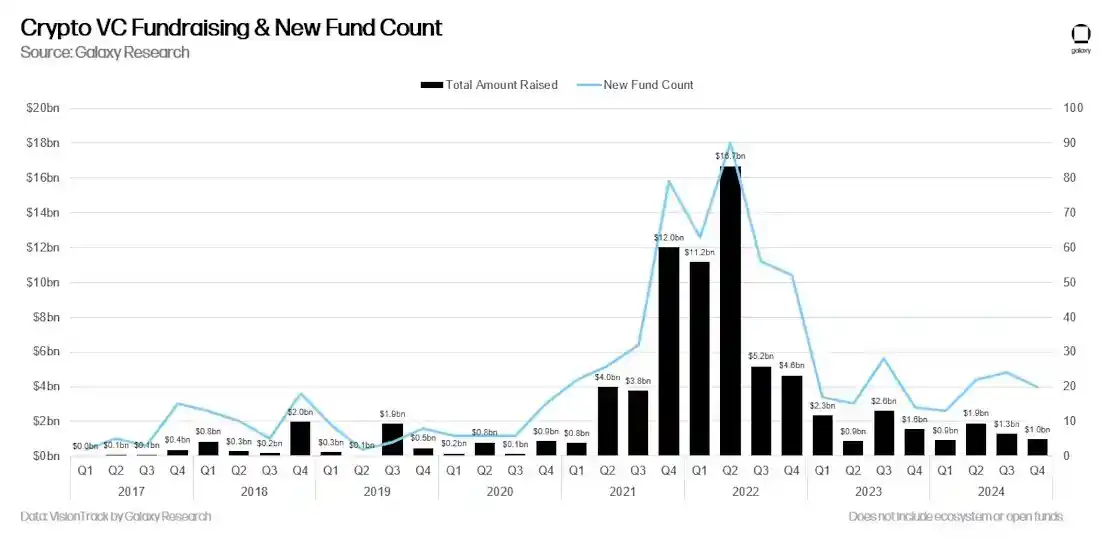
Farcaster is undoubtedly the product of the peak of this liquidity craze. In July 2022, Farcaster announced the completion of a $30 million financing round led by a16z. Two years later, Farcaster raised $150 million at a valuation of $1 billion, with Paradigm leading the round and notable VCs such as a16z crypto, Haun, USV, Variant, and Standard Crypto participating. With a valuation of $1 billion, it became the largest funding in the Web3 social track's history. At that time, a comment in Fortune magazine pointed out that this valuation was more of a result of internal fund game-playing rather than a true reflection of market demand.
Cryptocurrency investor Liron Shapira said, "If venture capital still has LP capital available, choosing to invest $150 million instead of returning it can earn an additional $20-30 million in management fees." This is not a market recognition of Web3 social, but a self-contained loop of capital operation. An article in Fortune magazine also stated that a source who requested anonymity due to business constraints expects Farcaster, like most protocols, to launch a token, and investors will be eager to capture its fully diluted value.
a16z partners have proposed that "technological waves often appear in combination," endorsing the intersection of Web3, AI, and hardware. However, they avoid a fundamental fact: every leap of the mobile Internet, whether it be smartphones or search engines, has been built on real user pain points and technological breakthroughs, not on a structural bubble under a capital narrative.
"Technology eats the world" was once a radical and precise judgment, but its applicable premise is that technology has a crushing advantage at the foundational level. The reason AI has erupted is that it challenges individual intelligence—a structurally irrepressible power differential; whereas blockchain challenges "sovereign currency," which is a credit system unchanged for two thousand years. It will not explosively disrupt societal structures like the Internet or AI; it will slowly evolve over long periods, be absorbed and co-opted by vested interest systems, and eventually become part of the existing order.
Therefore, in reality, the truly accepted and value-creating cryptocurrency systems are almost without exception "mechanism-driven + liquidity-first." From Uniswap to Lido, from GMX to friend.tech, they rely on capital attraction rather than idealism. The VC model of "investors driving world change" does not apply in this world.
Crypto has never lacked social tools. The so-called protocol ideal is just this industry's illusionary projection onto the internet platform era, attempting to replace business models with consensus mechanisms, but ultimately only deferring structural issues to the asset monetization stage.
The biggest crisis in the current crypto industry is not regulation, not technology, but strategic confusion and a vacuum of demand. Apart from "casino logic" and cross-border payments, almost no area demonstrates a sustained ability to create user value. The failure of VCs is fundamentally a loss of direction in the absence of value: if this industry itself lacks real value, then the discussion of value discovery is futile from the start.
猜你喜歡
穩定幣驅動全球B2B支付革新,如何打破工作流程瓶頸釋放兆市場潛力?
5月2日關鍵市場資訊差,一定要看! |Alpha早報
這些新創公司正在無需資料中心的情況下建立先進AI模型
RWA永續產品危機:為什麼GLP模式註定撐不住RWA永續?
科學平權運動:DeSci的萬億美元知識經濟重建革命
Sentient深度研報:獲8,500萬美元融資,建置去中心化AGI新範式
專訪Virtuals聯創empty:AI 創業不需要大量資金,Crypto是答案之一
今年 2 月,Base 生態中的 AI 協議 Virtuals 宣布跨鏈至 Solana,然而加密市場隨後進入流動性緊縮期,AI Agent 板塊從人聲鼎沸轉為低迷,Virtuals 生態也陷入一段蟄伏期。
三月初,BlockBeats 對 Virtuals 共同創辦人 empty 進行了一次專訪。彼時,團隊尚未推出如今被廣泛討論的 Genesis Launch 機制,但已在內部持續探索如何透過機制設計激活舊資產、提高用戶參與度,並重構代幣發行與融資路徑。那是一個市場尚未復甦、生態尚處冷啟動階段的時間點,Virtuals 團隊卻沒有停下腳步,而是在努力尋找新的產品方向和敘事突破口。
兩個月過去,AI Agent 板塊重新升溫,Virtuals 代幣反彈超 150%,Genesis 機製成為帶動生態回暖的重要觸發器。從積分獲取規則的動態調整,到專案參與熱度的持續上升,再到「新代幣帶老代幣」的機制閉環,Virtuals 逐漸走出寒冬,並再次站上討論焦點。
值得注意的是,Virtuals 的 Genesis 機制與近期 Binance 推出的 Alpha 積分系統有一些相似之處,評估用戶在 Alpha 和幣安錢包生態系統內的參與度,決定用戶 Alpha 代幣空投的資格。用戶可透過持倉、交易等方式獲得積分,積分越高,參與新項目的機會越大。透過積分系統篩選使用者、分配資源,專案方能夠更有效地激勵社群參與,提升專案的公平性和透明度。 Virtuals 和 Binance 的探索,或許預示著加密融資的新趨勢正在形成。
回看這次對話,empty 在專訪中所展現出的思路與判斷,正在一步步顯現其前瞻性,這不僅是一場圍繞打新機制的訪談,更是一次關於“資產驅動型 AI 協議”的路徑構建與底層邏輯的深度討論。
BlockBeats:可以簡單分享一下最近團隊主要在忙些什麼?
empty:目前我們的工作重點主要有兩個部分。第一部分,我們希望將 Virtuals 打造成一個類似「華爾街」的代理人(Agent)服務平台。設想一下,如果你是專注於 Agent 或 Agent 團隊建立的創業者,從融資、發幣到流動性退出,整個流程都需要係統性的支援。我們希望為真正專注於 Agent 和 AI 研發的團隊,提供這一整套服務體系,讓他們可以把精力集中在底層能力的開發上,而不用為其他環節分心。這一塊的工作其實也包括了與散戶買賣相關的內容,後面可以再詳細展開。
第二部分,我們正在深入推進 AI 相關的佈局。我們的願景是建立一個 AI 社會,希望每個 Agent 都能聚焦自身優勢,同時透過彼此之間的協作,實現更大的價值。因此,最近我們發布了一個新的標準——ACP(Agent Communication Protocol),目的是讓不同的 Agent 能夠相互互動、協作,共同推動各自的業務目標。這是目前我們主要在推進的兩大方向。
BlockBeats:可以再展開說說嗎?
empty:在我看來,其實我們面對的客戶群可以分為三類:第一類是專注於開發 Agent 的團隊;第二類是投資者,包括散戶、基金等各種投資機構;第三類則是 C 端用戶,也就是最終使用 Agent 產品的個人用戶。
不過,我們主要的精力其實是放在前兩大類──也就是團隊和投資人。對於 C 端用戶這一塊,我們並不打算直接介入,而是希望各個 Agent 團隊能夠自己解決 C 端市場的拓展問題。
此外,我們也認為,Agent 與 Agent 之間的交互作用應該成為一個核心模式。簡單來說,就是未來的服務更多應該是由一個 Agent 銷售或提供給另一個 Agent,而不是單純賣給人類使用者。因此,在團隊的 BD 工作中,我們也積極幫助現有的 AI 團隊尋找這樣的客戶和合作機會。
BlockBeats:大概有一些什麼具體案例呢?
empty:「華爾街」說白了就是圍繞資本運作體系的建設,假設你是一個技術團隊,想要融資,傳統路徑是去找 VC 募資,拿到資金後開始發展。如果專案做得不錯,接下來可能會考慮進入二級市場,例如在紐約證券交易所上市,或是在 Binance 這樣的交易所上幣,實現流動性退出。
我們希望把這一整套流程打通-從早期融資,到專案開發過程中對資金的靈活使用需求,再到最終二級市場的流動性退出,全部覆蓋和完善,這是我們希望補齊的一條完整鏈條。
而這一部分的工作和 ACP(Agent Communication Protocol)是不同的,ACP 更多是關於 Agent 與 Agent 之間交互標準的製定,不直接涉及資本運作系統。
BlockBeats:它和現在 Virtuals 的這個 Launchpad 有什麼差別呢?資金也是從 C 端來是嗎?
empty:其實現在你在 Virtuals 上發幣,如果沒有真正融到資金,那就只是發了一個幣而已,實際是融不到錢的。我們目前能提供的服務,是透過設定買賣時的交易稅機制,從中提取一部分稅收回饋給創業者,希望這部分能成為他們的現金流來源。
不過,問題其實還分成兩塊。第一是如何真正幫助團隊完成融資,這個問題目前我們還沒有徹底解決。第二是關於目前專案發行模式本身存在的結構性問題。簡單來說,現在的版本有點像過去 Pumpfun 那種模式——也就是當專案剛上線時,部分籌碼就被外賣給了外部投資人。但現實是,目前整個市場上存在著太多機構集團和「狙擊手」。
當一個真正優秀的專案一發幣,還沒真正觸達普通散戶,就已經被機構在極高估值時搶購了。等到散戶能夠接觸到時,往往價格已經偏高,專案品質也可能變差,整個價值發行體係被扭曲。
針對這個問題,我們希望探索一種新的發幣和融資模式,目的是讓專案方的籌碼既不是死死握在自己手裡,也不是優先流向英文圈的大機構,而是能夠真正留給那些相信專案、願意長期支持專案的普通投資者手中。我們正在思考該如何設計這樣一個新的發行機制,來解決這個根本問題。
BlockBeats:新模式的具體想法會是什麼樣子呢?
empty:關於資金這一塊,其實我們目前還沒有完全想透。現階段來看,最直接的方式還是去找 VC 融資,或是採取公開預售等形式進行資金募集。不過說實話,我個人對傳統的公開預售模式並不是特別認同。
在「公平發售」這件事上,我們正在嘗試換一個角度來思考-希望能從「reputation」出發,重新設計機制。
具體來說,就是如果你對整個 Virtuals 生態有貢獻,例如早期參與、提供支持或建設,那麼你就可以在後續購買優質代幣時享有更高的優先權。透過這種方式,我們希望把資源更多留給真正支持生態發展的用戶,而不是由短期套利的人主導。
BlockBeats:您會不會考慮採用類似之前 Fjord Foundry 推出的 LBP 模式,或者像 Daos.fun 那種採用白名單機制的模式。這些模式在某種程度上,和您剛才提到的「對生態有貢獻的人享有優先權」的想法是有些相似的。不過,這類做法後來也引發了一些爭議,例如白名單內部操作、分配不公等問題。 Virtuals 在設計時會考慮借鏡這些模式的優點,或有針對性地規避類似的問題嗎?
empty:我認為白名單機制最大的問題在於,白名單的選擇權掌握在專案方手中。這和「老鼠倉」行為非常相似。專案方可以選擇將白名單名額分配給自己人或身邊的朋友,導致最終的籌碼仍然掌握在少數人手中。
我們希望做的,依然是類似白名單的機制,但不同的是,白名單的獲取權應基於一個公開透明的規則體系,而不是由項目方單方面決定。只有這樣,才能真正做到公平分配,避免內幕操作的問題。
我認為在今天這個 AI 時代,很多時候創業並不需要大量資金。我常跟團隊強調,你們應該優先考慮自力更生,例如透過組成社區,而不是一開始就想著去融資。因為一旦融資,實際上就等於背負了負債。
我們更希望從 Training Fee的角度去看待早期發展路徑。也就是說,專案可以選擇直接發幣,透過交易稅所帶來的現金流,支持日常營運。這樣一來,專案可以在公開建設的過程中獲得初步資金,而不是依賴外部投資。如果專案做大了,自然也會有機會透過二級市場流動性退出。
當然最理想的情況是,專案本身能夠有穩定的現金流來源,這樣甚至連自己的幣都無需拋售,這才是真正健康可持續的狀態。
我自己也常在和團隊交流時分享這種思路,很有意思的是,那些真正抱著「搞快錢」心態的項目,一聽到這種機制就失去了興趣。他們會覺得,在這種模式下,既無法操作老鼠倉,也很難短期套利,於是很快就選擇離開。
但從我們的角度來看,這其實反而是個很好的篩選機制。透過這種方式,理念不同的專案自然會被過濾出去,最後留下的,都是那些願意真正建立、和我們價值觀契合的團隊,一起把事情做起來。
BlockBeats:這個理念可以發展出一些能夠創造收益的 AI agent。
empty:我覺得這是很有必要的。坦白說,放眼今天的市場,真正擁有穩定現金流的產品幾乎鳳毛麟角,但我認為這並不意味著我們應該停止嘗試。事實上,我們每天在對接的團隊中,有至少一半以上的人依然懷抱著長遠的願景。很多時候,他們甚至已經提前向我們提供了 VC 階段的資金支持,或表達了強烈的合作意願。
其實對他們來說想要去收穫一個很好的社區,因為社區可以給他們的產品做更好的回饋,這才是他們真正的目的。這樣聽起來有一點匪夷所思,但其實真的有很多這樣的團隊,而那種團隊的是我們真的想扶持的團隊。
BlockBeats:您剛才提到的這套「AI 華爾街」的產品體系-從融資、發行到退出,建構的是一整套完整的流程。這套機制是否更多是為了激勵那些有意願發幣的團隊?還是說,它在設計上也考慮瞭如何更好地支持那些希望透過產品本身的現金流來發展的團隊?這兩類團隊在您這套體系中會不會被區別對待,或者說有什麼機制設計能讓不同路徑的創業者都能被合理支持?
empty:是的,我們 BD 的核心職責其實就是去鼓勵團隊發幣。說得直接一點,就是引導他們思考發幣的可能性和意義。所以團隊最常問的問題就是:「為什麼要發幣?」這時我們需要採取不同的方式和角度,去幫助他們理解背後的價值邏輯。當然如果最終判斷不適合,我們也不會強迫他們推進。
不過我們觀察到一個非常明顯的趨勢,傳統的融資路徑已經越來越難走通了。過去那種融資做大,發幣上所的模式已經逐漸失效。面對這樣的現實,很多團隊都陷入了尷尬的境地。而我們希望能從鏈上和加密的視角,提供一套不同的解決方案,讓他們找到新的發展路徑。
BlockBeats:明白,我剛才其實想表達的是,您剛剛也提到,傳統的 AI 模式在很大程度上仍然依賴「燒錢」競爭。但在 DeepSeek 出現之後,市場上一些資金體積較小的團隊或投資人開始重新燃起了信心,躍躍欲試地進入這個領域。您怎麼看待這種現象?這會不會對目前正在做 AI 基礎研發,或是 AI 應用層開發的團隊產生一定的影響?
empty:對,我覺得先不談 DeepSeek,從傳統角度來看,其實到目前為止,AI 領域真正賺錢的只有英偉達,其他幾乎所有玩家都還沒有實現盈利。所以其實沒有人真正享受了這個商業模式的成果,大家也仍在探索如何面對 C 端打造真正有產出的應用。
沒有哪個領域像幣圈一樣能如此快速獲得社群回饋。你一發幣,用戶就會主動去讀白皮書的每一個字,試試你產品的每個功能。
當然,這套機制並不適合所有人。例如有些 Agent 產品偏 Web2,對於幣圈用戶而言,可能感知不到其價值。因此,我也會鼓勵做 Agent 的團隊在 Virtuals 生態中認真思考,如何真正將 Crypto 作為自身產品的差異化要素加以運用與設計。
BlockBeats:這點我特別認同,在 Crypto 這個領域 AI 的迭代速度確實非常快,但這群用戶給予的回饋,真的是代表真實的市場需求嗎?或者說這些回饋是否真的符合更大眾化、更具規模性的需求?
empty:我覺得很多時候產品本身不應該是強行推廣給不適合的使用者群體。例如 AIXBT 最成功的一點就在於,它的用戶本身就是那群炒作他人內容的人,所以他們的使用行為是非常自然的,並不覺得是在被迫使用一個無聊的產品。 mass adoption 這個概念已經講了很多年,大家可能早就該放棄這個執念了。我們不如就認了,把東西賣給幣圈的人就好了。
BlockBeats:AI Agent 與 AI Agent 所對應的代幣之間,究竟應該是什麼樣的動態關係?
empty:對,我覺得這裡可以分成兩個核心點。首先其實不是在投資某個具體的 AI Agent,而是在投資背後經營這個 Agent 的團隊。你應該把它理解為一種更接近創投的思路:你投的是這個人,而不是他目前正在做的產品。因為產品本身是可以快速變化的,可能一個月後團隊會發現方向不對,立即調整。所以,這裡的「幣」本質上代表的是對團隊的信任,而不是某個特定 Agent 本身。
第二則是期望一旦某個 Agent 產品做出來後,未來它能真正產生現金流,或者有實際的使用場景(utility),從而讓對應的代幣具備賦能效應。
BlockBeats:您覺得有哪些賦能方式是目前還沒看到的,但未來可能出現、值得期待的?
empty:其實主要有兩塊,第一是比較常見的那種你要使用我的產品,就必須付費,或者使用代幣支付,從而間接實現對代幣的「軟銷毀」或消耗。
但我覺得更有趣的賦能方式,其實是在獲客成本的角度思考。也就是說,你希望你的用戶同時也是你的投資者,這樣他們就有動機去主動幫你推廣、吸引更多用戶。
BlockBeats:那基於這些觀點,您怎麼看 ai16z,在專案設計和代幣機制方面,似乎整體表現並不太樂觀?
empty:從一個很純粹的投資角度來看,撇開我們與他們之間的關係,其實很簡單。他們現在做的事情,對代幣本身沒有任何賦能。從開源的角度來看,一個開源模型本身是無法直接賦能代幣的。
但它仍然有價值的原因在於,它像一個期權(call option),也就是說,如果有一天他們突然決定要做一些事情,比如推出一個 launchpad,那麼那些提前知道、提前參與的人,可能會因此受益。
開發者未來確實有可能會使用他們的 Launchpad,只有在那一刻,代幣才會真正產生賦能。這是目前最大的一個問號——如果這個模式真的跑得通,我認為確實會非常強大,因為他們的確觸達了大量開發者。
但我個人還是有很多疑問。例如即使我是使用 Eliza 的開發者,也不代表我一定會選擇在他們的 Launchpad 上發幣。我會貨比三家,會比較。而且,做一個 Launchpad 和做一個開源框架,所需的產品能力和社群運作能力是完全不同的,這是另一個重要的不確定性。
BlockBeats:這種不同是體現在什麼地方呢?
empty:在 Virtuals 上我們幾乎每天都在處理客服相關的問題,只要有任何一個團隊在我們平台上發生 rug,即使與我們沒有直接關係,用戶也會第一時間來找我們投訴。
這時我們就必須出面安撫用戶,並思考如何降低 rug 的整體風險。一旦有團隊因為自己的代幣設計錯誤或技術失誤而被駭客攻擊、資產被盜,我們往往需要自掏腰包,確保他們的社群至少能拿回一點資金,以便專案能夠重新開始。這些項目方可能在技術上很強,但未必擅長代幣發行,結果因操作失誤被攻擊導致資產損失。只要涉及「被欺騙」相關的問題,對我們來說就已經是非常麻煩的事了,做這些工作跟做交易所的客服沒有太大差別。
另一方面,做 BD 也非常困難。優秀的團隊手上有很多選擇,他們可以選擇在 Pumpfun 或交易所上發幣,為什麼他們要來找我們,那這背後必須要有一整套支援體系,包括融資支援、技術協助、市場推廣等,每個環節都不能出問題。
BlockBeats:那我們就繼續沿著這個話題聊聊 Virtuals 目前的 Launchpad 業務。有一些社群成員在 Twitter 上統計了 Virtuals Launchpad 的整體獲利狀況,確實目前看起來獲利的項目比較少。接下來 Launchpad 還會是 Virtuals 的主要業務區嗎?還是說,未來的重心會逐漸轉向您剛才提到的「AI 華爾街」這條路徑?
empty:其實這兩塊本質上是一件事,是一整套體系的一部分,所以我們必須繼續推進。市場的波動是很正常的,我們始終要堅持的一點是:非常清楚地認識到我們的核心客戶是誰。我一直強調我們的客戶只有兩類——團隊。所以市場行情的好壞對我們來說並不是最重要的,關鍵是在每一個關鍵節點上,對於一個團隊來說,發幣的最佳選擇是否依然是我們 Virtuals。
BlockBeats:您會不會擔心「Crypto + AI」或「Crypto AI Agent」這一類敘事已經過去了?如果未來還有一輪多頭市場,您是否認為市場炒作的焦點可能已經不再是這些方向了?
empty:有可能啊,我覺得 it is what it is,這確實是有可能發生的,但這也屬於我們無法控制的範圍。不過如果你問我,在所有可能的趨勢中,哪個賽道更有機會長期保持領先,我仍然認為是 AI。從一個打德撲的角度來看,它仍然是最優選擇。
而且我們團隊的技術架構和底層能力其實早已搭建完成了,現在只是順勢而為而已。更重要的是,我們本身真的熱愛這件事,帶著好奇心去做這件事。每天早上醒來就有驅動力去研究最新的技術,這種狀態本身就挺讓人滿足的,對吧?
很多時候,大家不應該只看產品本身。實際上很多優秀的團隊,他們的基因決定了他們有在規則中勝出的能力——他們可能過去在做派盤交易時,每筆規模就是上百萬的操作,而這些團隊的 CEO,一年的薪資可能就有 100 萬美金。如果他們願意出來單幹項目,從天使投資或 VC 的視角來看,這本質上是用一個很划算的價格買到一個高品質的團隊。
更何況這些資產是 liquid 的,不是鎖倉狀態。如果你當下不急著用錢,完全可以在早期階段買進一些優秀團隊的代幣,靜靜等待他們去創造一些奇蹟,基本上就是這樣一個邏輯。
a16z領投2500萬美元,0xMiden要在你手機裡跑一條隱私鏈
Sui Q1進階報告:BTCfi基建崛起、借貸協議爆發與執行分片未來
門羅幣市值一天暴增15億美元背後,為何駭客不再喜歡比特幣?
盤點10大新興Launchpad平台,誰能完成Pump.fun的顛覆?
GoRich正式上線:鏈上交易零門檻,新手也能抓住100x Meme幣
4月29日市場關鍵情報,你錯過了多少?
PENGU觸底反彈發拉漲360%,胖企鵝如何靠IP行銷迎第二春?
「打新帶老」:Genesis Launch如何用積分制重建AI Agent打新邏輯?
專訪AllianceDAO合夥人qw:Crypto創業家正逃向AI,90%的Crypto+AI都是偽命題
AI賽道重拾熱度,全面整理潛力專案與市場炒作邏輯


 App
App