

Gold Panning in the Desert: Seeking a long-term investment target that can weather market ups and downs

Original Article Title: "Gold Panning in the Desert: Seeking Long-term Investment Targets Through Bull and Bear Markets"
Original Article Authors: Alex Xu, Lawrence Lee, Mint Ventures
Introduction: Altseason Bear Market, Fundamental Investing Still Effective
There is no doubt that this bull market cycle has been the worst-performing one for altcoins.
Unlike previous bull markets where various altcoins saw price surges, causing a rapid decline in BTC dominance, in this current bull market since the market bottom in November 2022, BTC dominance has continuously risen from around 38% to now firmly above 61%. This is happening even as the number of altcoins has rapidly increased during this cycle, highlighting the weakness of altcoin prices in this cycle.
BTC Dominance Trend, Source: Tradingview
As the current market situation stands, it essentially confirms Mint Ventures' analysis in March 2024 in the article "Preparing for the Bull Market Primary Uptrend: My Phase-by-Phase Thoughts on This Cycle." In the original article, the author believed:
Three out of the four key drivers of this bull market cycle:
· BTC halving (expectations of supply-demand adjustment), √
· Loose or expected loose monetary policy, √
· Loose regulatory policies, √
· Innovation in new asset and business models, ×
Therefore, the price expectations for the previous altcoin season, including smart contract platforms (L1\L2), gaming, DeFi, NFTs, and DeFi, should be lowered. Hence, the recommended strategy for this bull market cycle at that time was:
· Have a higher allocation ratio in BTC and ETH (with a stronger preference for BTC in the long term)
· Control the allocation ratio in altcoins such as DeFi, GameFi, NFTs, and DeFi
· Choose new sectors and projects to pursue Alpha, including: Meme, AI, and BTC ecosystem
As of the publication date, the correctness of the above strategy has been largely validated (except for the underperformance of the BTC ecosystem).
However, it is worth noting that despite the lackluster price performance of most altcoin projects in this cycle, there are still a few altcoin projects whose prices have performed significantly better than BTC and ETH over the past year. The most typical examples are the two projects mentioned by Mint Ventures in early July 2024 during the darkest period of the altcoin market in the research report "Altcoins in a Continuous Decline: It's Time to Re-focus on DeFi," which are Aave and Raydium.
It was also since early July last year that Aave saw a highest surge of over 215% against BTC and 354% against ETH. Even with the current significant price pullback, Aave has seen a 77% increase against BTC and a 251% increase against ETH.
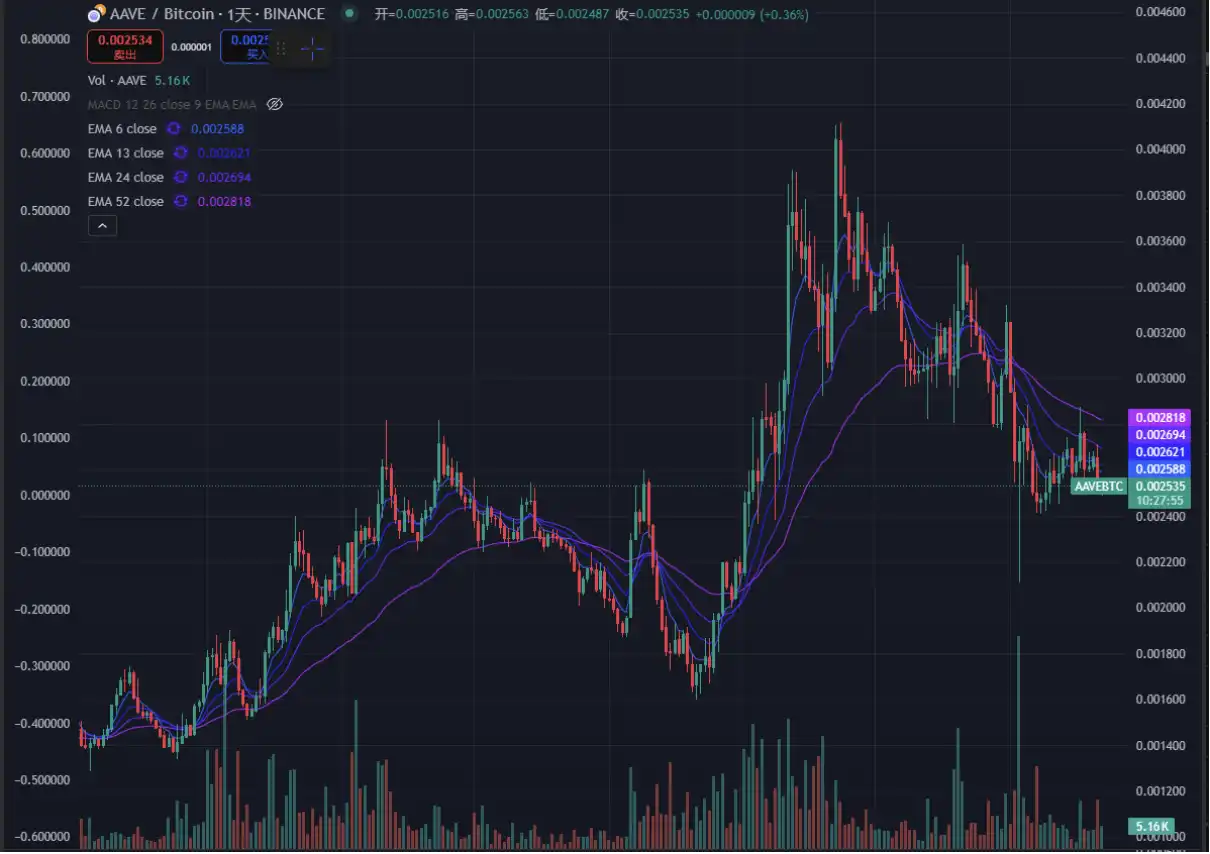
Aave/BTC Exchange Rate Trend, Source: Tradingview
Starting from early July last year, Ray experienced a highest surge of over 200% against BTC and 324% against ETH. Despite the overall decline in the Solana ecosystem and the significant bearish news of facing Pump.fun's proprietary Dex, Ray still maintains a positive surge against BTC and has significantly outperformed ETH.
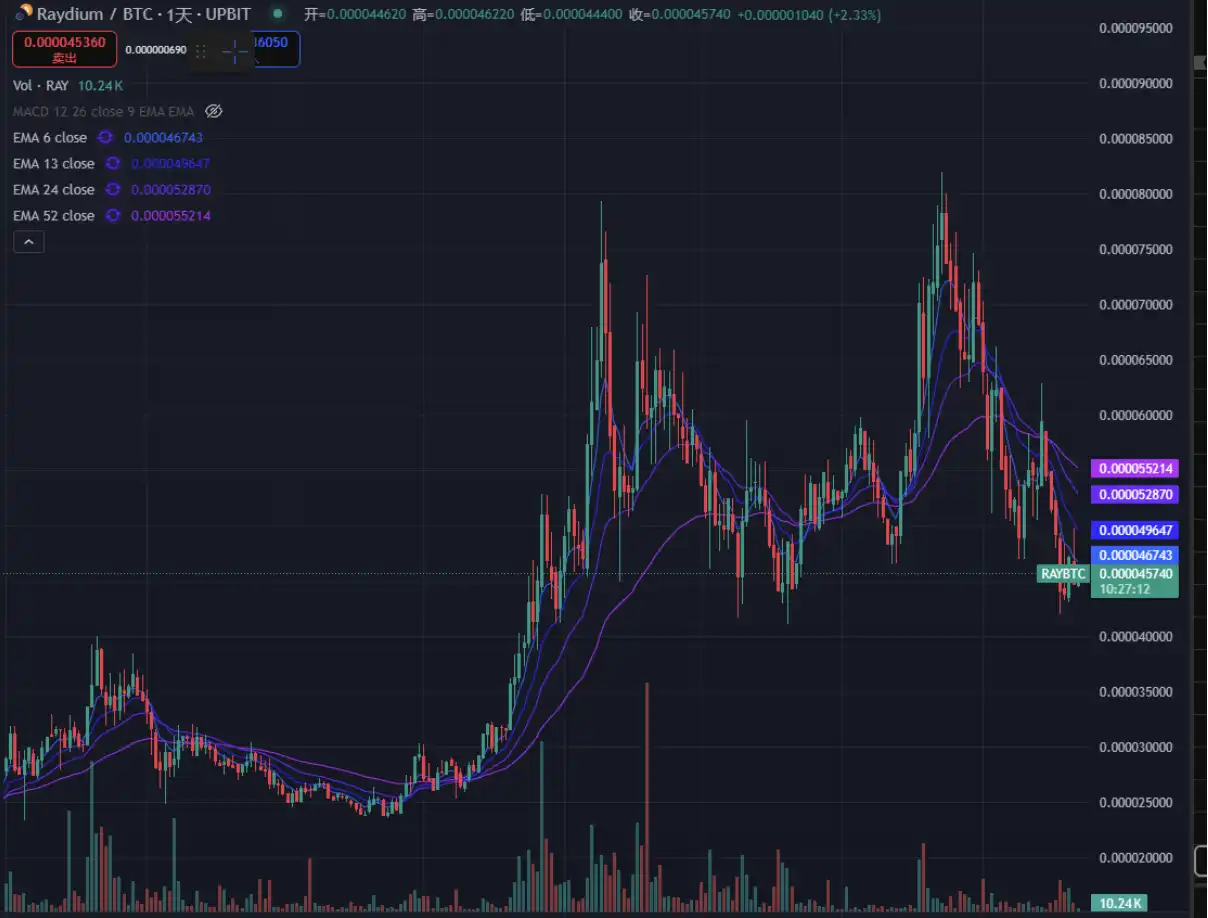
Ray/BTC Exchange Rate Trend, Source: Tradingview
Considering that BTC and ETH (especially BTC) have significantly outperformed most altcoin projects in this cycle, Aave and Ray's price performance stands out among these altcoins.
The reason for this is that compared to most altcoin projects, Aave and Raydium have stronger fundamentals, as evidenced by their core business data hitting all-time highs in this cycle and possessing unique moats, with stable or rapidly expanding market share.
Even in a "bear market for altcoins," projects that bet on outstanding fundamentals can achieve Alpha returns surpassing BTC and ETH, which is also the main purpose of our research work.
In this issue of the research report, Mint Ventures will identify high-quality projects with solid fundamentals from thousands of listed circulating crypto projects, track their recent business performance and market share, analyze their competitive advantages, evaluate their challenges and potential risks, and provide a reference for their valuation.
It is important to emphasize:
· The projects mentioned in this article have advantages and attractions in certain aspects, but at the same time, they also face various issues and challenges. Different individuals may have starkly different judgments on the same project after reading this article
· Similarly, projects not mentioned in this article do not imply that they are "fundamentally weak" or that "we are not optimistic." Feel free to recommend to us projects you are optimistic about and the reasons why.
· This article represents the interim thoughts of the two authors at the time of publication. The future may bring changes, and the views expressed are highly subjective. There may also be errors in facts, data, and reasoning logic. All views in this article are not investment advice. We welcome criticism and further discussion from peers and readers.
We will analyze projects from the dimensions of the project's current business status, competition, key challenges and risks, and valuation status. The following is the main body of the article.
1. Lending Track: Aave, Morpho, Kamino, MakerDao
DeFi remains the most successful track in the crypto business world to achieve Product-Market Fit (PMF). Among them, lending is one of the most important sub-tracks. With mature user demand and stable business revenue, this track has attracted many high-quality projects, old and new, each with its own advantages and disadvantages.
For lending projects, the most crucial metrics are loan volume (Active loans) and protocol revenue (Revenue). In addition, one must also evaluate the protocol's expenditure metric—Token Incentives.
1.1 Aave: King of Lending
Aave is one of the few projects that have crossed three crypto cycles and have steadily developed their business to date. In 2017, it completed funding through an ICO (the project was then called Lend, operating as a peer-to-peer lending model). In the previous cycle, it surpassed the lending leader at that time, Compound, and has since maintained the top position in lending volume. Aave currently provides services on most mainstream EVM L1 and L2.
Business Status
Aave's main business model is operating a peer-to-pool lending platform, earning interest income from lending and liquidation fines generated during collateral liquidation. In addition, Aave's stablecoin business GHO has also entered its second year, creating direct interest income for Aave.
Loan Volume (Active loans)
Aave's loan volume, data source: Tokenterminal
Aave's loan size has exceeded the previous peak of 121.4 billion from November of last year (2021) and reached its highest point at the end of January 25th, with a loan volume of 150.2 billion US dollars. More recently, as market trading enthusiasm has cooled down, the loan size has also fallen, currently standing at around 114 billion US dollars.
Protocol Revenue
Aave Protocol Revenue, Data Source: Tokenterminal
Similar to the loan size, Aave's protocol revenue has been consistently above the previous peak from October 2021 since November of last year. Over the past three months, Aave has spent most of its time with weekly protocol revenue above 3 million US dollars (excluding GHO interest income). However, in the last two weeks, as market activity has decreased and market rates have fallen, single-week protocol revenue has dropped to the level of 2 million US dollars or more.
Token Incentives
Aave Token Incentive Expenditure, Data Source: Aave Analytics
Aave still has a substantial token incentive program, with a daily expenditure of 822 Aave tokens, corresponding to a value of approximately 200,000 US dollars based on the $245 Aave market price. The relatively high incentive value is due to the significant increase in the value of the Aave token over the past six months.
However, it is important to note that unlike most practices that directly incentivize business metrics through token incentives, Aave's token incentives do not target users' core deposit and borrowing behaviors but rather incentivize the deposit guarantee fund. Therefore, Aave's deposit and borrowing business data is still based on organic demand.
Nevertheless, in the author's opinion, the incentive scale on Aave's Safety Module is still too high, and the current scale could be reduced by at least half. However, with a series of features in Aave's new economic model, especially with the launch of the new insurance module, Umbrella, Aave's use for incentives will no longer be in place.
For more information on Aave's new economic model, you can read Mint Ventures' article from last year titled "Initiating Buyback Dividends, Security Module Upgrade: In-Depth Analysis of Aave's New Economic Model."
Competitive Landscape
In terms of loan size (EVM chain), Aave's market share has remained relatively stable, consistently holding the top position since June 2021. In the latter half of 2023, its market share briefly dropped below 50%, but started to regain momentum from 2024 onwards, currently stabilizing at around 65%.
Data Source: Tokenterminal
Aave's Competitive Advantage
As of the author's analysis of Aave up to July of last year, Aave's core competitive advantages have remained largely unchanged, primarily stemming from four aspects:
1. Continuous Accumulation of Security Reputation: Most new lending protocols experience security incidents within the first year of operation. Aave, operating to date, has not encountered any smart contract-level security breaches. The accumulated security reputation of a platform that has run smoothly and risk-free over time is often the primary factor Defi users consider when choosing a lending platform, especially for large whales with significant fund sizes. For example, Justin Sun is a long-term user of Aave.
2. Bilateral Network Effects: Like many internet platforms, Defi lending operates as a typical two-sided market, with deposit and borrowing users interacting as the supply and demand ends. The growth of one side's scale in deposits or loans stimulates growth on the other side, making it increasingly difficult for competitors to catch up. Furthermore, the more abundant the platform's overall liquidity, the smoother the inflow and outflow of liquidity for depositors and borrowers, making it more attractive to large fund users, who in turn stimulate platform growth.
3. Excellent DAO Governance: The Aave protocol has fully embraced DAO-based governance. Compared to team-centralized management models, DAO-based governance offers more extensive information disclosure and more community discussions on key decisions. Additionally, the Aave DAO community includes a group of institutions with high governance capabilities, including top VCs, university blockchain clubs, market makers, risk management service providers, third-party developer teams, financial advisory teams, and more, with diverse and rich backgrounds, showing active participation in governance. From the project's operational results, Aave, as a later entrant in the money market lending service, has effectively balanced growth and security in product development and asset expansion, surpassing the pioneer Compound. In this process, DAO governance played a crucial role.
4. Multi-Chain Ecosystem Positioning: Aave is deployed on almost all EVM L1\L2 networks, and its TVL is consistently among the top on each chain. In the upcoming Aave V4 version, the protocol will achieve cross-chain liquidity composability, making the benefits of cross-chain liquidity even more prominent. In the future, Aave will also expand to Aptos (the first non-EVM chain), Linea, and reintegrate with Sonic (formerly Fantom).
Main Challenges and Risks
While Aave's market share has been steadily increasing over the past year, the development speed of the new competitor Morpho should not be underestimated.
Compared to Aave, where collateral asset types, various risk parameters, and oracles are centrally managed by the Aave Dao, Morpho has adopted a more open model:
It provides an open lending protocol that allows permissionless construction of independent lending markets, enabling the free choice of collateral assets, risk parameters, and oracles. Additionally, Morpho has introduced Vaults built by third-party professional organizations such as Gauntlet (similar to a money market fund), where users can directly deposit funds into the vault. After evaluating the risks, the managing entity decides which lending markets to lend the funds to in order to earn returns.
This open composability approach is more conducive to the rapid entry of the Morpho ecosystem into newer or niche lending markets. For example, new stablecoin projects like Usual and Resolv have built lending markets on Morpho, allowing users to earn project rewards or points through flash loans.
More detailed information about Morpho will be analyzed in later sections.
In addition to competition from the Ethereum ecosystem, Aave's development is also impacted by Ethereum's competition with other high-performance L1 blockchains. If ecosystems like Solana continue to encroach on Ethereum's territory, the growth potential of Aave, a key player in the Ethereum ecosystem, will undoubtedly be limited.
Furthermore, the highly cyclical nature of the crypto market also directly affects Aave's user demand. During bear market cycles, speculative and arbitrage opportunities in the market rapidly diminish, leading to a significant decrease in Aave's lending volume and protocol revenue. This is a common characteristic of various lending protocols, and further elaboration is not necessary.
Valuation Reference
From a vertical valuation perspective, Aave's PS (Price-to-Sales ratio, the ratio of fully diluted market cap to protocol revenue) is currently 28.23, within the median range of the past year. It is still far from the hundreds of PS values seen during the peak in 2021-2023.
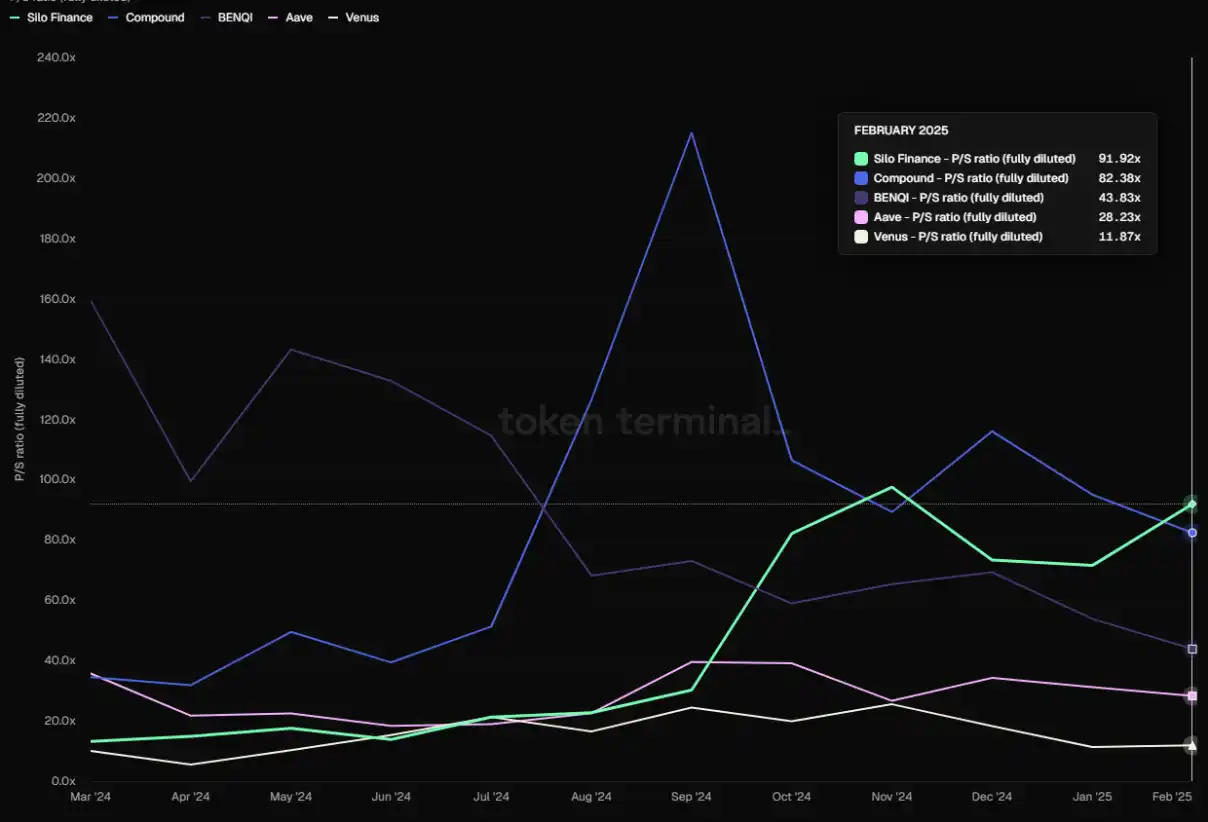
PS of mainstream lending protocols (based on FDV), data source: Tokenterminal
Horizontally comparing, Aave's PS metric is much lower than protocols such as Compound, Silo, benqi, etc., but higher than Venus.
However, it is important to consider that DeFi, similar to traditional financial enterprises, has a highly cyclical revenue multiple, often showing a rapid decrease in PS during bull markets and a high level during bear markets.
1.2 Morpho: Rising Star
Morpho started out by building a yield optimization protocol based on Compound and Aave. Originally a project parasitic to the two, Morpho officially launched the permissionless lending base protocol Morpho Blue in 2024, becoming a direct competitor to top lending projects like Aave. After the launch of Morpho Blue, the business grew rapidly, attracting new projects and assets. Morpho currently operates on Ethereum and Base.
Current State of Business
Morpho has multiple products under its umbrella, including:
1. Morpho Optimizers
Morpho's initial product aimed to enhance the capital efficiency of existing DeFi lending protocols (such as Aave and Compound). By allowing users to deposit their funds on these platforms to earn base interest, while also facilitating peer-to-peer fund matching based on lending demand to optimize capital utilization.
Morpho Optimizers, as Morpho's first-generation product, accumulated a large user base and funds, enabling a smooth transition to the launch of Morpho Blue. However, despite having a considerable amount of funds, the rate optimization brought by its matching function has decreased to the point where it can be largely ignored. This product is no longer the focus of Morpho's development and has stopped accepting new deposits and loans since December last year.
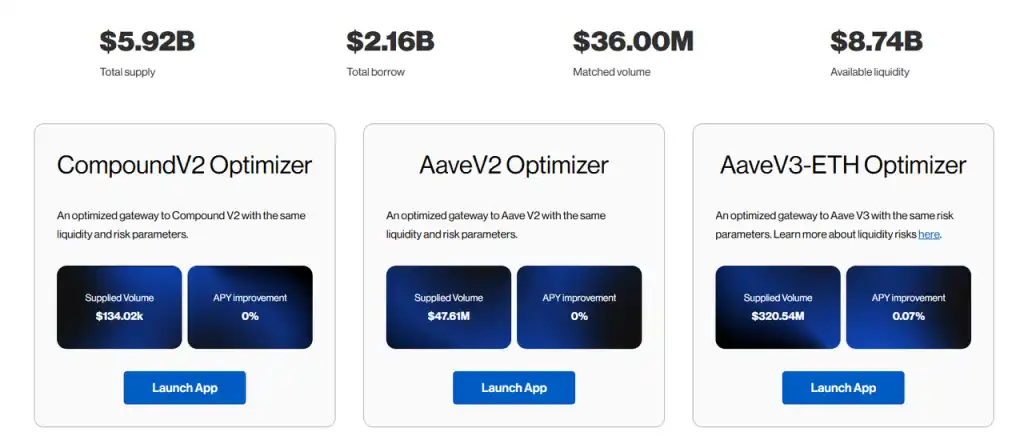
Due to the extremely low match rate, Optimizers currently only offer a 0.07% rate optimization, source: https://optimizers.morpho.org/
2. Morpho Blue (or simply Morpho)
Morpho Blue is a permissionless lending protocol layer that allows users to create custom lending markets. Users can freely choose parameters such as collateral asset, borrow asset, loan-to-liquidation ratio (LLTV), oracle, and interest rate model to create an independent market. The protocol's design ensures no need for external governance intervention, enabling market creators to manage risk and reward based on their own assessments to meet varying market demands.
Following the launch of Morpho Blue, its rapid business growth quickly put pressure on the leading lending protocol Aave. Subsequently, Aave introduced a user-centric Merit incentive program, where users adhering to the incentive rules on Aave would receive rewards, while addresses using Morpho would face incentive cuts.
Prior to the launch of Morpho Blue, most isolated lending market projects focusing on niche or novel assets were relatively unsuccessful, such as Euler, Silo, and others. The majority of funds were still concentrated in centralized lending platforms like Aave, Compound, and Spark, which primarily collateralize mainstream blue-chip assets.
However, Morpho Blue has now largely succeeded in this space for several reasons:
It has a long-standing, solid security record. Before the launch of Morpho Blue, Morpho Optimizers had long carried a significant amount of funds without any issues, earning Defi users' good brand trust in Morpho.
It is only an underlying protocol for lending markets, with openness in supported assets, asset parameter design, oracle selection, and management permissions for treasury funds. The benefits of this approach include:
· Further opening up the market's freedom for lending and responding more quickly to frontline lending market demands. New protocol asset issuers actively come to Morpho to build markets, providing leverage services around their assets. Professional risk service providers like Gauntlet can launch managed treasury funds (Vaults) for their evaluations, directly profiting from the vaults' performance fees, breaking away from the previous single pattern of charging fees for services provided to large lending protocols (Aave, Compound, Venus).
· Enabling further specialization in lending services, with each participant in the process playing their role. In a free market based on Morpho Blue, participants negotiate freely, enriching the product range. More importantly, through the "free outsourcing" of each stage, the costs associated with team-operated businesses are eliminated, such as frequent protocol upgrades and code audits, and specialized risk service provider fees.
3. MetaMorpho Vaults
MetaMorpho Vaults is an asset management tool designed to simplify the lending process, providing liquidity and yield opportunities. Users can earn yield by depositing assets into vaults managed by a professional team, which are optimized based on unique risk allocations and strategies. Currently, funds deposited in various Vaults are primarily directed to various lending markets built on Morpho Blue.
Morpho Product Structure Diagram
After understanding the product landscape of Morpho, let's take a look at the key business data of Morpho.
Loan Size (Active Loans)
Morpho Loan Size, Data Source: Tokenterminal
Morpho's peak loan total size, similar to Aave, occurred at the end of January, reaching $2.35 billion and currently standing at $1.9 billion.
As Morpho has not officially launched protocol fees yet, no protocol revenue has been generated. However, we can observe the amount of Fees (total revenue depositors receive from the protocol) and use it to estimate the protocol revenue Morpho could generate when the protocol fee switch is activated.
Comparison of Morpho and Aave Fees, Data Source: Tokenterminal
In February 2025, Aave generated a total fee of $67.12 million, while Morpho's fee was $15.59 million.
In the same period in February 2025, from the generated $67.12 million fee by Aave, $8.57 million was created as protocol revenue, indicating its approximate fee retention rate of 8.57/67.12=12.8% (just a rough calculation).
Considering that Aave is a lending protocol operated by the Aave DAO, where all of the lending market's revenue can flow into the protocol's treasury to cover various operational expenses,...
Meanwhile, Morpho is a base protocol serving the lending market with active participation from various third-party entities such as market creators and Vault operators. Therefore, even if Morpho activates its protocol fee switch in the future, the proportion of protocol revenue it can extract from generated fees will definitely be significantly lower than Aave's (due to the need to share with other service providers). I estimate that the actual fee retention rate for Morpho should be discounted by 70-90% from Aave's baseline, meaning 12.8*0.3%*(30%~50%)=3.84%~6.4%.
By multiplying (3.84%~6.4%) by 15.59, we can deduce that if Morpho activates protocol fees, it could potentially generate protocol revenue from the total $15.59 million generated in February, ranging approximately between $0.5987 million and $0.9978 million, representing 7%~11.6% of Aave's protocol revenue.
Token Incentives
Morpho is currently incentivizing users with its native token, Morpho. However, unlike Aave, Morpho directly incentivizes users' deposit and borrowing actions, whereas Aave incentivizes deposit insurance. Therefore, Morpho's core business data's organic nature is not as strong as Aave's.
Morpho Token Incentives Dashboard, Source: https://rewards.morpho.org/
According to Morpho's Token Incentives Dashboard, in the Ethereum market, Morpho currently offers a comprehensive subsidy interest rate of around 0.2% for borrowing actions and approximately 2% for deposit actions; in the Base market, Morpho currently offers a comprehensive subsidy interest rate of about 0.29% for borrowing actions and around 3% for deposit actions.
However, concerning token incentives, Morpho has been making frequent minor adjustments. Since December of last year, the Morpho community has initiated three proposals to continuously reduce Morpho token subsidies for user deposit and borrowing behaviors.
The most recent Morpho incentive adjustment occurred on February 21st, reducing the amount of Morpho reward tokens on ETH and BASE by 25%. Post-adjustment, Morpho's annual incentive expenditure will be:
· Ethereum: 11,730,934.98 MORPHO/year
· Base: 3,185,016.06 MORPHO/year
Total: 14,915,951.04 MORPHO/year
Based on today's (2024.3.3) Morpho market price, the corresponding annual incentive budget is $31.92 million, which, given Morpho's current protocol scale and operating costs, appears quite substantial.
However, it is expected that Morpho will continue to reduce Morpho's incentive spending in the future and eventually achieve subsidy cessation.
Competitive Landscape
Data Source: Tokenterminal
In terms of total loan amount market share, Morpho holds 10.55%, slightly higher than Spark but still significantly behind Aave. It sits in the second tier of the lending market.
Morpho's Competitive Advantage
Morpho's moat mainly stems from the following 2 aspects:
1. Decent security track record. Morpho's protocol has not been around for long, but based on its introduction of yield optimization products, it has been operational for nearly three years without any major protocol security incidents to date, accumulating a good security reputation. The growing amount of funds it absorbs also indirectly confirms the users' trust in it.
2. Focus on the lending base protocol. The benefits of this approach have been analyzed in the earlier section, facilitating the entry of more participants into the ecosystem to provide a richer, faster lending market selection, enhancing the specialization of division of labor, and reducing the protocol's operating costs.
Main Challenges and Risks
In addition to facing competition from other lending protocols and the ecosystem impact of L1 competition such as Ethereum and Solana, Morpho's token will face significant unlocking selling pressure in the next year.
According to tokenomist data, the upcoming token unlock schedule for Morpho in the next year is equivalent to 98.43% of the current circulating token supply, meaning the token inflation rate in the next year is close to 100%. Most of these tokens belong to early strategic investors, early contributors, and the Morpho Dao. The significant token liquidation from this portion may exert considerable downward pressure on the token price.
Valuation Reference
Although Morpho has not yet activated the protocol fee switch, we have estimated its post-fee revenue based on the protocol fees it has generated. Using its February protocol fee as a benchmark, the speculated protocol revenue could range between $597,000 to $997,800.
Based on today's (3/3) FDV of $2,138,047,873 USD (Coingecko data) combined with the above revenue data, its PS ratio is 178 to 297. Compared to other mainstream lending protocols, the valuation level is significantly higher.
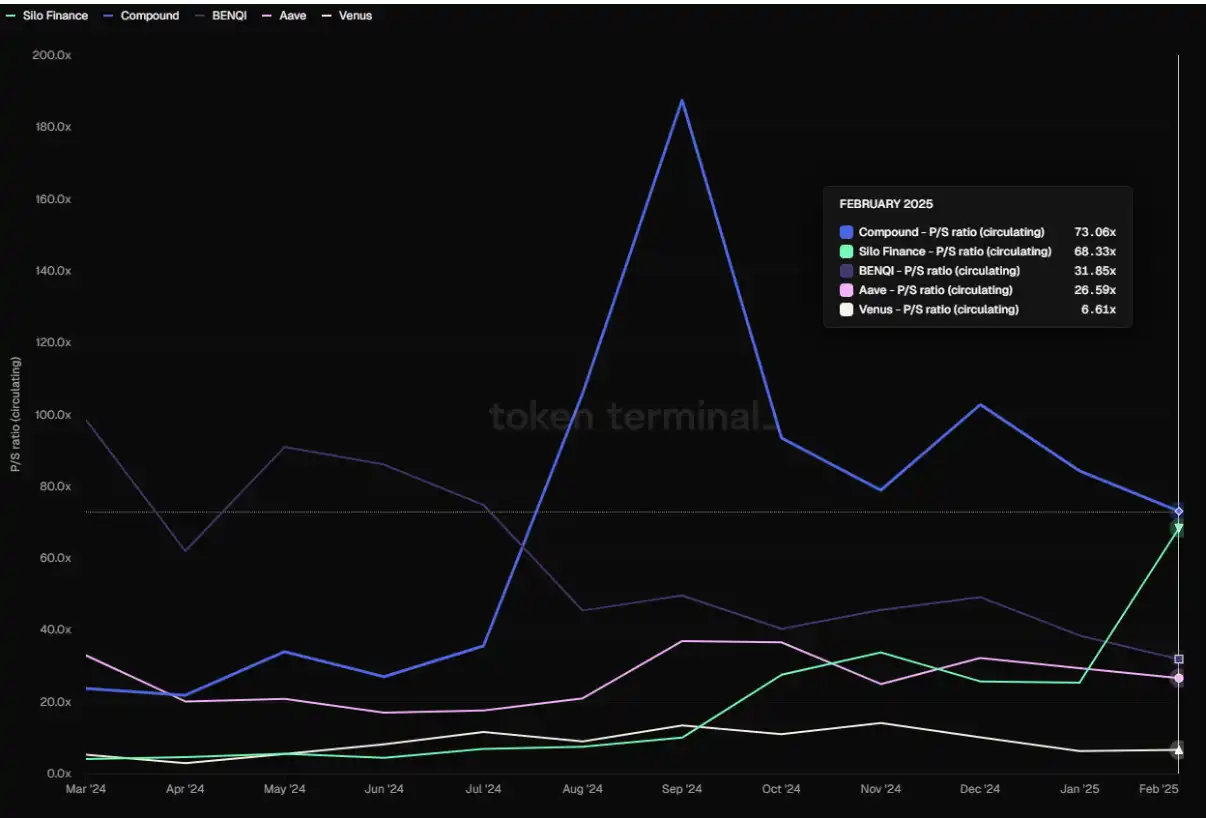
PS of mainstream lending protocols (based on FDV), data source: Tokenterminal
However, when calculated based on the circulating market cap, Morpho's current circulating market cap is $481,361,461 USD (Coingecko data), resulting in a PS ratio of 40.2 to 67, making its metrics relatively less expensive compared to other lending protocols.
PS of mainstream lending protocols (based on MC), data source: Tokenterminal
Of course, using FDV as a market cap reference is a more conservative valuation comparison method.
1.3 Kamino: Solana's Top Player
Kamino Finance is a comprehensive Solana-based DeFi protocol founded in 2022. Its initial product launched was a centralized liquidity automated management tool, and it now integrates lending, liquidity, leverage, and trading functionalities. However, lending is its core business, and most of the protocol's revenue comes from the lending business. Kamino has various fee structures, including a percentage of interest income, one-time initial fees charged when borrowing, liquidation fees, deposit fees, withdrawal fees, and performance fees for liquidity management business.
Current Business Status
Loan Size (Active loans)
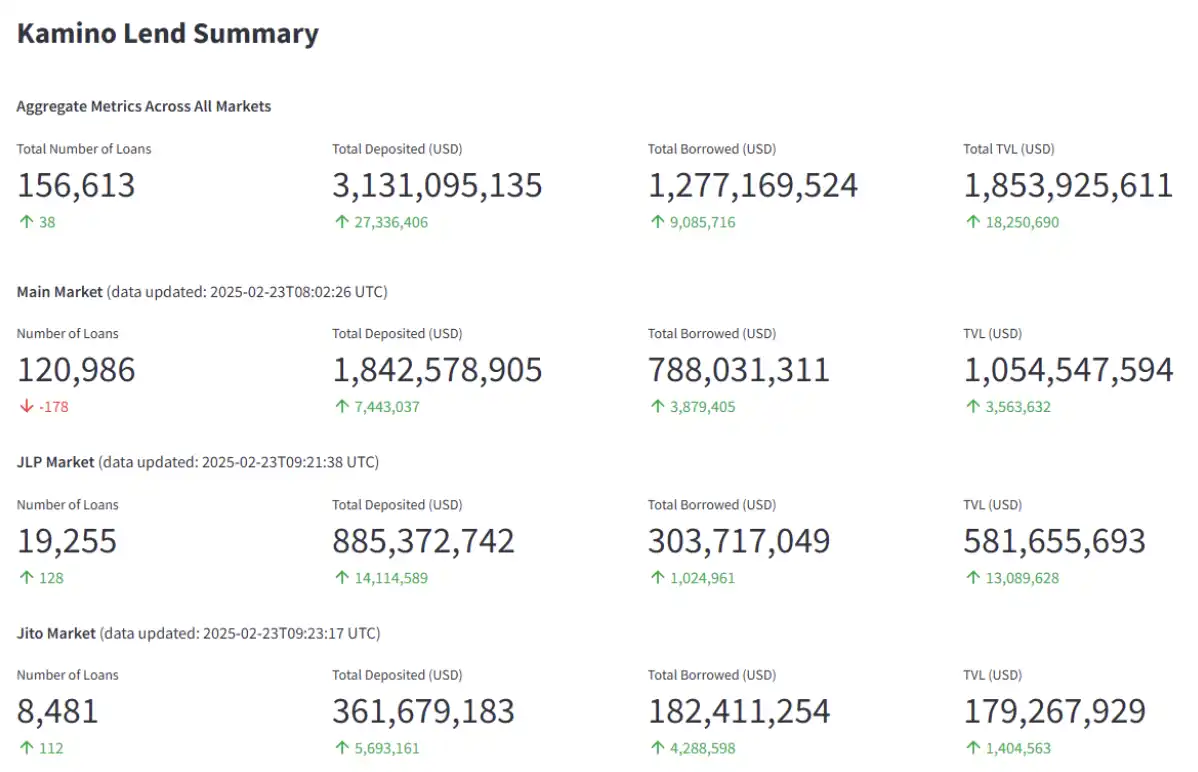
Key data of Kamino, data source: https://risk.kamino.finance/
Kamino's current loan size is $1.27 billion, with the highest loan amount reaching $1.538 billion, also occurring in late January of this year.
Kamino's Loan Size Trend, data source: https://allez.xyz/kamino
Protocol Revenue
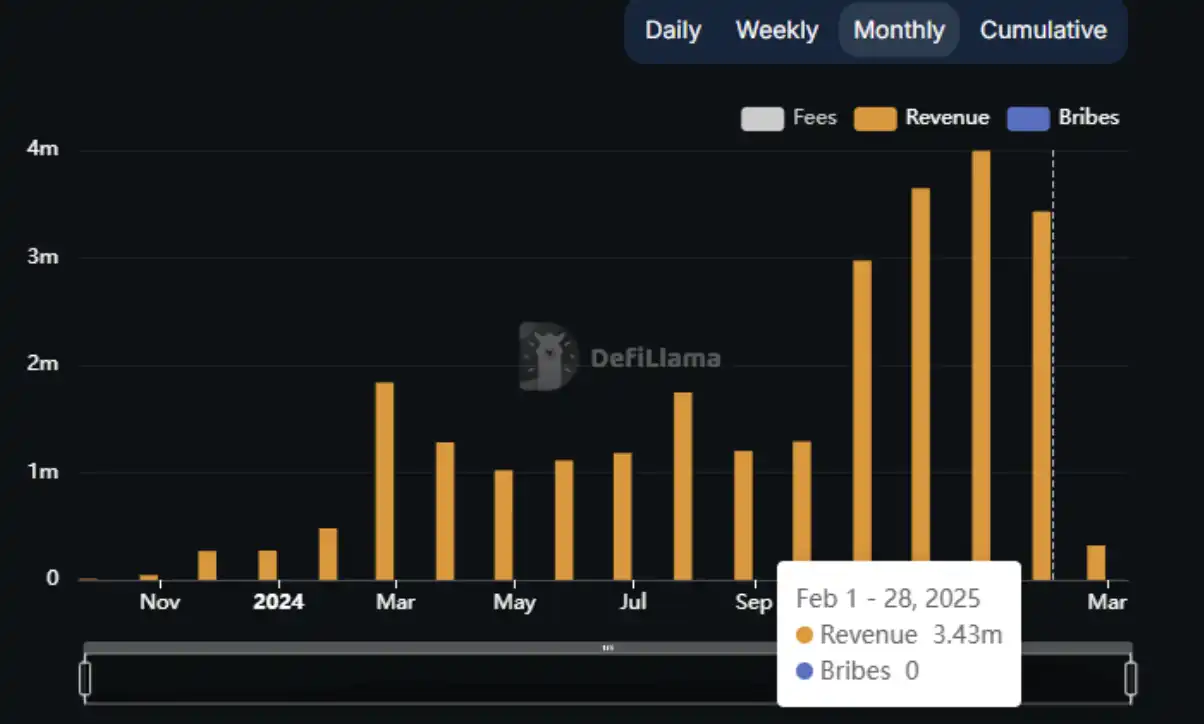
Kamino Protocol Total Revenue, Source: DefiLlama
January was the month with the highest revenue for the Kamino protocol, reaching $3.99 million. However, February's revenue was also good, at $3.43 million.
Kamino Protocol Revenue from Lending, Source: DefiLlama
Lending accounts for the majority of Kamino's protocol revenue, with, for example, 89.5% of the protocol revenue in January coming from lending.
Token Incentives
Unlike other lending protocols that directly incentivize users with tokens, Kamino has adopted a new incentive mechanism that appeared in this cycle, namely the "Season Points System." Users earn project points by completing officially designated incentive actions, and when the season ends, the total token rewards for each season are distributed based on individual point percentages.
The first season of Kamino's points race lasted for three months, with a total of 7.5% of the token supply distributed as a genesis airdrop. The second season points race also lasted for three months and distributed a total of 3.5% of the token supply.
Based on the current token price, the total value of the 11% KMNO tokens distributed in the above two seasons is $105 million, and the generous token rewards have been a key driver of Kamino's rapid business growth over the past year.
The current third points season of Kamino is still ongoing. Unlike the previous two points seasons, the third season started on August 1st of last year and has been running for over 6 months and is not yet concluded. However, this has not slowed down Kamino's protocol growth. If the airdrop in the third season remains similar in scale to the second season, the airdrop incentive value is also expected to be between $30-40 million.
It is worth noting that one of the main purposes of Kamino's KMNO token is to accelerate users' points earning during the season through staking, which has increased user stickiness in product usage and token holding.
Competitive Landscape
On the Solana blockchain, the main lending protocols include Kamino, Solend, MarginFi, and others.
· Kamino: Currently holds 70% to 75% of the market share (by loan size), with its market share on Solana even stronger than Aave's position on Ethereum.
· Solend: Led in 2022-2023 but experienced slowed growth in 2024, with market share dropping to less than 20%.
· MarginFi: After a management crisis in April 2024, a large amount of user assets were withdrawn, causing the project's share to drop to single digits.
Kamino's total locked value is stably in the top two on Solana, just behind the staking-focused Jito. Its lending TVL has also significantly surpassed former competitors like Solend, MarginFi, and others.
Kamino's Competitive Advantages
1. Rapid Product Iteration and Strong Delivery Capability: Kamino was founded by members of the Hubble team in 2022 and was initially positioned as Solana's first centralized liquidity pool optimizer. This early product launch allowed Kamino to meet users' needs in centralized liquidity pools, providing an automated, yield-optimized liquidity treasury solution. Building on this foundation, Kamino further developed lending, leverage, trading, and other product modules, forming a full-stack DeFi product matrix. Such an integrated DeFi project spanning multiple scenarios is not common, and to this day, the Kamino team continues to experiment with new businesses.
2. Strong Ecosystem Integration Capability: Kamino has been actively building a cooperation network both within and outside the Solana ecosystem. A notable example is its integration with PayPal's stablecoin — Kamino was the first protocol to go live and support PYUSD lending on Solana, playing a key role in the expansion of this asset. Additionally, Kamino partnered with Solana staking project Jito to launch leveraged products related to JitoSOL, attracting a large number of SOL staking users to the Kamino ecosystem. Upon announcing the upcoming V2 upgrade of Kamino Lend in 2024, the platform also plans to introduce new features such as order book lending, support for Real World Assets (RWA), and open modular interfaces for other protocols to integrate. These initiatives will further embed Kamino into Solana's underlying financial infrastructure. The more projects built on Kamino, the more new capital will prefer to flow into Kamino, making it increasingly difficult for competitors to challenge its position.
3. Economies of Scale and Network Effects: The DeFi lending sector exhibits a clear "winner takes all" effect, which Kamino's rapid expansion in 2024 exemplifies. Higher TVL and liquidity mean that users can borrow more securely and with lower slippage on the platform, enhancing the confidence of large fund entrants. A larger capital pool itself is a competitive barrier: funds tend to flow to the platform with the most liquidity, further increasing the platform's scale. By leveraging early liquidity and users, Kamino has benefited from the positive feedback loop of this network effect.
4. Strong Track Record in Risk Management: To date, Kamino has not experienced any major security incidents or large-scale liquidation defaults, unlike competing platforms such as MarginFi, which have faced turmoil, driving ecosystem users towards Kamino.
Main Challenges and Risks
In addition to the common risks faced by newer lending protocols, such as contract security and asset parameter design, potential issues for Kamino include:
Tokenomics, Inflation Pressure, and Interest Distribution
The points-based seasonal model adopted by Kamino is somewhat Ponzi-like and similar to Ethena. If the value of the airdropped tokens in the future falls short of expectations, it could lead to user attrition (although, given the current scale, the project's goal has already been achieved). Furthermore, based on tokenomics data, the unlock schedule for KMNO in the coming year is quite large, with an inflation rate of up to 170% based on the current circulating token supply. Lastly, all of Kamino's protocol revenue currently seems to be going into the team's pockets, not distributed to token holders or even the treasury. While a lack of decentralized governance in the short term is normal in the early stages of a project, if protocol revenues continue to not be directed to a treasury controlled by the project's DAO, with no transparent governance and financial planning, being monopolized by the core team, the expected value of the protocol's token may further decline.
The Development of Solana's Ecosystem
Although Solana's ecosystem has shown significant development compared to Ethereum in this cycle, Solana currently lacks a clearly defined track with product-market fit (PMF) other than Memes. DeFi remains a stronghold of the Ethereum ecosystem. In the future, Solana's ability to continue expanding asset categories and capacity, and attracting more funds, will be crucial for breaking through Kamino's ceiling.
Valuation Reference
Kamino 30-day Protocol Revenue, data source: https://allez.xyz/kamino/revenue
Using Kamino's protocol revenue in the last 30 days and its FDV as a benchmark, we calculated the FDV and MC market cap (based on Coingecko market value data) using a Price-to-Sales (PS) ratio, resulting in:
FDV PS=34, MC PS=4.7. This revenue multiple is not high compared to other mainstream lending protocols.
1.4.MakerDAO: Old Tree, New Blossom?
MakerDAO is the earliest DeFi protocol on the Ethereum blockchain, founded in 2015, making it a decade-old project. With the first-mover advantage, its stablecoin DAI (including the upgraded USDS) has long been the largest decentralized stablecoin in the market.
In terms of its business model, MakerDAO's main revenue comes from stability fees paid for generating DAI and the arbitrage on DAI. This model is very similar to the interest spread of lending protocols: borrowing DAI from the protocol incurs a fee, while providing excess liquidity to the protocol (sUSDS&sDAI) earns interest.
Moreover, from a business process perspective, a stablecoin like DAI, a type of Collateralized Debt Position (CDP), obtained by depositing ETH to receive DAI, is not much different from depositing ETH into AAVE to borrow USDC. Therefore, in early DeFi analysis, many people also considered MakerDAO's CDP protocol as a form of lending protocol. After rebranding to Sky and spinning off a separate lending protocol called Spark, MakerDAO is now also considered a lending protocol, and we will analyze it in this section.
Current Business Status
Loan Size (Active loans)
For a stablecoin protocol, the most important metric is its stablecoin supply, a concept that also corresponds to the loan size of a lending protocol.
Source: Sky Website
MakerDAO's loan size is currently close to $8 billion, still below the previous cycle's peak of $10.3 billion.
Spark's loan size is around $1.6 billion, higher than the established lending protocol Compound but slightly lower than the earlier-mentioned Mophro.
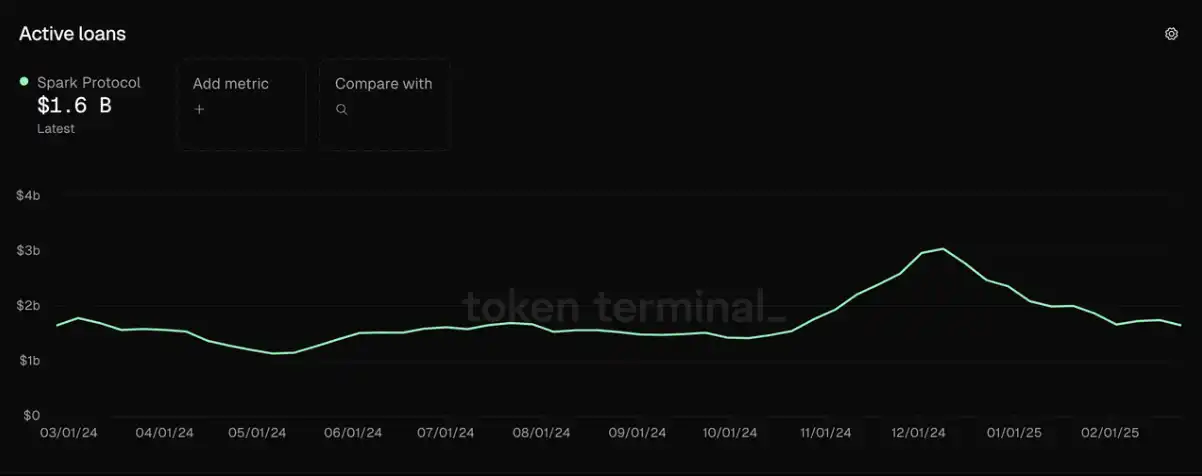
Data Source: Tokenterminal
Protocol Revenue
Corresponding to a lending protocol's revenue, MakerDAO's protocol revenue should be the sum of all protocol revenues, minus the interest cost paid to sDAI and sUSDS. From the chart below, we can see that currently, the majority of MakerDAO's protocol revenue comes from Stability Fee Revenue at $421 million, with other contributions such as Liquidation Fee and Price Stability Module Fee being minimal.
MakerDAO Historical Revenue Source: Sky Website
Within the Stability Fee, it is expected that the DAI deposited through Spark will generate an annualized Stability Fee of $140 million, while DAI directly generated from USDC will also receive $125 million in Stability Fees. These two parts account for 2/3 of the Stability Fee, with the remaining Stability Fees coming from RWA-generated DAI ($71.83 million) and crypto-collateralized DAI ($78.61 million).
MakerDAO Liability Composition and Annual Revenue Source: Sky Website
And in order to incentivize these scale stablecoin fees, MakerDAO expects to pay a deposit cost (Saving Expense) of 2.46 billion dollars per year. The protocol revenue for MakerDAO per year is approximately 175 million dollars, with an average weekly protocol revenue of 3.36 million dollars.
Of course, MakerDAO also announced their protocol operational expenses, with the protocol's annual operational expenses reaching 96.6 million dollars. After subtracting operational expenses from protocol revenue, a net profit of approximately 78.4 million dollars can be obtained, which is also the main source of funds for MKR and SKY buybacks.
Token Incentives
Previously, one of the reasons MakerDAO underwent a brand upgrade was that it no longer had additional MKR reserves to incentivize its business. Currently, MakerDAO's token incentives are mainly used to incentivize USDS deposits. From the launch of the incentive plan at the end of September 2024 to the present, 5 months have passed, with a total of 274 million SKY incentives released, equivalent to approximately 17.4 million dollars. The annualized incentive amount is around 42 million dollars.
Source: Sky Official Website
Competitive Situation
Currently, MakerDAO's stablecoin market share is 4.57%. Stablecoins are one of the clearest tracks of cryptocurrency demand, and MakerDAO, as a veteran stablecoin, has still established a certain moat, including brand effects and first-mover advantages. This was very evident in the last round of the Curve liquidity war, where DAI as one of the 3CRVs could receive a large amount of incentives released by other stablecoin projects to build popularity without any operation.
However, in the stablecoin track competition, MakerDAO's situation is not optimistic. As seen from the market share chart below, MakerDAO's market share (pink block) has not increased but decreased in this cycle.
Market Share of Top Ten Stablecoins Source: Tokenterminal
I believe that the most core factor causing this phenomenon is that DAI, as the third largest stablecoin, has lost (or has never truly had) the function of a settlement tool. Currently, users holding USDT and those holding DAI do so for completely different purposes: holding USDT is mainly used as a settlement tool, while holding DAI is for leveraging and earning yield. In this regard, apart from both being pegged to the dollar, they seem to have few similarities.
A stablecoin with settlement functionality has a strong network effect. Unfortunately, DAI has virtually lost its settlement function, making it difficult to achieve network effects.
This is reflected in the issuance scale, where DAI's market share has been gradually decreasing. Currently, DAI has not returned to its peak issuance scale in 2021, while USDT's issuance scale continues to rise and is now double compared to the end of 2021.
A stablecoin that serves only as a yield instrument has limited growth potential. Scale growth relies on sustained yield incentives and is heavily dependent on external conditions (such as relatively high U.S. Treasury bond rates). How to achieve long-term organic growth is key to whether MakerDAO can bring new vitality to the stablecoin market.
Main Challenges and Risks
In addition to the challenges we have analyzed above, MakerDAO faces competition from newcomers.
The newcomer in the stablecoin arena, Ethena, has experienced rapid growth. Launched less than a year ago, its current market size has reached 60% of MakerDAO's. Ethena's core product, also focusing on yield-bearing stablecoins, has a significant advantage over MakerDAO in terms of its revenue base: "Cryptocurrency perpetual contract arbitrage revenue" is far higher than MakerDAO's "Sovereign Debt-Backed Real World Asset (RWA) Revenue." In the medium to long term, if Treasury bond rates continue to decline, USDE will demonstrate greater competitive advantages over DAI.
Furthermore, MakerDAO's governance capability is also worrisome. With an annual expenditure of $97 million, the MakerDAO team's governance outcomes are highly ineffective and opaque. A typical example is the rebranding of MakerDAO to SKY, followed by discussions to revert back to Maker, making the entire process seem like a farce.
Evaluation Reference
Based on a protocol revenue of $175 million, MKR's current Price-to-Sales (PS) ratio is approximately 7.54, making it relatively cheaper compared to its main competitor, Ethena (22). Throughout history, MKR's PS ratio has consistently remained low.
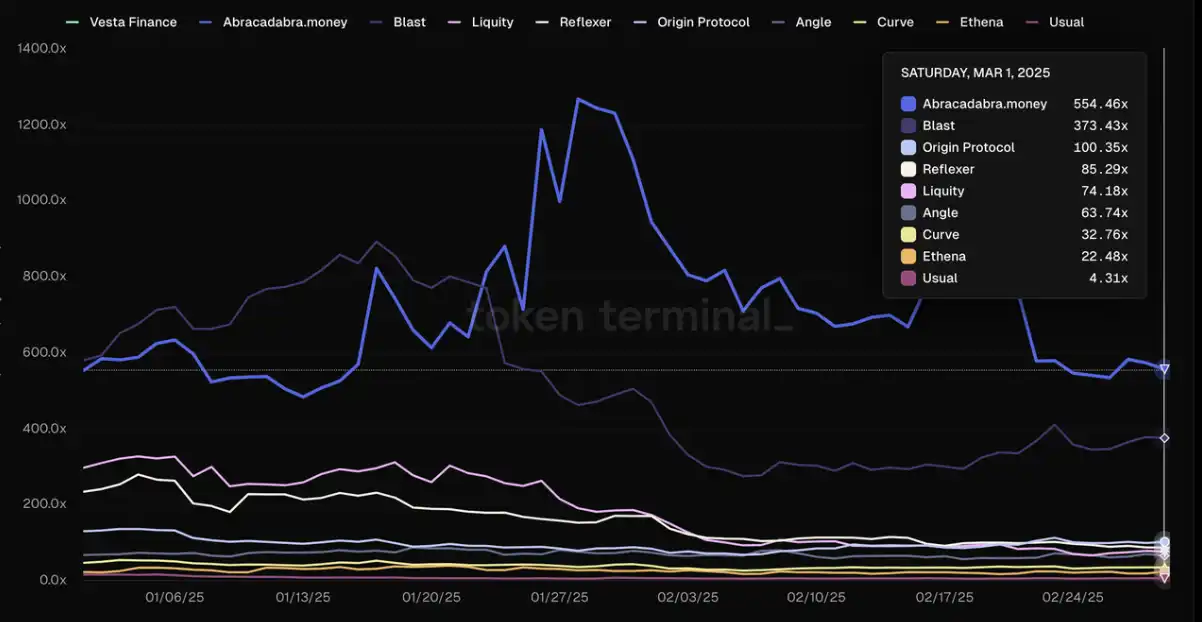
PS ratio of stablecoin projects other than MakerDAO source: Tokenterminal
II: Liquidity Staking Race - Lido, Jito
Liquidity Staking is one of the native tracks in crypto, providing better liquidity and composability compared to native staking. Therefore, it has solid demand and plays a crucial role in the PoS chain ecosystem. Currently, the two PoS chains with the highest TVL on Ethereum and Solana are both liquidity staking protocols. These two protocols, which we are about to introduce next, are Lido and Jito.
For liquidity staking projects, the key evaluation metric is the Assets Staked (which is equivalent to TVL for liquidity staking projects). Due to the presence of a third party outside of users in its operating model—node operators who also take a portion of the protocol revenue as their fee—Gross Profit might be more suitable for evaluating liquidity staking protocols compared to protocol revenue. Additionally, one should also evaluate the protocol's expenditure metric—Token Incentives.
2.1 Lido: Cautiously Tiptoeing on Ethereum
Business Status
Lido's business went live at the end of 2020 with the opening of ETH staking. Within half a year, Lido secured a leading position in Ethereum's network liquidity staking. Lido had previously been the largest liquidity staking service provider on the Terra network and the second-largest on the Solana network, with its business expanded to almost all mainstream PoS networks. However, starting in 2023, Lido began a strategic contraction, and currently, ETH liquidity staking is Lido's sole business. Its business model is relatively straightforward—Lido stakes the user's ETH through various node operators into Ethereum staking and collects 10% of the staking rewards as protocol revenue.
Assets Staked
Currently, over 9.4 million ETH has been deposited into Lido, accounting for approximately 8% of the circulating ETH supply, giving Lido a TVL of over $20 billion, making it the protocol with the largest TVL to date. At its peak, Lido's TVL was close to $40 billion.
Source: Tokenterminal
The fluctuation of staked assets measured in ETH has been much smaller. Since entering 2024, the overall staked ETH scale of Lido has not changed much, with the fluctuation of Lido's staked asset scale mostly coming from ETH price volatility.
Staked Assets Scale Measured in ETH Source: DeFillama
Lido's staked asset scale has continued to grow, mainly benefiting from the gradual increase in the Ethereum network staking rate (from 0 to 27%). As a leading liquid staking service provider, Lido has enjoyed the dividend of the overall market scale growth.
Gross Profit
Lido extracts 10% of the staking rewards as protocol revenue. Currently, 50% of the protocol revenue is allocated to node operators, and 50% belongs to the DAO, meaning 5% is gross profit. From the chart below, we can see that the gross profit of the Lido protocol has generally been steadily increasing, with the Lido protocol's weekly gross profit fluctuating between $750,000 and $1.5 million in the past year.
Data Source: Tokenterminal
It can be observed that Lido's protocol revenue is highly correlated with the staked asset scale, which is determined by their fee structure. The weekly fluctuation in Lido's protocol revenue is mainly driven by ETH price movements.
Token Incentives
In the first two years of the protocol's launch (2021-2022), Lido spent a massive amount of LDO token incentives to incentivize its stETH and ETH liquidity. Over the two-year period, they spent over $200 million in token incentives, allowing Lido to maintain ETH liquidity during severe market liquidity crises such as China's ban on BTC mining in May 2021, the LUNA crash in May 2022, and the FTX crash in November 2022, securing its leading position in Ethereum network liquidity staking.
Following this, Lido has seen a significant decrease in token incentives spending, with token incentive spending in the past year being less than $10 million. Moreover, the main destination of token incentives is towards the ecosystem. Lido maintains its current market share with little need for token incentives.
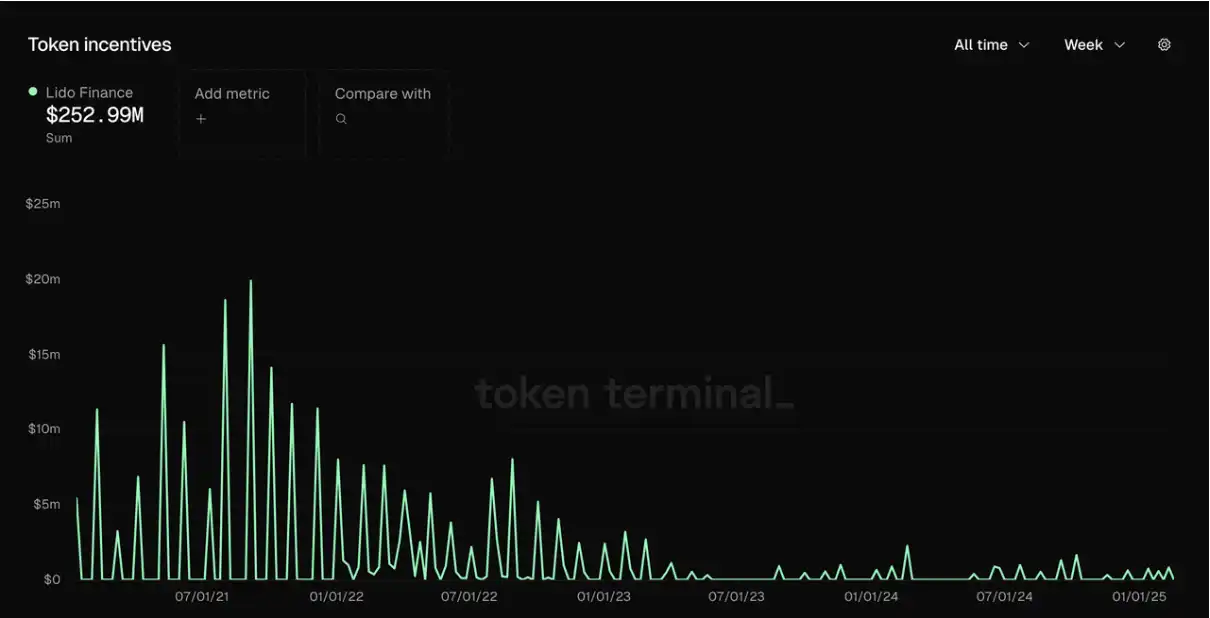
Data Source: Tokenterminal
Competitive Landscape
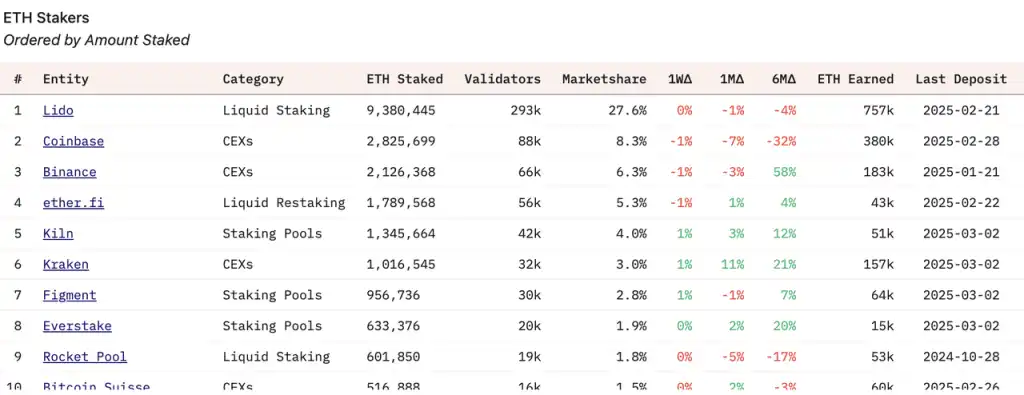
In the Ethereum network's liquidity staking projects, few projects can compete with Lido, with the current second-ranked liquidity staking project, RocketPool, having a staked asset size less than 10% of Lido's.
Among newer projects, one that poses some competitive pressure on Lido is the Liquid Restaking project ether.fi; however, currently, ether.fi's staked asset size is only close to 20% of Lido's, and with Eigenlayer's coin issuance, ether.fi's staked asset size growth rate has also rapidly slowed down. The possibility of challenging Lido's position in Ethereum staking is minimal.
Source: Dune
During its long-term development process, Lido has built a certain moat:
stETH (wstETH): Network effects brought by good liquidity and composability.
In addition to the liquidity advantages mentioned above, stETH is accepted by all major lending or stablecoin protocols as a staked asset, possessing incomparable composability advantages within the LST, which will to some extent influence new stakers' choices.
Security Credit Accumulation and Brand Awareness: Since its launch, Lido has not experienced any major security breaches overall, coupled with its long-standing market leadership position, making it an important consideration for whale users and institutions when choosing a staking service provider; for example, Justin Sun and Mantle before self-developed mETH are typical representatives who have used Lido's services.
Main Challenges and Risks
The main challenge Lido currently faces comes from the decentralized demand of the Ethereum network.
For a PoS chain, stakers determine the formation of consensus, and the Ethereum ecosystem currently has the most persistent pursuit of decentralization among mainstream PoS blockchains. Therefore, in terms of the Lido scale issue, some voices have been calling for limiting Lido's growth as Lido's staked assets reach 30% of the Ethereum network's staking scale. The Ethereum Foundation has also been continuously adjusting its staking mechanism to prevent the emergence of "oversized single staking entities."
For a dapp, the fact that its sole development business chain is not supported, or even limits its business development, is the biggest challenge for Lido in the medium to long term. Although Lido has long been aware of this and started cutting off all chains' business in the past years, making Ethereum its important focus, the results so far have not been significant.
Moreover, although ETH's staking rate is currently below 30% (28%), there is still a significant gap compared to other leading PoS chains in market capitalization such as Solana (65%), ADA (60%), and SUI (77%). However, the Ethereum team has never wanted too much ETH to enter staking and once proposed to limit the staking rate to a maximum of 30%, which also makes the future market incremental space of Lido relatively limited.
Furthermore, ETH itself has underperformed in this cycle, and Lido, as a project strongly correlated with ETH's price in terms of concept and business data, naturally struggles in this cycle.
Valuation Reference
Over the past year, LDO's PS has been in a historically low range, especially in the last six months, where its PS has remained below 20.

It is also worth noting that this year, there is a possibility of protocol revenue transitioning to $LDO revenue. Starting in 2024, the community has repeatedly proposed to allocate the protocol revenue (5% allocated to the DAO) to $LDO holders, but the core team has explicitly opposed this from a cautious standpoint, and multiple governance votes have not passed. However, with a significantly relaxed regulatory environment and the protocol formally generating "profits" from 2024 (protocol revenue minus all expenses, including team salaries, still leaves a surplus), the core team has also formally discussed "linking protocol revenue directly to LDO" in their 2025 objectives. In 2025, we can expect to see $LDO starting to receive protocol staking revenue.
Lido Protocol Economics (the blue-purple line in the chart represents protocol "net profit") Source: Dune
2.2 Jito: Making Bank Quietly on Solana
Current Business Status
Jito is the leading liquidity staking service provider on the Solana network and also serves as Solana's MEV infrastructure. They also started offering restaking services in 2024, although the scale of Restaking is currently small, with TVL just exceeding $1 billion, and the source of revenue from Restaking is not yet clear. Jito's main business is still the first two: liquidity staking services and MEV service provision.
Jito's liquidity staking service on Solana is similar to Lido on the Ethereum network, where users' deposited SOL is staked through node operators in Solana's staking, and 10% is taken from user earnings as protocol revenue.
Regarding MEV, previously the Jito Labs team took a 5% cut of all revenue. However, after the launch of NCN (Node Consensus Networks) and proposals like JIP-8 in late January this year, the Jito protocol began to receive 3% of the MEV revenue. The specific breakdown is: Jito DAO receives 2.7%, the staked JTO Vault receives 0.15%, and jitoSOL and other LST stakers receive 0.15%.
When users transact on Solana, the gas fee they pay can be divided into three categories: base fee, priority fee, and MEV tip. The base fee must be paid, while the priority fee and MEV tip are optional payments aimed at increasing transaction priority. The difference is that the purpose of the priority fee is to increase transaction priority during the on-chain phase and is a uniform setting at the Solana protocol layer, belonging to validators (i.e., stakers). The MEV tip, on the other hand, is a separate agreement between the user and the MEV service provider, aimed at obtaining a higher transaction priority at the MEV service provider to prioritize the construction of their transaction (before being included on-chain), with the specific allocation determined by the MEV service provider.
Currently, Jito's MEV service will return 94% of the fee charged to validators, with 3% extracted by Jito Labs and 3% allocated to the Jito protocol. In the previous Solana network's gas fee, the base fee was relatively small and negligible, while the scale of the priority fee and MEV tip was significant.
Source of REV (i.e., all fees paid by the user) on the Solana Network: Blockworks
Compared to Lido on Ethereum, Jito almost monopolizes the discourse on MEV in the Solana ecosystem, allowing it to capture more value from MEV income (Jito's MEV position in the Solana ecosystem is similar to Flashbots in the Ethereum ecosystem).
Next, let's look at Jito's specific data:
Assets Staked
Currently, Jito's asset staking size (liquidity staking) exceeds $2.5 billion.
Data Source: Tokenterminal
In terms of SOL, Jito's staked SOL amount is 15.82 million, about 3% of the total SOL circulation. Over the past year, staked SOL has shown a steady linear increase.
Source: Jito Website
In the MEV field, Jito is almost in a monopolistic position within Solana. Currently, out of the 394 million SOL staked, over 94% utilize Jito's MEV services.
Source: Jito Website
Gross Profit
Jito's current protocol revenue consists of two parts: they charge 10% of the revenue generated from liquidity staking and 3% of MEV income. Currently, Jito allocates 4% of the liquidity staking revenue to node operators, so the gross profit from its liquidity staking portion is 60% of the revenue. Since the author has not found a separate source for Jito's gross profit data, we analyze based on Jito's revenue situation, as shown in the graph below:
Data Source: Tokenterminal
It can be seen that Jito's revenue is closely related to the popularity of the Solana network. Their revenue saw a multiple increase starting from October 24th, reaching over $1 million weekly. There are two significant peaks in this revenue: on November 20th and January 20th, when Jito's protocol revenue reached $4 million and $5.4 million respectively, corresponding to two major on-chain speculative frenzies. However, after Solana's on-chain activity cooled down recently, Jito's revenue quickly declined as well.
Regarding the MEV part, possibly due to the recent launch of MEV revenue sharing, the author could not find specific statistics on this part from mainstream data websites or Dune. However, we can estimate based on JitoMEV's total revenue.
The following chart shows Jito's MEV total revenue:
Jito's MEV Total Revenue Source: Jito Official Website
Jito's MEV total revenue follows a similar trend to Jito's liquidity staking revenue. At the peak on January 20th of this year, the MEV total revenue was 100,000 SOL. After October 2024, the daily average MEV income is around 30,000 SOL, with a lowest value of 10,000 SOL.
We calculated the income during this period based on a 3% protocol revenue rate. The highest daily revenue was 3,000 SOL, valued at approximately $840,000 at that time. The highest weekly revenue was 14,400 SOL, around $3.7 million USD. The daily average MEV income is 1,000 SOL (about $170,000 USD). Further detailed forecasts regarding this income were previously proposed in the JIP-8 proposal, which interested readers can explore on their own.
Overall, in addition to the current liquidity staking revenue, the MEV revenue roughly increases Jito's revenue by another 50%;
In terms of gross profit scale, the average weekly gross profit from liquidity staking revenue is around $600,000. The gross profit from MEV revenue is as high as 95% (only 0.15% allocated to jitoSOL is not considered gross profit, while the portion going to DAO and JTO Vault can be classified as gross profit), resulting in a weekly gross profit of about $1 million. This can elevate Jito's gross profit scale by approximately 150%, with an annualized gross profit scale of around $85 million.
It should be noted that Jito's revenue and gross profit situation is strongly correlated with the popularity of the Solana network. After the recent decline of the Solana network meme trading frenzy, its daily revenue dropped to around 10% of its peak, showing significant data volatility.
Token Incentives
Whether in liquidity staking or MEV, Jito has not implemented token incentives in its business operations. The only instance of token incentive could be considered the one-time 10% token airdrop at its launch.
Competitive Landscape
Restaking has not yet demonstrated true PMF, so we will mainly analyze Jito's competitive position in liquidity staking and MEV.
In Solana's liquidity staking market, despite starting its operations officially in 2023, Jito managed to take a leading position, surpassing previous leaders Marinade and Lido, who once held over 90% of the Solana liquidity staking market share, but were later overtaken by Jito for various reasons.
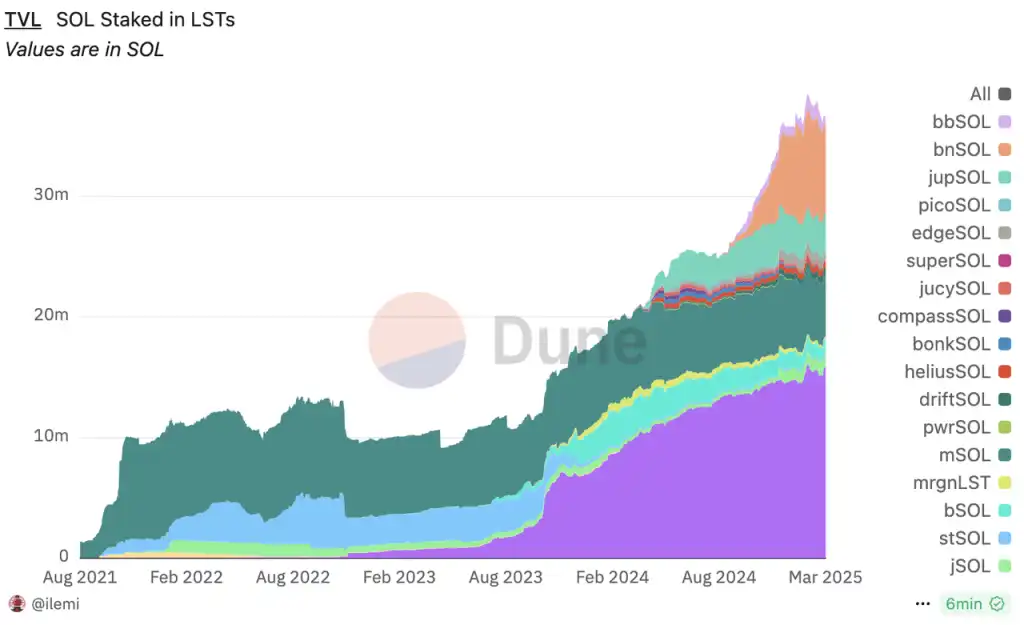
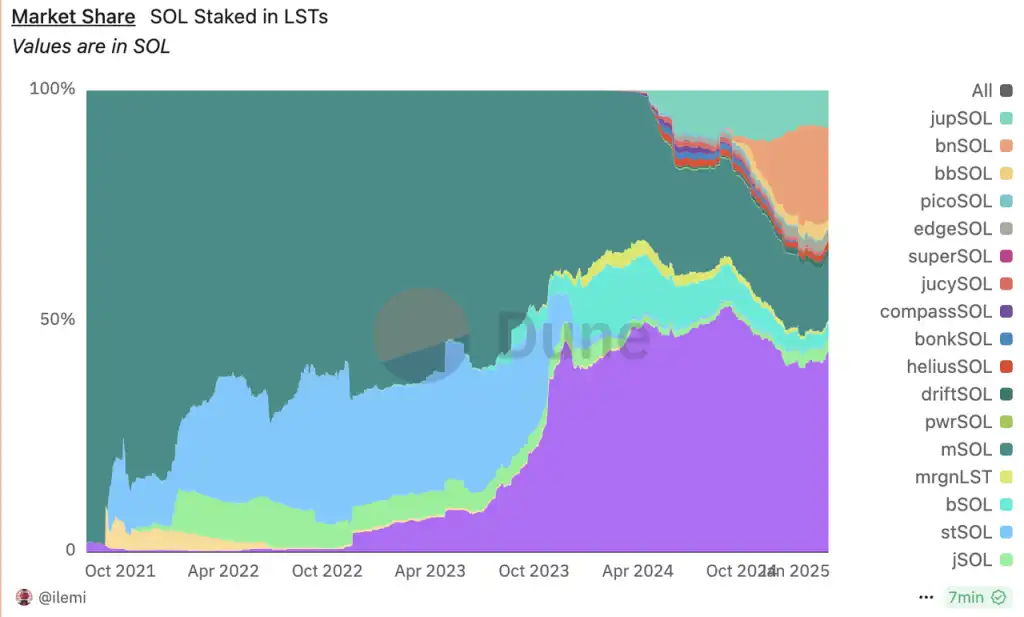
Solana Liquidity Staking Market Share Source: Dune
Starting at the end of 2023, more players entered Solana's liquidity staking market, with Blazestake, Jupiter, and others joining the battlefield. However, Jito's market share remained unaffected. Nevertheless, in October 2024, exchange-based SOL liquidity staking products (mainly Binance's bnSOL and Bybit's bbSOL) caused a slight decline in Jito's market share. This was mainly due to centralized exchanges having a natural advantage in custodial assets, converting SOL savings products from native staking to liquidity staking, providing users with a better experience, leading to a rapid increase in their market share. As we can see from the chart above, the incremental parts from bnSOL and bbSOL are relatively "independent," not encroaching on the share of certain LST protocols.
Currently, over 90% of Solana's staking is still native staking, with less than 10% being liquidity staking, showing significant room for improvement compared to Ethereum's around 38%. However, for the average user, participating in Solana's native staking is much easier than in Ethereum, so the liquidity staking ratio on Solana may not ultimately reach Ethereum's ratio. Nevertheless, liquidity staking still provides relatively better liquidity and composability. In the future, Jito will continue to benefit from the overall increase in Solana's liquidity staking scale.
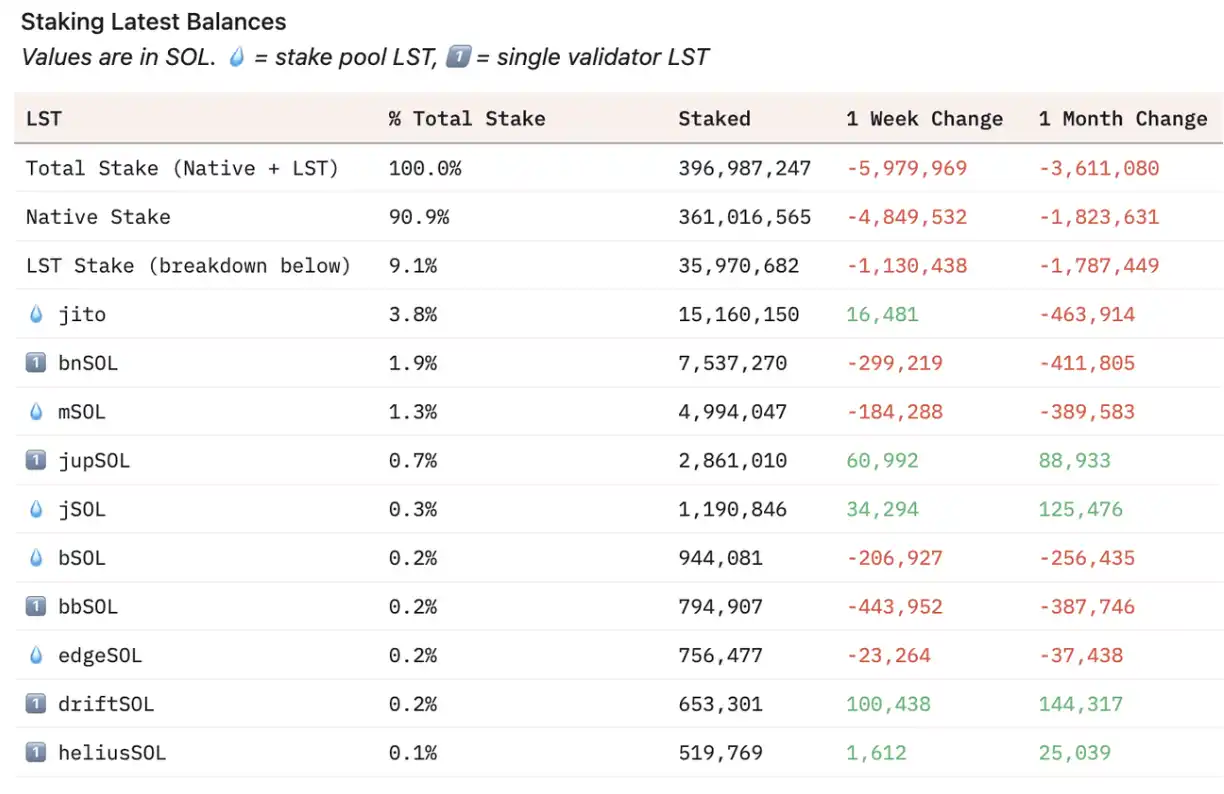
Solana Staking Market Share Source: Dune
Meanwhile, in the MEV space, Jito, which holds over 90% market share, has virtually no competitors. This market space largely depends on Solana's future on-chain activity.
Overall, Jito possesses a solid competitive advantage in both liquidity staking on the Solana network and the MEV space. When the SEC's ETP working group consulted on ETF staking issues, they consulted with Jito, indirectly highlighting this point.
Main Challenges and Risks
Jito's current business and revenue heavily rely on Solana's network popularity, making this its main risk factor. After the TRUMP and LIBRA incidents, market enthusiasm for memes quickly cooled off, SOL's price swiftly dropped, and Jito's business revenue decreased rapidly. Whether Jito's business can regain momentum in the future largely depends on Solana's network popularity.
In the liquidity staking space, competition from centralized exchanges may impact Jito's market share.
From an investment perspective, another potential risk is that less than 40% of the JTO token is currently in circulation, with a significant 15% unlock in December last year and continuous linear unlocks over the next 2 years, resulting in a 62% annual inflation rate in the next year. Selling pressure from early investors is also a potential risk factor.
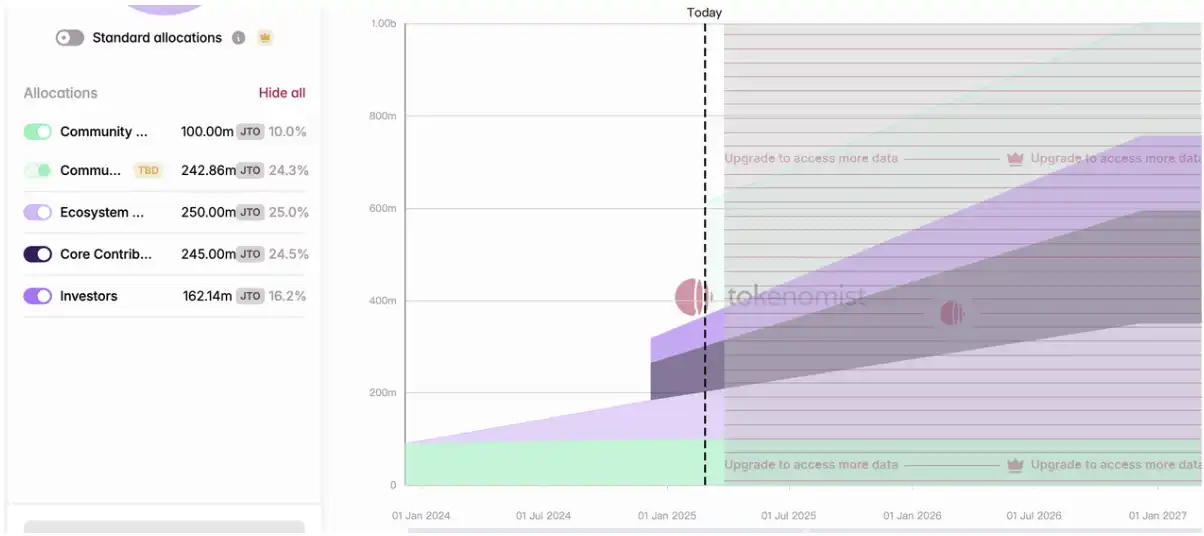
Source: tokennomist
Valuation Reference
With the recent surge in Solana's popularity, JTO's fully diluted PS valuation has dropped rapidly, currently hovering around 33. This valuation does not yet consider the recently started MEV income. Taking the MEV income into account would further decrease JTO's fully diluted valuation to around 22.
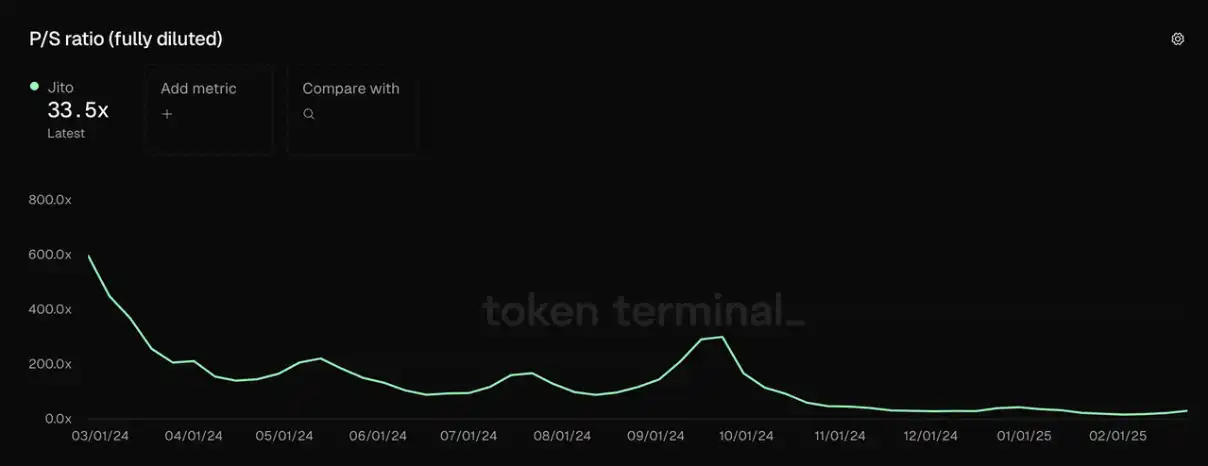
Data Source: Tokenterminal
Additionally, JTO may also accelerate income through dividends. Of the MEV revenue collected by the protocol, 0.15% has already been allocated to JTO stakers. In the future, as income continues to grow, more revenue may be distributed to JTO stakers.
猜你喜歡
穩定幣驅動全球B2B支付革新,如何打破工作流程瓶頸釋放兆市場潛力?
5月2日關鍵市場資訊差,一定要看! |Alpha早報
這些新創公司正在無需資料中心的情況下建立先進AI模型
CEX與Wallet之後,OKX入局支付
RWA永續產品危機:為什麼GLP模式註定撐不住RWA永續?
科學平權運動:DeSci的萬億美元知識經濟重建革命
Sentient深度研報:獲8,500萬美元融資,建置去中心化AGI新範式
專訪Virtuals聯創empty:AI 創業不需要大量資金,Crypto是答案之一
今年 2 月,Base 生態中的 AI 協議 Virtuals 宣布跨鏈至 Solana,然而加密市場隨後進入流動性緊縮期,AI Agent 板塊從人聲鼎沸轉為低迷,Virtuals 生態也陷入一段蟄伏期。
三月初,BlockBeats 對 Virtuals 共同創辦人 empty 進行了一次專訪。彼時,團隊尚未推出如今被廣泛討論的 Genesis Launch 機制,但已在內部持續探索如何透過機制設計激活舊資產、提高用戶參與度,並重構代幣發行與融資路徑。那是一個市場尚未復甦、生態尚處冷啟動階段的時間點,Virtuals 團隊卻沒有停下腳步,而是在努力尋找新的產品方向和敘事突破口。
兩個月過去,AI Agent 板塊重新升溫,Virtuals 代幣反彈超 150%,Genesis 機製成為帶動生態回暖的重要觸發器。從積分獲取規則的動態調整,到專案參與熱度的持續上升,再到「新代幣帶老代幣」的機制閉環,Virtuals 逐漸走出寒冬,並再次站上討論焦點。
值得注意的是,Virtuals 的 Genesis 機制與近期 Binance 推出的 Alpha 積分系統有一些相似之處,評估用戶在 Alpha 和幣安錢包生態系統內的參與度,決定用戶 Alpha 代幣空投的資格。用戶可透過持倉、交易等方式獲得積分,積分越高,參與新項目的機會越大。透過積分系統篩選使用者、分配資源,專案方能夠更有效地激勵社群參與,提升專案的公平性和透明度。 Virtuals 和 Binance 的探索,或許預示著加密融資的新趨勢正在形成。
回看這次對話,empty 在專訪中所展現出的思路與判斷,正在一步步顯現其前瞻性,這不僅是一場圍繞打新機制的訪談,更是一次關於“資產驅動型 AI 協議”的路徑構建與底層邏輯的深度討論。
BlockBeats:可以簡單分享一下最近團隊主要在忙些什麼?
empty:目前我們的工作重點主要有兩個部分。第一部分,我們希望將 Virtuals 打造成一個類似「華爾街」的代理人(Agent)服務平台。設想一下,如果你是專注於 Agent 或 Agent 團隊建立的創業者,從融資、發幣到流動性退出,整個流程都需要係統性的支援。我們希望為真正專注於 Agent 和 AI 研發的團隊,提供這一整套服務體系,讓他們可以把精力集中在底層能力的開發上,而不用為其他環節分心。這一塊的工作其實也包括了與散戶買賣相關的內容,後面可以再詳細展開。
第二部分,我們正在深入推進 AI 相關的佈局。我們的願景是建立一個 AI 社會,希望每個 Agent 都能聚焦自身優勢,同時透過彼此之間的協作,實現更大的價值。因此,最近我們發布了一個新的標準——ACP(Agent Communication Protocol),目的是讓不同的 Agent 能夠相互互動、協作,共同推動各自的業務目標。這是目前我們主要在推進的兩大方向。
BlockBeats:可以再展開說說嗎?
empty:在我看來,其實我們面對的客戶群可以分為三類:第一類是專注於開發 Agent 的團隊;第二類是投資者,包括散戶、基金等各種投資機構;第三類則是 C 端用戶,也就是最終使用 Agent 產品的個人用戶。
不過,我們主要的精力其實是放在前兩大類──也就是團隊和投資人。對於 C 端用戶這一塊,我們並不打算直接介入,而是希望各個 Agent 團隊能夠自己解決 C 端市場的拓展問題。
此外,我們也認為,Agent 與 Agent 之間的交互作用應該成為一個核心模式。簡單來說,就是未來的服務更多應該是由一個 Agent 銷售或提供給另一個 Agent,而不是單純賣給人類使用者。因此,在團隊的 BD 工作中,我們也積極幫助現有的 AI 團隊尋找這樣的客戶和合作機會。
BlockBeats:大概有一些什麼具體案例呢?
empty:「華爾街」說白了就是圍繞資本運作體系的建設,假設你是一個技術團隊,想要融資,傳統路徑是去找 VC 募資,拿到資金後開始發展。如果專案做得不錯,接下來可能會考慮進入二級市場,例如在紐約證券交易所上市,或是在 Binance 這樣的交易所上幣,實現流動性退出。
我們希望把這一整套流程打通-從早期融資,到專案開發過程中對資金的靈活使用需求,再到最終二級市場的流動性退出,全部覆蓋和完善,這是我們希望補齊的一條完整鏈條。
而這一部分的工作和 ACP(Agent Communication Protocol)是不同的,ACP 更多是關於 Agent 與 Agent 之間交互標準的製定,不直接涉及資本運作系統。
BlockBeats:它和現在 Virtuals 的這個 Launchpad 有什麼差別呢?資金也是從 C 端來是嗎?
empty:其實現在你在 Virtuals 上發幣,如果沒有真正融到資金,那就只是發了一個幣而已,實際是融不到錢的。我們目前能提供的服務,是透過設定買賣時的交易稅機制,從中提取一部分稅收回饋給創業者,希望這部分能成為他們的現金流來源。
不過,問題其實還分成兩塊。第一是如何真正幫助團隊完成融資,這個問題目前我們還沒有徹底解決。第二是關於目前專案發行模式本身存在的結構性問題。簡單來說,現在的版本有點像過去 Pumpfun 那種模式——也就是當專案剛上線時,部分籌碼就被外賣給了外部投資人。但現實是,目前整個市場上存在著太多機構集團和「狙擊手」。
當一個真正優秀的專案一發幣,還沒真正觸達普通散戶,就已經被機構在極高估值時搶購了。等到散戶能夠接觸到時,往往價格已經偏高,專案品質也可能變差,整個價值發行體係被扭曲。
針對這個問題,我們希望探索一種新的發幣和融資模式,目的是讓專案方的籌碼既不是死死握在自己手裡,也不是優先流向英文圈的大機構,而是能夠真正留給那些相信專案、願意長期支持專案的普通投資者手中。我們正在思考該如何設計這樣一個新的發行機制,來解決這個根本問題。
BlockBeats:新模式的具體想法會是什麼樣子呢?
empty:關於資金這一塊,其實我們目前還沒有完全想透。現階段來看,最直接的方式還是去找 VC 融資,或是採取公開預售等形式進行資金募集。不過說實話,我個人對傳統的公開預售模式並不是特別認同。
在「公平發售」這件事上,我們正在嘗試換一個角度來思考-希望能從「reputation」出發,重新設計機制。
具體來說,就是如果你對整個 Virtuals 生態有貢獻,例如早期參與、提供支持或建設,那麼你就可以在後續購買優質代幣時享有更高的優先權。透過這種方式,我們希望把資源更多留給真正支持生態發展的用戶,而不是由短期套利的人主導。
BlockBeats:您會不會考慮採用類似之前 Fjord Foundry 推出的 LBP 模式,或者像 Daos.fun 那種採用白名單機制的模式。這些模式在某種程度上,和您剛才提到的「對生態有貢獻的人享有優先權」的想法是有些相似的。不過,這類做法後來也引發了一些爭議,例如白名單內部操作、分配不公等問題。 Virtuals 在設計時會考慮借鏡這些模式的優點,或有針對性地規避類似的問題嗎?
empty:我認為白名單機制最大的問題在於,白名單的選擇權掌握在專案方手中。這和「老鼠倉」行為非常相似。專案方可以選擇將白名單名額分配給自己人或身邊的朋友,導致最終的籌碼仍然掌握在少數人手中。
我們希望做的,依然是類似白名單的機制,但不同的是,白名單的獲取權應基於一個公開透明的規則體系,而不是由項目方單方面決定。只有這樣,才能真正做到公平分配,避免內幕操作的問題。
我認為在今天這個 AI 時代,很多時候創業並不需要大量資金。我常跟團隊強調,你們應該優先考慮自力更生,例如透過組成社區,而不是一開始就想著去融資。因為一旦融資,實際上就等於背負了負債。
我們更希望從 Training Fee的角度去看待早期發展路徑。也就是說,專案可以選擇直接發幣,透過交易稅所帶來的現金流,支持日常營運。這樣一來,專案可以在公開建設的過程中獲得初步資金,而不是依賴外部投資。如果專案做大了,自然也會有機會透過二級市場流動性退出。
當然最理想的情況是,專案本身能夠有穩定的現金流來源,這樣甚至連自己的幣都無需拋售,這才是真正健康可持續的狀態。
我自己也常在和團隊交流時分享這種思路,很有意思的是,那些真正抱著「搞快錢」心態的項目,一聽到這種機制就失去了興趣。他們會覺得,在這種模式下,既無法操作老鼠倉,也很難短期套利,於是很快就選擇離開。
但從我們的角度來看,這其實反而是個很好的篩選機制。透過這種方式,理念不同的專案自然會被過濾出去,最後留下的,都是那些願意真正建立、和我們價值觀契合的團隊,一起把事情做起來。
BlockBeats:這個理念可以發展出一些能夠創造收益的 AI agent。
empty:我覺得這是很有必要的。坦白說,放眼今天的市場,真正擁有穩定現金流的產品幾乎鳳毛麟角,但我認為這並不意味著我們應該停止嘗試。事實上,我們每天在對接的團隊中,有至少一半以上的人依然懷抱著長遠的願景。很多時候,他們甚至已經提前向我們提供了 VC 階段的資金支持,或表達了強烈的合作意願。
其實對他們來說想要去收穫一個很好的社區,因為社區可以給他們的產品做更好的回饋,這才是他們真正的目的。這樣聽起來有一點匪夷所思,但其實真的有很多這樣的團隊,而那種團隊的是我們真的想扶持的團隊。
BlockBeats:您剛才提到的這套「AI 華爾街」的產品體系-從融資、發行到退出,建構的是一整套完整的流程。這套機制是否更多是為了激勵那些有意願發幣的團隊?還是說,它在設計上也考慮瞭如何更好地支持那些希望透過產品本身的現金流來發展的團隊?這兩類團隊在您這套體系中會不會被區別對待,或者說有什麼機制設計能讓不同路徑的創業者都能被合理支持?
empty:是的,我們 BD 的核心職責其實就是去鼓勵團隊發幣。說得直接一點,就是引導他們思考發幣的可能性和意義。所以團隊最常問的問題就是:「為什麼要發幣?」這時我們需要採取不同的方式和角度,去幫助他們理解背後的價值邏輯。當然如果最終判斷不適合,我們也不會強迫他們推進。
不過我們觀察到一個非常明顯的趨勢,傳統的融資路徑已經越來越難走通了。過去那種融資做大,發幣上所的模式已經逐漸失效。面對這樣的現實,很多團隊都陷入了尷尬的境地。而我們希望能從鏈上和加密的視角,提供一套不同的解決方案,讓他們找到新的發展路徑。
BlockBeats:明白,我剛才其實想表達的是,您剛剛也提到,傳統的 AI 模式在很大程度上仍然依賴「燒錢」競爭。但在 DeepSeek 出現之後,市場上一些資金體積較小的團隊或投資人開始重新燃起了信心,躍躍欲試地進入這個領域。您怎麼看待這種現象?這會不會對目前正在做 AI 基礎研發,或是 AI 應用層開發的團隊產生一定的影響?
empty:對,我覺得先不談 DeepSeek,從傳統角度來看,其實到目前為止,AI 領域真正賺錢的只有英偉達,其他幾乎所有玩家都還沒有實現盈利。所以其實沒有人真正享受了這個商業模式的成果,大家也仍在探索如何面對 C 端打造真正有產出的應用。
沒有哪個領域像幣圈一樣能如此快速獲得社群回饋。你一發幣,用戶就會主動去讀白皮書的每一個字,試試你產品的每個功能。
當然,這套機制並不適合所有人。例如有些 Agent 產品偏 Web2,對於幣圈用戶而言,可能感知不到其價值。因此,我也會鼓勵做 Agent 的團隊在 Virtuals 生態中認真思考,如何真正將 Crypto 作為自身產品的差異化要素加以運用與設計。
BlockBeats:這點我特別認同,在 Crypto 這個領域 AI 的迭代速度確實非常快,但這群用戶給予的回饋,真的是代表真實的市場需求嗎?或者說這些回饋是否真的符合更大眾化、更具規模性的需求?
empty:我覺得很多時候產品本身不應該是強行推廣給不適合的使用者群體。例如 AIXBT 最成功的一點就在於,它的用戶本身就是那群炒作他人內容的人,所以他們的使用行為是非常自然的,並不覺得是在被迫使用一個無聊的產品。 mass adoption 這個概念已經講了很多年,大家可能早就該放棄這個執念了。我們不如就認了,把東西賣給幣圈的人就好了。
BlockBeats:AI Agent 與 AI Agent 所對應的代幣之間,究竟應該是什麼樣的動態關係?
empty:對,我覺得這裡可以分成兩個核心點。首先其實不是在投資某個具體的 AI Agent,而是在投資背後經營這個 Agent 的團隊。你應該把它理解為一種更接近創投的思路:你投的是這個人,而不是他目前正在做的產品。因為產品本身是可以快速變化的,可能一個月後團隊會發現方向不對,立即調整。所以,這裡的「幣」本質上代表的是對團隊的信任,而不是某個特定 Agent 本身。
第二則是期望一旦某個 Agent 產品做出來後,未來它能真正產生現金流,或者有實際的使用場景(utility),從而讓對應的代幣具備賦能效應。
BlockBeats:您覺得有哪些賦能方式是目前還沒看到的,但未來可能出現、值得期待的?
empty:其實主要有兩塊,第一是比較常見的那種你要使用我的產品,就必須付費,或者使用代幣支付,從而間接實現對代幣的「軟銷毀」或消耗。
但我覺得更有趣的賦能方式,其實是在獲客成本的角度思考。也就是說,你希望你的用戶同時也是你的投資者,這樣他們就有動機去主動幫你推廣、吸引更多用戶。
BlockBeats:那基於這些觀點,您怎麼看 ai16z,在專案設計和代幣機制方面,似乎整體表現並不太樂觀?
empty:從一個很純粹的投資角度來看,撇開我們與他們之間的關係,其實很簡單。他們現在做的事情,對代幣本身沒有任何賦能。從開源的角度來看,一個開源模型本身是無法直接賦能代幣的。
但它仍然有價值的原因在於,它像一個期權(call option),也就是說,如果有一天他們突然決定要做一些事情,比如推出一個 launchpad,那麼那些提前知道、提前參與的人,可能會因此受益。
開發者未來確實有可能會使用他們的 Launchpad,只有在那一刻,代幣才會真正產生賦能。這是目前最大的一個問號——如果這個模式真的跑得通,我認為確實會非常強大,因為他們的確觸達了大量開發者。
但我個人還是有很多疑問。例如即使我是使用 Eliza 的開發者,也不代表我一定會選擇在他們的 Launchpad 上發幣。我會貨比三家,會比較。而且,做一個 Launchpad 和做一個開源框架,所需的產品能力和社群運作能力是完全不同的,這是另一個重要的不確定性。
BlockBeats:這種不同是體現在什麼地方呢?
empty:在 Virtuals 上我們幾乎每天都在處理客服相關的問題,只要有任何一個團隊在我們平台上發生 rug,即使與我們沒有直接關係,用戶也會第一時間來找我們投訴。
這時我們就必須出面安撫用戶,並思考如何降低 rug 的整體風險。一旦有團隊因為自己的代幣設計錯誤或技術失誤而被駭客攻擊、資產被盜,我們往往需要自掏腰包,確保他們的社群至少能拿回一點資金,以便專案能夠重新開始。這些項目方可能在技術上很強,但未必擅長代幣發行,結果因操作失誤被攻擊導致資產損失。只要涉及「被欺騙」相關的問題,對我們來說就已經是非常麻煩的事了,做這些工作跟做交易所的客服沒有太大差別。
另一方面,做 BD 也非常困難。優秀的團隊手上有很多選擇,他們可以選擇在 Pumpfun 或交易所上發幣,為什麼他們要來找我們,那這背後必須要有一整套支援體系,包括融資支援、技術協助、市場推廣等,每個環節都不能出問題。
BlockBeats:那我們就繼續沿著這個話題聊聊 Virtuals 目前的 Launchpad 業務。有一些社群成員在 Twitter 上統計了 Virtuals Launchpad 的整體獲利狀況,確實目前看起來獲利的項目比較少。接下來 Launchpad 還會是 Virtuals 的主要業務區嗎?還是說,未來的重心會逐漸轉向您剛才提到的「AI 華爾街」這條路徑?
empty:其實這兩塊本質上是一件事,是一整套體系的一部分,所以我們必須繼續推進。市場的波動是很正常的,我們始終要堅持的一點是:非常清楚地認識到我們的核心客戶是誰。我一直強調我們的客戶只有兩類——團隊。所以市場行情的好壞對我們來說並不是最重要的,關鍵是在每一個關鍵節點上,對於一個團隊來說,發幣的最佳選擇是否依然是我們 Virtuals。
BlockBeats:您會不會擔心「Crypto + AI」或「Crypto AI Agent」這一類敘事已經過去了?如果未來還有一輪多頭市場,您是否認為市場炒作的焦點可能已經不再是這些方向了?
empty:有可能啊,我覺得 it is what it is,這確實是有可能發生的,但這也屬於我們無法控制的範圍。不過如果你問我,在所有可能的趨勢中,哪個賽道更有機會長期保持領先,我仍然認為是 AI。從一個打德撲的角度來看,它仍然是最優選擇。
而且我們團隊的技術架構和底層能力其實早已搭建完成了,現在只是順勢而為而已。更重要的是,我們本身真的熱愛這件事,帶著好奇心去做這件事。每天早上醒來就有驅動力去研究最新的技術,這種狀態本身就挺讓人滿足的,對吧?
很多時候,大家不應該只看產品本身。實際上很多優秀的團隊,他們的基因決定了他們有在規則中勝出的能力——他們可能過去在做派盤交易時,每筆規模就是上百萬的操作,而這些團隊的 CEO,一年的薪資可能就有 100 萬美金。如果他們願意出來單幹項目,從天使投資或 VC 的視角來看,這本質上是用一個很划算的價格買到一個高品質的團隊。
更何況這些資產是 liquid 的,不是鎖倉狀態。如果你當下不急著用錢,完全可以在早期階段買進一些優秀團隊的代幣,靜靜等待他們去創造一些奇蹟,基本上就是這樣一個邏輯。
第16週鏈上數據:結構性供需失衡加劇,數據揭⽰下⼀輪上漲的堅實藍圖?
a16z領投2500萬美元,0xMiden要在你手機裡跑一條隱私鏈
Sui Q1進階報告:BTCfi基建崛起、借貸協議爆發與執行分片未來
川普次子的加密生意經
SignalPlus宏觀分析:關稅撕裂的M2敘事與TradFi式FOMO的回歸
盤點10大新興Launchpad平台,誰能完成Pump.fun的顛覆?
懂王簽字後,美國哪些州在「乖乖」推進比特幣戰略儲備法案?
GoRich正式上線:鏈上交易零門檻,新手也能抓住100x Meme幣
4月29日市場關鍵情報,你錯過了多少?


 App
App