

Stock Market Inflow into <code>Bitcoin Fentanyl</code>

Imagine this scenario: when your company is facing a crisis of closure, all you need to do is issue more shares for purchase, or simply announce that Bitcoin will be used as an asset reserve, easily defeating the annoying short sellers, and transitioning from the brink of liquidation back to the center of market attention. If this were true, would you do it?
As $MSTR once again became a buzzword in the investment circle, Bitcoin is rapidly taking over the balance sheets of global enterprises. In this new capital game centered around Bitcoin, some are chasing trends, some are poorly imitating, and some are finding new business opportunities, transforming into orchestrators behind the scenes creating "price miracles."
The Journey of MSTR
In 2024, MSTR's stock price soared by 477%, ranking second among US tech companies with a market value exceeding $5 billion, second only to AppLovin. The Bitcoin investment also brought the company a staggering $13.14 billion in unrealized gains, driving the market cap to surpass $100 billion, becoming a star enterprise in the US stock market.
As of April 2025, the company holds a total of 528,185 BTC, with a cost basis of approximately $33.14 billion, an average purchase price of $66,385 per Bitcoin. At the current Bitcoin price of around $81,400, the total market value is about $43 billion, accounting for over 2.5% of the global circulation.
Related Read: "The strategy of "issuing debt to buy coins" remains the same, why did MSTR's premium suddenly soar?"
As early as August 2020, at the end of the bear market in the crypto market, MicroStrategy first purchased 21,454 BTC in the $10,000 range, initiating the "Bitcoin Treasury Reserve Strategy" and becoming the first publicly traded company to allocate a significant portion of its treasury to Bitcoin.
Subsequently, the company continued to accumulate during downturns from 2020 to 2022 and steadily increased its holdings in 2023. With Bitcoin entering a bull market from 2024 to 2025, MicroStrategy further accelerated its accumulation, forming a clear operational path of "building a bottom during the bear market and accelerating during the bull market." The frenzy of the stock price is like a stone thrown into a pond, creating ripples. Enterprises all began to ask themselves: if we can't outperform Bitcoin, why not just buy it?
Bitcoin Fentanyl" src="https://image.theblockbeats.info/file_v6/20250418/1c8cb3c8-d1b5-4a90-9a44-43919270332f.png?x-oss-process=image/quality,q_50/format,webp" alt="" data-href="" style="" >
According to data from Bitcointreasuries, as of April 16, 2025, a total of 178 entities hold over 3.16 million BTC, with public companies holding approximately 665,636 BTC, and this number is rapidly increasing. This "Micro" trend is sweeping the globe, involving 26 US-listed companies, 22 Canadian-listed companies, and 8 Chinese (including Hong Kong) listed companies, including some previously undervalued, seldom-noticed edge companies.
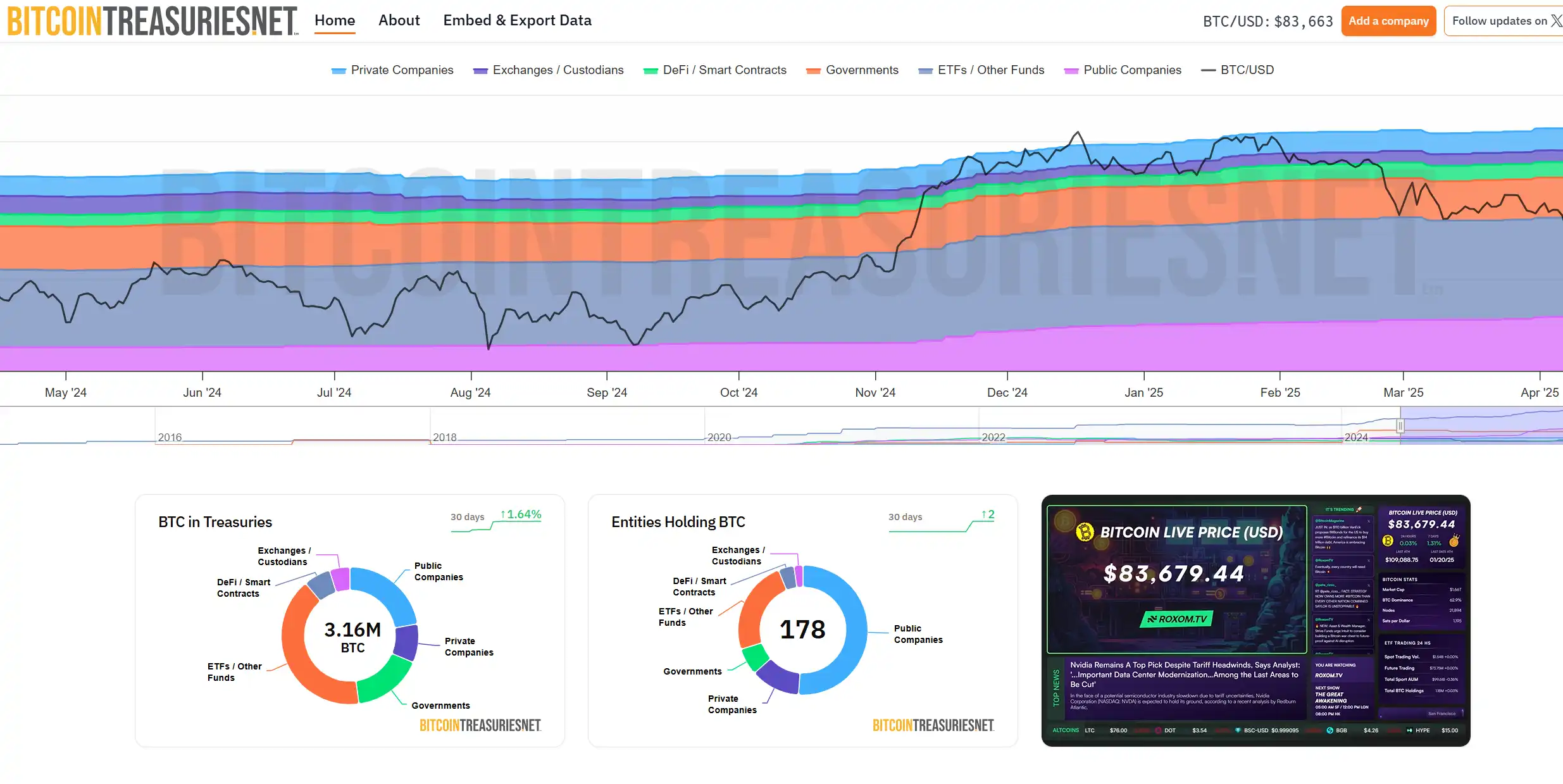
Image Source: bitcointreasuries.net
Represented by Hongya Holdings, a group of traditional businesses that were originally on the fringes are undergoing a narrative shift by incorporating Bitcoin into their operations.
Previously a low-profile fringe company mainly engaged in wholesale and retail of prepaid products (such as SIM cards and vouchers), the company made its first Bitcoin purchase in February 2025, spending $96,150 on 1 Bitcoin. Following this news, the company's stock price surged by 93%.
Having tasted success, Hongya Holdings continued to accumulate Bitcoin for three consecutive days, becoming the first listed company in Greater China to officially include Bitcoin in its balance sheet.
GameStop, the retail giant that gained fame during the 2021 "retail investor battle," announced on March 27, 2025, that it would issue $1.3 billion in zero-coupon convertible bonds to purchase Bitcoin. Prior to the announcement, its stock price surged over 18% in pre-market trading due to related rumors. Following MicroStrategy's lead, a Japanese company named Metaplanet saw its stock price soar by approximately 4000% after purchasing Bitcoin in April 2024, setting a 2025 target of holding 10,000 Bitcoins.
Aside from GameStop, Hongya Holdings, and Metaplanet, other publicly traded companies worldwide, originally unrelated to the crypto sector, are stealthily emulating the MicroStrategy model. They are making a bold bet on Bitcoin to hedge against inflation and speculate on the future.
For instance, Eric Semler, CEO of the U.S. medical company Semler Scientific, stated, "Not holding Bitcoin is irresponsible to shareholders." In India, the board of directors of Jerking company has approved a significant Bitcoin purchase. KULR Technology directly allocated 90% of its corporate cash reserves to gradually buy Bitcoin, while Canadian cannabis company LEEF Brands issued a $5 million bond to support Bitcoin. Boyaa in Hong Kong swapped $50 million worth of Ethereum for Bitcoin.
Related Reading: "Publicly Listed Companies Flock to Buy BTC: Revealing the Top 15 Profit Leaders, Who Grew Nearly 30 Times?"
From healthcare to cannabis, from North America to Asia, companies from different industries seem to be swept up by the same trend, diving headfirst into a field they may have been completely unfamiliar with. Since then, Bitcoin is becoming an increasingly prominent figure on many companies' balance sheets.
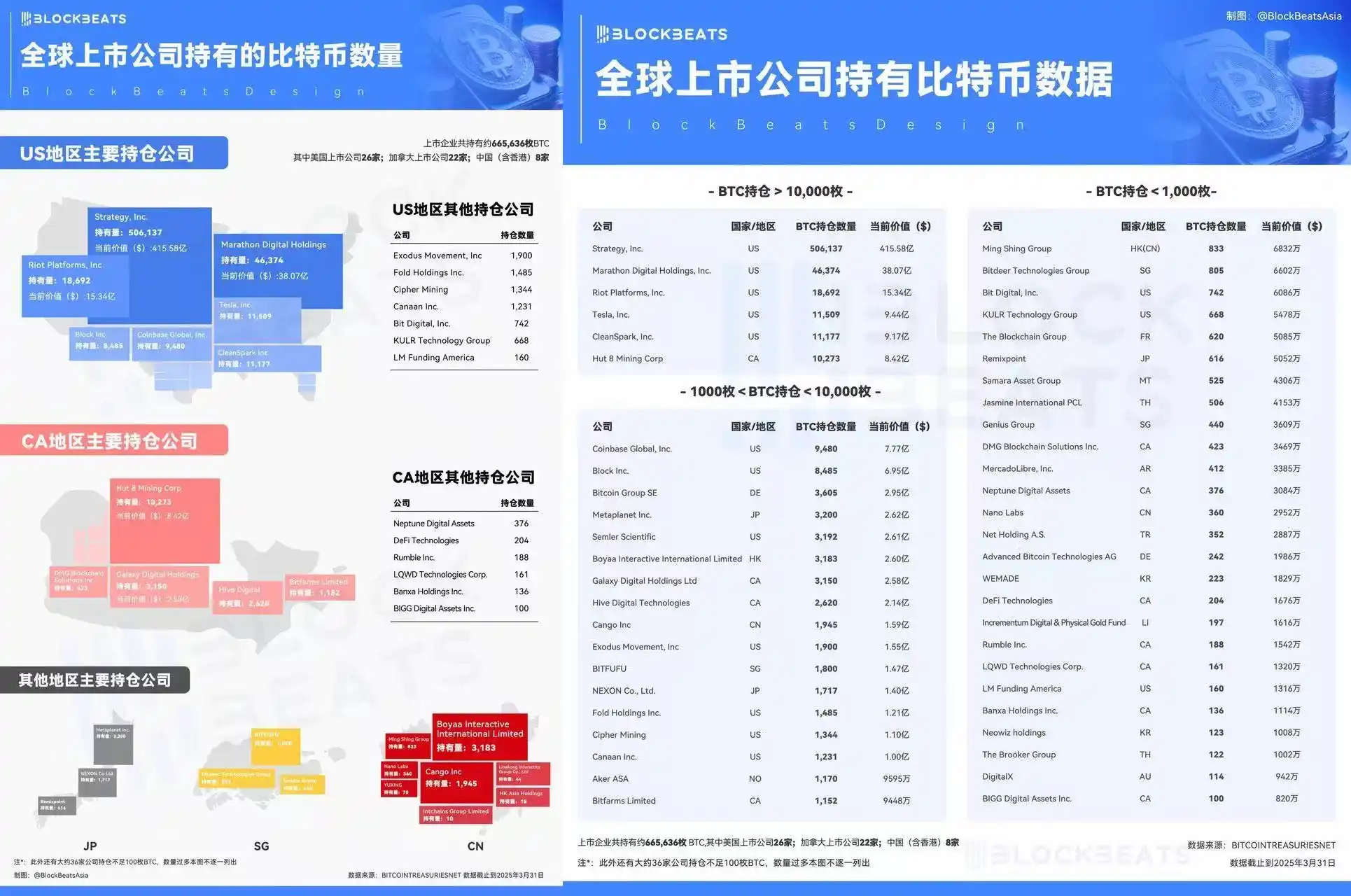
The "Golden Finger" Behind the Price Miracle: Market Makers, White Gloves, and Eric Trump
When capital meets political leverage, it always leads to many "price miracles." This wave, represented by MicroStrategy, is far more complex than it appears on the surface. Starting from the market frenzy sparked by the re-election of the "crypto president" Trump, everything began to heat up rapidly.
With the Trump administration pushing forward the Bitcoin Strategic Reserve Plan and the SEC's repeated relaxation of crypto regulations, these policies acted as a tailwind, propelling the Bitcoin price to nearly $110,000, nearing its all-time high. As the crypto industry and politicians take advantage of each other, the underlying currents are often unknown to many.
In this global stock market surge intertwined with crypto market frenzy, UTXO Management and Sora Ventures seized the opportunity, transforming into market makers in the capital market, successively pushing various "meme stocks" to the center stage.
Leverage Effect
If you have recently been paying attention to the Hong Kong or Japanese stock markets, you may be puzzled by the sudden skyrocketing of some strange companies.
A budget hotel operator, a game developer relying on Texas Hold'em, and an old telecom company selling data cards, despite having almost no outstanding business points, managed to see their stock prices surge several times or even thousands of percentage points in a short period. What kind of magic potion have these originally failing "distressed stocks" drunk?
Let's first look at the most typical case, Metaplanet. This company originally named Red Planet was a budget hotel operator. In 2024, CEO Simon, a Harvard graduate and former Tokyo Goldman Sachs executive, renamed the company to Metaplanet after selling most of the hotel business. This CEO also serves as Chairman of Red Planet Hotels and the head of a real estate company in Thailand.
In addition to its core BTC strategy, Metaplanet is redeveloping its remaining hotel into "The Bitcoin Hotel," set to open in the third quarter of 2025, aiming to provide companies with a one-stop service from finance, operations to Bitcoin education.
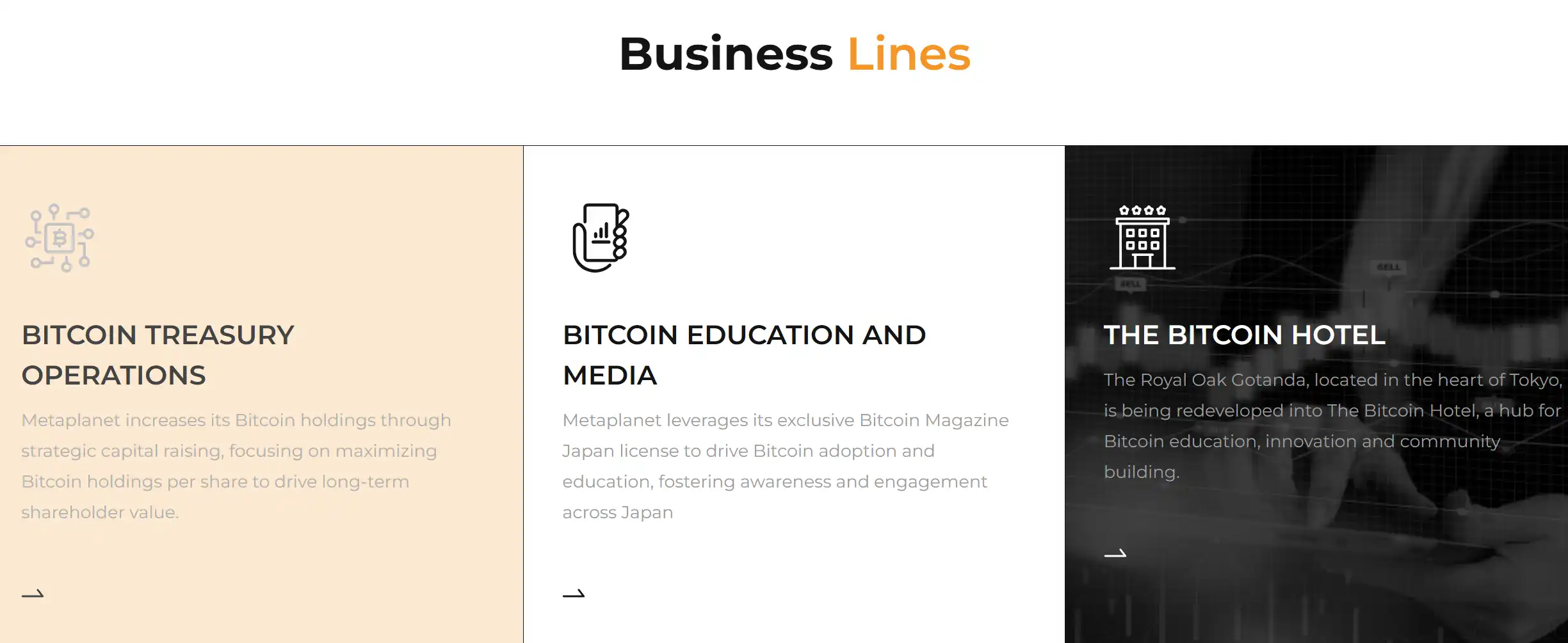
Metaplanet Business Scope (holding btc, btc education, btc-themed hotel), Image Source: Metaplanet
Through this series of capital operations, Metaplanet became the "first publicly traded Japanese company holding Bitcoin," accumulating approximately 3050 BTC in a short period of time and issuing a 2 billion yen bond in 2024 to continue building its position. Its stock price also skyrocketed over 4000% from a long-term low of below 50 yen.
In April 2024, Jason Fang, the founder of Sora Ventures, wrote on his personal Twitter account that Metaplanet is the "first MicroStrategy in Asia" and, through collaborations with UTXO Management, Mark Yusko, and others, helped Metaplanet integrate Bitcoin into its balance sheet, becoming Japan's first publicly traded company holding Bitcoin.
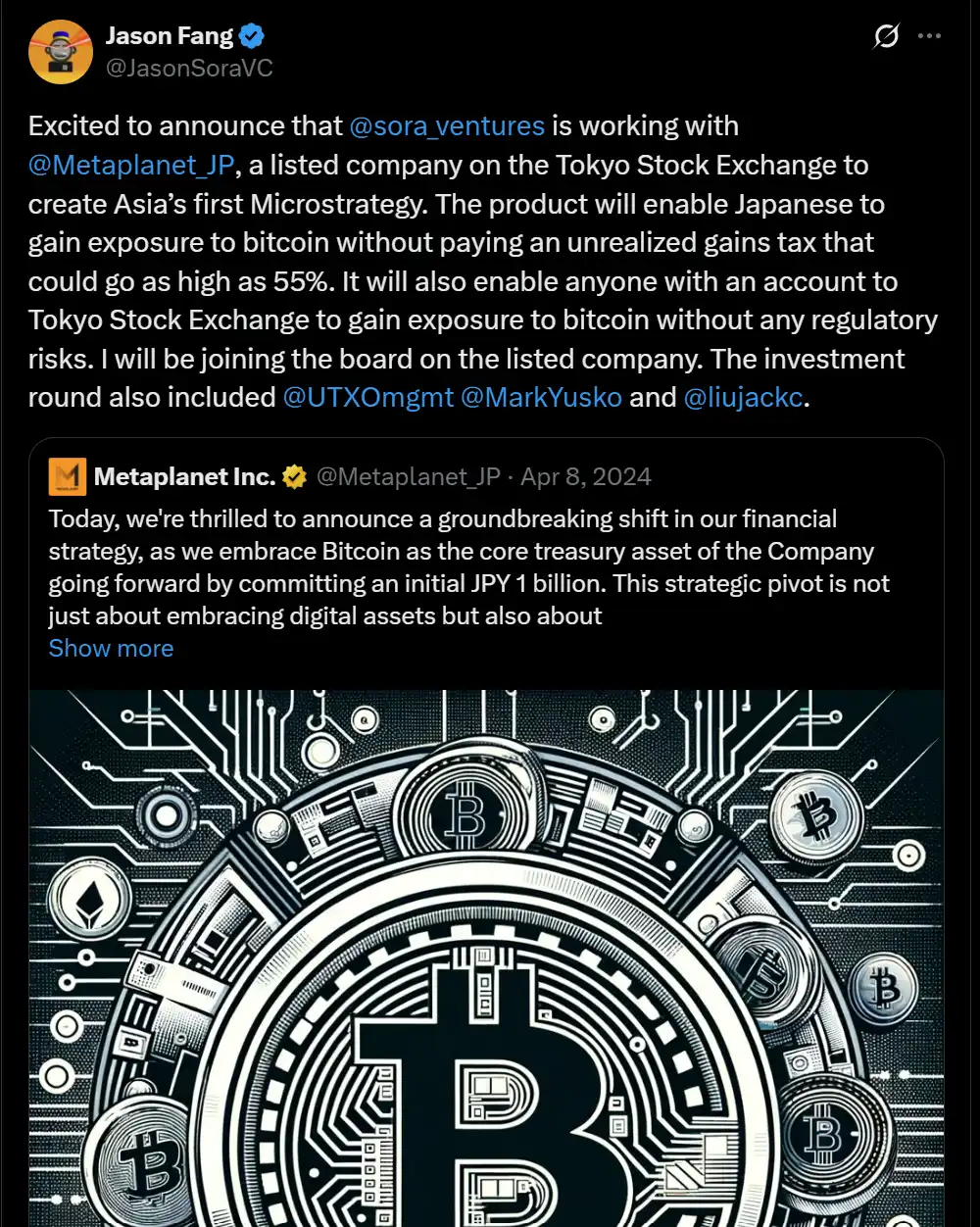
This is the first time Jason Fang, as a board member of Metaplanet, has brought Sora Ventures to the forefront. In fact, Sora has been very aggressive along the path of "replicating MicroStrategy."
A similar operation seemed to have also taken place in the same year with the Hong Kong-listed gaming company Boyaa Interactive.
Founded in 2004, Boyaa focuses on card games such as Texas Hold'em. The founder, Zhang Wei, a graduate of Shenzhen University, saw the stock price rise from 5.35 Hong Kong dollars to 15.16 Hong Kong dollars fueled by Chinese gamers' enthusiasm. However, as the hype faded, the company quickly fell to the bottom, lingering below 1 Hong Kong dollar for years. On November 14, 2023, Boyaa announced a $100 million investment to enter the cryptocurrency space, focusing on Bitcoin and Ethereum.
In November 2024, the company suddenly and prominently announced the conversion of 14,200 ETH from its asset sheet into 515 BTC, increasing its total holdings to 3,183 BTC, surpassing Japan's Metaplanet in one fell swoop, causing its stock price to surge 9 times within a year. Subsequently, in December, Sora Ventures announced the establishment of a $150 million fund dedicated to promoting the adoption of Bitcoin treasury strategies by Asian publicly traded companies, with Boyaa Interactive as its first pilot.
Another noteworthy detail is that in July 2024, Boyaa publicly announced a $1 million investment in the UTXO Management Bitcoin Ecosystem Fund, aiming to increase Boyaa's transitional exposure through BTC Inc.'s resources such as Bitcoin Magazine.
It's not just Sora Venture walking the "Replication Road." In the two cases mentioned above, we can also see the shadow of another "good helper" – UTXO Management.
Behind the push to adopt a Bitcoin strategy for Metaplanet, UTXO Management also played a crucial role. Its partner, Dylan LeClair, served as Metaplanet's Bitcoin Strategy Director, Tyler Evans as an independent director for Metaplanet, and UTXO is a major investment institution for Metaplanet.
This year, the two institutions once again joined forces to orchestrate another "price miracle" in the Hong Kong stock market.
In early 2025, Sora Ventures and UTXO Management teamed up to spend approximately HK$126 million to acquire more than 70% of Hong Asia Holdings' equity, taking over the company.
Hong Asia Holdings was originally a company that relied on selling data cards and running traditional distribution, with extremely low profits. It had long been relegated to the category of "penny stocks" in the Hong Kong stock market (stock price below 1 Hong Kong dollar). After the acquisition, the company was renamed Moon Inc., underwent a thorough "encryption" overhaul from the board to management, and promptly established a "Bitcoin-centric" financial strategy.
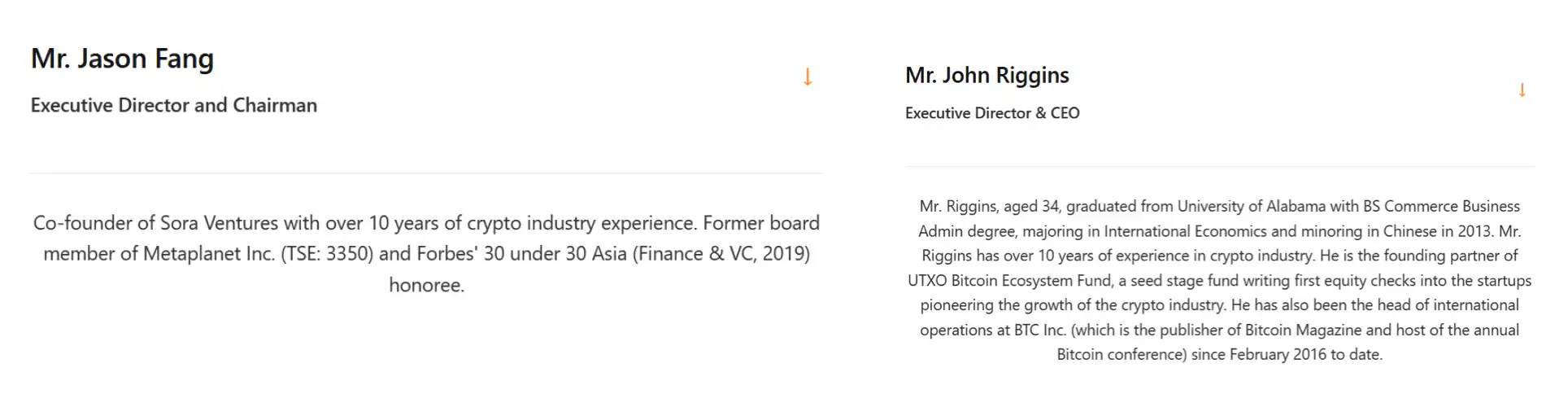
Image Source: http://1723.HK
However, as of the time of the draft, the company only held 28.88 BTC in its account. Hong Kong financial commentator Li Ming bluntly stated, "With such a small position, it doesn't even qualify as probing." Nonetheless, after the company initially announced the purchase of 1 BTC, the stock price quickly rose from 0.29 Hong Kong dollars to 0.38 Hong Kong dollars, an increase of approximately 31%. As of April 17, 2025, it closed at 4.84 Hong Kong dollars, down 32.5% from its 52-week high, but still up approximately 1669% from the year's start of 0.29 Hong Kong dollars.
A terminally ill company is often a low-cost, high-return target for transformation. "Trash shell companies" like Metaplanet and Hongya Holdings had long been trading at a low price before the Bitcoin strategy was implemented. What Sora and UTXO were interested in was not the business of these companies, but rather their cheap shell resources and the potential for capital magnification.
Trump Family's "Bitcoin Operator"
In the global stock market of 2024, Sora Ventures and UTXO Management acted like two highly skilled chess players, making moves frequently.
In 2024, Sora Ventures, in collaboration with UTXO Management, launched the $2 million Sora TTP Fund, betting on the TTP ecosystem under the Ordinals protocol, becoming the world's first decentralized index fund based on Ordinals. It attracted participation from founders of BTSE and Origin Protocol. With the help of UTXO and Bitcoin Magazine's promotion, the $PIPE token skyrocketed by 150% within a month.
Sora Ventures' story began in Hong Kong in 2017, where founder Jason Fang accumulated rich experience at the BTSE exchange and established this investment firm focused on the Bitcoin ecosystem. Initially, Sora mainly focused on early-stage Web3 investments, with assets under management exceeding $1 billion. By 2024, the company's ambitions began to emerge: driving Asian listed companies to adopt Bitcoin as a core treasury strategy on a large scale.
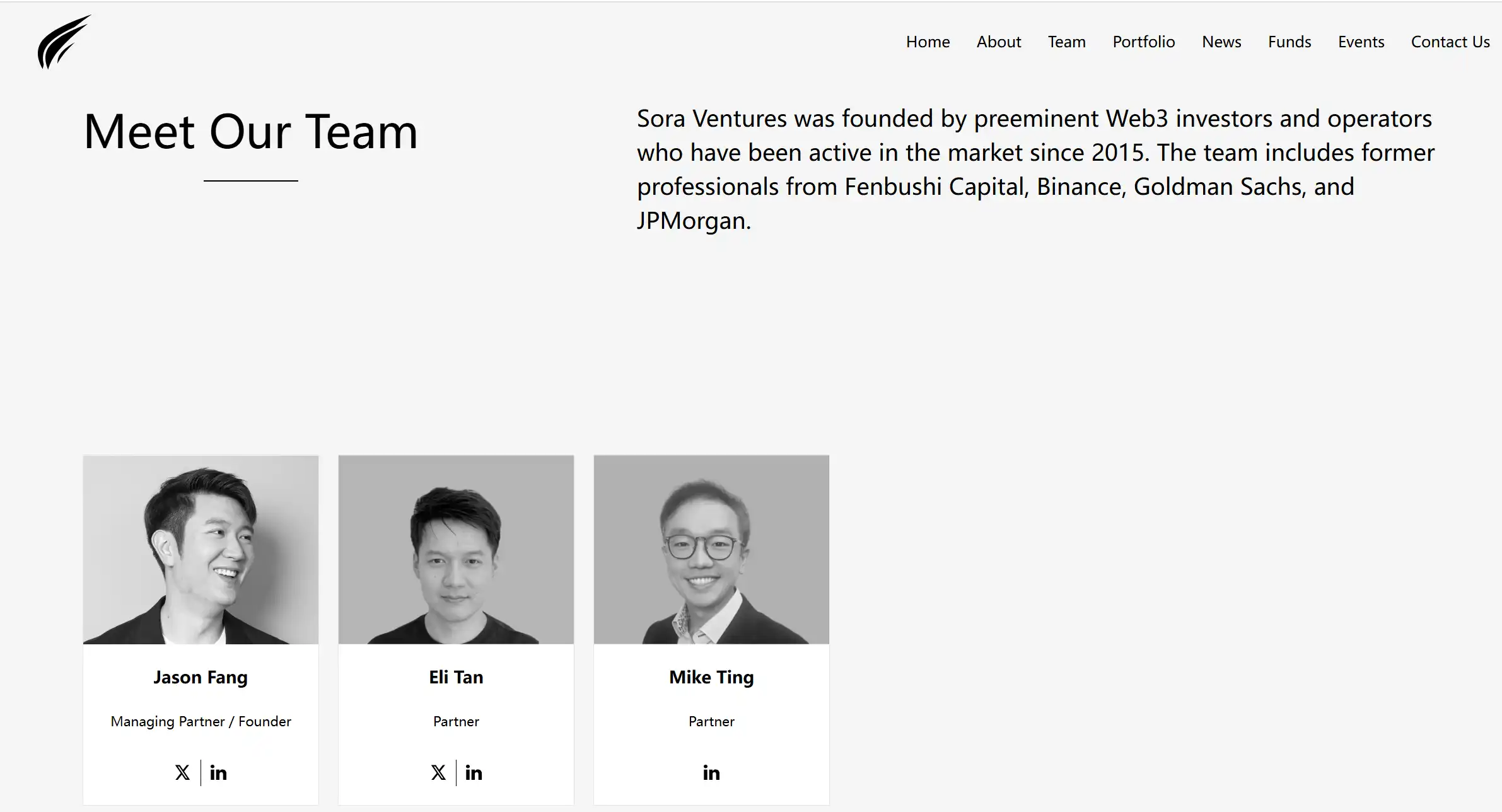
Behind Sora's expansion lies the close collaboration with UTXO. In the case of Metaplanet, UTXO brought in Eric Trump, the son of Trump, to serve as an advisor. Over the past period, this crypto believer has been giving the green light to the Trump family's crypto empire through World Liberty Financial.
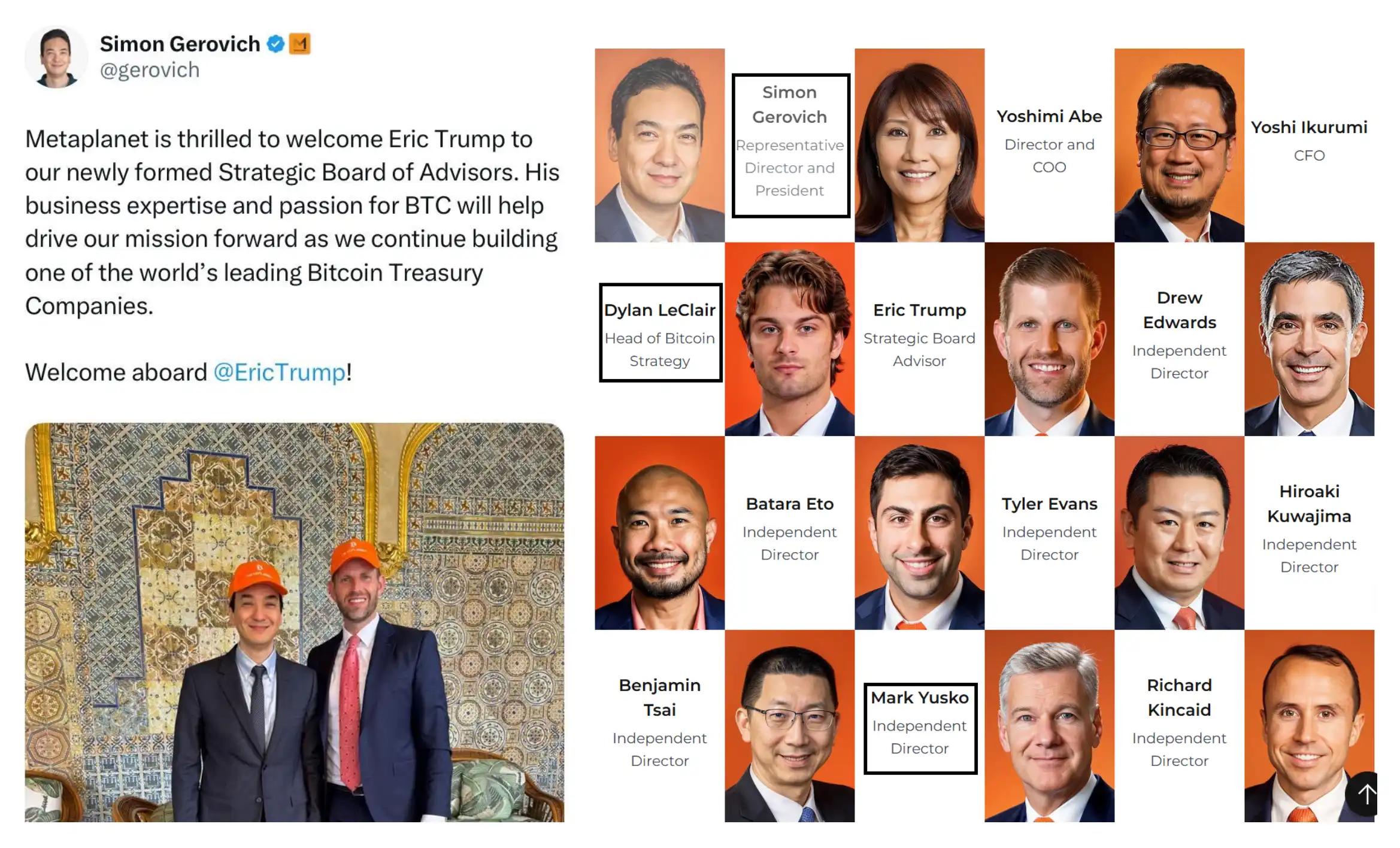
Left: Eric and Simon's group photo, Right: Metaplanet core members; Image source: X, Metaplanet
So, what is UTXO's background?
The story of UTXO Management begins in the state of Tennessee, USA, as part of BTC Inc. (publisher of "Bitcoin Magazine" and organizer of Bitcoin conferences). They initially focused on allocating Bitcoin assets for high-net-worth clients and had invested in over 60 mining and early-stage project companies as early as 2013.
As the Bitcoin ETF was approved in 2024 (with BlackRock recommending a 5% allocation, signaling to traditional capital that Bitcoin was now "allocatable"), UTXO quickly saw the opportunity of institutional capital and began to transition. UTXO's hedge fund, 210k Capital, emerged as a newcomer in this transformation, achieving a 164% annual return with a heavy Strategy and Metaplanet investment, placing them in the top five of the HFR.
Their Chief Investment Officer, Tyler Evans, proudly stated, "80% of our portfolio is concentrated in Bitcoin-related stocks, with Metaplanet and Strategy being the main sources of returns." These companies, through "securitizing Bitcoin," provided the most comfortable entry for institutional investors (such as the Wisconsin Teachers' Pension Fund and the Abu Dhabi Sovereign Wealth Fund) to enter the Bitcoin market with significant capital.
At the same time, The Smarter Web Company, invested in by UTXO Management, plans to IPO on the UK's Aquis Exchange, being dubbed the "UK version of Metaplanet," with its Bitcoin finance model penetrating the European market. This series of moves by UTXO, all trace back to the well-resourced parent company, BTC Inc., and are not devoid of the implicit assistance of the Trump family's political resources.
The relationship between BTC Inc. and the Trump family goes far beyond surface-level cooperation, deeply rooted in the intertwining of business interests and political resources.
As BTC Inc., publisher of "Bitcoin Magazine" and the world's largest Bitcoin conference organizer, leveraged its strong industry influence to provide a platform for the Trump family's public opinion control and, through a series of business collaborations, supported the Trump family.
This relationship can be traced back to Trump's 2024 election campaign, where, during the Bitcoin 2024 conference hosted by BTC Inc., Trump publicly endorsed the cryptocurrency industry for the first time as a presidential candidate. BTC Inc. CEO David Bailey personally organized a high-profile fundraising dinner with a ticket price as high as $846,000 per person, raising $25 million in campaign funds.
During his speech, Trump repeatedly mentioned the support of BTC Inc. and praised it as the "backbone of the Bitcoin community." During the campaign, BTC Inc. continuously reported on Trump's crypto policy stance through Bitcoin Magazine, garnering support from a significant portion of the crypto industry voters.
After a successful campaign, BTC Inc. continued to provide a platform for the Trump family's crypto policy through its hosted conferences. From December 9 to 10, 2024, at the Abu Dhabi Bitcoin MENA Conference, Trump's son Eric Trump served as a keynote speaker, predicting that Bitcoin would reach $1 million and emphasizing that his father would become the "most crypto-supportive president in history."
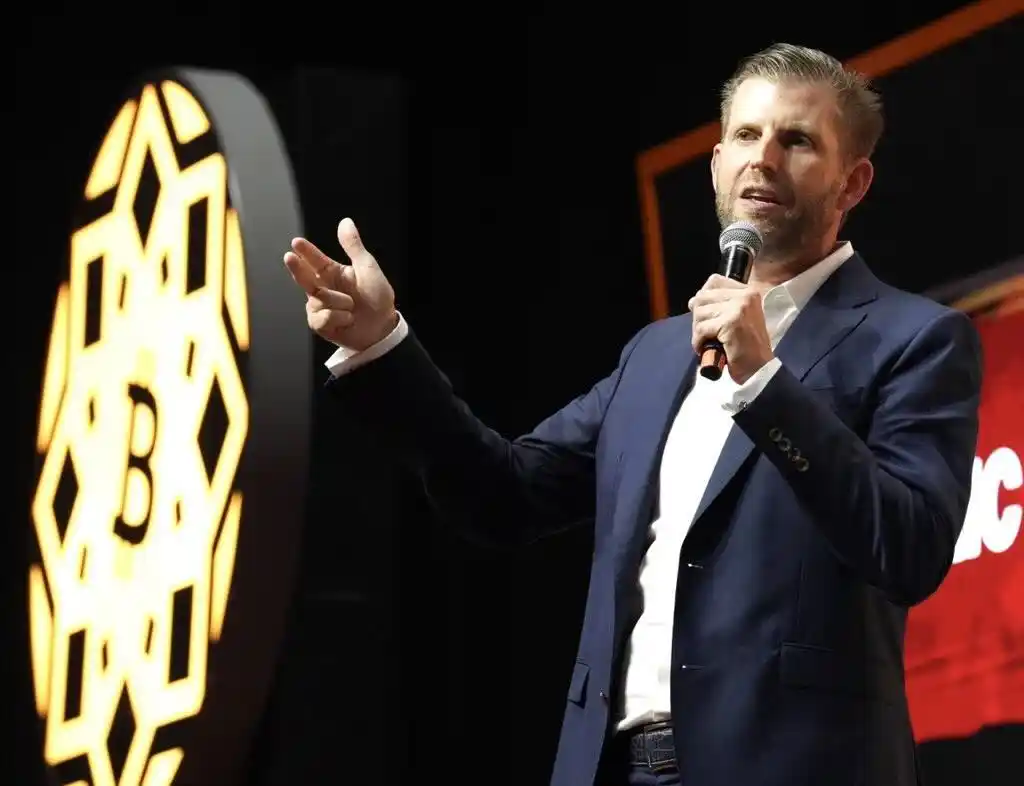
The relationship between BTC Inc. and the Trump family is primarily based on a mutually beneficial exchange of public opinion control and political resources. Bitcoin Magazine under BTC Inc. continuously endorsed the Trump family's crypto projects, such as reporting on the establishment of American Bitcoin and the progress of World Liberty Financial.
From financial support during the campaign to policy promotion at conferences, and to the commercial layout of mining companies, the two are inseparable. This "duet" inevitably triggers many external associations with their political influence and business ambitions.
"More and More MicroStrategy-Like Companies in the US Stock Market"
As Michael Saylor put it, the US stock market is also seeing more and more "MicroStrategy-like" companies. Upon closer examination of these "MicroStrategy-like" companies, it is evident that their motivations are not the same. Not every company is deeply integrating with Sora and UTXO like Metaplanet; some companies are more like "acting on loans," optimizing their balance sheets by holding Bitcoin, or doing so for market value management considerations.
Why Are US Stock Market Companies Buying Bitcoin?
Among the US stock market companies buying Bitcoin, GameStop may be a typical representative. The former offline gaming retail giant is attempting to prolong its life through a "hodl transformation", using Bitcoin as a hedge to alleviate inflation pressure and unsightly data on financial statements, more so out of "wanting to buy" rather than "having to buy."
Announcing the purchase of $1.5 billion in convertible bonds to buy Bitcoin and CEO Ryan Cohen's $10.7 million additional stock purchase both stimulated a short-term price surge, which quickly reversed. While the $1.5 billion investment is not insignificant, compared to GameStop's over $100 million loss in the 2024 financial report, it still seems like a drop in the bucket.
The GameStop saga seems more like an attempt to recreate the 2021 meme stock craze through the Bitcoin frenzy, with a strategy leaning more towards capital market maneuvers rather than business transformation.
Cohen's increased stake seems more like a short-term stimulus. Based on his experience of selling pet e-commerce Chewy for $3.2 billion, Ryan Cohen has always carried a strong e-commerce marketing flavor in his style.
According to media reports, although GameStop's total assets amount to $5.875 billion, nearly 81% of it is in cash reserves, and the operating cash flow is only $146 million, highlighting the company's profitability dilemma in its core business. Allocating a quarter of its assets to Bitcoin actually underscores GameStop's reliance on speculative strategies, showing a lack of resolution to its core business.
Another company facing a similar situation of stock price stagnation and ample cash is Semler Scientific. Chairman Eric Semler joined the board two years ago, calling himself a "boardroom radical." He described Semler at that time as a "money-making zombie company that was not recognized by the market," with an asset structure very similar to MicroStrategy in 2020: high cash reserves, low growth, and low valuation.
Semler chose not to pursue acquisitions or drastic business reforms but instead drove the company to incorporate Bitcoin into its treasury strategy, becoming the second publicly listed U.S. company to do so after MicroStrategy. This move triggered a reassessment of its value by the market and brought long-lost attention to its previously overlooked business.
However, not all companies blindly follow the "MicroStrategy-style" Bitcoin treasury operation trend. In October 2024, Microsoft seriously discussed whether to include Bitcoin in its balance sheet at a shareholder meeting but ultimately resoundingly voted against the proposal. The main concern was the high volatility of Bitcoin, which could disrupt the company's financial stability. Microsoft's CFO Amy Hood also clearly stated, "Our capital allocation is more focused on core growth areas such as AI and cloud computing, rather than speculative assets."
Can Anyone Be Like MicroStrategy?
Comparing these companies, it's easy to see that MicroStrategy deeply integrates Bitcoin into its financial structure for the long term. On the other hand, some companies are trying to use Bitcoin for self-rescue (Kongya), some see it as a financial hedge (Metaplanet), and some may just be seeking alpha (GameStop).
It's not accurate to call them "underachievers" imitating top performers. A more precise statement would be: they all want to do something with Bitcoin, just in different directions.
Currently, MicroStrategy's position is 27,987 times that of HKEX Holdings, 125 times that of Metaplanet, 30 times that of GameStop, and the positions of a series of other small companies are also very small. There is a significant gap in positions between MicroStrategy and these companies, and small-scale positions cannot really generate effective hedging effects.
The key difference lies in the overwhelming financing capability. MicroStrategy is like having unlimited ammunition, with the ability to issue bonds and super low borrowing rates, resulting in a relatively low blended cost of Bitcoin.
Since 2020, through debt issuance and stock offerings, a total of over $10 billion has been raised. In 2024, $1 billion in new shares will continue to increase the position. In the first quarter of 2025, a total of $7.69 billion was raised, with $4.4 billion used to purchase coins. This continuous financing capability has enabled MicroStrategy to continuously increase its position in the face of Bitcoin price fluctuations.
In contrast, HKEX Holdings sourced its coin purchase funds only from the acquisition by Sora Ventures and UTXO Management (at a cost of $126 million), with almost zero subsequent financing capability. Although Metaplanet raised funds through the issuance of zero-coupon bonds, the total investment is only about $250 million, far below MicroStrategy's scale. GameStop issued $1.5 billion in convertible bonds but announced a 22.1% stock price plunge thereafter, clearly demonstrating the market's lack of confidence in its financing.
From the stock market's perspective, the U.S. stock market has high liquidity, and Saylor's operations often quickly reflect in stock prices. HKEX Holdings is limited by the low liquidity of the Hong Kong stock market, where small-cap stocks are easily manipulated, and trends are more driven by retail investor sentiment. Metaplanet is constrained by the ceiling of the Japanese market itself, with relatively limited growth potential.
From the perspective of company ownership, Metaplanet, HKEX Holdings, and GameStop exhibit a highly dispersed ownership structure, with a large number of small and medium-sized investors in the shareholder composition, rather than being dominated by a single or a few large shareholders. Around 40% of GameStop's shares are held by retail investors, and a single post on Reddit or Twitter can cause its stock price to jump by a dozen or twenty points. Emotions come and go quickly, naturally leading to rapid price movements.
For secondary market investors, perhaps they are more like a leveraged BTC concept stock.
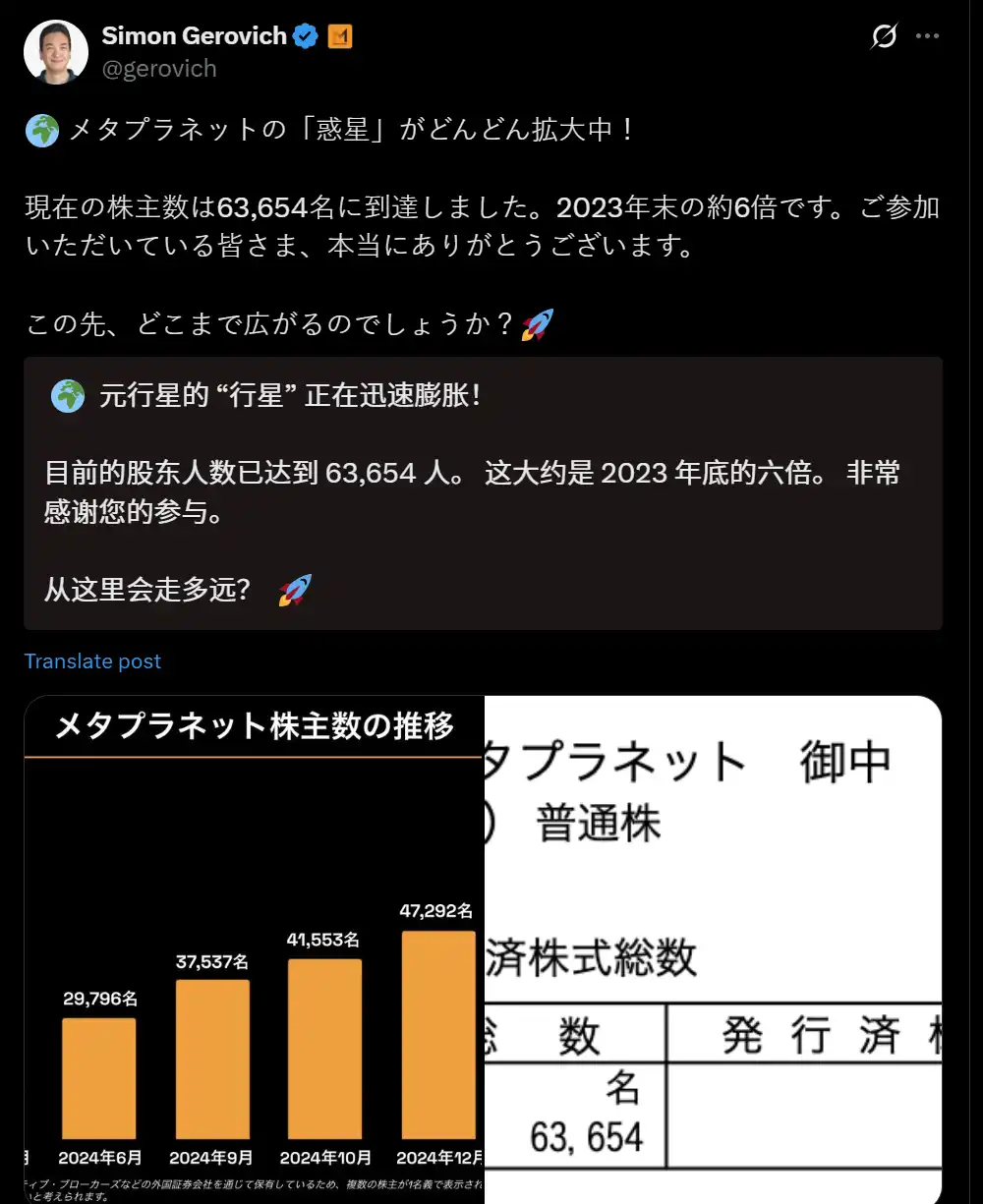
Chart: Metaplanet Shareholder Count Continues to Soar
Behind MicroStrategy stand stable large asset management companies such as BlackRock and Vanguard, with founder Saylor holding 20% of the company's shares, making it much more stable. One is like a cryptocurrency trading group, and the other is like a bond fund. It's not about which one is better, but about whether you want to chase a trend or play a long-term game.
In terms of market attention and importance, by 2024, MicroStrategy was included in the Nasdaq 100 Index, institutional ownership rose to 60%, Defiance and T-REX successively launched 2x long and short MicroStrategy leveraged ETFs (such as MSTX, SMST, MSTU). As of now, MicroStrategy is held by 216 ETFs, with VanEck having the heaviest allocation to it. The ETF halo is comparable to the "Big Seven" of the US stock market.
On the other hand, companies like GameStop, Metaplanet, and Kong Asia Holdings, among other "followers," do not have exclusive ETF products, and have not even been widely included in mainstream ETFs. In this exclusive club, without the backing of a stock index like Nasdaq, it is also difficult to receive the "golden touch" of the capital market.
“Fentanyl Addiction”: Risk of Stock Market Systemic Collapse
As of April 7, 2025, due to Trump's announcement of tariff increases, global markets experienced severe volatility, with the fallback in Bitcoin prices feeling like a cold wind blowing through. The stock prices of Hong Kong Stock 1723 (Kong Asia Holdings), GameStop, Metaplanet, and MicroStrategy all fell in response.
The highly correlated stock prices of these companies with the price of Bitcoin revealed an obvious risk: they are like the same type of tree planted on the same mountain, inevitably falling together when a storm hits. This “copycat” Bitcoin strategy may seem to bring short-term prosperity, but it also lays the groundwork for systemic collapse.
Companies that have bet their fate on a single Bitcoin asset, lacking diversification support, may face a series of events such as a breakdown in the funding chain, debt pressures, and a collapse of market confidence once Bitcoin market sentiment shifts or regulations tighten, triggering a chain reaction.
Although MicroStrategy appears somewhat stable due to its scale and first-mover advantage, the holding of over 440,000 BTC is backed by high leverage financing, and the risk of debt default cannot be ignored. On the other hand, Kong Asia Holdings 1723, GameStop, and Metaplanet have smaller capital bases and almost zero risk resistance. The essence of this strategy is to magnify speculation to the extreme, yet it has failed to build a moat around its core business.
Related Reading: "If MicroStrategy is forced to sell BTC, how much selling pressure will it bring to the market?"
The deeper issue is that most of these companies are not doing anything "real." HongYa Holdings' SIM card business is stagnant, GameStop's physical retail is on the decline, Metaplanet's Web3 transformation is all talk and no action, and even MicroStrategy's software business has long been marginalized.
They choose Bitcoin not because it synergizes with their core business, but because they see it as a "life-saving straw" in the capital markets. If companies in the stock market all give up on real business and instead chase speculative trends like BTC, one can't help but imagine that the entire economic ecosystem may become imbalanced.
Imagine if giants like Microsoft and Apple also gave up on technological innovation to hoard Bitcoin, where would the foundation of the global industry be? The real economy is the cornerstone of the economy; it creates value, addresses needs, and does not rely solely on financial leverage to create bubbles.
In summary, now that the tide is receding due to tariff shocks, those companies without solid business support are destined to be caught swimming naked. The capital markets should reward those who are down-to-earth and create long-term value, rather than blindly chasing speculative stories. After all, a healthy forest requires a diverse range of tree species, not just a single speculative tree.
猜你喜歡

穩定幣驅動全球B2B支付革新,如何打破工作流程瓶頸釋放兆市場潛力?
這些新創公司正在無需資料中心的情況下建立先進AI模型
CEX與Wallet之後,OKX入局支付
RWA永續產品危機:為什麼GLP模式註定撐不住RWA永續?
科學平權運動:DeSci的萬億美元知識經濟重建革命
Sentient深度研報:獲8,500萬美元融資,建置去中心化AGI新範式
專訪Virtuals聯創empty:AI 創業不需要大量資金,Crypto是答案之一
今年 2 月,Base 生態中的 AI 協議 Virtuals 宣布跨鏈至 Solana,然而加密市場隨後進入流動性緊縮期,AI Agent 板塊從人聲鼎沸轉為低迷,Virtuals 生態也陷入一段蟄伏期。
三月初,BlockBeats 對 Virtuals 共同創辦人 empty 進行了一次專訪。彼時,團隊尚未推出如今被廣泛討論的 Genesis Launch 機制,但已在內部持續探索如何透過機制設計激活舊資產、提高用戶參與度,並重構代幣發行與融資路徑。那是一個市場尚未復甦、生態尚處冷啟動階段的時間點,Virtuals 團隊卻沒有停下腳步,而是在努力尋找新的產品方向和敘事突破口。
兩個月過去,AI Agent 板塊重新升溫,Virtuals 代幣反彈超 150%,Genesis 機製成為帶動生態回暖的重要觸發器。從積分獲取規則的動態調整,到專案參與熱度的持續上升,再到「新代幣帶老代幣」的機制閉環,Virtuals 逐漸走出寒冬,並再次站上討論焦點。
值得注意的是,Virtuals 的 Genesis 機制與近期 Binance 推出的 Alpha 積分系統有一些相似之處,評估用戶在 Alpha 和幣安錢包生態系統內的參與度,決定用戶 Alpha 代幣空投的資格。用戶可透過持倉、交易等方式獲得積分,積分越高,參與新項目的機會越大。透過積分系統篩選使用者、分配資源,專案方能夠更有效地激勵社群參與,提升專案的公平性和透明度。 Virtuals 和 Binance 的探索,或許預示著加密融資的新趨勢正在形成。
回看這次對話,empty 在專訪中所展現出的思路與判斷,正在一步步顯現其前瞻性,這不僅是一場圍繞打新機制的訪談,更是一次關於“資產驅動型 AI 協議”的路徑構建與底層邏輯的深度討論。
BlockBeats:可以簡單分享一下最近團隊主要在忙些什麼?
empty:目前我們的工作重點主要有兩個部分。第一部分,我們希望將 Virtuals 打造成一個類似「華爾街」的代理人(Agent)服務平台。設想一下,如果你是專注於 Agent 或 Agent 團隊建立的創業者,從融資、發幣到流動性退出,整個流程都需要係統性的支援。我們希望為真正專注於 Agent 和 AI 研發的團隊,提供這一整套服務體系,讓他們可以把精力集中在底層能力的開發上,而不用為其他環節分心。這一塊的工作其實也包括了與散戶買賣相關的內容,後面可以再詳細展開。
第二部分,我們正在深入推進 AI 相關的佈局。我們的願景是建立一個 AI 社會,希望每個 Agent 都能聚焦自身優勢,同時透過彼此之間的協作,實現更大的價值。因此,最近我們發布了一個新的標準——ACP(Agent Communication Protocol),目的是讓不同的 Agent 能夠相互互動、協作,共同推動各自的業務目標。這是目前我們主要在推進的兩大方向。
BlockBeats:可以再展開說說嗎?
empty:在我看來,其實我們面對的客戶群可以分為三類:第一類是專注於開發 Agent 的團隊;第二類是投資者,包括散戶、基金等各種投資機構;第三類則是 C 端用戶,也就是最終使用 Agent 產品的個人用戶。
不過,我們主要的精力其實是放在前兩大類──也就是團隊和投資人。對於 C 端用戶這一塊,我們並不打算直接介入,而是希望各個 Agent 團隊能夠自己解決 C 端市場的拓展問題。
此外,我們也認為,Agent 與 Agent 之間的交互作用應該成為一個核心模式。簡單來說,就是未來的服務更多應該是由一個 Agent 銷售或提供給另一個 Agent,而不是單純賣給人類使用者。因此,在團隊的 BD 工作中,我們也積極幫助現有的 AI 團隊尋找這樣的客戶和合作機會。
BlockBeats:大概有一些什麼具體案例呢?
empty:「華爾街」說白了就是圍繞資本運作體系的建設,假設你是一個技術團隊,想要融資,傳統路徑是去找 VC 募資,拿到資金後開始發展。如果專案做得不錯,接下來可能會考慮進入二級市場,例如在紐約證券交易所上市,或是在 Binance 這樣的交易所上幣,實現流動性退出。
我們希望把這一整套流程打通-從早期融資,到專案開發過程中對資金的靈活使用需求,再到最終二級市場的流動性退出,全部覆蓋和完善,這是我們希望補齊的一條完整鏈條。
而這一部分的工作和 ACP(Agent Communication Protocol)是不同的,ACP 更多是關於 Agent 與 Agent 之間交互標準的製定,不直接涉及資本運作系統。
BlockBeats:它和現在 Virtuals 的這個 Launchpad 有什麼差別呢?資金也是從 C 端來是嗎?
empty:其實現在你在 Virtuals 上發幣,如果沒有真正融到資金,那就只是發了一個幣而已,實際是融不到錢的。我們目前能提供的服務,是透過設定買賣時的交易稅機制,從中提取一部分稅收回饋給創業者,希望這部分能成為他們的現金流來源。
不過,問題其實還分成兩塊。第一是如何真正幫助團隊完成融資,這個問題目前我們還沒有徹底解決。第二是關於目前專案發行模式本身存在的結構性問題。簡單來說,現在的版本有點像過去 Pumpfun 那種模式——也就是當專案剛上線時,部分籌碼就被外賣給了外部投資人。但現實是,目前整個市場上存在著太多機構集團和「狙擊手」。
當一個真正優秀的專案一發幣,還沒真正觸達普通散戶,就已經被機構在極高估值時搶購了。等到散戶能夠接觸到時,往往價格已經偏高,專案品質也可能變差,整個價值發行體係被扭曲。
針對這個問題,我們希望探索一種新的發幣和融資模式,目的是讓專案方的籌碼既不是死死握在自己手裡,也不是優先流向英文圈的大機構,而是能夠真正留給那些相信專案、願意長期支持專案的普通投資者手中。我們正在思考該如何設計這樣一個新的發行機制,來解決這個根本問題。
BlockBeats:新模式的具體想法會是什麼樣子呢?
empty:關於資金這一塊,其實我們目前還沒有完全想透。現階段來看,最直接的方式還是去找 VC 融資,或是採取公開預售等形式進行資金募集。不過說實話,我個人對傳統的公開預售模式並不是特別認同。
在「公平發售」這件事上,我們正在嘗試換一個角度來思考-希望能從「reputation」出發,重新設計機制。
具體來說,就是如果你對整個 Virtuals 生態有貢獻,例如早期參與、提供支持或建設,那麼你就可以在後續購買優質代幣時享有更高的優先權。透過這種方式,我們希望把資源更多留給真正支持生態發展的用戶,而不是由短期套利的人主導。
BlockBeats:您會不會考慮採用類似之前 Fjord Foundry 推出的 LBP 模式,或者像 Daos.fun 那種採用白名單機制的模式。這些模式在某種程度上,和您剛才提到的「對生態有貢獻的人享有優先權」的想法是有些相似的。不過,這類做法後來也引發了一些爭議,例如白名單內部操作、分配不公等問題。 Virtuals 在設計時會考慮借鏡這些模式的優點,或有針對性地規避類似的問題嗎?
empty:我認為白名單機制最大的問題在於,白名單的選擇權掌握在專案方手中。這和「老鼠倉」行為非常相似。專案方可以選擇將白名單名額分配給自己人或身邊的朋友,導致最終的籌碼仍然掌握在少數人手中。
我們希望做的,依然是類似白名單的機制,但不同的是,白名單的獲取權應基於一個公開透明的規則體系,而不是由項目方單方面決定。只有這樣,才能真正做到公平分配,避免內幕操作的問題。
我認為在今天這個 AI 時代,很多時候創業並不需要大量資金。我常跟團隊強調,你們應該優先考慮自力更生,例如透過組成社區,而不是一開始就想著去融資。因為一旦融資,實際上就等於背負了負債。
我們更希望從 Training Fee的角度去看待早期發展路徑。也就是說,專案可以選擇直接發幣,透過交易稅所帶來的現金流,支持日常營運。這樣一來,專案可以在公開建設的過程中獲得初步資金,而不是依賴外部投資。如果專案做大了,自然也會有機會透過二級市場流動性退出。
當然最理想的情況是,專案本身能夠有穩定的現金流來源,這樣甚至連自己的幣都無需拋售,這才是真正健康可持續的狀態。
我自己也常在和團隊交流時分享這種思路,很有意思的是,那些真正抱著「搞快錢」心態的項目,一聽到這種機制就失去了興趣。他們會覺得,在這種模式下,既無法操作老鼠倉,也很難短期套利,於是很快就選擇離開。
但從我們的角度來看,這其實反而是個很好的篩選機制。透過這種方式,理念不同的專案自然會被過濾出去,最後留下的,都是那些願意真正建立、和我們價值觀契合的團隊,一起把事情做起來。
BlockBeats:這個理念可以發展出一些能夠創造收益的 AI agent。
empty:我覺得這是很有必要的。坦白說,放眼今天的市場,真正擁有穩定現金流的產品幾乎鳳毛麟角,但我認為這並不意味著我們應該停止嘗試。事實上,我們每天在對接的團隊中,有至少一半以上的人依然懷抱著長遠的願景。很多時候,他們甚至已經提前向我們提供了 VC 階段的資金支持,或表達了強烈的合作意願。
其實對他們來說想要去收穫一個很好的社區,因為社區可以給他們的產品做更好的回饋,這才是他們真正的目的。這樣聽起來有一點匪夷所思,但其實真的有很多這樣的團隊,而那種團隊的是我們真的想扶持的團隊。
BlockBeats:您剛才提到的這套「AI 華爾街」的產品體系-從融資、發行到退出,建構的是一整套完整的流程。這套機制是否更多是為了激勵那些有意願發幣的團隊?還是說,它在設計上也考慮瞭如何更好地支持那些希望透過產品本身的現金流來發展的團隊?這兩類團隊在您這套體系中會不會被區別對待,或者說有什麼機制設計能讓不同路徑的創業者都能被合理支持?
empty:是的,我們 BD 的核心職責其實就是去鼓勵團隊發幣。說得直接一點,就是引導他們思考發幣的可能性和意義。所以團隊最常問的問題就是:「為什麼要發幣?」這時我們需要採取不同的方式和角度,去幫助他們理解背後的價值邏輯。當然如果最終判斷不適合,我們也不會強迫他們推進。
不過我們觀察到一個非常明顯的趨勢,傳統的融資路徑已經越來越難走通了。過去那種融資做大,發幣上所的模式已經逐漸失效。面對這樣的現實,很多團隊都陷入了尷尬的境地。而我們希望能從鏈上和加密的視角,提供一套不同的解決方案,讓他們找到新的發展路徑。
BlockBeats:明白,我剛才其實想表達的是,您剛剛也提到,傳統的 AI 模式在很大程度上仍然依賴「燒錢」競爭。但在 DeepSeek 出現之後,市場上一些資金體積較小的團隊或投資人開始重新燃起了信心,躍躍欲試地進入這個領域。您怎麼看待這種現象?這會不會對目前正在做 AI 基礎研發,或是 AI 應用層開發的團隊產生一定的影響?
empty:對,我覺得先不談 DeepSeek,從傳統角度來看,其實到目前為止,AI 領域真正賺錢的只有英偉達,其他幾乎所有玩家都還沒有實現盈利。所以其實沒有人真正享受了這個商業模式的成果,大家也仍在探索如何面對 C 端打造真正有產出的應用。
沒有哪個領域像幣圈一樣能如此快速獲得社群回饋。你一發幣,用戶就會主動去讀白皮書的每一個字,試試你產品的每個功能。
當然,這套機制並不適合所有人。例如有些 Agent 產品偏 Web2,對於幣圈用戶而言,可能感知不到其價值。因此,我也會鼓勵做 Agent 的團隊在 Virtuals 生態中認真思考,如何真正將 Crypto 作為自身產品的差異化要素加以運用與設計。
BlockBeats:這點我特別認同,在 Crypto 這個領域 AI 的迭代速度確實非常快,但這群用戶給予的回饋,真的是代表真實的市場需求嗎?或者說這些回饋是否真的符合更大眾化、更具規模性的需求?
empty:我覺得很多時候產品本身不應該是強行推廣給不適合的使用者群體。例如 AIXBT 最成功的一點就在於,它的用戶本身就是那群炒作他人內容的人,所以他們的使用行為是非常自然的,並不覺得是在被迫使用一個無聊的產品。 mass adoption 這個概念已經講了很多年,大家可能早就該放棄這個執念了。我們不如就認了,把東西賣給幣圈的人就好了。
BlockBeats:AI Agent 與 AI Agent 所對應的代幣之間,究竟應該是什麼樣的動態關係?
empty:對,我覺得這裡可以分成兩個核心點。首先其實不是在投資某個具體的 AI Agent,而是在投資背後經營這個 Agent 的團隊。你應該把它理解為一種更接近創投的思路:你投的是這個人,而不是他目前正在做的產品。因為產品本身是可以快速變化的,可能一個月後團隊會發現方向不對,立即調整。所以,這裡的「幣」本質上代表的是對團隊的信任,而不是某個特定 Agent 本身。
第二則是期望一旦某個 Agent 產品做出來後,未來它能真正產生現金流,或者有實際的使用場景(utility),從而讓對應的代幣具備賦能效應。
BlockBeats:您覺得有哪些賦能方式是目前還沒看到的,但未來可能出現、值得期待的?
empty:其實主要有兩塊,第一是比較常見的那種你要使用我的產品,就必須付費,或者使用代幣支付,從而間接實現對代幣的「軟銷毀」或消耗。
但我覺得更有趣的賦能方式,其實是在獲客成本的角度思考。也就是說,你希望你的用戶同時也是你的投資者,這樣他們就有動機去主動幫你推廣、吸引更多用戶。
BlockBeats:那基於這些觀點,您怎麼看 ai16z,在專案設計和代幣機制方面,似乎整體表現並不太樂觀?
empty:從一個很純粹的投資角度來看,撇開我們與他們之間的關係,其實很簡單。他們現在做的事情,對代幣本身沒有任何賦能。從開源的角度來看,一個開源模型本身是無法直接賦能代幣的。
但它仍然有價值的原因在於,它像一個期權(call option),也就是說,如果有一天他們突然決定要做一些事情,比如推出一個 launchpad,那麼那些提前知道、提前參與的人,可能會因此受益。
開發者未來確實有可能會使用他們的 Launchpad,只有在那一刻,代幣才會真正產生賦能。這是目前最大的一個問號——如果這個模式真的跑得通,我認為確實會非常強大,因為他們的確觸達了大量開發者。
但我個人還是有很多疑問。例如即使我是使用 Eliza 的開發者,也不代表我一定會選擇在他們的 Launchpad 上發幣。我會貨比三家,會比較。而且,做一個 Launchpad 和做一個開源框架,所需的產品能力和社群運作能力是完全不同的,這是另一個重要的不確定性。
BlockBeats:這種不同是體現在什麼地方呢?
empty:在 Virtuals 上我們幾乎每天都在處理客服相關的問題,只要有任何一個團隊在我們平台上發生 rug,即使與我們沒有直接關係,用戶也會第一時間來找我們投訴。
這時我們就必須出面安撫用戶,並思考如何降低 rug 的整體風險。一旦有團隊因為自己的代幣設計錯誤或技術失誤而被駭客攻擊、資產被盜,我們往往需要自掏腰包,確保他們的社群至少能拿回一點資金,以便專案能夠重新開始。這些項目方可能在技術上很強,但未必擅長代幣發行,結果因操作失誤被攻擊導致資產損失。只要涉及「被欺騙」相關的問題,對我們來說就已經是非常麻煩的事了,做這些工作跟做交易所的客服沒有太大差別。
另一方面,做 BD 也非常困難。優秀的團隊手上有很多選擇,他們可以選擇在 Pumpfun 或交易所上發幣,為什麼他們要來找我們,那這背後必須要有一整套支援體系,包括融資支援、技術協助、市場推廣等,每個環節都不能出問題。
BlockBeats:那我們就繼續沿著這個話題聊聊 Virtuals 目前的 Launchpad 業務。有一些社群成員在 Twitter 上統計了 Virtuals Launchpad 的整體獲利狀況,確實目前看起來獲利的項目比較少。接下來 Launchpad 還會是 Virtuals 的主要業務區嗎?還是說,未來的重心會逐漸轉向您剛才提到的「AI 華爾街」這條路徑?
empty:其實這兩塊本質上是一件事,是一整套體系的一部分,所以我們必須繼續推進。市場的波動是很正常的,我們始終要堅持的一點是:非常清楚地認識到我們的核心客戶是誰。我一直強調我們的客戶只有兩類——團隊。所以市場行情的好壞對我們來說並不是最重要的,關鍵是在每一個關鍵節點上,對於一個團隊來說,發幣的最佳選擇是否依然是我們 Virtuals。
BlockBeats:您會不會擔心「Crypto + AI」或「Crypto AI Agent」這一類敘事已經過去了?如果未來還有一輪多頭市場,您是否認為市場炒作的焦點可能已經不再是這些方向了?
empty:有可能啊,我覺得 it is what it is,這確實是有可能發生的,但這也屬於我們無法控制的範圍。不過如果你問我,在所有可能的趨勢中,哪個賽道更有機會長期保持領先,我仍然認為是 AI。從一個打德撲的角度來看,它仍然是最優選擇。
而且我們團隊的技術架構和底層能力其實早已搭建完成了,現在只是順勢而為而已。更重要的是,我們本身真的熱愛這件事,帶著好奇心去做這件事。每天早上醒來就有驅動力去研究最新的技術,這種狀態本身就挺讓人滿足的,對吧?
很多時候,大家不應該只看產品本身。實際上很多優秀的團隊,他們的基因決定了他們有在規則中勝出的能力——他們可能過去在做派盤交易時,每筆規模就是上百萬的操作,而這些團隊的 CEO,一年的薪資可能就有 100 萬美金。如果他們願意出來單幹項目,從天使投資或 VC 的視角來看,這本質上是用一個很划算的價格買到一個高品質的團隊。
更何況這些資產是 liquid 的,不是鎖倉狀態。如果你當下不急著用錢,完全可以在早期階段買進一些優秀團隊的代幣,靜靜等待他們去創造一些奇蹟,基本上就是這樣一個邏輯。
第16週鏈上數據:結構性供需失衡加劇,數據揭⽰下⼀輪上漲的堅實藍圖?
a16z領投2500萬美元,0xMiden要在你手機裡跑一條隱私鏈
Sui Q1進階報告:BTCfi基建崛起、借貸協議爆發與執行分片未來
川普次子的加密生意經
SignalPlus宏觀分析:關稅撕裂的M2敘事與TradFi式FOMO的回歸
門羅幣市值一天暴增15億美元背後,為何駭客不再喜歡比特幣?
盤點10大新興Launchpad平台,誰能完成Pump.fun的顛覆?
懂王簽字後,美國哪些州在「乖乖」推進比特幣戰略儲備法案?
GoRich正式上線:鏈上交易零門檻,新手也能抓住100x Meme幣
4月29日市場關鍵情報,你錯過了多少?


 App
App