

X Space Review | IP Soaring, What Are the Early Wealth Effects of Participating in the Story Ecosystem?

On February 13, Story launched its mainnet, and the IP airdrop claim started synchronously, listing on major exchanges such as OKX and Coinbase. There was almost no pullback after the launch, and it surged against the trend while BTC was underperforming, experiencing a week-long uptrend. The IP price once broke through $7, standing out among the recent TGE projects.
On February 26, BlockBeats invited Tim, the Head of Developer Relations at Story, Leo, CTO of PIP Labs, along with representatives from four potential projects in the Story ecosystem - Verio, Piper, SOLO AI, and Storyhunt - to discuss the early wealth effects in the Story ecosystem under the theme "IP Surging, What Early Wealth Effects in the Story Ecosystem Can You Participate In?."
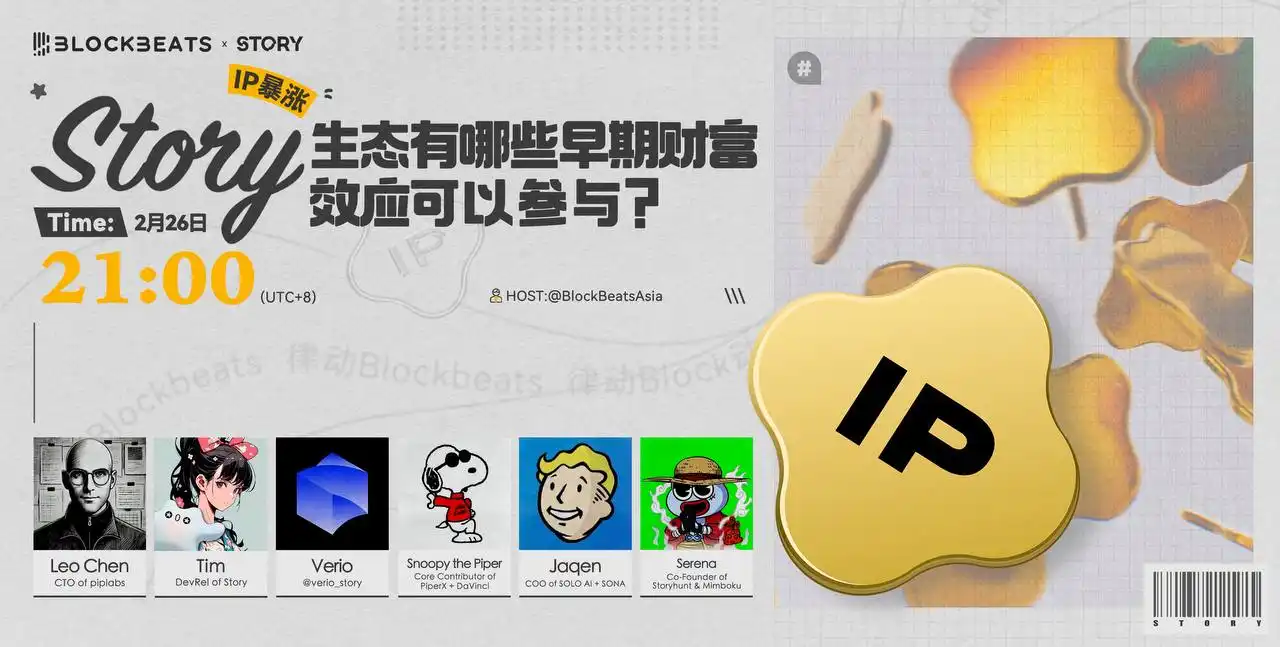
BlockBeats: We warmly welcome our guests today. Please introduce yourselves.
Tim: Hello, everyone. I'm Tim, currently responsible for Developer Relations at Story, and also overseeing partnerships for the node ecosystem and infrastructure.
Serena: Hi, everyone. I'm Serena, the Co-Founder of Storyhunt. Storyhunt is a native DEX on Story, using the AMM model, inspired by Uniswap V3 and mining mechanisms, supporting ERC-20 tokens. Our goal is to digitize IP assets and IPFI on Story, enabling creators and traders to easily transform stories into assets and trade directly on the DEX. I am also a core member of Mimboku, a community built from the ground up, focusing on the NFT development in the Story platform. We are driving the NFT development in the Mimboku community through three projects.
Verio: Hello, everyone. I'm a Co-Founder of Verio. Verio is a liquidity restaking protocol tailored for Story, where the native IP token is the core asset. Users can earn interest by staking IP and receive VIP tokens. VIP tokens can be restaked into various IP assets on Story, providing support and protection.
Snoopy the Piper: Hello, everyone. I'm Snoopy, a core contributor to PiperX. PiperX is the first and largest native DEX on the Story platform. We integrate the AMM mechanism and mining features of Uniswap V2 and V3, offering users a seamless trading experience and attractive liquidity incentives. You can find high-quality IP-backed RWAs, Meme, AI, and Agent assets on PiperX. Additionally, we have developed a DeFi Agent named DaVinci and previously collaborated with Luna (luna_virtuals) to release Luna's first IP asset on Story. This was also the first on-chain collaboration completed through agent negotiation on Story (TCP/IP). I'm excited to engage in today's discussion with everyone.
Jaqen: Hello everyone, I am Jaqen, a core contributor of SOLO AI. We are the first AI music generation platform on the Story protocol, supporting users to easily generate personalized music. On the first day of our launch on the Story mainnet, we released the digital music composition tool DJ Sona. Feel free to visit Solo AI's official website to explore more possibilities of music generation.
Leo Chen: Hello everyone, I am Leo, the CTO of PIP Labs. PIP Labs is the development company behind Story.
BlockBeats: Last week, the IP token price experienced a significant surge. What is the current focus in the ecosystem?
Tim: Currently, my focus is on the creator ecosystem. Story is fundamentally optimized and improved based on intellectual property (IP), while also building a solid infrastructure to help IP go on-chain and have legal effects. My background initially involved content internationalization, and my current focus in the ecosystem is primarily on the appeal of short video creation and text-based content creation. For example, we have collaborated with t2 World on text-based content creation, where they previously established a blog forum based on Links. Apart from this, I have not seen many other applications related to the creator ecosystem. I believe starting from text-based creation still holds promise, especially with platforms like Mirror, Paragraph, among others introduced. While there has been some progress, there hasn't been a breakout text-based creator economy project. Therefore, I am looking forward to seeing more text-based creator economy projects emerge.
Serena: This cycle has revolved around Memecoins, and what sets Story's Memecoin apart is that it is backed by intellectual property (IP). We hope to further drive the development of these IP-backed Memecoins, especially in terms of how to support this market through underlying infrastructure, including how to overcome current challenges since most liquidity is currently centered around Solana. We aim to make Memecoins more liquid in the market and facilitate seamless trading. Our goal is to enable Story community members to capture the value of IP-backed Memecoins and create wealth.
We are also contemplating how to better discover community-driven Alpha. Story itself is a trading platform that can early on capture which IPs are fermenting, which emerging IPs are rising, and which ones may become hot trends. Much of the Alpha information will first manifest on our platform and be traded on Piperx. Therefore, it is advisable to pay more attention to our DEX as opportunities in this area are just beginning to unfold.
Verio: We have now launched multiple IP assets on the Verio website, including Mimboku. I myself am also a GT of Mimboku. Additionally, others like Sofamon have also partnered with the Story official team to customize a set of emoji-like clothing for Story. (16:34)
Now, by staking LSD on different IP Assets, participants can receive special rewards. The first batch of rewards has been distributed, with some users receiving lottery opportunities. Prizes include Sofamon's hat, valued at approximately 1.5 ETH at the current market price. Additionally, regardless of the amount of VIP staked, users have the opportunity to participate in the lottery. Users staking on different IPs can also win different special rewards. So, we highly encourage everyone to participate in staking.
Snoopy the Piper: From the perspective of PiperX, we are positioned as high-quality blue-chip assets, and users trust us very much, so we hope to find the best assets for everyone.
Currently, one of the highest-quality assets in the IP ecosystem is the IP's native token. Previously, we discussed how IP's native tokens serve as the universal currency for AI and IP, driving the development of the creator economy and decentralized economy. In the future, Story's roadmap will also focus on promoting the utility of IP's native tokens to grow IP's GDP. The future gameplay of IP's native tokens will continue to expand, and everyone can pay attention to PiperX’s mainstream liquidity pools, including stablecoins, WETH, etc.
I looked at today's data, for example, the APY from IP to stablecoin (USDC) is over 100%, while the IPY from IP to WETH is over 4000%. This indicates that the trading activity of IP tokens is very high, and many IPs in the pool have been exchanged. Therefore, I recommend everyone to pay attention to the various plays of IP's native tokens and their utility.
Secondly, we value three types of assets: first is Memecoin supported by IP, such as WTF and Sona mentioned earlier, which are very interesting meme assets in the Story ecosystem; the second type is IP related to the real world. For example, Aria recently joined BTS as a partner. If you are a fan of these stars, you will find many high-quality IPs in the Story ecosystem, including Black Pink, Justin Bieber, etc., all of which are unique and practical assets; the third type is AI Agent-related assets, especially those related to AI computing power, algorithms, and data.
Previously, Jason also shared content about the AI field. AI data itself is a high-quality IP, and in this regard, everyone can look forward to the new assets that Story will launch in the future. At the same time, Story has collaborated with multiple AI projects, such as Stability AI. DaVinci once collaborated with Luna, helping Luna register the song released on EDC in Thailand as an IP asset on Story and sharing the revenue with the community that contributed content to Luna. The collaboration between these two Agents also illustrates the various innovative gameplay on Story. Through these collaborations, we can provide more creative opportunities and value for community members. Even Agents outside the Story ecosystem can issue IP Assets on Story, create pools, engage in trading, and more. In the future, more Agents will participate in the issuance process.
Jaqen: On the Story platform, we mainly focus on the asset level, especially asset issuance. In addition to asset issuers like us, there are also some DeFi-related gameplay. Since Story itself does not generate content, it is more like a PGC powerhouse, so it requires native asset protocols like us to create valuable AIGC content. We are one of the few native content creation projects.
In addition to us, other Agent assets like Mimboku, DaVinci, and projects like WTF mentioned earlier are also worth paying attention to. The issuance status of these native assets is crucial. Although we launched our own AI Agent with Story on the first day of the mainnet and had a good market performance, SoloAI's GTM (Go-to-Market) goes far beyond that.
Currently, our focus is on automating revenue management for artist content and building a low-threshold artist data marketplace to facilitate the efficient circulation of AI-generated IP assets. These are the directions we are currently more concerned about. We also have had discussions with some users deeply involved in liquidity mining and found that retail investors' focus is very direct. They are more concerned about whether the project's token has a celebrity effect, which attracts more market attention to such projects. In addition, innovative applications of DEFAI also easily attract retail investors' attention, which are two important aspects I have observed.
Leo Chen: I would like to share with you an English project called Emergence. This is a sci-fi IP co-creation project on Story. The reason I am interested in this project is that I am a passionate fan of science fiction novels. The project's creators, worldview, and architecture are by David S. Goyer, a well-known creator in Hollywood who is currently overseeing the Apple TV show "Foundation," which is considered a precursor to Star Wars and has already released its second season.
David S. Goyer is also one of the creators of "The Dark Knight" and "Blade," and his influence in Hollywood is significant. This project started operation several years ago, spending a lot of time collaborating with many well-known writers to create this worldview. David S. Goyer was responsible for building the entire worldview, storyline, and character design, with other writers participating in the co-creation, including collaboration with some Chinese-language writers. I believe this is one of the most distinctive projects on the Story platform. Currently, there is an AI agent behind it helping everyone participate, generate their own characters, and engage in story creation. This team also has support from A16z and a Hollywood background, but there is currently no Chinese content.
BlockBeats: Tonight's guests include those involved in DEX as well as backgrounds related to AI and memes. I'd like to ask how in the Story ecosystem, IPFi combines with DeFAI to better promote asset trading efficiency?
Tim: The direction we are currently focusing on is IPFi. In the traditional world, IP (Intellectual Property) is often seen as an implicit asset, lacking an effective bidding method and value capture mechanism. When we explore IP, we often encounter pricing issues and are also unsure about the rights that IP brings and whether it can be considered an asset.
The core reason for putting IP on the chain is that traditionally, power is vague and hard to capture. Although the concept of NFT was first proposed, although now widely understood as PFP (Profile Picture) NFT, EIP-721 mentions that NFT as a token is more of a "container," including negative assets, certificates, etc. Therefore, when we encapsulate IP and put it on the chain, we can clearly define and price these rights, thereby increasing liquidity. This is very attractive to the traditional world because currently, we find it difficult to price power and increase its liquidity.
The key to IPFi is how to further innovate after pricing power, such as using it as collateral or enhancing its liquidity. In addition, IP itself is divided into two levels, one is ownership, and the other is asset rights. Asset rights are more complex, for example, whether it is possible to create a meme based on a certain IP or to make it into IP licensing, and so on.
An important point of innovation is that with the help of license templates, we can better break down and monetize these rights. For example, if I hold the meme issuing rights of a certain IP, can I use it as collateral for borrowing? Or even further, bundle various rights for DeFi operations. These are all directions we can explore in the future.
Currently, the phase after IP on-chain is still in its early stages, and we can combine it with tokens to attempt operations like a regular loan pool or other liquidity operations. In the future, I believe that with the integration of DeFi and AI, we will be able to better tokenize IP, creating more value.
Serena: I would like to further discuss how we, as a DEX on the Story platform, view the role of the DeFi agent and how we enhance the user experience through the DeFi agent, simplifying complex operations to allow more mainstream users to seamlessly enter Story's IPFi application for interaction and mining. We have noticed that most users on the Story platform do not have a deep understanding of blockchain and DeFi like typical DeFi users. Therefore, there is a broad space for DeFi agents, as, to some extent, DeFi and blockchain are designed for agency.
In the direction of the agent, we are partnering with Unleash to explore more AI applications in DeFi. The current DeFi interactions are still relatively complex, especially in liquidity management, asset allocation, and how to discover high-potential arbitrage opportunities. The threshold is high, especially after the release of Uniswap V3. How to manage liquidity? We hope to automate these operations through DeFi agents, where users can simply set up easy strategies, such as purchasing the most popular IP assets or, in terms of mining, automatically reinvesting or compounding earnings.
Additionally, we have introduced the TCP/IP protocol, allowing more IP assets and IP agents to have stronger composability. Through this protocol, agents can automatically trade and execute different strategies between various DeFi protocols and IP assets.
Verio: I believe that in the Story platform, the entire architecture is very suitable for decentralized IP management. Story supports decentralized IP registration, it is a permissionless open platform that allows anyone to register IP on the platform. Verio's goal is to identify which IPs have high value, potential, or legitimacy through different staking mechanisms, allowing creators to collaborate with these IPs, whether for derivative works or other applications.
Story's native system also has a "dispute" module used to challenge the authenticity of IP, ensuring that IP rights are protected. We have previously co-authored a paper with a senior IP lawyer discussing how to efficiently judge and protect the authenticity and rights of IP on-chain, especially through a DeFi Agent to achieve this goal.
Snoopy the Piper: IPFi is actually a relatively new concept. I remember we first proposed this concept around March or April last year. Story is very focused on the IP field, and as part of IPFi, our goal is to build a robust infrastructure to support our IPFi ecosystem.
From the perspective of PiperX, IPFi can facilitate asset transactions by improving asset liquidity and transaction efficiency. When building a DEX, user experience is crucial, and we have found that users are very sensitive to speed and reliability. Therefore, we have put a lot of effort into the product, especially in transaction speed and asset swap success rate. We have increased processing speed by tenfold on the backend and have made many optimizations to ensure a smoother user experience. The Story platform has many existing and new users, and we aim to provide them with the best experience by enhancing transaction reliability and performance.
Regarding innovative gameplay, such as the DeFi agent, we have also made some attempts. For example, we introduced the DaVinci Agent, where users can directly create and register IP assets by issuing simple instructions like "I want to create an IP asset." Many users issued tokens on the Story platform for the first time using this feature. Additionally, users can quickly perform asset exchanges, manage liquidity, and other operations through similar actions. For liquidity management in the V3 pool, we also provide automated tools to help users easily adjust price ranges and manage asset liquidity.
In summary, first, we are committed to optimizing the user experience in trading and liquidity management to ensure high reliability and success rate; second, the DeFi agent feature allows users to increase asset transaction efficiency by simplifying operations. We will continue to serve all asset issuers and users, improving the overall platform experience.
Jaqen: Before joining Story, I was involved in DeFi derivative trading, including perpdex and some more complex options projects. From my perspective, for creator economy ecosystems like Story, the current IPFi gameplay is actually not suitable for many complex DeFi Lego or snowball growth operations with high leverage arbitrage. It is more suitable for liquidity staking platforms like PiperX, Verio, which offer one-click issuance and one-click liquidity provisioning. We can see that since the meme wave last year, to the rise of projects like AI agents, the whole cycle has seen users' trading behavior gradually becoming more speculative and transitioning to FOMO-style short-term trading.
The Story platform has done a great job catering to these user behaviors and successfully integrating with their transaction habits. However, in the long run, Story's goal is to engage in more long-term IP-related business. The recently released TCP/IP whitepaper and the encouragement of the creator economy indicate that Story's direction is towards long-term development. If we draw a parallel comparison, projects like Solana and those launched by its foundation also aim to build a long-term DeFi architecture after the hype, focusing on IPFi and DeFi fields, thus driving some very positive dynamics.
As for the integration of DeFi and AI, this concept has been around for about two to three months now. From a traditional industry perspective, automated one-click trading still primarily exists in Wall Street's quantitative trading. However, in Web3, this concept has become more innovative. Looking at the ferment logic of DeFAI, I tend to believe its development will follow a trend similar to early BTCfi. The main aspects to observe are project recognition and hot money acceptance. It is essential to see if this concept can encompass more IP projects and asset layers while attracting funds like a16z and Polychain into DeFAI projects.
From the perspective of Solo AI, our current goal is to tokenize artists and virtual artists, creating a clear relationship between them and their assets through tokenization. In this model, when artists receive income from IPFi through their work, we can automate on-chain transactions through smart contract design. Specifically, this transaction model has several advantages: firstly, it automates the management of artists' asset portfolio income distribution, making cash flow more transparent. Secondly, it achieves transparent tracking of copyright revenue from works, and fans can also participate in the artist's career development by holding artist tokens.
All of this is still in a stage full of possibilities and has not been fully defined. So, we welcome everyone to continue following our future collaborations with top artists. Thank you.
Leo Chen: Going back to the essence of blockchain, personally, I believe that the technological advantages of blockchain are mainly reflected in two aspects, with two main application directions. The first is asset issuance. This is actually a comprehensive disruption of Silicon Valley to Wall Street. The traditional asset issuance process is very complex, with many obstacles and typically involves many intermediaries, essentially monopolized by various investment banks or asset issuers. However, the emergence of blockchain has made asset issuance more decentralized, allowing almost anyone to issue their own assets.
For example, with the rise of meme coins, we can see that everyone can turn their influence or cultural phenomenon into an asset. This significantly lowers the barrier to asset issuance. Of course, this also brings some challenges, such as how to filter out fraudulent projects or how to identify valuable assets. Nevertheless, blockchain has made asset issuance incredibly simple and open. This is a major transformation that blockchain has brought to the global financial system and asset issuance system.
The second advantage is the transaction function. On the blockchain, transactions do not require complex intermediaries, and the entire process is public and transparent. With the rise of AMMs (Automated Market Makers), everyone has the opportunity to participate, not only in trading but also in providing liquidity. Previously, these functions were controlled by a small number of financial companies or trading platforms, but now everyone can participate. This is a fundamental change brought about by blockchain.
BlockBeats: Solana's PayFi, Sonic's DeFi, and Bear Chain's APY have all anchored an attractive direction. Similarly, as Layer 1, how does Story build its unique ecosystem culture?
Tim: Regarding community building, I think we should consider this issue from two aspects. Assuming that we really want to integrate Story with the Solana, Bera, and Monad communities, of course, these three communities, I believe, are very familiar to everyone, and many friends are building within the ecosystem. First, their time cycle is definitely longer than ours. We spent 8 months to complete the transition from the protocol layer to Layer 1. Our earliest testnet went live in August, and the first version of the testnet has just started to be utilized. To some extent, if we look at community building, we have done relatively well.
Secondly, our focus must be on intellectual property (IP). This is also why we need to build our L1 platform. You may ask, why does IP need L1? I think the simplest explanation is that sometimes when we examine the technology or its usage, we may not realize its maintenance cost. Suppose we are still at the protocol layer stage, then its overall maintenance cost is very high because we are not like cross-chain bridges or L1, which are directional services. For example, they only deploy when you need them, or because there are many competitors in the cross-chain bridge space, so in the IP field, our protocol layer does not have many competitors. This means that we must deploy the protocol layer on every chain. Suppose we now have close to 200 chains, or even 250 chains, then we must deploy on these chains to avoid potential risks.
Returning to the specific focus of our chain, I believe we should pay attention to how, now that we have a chain, we can bring the traditional artist ecosystem onto the chain to help everyone achieve IP assetization. This is also the direction we will be focusing on in the coming months. Because before we contacted some IP holders, especially in our Web2 collaborations, our biggest pain point was that they would often ask, "What successful cases do you have? I need to see successful cases, successful ROI, or successful IP so that I can better evaluate." So, when we were in negotiations with many IP holders in Japan, such as Asahi Television, Toei Animation, and companies with a large number of emoji IP on Line, their common feedback was that they must see successful cases before further cooperation can proceed.
This is also why we created our mascot IPPY and today have an NFT for sale on Color — our community manager's duck. Our first step is to understand how to hatch IP and build a successful case through these IPs to attract more existing IP to join our chain and further participate. You can also see that Arweave has already made a lot of preparations in the music sector. I still think IP is at the core of our focus.
Serena: As Tim mentioned just now, the construction of the chain and cultural sedimentation is a long process, full of ups and downs and value accumulation. Moreover, Story is currently in a very early stage, and we are constantly exploring which cultures and unique asset types people like. Many speculative directions are now being considered. From a technical perspective, Story has a unique module — the IPFi module. For example, there are many remixing functions, which are different from other on-chain assets. All assets have a narrative, and the design of the IP module allows these assets to be re-created or continuously grown through agency. After the launch, various derivatives can be derived, and this flywheel effect will be stronger, making the assets more sustainable.
Secondly, Tim also mentioned earlier that Story will initially focus on introducing top IP and creators. For example, the memecoin behind the IP also has two forms. One is a memecoin completely led by the community, such as Pnut, which has grown very rapidly. The other is a memecoin led by creators, which is more like a top-down model, driving the issuance of IP by top creators. For example, IP types like Tag Girl, Kanye West, Trump, Miranda, etc. As for the first type, memecoin completely operated by the community, it does not provide enough value support to the original creators, and usually, these creators will give up, and the project may eventually fail, becoming unsustainable.
Relatively speaking, creator-led memecoins tend to be more inclined toward a top-down approach, with many creators possibly being fickle and difficult to stabilize the community. So, how can this issue be addressed? One possible solution is to first reserve a certain proportion of tokens for the original creator and conduct appropriate verification. If indeed there is a creator or celebrity involved in this memecoin, these shares can be allocated to them. In this way, the memecoin behind the IP can more fairly distribute benefits, ensuring the long-term sustainability of the ecosystem.
Through this approach, not only can memecoins be more vibrant, but it can also drive a longer-lasting and more sustainable development of asset culture and community. This is also a significant aspect of the IPFi module and remixing, as it can bring about a more equitable distribution of benefits, enabling the entire ecosystem to develop more healthily.
Snoopy the Piper: As an L1, how should Story construct its own unique ecosystem culture? From an overarching narrative perspective, Story's features are very distinct compared to other chains. Story is a purpose-built chain, meaning that if you want to do something related to IP or AI, you wouldn't choose the "Bear Chain" as your first option but would think of Story instead.
Within this narrative, although Story's L1 work has only been in the past year, in reality, Story has been deeply involved in this field for three years. Therefore, the team has put a lot of thought and technical build into how to effectively combine IP and AI, especially in the way these technologies are integrated on the blockchain. These are also reasons why Story has been able to develop rapidly in this field—the team's profound foundation and innovativeness allow us to make such swift progress in a short period.
As an ecosystem project that has been growing with Story, we can feel the speed and depth of Story's ecosystem construction. At the core of the Story ecosystem is the ecosystem's foundation, followed by the collaborative construction of ecosystem projects and Story community members. The close collaboration between the Story Foundation and ecosystem projects is key to the rapid development of the ecosystem. For example, the partnership with PiperX has not only propelled the development of the DEX but has also provided support for the liquidity of IP assets. Story's community members possess a high degree of innovation and cutting-edge thinking, which creates a cultural atmosphere that attracts more high-quality projects and developers. By hosting hackathons, developer competitions, and other activities, Story can further inspire community creativity. The working style of the Story Foundation within and outside the entire ecosystem is fast-paced and challenging, continuously exploring new directions, and making many groundbreaking attempts. As an ecosystem project party, in our daily work, we can distinctly feel the unique culture of the Story ecosystem.
Returning to the narrative itself, in fact, our previous team and Sarina, along with other members, have done a lot of sharing, especially about why the IP+AI concept is very unique in the Story ecosystem. Story has a first-class position in this field, and many ecological projects are also developed around this direction. New assets, with real-world IP, such as BTS and BlackPink, IP-supported high-quality memecoins, are more willing to participate because of the protection of IP. Creators and DJs are more willing to participate because they have incentives to build and issue these assets, achieving efficient value capture. Story is collaborating with globally renowned IP projects, such as Asian K-pop IP and Hollywood film and television IP, further enriching the ecological content and international influence.
Additionally, AI and the token mechanism, each with a unique technical architecture, including technologies such as TCP/IP, help us achieve these goals. Therefore, Story's ecosystem culture is built on these strong foundations. These directions enable us to differentiate ourselves from other protocols or L1 within the ecosystem, focusing on more sustainable TVL and liquidity growth, and exploring truly unique assets, ultimately issuing and shaping them on the Story platform. These are key features of Story's unique ecosystem culture, as well as the differences between us and other L1 networks.
Jaqen: Regarding the development issues of Solo AI, initially, we discussed for a long time where to deploy Solo. For many projects, the first step is to think about the content: do you want to position yourself as a project focusing on the ecosystem, or do you want to aim high and build your independent chain. I think that building a culture, building an ecosystem culture, in simple terms, is to build broad user consensus based on the characteristics of your own chain.
For example, when Solana was promoted, it focused on its transaction speed and low-cost advantages, aiming to attract applications such as cross-border payments, which could bring high transaction volume and fees. Solana itself, as infrastructure, can support long-term cash flow and business models, which is one of the reasons it can attract so many users. Everyone knows that Solana has a natural advantage in cross-border payment settlement.
Those of us who have experienced the current cycle of "meme coins" should have a deep understanding that Tron, led by Sun, has a competitive advantage in the settlement layer. As far as I know, Tether seems to have a similar plan, but inevitably, everyone who does these things will carry their advantages and goals to build their unique ecosystem culture.
In fact, in doing these things, we can feel the attempts of other ecosystems, such as the frenzy around Bera BGT, where its extremely high APY has attracted a large number of users, and its core gameplay is the BERA PoL structure high-yield strategy. This fundamentally has created an appeal that surpasses Solana and other EVM-compatible chains.
Returning to the Story side, Story's logic has two distinct characteristics. The first is the incubation of its own native IP, and the second is leveraging existing real-world IP for leveraged growth. In terms of incubating native IP, Story drives user-generated content (UGC) and professional-generated content (PGC) through projects like Solo AI, which is a major highlight of Story, especially in its application in the music field.
As for existing real-world IP, Story's essence is quite evident, focusing on an IP-driven creator ecosystem. We all know that Story's founders were once involved in South Korea's Jinjiang literary platform. Based on this background, Story has a deep well of IP resources. Today, the projects Emergence and Ablo that Leo and Tim will introduce are such examples—fun, visually appealing, and practical, serving as the cornerstone of the creator economy.
Users' attention and liquidity are both very valuable. For a project to attract users to provide liquidity, there must be a target with sufficient short-term/long-term value. Users need to be able to either earn money or have fun and enjoyment—otherwise, why would they come over? Story aims to help build an ecosystem culture co-developed by retail investors and users through collaboration with these high-quality IPs and to make IP a core element of the Story ecosystem. All of these efforts ultimately aim to build a culture of consensus centered around IP to drive rapid growth of the Story ecosystem.
BlockBeats: What plans do you have for the projects you are responsible for?
Tim: Basically, as a project team, we should remain neutral. The pinned part in my tweet lists many projects on our mainnet for everyone to try. I think at this stage, we are more hoping to guide exchange users to the chain and transform them into active on-chain users. And there are also some very interesting projects, like ABLO. In fact, when I was at KPW's printing press, I also came into contact with them. At last year's KPW offline event, they brought their own printing equipment, and everyone could design and make their own clothes through their website. At that time, I also made a few pieces of clothes based on my own designs. I have always felt that this return of the printing press is very meaningful because it gives everyone the opportunity to become a creator, no matter what your background is. As long as you have good ideas, others will be willing to buy. If you can create your own clothes, you have the opportunity to be recognized in this market. So, everyone can go and play around, design, and make your own clothes.
From zero to hero, you are the designer of the new era of fashion, and such an opportunity is worth trying. Also, of course, everyone is welcome to pay attention to other projects on our platform, such as PiperX, Storyhunt, and SOLO AI, all of which are excellent ecosystem projects that everyone can experience. Lastly, what I want to say is, we are still in a very early stage, and many things are just beginning. If anyone has any ideas or suggestions, feel free to reach out to me.
Serena: Storyhunt will soon launch more incentive programs. Currently, we already have some incentive programs ongoing, in addition to the current high Farming rewards, Mimboku's APR has also reached 700%, and everyone is welcome to participate. Furthermore, the Mimboku community plan, which just started yesterday, also provides additional API Boost for Mimboku holders, and we hope Mimboku holders can also participate.
Let me focus on introducing the NFT project Mimboku. Mimboku is a project created through a collaboration with a third party, incorporating many outstanding project teams into the Mimboku family. In the future, Mimboku will launch more incentive programs, initially in collaboration with all Story projects. Through these collaborations, we hope to bring about a wealth effect, provide more opportunities for everyone, and help everyone achieve better results in multiple fields such as Meancoins, Tradfi, GameFi, and more.
In fact, Mimboku is also a community with Japanese characteristics. In Japanese, Mimboku read backward is "i m meme," meaning "I am meme." I hope everyone can pay more attention to Mimboku as we have some very exciting activities coming up, so please stay tuned.
Snoopy the Piper: We have been continuously enhancing the trading experience and bringing more high-quality assets to everyone. Our incentive feature has been online for a long time now and has entered the second season. If you have not claimed rewards for the first season yet, hurry to claim them so you can receive more rewards for the second and third seasons.
Next, we will collaborate with more large traffic entries to provide more practical incentive measures. The current platform APY is as high as 100% to 3000%, and everyone can explore these opportunities. For example, projects like WTF, Real-world IP, and others have been added to the default list for everyone to follow. If you have any product suggestions, feel free to submit them, and we will improve and address issues based on the suggestions of each community member. We hope to work together with everyone to build the ecosystem of stories in the future.
Jaqen: We have previously received some Story support, so we are deeply rooted here. We have some unique features in the music generation and AI fields, which align well with Story's cultural development. We have been preparing for a super big project, but we have not yet conducted public relations or promotion on Twitter. The main reason is that we hope to carry out large-scale promotion only after the project is ready. We will collaborate directly with some very talented artists, instead of acquiring IP distribution rights through their agencies. Our collaboration will involve AI interacting with artists, such as lip-syncing, remixing artists, and other interactive gameplay. We hope everyone will pay more attention to us. The true value of IP lies in activating it, allowing more users to participate and enjoy interactive scenarios and use cases. I believe this is the most important.
Space Link: https://x.com/blockbeatsasia/status/1894732994373734525?s=46 (first half)
https://x.com/blockbeatsasia/status/1894747748030959898?s=46 (second half)
猜你喜歡

穩定幣驅動全球B2B支付革新,如何打破工作流程瓶頸釋放兆市場潛力?
這些新創公司正在無需資料中心的情況下建立先進AI模型
CEX與Wallet之後,OKX入局支付
RWA永續產品危機:為什麼GLP模式註定撐不住RWA永續?
科學平權運動:DeSci的萬億美元知識經濟重建革命
Sentient深度研報:獲8,500萬美元融資,建置去中心化AGI新範式
加密項目為何札堆發卡?一場Web3與現實世界的通行權之爭
專訪Virtuals聯創empty:AI 創業不需要大量資金,Crypto是答案之一
今年 2 月,Base 生態中的 AI 協議 Virtuals 宣布跨鏈至 Solana,然而加密市場隨後進入流動性緊縮期,AI Agent 板塊從人聲鼎沸轉為低迷,Virtuals 生態也陷入一段蟄伏期。
三月初,BlockBeats 對 Virtuals 共同創辦人 empty 進行了一次專訪。彼時,團隊尚未推出如今被廣泛討論的 Genesis Launch 機制,但已在內部持續探索如何透過機制設計激活舊資產、提高用戶參與度,並重構代幣發行與融資路徑。那是一個市場尚未復甦、生態尚處冷啟動階段的時間點,Virtuals 團隊卻沒有停下腳步,而是在努力尋找新的產品方向和敘事突破口。
兩個月過去,AI Agent 板塊重新升溫,Virtuals 代幣反彈超 150%,Genesis 機製成為帶動生態回暖的重要觸發器。從積分獲取規則的動態調整,到專案參與熱度的持續上升,再到「新代幣帶老代幣」的機制閉環,Virtuals 逐漸走出寒冬,並再次站上討論焦點。
值得注意的是,Virtuals 的 Genesis 機制與近期 Binance 推出的 Alpha 積分系統有一些相似之處,評估用戶在 Alpha 和幣安錢包生態系統內的參與度,決定用戶 Alpha 代幣空投的資格。用戶可透過持倉、交易等方式獲得積分,積分越高,參與新項目的機會越大。透過積分系統篩選使用者、分配資源,專案方能夠更有效地激勵社群參與,提升專案的公平性和透明度。 Virtuals 和 Binance 的探索,或許預示著加密融資的新趨勢正在形成。
回看這次對話,empty 在專訪中所展現出的思路與判斷,正在一步步顯現其前瞻性,這不僅是一場圍繞打新機制的訪談,更是一次關於“資產驅動型 AI 協議”的路徑構建與底層邏輯的深度討論。
BlockBeats:可以簡單分享一下最近團隊主要在忙些什麼?
empty:目前我們的工作重點主要有兩個部分。第一部分,我們希望將 Virtuals 打造成一個類似「華爾街」的代理人(Agent)服務平台。設想一下,如果你是專注於 Agent 或 Agent 團隊建立的創業者,從融資、發幣到流動性退出,整個流程都需要係統性的支援。我們希望為真正專注於 Agent 和 AI 研發的團隊,提供這一整套服務體系,讓他們可以把精力集中在底層能力的開發上,而不用為其他環節分心。這一塊的工作其實也包括了與散戶買賣相關的內容,後面可以再詳細展開。
第二部分,我們正在深入推進 AI 相關的佈局。我們的願景是建立一個 AI 社會,希望每個 Agent 都能聚焦自身優勢,同時透過彼此之間的協作,實現更大的價值。因此,最近我們發布了一個新的標準——ACP(Agent Communication Protocol),目的是讓不同的 Agent 能夠相互互動、協作,共同推動各自的業務目標。這是目前我們主要在推進的兩大方向。
BlockBeats:可以再展開說說嗎?
empty:在我看來,其實我們面對的客戶群可以分為三類:第一類是專注於開發 Agent 的團隊;第二類是投資者,包括散戶、基金等各種投資機構;第三類則是 C 端用戶,也就是最終使用 Agent 產品的個人用戶。
不過,我們主要的精力其實是放在前兩大類──也就是團隊和投資人。對於 C 端用戶這一塊,我們並不打算直接介入,而是希望各個 Agent 團隊能夠自己解決 C 端市場的拓展問題。
此外,我們也認為,Agent 與 Agent 之間的交互作用應該成為一個核心模式。簡單來說,就是未來的服務更多應該是由一個 Agent 銷售或提供給另一個 Agent,而不是單純賣給人類使用者。因此,在團隊的 BD 工作中,我們也積極幫助現有的 AI 團隊尋找這樣的客戶和合作機會。
BlockBeats:大概有一些什麼具體案例呢?
empty:「華爾街」說白了就是圍繞資本運作體系的建設,假設你是一個技術團隊,想要融資,傳統路徑是去找 VC 募資,拿到資金後開始發展。如果專案做得不錯,接下來可能會考慮進入二級市場,例如在紐約證券交易所上市,或是在 Binance 這樣的交易所上幣,實現流動性退出。
我們希望把這一整套流程打通-從早期融資,到專案開發過程中對資金的靈活使用需求,再到最終二級市場的流動性退出,全部覆蓋和完善,這是我們希望補齊的一條完整鏈條。
而這一部分的工作和 ACP(Agent Communication Protocol)是不同的,ACP 更多是關於 Agent 與 Agent 之間交互標準的製定,不直接涉及資本運作系統。
BlockBeats:它和現在 Virtuals 的這個 Launchpad 有什麼差別呢?資金也是從 C 端來是嗎?
empty:其實現在你在 Virtuals 上發幣,如果沒有真正融到資金,那就只是發了一個幣而已,實際是融不到錢的。我們目前能提供的服務,是透過設定買賣時的交易稅機制,從中提取一部分稅收回饋給創業者,希望這部分能成為他們的現金流來源。
不過,問題其實還分成兩塊。第一是如何真正幫助團隊完成融資,這個問題目前我們還沒有徹底解決。第二是關於目前專案發行模式本身存在的結構性問題。簡單來說,現在的版本有點像過去 Pumpfun 那種模式——也就是當專案剛上線時,部分籌碼就被外賣給了外部投資人。但現實是,目前整個市場上存在著太多機構集團和「狙擊手」。
當一個真正優秀的專案一發幣,還沒真正觸達普通散戶,就已經被機構在極高估值時搶購了。等到散戶能夠接觸到時,往往價格已經偏高,專案品質也可能變差,整個價值發行體係被扭曲。
針對這個問題,我們希望探索一種新的發幣和融資模式,目的是讓專案方的籌碼既不是死死握在自己手裡,也不是優先流向英文圈的大機構,而是能夠真正留給那些相信專案、願意長期支持專案的普通投資者手中。我們正在思考該如何設計這樣一個新的發行機制,來解決這個根本問題。
BlockBeats:新模式的具體想法會是什麼樣子呢?
empty:關於資金這一塊,其實我們目前還沒有完全想透。現階段來看,最直接的方式還是去找 VC 融資,或是採取公開預售等形式進行資金募集。不過說實話,我個人對傳統的公開預售模式並不是特別認同。
在「公平發售」這件事上,我們正在嘗試換一個角度來思考-希望能從「reputation」出發,重新設計機制。
具體來說,就是如果你對整個 Virtuals 生態有貢獻,例如早期參與、提供支持或建設,那麼你就可以在後續購買優質代幣時享有更高的優先權。透過這種方式,我們希望把資源更多留給真正支持生態發展的用戶,而不是由短期套利的人主導。
BlockBeats:您會不會考慮採用類似之前 Fjord Foundry 推出的 LBP 模式,或者像 Daos.fun 那種採用白名單機制的模式。這些模式在某種程度上,和您剛才提到的「對生態有貢獻的人享有優先權」的想法是有些相似的。不過,這類做法後來也引發了一些爭議,例如白名單內部操作、分配不公等問題。 Virtuals 在設計時會考慮借鏡這些模式的優點,或有針對性地規避類似的問題嗎?
empty:我認為白名單機制最大的問題在於,白名單的選擇權掌握在專案方手中。這和「老鼠倉」行為非常相似。專案方可以選擇將白名單名額分配給自己人或身邊的朋友,導致最終的籌碼仍然掌握在少數人手中。
我們希望做的,依然是類似白名單的機制,但不同的是,白名單的獲取權應基於一個公開透明的規則體系,而不是由項目方單方面決定。只有這樣,才能真正做到公平分配,避免內幕操作的問題。
我認為在今天這個 AI 時代,很多時候創業並不需要大量資金。我常跟團隊強調,你們應該優先考慮自力更生,例如透過組成社區,而不是一開始就想著去融資。因為一旦融資,實際上就等於背負了負債。
我們更希望從 Training Fee的角度去看待早期發展路徑。也就是說,專案可以選擇直接發幣,透過交易稅所帶來的現金流,支持日常營運。這樣一來,專案可以在公開建設的過程中獲得初步資金,而不是依賴外部投資。如果專案做大了,自然也會有機會透過二級市場流動性退出。
當然最理想的情況是,專案本身能夠有穩定的現金流來源,這樣甚至連自己的幣都無需拋售,這才是真正健康可持續的狀態。
我自己也常在和團隊交流時分享這種思路,很有意思的是,那些真正抱著「搞快錢」心態的項目,一聽到這種機制就失去了興趣。他們會覺得,在這種模式下,既無法操作老鼠倉,也很難短期套利,於是很快就選擇離開。
但從我們的角度來看,這其實反而是個很好的篩選機制。透過這種方式,理念不同的專案自然會被過濾出去,最後留下的,都是那些願意真正建立、和我們價值觀契合的團隊,一起把事情做起來。
BlockBeats:這個理念可以發展出一些能夠創造收益的 AI agent。
empty:我覺得這是很有必要的。坦白說,放眼今天的市場,真正擁有穩定現金流的產品幾乎鳳毛麟角,但我認為這並不意味著我們應該停止嘗試。事實上,我們每天在對接的團隊中,有至少一半以上的人依然懷抱著長遠的願景。很多時候,他們甚至已經提前向我們提供了 VC 階段的資金支持,或表達了強烈的合作意願。
其實對他們來說想要去收穫一個很好的社區,因為社區可以給他們的產品做更好的回饋,這才是他們真正的目的。這樣聽起來有一點匪夷所思,但其實真的有很多這樣的團隊,而那種團隊的是我們真的想扶持的團隊。
BlockBeats:您剛才提到的這套「AI 華爾街」的產品體系-從融資、發行到退出,建構的是一整套完整的流程。這套機制是否更多是為了激勵那些有意願發幣的團隊?還是說,它在設計上也考慮瞭如何更好地支持那些希望透過產品本身的現金流來發展的團隊?這兩類團隊在您這套體系中會不會被區別對待,或者說有什麼機制設計能讓不同路徑的創業者都能被合理支持?
empty:是的,我們 BD 的核心職責其實就是去鼓勵團隊發幣。說得直接一點,就是引導他們思考發幣的可能性和意義。所以團隊最常問的問題就是:「為什麼要發幣?」這時我們需要採取不同的方式和角度,去幫助他們理解背後的價值邏輯。當然如果最終判斷不適合,我們也不會強迫他們推進。
不過我們觀察到一個非常明顯的趨勢,傳統的融資路徑已經越來越難走通了。過去那種融資做大,發幣上所的模式已經逐漸失效。面對這樣的現實,很多團隊都陷入了尷尬的境地。而我們希望能從鏈上和加密的視角,提供一套不同的解決方案,讓他們找到新的發展路徑。
BlockBeats:明白,我剛才其實想表達的是,您剛剛也提到,傳統的 AI 模式在很大程度上仍然依賴「燒錢」競爭。但在 DeepSeek 出現之後,市場上一些資金體積較小的團隊或投資人開始重新燃起了信心,躍躍欲試地進入這個領域。您怎麼看待這種現象?這會不會對目前正在做 AI 基礎研發,或是 AI 應用層開發的團隊產生一定的影響?
empty:對,我覺得先不談 DeepSeek,從傳統角度來看,其實到目前為止,AI 領域真正賺錢的只有英偉達,其他幾乎所有玩家都還沒有實現盈利。所以其實沒有人真正享受了這個商業模式的成果,大家也仍在探索如何面對 C 端打造真正有產出的應用。
沒有哪個領域像幣圈一樣能如此快速獲得社群回饋。你一發幣,用戶就會主動去讀白皮書的每一個字,試試你產品的每個功能。
當然,這套機制並不適合所有人。例如有些 Agent 產品偏 Web2,對於幣圈用戶而言,可能感知不到其價值。因此,我也會鼓勵做 Agent 的團隊在 Virtuals 生態中認真思考,如何真正將 Crypto 作為自身產品的差異化要素加以運用與設計。
BlockBeats:這點我特別認同,在 Crypto 這個領域 AI 的迭代速度確實非常快,但這群用戶給予的回饋,真的是代表真實的市場需求嗎?或者說這些回饋是否真的符合更大眾化、更具規模性的需求?
empty:我覺得很多時候產品本身不應該是強行推廣給不適合的使用者群體。例如 AIXBT 最成功的一點就在於,它的用戶本身就是那群炒作他人內容的人,所以他們的使用行為是非常自然的,並不覺得是在被迫使用一個無聊的產品。 mass adoption 這個概念已經講了很多年,大家可能早就該放棄這個執念了。我們不如就認了,把東西賣給幣圈的人就好了。
BlockBeats:AI Agent 與 AI Agent 所對應的代幣之間,究竟應該是什麼樣的動態關係?
empty:對,我覺得這裡可以分成兩個核心點。首先其實不是在投資某個具體的 AI Agent,而是在投資背後經營這個 Agent 的團隊。你應該把它理解為一種更接近創投的思路:你投的是這個人,而不是他目前正在做的產品。因為產品本身是可以快速變化的,可能一個月後團隊會發現方向不對,立即調整。所以,這裡的「幣」本質上代表的是對團隊的信任,而不是某個特定 Agent 本身。
第二則是期望一旦某個 Agent 產品做出來後,未來它能真正產生現金流,或者有實際的使用場景(utility),從而讓對應的代幣具備賦能效應。
BlockBeats:您覺得有哪些賦能方式是目前還沒看到的,但未來可能出現、值得期待的?
empty:其實主要有兩塊,第一是比較常見的那種你要使用我的產品,就必須付費,或者使用代幣支付,從而間接實現對代幣的「軟銷毀」或消耗。
但我覺得更有趣的賦能方式,其實是在獲客成本的角度思考。也就是說,你希望你的用戶同時也是你的投資者,這樣他們就有動機去主動幫你推廣、吸引更多用戶。
BlockBeats:那基於這些觀點,您怎麼看 ai16z,在專案設計和代幣機制方面,似乎整體表現並不太樂觀?
empty:從一個很純粹的投資角度來看,撇開我們與他們之間的關係,其實很簡單。他們現在做的事情,對代幣本身沒有任何賦能。從開源的角度來看,一個開源模型本身是無法直接賦能代幣的。
但它仍然有價值的原因在於,它像一個期權(call option),也就是說,如果有一天他們突然決定要做一些事情,比如推出一個 launchpad,那麼那些提前知道、提前參與的人,可能會因此受益。
開發者未來確實有可能會使用他們的 Launchpad,只有在那一刻,代幣才會真正產生賦能。這是目前最大的一個問號——如果這個模式真的跑得通,我認為確實會非常強大,因為他們的確觸達了大量開發者。
但我個人還是有很多疑問。例如即使我是使用 Eliza 的開發者,也不代表我一定會選擇在他們的 Launchpad 上發幣。我會貨比三家,會比較。而且,做一個 Launchpad 和做一個開源框架,所需的產品能力和社群運作能力是完全不同的,這是另一個重要的不確定性。
BlockBeats:這種不同是體現在什麼地方呢?
empty:在 Virtuals 上我們幾乎每天都在處理客服相關的問題,只要有任何一個團隊在我們平台上發生 rug,即使與我們沒有直接關係,用戶也會第一時間來找我們投訴。
這時我們就必須出面安撫用戶,並思考如何降低 rug 的整體風險。一旦有團隊因為自己的代幣設計錯誤或技術失誤而被駭客攻擊、資產被盜,我們往往需要自掏腰包,確保他們的社群至少能拿回一點資金,以便專案能夠重新開始。這些項目方可能在技術上很強,但未必擅長代幣發行,結果因操作失誤被攻擊導致資產損失。只要涉及「被欺騙」相關的問題,對我們來說就已經是非常麻煩的事了,做這些工作跟做交易所的客服沒有太大差別。
另一方面,做 BD 也非常困難。優秀的團隊手上有很多選擇,他們可以選擇在 Pumpfun 或交易所上發幣,為什麼他們要來找我們,那這背後必須要有一整套支援體系,包括融資支援、技術協助、市場推廣等,每個環節都不能出問題。
BlockBeats:那我們就繼續沿著這個話題聊聊 Virtuals 目前的 Launchpad 業務。有一些社群成員在 Twitter 上統計了 Virtuals Launchpad 的整體獲利狀況,確實目前看起來獲利的項目比較少。接下來 Launchpad 還會是 Virtuals 的主要業務區嗎?還是說,未來的重心會逐漸轉向您剛才提到的「AI 華爾街」這條路徑?
empty:其實這兩塊本質上是一件事,是一整套體系的一部分,所以我們必須繼續推進。市場的波動是很正常的,我們始終要堅持的一點是:非常清楚地認識到我們的核心客戶是誰。我一直強調我們的客戶只有兩類——團隊。所以市場行情的好壞對我們來說並不是最重要的,關鍵是在每一個關鍵節點上,對於一個團隊來說,發幣的最佳選擇是否依然是我們 Virtuals。
BlockBeats:您會不會擔心「Crypto + AI」或「Crypto AI Agent」這一類敘事已經過去了?如果未來還有一輪多頭市場,您是否認為市場炒作的焦點可能已經不再是這些方向了?
empty:有可能啊,我覺得 it is what it is,這確實是有可能發生的,但這也屬於我們無法控制的範圍。不過如果你問我,在所有可能的趨勢中,哪個賽道更有機會長期保持領先,我仍然認為是 AI。從一個打德撲的角度來看,它仍然是最優選擇。
而且我們團隊的技術架構和底層能力其實早已搭建完成了,現在只是順勢而為而已。更重要的是,我們本身真的熱愛這件事,帶著好奇心去做這件事。每天早上醒來就有驅動力去研究最新的技術,這種狀態本身就挺讓人滿足的,對吧?
很多時候,大家不應該只看產品本身。實際上很多優秀的團隊,他們的基因決定了他們有在規則中勝出的能力——他們可能過去在做派盤交易時,每筆規模就是上百萬的操作,而這些團隊的 CEO,一年的薪資可能就有 100 萬美金。如果他們願意出來單幹項目,從天使投資或 VC 的視角來看,這本質上是用一個很划算的價格買到一個高品質的團隊。
更何況這些資產是 liquid 的,不是鎖倉狀態。如果你當下不急著用錢,完全可以在早期階段買進一些優秀團隊的代幣,靜靜等待他們去創造一些奇蹟,基本上就是這樣一個邏輯。
第16週鏈上數據:結構性供需失衡加劇,數據揭⽰下⼀輪上漲的堅實藍圖?
a16z領投2500萬美元,0xMiden要在你手機裡跑一條隱私鏈
Sui Q1進階報告:BTCfi基建崛起、借貸協議爆發與執行分片未來
川普次子的加密生意經
SignalPlus宏觀分析:關稅撕裂的M2敘事與TradFi式FOMO的回歸
上線Binance Alpha,你的HAEDAL空投值多少錢?
盤點10大新興Launchpad平台,誰能完成Pump.fun的顛覆?
懂王簽字後,美國哪些州在「乖乖」推進比特幣戰略儲備法案?
GoRich正式上線:鏈上交易零門檻,新手也能抓住100x Meme幣


 App
App