

X Space Review | The Future of Memes, Exploring the Development Trends of the Meme Space Post-Hype

Recently, the crypto market has been cooling down, with both mainstream assets and once popular project tokens experiencing varying degrees of pullback. In such a market environment, it seems that only Meme coins still hold a hint of popularity. However, as the frenzy gradually fades, where will the Meme track head in the future?
On April 3, BlockBeats invited Gate.io's Wallet Growth Lead, Darian, DD Community Founder Xiao Wei, and crypto KOL Dog Head Advisor to discuss and share insights on the topic "The Future of Meme: Exploring the Development Trends of the Meme Track After the Frenzy Subsides," delving into new opportunities for the future of Memes.
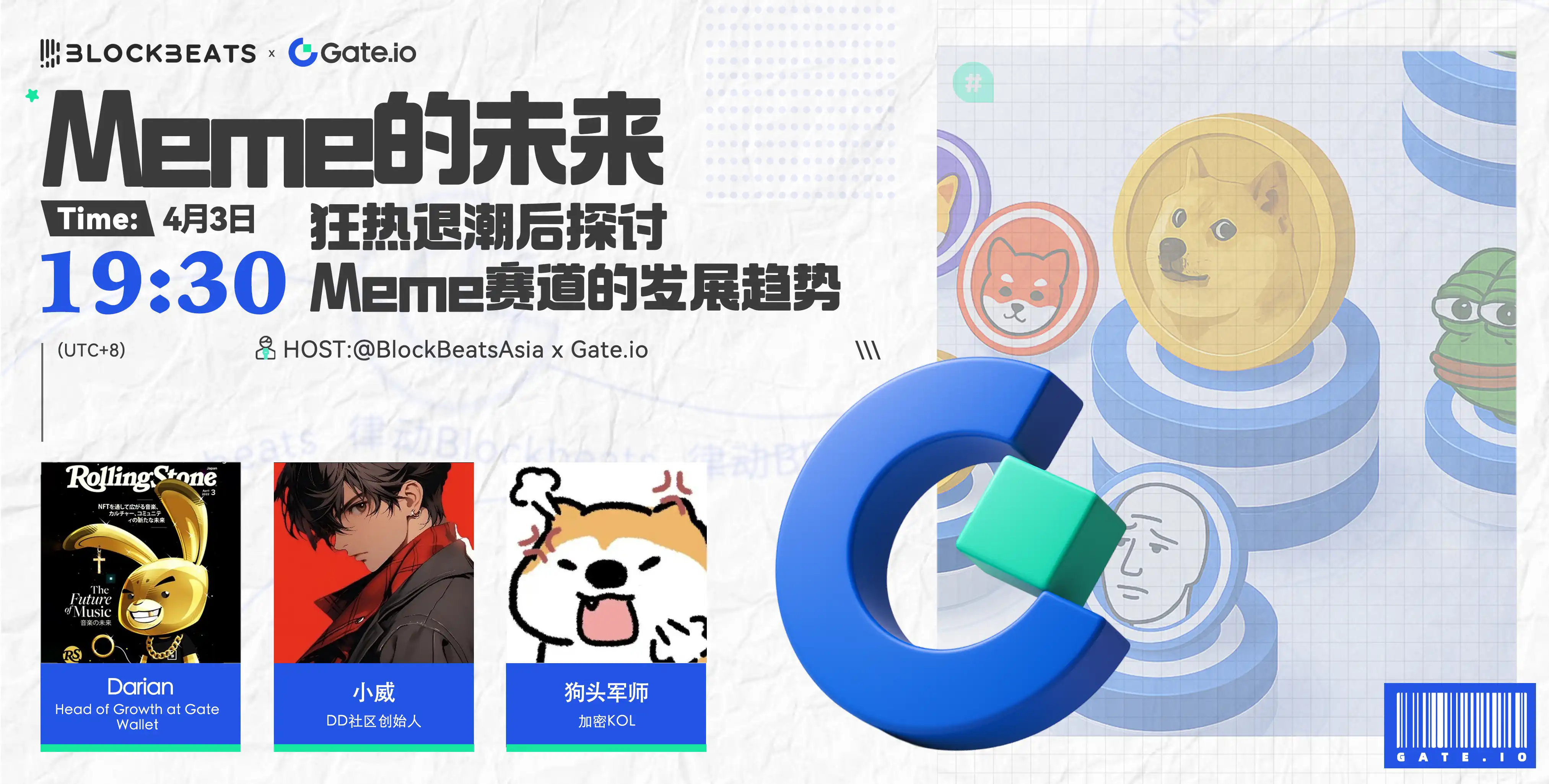
Rhythm BlockBeats: Please have the guests introduce themselves briefly and share their most focused Memecoin track or project.
Darian: Hello everyone, I am Darian, the Head of Operations Growth at Gate Wallet. Personally, I am a crypto industry "old-timer" who has experienced two bull-bear cycles. Before introducing the track I am focused on, let me briefly introduce Gate Wallet. It is a full-chain, decentralized, non-custodial wallet. Currently, users of on-chain transactions generally face the issue of high fees, while our wallet consistently maintains a "zero fee" strategy. For seasoned players, the advantages of such low fees are self-evident. Additionally, we provide new users with generous airdrop rewards. For example, users can often receive airdropped tokens worth $30 to $50 when trading on our platform. You are welcome to experience it.
Getting back to the main topic, from last year to this year, I have primarily focused on three tracks. First is AI-related projects, which is the direction I started focusing on earliest; second is the celebrity track and political track, which have been quite hot in the recent quarter. I have been continuously tracking many projects in these three major directions. A representative case is from early November last year when I noticed that A16Z founder Marc Andreessen made a $50,000 small donation to ai16z. When I met Shaw, the founder of ai16z, he was not yet well-known in the community and was just a relatively unknown developer. During his project with ai16z, I was also involved in early community outreach in the Chinese community. This is one of the earliest and in-depth AI track cases I have participated in this cycle.
Xiao Wei: Hello everyone, I am Xiao Wei, the founder of the DD community. I got involved in Meme projects starting from the BOME bull run. At that time, Meme was a market hot spot, and personally, it was my first time participating in such projects. I entered the circle relatively early, starting from Inscription. At that time, Dog Head Advisor and I entered the circle together, and we were almost participating in Inscription-related projects every day. But for us, Shiba Inu represented a brand new opportunity, so after BOME, we have been deeply cultivating in the Meme field. I have also written many related tutorials to drive community development.
Memecoin Strategist: Hello everyone, I am the Memecoin Strategist. Previously, I was active on-chain with Lil' Wayne, mainly researching various Alpha projects. Later, due to market changes, our direction shifted, focusing more on research and practice in the Meme domain. Currently, I mainly focus on the Meme sector on Solana, actively participating in various communities and projects on the Solana chain. At the same time, I also participate in and follow other chains like BSC.
Rhythm BlockBeats Interviewer: Meme has become a major narrative in the crypto market since last year and is now in a clear transition phase. Have you ever bought a Meme? What is your favorite Meme? Why?
Darian: Before we begin, I'd like to share a somewhat bittersweet story for me. I've been in the crypto space for about five to six years, considered one of the early adopters. I truly started paying attention to the Meme track in 2021. At that time, I was working at a custody institution in the Asia-Pacific region, interacting with many project teams and platforms daily. The initial explosion of the Meme market in 2021 started with DOGE, with a staggering price surge, nearly 50x. During that period, I was busy with custody-related work at the company. One day, a friend called me, discussing many crypto-related topics, and finally asked if I could help him buy 100,000 RMB worth of DOGE. At that time, there was about a week to go before the DOGE surge. However, from the analysis perspective of our custody institution, I did not believe Meme coins had actual value, so I advised him not to buy. Later, that friend never contacted me again, and I missed out on that Meme market surge.
I rekindled my interest in the Meme track when a friend recommended PEPE to me. That was when I truly began to understand the community culture around Meme and the atmosphere behind it, gradually getting involved. Over the past two years, I have mainly worked in the on-chain growth and wallet-related fields. I believe memeing is one of the most direct ways to feel the market's pulse, almost becoming a daily "work task" for me. However, due to my busy work schedule, I cannot monitor the market all day like many on-chain experts. Currently, I am more involved in wallet applications and am quite familiar with many of their functions, including the GMV metric and our own wallet tools, with the goal of better meeting user needs. I now use the Gate Wallet daily to screen targets on the AI recommendation list, significantly reducing the workload of selecting coins. I generally scan the list two to three times a day to get a rough idea of the market status and the main trading trends. If the market is doing well, I can also identify some potential Alpha opportunities.
As for my favorite Meme coin, personally, I don't have a particularly strong preference for the coin itself—neither liking it nor disliking it. In the past two years, my trading style has shifted towards day trading and trend trading of mainstream coins. I no longer make predictions, emphasizing discipline and rhythm instead. One could say my style is a bit of a "hit and run" mentality—take profit when you see it. This approach has its pros and cons. For example, last year, I first encountered the AI Meme track through the Chinese community. Many projects shared at an early stage saw significant gains, often starting from dozens of multiples. However, due to my habit of swing trading, I often sold off shortly after entering, missing out on the subsequent massive price increases. Even though I sold off many Meme coins prematurely, I still have high expectations for the potential of this track.
Serena: My favorite is actually the POPCAT Meme coin, but I was unable to get on board before. I could only watch as it kept rising. At the time, it was on the Ethereum chain, and I started paying attention to it when it was at $0.025. Later, it rose about 7 times, then fell back from its peak. Throughout the process, it had at least two or three obvious buying opportunities, fluctuating by 5 times up and down. I was always on the sidelines observing and couldn't enter in time, which was quite regrettable. Afterward, I started looking for similar projects and discovered the coin FROG, which can be said to be a counterpart to POPCAT. I started following it in the group at the whitelist opening and project launch early stage. They did a great job with their packaging on visual content like emojis. Later, although the project team ran away, the CTO took over, so I think this coin overall has great potential.
Doge Strategist: I actually like quite a few Meme coins because I have a broad range of interests. If I have to name my favorites, I can list three: LUCE, BAT, and FIGHT. I have participated in and achieved some good results in these three projects. Among them, the one that left the deepest impression on me is FIGHT. It happened to be the time when TrumpCoin was launched. Due to some of my personal inherent thoughts, I did not gain much profit from TRUMP. My usual habit is not to chase after flagship projects but to prefer exploring those hot topics derived from the flagship, such as related concept coins, forks, or tokens strongly associated with it.
If we were to say, besides TrumpCoin, what is the most related token to Trump? The first thing that came to my mind was FIGHT. I remember that day, I bought a considerable amount of chips around 1M and held all the way through. Because TRUMP was rising very sharply at the time, it drove a series of related tokens to follow suit. At this point, funds from many communities also began flowing into these peripheral tokens. Later, the price of FIGHT rose to about 69 or 70M (can't quite remember), and I exited when it was over 50M. This time, I was determined. Although not all in, it was a small all-in, and the final result met my expectations. I also led my community members to participate, and everyone bought quite a bit. So for me, FIGHT left a particularly deep impression.
Rhythm BlockBeats: From Peak to Cooling Down, What Major Issues is the Meme Track Currently Facing? Is it the Impact of the Market Cycle or the Track Itself?
Darian: I think the current situation can be summed up in one sentence: the Meme track is currently in a state of "entropy increase," leaning towards the middle to late stage. The most direct manifestation is situations like the drastic drop in ACT on April 1, which often occurs in the extreme stages of the later part of a cycle. Most memes have lost their independence, and in the past one to two months, trading and volatility have been close to zero. Isolated events, such as whale sells, liquidity disruptions, or fee adjustments, can trigger drastic market fluctuations.
Prior to this, Meme coins had been constantly building up an imaginary enemy throughout the cycle, namely traditional altcoins, attempting to "suck" their liquidity. However, this opponent no longer exists, and liquidity itself has collapsed. The gameplay of Meme coins is also in a state of interruption, and the wealth effect has almost disappeared. The current number of tokens that can successfully launch is very limited, with many tokens only able to conduct small-scale launches on Pump.fun or some issuance platforms. From a market capitalization perspective, the market has shrunk from its previous multi-billion scale to possibly only a million-dollar level, and this issuance frequency is also very low, with perhaps only one or two projects per week.
Some KOLs have attempted to inject attention or funds into the market in the short term through "risk control" or information manipulation, partially alleviating the state of entropy increase. However, overall, the structural chaos of the entire Meme ecosystem is still intensifying. Without fundamental changes, this trend will not stop. This state can be observed through several indicators: first, the birth and death rate of tokens, that is, the speed of new coin listings and project removal, has already indicated market turmoil. Secondly, there are now many AI-based analytical tools that can measure the degree of information dissemination, allowing for the judgment of the spread of emotions and heat. Lastly, the change in on-chain addresses, especially the significant fluctuations in the number of small wallets, also reflects the drastic changes in user participation.
So I believe that Meme coins are currently indeed in a state of entropy increase. However, I do not think this track has fundamental issues. From the birth of Bitcoin, it is inherently part of the "Meme" track. Bitcoin itself is the biggest "Meme." The emergence of the last cycle's Ethereum and ICOs also drove the development of the entire Altcoin sector in the form of Memecoins. Our current definition of "Meme coins" is more of a man-made division, and it is fundamentally no different from the ICO projects before the last DeFi Summer; both are mechanisms surrounding asset issuance. The difference lies in the issuance methods, market pricing methods, and narrative logics of each cycle, which will undergo changes.
Similar to the wave from 2021 to 2022, many DeFi OGs from the DeFi Summer era actually did not receive much reward during this cycle, which is quite normal. In the past, they focused on metrics like TVL, lock-up volume, and buybacks, but Memecoins often cannot be measured in value through these traditional means. Take ai16z, for example, these tokens are difficult to explain their value through fundamental or traditional investment logic. Investors who rely on old paths will find it difficult to assess, difficult to get involved, and the logic cannot be closed-looped. So the issue in this track is not with the "project," but rather the gameplay, users, dissemination methods, and narrative logic have changed. For users, this is a complete cognitive reconstruction. I believe this is also one of the important driving forces behind the continuous evolution of the crypto industry.
Weiyi: I also feel that "Meme Coins" indeed have a clear cyclical nature, just like the market trends we see in the primary and secondary markets, whether it's NFTs, rug pulls, they will all go through phases of prosperity and cooling. For example, before PVP came out, the entire market was relatively calm; but after PVP exploded, various chains imitated and launched their PVP platforms. At that time, we mainly participated in some Alpha projects, and there were many artists issuing coins at that time, so the wave in March-April last year was truly a "money-picking market."
But that kind of market cannot be sustained. Memes won't always have people hyping them, nor will there always be people who can gain a lot of wealth through a single coin. Many times, it's because of a long period of market dullness, followed by a sudden emergence of a new pattern, causing a massive FOMO outbreak and everyone rushing in. If the market enters an extremely scarce state again in the future, there may be an opportunity for this window to reappear. But looking at it now, this novel gameplay is already outdated, especially pre-sale. For example, a few days ago, I participated in a pre-sale, invested 20 BNB, and in the end, I only received 80U, not even enough to cover the gas fee loss. This indicates that the current market environment is no longer suitable for profiting through pre-sales. It must be a phase, when the tide goes out, it goes out. But I think, since we have been in this industry, continuously paying attention and participating, we will still encounter opportunities. The key is to remain patient and wait for the right moment.
Dogecoin Strategist: The first issue is that on-chain liquidity is no longer as abundant as before. Why is this happening? Mainly because everyone is getting smarter, information is spread rapidly, and opportunities are quickly consumed. The second point is the maturity of tools, which is crucial. Now, on-chain analytics tools are becoming more professional and convenient, leading to a significant increase in everyone's ability to access information, and blockchain scanning has become very accessible. It used to be "who has excellent blockchain scanning technology," and now it has turned into "who uses the tools well." When an industry gradually matures and becomes more automated, competition becomes very fierce.
When choosing memes in the early days, we didn't have as many metrics to refer to. As long as the front end was clean and the narrative made sense, we dared to join, and the accuracy was relatively high. But now, many project teams make the plate very clean and the logic very sound, which actually makes it more likely to become a trap. As a result, it's actually harder for everyone to get started, leading to insufficient on-chain liquidity. This is actually the process of the entire track changing from a blue ocean to a red ocean—the tools are becoming more mature, the participants are increasing, and the opportunities are decreasing. Of course, opportunities still exist, they just become fewer and harder to grasp. In addition, the impact of market cycles is also crucial. For example, Solana dropped by about 60% from its peak, which also had a significant impact on the overall market. At the same time, funds are constantly diverging. But I still insist on one thing: the Meme track still has opportunities, even in the cycle of bull and bear transition, Memes are still worth paying attention to.
Rhythm BlockBeats Interview: Recent Status of the Meme Market: Memes on BNB Chain and Solana are starting to rebound. Some believe that the growth of Memes on the BNB Chain mainly relies on "influential people" creating momentum, while memes in the Solana ecosystem tend to be more community-driven. How do you view the growth logic of these two major ecosystem Memes?
Darian: I think the Meme track is currently in a state of "commercialization expansion." Why can ecosystems like the BNB Chain rise in this cycle? I think this is an embodiment of the "Maxwell-Tim effect"—that is, in a chaotic environment, someone creates a fractured information flow and manufactures "hype," especially those with top influence, they can guide the flow of traffic, thus creating local prosperity.
For example, in recent days, some Meme coins on BSC have also experienced a significant decline. We can see that the players on the BNB Chain and the Meme players on Solana actually have very different gameplay and logic. Solana's Memes are more diverse, with not only retail participation but also various DeFi combination plays. It is easier to form a spontaneous community nature. Moreover, in a complete cycle, its fluctuations are usually more frequent, and the volatility is more intense. From my observation, Solana's washout cycle is usually between one to three months.
In contrast, although the BNB Chain performed quite well in the first half of the month, looking at the recent market trends, the overall upward momentum was weak. Even when new head Meme projects appeared, their performance was relatively weak. Looking at the path, many projects on the BNB Chain are actually typical of a "top hype, bottom buy" model. From my perspective, this is a typical "hype culture"—guiding traders to enter by creating continuous hype. At the same time, leveraging the empowerment of major exchanges, such as Bonuses, Binance Alpha Launchpad, IEOs, voting mechanisms, and so on. This deep integration is a very key point for the Meme market. As Professor Xiaowei mentioned, the liquidity of ordinary projects is far less than those empowered by Binance Alpha.
Let's look at the differences in capital operation. Taking Solana as an example, from an institutional perspective, it is closer to an internationally dominated narrative led by the United States. To put it more bluntly, it is an ecosystem with "American heritage." This means that it has more advantages in global community culture and financial purchasing power. In the Chinese community, the concept of community is relatively weaker. In the United States, many communities, whether virtual or real, do have a clear sense of community consciousness and practice. In Chinese culture, the emphasis is more on individual independence and self-development, which also influences the formation and development of online culture.
This cultural difference is also reflected in trading strategies. Projects on the BNB Chain are often highly controlled and subject to partial concentration of operations, often experiencing a rapid rise of two to three hundred points in a short period, followed by a rapid collapse. On the other hand, the gameplay on Solana leans more towards continuous accumulation of small funds, achieving concentrated outbreaks at certain points through narrative coordination with community rhythm. Overall, Solana's trading mode is more meticulous and places more emphasis on community involvement. Many so-called "copycat" or "market makers" in the current market have basically adopted the trading methods of some mature tokens from Q4 to Q1 during this period. These differences reflect the distinctions in the ecosystem culture, trading mechanism, and community development path of different chains.
Little V: The first blockchain I came into contact with was Solana, followed by Base Chain and BSC, among others like Linea and so on. There are many blockchains, but overall, the most prosperous are still Solana and BSC. Solana has a relatively stronger consensus, making it easier to launch some high market cap tokens and projects. These two chains share a common point: once a project on one chain gains popularity, we will observe if there are corresponding opportunities to participate on the other chain. This approach does not actually require us to actively compete for projects but rather seeks opportunities through benchmarking. If a project on BSC suddenly becomes popular, we will look for a corresponding opportunity on Solana to participate, and vice versa.
The reason Solana and BSC have become the focus is related to the joint efforts of CZ and He Yi in the past, making the BSC ecosystem particularly thriving. Initially, when we were playing in the Meme market, we actually supported 20 to 30 chains for Pump, including Ethereum, but it never really took off. The reason is that market consensus still focuses on Solana. After that, many chains began to imitate Solana and indeed established many platforms. In the end, only these leading chains could survive. Even though there are many projects issuing tokens on BSC, the ones that truly have vitality are the leading projects. Many other chains have also made attempts, but we only need to focus on the leading chains.
Looking at the project's lifecycle, I believe Solana is more sustainable. The popularity of BSC may be only cyclical, such as some projects initiated by "Sun Ge," which may end in a day. However, Solana has a longer lifecycle and is easier to accumulate consensus. When choosing a chain, we need to consider its long-term value, whether the Gas fee is low enough, whether the user base is stable, and so on. Everyone's choices are different; some can make money on Solana, but not necessarily on BSC. Most early projects on BSC were largely of the "startup" type or had rug-pull characteristics, with many being "rug-pulls" where they deployed their own contract. Later, due to the emulation of the Solana model and some filtering mechanisms screening out some projects, coupled with CZ and their market hype, a wealth effect emerged, and everyone dared to participate.
Dog Head Military Advisor: Regarding the growth logic of MEME, I believe that CZ and the He family have a significant impact on the current surge on BSC. It can be said that half of BSC's market performance is due to their calls. Initially, it was indeed effective, but later, the frequent calls diluted the value instead.
At that time, almost everyone was engaging in "archaeology," and even every word and punctuation mark they said would trigger a round of speculation. The MEME project, which was first launched on AlphaZone, did bring a strong wealth effect. However, as more projects emerged, funds began to diversify, and the market gradually declined, leading to the current market situation. The main user group of BSC is Chinese, although it is a large group, the structure is relatively single. Long-term focus on CZ and HO's model makes it easy for users to experience aesthetic fatigue. Although they later attempted to shift to other narratives such as GameFi, it was still difficult to break away from the influence of this couple.
Another key issue is: BSC's infrastructure is not as good as Solana's. When the market surges, users will find that the user experience on BSC is inferior to Solana, especially users accustomed to Solana, often incur losses when operating on BSC. I myself have experienced this; sometimes, I even spend a long time searching for a tool. In comparison, I highly appreciate Solana's community-driven approach. Its ecosystem infrastructure is sound, the user base includes foreigners and Chinese, the community has strong driving forces, and many tokens eventually bring about a wealth effect.
For example, the recent STONKS project initiated by "Big Brother" is still supported by many believers despite its long duration. Some time ago, they even distributed coins to KOLs offline. In the crypto world, faith is very important. For example, projects like BTC, DOGE, etc., rely on community belief for support. Without community support, a currency is hard to sustain its long-term value. Therefore, I believe that community-driven initiatives are very important, and Solana performs exceptionally well in this aspect.
Rhythm BlockBeats: There is a significant difference in the transaction experience between the BNB Chain and Solana when interacting with Meme using a wallet. Could Gate Wallet share its usage experience on these two chains, and whether Gate Wallet will optimize the interaction experience for Meme transactions in the future?
Darian: Certainly, regarding Gate Wallet, we must admit that objectively, the current data performance is not as impressive as some of the industry-leading wallets like OKX Wallet. However, in reality, we have been focusing on the on-chain track and continuously paying attention to and recording a large amount of information related to on-chain data and user feedback. We plan to launch a brand-new version of Gate Wallet by the end of April, before Gate.io's 12th-anniversary celebration. This update will bring a comprehensive improvement to the transaction experience and underlying chain connectivity.
First and foremost, in terms of the transaction experience, there has indeed been user feedback in the past that our wallet had some shortcomings in terms of functionality. As a wallet product, the top priority is security, followed by the comprehensiveness and convenience of functionality, and finally, the highlights of some unique features. However, in the recent period, most users have been more concerned about the convenience and speed of cryptocurrency trading, overlooking the presence of risks. Such issues have already been reflected in the industry, such as exit scams of some DEX platforms, and the risks exposed by users authorizing operations through third-party bot tools.
Therefore, in this update, we prioritize enhancing overall integrity and security while ensuring user convenience. In the new version, we have introduced more data dimensions and richer data display functions to help users make investment decisions quickly within the platform without the need to switch to third-party platforms for data comparison and information traceability, thereby simplifying user interaction paths. In the past, our interaction paths were relatively cumbersome, but the new version will provide a more intuitive and easily understandable way of operation to help all users, including newcomers and heavy users, reduce mis-touch and misguidance. The UI has also undergone a comprehensive upgrade, achieving significant improvements in visual and operational experience.
Optimizing the underlying chain connectivity is one of the key focuses of this update. Previously, GMGN shared some comparison data on platforms (such as Binance and OKX) in terms of transaction speed on Twitter. After this optimization, our on-chain interaction performance is now close to the level of leading platforms. We will provide more detailed quantitative metrics, including transaction speed, on-chain pricing, on-chain state synchronization, and more. Additionally, we will significantly enhance on-chain success rates, address some transaction accuracy issues raised by users, and introduce a series of mechanisms to prevent sandwich attacks and front-running, ensuring the stability of on-chain transactions and user experience.
Overall, our core goal is to provide users with a more complete, secure, and efficient on-chain interaction experience. In the past, we focused more on the balance between security and convenience, but this time we are more focused on how to achieve true freedom and smoothness in on-chain transactions. Users no longer need to worry about operational issues and can focus on the transactions themselves. This is the key breakthrough and working direction for us in this iteration cycle. Thank you all for your support.
Rhythm BlockBeats: What is the core driving force behind the Meme track? Is it community culture, celebrity effect, or other factors? Which Meme projects have stronger long-term vitality?
Darian: I think the core driving force is an alternating process, starting with the native culture or spirit driving community development, during which there will be outbreaks of emotional points, and the capital trend and wealth effect also drive buying. I think the most concise description is the ai16z coin. Although the person behind it likes to cause trouble and has some character flaws, for this market, if you have paid attention to the AI track or this coin, you will find that it is a typical Western coin, from manipulation to the final surge, yielding at least hundreds of times returns. So this is an alternating process; community culture and the celebrity effect are more short-term influences.
I have done some commonality analysis of classic Meme coins and think there are several key points for the long-term vitality of Meme coins. First, it needs to have a genuine cultural spirit, whether it is low-key or high-brow. The key is to attract a group of people who pay attention to and spread this culture. Second, Meme coins have a lot of memes, and they can easily trigger spontaneous dissemination, which is a very natural and autonomous process. Third, most well-known or large projects have almost no founders. Also, from the ICO era to the end of 2021, the whitepaper was a topic of much discussion. I have helped others write many whitepapers, and to be honest, there is a lot of algorithmic logic at the Ph.D. level that I myself did not fully understand. For Meme coin projects, a whitepaper is usually not needed, or at most three pages, simply and clearly explaining is sufficient.
Furthermore, Meme coins usually have a whimsical or operable pattern. For example, BTC is the most classic Meme coin, with its pattern being digital gold plus a mining network. Whereas coins like SHIBA, although not very eye-catching in the early days of circulation, have formed their own set of patterns through the construction of a burn and deflation mechanism. So, for a Meme coin that can survive in the long term, the basic commonalities are roughly these.
Dog Head Strategist: In passing car insurance, if we want to talk about the most typical depreciation case, I think the most obvious one is the celebrity coin. At that time, especially after Trump, many presidents and celebrities started to issue their own coins. The earliest participants did feel like they were picking up money, why? Because they leveraged their celebrity effect, and everyone followed the trend to buy due to Trump's influence, causing the coin price to skyrocket. Although these coins rise sharply, their popularity usually does not last long.
I believe that celebrity-backed coins do indeed experience a strong core driving force in the short term. However, in the long run, community culture is a more critical factor. When you extend the timeline, you often find that few people are willing to continue holding the bag. Because these coins lack long-term emotional support, as time goes on, the price begins to decline, and eventually, no one pays attention anymore. For example, coins associated with Trump's wife, once they start falling, they keep falling, and no one mentions them again. Therefore, a secret narrative is also a crucial factor.
A good narrative can create a good meme and form a strong community. If this narrative is compelling enough, can tell a good story, and is spread effectively, the coin's meme factor can attract retail investors to actively participate, form a community, drive this secret narrative, and ultimately make more people aware.
Therefore, I still believe that community culture and a secret narrative have long-term vitality. For instance, although some coins may seem somewhat gimmicky on the surface, they can indeed survive for a long time, making them typical meme coins. In contrast, celebrity coins may attract attention in the short term, but in today's market environment, many people are no longer willing to try them, as no one wants to hold the bag.
Rhythm BlockBeats: How will the future development of Meme narratives evolve? Will it lean more towards GameFi, DeFi integration, or continue to maintain community culture and hype attributes?
Serena: First and foremost, the community is still the most crucial aspect. Without community support, relying solely on trends is unsustainable for the long term, just like projects such as Grok and Deepseek. They are just part of the information flow, and when the trend passes, they quickly move on to the next one, unable to establish long-term consensus. On the contrary, looking back at projects that have been able to build consensus and still survive to this day, such as MEW, WIF, PEPE, they have been able to maintain longevity. Their success lies in robust community support and long-term emotional accumulation.
I thought PNUT was pretty strong at the time, but this project was purely driven by capital, without strong consensus behind it. It was more about creating a wealth effect, attracting everyone to participate, and everyone hoped to catch this wave. However, I believe that community consensus cannot only be about price increases and price; that would be meaningless. I invested tens of thousands at that time, but in the end, I suffered heavy losses. There was nothing I could do, and the coin had no bottom to it.
As for meme coins, every time there is a rebound in the overall market, they are usually the first to respond because of their small market capitalization, making them easier to pump compared to traditional mainstream coins. So, I think when choosing meme coins, it's best to look for projects with small market caps, strong community consensus, and a meme culture, especially those involving foreign teams. It's evident that many domestic projects don't have the same scope, and many Chinese projects, even if well-packaged and promoted, still struggle to gain traction. Conversely, foreign teams can better drive these projects forward.
As for my personal choice, when it comes to investment, I usually choose the current hot trend, and I buy into it today. I don't get deeply involved in community building or long-term operation of a coin because, for me, that would require too much time and effort, and I don't have that much time to manage a community. I prefer to seize opportunities in the short term rather than engage in long-term community building.
Rhythm BlockBeats: For investors or projects looking to enter the Meme track, do you have any suggestions? How can one seize new opportunities in this market?
Darian: I wouldn't necessarily call it advice, but for Meme coin investors, as a participant in this track, I can offer some quick tips on risk assessment and capturing ALPHA. Generally, investors do not have much time to conduct in-depth analysis. Personally, I have developed an AIP Pool leaderboard in collaboration with the product and development team because I run a wallet and need to check relevant leaderboards daily. This leaderboard can help many ordinary users solve on-chain monitoring issues and time differences. Capturing ALPHA on-chain or analyzing coins does require a significant amount of time and experience. Through AI algorithms and mechanisms, we help users solve these issues. For ordinary investors, by following this AI leaderboard and combining it with their own filtering criteria, they can screen risks, identify early opportunities, and, accordingly, find early-stage opportunities.
Upon opening the AI leaderboard, I combine it with my own filtering criteria to screen for promising coins. Then, I analyze the smart money flow and some investment strategies to help me identify potential opportunities. For example, understanding the flow of smart money can help me grasp market trends, and based on this information, I can identify corresponding investment opportunities. This is also some of the actions we are planning to take in the upcoming version (to be released at the end of April), which will help me track funds quickly. By leveraging the strengths of existing tools in the market, I can identify some relative advantages or meme coins that may break out in the current cycle.
As for projects, I think it's more about collaborating with them, participating in ecosystem building, or engaging in trading competitions to help each other share liquidity pools and support the expansion and exposure of high-quality projects. These are some of my considerations as a wallet operator and growth strategist. Thank you.
Xiao Wei: To seize the Meme opportunity, I think you can refer to my previous experience. I have written many articles about Meme today, and basically, there are only a few ways to play, with the most mainstream ways being two. One is strategic, and the other is to focus on trends, buy at the bottom, seize the opportunity, and get significant results. Another way is to use large funds to allocate positions, make a second grab opportunity, and still achieve significant results.
How to seize these opportunities? First, you need to join a large number of groups because once you discover a meme, you need to quickly find its source, see who posted it, what angle it takes, and quickly analyze it. You can also use some tools, such as DBot, to analyze its narrative. After understanding the story behind it, you can judge whether you dare to enter the market. If you find a very early opportunity, you can buy first, analyze later, and decide whether to sell after analysis. Decision-making should be based on a deep understanding of the market and the project, rather than just blindly following the trend.
Additionally, you should also make good use of Twitter's search function, especially the PRO version, which allows you to track a CA in real time and receive the latest news. This way, you can know who has previously posted about this CA, who has bought it, stay informed about market trends in real time, and then decide whether to increase your position, sell, or continue observing. Furthermore, you need to join some monitoring groups or at least have your own smart alerts and monitoring tools. For example, we have created a rapid monitoring channel specifically tracking tokens with large transactions within one or two minutes. When the trading volume suddenly spikes and the price fluctuates rapidly, this tool can help us quickly capture this "conspiratorial" market response and make timely decisions.
I usually go through each one, so as not to miss any token information as much as possible. Then, I analyze and, combined with the methods I mentioned earlier, continue to pay attention to the dynamics of the CA in various groups. If a coin has already taken off before I even get on board, then that opportunity may have been missed, and there's no need to chase it anymore. If someone posts a meme coin with an angle, you can observe it, add it to your watchlist, and buy at the right time. This is basically my operational train of thought, mainly like this.
Top Dog Strategist: In the current market situation, if it were a previous recommendation, I would suggest trying play styles similar to Xiao Wei's. However, in the current market trend, my advice is: observe more, review more, judge whether you feel secure, and make decisions based on your own understanding.
If you think a certain narrative has potential, but behind it lies a very harsh market environment, then you should be cautious. In today's market, getting in may result in a lesson. Therefore, if you want to achieve results in certain coins, you must find differentiation from previous trends.
In the past, if you thought a narrative had potential, you would jump in directly, but now, you definitely need to use some tools to avoid pitfalls. Tools I often use include Debot, monitoring KOL tools to see which KOLs have posted about a CA, as well as some smart money rapid monitoring tools. We have also developed our own tools, all of which are used in conjunction with existing tools on the market.
The current meme market is indeed not as easy as it used to be, and retail investors need to be more patient and research-oriented. I recommend less action and more observation because the current market is not as easy to navigate as before. It's essential to protect your principal investment, as the secondary market is also not particularly favorable, with many coins seeing losses even in holding positions.
Rhythm BlockBeats: Lastly, please summarize your outlook on the future of memes in one sentence.
Darian: Currently, from listing to launch to fair launches, the meme coin playbook has become very mature, forming almost a complete industry chain. If you still want to participate in the on-chain arms race, in the end, only the top players will be left to compete with each other, and liquidity at the lower or middle levels will essentially disappear. The birth model and gameplay of meme tokens differ from those of meme coins five years ago. Nowadays, the participating group consists mostly of post-2000s, making it a fast-food model—price pumping is key. After the pump, you can choose whether to continue building the project. I remember when working with WhaleShark, he once said, "At its peak, many false believers will emerge, and only during dusk will true believers in faith construction appear." This statement actually makes sense. It reminds me of the theme I mentioned at the beginning. When the market reaches a certain stage of development, most meme coins will start to deteriorate, gradually entering a phase of selective elimination.
I agree more with what CZ previously said that most meme coins will eventually disappear as funds are reallocated. As for whether meme coins can integrate with meal ordering, I think it has a certain feasibility, especially in the short term. There have been successful cases in the past, such as GMT and Axie. However, these projects themselves carry the GameFi attribute in their cultural DNA. If one aims to break away from this instrumental attribute, I believe integration with GameFi or DeFi, while being a tool, must evolve into a tool that the previous community believers can truly understand and admire.
Ultimately, meme coins may evolve into a cultural or social infrastructure need. For example, it could become a reserve asset, represent certain cultural attributes, or even become a means of payment. I think these are all possible directions. In conclusion, it undergoes an evolutionary process. Currently, most meme coins still remain in the stage of cultural symbols, which is also a key issue that project teams need to consider.
Xiao Wei: I think we can view this situation as a "Meme Dog Crossing Bear and Bull Markets." This is a consensus between Ge Zhuo and me: this phenomenon will continue and not disappear. People always find new hotspots to participate in; it's just that there may be a relatively quiet period for a while, and then at some point, a new hotspot will suddenly stir market sentiment, repeating in cycles.
The real tipping point may come when the bull market starts, with the prosperity on-chain and the activity in the secondary market. However, I think on-chain and the secondary market are inversely related, exhibiting a sector rotation relationship. For example, when the spot market is surging rapidly, meme coins may not see much action as everyone is busy trading spot or futures contracts. And when the spot market's rally stabilizes, the market sentiment for meme coins may be reinvigorated, and everyone will start pumping dog coins again.
I have always been pursuing these two tracks, but I am more focused on Alpha, such as when a new platform is launched on the Lina blockchain, I will be the first to pump it. These kinds of new projects are more attractive to me. As for meme coins, I tend to be cautious and usually stay on the sidelines. Sometimes, when the market is unfavorable, simply holding your position can keep you in profit. So I also want to remind everyone to manage their capital properly and not be swayed by market speculation and hype. If you hold your chips, you will not miss out on the bull market opportunities.
Meme Coin Advisor: I have always believed that meme coins present an opportunity, although I have not been in this circle for long, as I am a post-2000s generation, younger than you old hodlers. However, I believe that the opportunity for meme coins always exists, and they will shuttle between bull and bear markets. During a bull market, the meme coin cycle will be more frequent, and although the activity may decrease in a bear market, it will still have periodic occurrences.
For example, on the Ethereum blockchain currently, although the market is not doing well, occasionally some meme coins emerge, and even those previously underperforming dog coins occasionally have opportunities for significant gains. I have a group with over 100 members. They all persist in playing these projects on the Ethereum blockchain, despite the current situation not being favorable. However, they are still waiting for an opportunity because occasionally some meme coins worth noting appear.
Although the current meme cycle may be relatively quiet, it still holds a significant market share between the bull and bear markets. Meme coins are unafraid of market conditions. Whether you are investing, exploring alpha in the secondary market, or participating in star projects, meme coins always need to be closely monitored. Especially their retaliatory effect. If you can get the right meme coin, its return will undoubtedly be several times that of other traditional value products, or even higher.
Space Link: https://x.com/i/spaces/1BdxYqDqbkyxX
Disclaimer: This content does not constitute any offer, solicitation, or advice. You should always seek independent professional advice before making any investment decisions. Please note that Gate.io may restrict or prohibit all or some services from users in restricted areas. Please read the user agreement for more information.
猜你喜歡

穩定幣驅動全球B2B支付革新,如何打破工作流程瓶頸釋放兆市場潛力?
這些新創公司正在無需資料中心的情況下建立先進AI模型
RWA永續產品危機:為什麼GLP模式註定撐不住RWA永續?
科學平權運動:DeSci的萬億美元知識經濟重建革命
Sentient深度研報:獲8,500萬美元融資,建置去中心化AGI新範式
專訪Virtuals聯創empty:AI 創業不需要大量資金,Crypto是答案之一
今年 2 月,Base 生態中的 AI 協議 Virtuals 宣布跨鏈至 Solana,然而加密市場隨後進入流動性緊縮期,AI Agent 板塊從人聲鼎沸轉為低迷,Virtuals 生態也陷入一段蟄伏期。
三月初,BlockBeats 對 Virtuals 共同創辦人 empty 進行了一次專訪。彼時,團隊尚未推出如今被廣泛討論的 Genesis Launch 機制,但已在內部持續探索如何透過機制設計激活舊資產、提高用戶參與度,並重構代幣發行與融資路徑。那是一個市場尚未復甦、生態尚處冷啟動階段的時間點,Virtuals 團隊卻沒有停下腳步,而是在努力尋找新的產品方向和敘事突破口。
兩個月過去,AI Agent 板塊重新升溫,Virtuals 代幣反彈超 150%,Genesis 機製成為帶動生態回暖的重要觸發器。從積分獲取規則的動態調整,到專案參與熱度的持續上升,再到「新代幣帶老代幣」的機制閉環,Virtuals 逐漸走出寒冬,並再次站上討論焦點。
值得注意的是,Virtuals 的 Genesis 機制與近期 Binance 推出的 Alpha 積分系統有一些相似之處,評估用戶在 Alpha 和幣安錢包生態系統內的參與度,決定用戶 Alpha 代幣空投的資格。用戶可透過持倉、交易等方式獲得積分,積分越高,參與新項目的機會越大。透過積分系統篩選使用者、分配資源,專案方能夠更有效地激勵社群參與,提升專案的公平性和透明度。 Virtuals 和 Binance 的探索,或許預示著加密融資的新趨勢正在形成。
回看這次對話,empty 在專訪中所展現出的思路與判斷,正在一步步顯現其前瞻性,這不僅是一場圍繞打新機制的訪談,更是一次關於“資產驅動型 AI 協議”的路徑構建與底層邏輯的深度討論。
BlockBeats:可以簡單分享一下最近團隊主要在忙些什麼?
empty:目前我們的工作重點主要有兩個部分。第一部分,我們希望將 Virtuals 打造成一個類似「華爾街」的代理人(Agent)服務平台。設想一下,如果你是專注於 Agent 或 Agent 團隊建立的創業者,從融資、發幣到流動性退出,整個流程都需要係統性的支援。我們希望為真正專注於 Agent 和 AI 研發的團隊,提供這一整套服務體系,讓他們可以把精力集中在底層能力的開發上,而不用為其他環節分心。這一塊的工作其實也包括了與散戶買賣相關的內容,後面可以再詳細展開。
第二部分,我們正在深入推進 AI 相關的佈局。我們的願景是建立一個 AI 社會,希望每個 Agent 都能聚焦自身優勢,同時透過彼此之間的協作,實現更大的價值。因此,最近我們發布了一個新的標準——ACP(Agent Communication Protocol),目的是讓不同的 Agent 能夠相互互動、協作,共同推動各自的業務目標。這是目前我們主要在推進的兩大方向。
BlockBeats:可以再展開說說嗎?
empty:在我看來,其實我們面對的客戶群可以分為三類:第一類是專注於開發 Agent 的團隊;第二類是投資者,包括散戶、基金等各種投資機構;第三類則是 C 端用戶,也就是最終使用 Agent 產品的個人用戶。
不過,我們主要的精力其實是放在前兩大類──也就是團隊和投資人。對於 C 端用戶這一塊,我們並不打算直接介入,而是希望各個 Agent 團隊能夠自己解決 C 端市場的拓展問題。
此外,我們也認為,Agent 與 Agent 之間的交互作用應該成為一個核心模式。簡單來說,就是未來的服務更多應該是由一個 Agent 銷售或提供給另一個 Agent,而不是單純賣給人類使用者。因此,在團隊的 BD 工作中,我們也積極幫助現有的 AI 團隊尋找這樣的客戶和合作機會。
BlockBeats:大概有一些什麼具體案例呢?
empty:「華爾街」說白了就是圍繞資本運作體系的建設,假設你是一個技術團隊,想要融資,傳統路徑是去找 VC 募資,拿到資金後開始發展。如果專案做得不錯,接下來可能會考慮進入二級市場,例如在紐約證券交易所上市,或是在 Binance 這樣的交易所上幣,實現流動性退出。
我們希望把這一整套流程打通-從早期融資,到專案開發過程中對資金的靈活使用需求,再到最終二級市場的流動性退出,全部覆蓋和完善,這是我們希望補齊的一條完整鏈條。
而這一部分的工作和 ACP(Agent Communication Protocol)是不同的,ACP 更多是關於 Agent 與 Agent 之間交互標準的製定,不直接涉及資本運作系統。
BlockBeats:它和現在 Virtuals 的這個 Launchpad 有什麼差別呢?資金也是從 C 端來是嗎?
empty:其實現在你在 Virtuals 上發幣,如果沒有真正融到資金,那就只是發了一個幣而已,實際是融不到錢的。我們目前能提供的服務,是透過設定買賣時的交易稅機制,從中提取一部分稅收回饋給創業者,希望這部分能成為他們的現金流來源。
不過,問題其實還分成兩塊。第一是如何真正幫助團隊完成融資,這個問題目前我們還沒有徹底解決。第二是關於目前專案發行模式本身存在的結構性問題。簡單來說,現在的版本有點像過去 Pumpfun 那種模式——也就是當專案剛上線時,部分籌碼就被外賣給了外部投資人。但現實是,目前整個市場上存在著太多機構集團和「狙擊手」。
當一個真正優秀的專案一發幣,還沒真正觸達普通散戶,就已經被機構在極高估值時搶購了。等到散戶能夠接觸到時,往往價格已經偏高,專案品質也可能變差,整個價值發行體係被扭曲。
針對這個問題,我們希望探索一種新的發幣和融資模式,目的是讓專案方的籌碼既不是死死握在自己手裡,也不是優先流向英文圈的大機構,而是能夠真正留給那些相信專案、願意長期支持專案的普通投資者手中。我們正在思考該如何設計這樣一個新的發行機制,來解決這個根本問題。
BlockBeats:新模式的具體想法會是什麼樣子呢?
empty:關於資金這一塊,其實我們目前還沒有完全想透。現階段來看,最直接的方式還是去找 VC 融資,或是採取公開預售等形式進行資金募集。不過說實話,我個人對傳統的公開預售模式並不是特別認同。
在「公平發售」這件事上,我們正在嘗試換一個角度來思考-希望能從「reputation」出發,重新設計機制。
具體來說,就是如果你對整個 Virtuals 生態有貢獻,例如早期參與、提供支持或建設,那麼你就可以在後續購買優質代幣時享有更高的優先權。透過這種方式,我們希望把資源更多留給真正支持生態發展的用戶,而不是由短期套利的人主導。
BlockBeats:您會不會考慮採用類似之前 Fjord Foundry 推出的 LBP 模式,或者像 Daos.fun 那種採用白名單機制的模式。這些模式在某種程度上,和您剛才提到的「對生態有貢獻的人享有優先權」的想法是有些相似的。不過,這類做法後來也引發了一些爭議,例如白名單內部操作、分配不公等問題。 Virtuals 在設計時會考慮借鏡這些模式的優點,或有針對性地規避類似的問題嗎?
empty:我認為白名單機制最大的問題在於,白名單的選擇權掌握在專案方手中。這和「老鼠倉」行為非常相似。專案方可以選擇將白名單名額分配給自己人或身邊的朋友,導致最終的籌碼仍然掌握在少數人手中。
我們希望做的,依然是類似白名單的機制,但不同的是,白名單的獲取權應基於一個公開透明的規則體系,而不是由項目方單方面決定。只有這樣,才能真正做到公平分配,避免內幕操作的問題。
我認為在今天這個 AI 時代,很多時候創業並不需要大量資金。我常跟團隊強調,你們應該優先考慮自力更生,例如透過組成社區,而不是一開始就想著去融資。因為一旦融資,實際上就等於背負了負債。
我們更希望從 Training Fee的角度去看待早期發展路徑。也就是說,專案可以選擇直接發幣,透過交易稅所帶來的現金流,支持日常營運。這樣一來,專案可以在公開建設的過程中獲得初步資金,而不是依賴外部投資。如果專案做大了,自然也會有機會透過二級市場流動性退出。
當然最理想的情況是,專案本身能夠有穩定的現金流來源,這樣甚至連自己的幣都無需拋售,這才是真正健康可持續的狀態。
我自己也常在和團隊交流時分享這種思路,很有意思的是,那些真正抱著「搞快錢」心態的項目,一聽到這種機制就失去了興趣。他們會覺得,在這種模式下,既無法操作老鼠倉,也很難短期套利,於是很快就選擇離開。
但從我們的角度來看,這其實反而是個很好的篩選機制。透過這種方式,理念不同的專案自然會被過濾出去,最後留下的,都是那些願意真正建立、和我們價值觀契合的團隊,一起把事情做起來。
BlockBeats:這個理念可以發展出一些能夠創造收益的 AI agent。
empty:我覺得這是很有必要的。坦白說,放眼今天的市場,真正擁有穩定現金流的產品幾乎鳳毛麟角,但我認為這並不意味著我們應該停止嘗試。事實上,我們每天在對接的團隊中,有至少一半以上的人依然懷抱著長遠的願景。很多時候,他們甚至已經提前向我們提供了 VC 階段的資金支持,或表達了強烈的合作意願。
其實對他們來說想要去收穫一個很好的社區,因為社區可以給他們的產品做更好的回饋,這才是他們真正的目的。這樣聽起來有一點匪夷所思,但其實真的有很多這樣的團隊,而那種團隊的是我們真的想扶持的團隊。
BlockBeats:您剛才提到的這套「AI 華爾街」的產品體系-從融資、發行到退出,建構的是一整套完整的流程。這套機制是否更多是為了激勵那些有意願發幣的團隊?還是說,它在設計上也考慮瞭如何更好地支持那些希望透過產品本身的現金流來發展的團隊?這兩類團隊在您這套體系中會不會被區別對待,或者說有什麼機制設計能讓不同路徑的創業者都能被合理支持?
empty:是的,我們 BD 的核心職責其實就是去鼓勵團隊發幣。說得直接一點,就是引導他們思考發幣的可能性和意義。所以團隊最常問的問題就是:「為什麼要發幣?」這時我們需要採取不同的方式和角度,去幫助他們理解背後的價值邏輯。當然如果最終判斷不適合,我們也不會強迫他們推進。
不過我們觀察到一個非常明顯的趨勢,傳統的融資路徑已經越來越難走通了。過去那種融資做大,發幣上所的模式已經逐漸失效。面對這樣的現實,很多團隊都陷入了尷尬的境地。而我們希望能從鏈上和加密的視角,提供一套不同的解決方案,讓他們找到新的發展路徑。
BlockBeats:明白,我剛才其實想表達的是,您剛剛也提到,傳統的 AI 模式在很大程度上仍然依賴「燒錢」競爭。但在 DeepSeek 出現之後,市場上一些資金體積較小的團隊或投資人開始重新燃起了信心,躍躍欲試地進入這個領域。您怎麼看待這種現象?這會不會對目前正在做 AI 基礎研發,或是 AI 應用層開發的團隊產生一定的影響?
empty:對,我覺得先不談 DeepSeek,從傳統角度來看,其實到目前為止,AI 領域真正賺錢的只有英偉達,其他幾乎所有玩家都還沒有實現盈利。所以其實沒有人真正享受了這個商業模式的成果,大家也仍在探索如何面對 C 端打造真正有產出的應用。
沒有哪個領域像幣圈一樣能如此快速獲得社群回饋。你一發幣,用戶就會主動去讀白皮書的每一個字,試試你產品的每個功能。
當然,這套機制並不適合所有人。例如有些 Agent 產品偏 Web2,對於幣圈用戶而言,可能感知不到其價值。因此,我也會鼓勵做 Agent 的團隊在 Virtuals 生態中認真思考,如何真正將 Crypto 作為自身產品的差異化要素加以運用與設計。
BlockBeats:這點我特別認同,在 Crypto 這個領域 AI 的迭代速度確實非常快,但這群用戶給予的回饋,真的是代表真實的市場需求嗎?或者說這些回饋是否真的符合更大眾化、更具規模性的需求?
empty:我覺得很多時候產品本身不應該是強行推廣給不適合的使用者群體。例如 AIXBT 最成功的一點就在於,它的用戶本身就是那群炒作他人內容的人,所以他們的使用行為是非常自然的,並不覺得是在被迫使用一個無聊的產品。 mass adoption 這個概念已經講了很多年,大家可能早就該放棄這個執念了。我們不如就認了,把東西賣給幣圈的人就好了。
BlockBeats:AI Agent 與 AI Agent 所對應的代幣之間,究竟應該是什麼樣的動態關係?
empty:對,我覺得這裡可以分成兩個核心點。首先其實不是在投資某個具體的 AI Agent,而是在投資背後經營這個 Agent 的團隊。你應該把它理解為一種更接近創投的思路:你投的是這個人,而不是他目前正在做的產品。因為產品本身是可以快速變化的,可能一個月後團隊會發現方向不對,立即調整。所以,這裡的「幣」本質上代表的是對團隊的信任,而不是某個特定 Agent 本身。
第二則是期望一旦某個 Agent 產品做出來後,未來它能真正產生現金流,或者有實際的使用場景(utility),從而讓對應的代幣具備賦能效應。
BlockBeats:您覺得有哪些賦能方式是目前還沒看到的,但未來可能出現、值得期待的?
empty:其實主要有兩塊,第一是比較常見的那種你要使用我的產品,就必須付費,或者使用代幣支付,從而間接實現對代幣的「軟銷毀」或消耗。
但我覺得更有趣的賦能方式,其實是在獲客成本的角度思考。也就是說,你希望你的用戶同時也是你的投資者,這樣他們就有動機去主動幫你推廣、吸引更多用戶。
BlockBeats:那基於這些觀點,您怎麼看 ai16z,在專案設計和代幣機制方面,似乎整體表現並不太樂觀?
empty:從一個很純粹的投資角度來看,撇開我們與他們之間的關係,其實很簡單。他們現在做的事情,對代幣本身沒有任何賦能。從開源的角度來看,一個開源模型本身是無法直接賦能代幣的。
但它仍然有價值的原因在於,它像一個期權(call option),也就是說,如果有一天他們突然決定要做一些事情,比如推出一個 launchpad,那麼那些提前知道、提前參與的人,可能會因此受益。
開發者未來確實有可能會使用他們的 Launchpad,只有在那一刻,代幣才會真正產生賦能。這是目前最大的一個問號——如果這個模式真的跑得通,我認為確實會非常強大,因為他們的確觸達了大量開發者。
但我個人還是有很多疑問。例如即使我是使用 Eliza 的開發者,也不代表我一定會選擇在他們的 Launchpad 上發幣。我會貨比三家,會比較。而且,做一個 Launchpad 和做一個開源框架,所需的產品能力和社群運作能力是完全不同的,這是另一個重要的不確定性。
BlockBeats:這種不同是體現在什麼地方呢?
empty:在 Virtuals 上我們幾乎每天都在處理客服相關的問題,只要有任何一個團隊在我們平台上發生 rug,即使與我們沒有直接關係,用戶也會第一時間來找我們投訴。
這時我們就必須出面安撫用戶,並思考如何降低 rug 的整體風險。一旦有團隊因為自己的代幣設計錯誤或技術失誤而被駭客攻擊、資產被盜,我們往往需要自掏腰包,確保他們的社群至少能拿回一點資金,以便專案能夠重新開始。這些項目方可能在技術上很強,但未必擅長代幣發行,結果因操作失誤被攻擊導致資產損失。只要涉及「被欺騙」相關的問題,對我們來說就已經是非常麻煩的事了,做這些工作跟做交易所的客服沒有太大差別。
另一方面,做 BD 也非常困難。優秀的團隊手上有很多選擇,他們可以選擇在 Pumpfun 或交易所上發幣,為什麼他們要來找我們,那這背後必須要有一整套支援體系,包括融資支援、技術協助、市場推廣等,每個環節都不能出問題。
BlockBeats:那我們就繼續沿著這個話題聊聊 Virtuals 目前的 Launchpad 業務。有一些社群成員在 Twitter 上統計了 Virtuals Launchpad 的整體獲利狀況,確實目前看起來獲利的項目比較少。接下來 Launchpad 還會是 Virtuals 的主要業務區嗎?還是說,未來的重心會逐漸轉向您剛才提到的「AI 華爾街」這條路徑?
empty:其實這兩塊本質上是一件事,是一整套體系的一部分,所以我們必須繼續推進。市場的波動是很正常的,我們始終要堅持的一點是:非常清楚地認識到我們的核心客戶是誰。我一直強調我們的客戶只有兩類——團隊。所以市場行情的好壞對我們來說並不是最重要的,關鍵是在每一個關鍵節點上,對於一個團隊來說,發幣的最佳選擇是否依然是我們 Virtuals。
BlockBeats:您會不會擔心「Crypto + AI」或「Crypto AI Agent」這一類敘事已經過去了?如果未來還有一輪多頭市場,您是否認為市場炒作的焦點可能已經不再是這些方向了?
empty:有可能啊,我覺得 it is what it is,這確實是有可能發生的,但這也屬於我們無法控制的範圍。不過如果你問我,在所有可能的趨勢中,哪個賽道更有機會長期保持領先,我仍然認為是 AI。從一個打德撲的角度來看,它仍然是最優選擇。
而且我們團隊的技術架構和底層能力其實早已搭建完成了,現在只是順勢而為而已。更重要的是,我們本身真的熱愛這件事,帶著好奇心去做這件事。每天早上醒來就有驅動力去研究最新的技術,這種狀態本身就挺讓人滿足的,對吧?
很多時候,大家不應該只看產品本身。實際上很多優秀的團隊,他們的基因決定了他們有在規則中勝出的能力——他們可能過去在做派盤交易時,每筆規模就是上百萬的操作,而這些團隊的 CEO,一年的薪資可能就有 100 萬美金。如果他們願意出來單幹項目,從天使投資或 VC 的視角來看,這本質上是用一個很划算的價格買到一個高品質的團隊。
更何況這些資產是 liquid 的,不是鎖倉狀態。如果你當下不急著用錢,完全可以在早期階段買進一些優秀團隊的代幣,靜靜等待他們去創造一些奇蹟,基本上就是這樣一個邏輯。
第16週鏈上數據:結構性供需失衡加劇,數據揭⽰下⼀輪上漲的堅實藍圖?
a16z領投2500萬美元,0xMiden要在你手機裡跑一條隱私鏈
Sui Q1進階報告:BTCfi基建崛起、借貸協議爆發與執行分片未來
川普次子的加密生意經
SignalPlus宏觀分析:關稅撕裂的M2敘事與TradFi式FOMO的回歸
盤點10大新興Launchpad平台,誰能完成Pump.fun的顛覆?
懂王簽字後,美國哪些州在「乖乖」推進比特幣戰略儲備法案?
GoRich正式上線:鏈上交易零門檻,新手也能抓住100x Meme幣
4月29日市場關鍵情報,你錯過了多少?
PENGU觸底反彈發拉漲360%,胖企鵝如何靠IP行銷迎第二春?
「打新帶老」:Genesis Launch如何用積分制重建AI Agent打新邏輯?
Arthur Hayes最新訪談:漲勢能否持續?誰能跑贏BTC?選幣邏輯是什麼?
穩定幣驅動全球B2B支付革新,如何打破工作流程瓶頸釋放兆市場潛力?
這些新創公司正在無需資料中心的情況下建立先進AI模型
RWA永續產品危機:為什麼GLP模式註定撐不住RWA永續?
科學平權運動:DeSci的萬億美元知識經濟重建革命
Sentient深度研報:獲8,500萬美元融資,建置去中心化AGI新範式
專訪Virtuals聯創empty:AI 創業不需要大量資金,Crypto是答案之一
今年 2 月,Base 生態中的 AI 協議 Virtuals 宣布跨鏈至 Solana,然而加密市場隨後進入流動性緊縮期,AI Agent 板塊從人聲鼎沸轉為低迷,Virtuals 生態也陷入一段蟄伏期。
三月初,BlockBeats 對 Virtuals 共同創辦人 empty 進行了一次專訪。彼時,團隊尚未推出如今被廣泛討論的 Genesis Launch 機制,但已在內部持續探索如何透過機制設計激活舊資產、提高用戶參與度,並重構代幣發行與融資路徑。那是一個市場尚未復甦、生態尚處冷啟動階段的時間點,Virtuals 團隊卻沒有停下腳步,而是在努力尋找新的產品方向和敘事突破口。
兩個月過去,AI Agent 板塊重新升溫,Virtuals 代幣反彈超 150%,Genesis 機製成為帶動生態回暖的重要觸發器。從積分獲取規則的動態調整,到專案參與熱度的持續上升,再到「新代幣帶老代幣」的機制閉環,Virtuals 逐漸走出寒冬,並再次站上討論焦點。
值得注意的是,Virtuals 的 Genesis 機制與近期 Binance 推出的 Alpha 積分系統有一些相似之處,評估用戶在 Alpha 和幣安錢包生態系統內的參與度,決定用戶 Alpha 代幣空投的資格。用戶可透過持倉、交易等方式獲得積分,積分越高,參與新項目的機會越大。透過積分系統篩選使用者、分配資源,專案方能夠更有效地激勵社群參與,提升專案的公平性和透明度。 Virtuals 和 Binance 的探索,或許預示著加密融資的新趨勢正在形成。
回看這次對話,empty 在專訪中所展現出的思路與判斷,正在一步步顯現其前瞻性,這不僅是一場圍繞打新機制的訪談,更是一次關於“資產驅動型 AI 協議”的路徑構建與底層邏輯的深度討論。
BlockBeats:可以簡單分享一下最近團隊主要在忙些什麼?
empty:目前我們的工作重點主要有兩個部分。第一部分,我們希望將 Virtuals 打造成一個類似「華爾街」的代理人(Agent)服務平台。設想一下,如果你是專注於 Agent 或 Agent 團隊建立的創業者,從融資、發幣到流動性退出,整個流程都需要係統性的支援。我們希望為真正專注於 Agent 和 AI 研發的團隊,提供這一整套服務體系,讓他們可以把精力集中在底層能力的開發上,而不用為其他環節分心。這一塊的工作其實也包括了與散戶買賣相關的內容,後面可以再詳細展開。
第二部分,我們正在深入推進 AI 相關的佈局。我們的願景是建立一個 AI 社會,希望每個 Agent 都能聚焦自身優勢,同時透過彼此之間的協作,實現更大的價值。因此,最近我們發布了一個新的標準——ACP(Agent Communication Protocol),目的是讓不同的 Agent 能夠相互互動、協作,共同推動各自的業務目標。這是目前我們主要在推進的兩大方向。
BlockBeats:可以再展開說說嗎?
empty:在我看來,其實我們面對的客戶群可以分為三類:第一類是專注於開發 Agent 的團隊;第二類是投資者,包括散戶、基金等各種投資機構;第三類則是 C 端用戶,也就是最終使用 Agent 產品的個人用戶。
不過,我們主要的精力其實是放在前兩大類──也就是團隊和投資人。對於 C 端用戶這一塊,我們並不打算直接介入,而是希望各個 Agent 團隊能夠自己解決 C 端市場的拓展問題。
此外,我們也認為,Agent 與 Agent 之間的交互作用應該成為一個核心模式。簡單來說,就是未來的服務更多應該是由一個 Agent 銷售或提供給另一個 Agent,而不是單純賣給人類使用者。因此,在團隊的 BD 工作中,我們也積極幫助現有的 AI 團隊尋找這樣的客戶和合作機會。
BlockBeats:大概有一些什麼具體案例呢?
empty:「華爾街」說白了就是圍繞資本運作體系的建設,假設你是一個技術團隊,想要融資,傳統路徑是去找 VC 募資,拿到資金後開始發展。如果專案做得不錯,接下來可能會考慮進入二級市場,例如在紐約證券交易所上市,或是在 Binance 這樣的交易所上幣,實現流動性退出。
我們希望把這一整套流程打通-從早期融資,到專案開發過程中對資金的靈活使用需求,再到最終二級市場的流動性退出,全部覆蓋和完善,這是我們希望補齊的一條完整鏈條。
而這一部分的工作和 ACP(Agent Communication Protocol)是不同的,ACP 更多是關於 Agent 與 Agent 之間交互標準的製定,不直接涉及資本運作系統。
BlockBeats:它和現在 Virtuals 的這個 Launchpad 有什麼差別呢?資金也是從 C 端來是嗎?
empty:其實現在你在 Virtuals 上發幣,如果沒有真正融到資金,那就只是發了一個幣而已,實際是融不到錢的。我們目前能提供的服務,是透過設定買賣時的交易稅機制,從中提取一部分稅收回饋給創業者,希望這部分能成為他們的現金流來源。
不過,問題其實還分成兩塊。第一是如何真正幫助團隊完成融資,這個問題目前我們還沒有徹底解決。第二是關於目前專案發行模式本身存在的結構性問題。簡單來說,現在的版本有點像過去 Pumpfun 那種模式——也就是當專案剛上線時,部分籌碼就被外賣給了外部投資人。但現實是,目前整個市場上存在著太多機構集團和「狙擊手」。
當一個真正優秀的專案一發幣,還沒真正觸達普通散戶,就已經被機構在極高估值時搶購了。等到散戶能夠接觸到時,往往價格已經偏高,專案品質也可能變差,整個價值發行體係被扭曲。
針對這個問題,我們希望探索一種新的發幣和融資模式,目的是讓專案方的籌碼既不是死死握在自己手裡,也不是優先流向英文圈的大機構,而是能夠真正留給那些相信專案、願意長期支持專案的普通投資者手中。我們正在思考該如何設計這樣一個新的發行機制,來解決這個根本問題。
BlockBeats:新模式的具體想法會是什麼樣子呢?
empty:關於資金這一塊,其實我們目前還沒有完全想透。現階段來看,最直接的方式還是去找 VC 融資,或是採取公開預售等形式進行資金募集。不過說實話,我個人對傳統的公開預售模式並不是特別認同。
在「公平發售」這件事上,我們正在嘗試換一個角度來思考-希望能從「reputation」出發,重新設計機制。
具體來說,就是如果你對整個 Virtuals 生態有貢獻,例如早期參與、提供支持或建設,那麼你就可以在後續購買優質代幣時享有更高的優先權。透過這種方式,我們希望把資源更多留給真正支持生態發展的用戶,而不是由短期套利的人主導。
BlockBeats:您會不會考慮採用類似之前 Fjord Foundry 推出的 LBP 模式,或者像 Daos.fun 那種採用白名單機制的模式。這些模式在某種程度上,和您剛才提到的「對生態有貢獻的人享有優先權」的想法是有些相似的。不過,這類做法後來也引發了一些爭議,例如白名單內部操作、分配不公等問題。 Virtuals 在設計時會考慮借鏡這些模式的優點,或有針對性地規避類似的問題嗎?
empty:我認為白名單機制最大的問題在於,白名單的選擇權掌握在專案方手中。這和「老鼠倉」行為非常相似。專案方可以選擇將白名單名額分配給自己人或身邊的朋友,導致最終的籌碼仍然掌握在少數人手中。
我們希望做的,依然是類似白名單的機制,但不同的是,白名單的獲取權應基於一個公開透明的規則體系,而不是由項目方單方面決定。只有這樣,才能真正做到公平分配,避免內幕操作的問題。
我認為在今天這個 AI 時代,很多時候創業並不需要大量資金。我常跟團隊強調,你們應該優先考慮自力更生,例如透過組成社區,而不是一開始就想著去融資。因為一旦融資,實際上就等於背負了負債。
我們更希望從 Training Fee的角度去看待早期發展路徑。也就是說,專案可以選擇直接發幣,透過交易稅所帶來的現金流,支持日常營運。這樣一來,專案可以在公開建設的過程中獲得初步資金,而不是依賴外部投資。如果專案做大了,自然也會有機會透過二級市場流動性退出。
當然最理想的情況是,專案本身能夠有穩定的現金流來源,這樣甚至連自己的幣都無需拋售,這才是真正健康可持續的狀態。
我自己也常在和團隊交流時分享這種思路,很有意思的是,那些真正抱著「搞快錢」心態的項目,一聽到這種機制就失去了興趣。他們會覺得,在這種模式下,既無法操作老鼠倉,也很難短期套利,於是很快就選擇離開。
但從我們的角度來看,這其實反而是個很好的篩選機制。透過這種方式,理念不同的專案自然會被過濾出去,最後留下的,都是那些願意真正建立、和我們價值觀契合的團隊,一起把事情做起來。
BlockBeats:這個理念可以發展出一些能夠創造收益的 AI agent。
empty:我覺得這是很有必要的。坦白說,放眼今天的市場,真正擁有穩定現金流的產品幾乎鳳毛麟角,但我認為這並不意味著我們應該停止嘗試。事實上,我們每天在對接的團隊中,有至少一半以上的人依然懷抱著長遠的願景。很多時候,他們甚至已經提前向我們提供了 VC 階段的資金支持,或表達了強烈的合作意願。
其實對他們來說想要去收穫一個很好的社區,因為社區可以給他們的產品做更好的回饋,這才是他們真正的目的。這樣聽起來有一點匪夷所思,但其實真的有很多這樣的團隊,而那種團隊的是我們真的想扶持的團隊。
BlockBeats:您剛才提到的這套「AI 華爾街」的產品體系-從融資、發行到退出,建構的是一整套完整的流程。這套機制是否更多是為了激勵那些有意願發幣的團隊?還是說,它在設計上也考慮瞭如何更好地支持那些希望透過產品本身的現金流來發展的團隊?這兩類團隊在您這套體系中會不會被區別對待,或者說有什麼機制設計能讓不同路徑的創業者都能被合理支持?
empty:是的,我們 BD 的核心職責其實就是去鼓勵團隊發幣。說得直接一點,就是引導他們思考發幣的可能性和意義。所以團隊最常問的問題就是:「為什麼要發幣?」這時我們需要採取不同的方式和角度,去幫助他們理解背後的價值邏輯。當然如果最終判斷不適合,我們也不會強迫他們推進。
不過我們觀察到一個非常明顯的趨勢,傳統的融資路徑已經越來越難走通了。過去那種融資做大,發幣上所的模式已經逐漸失效。面對這樣的現實,很多團隊都陷入了尷尬的境地。而我們希望能從鏈上和加密的視角,提供一套不同的解決方案,讓他們找到新的發展路徑。
BlockBeats:明白,我剛才其實想表達的是,您剛剛也提到,傳統的 AI 模式在很大程度上仍然依賴「燒錢」競爭。但在 DeepSeek 出現之後,市場上一些資金體積較小的團隊或投資人開始重新燃起了信心,躍躍欲試地進入這個領域。您怎麼看待這種現象?這會不會對目前正在做 AI 基礎研發,或是 AI 應用層開發的團隊產生一定的影響?
empty:對,我覺得先不談 DeepSeek,從傳統角度來看,其實到目前為止,AI 領域真正賺錢的只有英偉達,其他幾乎所有玩家都還沒有實現盈利。所以其實沒有人真正享受了這個商業模式的成果,大家也仍在探索如何面對 C 端打造真正有產出的應用。
沒有哪個領域像幣圈一樣能如此快速獲得社群回饋。你一發幣,用戶就會主動去讀白皮書的每一個字,試試你產品的每個功能。
當然,這套機制並不適合所有人。例如有些 Agent 產品偏 Web2,對於幣圈用戶而言,可能感知不到其價值。因此,我也會鼓勵做 Agent 的團隊在 Virtuals 生態中認真思考,如何真正將 Crypto 作為自身產品的差異化要素加以運用與設計。
BlockBeats:這點我特別認同,在 Crypto 這個領域 AI 的迭代速度確實非常快,但這群用戶給予的回饋,真的是代表真實的市場需求嗎?或者說這些回饋是否真的符合更大眾化、更具規模性的需求?
empty:我覺得很多時候產品本身不應該是強行推廣給不適合的使用者群體。例如 AIXBT 最成功的一點就在於,它的用戶本身就是那群炒作他人內容的人,所以他們的使用行為是非常自然的,並不覺得是在被迫使用一個無聊的產品。 mass adoption 這個概念已經講了很多年,大家可能早就該放棄這個執念了。我們不如就認了,把東西賣給幣圈的人就好了。
BlockBeats:AI Agent 與 AI Agent 所對應的代幣之間,究竟應該是什麼樣的動態關係?
empty:對,我覺得這裡可以分成兩個核心點。首先其實不是在投資某個具體的 AI Agent,而是在投資背後經營這個 Agent 的團隊。你應該把它理解為一種更接近創投的思路:你投的是這個人,而不是他目前正在做的產品。因為產品本身是可以快速變化的,可能一個月後團隊會發現方向不對,立即調整。所以,這裡的「幣」本質上代表的是對團隊的信任,而不是某個特定 Agent 本身。
第二則是期望一旦某個 Agent 產品做出來後,未來它能真正產生現金流,或者有實際的使用場景(utility),從而讓對應的代幣具備賦能效應。
BlockBeats:您覺得有哪些賦能方式是目前還沒看到的,但未來可能出現、值得期待的?
empty:其實主要有兩塊,第一是比較常見的那種你要使用我的產品,就必須付費,或者使用代幣支付,從而間接實現對代幣的「軟銷毀」或消耗。
但我覺得更有趣的賦能方式,其實是在獲客成本的角度思考。也就是說,你希望你的用戶同時也是你的投資者,這樣他們就有動機去主動幫你推廣、吸引更多用戶。
BlockBeats:那基於這些觀點,您怎麼看 ai16z,在專案設計和代幣機制方面,似乎整體表現並不太樂觀?
empty:從一個很純粹的投資角度來看,撇開我們與他們之間的關係,其實很簡單。他們現在做的事情,對代幣本身沒有任何賦能。從開源的角度來看,一個開源模型本身是無法直接賦能代幣的。
但它仍然有價值的原因在於,它像一個期權(call option),也就是說,如果有一天他們突然決定要做一些事情,比如推出一個 launchpad,那麼那些提前知道、提前參與的人,可能會因此受益。
開發者未來確實有可能會使用他們的 Launchpad,只有在那一刻,代幣才會真正產生賦能。這是目前最大的一個問號——如果這個模式真的跑得通,我認為確實會非常強大,因為他們的確觸達了大量開發者。
但我個人還是有很多疑問。例如即使我是使用 Eliza 的開發者,也不代表我一定會選擇在他們的 Launchpad 上發幣。我會貨比三家,會比較。而且,做一個 Launchpad 和做一個開源框架,所需的產品能力和社群運作能力是完全不同的,這是另一個重要的不確定性。
BlockBeats:這種不同是體現在什麼地方呢?
empty:在 Virtuals 上我們幾乎每天都在處理客服相關的問題,只要有任何一個團隊在我們平台上發生 rug,即使與我們沒有直接關係,用戶也會第一時間來找我們投訴。
這時我們就必須出面安撫用戶,並思考如何降低 rug 的整體風險。一旦有團隊因為自己的代幣設計錯誤或技術失誤而被駭客攻擊、資產被盜,我們往往需要自掏腰包,確保他們的社群至少能拿回一點資金,以便專案能夠重新開始。這些項目方可能在技術上很強,但未必擅長代幣發行,結果因操作失誤被攻擊導致資產損失。只要涉及「被欺騙」相關的問題,對我們來說就已經是非常麻煩的事了,做這些工作跟做交易所的客服沒有太大差別。
另一方面,做 BD 也非常困難。優秀的團隊手上有很多選擇,他們可以選擇在 Pumpfun 或交易所上發幣,為什麼他們要來找我們,那這背後必須要有一整套支援體系,包括融資支援、技術協助、市場推廣等,每個環節都不能出問題。
BlockBeats:那我們就繼續沿著這個話題聊聊 Virtuals 目前的 Launchpad 業務。有一些社群成員在 Twitter 上統計了 Virtuals Launchpad 的整體獲利狀況,確實目前看起來獲利的項目比較少。接下來 Launchpad 還會是 Virtuals 的主要業務區嗎?還是說,未來的重心會逐漸轉向您剛才提到的「AI 華爾街」這條路徑?
empty:其實這兩塊本質上是一件事,是一整套體系的一部分,所以我們必須繼續推進。市場的波動是很正常的,我們始終要堅持的一點是:非常清楚地認識到我們的核心客戶是誰。我一直強調我們的客戶只有兩類——團隊。所以市場行情的好壞對我們來說並不是最重要的,關鍵是在每一個關鍵節點上,對於一個團隊來說,發幣的最佳選擇是否依然是我們 Virtuals。
BlockBeats:您會不會擔心「Crypto + AI」或「Crypto AI Agent」這一類敘事已經過去了?如果未來還有一輪多頭市場,您是否認為市場炒作的焦點可能已經不再是這些方向了?
empty:有可能啊,我覺得 it is what it is,這確實是有可能發生的,但這也屬於我們無法控制的範圍。不過如果你問我,在所有可能的趨勢中,哪個賽道更有機會長期保持領先,我仍然認為是 AI。從一個打德撲的角度來看,它仍然是最優選擇。
而且我們團隊的技術架構和底層能力其實早已搭建完成了,現在只是順勢而為而已。更重要的是,我們本身真的熱愛這件事,帶著好奇心去做這件事。每天早上醒來就有驅動力去研究最新的技術,這種狀態本身就挺讓人滿足的,對吧?
很多時候,大家不應該只看產品本身。實際上很多優秀的團隊,他們的基因決定了他們有在規則中勝出的能力——他們可能過去在做派盤交易時,每筆規模就是上百萬的操作,而這些團隊的 CEO,一年的薪資可能就有 100 萬美金。如果他們願意出來單幹項目,從天使投資或 VC 的視角來看,這本質上是用一個很划算的價格買到一個高品質的團隊。
更何況這些資產是 liquid 的,不是鎖倉狀態。如果你當下不急著用錢,完全可以在早期階段買進一些優秀團隊的代幣,靜靜等待他們去創造一些奇蹟,基本上就是這樣一個邏輯。


 App
App