

AI×Crypto Future Convergence: In-Depth Analysis of the Top Five AI Layer1 Projects

Original Article Title: "The Future Intersection of AI and Crypto: In-Depth Analysis of Five AI Layer1 Projects"
Original Article Author: Louis, Biteye
With the rapid advancement of AI technology, traditional blockchain architecture no longer meets the high-performance computing and complex data processing requirements of AI applications. This has led to the emergence of Layer 1 blockchain platforms optimized for AI, which exhibit diversification in technical architecture, application scenarios, and business models. This study provides a detailed analysis of Bittensor, Vana, Kite AI, Nillion, and Sahara, the five leading AI Layer1 projects, and offers investors a comprehensive participation guide.
1. Bittensor: Decentralized AI Network Infrastructure
As an early explorer in the blockchain AI field, Bittensor is committed to building an open decentralized artificial intelligence collaboration network. Its goal is to break down the centralized barriers in traditional AI research and development, allowing more participants to contribute and benefit together. Unlike traditional centralized AI systems (such as companies like OpenAI), Bittensor has created an open peer-to-peer ecosystem where participants can receive rewards based on their contributions to the network.
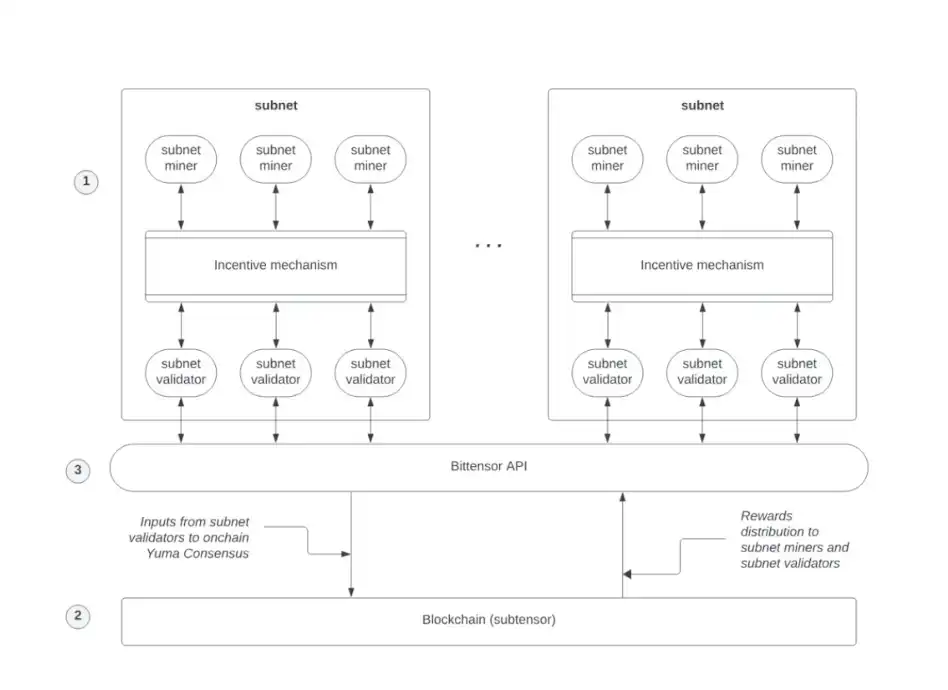
Bittensor's technical architecture adopts a two-layer design:
· Root Network (Mainnet): Responsible for the overall system coordination, validation, and TAO token issuance management, serving as the central hub for network resource allocation.
· Subnet Ecosystem: Various subnets act as independent AI labs, developing specialized solutions for specific AI application scenarios and proving their value in market competition.
This design allows Bittensor to balance the overall network's stability with domain-specific expertise, providing a flexible infrastructure for the development of decentralized AI.
Ecosystem Development Progress
The number of subnets has expanded from the initial 32 to over 64, covering various AI application scenarios such as text generation, trade signals, and data labeling.
The active user base has reached 140,000, doubling compared to the previous year.
The subnetwork market has a total valuation exceeding $1 billion, with daily trading volume maintaining around $45 million
Institutional participation has significantly increased, with prominent fund Grayscale incorporating TAO into its decentralized AI fund, adjusting the weight to 29.55%
These data indicate that Bittensor is gaining more recognition from market participants, and its ecosystem is entering a virtuous development track.
The recently completed dTAO (Dynamic TAO) system upgrade by Bittensor is a significant innovation in its economic model. The core of this upgrade lies in optimizing the allocation mechanism of the token TAO, transitioning from a resource allocation method reliant on validators' subjective judgment to a more market-oriented allocation mechanism. This change enables resources to flow more accurately to those subnetworks that are truly competitive.
Bittensor's original economic model revealed several key issues in practical operation:
· Lack of Objectivity in Evaluation Mechanism: As the number of subnetworks increases, validators find it challenging to objectively assess the actual value of each subnetwork, leading to a gradual decline in allocation efficiency.
· Power Structure Imbalance: Many validators also serve as subnetwork operators, and this role overlap can easily result in conflicts of interest. Validators may incline toward the subnetworks they are involved in, and even covert transactions may occur.
· Participation Barriers: Ordinary TAO holders find it difficult to directly influence the network's resource allocation decisions, with power excessively concentrated in the hands of a few validators.
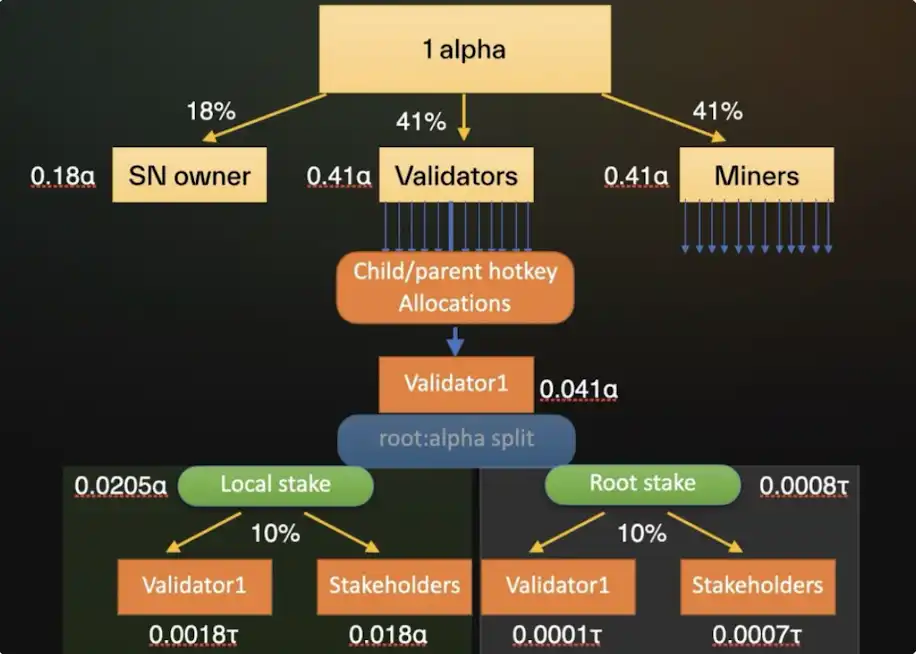
To address these issues, the dTAO upgrade introduces a market-based dynamic resource allocation system. This system transforms each subnetwork into an independent economic unit driven by users' actual needs to steer resource allocation.
Its core innovation is the Subnetwork Token (Alpha Token) mechanism:
· Operation Principle: Users can stake TAO to receive Alpha Tokens issued by various subnetworks, representing the user's support for a specific subnetwork
· Resource Allocation Logic: The market price of Alpha Tokens serves as a signal of subnetwork demand intensity. Initially, all alpha tokens have the same price, with each pool containing only 1 TAO and 1 Alpha Token. As liquidity of both tokens in the subnetwork increases, the price of the Alpha Token will change accordingly. TAO emission is proportionally distributed based on the subnetwork token price among all tokens, with higher-priced subnetworks receiving more TAO allocation, thereby achieving automated resource optimization
This mechanism significantly improves the efficiency and fairness of resource allocation, making the TAO token more stable in value, and providing more pathways for ordinary users to participate in network governance.
Investor Engagement Strategies
For retail investors interested in participating in the Bittensor ecosystem, there are mainly the following ways:
· Liquidity Provision: Stake TAO to receive Alpha tokens from various subnets and participate in subnet ecosystem development. This method is relatively robust, allowing for resource allocation based on views of different subnets to diversify risks.
· Secondary Market Investment: Directly purchase Alpha tokens of the desired subnets from the trading market. However, it is important to note that Alpha tokens are currently in the early emission stage, with a relatively high inflation rate and selling pressure. Investors should carefully select subnets with long-term development value.
· Technical Contribution: For investors with a technical background, they can choose to become network validators or subnet miners to earn rewards by validating the quality of AI models on the network or running specific subnet AI models.
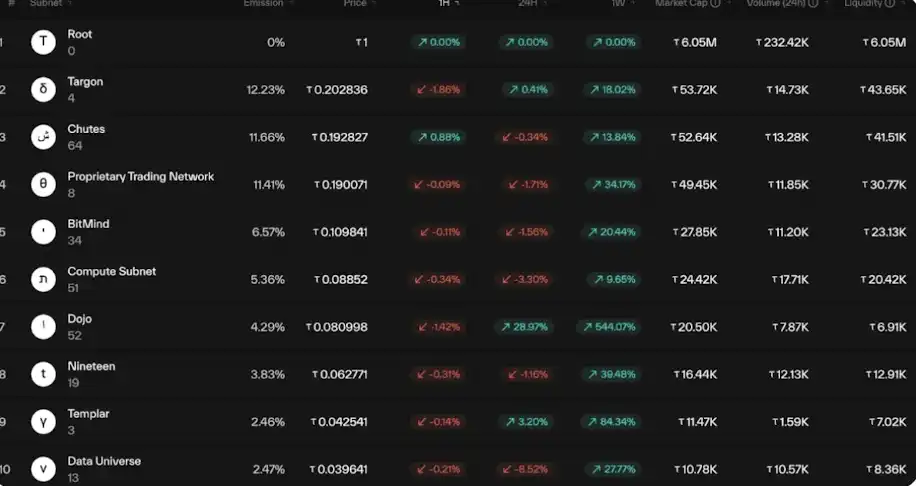
Currently, the most active subnets include:
· Subnet 4 Targon: Focuses on AI inference services for text generation, known for fast response times and low costs
· Subnet 64 Chutes: Provides various LLM API interfaces, allowing developers to build and deploy AI applications on the Bittensor network
· Subnet 8 PTN: Focuses on the financial sector, incentivizing miners to generate accurate trading signals through a reward mechanism, covering various financial markets such as forex and cryptocurrencies
· Subnet 52 Dojo: Handles data labeling, encouraging users to earn tokens through data labeling. Yzi Labs entered by investing in its parent company, Tensorplex.
II. Vana: Data Sovereignty and Value Refactoring Platform
The Vana project focuses on addressing a core issue in today's digital economy: the ownership and value distribution of personal data. In the current internet ecosystem, users' data is mostly monopolized and controlled by large tech companies, while the users who actually create this data rarely benefit from it. Vana's innovation lies in establishing an ecosystem where users truly own and control their own data, while being able to receive economic rewards from it.
As an EVM-compatible Layer 1 blockchain network, Vana's technical architecture consists of five core components:
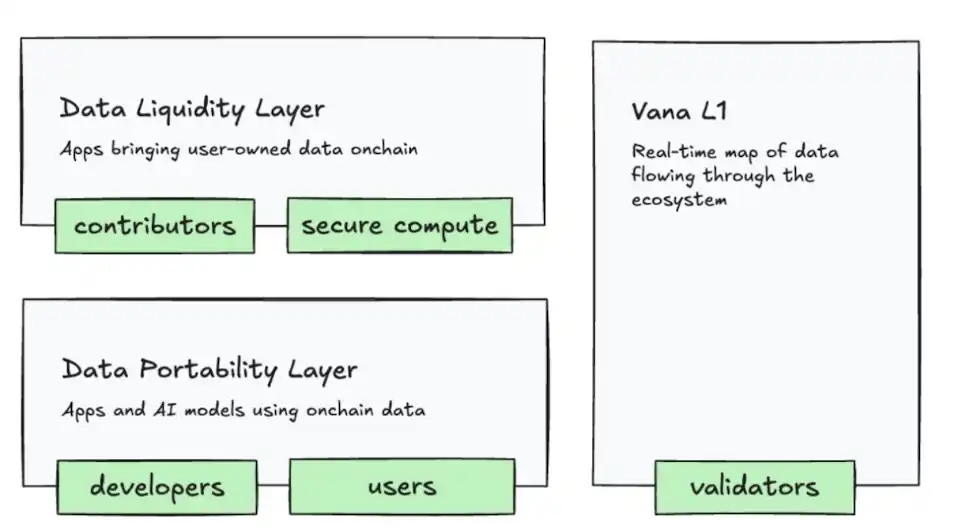
1. Data Liquidity Layer: This is the core of the Vana network, enabling data asset incentivization, aggregation, and validation through Data Liquidity Pools (DLPs). Each DLP is a smart contract specialized in aggregating specific types of data assets, such as social media data and browsing history.
2. Data Portability Layer: Ensures seamless data transferability across different applications and AI models, enhancing data flexibility.
3. Universal Connectome: Tracks real-time data flow throughout the entire ecosystem, forming a data ecosystem graph to ensure system transparency.
4. Non-Custodial Data Storage: A key innovation of Vana is its unique data management approach. Users' raw data is not stored on-chain but rather users choose their storage location, such as cloud servers or personal devices, ensuring users maintain full control over their data.
5. Application Ecosystem: Built on the foundation of data, Vana has established an open application ecosystem where developers can leverage the data accumulated in DLPs to build various innovative applications, including AI applications. Data contributors can then receive rewards from these applications.
This design enables Vana to protect user data privacy while creating a more equitable data value distribution mechanism, providing a crucial data foundation for decentralized AI development.
Latest Developments
Vana's funding and partnership expansion have been progressing:
In February 2025, YZi Labs announced a strategic investment in Vana, with Binance founder CZ joining as an advisor.
In terms of ecosystem development, Vana has built several data projects covering various areas from social media data to financial prediction data, including: Finquarium (financial prediction data), GPT Data DAO (ChatGPT chat data), Reddit Data DAO (Reddit user data), Volara (Twitter data), Flirtual (dating data), among others.
Recently, Vana organized a hackathon event during Eth Denver, offering a prize pool of up to fifty thousand dollars to incentivize developers to build DataDAO and AI applications based on Vana data, further expanding its ecosystem.
These developments indicate that Vana is actively building a complete ecosystem around data ownership and value realization, and its momentum is worth paying attention to.
Participation Path Analysis
For investors interested in participating in the Vana ecosystem, there are mainly the following ways to participate:
· Data Contribution: Upload your social media data, browsing data, etc., to the corresponding Data Liquidity Pool (DLP) to receive the corresponding token rewards. For example, contributing data to the Reddit Data DAO can earn RDAT tokens. This is the most basic and lowest barrier way to participate.
· Staking Participation: Stake Vana tokens through DataHub in a preferred DLP to share Vana block rewards from the DLP. It is important to note that only the top 16 DLPs can receive rewards, so choosing a high-quality DLP is crucial.
· Ecosystem Co-Creation: For participants with certain expertise, you can try to create a new Data Liquidity Pool. As the creator of a new DLP, you need to design specific data contribution goals, validation methods, and reward parameters, and implement a contribution proof function that can accurately assess the value of the data.
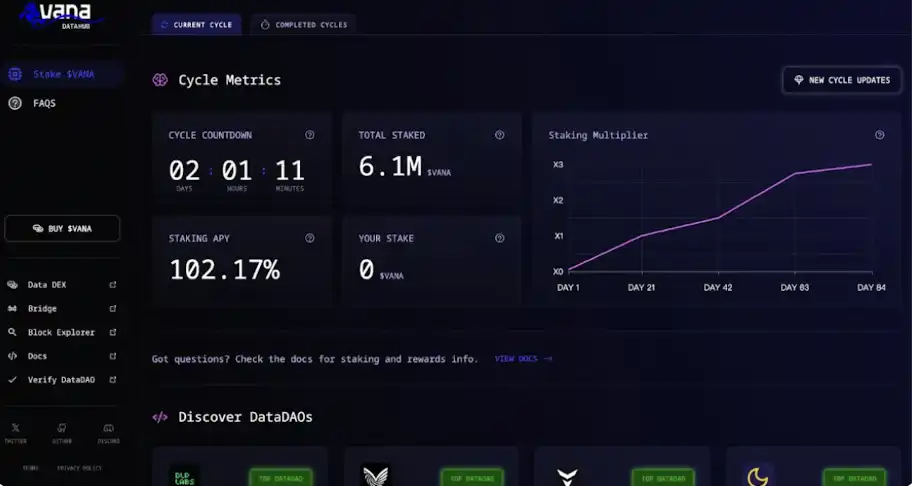
Vana represents a significant innovation at the intersection of blockchain technology, data economy, and artificial intelligence. By establishing a decentralized data platform, Vana aims to redefine data ownership and value distribution, providing fair rewards to data creators and high-quality training resources for AI development.
III. Kite AI: Technological Breakthrough of an AI-Native Public Chain
Kite AI is a Layer 1 blockchain project focused on the AI field, built on the Avalanche framework. It aims to address various challenges faced by traditional blockchains in handling AI assets, particularly how to achieve transparent rights and incentives for AI data, models, and agent contributions.
Kite AI has proposed four core technological innovations:
1. PoAI Consensus Mechanism: Proof of Attributed Intelligence is Kite AI's pioneering consensus mechanism, which accurately tracks the value contribution of data, models, and AI agents through an on-chain verifiable contribution record system. The project has designed a dynamic reward pool mechanism to distribute earnings according to the contribution ratio, effectively addressing issues such as "data black box" and "model plagiarism" in traditional AI economies.
2. Composable AI Subnet: Kite AI adopts a modular architecture that supports developers in building industry-specific AI collaboration ecosystems as needed. For example, in a healthcare subnet, patient data encrypted can be selectively authorized to pharmaceutical companies for AI model development. The earnings are distributed to data subjects, model developers, and subnet maintainers in a certain proportion, creating a multi-win ecosystem.
3. AI-native Execution Layer: Kite AI is building an on-chain AI-native execution layer dedicated to handling AI computing tasks such as inference, embedding, and fine-tuning/training. Users can authorize smart contract wallets to execute inference calls and interact with models through this layer. The execution layer not only supports blockchain transactions and state changes but also integrates secure computing environments (such as Trusted Execution Environments TEE) to ensure data security and privacy protection during computation.
4. Decentralized Data Engine: Kite AI ensures that data creators receive fair rewards in the AI workflow. The platform has built-in compliance modules that comply with regulations such as GDPR/CCPA, meeting data privacy requirements globally, and reducing developers' compliance costs.
These technological innovations enable Kite AI to create a more equitable and transparent value distribution environment for AI developers and data providers, driving the decentralized development of AI technology.
Current Development
On February 6, 2025, Kite AI launched the incentive testnet, the first AI-native Layer 1 sovereign blockchain testnet.
The testnet performed remarkably well:
In less than 70 hours after the testnet went live, the number of connected wallets exceeded 100,000. As of now, a total of 1.95 million wallets have joined Incentive Testnet V1, with over 1 million wallets already interacting with AI agents, surpassing 115 million total call times.
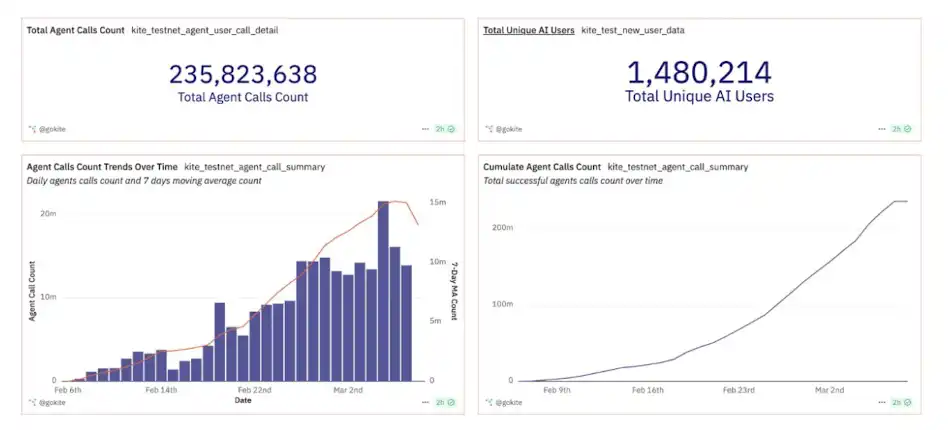
The project has a strong background and is built by an experienced Silicon Valley team. The co-founders, each with deep technical leadership experience in the field of artificial intelligence, have held positions at top-tier tech companies such as Uber, Salesforce, and Databricks. Core team members come from industry-leading companies such as Google, BlackRock, Uber, the NEAR Foundation, with academic backgrounds from top institutions like MIT and Harvard.
In terms of capital support, the project has received investment from top institutions such as General Catalyst, Hashed, Hashkey, Samsung Next, and has established technical partnerships with Eigenlayer, Sui, Avalanche, AWS, among others.
As a selection committee member of Avalanche's InfraBUILDL(AI) program, Kite AI plays an active role in advancing the Avalanche artificial intelligence ecosystem. This collaboration aims to position Avalanche as a leading blockchain for AI applications.
With the global data economy expected to surpass $700 billion in 2025, Kite AI is poised to become a critical infrastructure for data rights and monetization, with promising development potential.
Participation Opportunity Analysis
Early participation in the Kite ecosystem primarily involves the following avenues:
· Testnet Participation: Kite AI's testnet is now open, providing early participants with generous incentives. Investors can engage through the official website (gokite.ai) or testnet portal (testnet.gokite.ai) to experience network functionality and have the opportunity to receive testnet rewards.
· Application Development: Investors with development capabilities can explore deploying AI-driven DApps on Kite AI, delving into innovative scenarios such as on-chain model training and data markets. The platform offers developers rich tools and support, lowering the barrier to entry for development.
· Subnet Deployment: Kite AI has prepared a token airdrop plan for the earliest teams deploying AI subnets, encouraging developers to create specialized AI subnets. For investors with specific industry expertise, this is an opportunity to leverage their knowledge for additional rewards.
· Early Contributors Points: Users actively participating in building the Kite AI ecosystem will receive point rewards and priority ecosystem resource support. These points may be converted into specific tokens or other benefits in the future.
Four. Nillion: Exploring the Frontier of Privacy Computing
Nillion is redefining the way sensitive data is handled for future digital privacy by leveraging its unique "Blind Computation" technology.
Nillion is a decentralized public network based on an innovative cryptographic primitive called Nil Message Compute (NMC), enabling network nodes to operate in a non-traditional blockchain manner. Founded in November 2021, the project is led by forward-thinking innovators such as Alex Page and Andrew Masanto, aiming to create a system that can securely process high-value data without exposing sensitive details.
The core strength of Nillion lies in its "Blind Computation" capability—a process that allows data to remain encrypted throughout its lifecycle, including storage, transmission, and processing. Its technical architecture integrates various cutting-edge privacy protection technologies:
· Multi-Party Computation (MPC): Enables multiple nodes to collaboratively compute functions without revealing their private inputs, achieving joint computation without data sharing.
· Fully Homomorphic Encryption (FHE): Allows direct operations on encrypted data, ensuring data remains encrypted end-to-end, providing comprehensive privacy protection.
· Zero-Knowledge Proof (ZKP): Offers a way to verify computations without disclosing any underlying data, enhancing the system's trustworthiness.
· Nada Language: This is a domain-specific language designed for creating secure MPC programs, simplifying the development process of privacy-preserving applications and reducing the learning curve for developers.
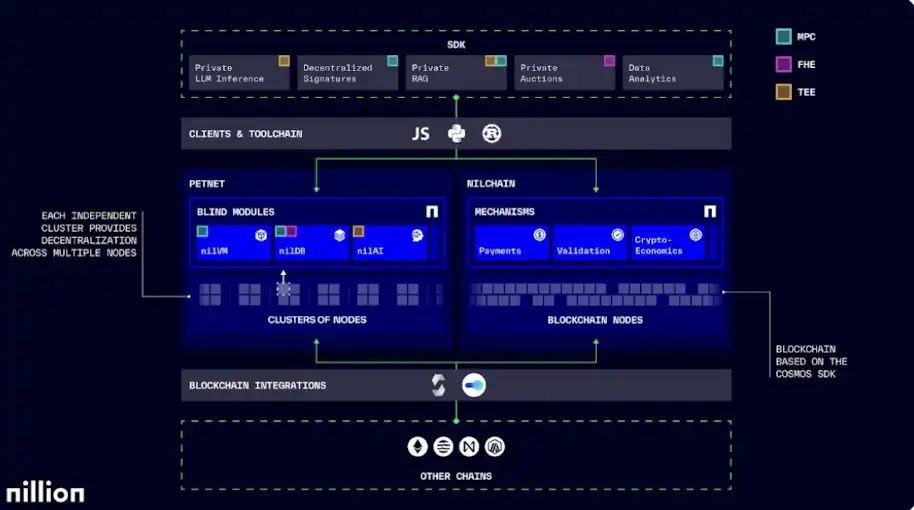
Nillion's network architecture consists of three main layers: the Processing Layer (responsible for secure computation), the Coordination Layer (NilChain, managing inter-node communication), and the Connectivity Layer (serving as a gateway to connect external systems). This multi-layer architecture enables Nillion to offer robust computational power while safeguarding data privacy, meeting the requirements of various privacy-sensitive scenarios.
Latest Development Progress
According to recent information, the development of the Nillion network is steadily progressing:
The Nillion mainnet is scheduled to launch in March 2025 (this month). The total supply of Nillion tokens is 1 billion, and distribution is expected to take place at the launch of the mainnet.
In terms of funding, Nillion completed a $25 million financing round led by Hack VC on October 30, 2024. Investors include HashKey Capital, Animoca Brands, and well-known institutions, as well as angel investors from projects such as Arbitrum, Worldcoin, and Sei. This round of financing brought Nillion's total funding to $45 million, providing ample financial support for the project's long-term development.
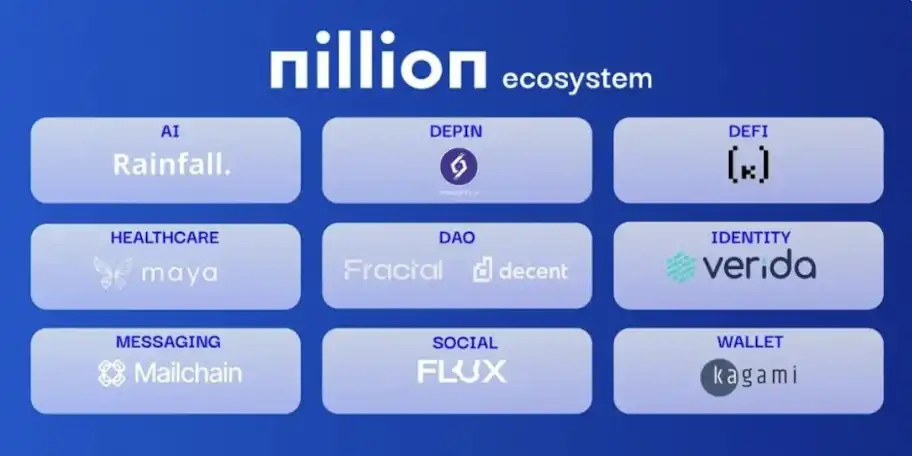
In terms of ecosystem expansion, Nillion has established integration relationships with several mainstream blockchains such as NEAR Protocol, Aptos, Arbitrum, Mantle, and Sei. Through its collaboration with NEAR Protocol, Nillion aims to enhance privacy tools, enabling developers to innovate more effectively in the DeFi space.
Regarding the AI ecosystem, Nillion has partnered with various AI-related projects, including Ritual, Crush AI, Skillful AI, and Virtuals Protocol. For example, Virtuals Protocol is currently the largest multimodal AI agent protocol. Through collaboration with Nillion, it leverages its secure computing infrastructure to support AI model training and inference privately, achieving a perfect integration of AI and privacy.
For a more detailed introduction to Nillion's ecosystem projects, please refer to our previous article: https://x.com/BiteyeCN/status/1881297074228252702
Ecosystem Participation Strategy
As the Nillion mainnet is about to be launched, retail investors have various ways to participate in its ecosystem:
· Tokenomics Participation: Although Nillion's airdrop eligibility check closed on February 3, 2025, more opportunities to participate in Nillion's tokenomics system will arise with the mainnet launch. According to official information, the Nillion airdrop will reward community members and early builders with up to 75 million NIL tokens.
· Developer Ecosystem Participation: Nillion provides developers with abundant tools and resources to support the creation of privacy-centric applications:
· Node Deployment Kit (NDK): Simplifies the process of joining the network and managing nodes, reducing the technical barrier to entry
· Nada Language: Specifically designed for creating secure MPC programs, making it easier for developers to build privacy-preserving applications
· Application Areas: Developers can create Nillion-based applications in multiple areas, including:
· Artificial Intelligence: Processing data and inference without exposing sensitive information
· Personalized Agents: AI agents that store, compute, and process private data
· Privacy-Preserving Model Inference: AI models that securely handle sensitive data
· Privacy-Aware Knowledge Base and Search: Data encrypted for storage while providing search capabilities
· Network Node Operation: As a decentralized network, Nillion offers participants the opportunity to operate nodes. By running nodes, users can contribute computational resources, earn rewards, and help maintain the network's security and decentralization.
5. Sahara AI: Building a Platform for the New AI Asset Economy
Project Development
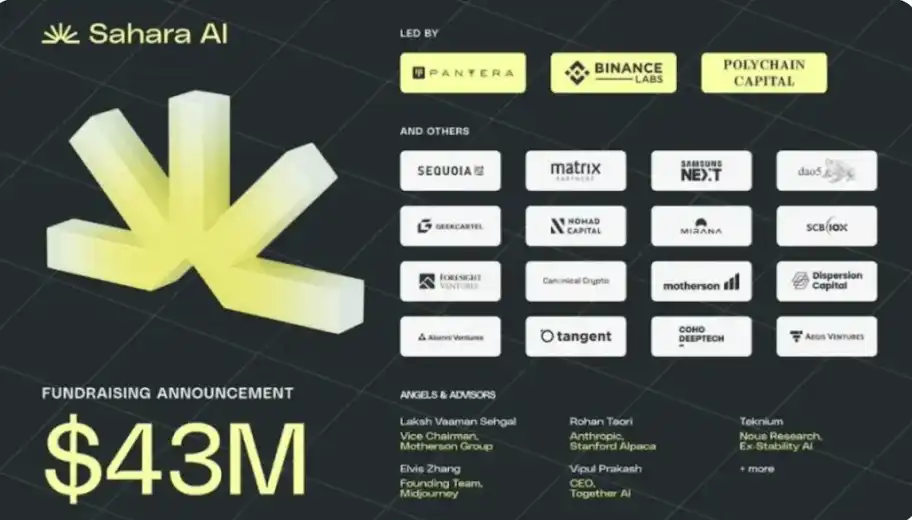
The core idea of Sahara AI is to build a "Human-AI Collaboration Network" that enables ordinary users, developers, and businesses to participate in the creation, deployment, and monetization of AI assets. Through this collaborative model, Sahara AI aims to lower the barriers to entry for AI, allowing every participant to share in the industry's growth dividend. The project has successfully raised a total of $43 million in funding led by Binance Labs, Polychain Capital, and Pantera Capital.
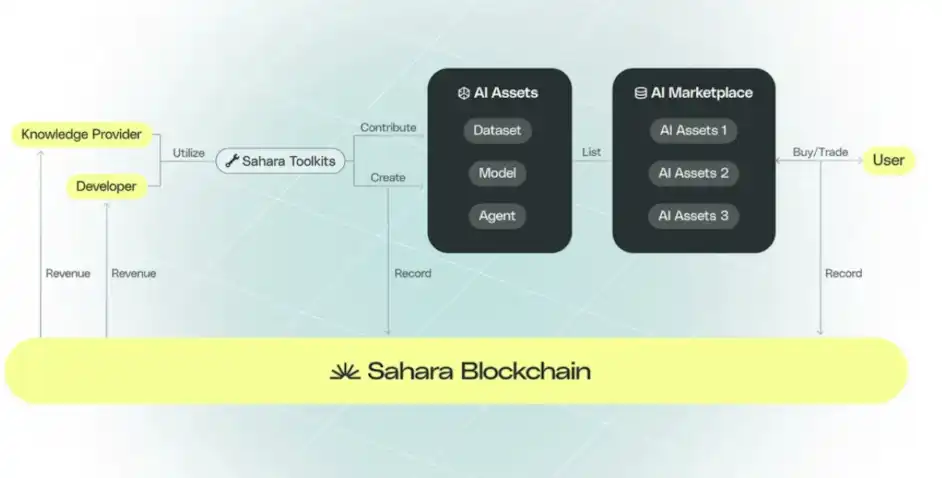
The platform's technical architecture consists of three key components:
1. Sahara Blockchain: Provides the ecosystem with a secure, transparent transaction environment and efficient AI lifecycle management foundation
2. AI Infrastructure: Supports distributed collaboration training and serving capabilities for advanced algorithms and computing frameworks
3. Sahara AI Marketplace: A decentralized trading center for AI assets
These components together form a complete ecosystem that supports the end-to-end process from data collection and annotation to model training, deployment, and monetization.
Latest Development Progress
The Sahara AI project is in a rapid development phase, and its testnet has gone through several key stages:
In December 2024, Sahara AI launched the first-phase Data Service Platform Beta version testnet, attracting applications from over 780,000 users, with over 10,000 waitlisted applicants qualifying for initial participation. In this stage, participants could contribute to the AI ecosystem by completing data collection, optimization, and annotation tasks and earn rewards.
In February 2025, Sahara AI initiated the second-stage testnet, expanding the platform's contributor base and introducing additional reward opportunities. This stage further strengthened user engagement in shaping the decentralized AI future.
The latest development is that Sahara AI has announced the launch of a public testnet called "SIWA" on March 10, 2025. This is considered the final significant test before the Sahara AI mainnet launch and TGE, and may also be the last opportunity for participants to earn airdrop rewards (referred to as "points").
Sahara AI has released its 2024-2025 roadmap, which includes several key milestones:
· Q4 2024: Launched the Data Service Platform and testnet, where users could earn rewards through data collection and annotation.
· Q1 2025: AI Marketplace launched, providing development tools and data service expansion functions to support model development, training, deployment, and introducing an early access program.
· Q2 2025: Introduced the Sahara Studio tool suite, covering model training, deployment, and workflow management to further optimize the developer experience.
· Q3 2025: The Sahara Chain mainnet is launched, providing a secure, transparent on-chain infrastructure for large-scale decentralized AI, while also supporting the tokenization and trading of data and models.
On March 1, 2025, Sahara AI introduced the Incubator Program aimed at discovering and supporting the world's most promising AI x Web3 innovation projects. The program focuses on two main tracks: AI infrastructure and AI applications, welcoming teams with an MVP or higher maturity level to participate. Successfully selected projects will have the opportunity to fully integrate into the Sahara AI ecosystem, receive exclusive technical support, market expansion resources, and investment opportunities.
Ecosystem Participation Strategy
For users interested in participating in the Sahara AI ecosystem, here are several key participation methods:
1. Join the Waiting List and Testnet
The primary step to engage with the Sahara AI ecosystem is to join the official waiting list:
· Visit the Sahara AI official waiting list page
· Fill in the required information and submit the application form
· Selected users will receive testnet access
· Complete various tasks in the testnet to earn Sahara Points
Of particular note, the SIWA public testnet, launching on March 10, 2025, may be the last opportunity to receive airdrop rewards before the mainnet TGE. Users interested in participation should act quickly to apply.
2. Participate in Legends Event
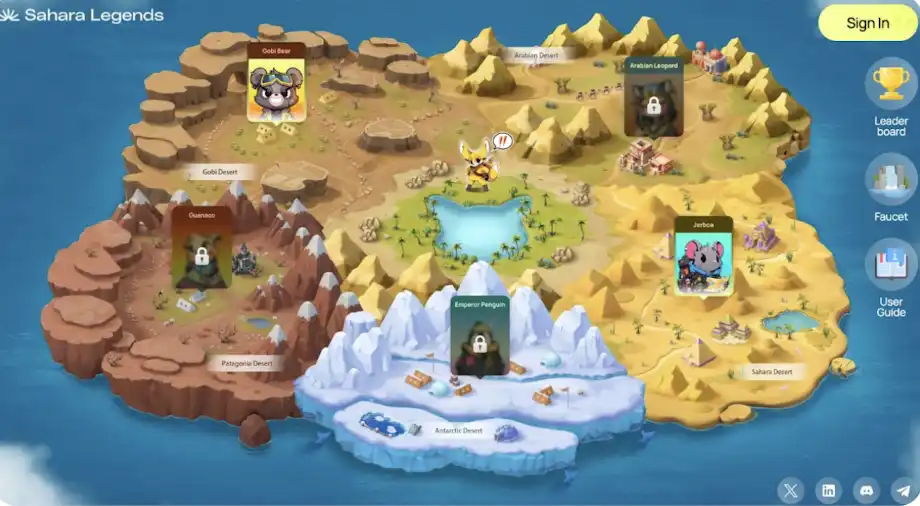
Sahara AI also offers an event called "Legends," allowing users to collect shards and forge NFTs:
· Visit the Sahara Legends event page and log in, connect your wallet
· Explore five unique desert-themed areas to start collecting shards
· Invite friends to join the event to earn additional shards
· Use the collected shards to forge the Soulbound Desert Guardian NFT
· Collect a mascot NFT from each desert and merge them to create an exclusive Fennec Fox NFT
3. Data Contribution Platform
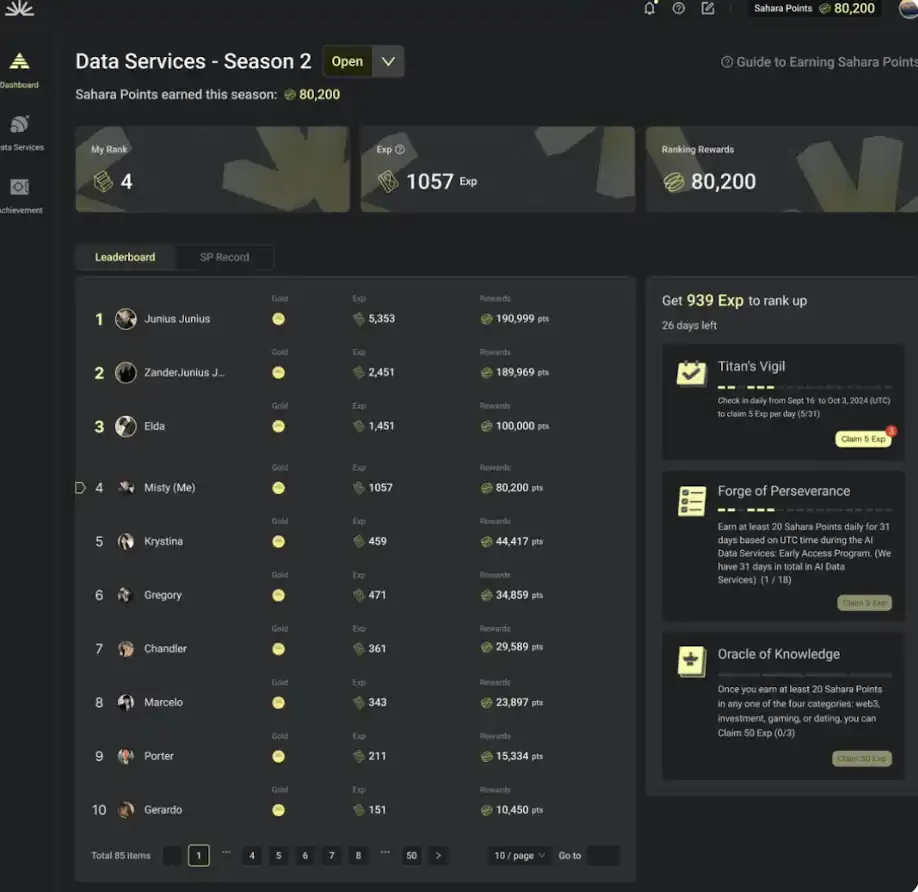
The Sahara AI data contribution platform provides users with the opportunity to be rewarded for contributing data:
· Participants can choose high-value data tasks from various fields such as the creator economy, finance, and science
· Upon task completion, the platform will reward users based on their contribution, accuracy, and consistency
· A leaderboard is in place to encourage outstanding performers
· All rewards are distributed in the form of points, laying the foundation for token distribution within the ecosystem
Six. Conclusion
AI Layer 1 is at a critical stage of rapid evolution. This emerging track is restructuring the underlying architecture of AI technology through decentralized infrastructure. From data empowerment to computational resource allocation, from model training to application deployment, these platforms are breaking through the limitations of traditional centralized AI systems, building a more open, transparent, and efficient technical ecosystem. In the future, this track will continue to drive technological innovation, advancing artificial intelligence towards a more decentralized and collaborative development direction.
猜你喜歡
穩定幣驅動全球B2B支付革新,如何打破工作流程瓶頸釋放兆市場潛力?
這些新創公司正在無需資料中心的情況下建立先進AI模型
科學平權運動:DeSci的萬億美元知識經濟重建革命
Sentient深度研報:獲8,500萬美元融資,建置去中心化AGI新範式
專訪Virtuals聯創empty:AI 創業不需要大量資金,Crypto是答案之一
今年 2 月,Base 生態中的 AI 協議 Virtuals 宣布跨鏈至 Solana,然而加密市場隨後進入流動性緊縮期,AI Agent 板塊從人聲鼎沸轉為低迷,Virtuals 生態也陷入一段蟄伏期。
三月初,BlockBeats 對 Virtuals 共同創辦人 empty 進行了一次專訪。彼時,團隊尚未推出如今被廣泛討論的 Genesis Launch 機制,但已在內部持續探索如何透過機制設計激活舊資產、提高用戶參與度,並重構代幣發行與融資路徑。那是一個市場尚未復甦、生態尚處冷啟動階段的時間點,Virtuals 團隊卻沒有停下腳步,而是在努力尋找新的產品方向和敘事突破口。
兩個月過去,AI Agent 板塊重新升溫,Virtuals 代幣反彈超 150%,Genesis 機製成為帶動生態回暖的重要觸發器。從積分獲取規則的動態調整,到專案參與熱度的持續上升,再到「新代幣帶老代幣」的機制閉環,Virtuals 逐漸走出寒冬,並再次站上討論焦點。
值得注意的是,Virtuals 的 Genesis 機制與近期 Binance 推出的 Alpha 積分系統有一些相似之處,評估用戶在 Alpha 和幣安錢包生態系統內的參與度,決定用戶 Alpha 代幣空投的資格。用戶可透過持倉、交易等方式獲得積分,積分越高,參與新項目的機會越大。透過積分系統篩選使用者、分配資源,專案方能夠更有效地激勵社群參與,提升專案的公平性和透明度。 Virtuals 和 Binance 的探索,或許預示著加密融資的新趨勢正在形成。
回看這次對話,empty 在專訪中所展現出的思路與判斷,正在一步步顯現其前瞻性,這不僅是一場圍繞打新機制的訪談,更是一次關於“資產驅動型 AI 協議”的路徑構建與底層邏輯的深度討論。
BlockBeats:可以簡單分享一下最近團隊主要在忙些什麼?
empty:目前我們的工作重點主要有兩個部分。第一部分,我們希望將 Virtuals 打造成一個類似「華爾街」的代理人(Agent)服務平台。設想一下,如果你是專注於 Agent 或 Agent 團隊建立的創業者,從融資、發幣到流動性退出,整個流程都需要係統性的支援。我們希望為真正專注於 Agent 和 AI 研發的團隊,提供這一整套服務體系,讓他們可以把精力集中在底層能力的開發上,而不用為其他環節分心。這一塊的工作其實也包括了與散戶買賣相關的內容,後面可以再詳細展開。
第二部分,我們正在深入推進 AI 相關的佈局。我們的願景是建立一個 AI 社會,希望每個 Agent 都能聚焦自身優勢,同時透過彼此之間的協作,實現更大的價值。因此,最近我們發布了一個新的標準——ACP(Agent Communication Protocol),目的是讓不同的 Agent 能夠相互互動、協作,共同推動各自的業務目標。這是目前我們主要在推進的兩大方向。
BlockBeats:可以再展開說說嗎?
empty:在我看來,其實我們面對的客戶群可以分為三類:第一類是專注於開發 Agent 的團隊;第二類是投資者,包括散戶、基金等各種投資機構;第三類則是 C 端用戶,也就是最終使用 Agent 產品的個人用戶。
不過,我們主要的精力其實是放在前兩大類──也就是團隊和投資人。對於 C 端用戶這一塊,我們並不打算直接介入,而是希望各個 Agent 團隊能夠自己解決 C 端市場的拓展問題。
此外,我們也認為,Agent 與 Agent 之間的交互作用應該成為一個核心模式。簡單來說,就是未來的服務更多應該是由一個 Agent 銷售或提供給另一個 Agent,而不是單純賣給人類使用者。因此,在團隊的 BD 工作中,我們也積極幫助現有的 AI 團隊尋找這樣的客戶和合作機會。
BlockBeats:大概有一些什麼具體案例呢?
empty:「華爾街」說白了就是圍繞資本運作體系的建設,假設你是一個技術團隊,想要融資,傳統路徑是去找 VC 募資,拿到資金後開始發展。如果專案做得不錯,接下來可能會考慮進入二級市場,例如在紐約證券交易所上市,或是在 Binance 這樣的交易所上幣,實現流動性退出。
我們希望把這一整套流程打通-從早期融資,到專案開發過程中對資金的靈活使用需求,再到最終二級市場的流動性退出,全部覆蓋和完善,這是我們希望補齊的一條完整鏈條。
而這一部分的工作和 ACP(Agent Communication Protocol)是不同的,ACP 更多是關於 Agent 與 Agent 之間交互標準的製定,不直接涉及資本運作系統。
BlockBeats:它和現在 Virtuals 的這個 Launchpad 有什麼差別呢?資金也是從 C 端來是嗎?
empty:其實現在你在 Virtuals 上發幣,如果沒有真正融到資金,那就只是發了一個幣而已,實際是融不到錢的。我們目前能提供的服務,是透過設定買賣時的交易稅機制,從中提取一部分稅收回饋給創業者,希望這部分能成為他們的現金流來源。
不過,問題其實還分成兩塊。第一是如何真正幫助團隊完成融資,這個問題目前我們還沒有徹底解決。第二是關於目前專案發行模式本身存在的結構性問題。簡單來說,現在的版本有點像過去 Pumpfun 那種模式——也就是當專案剛上線時,部分籌碼就被外賣給了外部投資人。但現實是,目前整個市場上存在著太多機構集團和「狙擊手」。
當一個真正優秀的專案一發幣,還沒真正觸達普通散戶,就已經被機構在極高估值時搶購了。等到散戶能夠接觸到時,往往價格已經偏高,專案品質也可能變差,整個價值發行體係被扭曲。
針對這個問題,我們希望探索一種新的發幣和融資模式,目的是讓專案方的籌碼既不是死死握在自己手裡,也不是優先流向英文圈的大機構,而是能夠真正留給那些相信專案、願意長期支持專案的普通投資者手中。我們正在思考該如何設計這樣一個新的發行機制,來解決這個根本問題。
BlockBeats:新模式的具體想法會是什麼樣子呢?
empty:關於資金這一塊,其實我們目前還沒有完全想透。現階段來看,最直接的方式還是去找 VC 融資,或是採取公開預售等形式進行資金募集。不過說實話,我個人對傳統的公開預售模式並不是特別認同。
在「公平發售」這件事上,我們正在嘗試換一個角度來思考-希望能從「reputation」出發,重新設計機制。
具體來說,就是如果你對整個 Virtuals 生態有貢獻,例如早期參與、提供支持或建設,那麼你就可以在後續購買優質代幣時享有更高的優先權。透過這種方式,我們希望把資源更多留給真正支持生態發展的用戶,而不是由短期套利的人主導。
BlockBeats:您會不會考慮採用類似之前 Fjord Foundry 推出的 LBP 模式,或者像 Daos.fun 那種採用白名單機制的模式。這些模式在某種程度上,和您剛才提到的「對生態有貢獻的人享有優先權」的想法是有些相似的。不過,這類做法後來也引發了一些爭議,例如白名單內部操作、分配不公等問題。 Virtuals 在設計時會考慮借鏡這些模式的優點,或有針對性地規避類似的問題嗎?
empty:我認為白名單機制最大的問題在於,白名單的選擇權掌握在專案方手中。這和「老鼠倉」行為非常相似。專案方可以選擇將白名單名額分配給自己人或身邊的朋友,導致最終的籌碼仍然掌握在少數人手中。
我們希望做的,依然是類似白名單的機制,但不同的是,白名單的獲取權應基於一個公開透明的規則體系,而不是由項目方單方面決定。只有這樣,才能真正做到公平分配,避免內幕操作的問題。
我認為在今天這個 AI 時代,很多時候創業並不需要大量資金。我常跟團隊強調,你們應該優先考慮自力更生,例如透過組成社區,而不是一開始就想著去融資。因為一旦融資,實際上就等於背負了負債。
我們更希望從 Training Fee的角度去看待早期發展路徑。也就是說,專案可以選擇直接發幣,透過交易稅所帶來的現金流,支持日常營運。這樣一來,專案可以在公開建設的過程中獲得初步資金,而不是依賴外部投資。如果專案做大了,自然也會有機會透過二級市場流動性退出。
當然最理想的情況是,專案本身能夠有穩定的現金流來源,這樣甚至連自己的幣都無需拋售,這才是真正健康可持續的狀態。
我自己也常在和團隊交流時分享這種思路,很有意思的是,那些真正抱著「搞快錢」心態的項目,一聽到這種機制就失去了興趣。他們會覺得,在這種模式下,既無法操作老鼠倉,也很難短期套利,於是很快就選擇離開。
但從我們的角度來看,這其實反而是個很好的篩選機制。透過這種方式,理念不同的專案自然會被過濾出去,最後留下的,都是那些願意真正建立、和我們價值觀契合的團隊,一起把事情做起來。
BlockBeats:這個理念可以發展出一些能夠創造收益的 AI agent。
empty:我覺得這是很有必要的。坦白說,放眼今天的市場,真正擁有穩定現金流的產品幾乎鳳毛麟角,但我認為這並不意味著我們應該停止嘗試。事實上,我們每天在對接的團隊中,有至少一半以上的人依然懷抱著長遠的願景。很多時候,他們甚至已經提前向我們提供了 VC 階段的資金支持,或表達了強烈的合作意願。
其實對他們來說想要去收穫一個很好的社區,因為社區可以給他們的產品做更好的回饋,這才是他們真正的目的。這樣聽起來有一點匪夷所思,但其實真的有很多這樣的團隊,而那種團隊的是我們真的想扶持的團隊。
BlockBeats:您剛才提到的這套「AI 華爾街」的產品體系-從融資、發行到退出,建構的是一整套完整的流程。這套機制是否更多是為了激勵那些有意願發幣的團隊?還是說,它在設計上也考慮瞭如何更好地支持那些希望透過產品本身的現金流來發展的團隊?這兩類團隊在您這套體系中會不會被區別對待,或者說有什麼機制設計能讓不同路徑的創業者都能被合理支持?
empty:是的,我們 BD 的核心職責其實就是去鼓勵團隊發幣。說得直接一點,就是引導他們思考發幣的可能性和意義。所以團隊最常問的問題就是:「為什麼要發幣?」這時我們需要採取不同的方式和角度,去幫助他們理解背後的價值邏輯。當然如果最終判斷不適合,我們也不會強迫他們推進。
不過我們觀察到一個非常明顯的趨勢,傳統的融資路徑已經越來越難走通了。過去那種融資做大,發幣上所的模式已經逐漸失效。面對這樣的現實,很多團隊都陷入了尷尬的境地。而我們希望能從鏈上和加密的視角,提供一套不同的解決方案,讓他們找到新的發展路徑。
BlockBeats:明白,我剛才其實想表達的是,您剛剛也提到,傳統的 AI 模式在很大程度上仍然依賴「燒錢」競爭。但在 DeepSeek 出現之後,市場上一些資金體積較小的團隊或投資人開始重新燃起了信心,躍躍欲試地進入這個領域。您怎麼看待這種現象?這會不會對目前正在做 AI 基礎研發,或是 AI 應用層開發的團隊產生一定的影響?
empty:對,我覺得先不談 DeepSeek,從傳統角度來看,其實到目前為止,AI 領域真正賺錢的只有英偉達,其他幾乎所有玩家都還沒有實現盈利。所以其實沒有人真正享受了這個商業模式的成果,大家也仍在探索如何面對 C 端打造真正有產出的應用。
沒有哪個領域像幣圈一樣能如此快速獲得社群回饋。你一發幣,用戶就會主動去讀白皮書的每一個字,試試你產品的每個功能。
當然,這套機制並不適合所有人。例如有些 Agent 產品偏 Web2,對於幣圈用戶而言,可能感知不到其價值。因此,我也會鼓勵做 Agent 的團隊在 Virtuals 生態中認真思考,如何真正將 Crypto 作為自身產品的差異化要素加以運用與設計。
BlockBeats:這點我特別認同,在 Crypto 這個領域 AI 的迭代速度確實非常快,但這群用戶給予的回饋,真的是代表真實的市場需求嗎?或者說這些回饋是否真的符合更大眾化、更具規模性的需求?
empty:我覺得很多時候產品本身不應該是強行推廣給不適合的使用者群體。例如 AIXBT 最成功的一點就在於,它的用戶本身就是那群炒作他人內容的人,所以他們的使用行為是非常自然的,並不覺得是在被迫使用一個無聊的產品。 mass adoption 這個概念已經講了很多年,大家可能早就該放棄這個執念了。我們不如就認了,把東西賣給幣圈的人就好了。
BlockBeats:AI Agent 與 AI Agent 所對應的代幣之間,究竟應該是什麼樣的動態關係?
empty:對,我覺得這裡可以分成兩個核心點。首先其實不是在投資某個具體的 AI Agent,而是在投資背後經營這個 Agent 的團隊。你應該把它理解為一種更接近創投的思路:你投的是這個人,而不是他目前正在做的產品。因為產品本身是可以快速變化的,可能一個月後團隊會發現方向不對,立即調整。所以,這裡的「幣」本質上代表的是對團隊的信任,而不是某個特定 Agent 本身。
第二則是期望一旦某個 Agent 產品做出來後,未來它能真正產生現金流,或者有實際的使用場景(utility),從而讓對應的代幣具備賦能效應。
BlockBeats:您覺得有哪些賦能方式是目前還沒看到的,但未來可能出現、值得期待的?
empty:其實主要有兩塊,第一是比較常見的那種你要使用我的產品,就必須付費,或者使用代幣支付,從而間接實現對代幣的「軟銷毀」或消耗。
但我覺得更有趣的賦能方式,其實是在獲客成本的角度思考。也就是說,你希望你的用戶同時也是你的投資者,這樣他們就有動機去主動幫你推廣、吸引更多用戶。
BlockBeats:那基於這些觀點,您怎麼看 ai16z,在專案設計和代幣機制方面,似乎整體表現並不太樂觀?
empty:從一個很純粹的投資角度來看,撇開我們與他們之間的關係,其實很簡單。他們現在做的事情,對代幣本身沒有任何賦能。從開源的角度來看,一個開源模型本身是無法直接賦能代幣的。
但它仍然有價值的原因在於,它像一個期權(call option),也就是說,如果有一天他們突然決定要做一些事情,比如推出一個 launchpad,那麼那些提前知道、提前參與的人,可能會因此受益。
開發者未來確實有可能會使用他們的 Launchpad,只有在那一刻,代幣才會真正產生賦能。這是目前最大的一個問號——如果這個模式真的跑得通,我認為確實會非常強大,因為他們的確觸達了大量開發者。
但我個人還是有很多疑問。例如即使我是使用 Eliza 的開發者,也不代表我一定會選擇在他們的 Launchpad 上發幣。我會貨比三家,會比較。而且,做一個 Launchpad 和做一個開源框架,所需的產品能力和社群運作能力是完全不同的,這是另一個重要的不確定性。
BlockBeats:這種不同是體現在什麼地方呢?
empty:在 Virtuals 上我們幾乎每天都在處理客服相關的問題,只要有任何一個團隊在我們平台上發生 rug,即使與我們沒有直接關係,用戶也會第一時間來找我們投訴。
這時我們就必須出面安撫用戶,並思考如何降低 rug 的整體風險。一旦有團隊因為自己的代幣設計錯誤或技術失誤而被駭客攻擊、資產被盜,我們往往需要自掏腰包,確保他們的社群至少能拿回一點資金,以便專案能夠重新開始。這些項目方可能在技術上很強,但未必擅長代幣發行,結果因操作失誤被攻擊導致資產損失。只要涉及「被欺騙」相關的問題,對我們來說就已經是非常麻煩的事了,做這些工作跟做交易所的客服沒有太大差別。
另一方面,做 BD 也非常困難。優秀的團隊手上有很多選擇,他們可以選擇在 Pumpfun 或交易所上發幣,為什麼他們要來找我們,那這背後必須要有一整套支援體系,包括融資支援、技術協助、市場推廣等,每個環節都不能出問題。
BlockBeats:那我們就繼續沿著這個話題聊聊 Virtuals 目前的 Launchpad 業務。有一些社群成員在 Twitter 上統計了 Virtuals Launchpad 的整體獲利狀況,確實目前看起來獲利的項目比較少。接下來 Launchpad 還會是 Virtuals 的主要業務區嗎?還是說,未來的重心會逐漸轉向您剛才提到的「AI 華爾街」這條路徑?
empty:其實這兩塊本質上是一件事,是一整套體系的一部分,所以我們必須繼續推進。市場的波動是很正常的,我們始終要堅持的一點是:非常清楚地認識到我們的核心客戶是誰。我一直強調我們的客戶只有兩類——團隊。所以市場行情的好壞對我們來說並不是最重要的,關鍵是在每一個關鍵節點上,對於一個團隊來說,發幣的最佳選擇是否依然是我們 Virtuals。
BlockBeats:您會不會擔心「Crypto + AI」或「Crypto AI Agent」這一類敘事已經過去了?如果未來還有一輪多頭市場,您是否認為市場炒作的焦點可能已經不再是這些方向了?
empty:有可能啊,我覺得 it is what it is,這確實是有可能發生的,但這也屬於我們無法控制的範圍。不過如果你問我,在所有可能的趨勢中,哪個賽道更有機會長期保持領先,我仍然認為是 AI。從一個打德撲的角度來看,它仍然是最優選擇。
而且我們團隊的技術架構和底層能力其實早已搭建完成了,現在只是順勢而為而已。更重要的是,我們本身真的熱愛這件事,帶著好奇心去做這件事。每天早上醒來就有驅動力去研究最新的技術,這種狀態本身就挺讓人滿足的,對吧?
很多時候,大家不應該只看產品本身。實際上很多優秀的團隊,他們的基因決定了他們有在規則中勝出的能力——他們可能過去在做派盤交易時,每筆規模就是上百萬的操作,而這些團隊的 CEO,一年的薪資可能就有 100 萬美金。如果他們願意出來單幹項目,從天使投資或 VC 的視角來看,這本質上是用一個很划算的價格買到一個高品質的團隊。
更何況這些資產是 liquid 的,不是鎖倉狀態。如果你當下不急著用錢,完全可以在早期階段買進一些優秀團隊的代幣,靜靜等待他們去創造一些奇蹟,基本上就是這樣一個邏輯。
a16z領投2500萬美元,0xMiden要在你手機裡跑一條隱私鏈
Sui Q1進階報告:BTCfi基建崛起、借貸協議爆發與執行分片未來
盤點10大新興Launchpad平台,誰能完成Pump.fun的顛覆?
4月29日市場關鍵情報,你錯過了多少?
「打新帶老」:Genesis Launch如何用積分制重建AI Agent打新邏輯?
專訪AllianceDAO合夥人qw:Crypto創業家正逃向AI,90%的Crypto+AI都是偽命題
AI賽道重拾熱度,全面整理潛力專案與市場炒作邏輯
穩定幣爭霸戰:六路新銳殺出,市場格局生變?
以太坊基金會「三文宣言」:從核心願景到放權改革,Vitalik重申使命
4月28日市場關鍵情報,你錯過了多少?
比特幣只是序章:兆資管巨頭Hamilton Lane揭秘代幣化如何吞噬傳統金融?
為什麼貝萊德全面佈局並宣稱代幣化就是民主化?
深入挖掘杜拜的加密夢:幻覺、資本與去中心化帝國
穩定幣驅動全球B2B支付革新,如何打破工作流程瓶頸釋放兆市場潛力?
這些新創公司正在無需資料中心的情況下建立先進AI模型
科學平權運動:DeSci的萬億美元知識經濟重建革命
Sentient深度研報:獲8,500萬美元融資,建置去中心化AGI新範式
專訪Virtuals聯創empty:AI 創業不需要大量資金,Crypto是答案之一
今年 2 月,Base 生態中的 AI 協議 Virtuals 宣布跨鏈至 Solana,然而加密市場隨後進入流動性緊縮期,AI Agent 板塊從人聲鼎沸轉為低迷,Virtuals 生態也陷入一段蟄伏期。
三月初,BlockBeats 對 Virtuals 共同創辦人 empty 進行了一次專訪。彼時,團隊尚未推出如今被廣泛討論的 Genesis Launch 機制,但已在內部持續探索如何透過機制設計激活舊資產、提高用戶參與度,並重構代幣發行與融資路徑。那是一個市場尚未復甦、生態尚處冷啟動階段的時間點,Virtuals 團隊卻沒有停下腳步,而是在努力尋找新的產品方向和敘事突破口。
兩個月過去,AI Agent 板塊重新升溫,Virtuals 代幣反彈超 150%,Genesis 機製成為帶動生態回暖的重要觸發器。從積分獲取規則的動態調整,到專案參與熱度的持續上升,再到「新代幣帶老代幣」的機制閉環,Virtuals 逐漸走出寒冬,並再次站上討論焦點。
值得注意的是,Virtuals 的 Genesis 機制與近期 Binance 推出的 Alpha 積分系統有一些相似之處,評估用戶在 Alpha 和幣安錢包生態系統內的參與度,決定用戶 Alpha 代幣空投的資格。用戶可透過持倉、交易等方式獲得積分,積分越高,參與新項目的機會越大。透過積分系統篩選使用者、分配資源,專案方能夠更有效地激勵社群參與,提升專案的公平性和透明度。 Virtuals 和 Binance 的探索,或許預示著加密融資的新趨勢正在形成。
回看這次對話,empty 在專訪中所展現出的思路與判斷,正在一步步顯現其前瞻性,這不僅是一場圍繞打新機制的訪談,更是一次關於“資產驅動型 AI 協議”的路徑構建與底層邏輯的深度討論。
BlockBeats:可以簡單分享一下最近團隊主要在忙些什麼?
empty:目前我們的工作重點主要有兩個部分。第一部分,我們希望將 Virtuals 打造成一個類似「華爾街」的代理人(Agent)服務平台。設想一下,如果你是專注於 Agent 或 Agent 團隊建立的創業者,從融資、發幣到流動性退出,整個流程都需要係統性的支援。我們希望為真正專注於 Agent 和 AI 研發的團隊,提供這一整套服務體系,讓他們可以把精力集中在底層能力的開發上,而不用為其他環節分心。這一塊的工作其實也包括了與散戶買賣相關的內容,後面可以再詳細展開。
第二部分,我們正在深入推進 AI 相關的佈局。我們的願景是建立一個 AI 社會,希望每個 Agent 都能聚焦自身優勢,同時透過彼此之間的協作,實現更大的價值。因此,最近我們發布了一個新的標準——ACP(Agent Communication Protocol),目的是讓不同的 Agent 能夠相互互動、協作,共同推動各自的業務目標。這是目前我們主要在推進的兩大方向。
BlockBeats:可以再展開說說嗎?
empty:在我看來,其實我們面對的客戶群可以分為三類:第一類是專注於開發 Agent 的團隊;第二類是投資者,包括散戶、基金等各種投資機構;第三類則是 C 端用戶,也就是最終使用 Agent 產品的個人用戶。
不過,我們主要的精力其實是放在前兩大類──也就是團隊和投資人。對於 C 端用戶這一塊,我們並不打算直接介入,而是希望各個 Agent 團隊能夠自己解決 C 端市場的拓展問題。
此外,我們也認為,Agent 與 Agent 之間的交互作用應該成為一個核心模式。簡單來說,就是未來的服務更多應該是由一個 Agent 銷售或提供給另一個 Agent,而不是單純賣給人類使用者。因此,在團隊的 BD 工作中,我們也積極幫助現有的 AI 團隊尋找這樣的客戶和合作機會。
BlockBeats:大概有一些什麼具體案例呢?
empty:「華爾街」說白了就是圍繞資本運作體系的建設,假設你是一個技術團隊,想要融資,傳統路徑是去找 VC 募資,拿到資金後開始發展。如果專案做得不錯,接下來可能會考慮進入二級市場,例如在紐約證券交易所上市,或是在 Binance 這樣的交易所上幣,實現流動性退出。
我們希望把這一整套流程打通-從早期融資,到專案開發過程中對資金的靈活使用需求,再到最終二級市場的流動性退出,全部覆蓋和完善,這是我們希望補齊的一條完整鏈條。
而這一部分的工作和 ACP(Agent Communication Protocol)是不同的,ACP 更多是關於 Agent 與 Agent 之間交互標準的製定,不直接涉及資本運作系統。
BlockBeats:它和現在 Virtuals 的這個 Launchpad 有什麼差別呢?資金也是從 C 端來是嗎?
empty:其實現在你在 Virtuals 上發幣,如果沒有真正融到資金,那就只是發了一個幣而已,實際是融不到錢的。我們目前能提供的服務,是透過設定買賣時的交易稅機制,從中提取一部分稅收回饋給創業者,希望這部分能成為他們的現金流來源。
不過,問題其實還分成兩塊。第一是如何真正幫助團隊完成融資,這個問題目前我們還沒有徹底解決。第二是關於目前專案發行模式本身存在的結構性問題。簡單來說,現在的版本有點像過去 Pumpfun 那種模式——也就是當專案剛上線時,部分籌碼就被外賣給了外部投資人。但現實是,目前整個市場上存在著太多機構集團和「狙擊手」。
當一個真正優秀的專案一發幣,還沒真正觸達普通散戶,就已經被機構在極高估值時搶購了。等到散戶能夠接觸到時,往往價格已經偏高,專案品質也可能變差,整個價值發行體係被扭曲。
針對這個問題,我們希望探索一種新的發幣和融資模式,目的是讓專案方的籌碼既不是死死握在自己手裡,也不是優先流向英文圈的大機構,而是能夠真正留給那些相信專案、願意長期支持專案的普通投資者手中。我們正在思考該如何設計這樣一個新的發行機制,來解決這個根本問題。
BlockBeats:新模式的具體想法會是什麼樣子呢?
empty:關於資金這一塊,其實我們目前還沒有完全想透。現階段來看,最直接的方式還是去找 VC 融資,或是採取公開預售等形式進行資金募集。不過說實話,我個人對傳統的公開預售模式並不是特別認同。
在「公平發售」這件事上,我們正在嘗試換一個角度來思考-希望能從「reputation」出發,重新設計機制。
具體來說,就是如果你對整個 Virtuals 生態有貢獻,例如早期參與、提供支持或建設,那麼你就可以在後續購買優質代幣時享有更高的優先權。透過這種方式,我們希望把資源更多留給真正支持生態發展的用戶,而不是由短期套利的人主導。
BlockBeats:您會不會考慮採用類似之前 Fjord Foundry 推出的 LBP 模式,或者像 Daos.fun 那種採用白名單機制的模式。這些模式在某種程度上,和您剛才提到的「對生態有貢獻的人享有優先權」的想法是有些相似的。不過,這類做法後來也引發了一些爭議,例如白名單內部操作、分配不公等問題。 Virtuals 在設計時會考慮借鏡這些模式的優點,或有針對性地規避類似的問題嗎?
empty:我認為白名單機制最大的問題在於,白名單的選擇權掌握在專案方手中。這和「老鼠倉」行為非常相似。專案方可以選擇將白名單名額分配給自己人或身邊的朋友,導致最終的籌碼仍然掌握在少數人手中。
我們希望做的,依然是類似白名單的機制,但不同的是,白名單的獲取權應基於一個公開透明的規則體系,而不是由項目方單方面決定。只有這樣,才能真正做到公平分配,避免內幕操作的問題。
我認為在今天這個 AI 時代,很多時候創業並不需要大量資金。我常跟團隊強調,你們應該優先考慮自力更生,例如透過組成社區,而不是一開始就想著去融資。因為一旦融資,實際上就等於背負了負債。
我們更希望從 Training Fee的角度去看待早期發展路徑。也就是說,專案可以選擇直接發幣,透過交易稅所帶來的現金流,支持日常營運。這樣一來,專案可以在公開建設的過程中獲得初步資金,而不是依賴外部投資。如果專案做大了,自然也會有機會透過二級市場流動性退出。
當然最理想的情況是,專案本身能夠有穩定的現金流來源,這樣甚至連自己的幣都無需拋售,這才是真正健康可持續的狀態。
我自己也常在和團隊交流時分享這種思路,很有意思的是,那些真正抱著「搞快錢」心態的項目,一聽到這種機制就失去了興趣。他們會覺得,在這種模式下,既無法操作老鼠倉,也很難短期套利,於是很快就選擇離開。
但從我們的角度來看,這其實反而是個很好的篩選機制。透過這種方式,理念不同的專案自然會被過濾出去,最後留下的,都是那些願意真正建立、和我們價值觀契合的團隊,一起把事情做起來。
BlockBeats:這個理念可以發展出一些能夠創造收益的 AI agent。
empty:我覺得這是很有必要的。坦白說,放眼今天的市場,真正擁有穩定現金流的產品幾乎鳳毛麟角,但我認為這並不意味著我們應該停止嘗試。事實上,我們每天在對接的團隊中,有至少一半以上的人依然懷抱著長遠的願景。很多時候,他們甚至已經提前向我們提供了 VC 階段的資金支持,或表達了強烈的合作意願。
其實對他們來說想要去收穫一個很好的社區,因為社區可以給他們的產品做更好的回饋,這才是他們真正的目的。這樣聽起來有一點匪夷所思,但其實真的有很多這樣的團隊,而那種團隊的是我們真的想扶持的團隊。
BlockBeats:您剛才提到的這套「AI 華爾街」的產品體系-從融資、發行到退出,建構的是一整套完整的流程。這套機制是否更多是為了激勵那些有意願發幣的團隊?還是說,它在設計上也考慮瞭如何更好地支持那些希望透過產品本身的現金流來發展的團隊?這兩類團隊在您這套體系中會不會被區別對待,或者說有什麼機制設計能讓不同路徑的創業者都能被合理支持?
empty:是的,我們 BD 的核心職責其實就是去鼓勵團隊發幣。說得直接一點,就是引導他們思考發幣的可能性和意義。所以團隊最常問的問題就是:「為什麼要發幣?」這時我們需要採取不同的方式和角度,去幫助他們理解背後的價值邏輯。當然如果最終判斷不適合,我們也不會強迫他們推進。
不過我們觀察到一個非常明顯的趨勢,傳統的融資路徑已經越來越難走通了。過去那種融資做大,發幣上所的模式已經逐漸失效。面對這樣的現實,很多團隊都陷入了尷尬的境地。而我們希望能從鏈上和加密的視角,提供一套不同的解決方案,讓他們找到新的發展路徑。
BlockBeats:明白,我剛才其實想表達的是,您剛剛也提到,傳統的 AI 模式在很大程度上仍然依賴「燒錢」競爭。但在 DeepSeek 出現之後,市場上一些資金體積較小的團隊或投資人開始重新燃起了信心,躍躍欲試地進入這個領域。您怎麼看待這種現象?這會不會對目前正在做 AI 基礎研發,或是 AI 應用層開發的團隊產生一定的影響?
empty:對,我覺得先不談 DeepSeek,從傳統角度來看,其實到目前為止,AI 領域真正賺錢的只有英偉達,其他幾乎所有玩家都還沒有實現盈利。所以其實沒有人真正享受了這個商業模式的成果,大家也仍在探索如何面對 C 端打造真正有產出的應用。
沒有哪個領域像幣圈一樣能如此快速獲得社群回饋。你一發幣,用戶就會主動去讀白皮書的每一個字,試試你產品的每個功能。
當然,這套機制並不適合所有人。例如有些 Agent 產品偏 Web2,對於幣圈用戶而言,可能感知不到其價值。因此,我也會鼓勵做 Agent 的團隊在 Virtuals 生態中認真思考,如何真正將 Crypto 作為自身產品的差異化要素加以運用與設計。
BlockBeats:這點我特別認同,在 Crypto 這個領域 AI 的迭代速度確實非常快,但這群用戶給予的回饋,真的是代表真實的市場需求嗎?或者說這些回饋是否真的符合更大眾化、更具規模性的需求?
empty:我覺得很多時候產品本身不應該是強行推廣給不適合的使用者群體。例如 AIXBT 最成功的一點就在於,它的用戶本身就是那群炒作他人內容的人,所以他們的使用行為是非常自然的,並不覺得是在被迫使用一個無聊的產品。 mass adoption 這個概念已經講了很多年,大家可能早就該放棄這個執念了。我們不如就認了,把東西賣給幣圈的人就好了。
BlockBeats:AI Agent 與 AI Agent 所對應的代幣之間,究竟應該是什麼樣的動態關係?
empty:對,我覺得這裡可以分成兩個核心點。首先其實不是在投資某個具體的 AI Agent,而是在投資背後經營這個 Agent 的團隊。你應該把它理解為一種更接近創投的思路:你投的是這個人,而不是他目前正在做的產品。因為產品本身是可以快速變化的,可能一個月後團隊會發現方向不對,立即調整。所以,這裡的「幣」本質上代表的是對團隊的信任,而不是某個特定 Agent 本身。
第二則是期望一旦某個 Agent 產品做出來後,未來它能真正產生現金流,或者有實際的使用場景(utility),從而讓對應的代幣具備賦能效應。
BlockBeats:您覺得有哪些賦能方式是目前還沒看到的,但未來可能出現、值得期待的?
empty:其實主要有兩塊,第一是比較常見的那種你要使用我的產品,就必須付費,或者使用代幣支付,從而間接實現對代幣的「軟銷毀」或消耗。
但我覺得更有趣的賦能方式,其實是在獲客成本的角度思考。也就是說,你希望你的用戶同時也是你的投資者,這樣他們就有動機去主動幫你推廣、吸引更多用戶。
BlockBeats:那基於這些觀點,您怎麼看 ai16z,在專案設計和代幣機制方面,似乎整體表現並不太樂觀?
empty:從一個很純粹的投資角度來看,撇開我們與他們之間的關係,其實很簡單。他們現在做的事情,對代幣本身沒有任何賦能。從開源的角度來看,一個開源模型本身是無法直接賦能代幣的。
但它仍然有價值的原因在於,它像一個期權(call option),也就是說,如果有一天他們突然決定要做一些事情,比如推出一個 launchpad,那麼那些提前知道、提前參與的人,可能會因此受益。
開發者未來確實有可能會使用他們的 Launchpad,只有在那一刻,代幣才會真正產生賦能。這是目前最大的一個問號——如果這個模式真的跑得通,我認為確實會非常強大,因為他們的確觸達了大量開發者。
但我個人還是有很多疑問。例如即使我是使用 Eliza 的開發者,也不代表我一定會選擇在他們的 Launchpad 上發幣。我會貨比三家,會比較。而且,做一個 Launchpad 和做一個開源框架,所需的產品能力和社群運作能力是完全不同的,這是另一個重要的不確定性。
BlockBeats:這種不同是體現在什麼地方呢?
empty:在 Virtuals 上我們幾乎每天都在處理客服相關的問題,只要有任何一個團隊在我們平台上發生 rug,即使與我們沒有直接關係,用戶也會第一時間來找我們投訴。
這時我們就必須出面安撫用戶,並思考如何降低 rug 的整體風險。一旦有團隊因為自己的代幣設計錯誤或技術失誤而被駭客攻擊、資產被盜,我們往往需要自掏腰包,確保他們的社群至少能拿回一點資金,以便專案能夠重新開始。這些項目方可能在技術上很強,但未必擅長代幣發行,結果因操作失誤被攻擊導致資產損失。只要涉及「被欺騙」相關的問題,對我們來說就已經是非常麻煩的事了,做這些工作跟做交易所的客服沒有太大差別。
另一方面,做 BD 也非常困難。優秀的團隊手上有很多選擇,他們可以選擇在 Pumpfun 或交易所上發幣,為什麼他們要來找我們,那這背後必須要有一整套支援體系,包括融資支援、技術協助、市場推廣等,每個環節都不能出問題。
BlockBeats:那我們就繼續沿著這個話題聊聊 Virtuals 目前的 Launchpad 業務。有一些社群成員在 Twitter 上統計了 Virtuals Launchpad 的整體獲利狀況,確實目前看起來獲利的項目比較少。接下來 Launchpad 還會是 Virtuals 的主要業務區嗎?還是說,未來的重心會逐漸轉向您剛才提到的「AI 華爾街」這條路徑?
empty:其實這兩塊本質上是一件事,是一整套體系的一部分,所以我們必須繼續推進。市場的波動是很正常的,我們始終要堅持的一點是:非常清楚地認識到我們的核心客戶是誰。我一直強調我們的客戶只有兩類——團隊。所以市場行情的好壞對我們來說並不是最重要的,關鍵是在每一個關鍵節點上,對於一個團隊來說,發幣的最佳選擇是否依然是我們 Virtuals。
BlockBeats:您會不會擔心「Crypto + AI」或「Crypto AI Agent」這一類敘事已經過去了?如果未來還有一輪多頭市場,您是否認為市場炒作的焦點可能已經不再是這些方向了?
empty:有可能啊,我覺得 it is what it is,這確實是有可能發生的,但這也屬於我們無法控制的範圍。不過如果你問我,在所有可能的趨勢中,哪個賽道更有機會長期保持領先,我仍然認為是 AI。從一個打德撲的角度來看,它仍然是最優選擇。
而且我們團隊的技術架構和底層能力其實早已搭建完成了,現在只是順勢而為而已。更重要的是,我們本身真的熱愛這件事,帶著好奇心去做這件事。每天早上醒來就有驅動力去研究最新的技術,這種狀態本身就挺讓人滿足的,對吧?
很多時候,大家不應該只看產品本身。實際上很多優秀的團隊,他們的基因決定了他們有在規則中勝出的能力——他們可能過去在做派盤交易時,每筆規模就是上百萬的操作,而這些團隊的 CEO,一年的薪資可能就有 100 萬美金。如果他們願意出來單幹項目,從天使投資或 VC 的視角來看,這本質上是用一個很划算的價格買到一個高品質的團隊。
更何況這些資產是 liquid 的,不是鎖倉狀態。如果你當下不急著用錢,完全可以在早期階段買進一些優秀團隊的代幣,靜靜等待他們去創造一些奇蹟,基本上就是這樣一個邏輯。


 App
App