

Telegram Escape Roomer

Last week, Yescoin's team's hostile takeover split brought the spotlight back to the "TON ecosystem." After a long time without hearing about the TON chain, we started reminiscing about this three-year period on the verge of takeoff, which ultimately only saw a few months of hype for the Telegram-backed public chain.
During its peak, exchanges scrambled to list tokens related to Telegram's small games. Over a span of more than 4 months, the world's largest cryptocurrency exchange, Binance, successively listed 5 tokens from the TON ecosystem. Hundreds of small games emerged in a short period, with over 2000 in preparation for launch. Notcoin had a monthly revenue exceeding $300,000, while Catizen achieved over $16 million in revenue. The Total Value Locked (TVL) on the TON chain grew 70-fold. TON's price also surged from $2 to a peak of $8. The market's expectations for the TON ecosystem were pushed to the highest point, with both inside and outside the industry believing that Web3's "traffic goldmine" had finally found a new outbreak point.
However, this seemingly thriving ecosystem was nothing more than a short-lived speculative game. In the summer of 2024, the market came to a sudden halt—the exchanges ceased listing TON ecosystem coins, Telegram's founder was arrested, the project teams collectively fell silent, and the player communities turned into "ghost towns." Overnight, this so-called "traffic goldmine" track turned into a depleted mine, leaving only a data black hole, an overdrawn market, and abandoned developers.
What exactly happened during this period? BlockBeats conducted interviews with three former Telegram small game projects to dissect the true reasons behind the TON ecosystem's "flash in the pan."
False Prosperity; Black Box Traffic
The remarkably low customer acquisition cost of Telegram small games had always been a topic of discussion and one of the main reasons most Telegram small game project teams chose to undertake their projects. Today, looking back, it was also the root cause of the entire ecosystem's bubble.
"In Web3, a company such as an exchange or a large-scale blockchain game has a customer acquisition cost of around $10 to $15, but through Telegram small games, this cost can be much lower, well below $1, around $0.7," said KinKin, a project team member who left Telegram small games six months ago and has now shifted to AI Agent research. She further told BlockBeats, "In some regions, it's even more extreme, such as in India, where the customer acquisition cost can be as low as $0.002 to $0.05."
This ultra-compressed user acquisition cost has created a paradise for project factories, where real users have become a kind of optional presence.
“Before listing, I didn't really need some real users; the studio's volume was enough. We achieved a volume of 200,000 to 300,000 in a very short time. This volume is a qualifying line for a Telegram mini-game, considered a lightweight and medium-sized volume.” Xiaoguang has orchestrated the token launches of multiple Telegram mini-games. When faced with inquiries from BlockBeats, he didn't shy away from discussing the industry's operational model.
This play has already been standardized and process-driven in the industry. Several studios with long-term collaborations are very experienced, even outlasting most Web3 projects. “How much volume is needed in the early stages of the project, how much volume needs to be added before the TGE (Token Generation Event), the project team and the studio will agree on it,” Xiaoguang explained. If simply increasing volume is not enough, they will amplify the data through “volume exchange.”
The decline in the ratio of real users has further exacerbated the market's false prosperity. “In the early games, like Hamster Kombat, the ratio of real users was relatively good, probably around 60%. But as the ecosystem expanded, this ratio kept decreasing, and by the end, having 40% is already considered remarkable,” Xiaoguang revealed to BlockBeats.
Even within this 40%, the “airdrop tax” from professional airdrop hunters has not been excluded; their goal is not to play the game but to receive airdrop rewards. “When we calculate paying users, among the remaining real users, 90% of the addresses are held by the same group of people. They are specifically here for airdrop benefits, play and leave immediately afterward.”
This user structure directly determines the vicious cycle of the Telegram mini-games ecosystem. In the short term, data inflation masks the true situation, allowing investors and trading platforms to continue footing the bill. However, in the long run, the entire ecosystem suffers from extremely poor user quality and low stickiness.
From the perspective of trading platforms and investors, the surface-level monthly active data of Telegram mini-games is astonishing, with immense traffic. However, the real user retention rate and conversion rate are abysmally low. "If the sole purpose is to manufacture monthly active data and wallet addresses to show trading platforms and investors, then this low-cost traffic is sufficient," said Sleepy, the founder of the Ghost NFT, who confirmed this month that they have temporarily suspended mini-game development on Telegram.
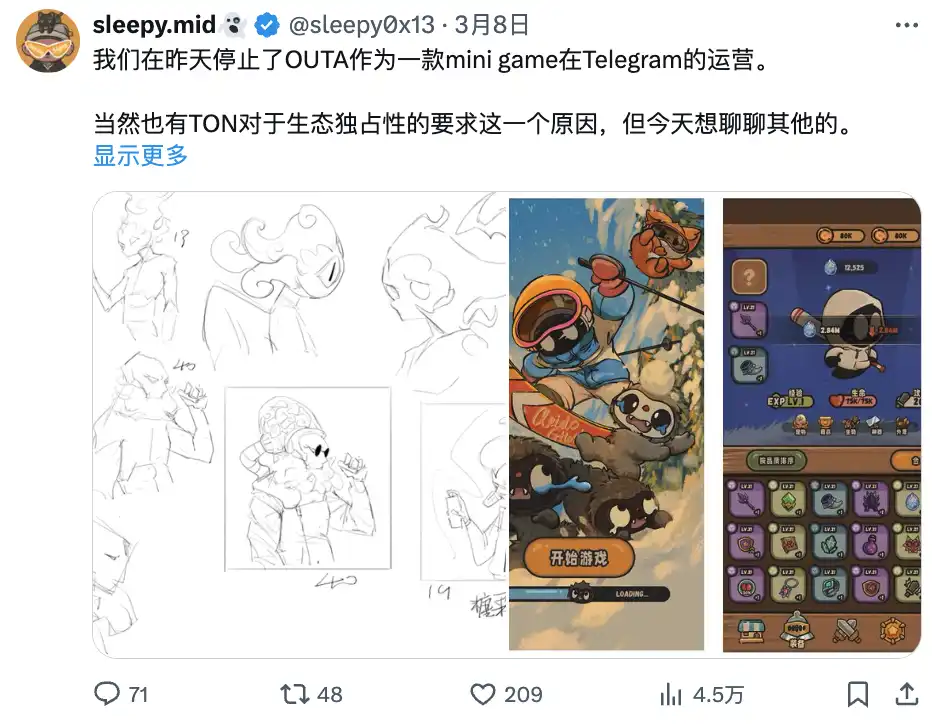
"But if you want truly active users, users who are willing to play your game, use your app, then it is absolutely impossible to obtain them with such low acquisition costs," Sleepy expressed. "It seems that, looking at it now, the saying still holds true—one gets what one pays for."
Our promotion method still relies on Crypto Twitter, community promotion, and crypto ad channels, along with exchanges between projects," Sleepy stated. "However, in these exchanges, we have never been able to break out of this circle."
In other words, the traffic only flows from one project to another, but the water in the entire pool remains stagnant, with no fresh inflow.
The TON ecosystem has never truly bridged the gap between Telegram's 9 billion users and Web3. It seems that the TON Foundation and Telegram have not built a truly effective distribution channel to allow Crypto apps to reach a broader audience. Sleepy remarked, "Perhaps they are trying, but I have not seen the results yet."
TON and Telegram have never been the same.
TON Foundation: Vacuum of Power and Uncontrolled Direction
In the past six months, when discussing the TON Foundation with industry insiders, they always mention the "factional struggles" within the TON Foundation: the Russian team, the Taiwanese team, and the Dubai team after TON obtained the Dubai Financial License. These three teams did not bring synergies but instead made the resource allocation within the TON ecosystem extremely uneven—whether one can receive support within the TON ecosystem often depends on the relationship with the Russian team.
The TON Foundation was originally founded by two core members, one of whom is the current Foundation President, Steve Yun, who is still active in various online and offline events. The other member is Andrew Rogozov, who was the former CEO of VK (the predecessor of Telegram, the first social platform created by Telegram's founder, similar to the Russian version of Facebook), and is considered by some to be a "key figure" in the inner circle.
However, at some point, the power structure of the TON Foundation underwent a subtle change—Andrew Rogozov seemed to fade out of the core management of the Foundation and founded TOP (The Open Platform). This organization now seems more like a true foundation than the TON Foundation, or perhaps like Consensys in the TON ecosystem, and even leads the core ecosystem development of TON.
"To be honest, as a foundation, the information we actually receive from Telegram is not much. Pavel Durov and his team do not discuss anything with us at all. In fact, they only communicate with the wallet team because the wallet is the only real integration point. And that is not our team, it's a completely different company called TOP." This was said by Jack Booth, the Marketing Director of the TON Foundation, in an interview in July 2024, indirectly confirming the influence of TOP.
TOP's influence has gradually surpassed that of the TON Foundation, not only investing in and supporting the most crucial projects on TON but also controlling the ecosystem's infrastructure. They are responsible for running the Telegram official wallet TON Space, supporting the most active wallet in the TON ecosystem, Tonkeeper, and the largest DEX Stonfi in terms of trading volume. Even the only staking protocol Tonstakers is also supported by TOP. From the perspective of key nodes in the TON ecosystem, TOP has become the de facto "core builder" of TON, while the TON Foundation seems more like a publicity organ, with its power gradually being marginalized.
Then on January 14, 2025, the TON Foundation announced the appointment of board member and Kingsway Capital founder Manuel Stotz as the new CEO, with former CEO Steve Yun continuing to serve on the board.
In the face of such "power erosion," it is also understandable why there are rumors that "the TON Foundation, mainly led by a Taiwan team, has almost no say in many affairs."
The vulnerability of the TON Foundation's Chinese community in ecosystem resource allocation has become more apparent. "The Taiwan team has little say, and core technical decisions are still in the hands of the Russian team," Xiaoguang pointed out. "If they can maintain a good relationship with the Russian team, they can get the most support. For example, Catizen has a very good relationship with the Russian team, received investment, and gained a lot of resources."
Xiaoguang's words were indirectly confirmed in TOP's investment list, which includes Catizen's game developer, Pluto Studio.
Another blockbuster indie game, Notcoin, founder Sasha Plotvinov, openly stated that he has a close relationship with the TON Foundation. This relationship not only allowed Notcoin to take the lead in the TON ecosystem but also made it a benchmark project in the Telegram indie game track. It is worth noting that Sasha Plotvinov is also the CEO of Open Builders, and Open Builders' products largely overlap with TOP's and belong to the "core circle." "DOGS is also made by the Notcoin team. They are all part of Russia's own control," Xiaoguang said, "showing many similarities in trend."
Looking at the trend charts of the three coins from August last year to date, the trends are indeed very similar. Furthermore, looking at March 16 yesterday, influenced by the news that "Telegram founder Pavel Durov was allowed to leave France," some tokens in the TON ecosystem surged. Among them: TON's 24-hour gain is 20.7%, currently priced at $3.53; NOT's 24-hour gain is 18.7%, currently priced at $0.002543; DOGS' 24-hour gain is 10%, currently priced at $0.0001475. (Prices are as of March 17th at the time of writing)
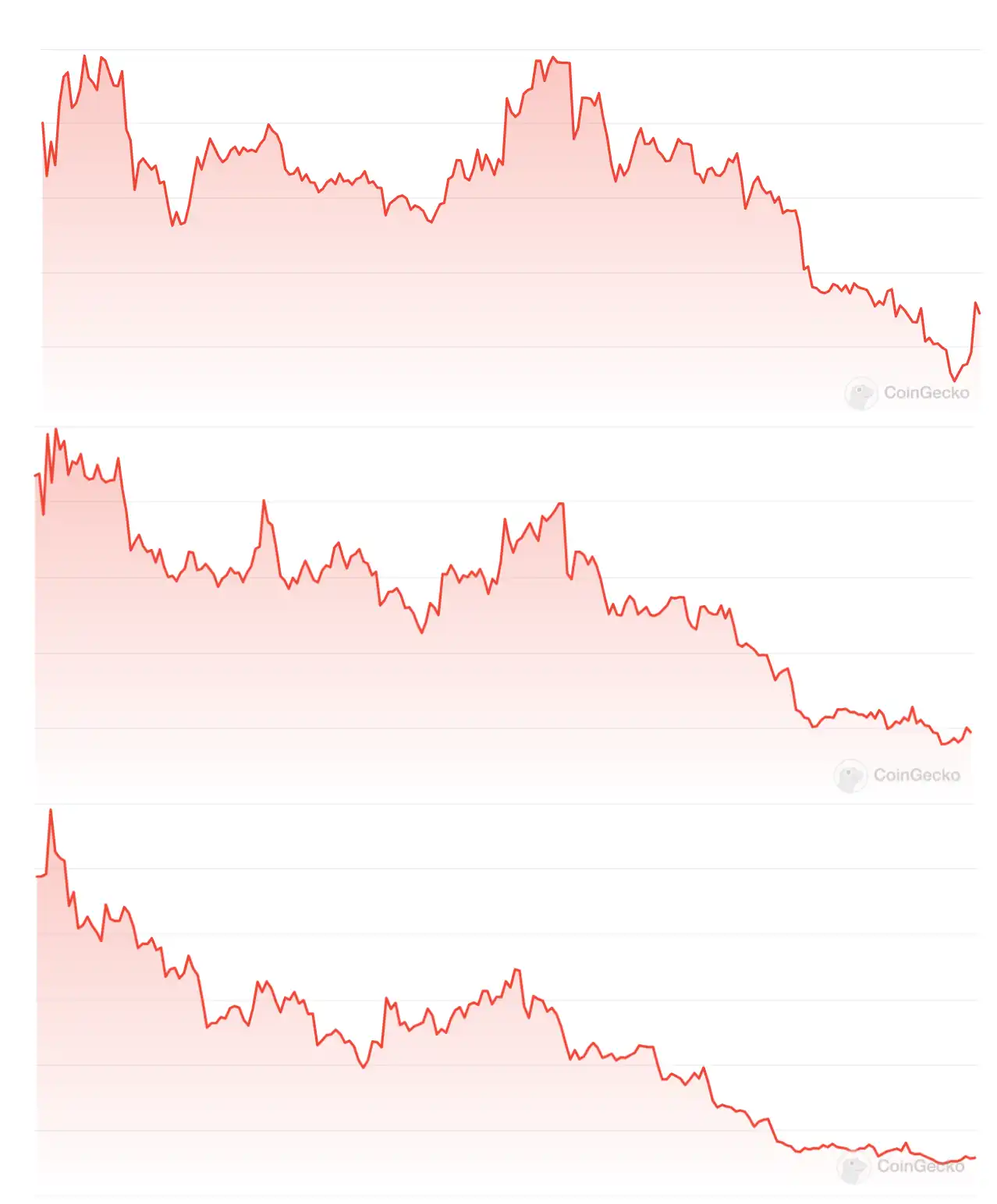
From top to bottom are: TON, NOT, DOGS
The success of Catizen and Notcoin is to some extent not a success in the track, but a result of the high centralization of TON core resources. These two projects started half a year earlier than most indie games and received full support from the foundation. In other words, the prosperity of TON indie games is not a true "open ecosystem" but a game of resource allocation.
Another fatal problem in the TON ecosystem is the confusion and abrupt turn in strategic direction. At the resource support level, the TON Foundation's focus swiftly shifted from Telegram small games to DeFi, directly causing many small game developers to be forced to abandon their projects.
"When we were in contact with the Foundation, we could clearly feel that, at some point, they basically stopped paying attention to all game projects and started frantically searching for DeFi projects," Sleepy said. "This shift came too suddenly and was a huge blow to teams that were seriously developing products, causing a significant loss of developers and users."
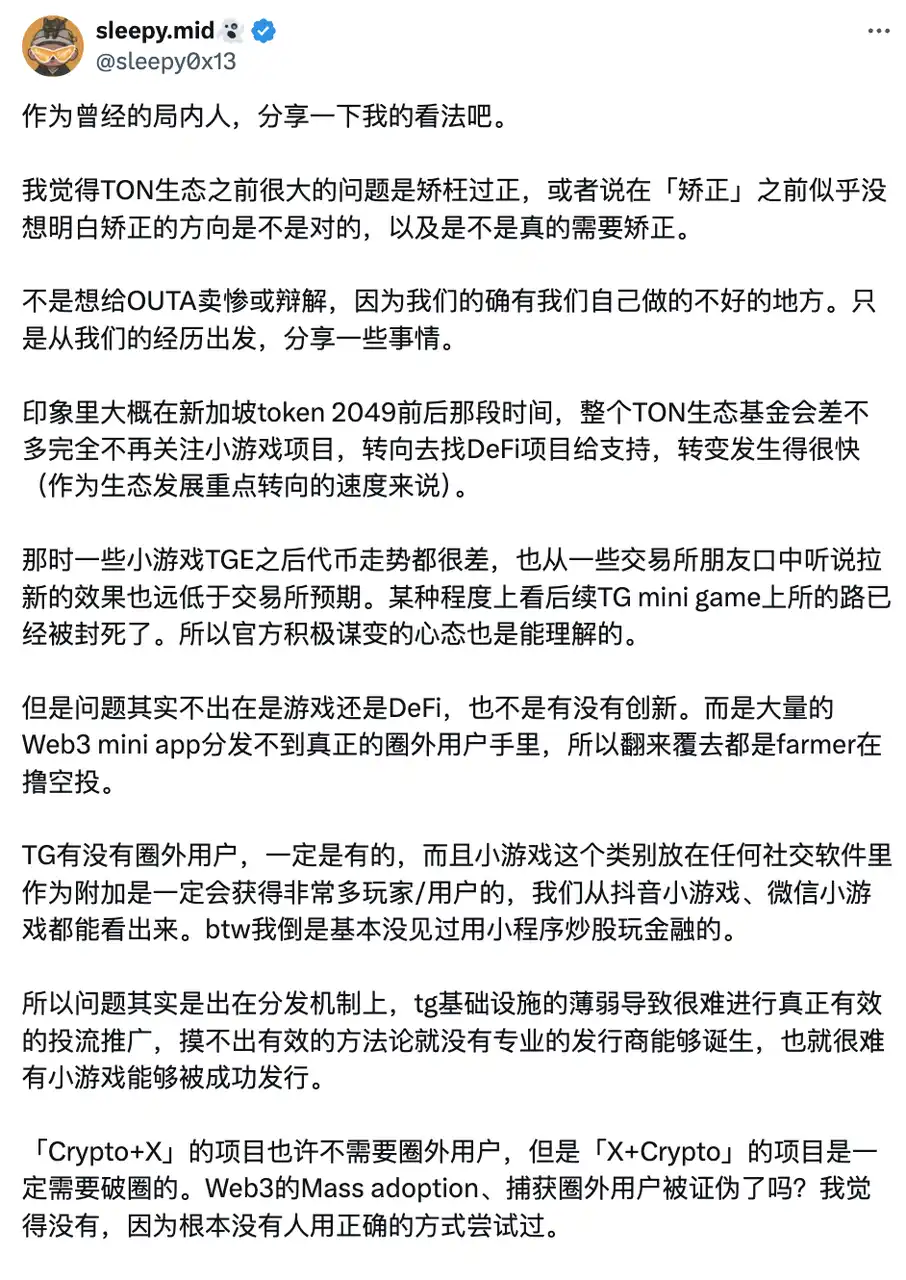
Sleepy strongly disagrees with the direction change made by the TON ecosystem: "I think TON should not simply copy what other public chains are doing. Without relying on Telegram, TON cannot achieve its current user base in terms of performance, language, and development difficulty. Therefore, TON should plan its next steps according to the characteristics of a social platform, rather than blindly following other public chains."
"Our initial assessment of TON was that its ecosystem would be similar to WeChat Mini Games or TikTok Mini Games, becoming part of a social platform's traffic monetization." However, the TON Foundation's decisions completely deviated from this direction. "They are doing stablecoins, they are doing DeFi, these are all huge mistakes, just like WeChat creating a stock trading mini program. Would you use a WeChat mini program for stock trading?" Sleepy bluntly stated.
This strategic mistake by the TON Foundation not only caused the ecosystem to miss the right narrative direction but also directly triggered a crisis—In August 2024, TON founder Pavel Durov was arrested in France. This event dealt a huge blow to the TON ecosystem, plunging the Foundation into chaos.
"The reason is actually because they added a function similar to fiat-to-stablecoin, which involved compliance and political factors, especially against the backdrop of the Russia-Ukraine war," Xiaoguang revealed to BlockBeats. Prior to this, BlockBeats had also heard similar opinions from other sources, indicating that a stablecoin-related feature drew regulatory scrutiny.
The original TON ecosystem had already been thrown into chaos due to strategic swings and uneven power distribution, and the founder's sudden event further deprived this ecosystem of its last support.
"Death Accelerator": Project Factory and Trading Platform
In addition to the traffic black box, factional struggles within the TON Foundation, and sudden shifts in resource support, the project factory and trading platforms were also key factors accelerating the demise of the Telegram mini-game track. The frenzy in this ecosystem was essentially a short-lived capital game, and true user growth had long been stagnant.
Within this track, game development was highly industrialized, with project factories mass-producing various mini-games in a assembly line fashion, experimenting in the market, and inevitably, a few projects would succeed. "For example, the game developer behind Catizen, Pluto Studio, initially ran more than a dozen games, and ultimately found that the cat-breeding model was the best, so they decided to focus on it," KinKin remarked.
In other words, Catizen's success was not accidental but rather the result of intensive project experiments. This model is essentially high-turnover, low-cost, rapid trial and error.
"The cost of this is actually very low," KinKin explained, "Many game developers directly go to the WeChat Mini Program market to find validated games, get the game code, change the H5 skin, then wrap it in a Telegram IDK (Integrated Development Kit), and they can go live directly. Moreover, in the later stages, the price of these mini-game codes becomes cheaper and cheaper.
Low cost, short cycle, quick deployment, have made these game projects highly speculative. More importantly, once a game model has been market-validated, it will be quickly replicated and scaled up, with the top players often having "pricing power." KinKin mentioned, "Catizen was very aggressive in negotiating with the trading platform and even leaned towards OKX, demanding $500,000."
Once a project succeeds, its bargaining power will increase significantly. The reason Catizen was able to negotiate strongly was that after the failure of multiple game projects, it accumulated enough market experience and precisely identified the user base willing to spend money. "Small games like Catizen that have been validated through a dozen projects do have mature products and have attracted a wave of users willing to spend money," KinKin said.
The success of top projects has also brought another problem—highly concentrated resources. "The traffic of a project like Hamster Kombat is almost equivalent to that of a medium-sized trading platform."
However, the Telegram mini-game ecosystem never saw a "living water" influx, lacking external incremental market entry. The high-density "bombardment" by project factories left almost no room for other mini-games to survive, let alone Web2 game developers—they hold a large amount of abandoned, unlisted games, with very low trial and error costs. In this competitive environment, the Telegram mini-game track accelerated its decline.
Another driving factor is the game theory of the trading platforms. The traffic brought by the TON mini-game has shown the platforms a new growth point. In the short term, frequent listings have led to the market being oversold prematurely. Looking back at Binance's listing timeline, it can be observed that the interval between listings for new projects is becoming shorter:
May 16: Notcoin listing;
84 days later: TON listing;
13 days later: DOGS listing;
23 days later: Catizen listing;
13 days later: Hamster Kombat listing
"During the DOGS listing, all trading platforms were competing for this data, even offering rewards through activities like 'Withdraw from my platform, and I'll give you back some DOGS.' Why did they know DOGS had traffic? Because NotCoin had already proven it once. NotCoin and DOGS are from the same team, just with a different skin repeating the same path as NotCoin," KinKin told BlockBeats.
A deeper issue is that the user growth rate in this cycle has fallen far behind the previous cycle. At least before Trump launched his coin, the market's anxiety about Web3 user growth was very evident, and this anxiety naturally transferred to the trading platforms. Although the user quality in the Telegram mini-game track is uneven, at least in the early stages, the conversion of TON's traffic could still bring some data growth to the trading platforms. However, this data growth is fundamentally unsustainable.
Ultimately, the more projects in the pipeline of the project factory, the faster the listing frequency on trading platforms, and the faster the cool-down of the race track.
After several rounds of listings, the user increment on trading platforms gradually dries up, losing the motivation to continue listings. For latecomers, the first-mover advantage has been maximized, and the space for latecomer projects and coins is getting smaller and smaller. All of this makes the collapse of the Telegram mini-game ecosystem inevitable.
TG+ Web3, Is It Really a False Proposition?
"Have you ever envied those projects that can list on Binance?" Faced with BlockBeats' question, Sleepy responded quickly, clearly having considered this question long ago.
"It depends on how you define success. Many people think that getting listed on a trading platform is a kind of industry recognition, but I don't feel that way. For me, issuing a coin is not the project's end point. If you treat it as the end point, it will be very hurtful, hurting yourself, the community, and the investors. Because everyone can see that the performance of these coins after listing is very poor, and the effect of attracting new users is far from the trading platform's expectations," Sleepy said.
The "Fast Money Logic" of the TON ecosystem makes everything simple and brutal—changing to a new narrative every three weeks, the quick-money traders lead the market's rhythm, while teams that truly want to build become the eliminated "outliers." In this ecosystem, idealists ultimately have only two choices: either abandon their beliefs and go with the flow, or be eliminated.
Sleepy and his team ultimately chose the latter. He cut 80% of the team, several core members agreed to delay their salaries, and allocated some resources to do Web2 design outsourcing to sustain the team.
"In addition, we are also in talks with some public chains for grants. We have already received the first Launch Grant and will continue to do some development work to complete the remaining KPIs. We have also applied for hackathons like Monad Madness to see if we can achieve some results. Currently, the income from the past few months is already more than what we earned from gaming on TON," he self-deprecatingly said.
After the collapse of the TON ecosystem, various people who were once active in it have found their own new paths.
KinKin has now shifted to the AI Agent track and is very optimistic about the future of the BASE chain. Meanwhile, Xiaoguang, who excelled at creating narratives, is researching memes. He understood early on that "Telegram mini-games business is structural, not a sustainable model, and the window of opportunity is only a few months." A former member who once worked hard to promote the TON ecosystem at the foundation has left and started studying the Kaia public chain that merges Korea and Japan.
In an ecosystem that prioritizes traffic above all else, only traffic remains in the end. The TON ecosystem did not become the "future of crypto-social," it was merely another cyclical Web3 narrative, a market game that is shorter, faster, and more extreme in profits than public chains or ZK tracks.
Looking back on this frenzy today, for developers, the TON ecosystem once disguised itself as the hope for "social + Web3," attracting them to enter this market, but ultimately turned them into producers of black-box data; for players, airdrops created the illusion of "overnight wealth," but the result was simply a $0.99 game bundle becoming the "cyber incense money" of a new era.
Looking at the entire industry again, the rise and fall of Telegram mini-games is not an isolated phenomenon, it is merely an extreme "microcosm" of the entire Web3 industry. In fact, whether it is a public chain, ZK Rollup, or Layer 2, the essence of many tracks is the same, just packaged more "grandiosely," with higher costs and longer cycles. Most Web3 projects are essentially running a large-scale Telegram mini-game, some with longer lifecycles, some shorter.
「Telegram + Web3, Is It Really a False Proposition?」
Each interviewee gave their own answer, but I decided not to write it down because, dear reader, this time, I want to hear your thoughts.
This article thanks all the interviewees for providing information. To protect privacy, some interviewee information has been blurred.
猜你喜歡

穩定幣驅動全球B2B支付革新,如何打破工作流程瓶頸釋放兆市場潛力?
這些新創公司正在無需資料中心的情況下建立先進AI模型
CEX與Wallet之後,OKX入局支付
科學平權運動:DeSci的萬億美元知識經濟重建革命
Sentient深度研報:獲8,500萬美元融資,建置去中心化AGI新範式
專訪Virtuals聯創empty:AI 創業不需要大量資金,Crypto是答案之一
今年 2 月,Base 生態中的 AI 協議 Virtuals 宣布跨鏈至 Solana,然而加密市場隨後進入流動性緊縮期,AI Agent 板塊從人聲鼎沸轉為低迷,Virtuals 生態也陷入一段蟄伏期。
三月初,BlockBeats 對 Virtuals 共同創辦人 empty 進行了一次專訪。彼時,團隊尚未推出如今被廣泛討論的 Genesis Launch 機制,但已在內部持續探索如何透過機制設計激活舊資產、提高用戶參與度,並重構代幣發行與融資路徑。那是一個市場尚未復甦、生態尚處冷啟動階段的時間點,Virtuals 團隊卻沒有停下腳步,而是在努力尋找新的產品方向和敘事突破口。
兩個月過去,AI Agent 板塊重新升溫,Virtuals 代幣反彈超 150%,Genesis 機製成為帶動生態回暖的重要觸發器。從積分獲取規則的動態調整,到專案參與熱度的持續上升,再到「新代幣帶老代幣」的機制閉環,Virtuals 逐漸走出寒冬,並再次站上討論焦點。
值得注意的是,Virtuals 的 Genesis 機制與近期 Binance 推出的 Alpha 積分系統有一些相似之處,評估用戶在 Alpha 和幣安錢包生態系統內的參與度,決定用戶 Alpha 代幣空投的資格。用戶可透過持倉、交易等方式獲得積分,積分越高,參與新項目的機會越大。透過積分系統篩選使用者、分配資源,專案方能夠更有效地激勵社群參與,提升專案的公平性和透明度。 Virtuals 和 Binance 的探索,或許預示著加密融資的新趨勢正在形成。
回看這次對話,empty 在專訪中所展現出的思路與判斷,正在一步步顯現其前瞻性,這不僅是一場圍繞打新機制的訪談,更是一次關於“資產驅動型 AI 協議”的路徑構建與底層邏輯的深度討論。
BlockBeats:可以簡單分享一下最近團隊主要在忙些什麼?
empty:目前我們的工作重點主要有兩個部分。第一部分,我們希望將 Virtuals 打造成一個類似「華爾街」的代理人(Agent)服務平台。設想一下,如果你是專注於 Agent 或 Agent 團隊建立的創業者,從融資、發幣到流動性退出,整個流程都需要係統性的支援。我們希望為真正專注於 Agent 和 AI 研發的團隊,提供這一整套服務體系,讓他們可以把精力集中在底層能力的開發上,而不用為其他環節分心。這一塊的工作其實也包括了與散戶買賣相關的內容,後面可以再詳細展開。
第二部分,我們正在深入推進 AI 相關的佈局。我們的願景是建立一個 AI 社會,希望每個 Agent 都能聚焦自身優勢,同時透過彼此之間的協作,實現更大的價值。因此,最近我們發布了一個新的標準——ACP(Agent Communication Protocol),目的是讓不同的 Agent 能夠相互互動、協作,共同推動各自的業務目標。這是目前我們主要在推進的兩大方向。
BlockBeats:可以再展開說說嗎?
empty:在我看來,其實我們面對的客戶群可以分為三類:第一類是專注於開發 Agent 的團隊;第二類是投資者,包括散戶、基金等各種投資機構;第三類則是 C 端用戶,也就是最終使用 Agent 產品的個人用戶。
不過,我們主要的精力其實是放在前兩大類──也就是團隊和投資人。對於 C 端用戶這一塊,我們並不打算直接介入,而是希望各個 Agent 團隊能夠自己解決 C 端市場的拓展問題。
此外,我們也認為,Agent 與 Agent 之間的交互作用應該成為一個核心模式。簡單來說,就是未來的服務更多應該是由一個 Agent 銷售或提供給另一個 Agent,而不是單純賣給人類使用者。因此,在團隊的 BD 工作中,我們也積極幫助現有的 AI 團隊尋找這樣的客戶和合作機會。
BlockBeats:大概有一些什麼具體案例呢?
empty:「華爾街」說白了就是圍繞資本運作體系的建設,假設你是一個技術團隊,想要融資,傳統路徑是去找 VC 募資,拿到資金後開始發展。如果專案做得不錯,接下來可能會考慮進入二級市場,例如在紐約證券交易所上市,或是在 Binance 這樣的交易所上幣,實現流動性退出。
我們希望把這一整套流程打通-從早期融資,到專案開發過程中對資金的靈活使用需求,再到最終二級市場的流動性退出,全部覆蓋和完善,這是我們希望補齊的一條完整鏈條。
而這一部分的工作和 ACP(Agent Communication Protocol)是不同的,ACP 更多是關於 Agent 與 Agent 之間交互標準的製定,不直接涉及資本運作系統。
BlockBeats:它和現在 Virtuals 的這個 Launchpad 有什麼差別呢?資金也是從 C 端來是嗎?
empty:其實現在你在 Virtuals 上發幣,如果沒有真正融到資金,那就只是發了一個幣而已,實際是融不到錢的。我們目前能提供的服務,是透過設定買賣時的交易稅機制,從中提取一部分稅收回饋給創業者,希望這部分能成為他們的現金流來源。
不過,問題其實還分成兩塊。第一是如何真正幫助團隊完成融資,這個問題目前我們還沒有徹底解決。第二是關於目前專案發行模式本身存在的結構性問題。簡單來說,現在的版本有點像過去 Pumpfun 那種模式——也就是當專案剛上線時,部分籌碼就被外賣給了外部投資人。但現實是,目前整個市場上存在著太多機構集團和「狙擊手」。
當一個真正優秀的專案一發幣,還沒真正觸達普通散戶,就已經被機構在極高估值時搶購了。等到散戶能夠接觸到時,往往價格已經偏高,專案品質也可能變差,整個價值發行體係被扭曲。
針對這個問題,我們希望探索一種新的發幣和融資模式,目的是讓專案方的籌碼既不是死死握在自己手裡,也不是優先流向英文圈的大機構,而是能夠真正留給那些相信專案、願意長期支持專案的普通投資者手中。我們正在思考該如何設計這樣一個新的發行機制,來解決這個根本問題。
BlockBeats:新模式的具體想法會是什麼樣子呢?
empty:關於資金這一塊,其實我們目前還沒有完全想透。現階段來看,最直接的方式還是去找 VC 融資,或是採取公開預售等形式進行資金募集。不過說實話,我個人對傳統的公開預售模式並不是特別認同。
在「公平發售」這件事上,我們正在嘗試換一個角度來思考-希望能從「reputation」出發,重新設計機制。
具體來說,就是如果你對整個 Virtuals 生態有貢獻,例如早期參與、提供支持或建設,那麼你就可以在後續購買優質代幣時享有更高的優先權。透過這種方式,我們希望把資源更多留給真正支持生態發展的用戶,而不是由短期套利的人主導。
BlockBeats:您會不會考慮採用類似之前 Fjord Foundry 推出的 LBP 模式,或者像 Daos.fun 那種採用白名單機制的模式。這些模式在某種程度上,和您剛才提到的「對生態有貢獻的人享有優先權」的想法是有些相似的。不過,這類做法後來也引發了一些爭議,例如白名單內部操作、分配不公等問題。 Virtuals 在設計時會考慮借鏡這些模式的優點,或有針對性地規避類似的問題嗎?
empty:我認為白名單機制最大的問題在於,白名單的選擇權掌握在專案方手中。這和「老鼠倉」行為非常相似。專案方可以選擇將白名單名額分配給自己人或身邊的朋友,導致最終的籌碼仍然掌握在少數人手中。
我們希望做的,依然是類似白名單的機制,但不同的是,白名單的獲取權應基於一個公開透明的規則體系,而不是由項目方單方面決定。只有這樣,才能真正做到公平分配,避免內幕操作的問題。
我認為在今天這個 AI 時代,很多時候創業並不需要大量資金。我常跟團隊強調,你們應該優先考慮自力更生,例如透過組成社區,而不是一開始就想著去融資。因為一旦融資,實際上就等於背負了負債。
我們更希望從 Training Fee的角度去看待早期發展路徑。也就是說,專案可以選擇直接發幣,透過交易稅所帶來的現金流,支持日常營運。這樣一來,專案可以在公開建設的過程中獲得初步資金,而不是依賴外部投資。如果專案做大了,自然也會有機會透過二級市場流動性退出。
當然最理想的情況是,專案本身能夠有穩定的現金流來源,這樣甚至連自己的幣都無需拋售,這才是真正健康可持續的狀態。
我自己也常在和團隊交流時分享這種思路,很有意思的是,那些真正抱著「搞快錢」心態的項目,一聽到這種機制就失去了興趣。他們會覺得,在這種模式下,既無法操作老鼠倉,也很難短期套利,於是很快就選擇離開。
但從我們的角度來看,這其實反而是個很好的篩選機制。透過這種方式,理念不同的專案自然會被過濾出去,最後留下的,都是那些願意真正建立、和我們價值觀契合的團隊,一起把事情做起來。
BlockBeats:這個理念可以發展出一些能夠創造收益的 AI agent。
empty:我覺得這是很有必要的。坦白說,放眼今天的市場,真正擁有穩定現金流的產品幾乎鳳毛麟角,但我認為這並不意味著我們應該停止嘗試。事實上,我們每天在對接的團隊中,有至少一半以上的人依然懷抱著長遠的願景。很多時候,他們甚至已經提前向我們提供了 VC 階段的資金支持,或表達了強烈的合作意願。
其實對他們來說想要去收穫一個很好的社區,因為社區可以給他們的產品做更好的回饋,這才是他們真正的目的。這樣聽起來有一點匪夷所思,但其實真的有很多這樣的團隊,而那種團隊的是我們真的想扶持的團隊。
BlockBeats:您剛才提到的這套「AI 華爾街」的產品體系-從融資、發行到退出,建構的是一整套完整的流程。這套機制是否更多是為了激勵那些有意願發幣的團隊?還是說,它在設計上也考慮瞭如何更好地支持那些希望透過產品本身的現金流來發展的團隊?這兩類團隊在您這套體系中會不會被區別對待,或者說有什麼機制設計能讓不同路徑的創業者都能被合理支持?
empty:是的,我們 BD 的核心職責其實就是去鼓勵團隊發幣。說得直接一點,就是引導他們思考發幣的可能性和意義。所以團隊最常問的問題就是:「為什麼要發幣?」這時我們需要採取不同的方式和角度,去幫助他們理解背後的價值邏輯。當然如果最終判斷不適合,我們也不會強迫他們推進。
不過我們觀察到一個非常明顯的趨勢,傳統的融資路徑已經越來越難走通了。過去那種融資做大,發幣上所的模式已經逐漸失效。面對這樣的現實,很多團隊都陷入了尷尬的境地。而我們希望能從鏈上和加密的視角,提供一套不同的解決方案,讓他們找到新的發展路徑。
BlockBeats:明白,我剛才其實想表達的是,您剛剛也提到,傳統的 AI 模式在很大程度上仍然依賴「燒錢」競爭。但在 DeepSeek 出現之後,市場上一些資金體積較小的團隊或投資人開始重新燃起了信心,躍躍欲試地進入這個領域。您怎麼看待這種現象?這會不會對目前正在做 AI 基礎研發,或是 AI 應用層開發的團隊產生一定的影響?
empty:對,我覺得先不談 DeepSeek,從傳統角度來看,其實到目前為止,AI 領域真正賺錢的只有英偉達,其他幾乎所有玩家都還沒有實現盈利。所以其實沒有人真正享受了這個商業模式的成果,大家也仍在探索如何面對 C 端打造真正有產出的應用。
沒有哪個領域像幣圈一樣能如此快速獲得社群回饋。你一發幣,用戶就會主動去讀白皮書的每一個字,試試你產品的每個功能。
當然,這套機制並不適合所有人。例如有些 Agent 產品偏 Web2,對於幣圈用戶而言,可能感知不到其價值。因此,我也會鼓勵做 Agent 的團隊在 Virtuals 生態中認真思考,如何真正將 Crypto 作為自身產品的差異化要素加以運用與設計。
BlockBeats:這點我特別認同,在 Crypto 這個領域 AI 的迭代速度確實非常快,但這群用戶給予的回饋,真的是代表真實的市場需求嗎?或者說這些回饋是否真的符合更大眾化、更具規模性的需求?
empty:我覺得很多時候產品本身不應該是強行推廣給不適合的使用者群體。例如 AIXBT 最成功的一點就在於,它的用戶本身就是那群炒作他人內容的人,所以他們的使用行為是非常自然的,並不覺得是在被迫使用一個無聊的產品。 mass adoption 這個概念已經講了很多年,大家可能早就該放棄這個執念了。我們不如就認了,把東西賣給幣圈的人就好了。
BlockBeats:AI Agent 與 AI Agent 所對應的代幣之間,究竟應該是什麼樣的動態關係?
empty:對,我覺得這裡可以分成兩個核心點。首先其實不是在投資某個具體的 AI Agent,而是在投資背後經營這個 Agent 的團隊。你應該把它理解為一種更接近創投的思路:你投的是這個人,而不是他目前正在做的產品。因為產品本身是可以快速變化的,可能一個月後團隊會發現方向不對,立即調整。所以,這裡的「幣」本質上代表的是對團隊的信任,而不是某個特定 Agent 本身。
第二則是期望一旦某個 Agent 產品做出來後,未來它能真正產生現金流,或者有實際的使用場景(utility),從而讓對應的代幣具備賦能效應。
BlockBeats:您覺得有哪些賦能方式是目前還沒看到的,但未來可能出現、值得期待的?
empty:其實主要有兩塊,第一是比較常見的那種你要使用我的產品,就必須付費,或者使用代幣支付,從而間接實現對代幣的「軟銷毀」或消耗。
但我覺得更有趣的賦能方式,其實是在獲客成本的角度思考。也就是說,你希望你的用戶同時也是你的投資者,這樣他們就有動機去主動幫你推廣、吸引更多用戶。
BlockBeats:那基於這些觀點,您怎麼看 ai16z,在專案設計和代幣機制方面,似乎整體表現並不太樂觀?
empty:從一個很純粹的投資角度來看,撇開我們與他們之間的關係,其實很簡單。他們現在做的事情,對代幣本身沒有任何賦能。從開源的角度來看,一個開源模型本身是無法直接賦能代幣的。
但它仍然有價值的原因在於,它像一個期權(call option),也就是說,如果有一天他們突然決定要做一些事情,比如推出一個 launchpad,那麼那些提前知道、提前參與的人,可能會因此受益。
開發者未來確實有可能會使用他們的 Launchpad,只有在那一刻,代幣才會真正產生賦能。這是目前最大的一個問號——如果這個模式真的跑得通,我認為確實會非常強大,因為他們的確觸達了大量開發者。
但我個人還是有很多疑問。例如即使我是使用 Eliza 的開發者,也不代表我一定會選擇在他們的 Launchpad 上發幣。我會貨比三家,會比較。而且,做一個 Launchpad 和做一個開源框架,所需的產品能力和社群運作能力是完全不同的,這是另一個重要的不確定性。
BlockBeats:這種不同是體現在什麼地方呢?
empty:在 Virtuals 上我們幾乎每天都在處理客服相關的問題,只要有任何一個團隊在我們平台上發生 rug,即使與我們沒有直接關係,用戶也會第一時間來找我們投訴。
這時我們就必須出面安撫用戶,並思考如何降低 rug 的整體風險。一旦有團隊因為自己的代幣設計錯誤或技術失誤而被駭客攻擊、資產被盜,我們往往需要自掏腰包,確保他們的社群至少能拿回一點資金,以便專案能夠重新開始。這些項目方可能在技術上很強,但未必擅長代幣發行,結果因操作失誤被攻擊導致資產損失。只要涉及「被欺騙」相關的問題,對我們來說就已經是非常麻煩的事了,做這些工作跟做交易所的客服沒有太大差別。
另一方面,做 BD 也非常困難。優秀的團隊手上有很多選擇,他們可以選擇在 Pumpfun 或交易所上發幣,為什麼他們要來找我們,那這背後必須要有一整套支援體系,包括融資支援、技術協助、市場推廣等,每個環節都不能出問題。
BlockBeats:那我們就繼續沿著這個話題聊聊 Virtuals 目前的 Launchpad 業務。有一些社群成員在 Twitter 上統計了 Virtuals Launchpad 的整體獲利狀況,確實目前看起來獲利的項目比較少。接下來 Launchpad 還會是 Virtuals 的主要業務區嗎?還是說,未來的重心會逐漸轉向您剛才提到的「AI 華爾街」這條路徑?
empty:其實這兩塊本質上是一件事,是一整套體系的一部分,所以我們必須繼續推進。市場的波動是很正常的,我們始終要堅持的一點是:非常清楚地認識到我們的核心客戶是誰。我一直強調我們的客戶只有兩類——團隊。所以市場行情的好壞對我們來說並不是最重要的,關鍵是在每一個關鍵節點上,對於一個團隊來說,發幣的最佳選擇是否依然是我們 Virtuals。
BlockBeats:您會不會擔心「Crypto + AI」或「Crypto AI Agent」這一類敘事已經過去了?如果未來還有一輪多頭市場,您是否認為市場炒作的焦點可能已經不再是這些方向了?
empty:有可能啊,我覺得 it is what it is,這確實是有可能發生的,但這也屬於我們無法控制的範圍。不過如果你問我,在所有可能的趨勢中,哪個賽道更有機會長期保持領先,我仍然認為是 AI。從一個打德撲的角度來看,它仍然是最優選擇。
而且我們團隊的技術架構和底層能力其實早已搭建完成了,現在只是順勢而為而已。更重要的是,我們本身真的熱愛這件事,帶著好奇心去做這件事。每天早上醒來就有驅動力去研究最新的技術,這種狀態本身就挺讓人滿足的,對吧?
很多時候,大家不應該只看產品本身。實際上很多優秀的團隊,他們的基因決定了他們有在規則中勝出的能力——他們可能過去在做派盤交易時,每筆規模就是上百萬的操作,而這些團隊的 CEO,一年的薪資可能就有 100 萬美金。如果他們願意出來單幹項目,從天使投資或 VC 的視角來看,這本質上是用一個很划算的價格買到一個高品質的團隊。
更何況這些資產是 liquid 的,不是鎖倉狀態。如果你當下不急著用錢,完全可以在早期階段買進一些優秀團隊的代幣,靜靜等待他們去創造一些奇蹟,基本上就是這樣一個邏輯。
a16z領投2500萬美元,0xMiden要在你手機裡跑一條隱私鏈
Sui Q1進階報告:BTCfi基建崛起、借貸協議爆發與執行分片未來
盤點10大新興Launchpad平台,誰能完成Pump.fun的顛覆?
4月29日市場關鍵情報,你錯過了多少?
「打新帶老」:Genesis Launch如何用積分制重建AI Agent打新邏輯?
專訪AllianceDAO合夥人qw:Crypto創業家正逃向AI,90%的Crypto+AI都是偽命題
AI賽道重拾熱度,全面整理潛力專案與市場炒作邏輯
穩定幣爭霸戰:六路新銳殺出,市場格局生變?
以太坊基金會「三文宣言」:從核心願景到放權改革,Vitalik重申使命
4月28日市場關鍵情報,你錯過了多少?
為什麼貝萊德全面佈局並宣稱代幣化就是民主化?
深入挖掘杜拜的加密夢:幻覺、資本與去中心化帝國
穩定幣驅動全球B2B支付革新,如何打破工作流程瓶頸釋放兆市場潛力?
這些新創公司正在無需資料中心的情況下建立先進AI模型
CEX與Wallet之後,OKX入局支付
科學平權運動:DeSci的萬億美元知識經濟重建革命
Sentient深度研報:獲8,500萬美元融資,建置去中心化AGI新範式
專訪Virtuals聯創empty:AI 創業不需要大量資金,Crypto是答案之一
今年 2 月,Base 生態中的 AI 協議 Virtuals 宣布跨鏈至 Solana,然而加密市場隨後進入流動性緊縮期,AI Agent 板塊從人聲鼎沸轉為低迷,Virtuals 生態也陷入一段蟄伏期。
三月初,BlockBeats 對 Virtuals 共同創辦人 empty 進行了一次專訪。彼時,團隊尚未推出如今被廣泛討論的 Genesis Launch 機制,但已在內部持續探索如何透過機制設計激活舊資產、提高用戶參與度,並重構代幣發行與融資路徑。那是一個市場尚未復甦、生態尚處冷啟動階段的時間點,Virtuals 團隊卻沒有停下腳步,而是在努力尋找新的產品方向和敘事突破口。
兩個月過去,AI Agent 板塊重新升溫,Virtuals 代幣反彈超 150%,Genesis 機製成為帶動生態回暖的重要觸發器。從積分獲取規則的動態調整,到專案參與熱度的持續上升,再到「新代幣帶老代幣」的機制閉環,Virtuals 逐漸走出寒冬,並再次站上討論焦點。
值得注意的是,Virtuals 的 Genesis 機制與近期 Binance 推出的 Alpha 積分系統有一些相似之處,評估用戶在 Alpha 和幣安錢包生態系統內的參與度,決定用戶 Alpha 代幣空投的資格。用戶可透過持倉、交易等方式獲得積分,積分越高,參與新項目的機會越大。透過積分系統篩選使用者、分配資源,專案方能夠更有效地激勵社群參與,提升專案的公平性和透明度。 Virtuals 和 Binance 的探索,或許預示著加密融資的新趨勢正在形成。
回看這次對話,empty 在專訪中所展現出的思路與判斷,正在一步步顯現其前瞻性,這不僅是一場圍繞打新機制的訪談,更是一次關於“資產驅動型 AI 協議”的路徑構建與底層邏輯的深度討論。
BlockBeats:可以簡單分享一下最近團隊主要在忙些什麼?
empty:目前我們的工作重點主要有兩個部分。第一部分,我們希望將 Virtuals 打造成一個類似「華爾街」的代理人(Agent)服務平台。設想一下,如果你是專注於 Agent 或 Agent 團隊建立的創業者,從融資、發幣到流動性退出,整個流程都需要係統性的支援。我們希望為真正專注於 Agent 和 AI 研發的團隊,提供這一整套服務體系,讓他們可以把精力集中在底層能力的開發上,而不用為其他環節分心。這一塊的工作其實也包括了與散戶買賣相關的內容,後面可以再詳細展開。
第二部分,我們正在深入推進 AI 相關的佈局。我們的願景是建立一個 AI 社會,希望每個 Agent 都能聚焦自身優勢,同時透過彼此之間的協作,實現更大的價值。因此,最近我們發布了一個新的標準——ACP(Agent Communication Protocol),目的是讓不同的 Agent 能夠相互互動、協作,共同推動各自的業務目標。這是目前我們主要在推進的兩大方向。
BlockBeats:可以再展開說說嗎?
empty:在我看來,其實我們面對的客戶群可以分為三類:第一類是專注於開發 Agent 的團隊;第二類是投資者,包括散戶、基金等各種投資機構;第三類則是 C 端用戶,也就是最終使用 Agent 產品的個人用戶。
不過,我們主要的精力其實是放在前兩大類──也就是團隊和投資人。對於 C 端用戶這一塊,我們並不打算直接介入,而是希望各個 Agent 團隊能夠自己解決 C 端市場的拓展問題。
此外,我們也認為,Agent 與 Agent 之間的交互作用應該成為一個核心模式。簡單來說,就是未來的服務更多應該是由一個 Agent 銷售或提供給另一個 Agent,而不是單純賣給人類使用者。因此,在團隊的 BD 工作中,我們也積極幫助現有的 AI 團隊尋找這樣的客戶和合作機會。
BlockBeats:大概有一些什麼具體案例呢?
empty:「華爾街」說白了就是圍繞資本運作體系的建設,假設你是一個技術團隊,想要融資,傳統路徑是去找 VC 募資,拿到資金後開始發展。如果專案做得不錯,接下來可能會考慮進入二級市場,例如在紐約證券交易所上市,或是在 Binance 這樣的交易所上幣,實現流動性退出。
我們希望把這一整套流程打通-從早期融資,到專案開發過程中對資金的靈活使用需求,再到最終二級市場的流動性退出,全部覆蓋和完善,這是我們希望補齊的一條完整鏈條。
而這一部分的工作和 ACP(Agent Communication Protocol)是不同的,ACP 更多是關於 Agent 與 Agent 之間交互標準的製定,不直接涉及資本運作系統。
BlockBeats:它和現在 Virtuals 的這個 Launchpad 有什麼差別呢?資金也是從 C 端來是嗎?
empty:其實現在你在 Virtuals 上發幣,如果沒有真正融到資金,那就只是發了一個幣而已,實際是融不到錢的。我們目前能提供的服務,是透過設定買賣時的交易稅機制,從中提取一部分稅收回饋給創業者,希望這部分能成為他們的現金流來源。
不過,問題其實還分成兩塊。第一是如何真正幫助團隊完成融資,這個問題目前我們還沒有徹底解決。第二是關於目前專案發行模式本身存在的結構性問題。簡單來說,現在的版本有點像過去 Pumpfun 那種模式——也就是當專案剛上線時,部分籌碼就被外賣給了外部投資人。但現實是,目前整個市場上存在著太多機構集團和「狙擊手」。
當一個真正優秀的專案一發幣,還沒真正觸達普通散戶,就已經被機構在極高估值時搶購了。等到散戶能夠接觸到時,往往價格已經偏高,專案品質也可能變差,整個價值發行體係被扭曲。
針對這個問題,我們希望探索一種新的發幣和融資模式,目的是讓專案方的籌碼既不是死死握在自己手裡,也不是優先流向英文圈的大機構,而是能夠真正留給那些相信專案、願意長期支持專案的普通投資者手中。我們正在思考該如何設計這樣一個新的發行機制,來解決這個根本問題。
BlockBeats:新模式的具體想法會是什麼樣子呢?
empty:關於資金這一塊,其實我們目前還沒有完全想透。現階段來看,最直接的方式還是去找 VC 融資,或是採取公開預售等形式進行資金募集。不過說實話,我個人對傳統的公開預售模式並不是特別認同。
在「公平發售」這件事上,我們正在嘗試換一個角度來思考-希望能從「reputation」出發,重新設計機制。
具體來說,就是如果你對整個 Virtuals 生態有貢獻,例如早期參與、提供支持或建設,那麼你就可以在後續購買優質代幣時享有更高的優先權。透過這種方式,我們希望把資源更多留給真正支持生態發展的用戶,而不是由短期套利的人主導。
BlockBeats:您會不會考慮採用類似之前 Fjord Foundry 推出的 LBP 模式,或者像 Daos.fun 那種採用白名單機制的模式。這些模式在某種程度上,和您剛才提到的「對生態有貢獻的人享有優先權」的想法是有些相似的。不過,這類做法後來也引發了一些爭議,例如白名單內部操作、分配不公等問題。 Virtuals 在設計時會考慮借鏡這些模式的優點,或有針對性地規避類似的問題嗎?
empty:我認為白名單機制最大的問題在於,白名單的選擇權掌握在專案方手中。這和「老鼠倉」行為非常相似。專案方可以選擇將白名單名額分配給自己人或身邊的朋友,導致最終的籌碼仍然掌握在少數人手中。
我們希望做的,依然是類似白名單的機制,但不同的是,白名單的獲取權應基於一個公開透明的規則體系,而不是由項目方單方面決定。只有這樣,才能真正做到公平分配,避免內幕操作的問題。
我認為在今天這個 AI 時代,很多時候創業並不需要大量資金。我常跟團隊強調,你們應該優先考慮自力更生,例如透過組成社區,而不是一開始就想著去融資。因為一旦融資,實際上就等於背負了負債。
我們更希望從 Training Fee的角度去看待早期發展路徑。也就是說,專案可以選擇直接發幣,透過交易稅所帶來的現金流,支持日常營運。這樣一來,專案可以在公開建設的過程中獲得初步資金,而不是依賴外部投資。如果專案做大了,自然也會有機會透過二級市場流動性退出。
當然最理想的情況是,專案本身能夠有穩定的現金流來源,這樣甚至連自己的幣都無需拋售,這才是真正健康可持續的狀態。
我自己也常在和團隊交流時分享這種思路,很有意思的是,那些真正抱著「搞快錢」心態的項目,一聽到這種機制就失去了興趣。他們會覺得,在這種模式下,既無法操作老鼠倉,也很難短期套利,於是很快就選擇離開。
但從我們的角度來看,這其實反而是個很好的篩選機制。透過這種方式,理念不同的專案自然會被過濾出去,最後留下的,都是那些願意真正建立、和我們價值觀契合的團隊,一起把事情做起來。
BlockBeats:這個理念可以發展出一些能夠創造收益的 AI agent。
empty:我覺得這是很有必要的。坦白說,放眼今天的市場,真正擁有穩定現金流的產品幾乎鳳毛麟角,但我認為這並不意味著我們應該停止嘗試。事實上,我們每天在對接的團隊中,有至少一半以上的人依然懷抱著長遠的願景。很多時候,他們甚至已經提前向我們提供了 VC 階段的資金支持,或表達了強烈的合作意願。
其實對他們來說想要去收穫一個很好的社區,因為社區可以給他們的產品做更好的回饋,這才是他們真正的目的。這樣聽起來有一點匪夷所思,但其實真的有很多這樣的團隊,而那種團隊的是我們真的想扶持的團隊。
BlockBeats:您剛才提到的這套「AI 華爾街」的產品體系-從融資、發行到退出,建構的是一整套完整的流程。這套機制是否更多是為了激勵那些有意願發幣的團隊?還是說,它在設計上也考慮瞭如何更好地支持那些希望透過產品本身的現金流來發展的團隊?這兩類團隊在您這套體系中會不會被區別對待,或者說有什麼機制設計能讓不同路徑的創業者都能被合理支持?
empty:是的,我們 BD 的核心職責其實就是去鼓勵團隊發幣。說得直接一點,就是引導他們思考發幣的可能性和意義。所以團隊最常問的問題就是:「為什麼要發幣?」這時我們需要採取不同的方式和角度,去幫助他們理解背後的價值邏輯。當然如果最終判斷不適合,我們也不會強迫他們推進。
不過我們觀察到一個非常明顯的趨勢,傳統的融資路徑已經越來越難走通了。過去那種融資做大,發幣上所的模式已經逐漸失效。面對這樣的現實,很多團隊都陷入了尷尬的境地。而我們希望能從鏈上和加密的視角,提供一套不同的解決方案,讓他們找到新的發展路徑。
BlockBeats:明白,我剛才其實想表達的是,您剛剛也提到,傳統的 AI 模式在很大程度上仍然依賴「燒錢」競爭。但在 DeepSeek 出現之後,市場上一些資金體積較小的團隊或投資人開始重新燃起了信心,躍躍欲試地進入這個領域。您怎麼看待這種現象?這會不會對目前正在做 AI 基礎研發,或是 AI 應用層開發的團隊產生一定的影響?
empty:對,我覺得先不談 DeepSeek,從傳統角度來看,其實到目前為止,AI 領域真正賺錢的只有英偉達,其他幾乎所有玩家都還沒有實現盈利。所以其實沒有人真正享受了這個商業模式的成果,大家也仍在探索如何面對 C 端打造真正有產出的應用。
沒有哪個領域像幣圈一樣能如此快速獲得社群回饋。你一發幣,用戶就會主動去讀白皮書的每一個字,試試你產品的每個功能。
當然,這套機制並不適合所有人。例如有些 Agent 產品偏 Web2,對於幣圈用戶而言,可能感知不到其價值。因此,我也會鼓勵做 Agent 的團隊在 Virtuals 生態中認真思考,如何真正將 Crypto 作為自身產品的差異化要素加以運用與設計。
BlockBeats:這點我特別認同,在 Crypto 這個領域 AI 的迭代速度確實非常快,但這群用戶給予的回饋,真的是代表真實的市場需求嗎?或者說這些回饋是否真的符合更大眾化、更具規模性的需求?
empty:我覺得很多時候產品本身不應該是強行推廣給不適合的使用者群體。例如 AIXBT 最成功的一點就在於,它的用戶本身就是那群炒作他人內容的人,所以他們的使用行為是非常自然的,並不覺得是在被迫使用一個無聊的產品。 mass adoption 這個概念已經講了很多年,大家可能早就該放棄這個執念了。我們不如就認了,把東西賣給幣圈的人就好了。
BlockBeats:AI Agent 與 AI Agent 所對應的代幣之間,究竟應該是什麼樣的動態關係?
empty:對,我覺得這裡可以分成兩個核心點。首先其實不是在投資某個具體的 AI Agent,而是在投資背後經營這個 Agent 的團隊。你應該把它理解為一種更接近創投的思路:你投的是這個人,而不是他目前正在做的產品。因為產品本身是可以快速變化的,可能一個月後團隊會發現方向不對,立即調整。所以,這裡的「幣」本質上代表的是對團隊的信任,而不是某個特定 Agent 本身。
第二則是期望一旦某個 Agent 產品做出來後,未來它能真正產生現金流,或者有實際的使用場景(utility),從而讓對應的代幣具備賦能效應。
BlockBeats:您覺得有哪些賦能方式是目前還沒看到的,但未來可能出現、值得期待的?
empty:其實主要有兩塊,第一是比較常見的那種你要使用我的產品,就必須付費,或者使用代幣支付,從而間接實現對代幣的「軟銷毀」或消耗。
但我覺得更有趣的賦能方式,其實是在獲客成本的角度思考。也就是說,你希望你的用戶同時也是你的投資者,這樣他們就有動機去主動幫你推廣、吸引更多用戶。
BlockBeats:那基於這些觀點,您怎麼看 ai16z,在專案設計和代幣機制方面,似乎整體表現並不太樂觀?
empty:從一個很純粹的投資角度來看,撇開我們與他們之間的關係,其實很簡單。他們現在做的事情,對代幣本身沒有任何賦能。從開源的角度來看,一個開源模型本身是無法直接賦能代幣的。
但它仍然有價值的原因在於,它像一個期權(call option),也就是說,如果有一天他們突然決定要做一些事情,比如推出一個 launchpad,那麼那些提前知道、提前參與的人,可能會因此受益。
開發者未來確實有可能會使用他們的 Launchpad,只有在那一刻,代幣才會真正產生賦能。這是目前最大的一個問號——如果這個模式真的跑得通,我認為確實會非常強大,因為他們的確觸達了大量開發者。
但我個人還是有很多疑問。例如即使我是使用 Eliza 的開發者,也不代表我一定會選擇在他們的 Launchpad 上發幣。我會貨比三家,會比較。而且,做一個 Launchpad 和做一個開源框架,所需的產品能力和社群運作能力是完全不同的,這是另一個重要的不確定性。
BlockBeats:這種不同是體現在什麼地方呢?
empty:在 Virtuals 上我們幾乎每天都在處理客服相關的問題,只要有任何一個團隊在我們平台上發生 rug,即使與我們沒有直接關係,用戶也會第一時間來找我們投訴。
這時我們就必須出面安撫用戶,並思考如何降低 rug 的整體風險。一旦有團隊因為自己的代幣設計錯誤或技術失誤而被駭客攻擊、資產被盜,我們往往需要自掏腰包,確保他們的社群至少能拿回一點資金,以便專案能夠重新開始。這些項目方可能在技術上很強,但未必擅長代幣發行,結果因操作失誤被攻擊導致資產損失。只要涉及「被欺騙」相關的問題,對我們來說就已經是非常麻煩的事了,做這些工作跟做交易所的客服沒有太大差別。
另一方面,做 BD 也非常困難。優秀的團隊手上有很多選擇,他們可以選擇在 Pumpfun 或交易所上發幣,為什麼他們要來找我們,那這背後必須要有一整套支援體系,包括融資支援、技術協助、市場推廣等,每個環節都不能出問題。
BlockBeats:那我們就繼續沿著這個話題聊聊 Virtuals 目前的 Launchpad 業務。有一些社群成員在 Twitter 上統計了 Virtuals Launchpad 的整體獲利狀況,確實目前看起來獲利的項目比較少。接下來 Launchpad 還會是 Virtuals 的主要業務區嗎?還是說,未來的重心會逐漸轉向您剛才提到的「AI 華爾街」這條路徑?
empty:其實這兩塊本質上是一件事,是一整套體系的一部分,所以我們必須繼續推進。市場的波動是很正常的,我們始終要堅持的一點是:非常清楚地認識到我們的核心客戶是誰。我一直強調我們的客戶只有兩類——團隊。所以市場行情的好壞對我們來說並不是最重要的,關鍵是在每一個關鍵節點上,對於一個團隊來說,發幣的最佳選擇是否依然是我們 Virtuals。
BlockBeats:您會不會擔心「Crypto + AI」或「Crypto AI Agent」這一類敘事已經過去了?如果未來還有一輪多頭市場,您是否認為市場炒作的焦點可能已經不再是這些方向了?
empty:有可能啊,我覺得 it is what it is,這確實是有可能發生的,但這也屬於我們無法控制的範圍。不過如果你問我,在所有可能的趨勢中,哪個賽道更有機會長期保持領先,我仍然認為是 AI。從一個打德撲的角度來看,它仍然是最優選擇。
而且我們團隊的技術架構和底層能力其實早已搭建完成了,現在只是順勢而為而已。更重要的是,我們本身真的熱愛這件事,帶著好奇心去做這件事。每天早上醒來就有驅動力去研究最新的技術,這種狀態本身就挺讓人滿足的,對吧?
很多時候,大家不應該只看產品本身。實際上很多優秀的團隊,他們的基因決定了他們有在規則中勝出的能力——他們可能過去在做派盤交易時,每筆規模就是上百萬的操作,而這些團隊的 CEO,一年的薪資可能就有 100 萬美金。如果他們願意出來單幹項目,從天使投資或 VC 的視角來看,這本質上是用一個很划算的價格買到一個高品質的團隊。
更何況這些資產是 liquid 的,不是鎖倉狀態。如果你當下不急著用錢,完全可以在早期階段買進一些優秀團隊的代幣,靜靜等待他們去創造一些奇蹟,基本上就是這樣一個邏輯。


 App
App