

Waterdrip Capital: The New Logic of Web3 Entrepreneurship in the Global Trade Order

This article is compiled from the keynote speech given by Dashan, Founder of Waterdrip Capital, at the Wandering Island event.
Introduction:
This article will start by delving into the underlying logic of Trump's tariff policy, analyzing the new financial order planned by the United States, envisioning a new round of blockchain entrepreneurship amid macro turbulence (including BTCFi, RWA, stablecoins, AI payments, and other directions), and discussing how traditional capital entry can provide a revaluation opportunity for the crypto industry.
This article is compiled from the keynote speech given by Dashan, Founder of Waterdrip Capital, at the Wandering Island event.
1. Deterioration of the Macro Environment - Crisis Shaping a New Order
1.1 Financial Shift towards Chaos
Since Trump's return to the White House, a series of unexpected economic and political measures have kept the global markets in continuous turmoil. Among them, one of the most significant shocks was the escalation of the tariff policy: starting from April 5, 2025, the United States imposed a uniform 10% "baseline tariff" on all imported goods and applied higher "counterpart tariffs" to 60 countries including China and Vietnam (at one point, tariffs against China were raised to 125%). In the short term, Trump's tariff saber rattling caused massive fluctuations in the global market: US Treasuries faced a sell-off, the yield on the 10-year Treasury surged to over 4.5%, marking the largest single-week increase in 20 years; the US stock market experienced severe volatility, almost triggering a circuit breaker; the US dollar index continued to decline and recorded its largest daily drop in several years. Although the US later announced a temporary suspension of imposing new tariffs on some allied countries in exchange for relief, investors remain full of concerns about the future's uncertainty, making the global financial system seem to step into a "chaotic era."
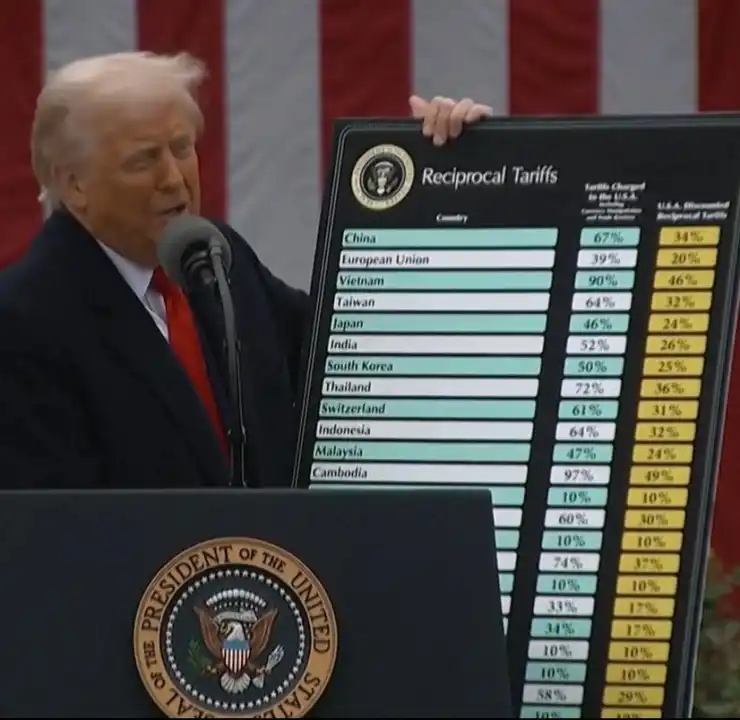
The post-World War II international economic system centered around the United States (such as the Bretton Woods system and the WTO framework) is facing the risk of collapse: the rise of emerging economies has weakened America's relative advantage, the huge debt and fiscal deficits accumulated by the US have continuously eroded the credibility of the US dollar, and the US dollar's share of global foreign exchange reserves has declined. Especially since China's accession to the WTO, its rapid development has gradually approached or even surpassed the US in many technological fields, triggering deep-seated anxiety among the American elite. Breakthroughs by Chinese firms like Huawei in 5G chip design and communication base stations in key technologies are signals that have alerted the US: the once lofty technology gap has rapidly narrowed, America's traditional edge in the manufacturing sector is now at risk, and the younger American generation is more inclined to engage in finance and the arts rather than manufacturing. These series of changes imply that the old order on which the US dominion relied is loosening.
In this context, the U.S. decision-makers began to contemplate building a new trade and financial order to maintain its global dominance. The strategic goal of the Trump administration is not only to seek better terms in trade negotiations but also to attempt a "fresh start" — to reestablish the U.S.' central position by creating a new rules-based system. This includes two main intentions: first, to counter major competitors and weaken the momentum of countries like China rapidly rising through the existing benefits of globalization; and second, to seek a new value anchor to provide new support for the shaky U.S. dollar credit and global trade. In this line of thinking, traditional U.S. dollar credit needs stronger endorsement, and the U.S. is beginning to turn its attention to assets such as gold and Bitcoin, hoping to rebuild the trust foundation of the global financial system through this.
It is noteworthy that since Trump took office, there has been a significant shift in the U.S. government's attitude towards the cryptocurrency field. Shortly after taking office, Trump publicly expressed concern about the development of virtual currency, reversing his previous critical stance on Bitcoin. Some forces within the Republican Party and some state governments have gradually embraced Bitcoin in recent years, seeing it as "digital gold" to hedge against U.S. dollar risks. It can be said that the U.S. is laying the groundwork for a potential new financial order, incorporating Bitcoin into its national strategic vision.
1.2 Bitcoin and Gold: The New "Dual Anchor" of the Dollar
As global trade and financial rules face restructuring, the U.S. is attempting to create a new credit cornerstone for the dollar through "dual asset anchoring": encompassing both traditional gold reserves and emerging Bitcoin reserves. This strategy aims to consolidate the dollar's reputation in the new order through a combination of physical assets and digital assets.
Gold, as a store of value, has long been widely held by central banks worldwide, and the U.S. Treasury's gold reserves (stored at the famous Fort Knox) are a key card in the dollar's dominance. Today, Bitcoin is being endowed with a similar strategic position — seen as the "digital gold" of the new era. By the end of 2024, the total market value of Bitcoin is about $2 trillion, only about one-tenth of the value of gold (about $20 trillion). In terms of long-term potential, if the market value of Bitcoin could one day match that of gold, then its price still has several times the room to grow. It is precisely because of this growth potential, coupled with Bitcoin's unique advantages of decentralization, limited supply (21 million coins), and high liquidity, that the U.S. is seriously considering incorporating it into the national reserve system.
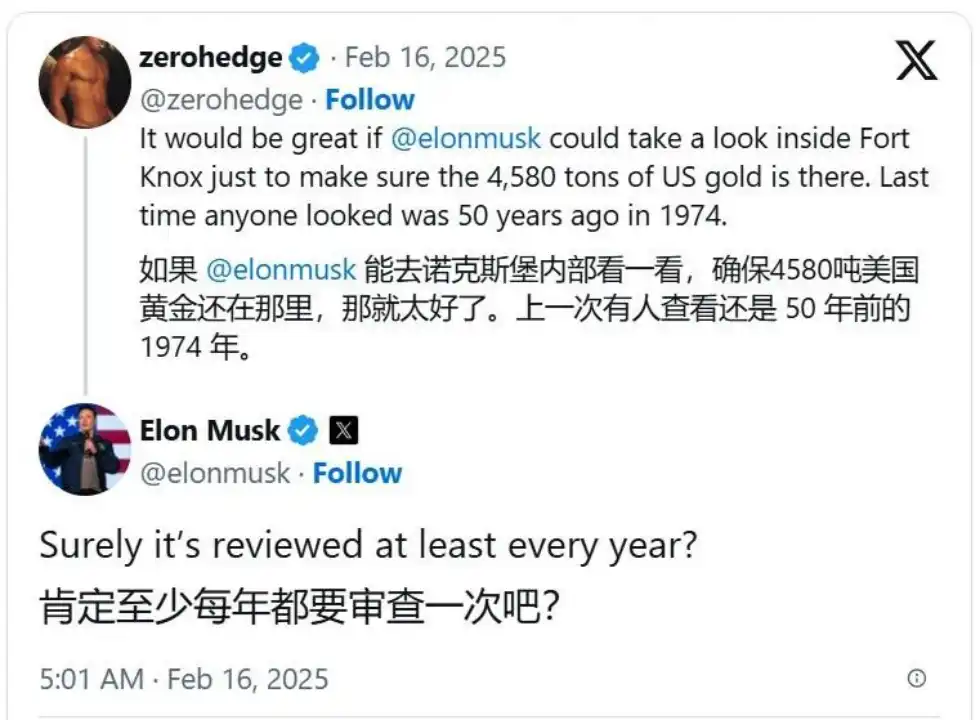
In March 2025, the U.S. government released a series of significant measures in the crypto field: On March 6, President Trump signed an executive order announcing the establishment of a "Strategic Bitcoin Reserve" and a "U.S. Digital Asset Reserve." The following day, the White House held a high-profile crypto summit, inviting industry giants such as Coinbase, MicroStrategy, as well as members of Congress and officials to participate. Trump openly expressed support for the development of the crypto industry at the summit, promising to push Congress to quickly pass legislation on stablecoins and digital asset regulatory frameworks to provide a clear legal environment. More notably, Trump stated at the summit, "Establishing a Bitcoin reserve is creating a virtual Fort Knox" — meaning the U.S. aims to view a Bitcoin reserve as the digital-era treasury gold. This statement marks Bitcoin's formal entry into the U.S. national strategic level, being endowed with a position similar to gold.
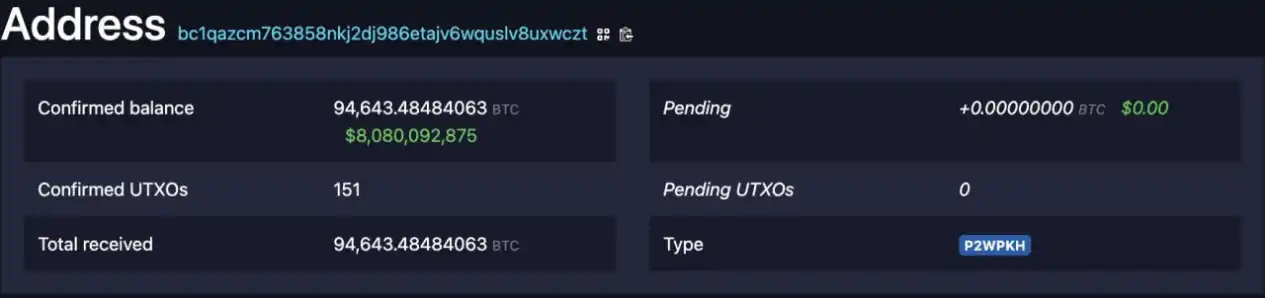
The above image shows a Bitcoin wallet address seized by the U.S. government. Compared to the gold reserves in the national treasury, the BTC network is more transparent and decentralized.
These series of actions indicate the U.S.'s intention to anchor Bitcoin alongside gold as assets in the new financial system. In practice, the U.S. government already holds a significant amount of Bitcoin reserves (mainly from law enforcement seizures, among other channels) and plans to further increase its holdings. Market rumors suggest a target accumulation of around 1 million BTC (5% of the total supply), a quantity that is close to the share of the U.S.'s official gold reserves in the global gold market. While this target has not been fully achieved yet, the trend is already evident: some U.S. state governments have even taken the lead by approving the use of treasury funds to purchase Bitcoin for reserves; at the federal level, administrative orders and legislative proposals are being used to legitimize Bitcoin. If the U.S. dollar can be partially anchored by physical gold and digital gold (Bitcoin) in the future, supplemented by blockchain technology to establish a new international settlement system, then the U.S. is poised to take the lead in the future global financial game, sustaining the viability of the dollar system.
Of course, the inclusion of Bitcoin also helps the U.S. solve its own challenges. For example, the massive national debt burden carried by the U.S. government is becoming increasingly heavy, leading to a credit crisis. If the U.S. controls a sufficient amount of Bitcoin reserves and raises its price in the future, it could cleverly mitigate debt risks by selling a portion of its reserves to fill the debt hole. This idea of "diluting debt with crypto assets" has become a new part of U.S. financial strategy. At the same time, the U.S. is also making efforts in digital currency regulation: a recent bill proposed bringing stablecoins with a circulation exceeding $100 billion under the regulation of the Federal Reserve, showing the U.S.'s desire to control the issuance and rule-making of the digital dollar (USD stablecoin) to consolidate the dollar's dominant position in the crypto world. USD stablecoins + gold + Bitcoin outline the embryonic form of the new dollar order—maintaining the legal status of the dollar while being supported by physical and digital assets, enhancing resilience against risks.
2. Market Environment Adjustment and "What to Do in the Second Half"
Over the past year, the global crypto market has undergone a drastic transition from frenzy to calm. The total market capitalization of crypto assets has dropped from a historical peak of around $3.71 trillion to about $3.04 trillion (data source: CoinMarketCap, data as of 2025.04.23), as the market enters a deep correction and liquidation phase. Macro economic turmoil (such as rising inflation and interest rates) coupled with increased regulatory scrutiny has caused numerous projects lacking real value support to disappear during this adjustment cycle. However, for entrepreneurs who believe in the long-term value of blockchain, this moment is actually the best time to build a foundation, gather strength, and nurture new opportunities—the previous cycle's bubble is dissipating, providing a good opportunity to focus on polishing products, accumulating strength, and standing out.
In such a "second half" environment, entrepreneurs should consider: What should be done in the second half? Simple traffic-driven strategies are no longer sustainable, and instead, a startup logic centered around hardcore value should be pursued. In the current market environment, the following directions hold new opportunities:
· Bitcoin (BTC) Ecosystem: Financial innovations around the Bitcoin network ("BTC Fi"), infrastructure upgrades, and the reconstruction of real-world assets and payment networks based on BTC.
· Other Public Chain Ecosystems: Innovations on public chains such as Ethereum that focus on efficiency and profit essence, moving away from mere "traffic farming" and instead building sustainable decentralized finance (DeFi) applications guided by product orientation.
· Real-World Assets (RWA) and Payment Finance (PayFi): Combining on-chain technology with real-world assets and payment scenarios to develop new models supported by stable cash flows.
· Crypto Concept Stocks: Keeping an eye on the rise of "blockchain concept stocks" in traditional capital markets and the new trend of Web3 startups moving towards securitization.
Next, we will analyze the above strategies and explore specific entrepreneurial opportunities worth paying attention to during the macro pullback period.
2.1 Entrepreneurial Opportunities Around BTC: BTC Fi, BTC Infra, BTC RWA & PayFi
Although Bitcoin has long been considered "digital gold" and its main network functionality relatively simple, recent technological and application advancements are injecting new vitality into the Bitcoin ecosystem. Around the BTC network, we see three major entrepreneurial opportunities:
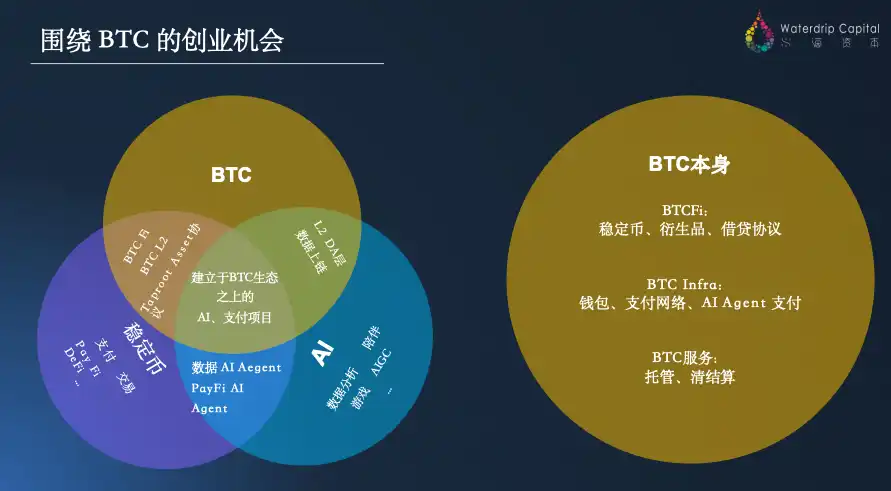
· BTC Fi (Bitcoin Finance): Creating new financial assets on the Bitcoin network. Bitcoin is no longer just a static store of value but is evolving into an underlying platform for issuing various financial assets. Recently emerged protocols like BRC-20 and Runes have sparked a trend of issuing token assets on the BTC mainnet; Lightning Labs' introduction of the Taproot Assets protocol (TA protocol) enables the issuance of stablecoins, bonds, and other financial assets in the Bitcoin ecosystem. This means that the Bitcoin mainnet is expected to take on more value-carrying functions in the next cycle, upgrading from "digital gold" to a value storage network that supports a variety of assets. Representative projects such as Bedrock and Solv are focusing on building decentralized financial services such as lending, trading, and derivatives on the Bitcoin network, driving the transition of BTC financing and asset issuance capabilities.
· BTC Infra (Bitcoin Infrastructure): Reshaping the intelligent infrastructure on Bitcoin. To address the shortcomings of BTC's native functionality, the industry is attempting to create a smart contract layer on Bitcoin similar to Ethereum. One approach is to develop an EVM-compatible Bitcoin sidechain or Layer2 (such as BTC L2 with Ethereum smart contract capabilities) to expand the DApp development space on the BTC network. Another approach involves solutions native to the Bitcoin protocol family, such as the RGB protocol, Lightning Network, and other Bitcoin-native Layer2 technologies. These solutions focus more on enhancing privacy, scalability, and payment efficiency to build a lightweight and economical on-chain execution layer for the BTC mainnet. Representative projects like Unisat, Merlin, B², etc., are dedicated to building Bitcoin's Layer2, middleware tools, etc., to enhance Bitcoin's development ecosystem and scalability.
· BTC-Powered RWA & PayFi: Unlocking Bitcoin's potential in the real-world asset and payment fields. Bitcoin-based RWAs are gradually emerging, tokenizing assets like US Treasury bonds, physical assets, etc. Bitcoin serves as a settlement layer providing a globally verifiable clearing mechanism, giving such assets a highly trusted value anchor. Concurrently, the "PayFi" model emerging based on payment infrastructure like the Lightning Network brings Bitcoin back to the payment stage—for example, combining AI Agents with Bitcoin micropayments to enable real-time microtransactions between machines, humans, and machines, offering efficient payment solutions for SaaS services, data exchange, etc. Representative projects like LNFi focus on enhancing Bitcoin's practical application efficiency and user experience in RWA and payment scenarios, empowering Bitcoin's payment and circulation.
Overall, the Bitcoin ecosystem is experiencing a comprehensive awakening from the underlying protocol to the application layer. Whether issuing assets on the BTC mainnet, building a smart contract layer, or using BTC for settling real assets and instant payments, Bitcoin has the potential to become a hotbed for the next phase of innovation and entrepreneurship. For entrepreneurs, reassessing the possibilities of the Bitcoin network may reveal underestimated golden opportunities.
2.2 Entrepreneurial Opportunities Around Other Public Chains: Efficiency-Driven and Product-Centric Entrepreneurial Logic
Aside from Bitcoin, other public chains (such as Ethereum, BSC, Solana, etc.) are also fostering new entrepreneurial logic and opportunities. After the DeFi craze and public chain battles, the industry is returning to rationality, giving rise to two major trends:
· Return to the "Money-Making" Underlying Logic: Whether it's on-chain lending, trading, liquidity provision, or derivatives, as long as it revolves around capital flow, a viable business model and profit path can be found. In the past few years, numerous DeFi projects attracted funds through liquidity mining and other incentives. However, after enduring a market cooldown, models incapable of generating sustainable fees and profits are gradually being phased out. Conversely, akin to traditional finance, on-chain businesses with clear revenue streams (such as transaction fees, lending interest, derivative fees, etc.) have proven their value. This serves as a reminder for entrepreneurs to reassess the underlying logic of their projects: Do they have a genuine profit model? In the current environment, businesses that can "make money" possess the confidence to withstand market cycles.
· Public Chain Ecosystem Shifting from "Volume Flow" to "Efficiency Volume," with Product-Oriented Entrepreneurship Rising: In the early days, public chains and protocols, in their pursuit of users and funding, were keen on piling high incentives and crafting narratives to drive "volume flow." However, this narrative-driven growth, relying solely on storytelling, proved to be unsustainable. Capital now favors projects that aim to improve efficiency and enhance user experience — in other words, projects that win based on product and technology. Whether it's a new decentralized exchange, a more profitable liquidity provision mechanism, a low-risk lending protocol, or a secure and efficient on-chain asset issuance platform, data service tools, etc., as long as they can address real needs and prove their business model, they are more likely to gain favor. In other words, public chain entrepreneurship is transitioning from competing on subsidies and concepts to competing on product strength and efficiency. For entrepreneurs, this means that focusing on product development, performance optimization, and user experience improvement will be more critical than blindly chasing a mythical "narrative."
In other public chain ecosystems, a new competitive landscape is emerging — efficiency is becoming the key theme, and product-oriented entrepreneurship is becoming mainstream. This shift is a wake-up call for the entire crypto startup scene: only by enabling applications to truly create value and generate revenue can they survive in the cold capital winter and usher in the next spring.
2.3 Sustainable Entrepreneurship Model: Cash Flow-Driven Path Selection
Whether in the Bitcoin ecosystem or on other public chains, building a sustainable cash flow has become a watershed for whether a startup project can go far. The traditional capital markets are starting to evaluate crypto startup companies based on the standards of mature enterprises, with "cash flow" and "profitability" becoming key evaluation criteria. It can be said that traditional investors are redefining the essence of a "crypto company," opening a window for Web3 entrepreneurs to engage with mainstream capital.
Currently, some crypto projects with real-world business models are becoming bridges between Web3 and the traditional capital markets. These projects typically have clear revenue streams, stable cash flow expectations, and good regulatory compliance capabilities, making them the focus of traditional institutions and potential targets for entering mainstream capital markets through IPOs or acquisitions.
· Among several niche tracks, DePIN stands out. By bringing real-world resources such as computing power, electricity, bandwidth, onto the chain management and combining them with economic incentive mechanisms, it builds a distributed infrastructure network for the physical world with a natural SaaS-like revenue model. Representative projects such as PEAQ, Jambo, OORT, Swan are jointly building the foundational layer of the DePIN ecosystem, covering machine access, Web3 mobile devices, AI data storage, and compute sharing.
· AI+Crypto Track demonstrates strong integration potential. By combining AI Agent, on-chain identity, and micro-payment mechanisms, it promotes data interchange and resource scheduling among intelligent agents. Projects like Footprint focus on data analytics engines, while DeAgent.ai builds a decentralized AI Agent protocol to serve Web3 smart infrastructure.
· RWA (Real World Assets) direction is rapidly developing, with the continued tokenization of on-chain assets such as US Treasuries, corporate bonds, and real estate, with an expected future market space of up to $10 trillion. Representative projects like The PAC offer asset mapping services under a compliance framework, driving RWAs to circulate on-chain within regulatory frameworks.
· PayFi (Payment Finance) has become the most active track for on-chain transactions. By 2024, stablecoin transaction volume is projected to surpass $15.6 trillion, exceeding Visa for the first time. Projects like Aisa are integrating stablecoins with AI wallets to build payment infrastructure supporting automation and real-time settlement for e-commerce, cross-border, and machine-to-machine payment scenarios.
In summary, these kinds of encrypted entrepreneurial projects that are "cash flow generative, easily valued, and have a compliance path" are currently favored by Wall Street and mainstream capital as core candidates to lead the way into the mainstream financial system.
For entrepreneurs, the insight brought by this trend is: design your business model with a cash flow orientation in mind. Consider how to generate stable income early in the project, rather than relying solely on token appreciation or subsidy for expansion. Only when your project has a real-world revenue and profit model can you attract both crypto-native funds and appeal to more conservative traditional investors. In a macro-environment of turbulence and a preference for conservative capital in the "second half," crypto startups that operate soundly and have healthy cash flow are actually more likely to break through.
3. Cryptocurrency Concept Stocks: Moving Towards Mainstream Financial Structural Integration
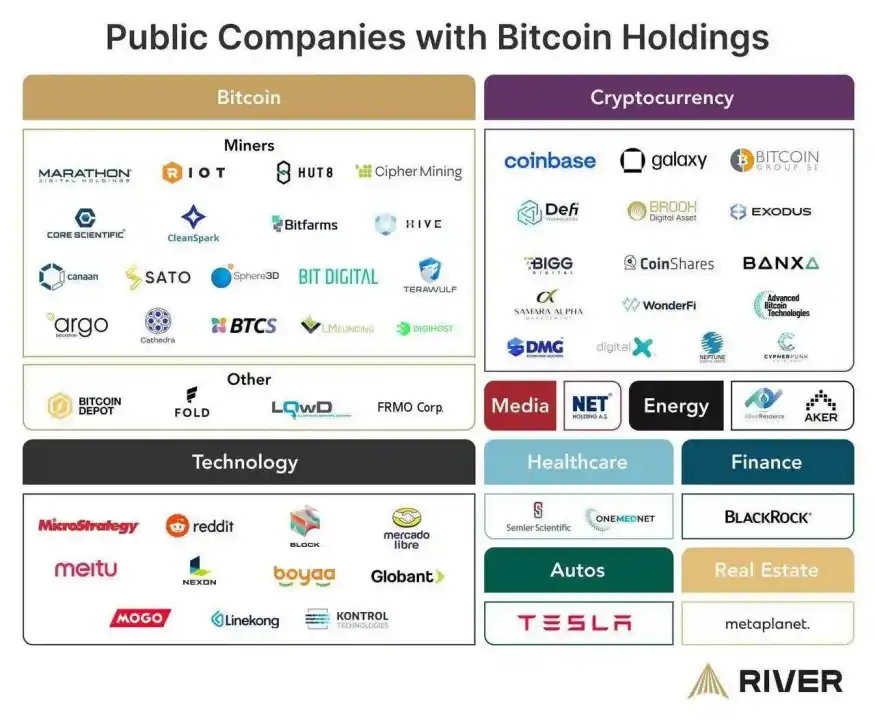
3.1 Classification of Cryptocurrency Concept Stocks
The wave of "cryptocurrency concept stocks" emerging in the traditional capital market is a significant sign of the integration of the crypto industry with mainstream finance. These publicly traded companies each participate in the blockchain industry in different ways, providing investors with diversified investment targets. Based on differences in business models and business focus, cryptocurrency concept stocks can be roughly divided into the following categories:
· Asset-Driven (BTC Reserve Core): Companies in this category's strategy involve making cryptocurrencies such as Bitcoin a core part of the company's balance sheet, leveraging the holding of large amounts of crypto assets to amplify the company's value. Typical representatives include US-based MicroStrategy, as well as Semler Scientific and Hong Kong-listed company Boya Interactive. These companies view BTC as a "strategic reserve asset," and their investment logic is similar to "crypto-version cash flow + market value amplifier" — enjoying main business cash flow while benefiting from the appreciation of their held Bitcoin to increase market value. Their business models often involve a combination of coin buying, bond financing, stock issuance for coin swap, etc., with a leverage nature suited for investors bullish on Bitcoin's long-term uptrend. From a startup perspective, this indicates that opportunities may exist in areas focused on BTC asset management, enterprise coin purchase services, and more.
· Mining Stock Concept (Hashrate Infrastructure Direction): These companies are directly involved in cryptocurrency mining and related businesses. Some companies have expanded from a single mining operation to the multi-faceted hashrate infrastructure field. Representative companies include Marathon Digital, CleanSpark, Riot Blockchain, Core Scientific, TeraWulf, Hut 8, among others. Some mining companies have started using their hashrate for areas such as artificial intelligence, high-performance computing (HPC), and have adopted clean energy to reduce costs and respond to environmental trends. The demand for AI high hashrate and green energy are becoming their new valuation drivers. The development trends of these companies provide directional inspiration for entrepreneurs, such as the upgrade of Bitcoin mining infrastructure, the application of green energy in blockchain hashrate, and the construction of new data centers integrating Web3 and AI, all of which are tracks worth exploring.
· Infrastructure and Solution Providers: This category includes companies that provide blockchain underlying hardware, cloud services, and technical solutions. Typical representatives include mining machine manufacturer Canaan, mining service company Bitdeer, cloud mining platform BitFuFu, among others. Their characteristic is to provide "mining tools" and hashrate services to the blockchain network, equivalent to the "water seller" of the crypto industry, serving as core suppliers in the hardware and cloud hashrate field. The existence of these companies indicates that, at the entrepreneurship level, the middleware layer of the Bitcoin ecosystem (such as improving mining efficiency, connecting miners with financial services solutions) and "mining serviceization" (packaging mining capacity as cloud services for enterprises or individuals) may be feasible business directions.
· Exchange Platform Concept Stocks: Companies in this category mainly operate compliant cryptocurrency exchange platforms or custody businesses, such as the US's Coinbase (COIN) and digital asset trading platform Bakkt (BKKT), among others. They have strict regulatory licenses and compliance systems, and their business models are significantly influenced by macro policies and user trading activities. The success of these companies indicates that, in the trend of increasingly sound regulations, compliant financial services will become mainstream. For entrepreneurs, areas worth paying attention to include around compliant custody, on-chain transaction data analysis, wallet account abstraction, and bridging centralized exchanges with decentralized finance (for example, providing services that enable CeFi and DeFi interoperability) — these are entrepreneurial opportunities extended from exchange-type companies.
· Payment Concept Stocks: These companies, derived from traditional payment giants, have incorporated blockchain payments into their business scope. Representative companies include Block (formerly Square) and PayPal, among others. Their characteristic is to overlay a Bitcoin or stablecoin strategy on top of their core payment business with a stable cash flow, thereby gaining new growth drivers. For example, Block supports Bitcoin transactions in its app, and PayPal has also launched cryptocurrency buying, selling, and transfer services. These companies prove the feasibility and value of crypto payments. For entrepreneurial teams, areas such as stablecoin payment solutions (such as cross-border settlement using USDT, etc.), new payment finance (PayFi) products, and AI-integrated smart wallets (such as AI Wallets for automated investment/payment) are all innovative points that can be deeply explored in this field.
The rise of Crypto Concept Stocks has prompted more and more entrepreneurs to rethink their funding paths. In addition to token financing, the path of securitization is becoming an important complement for the new generation of Web3 projects—especially for those companies with stable revenue and a clear compliance structure, a longer-term, more robust capitalization approach is emerging.
Some companies are validating this path through real-world examples. For instance, as mentioned earlier, Boyaa Interactive (00434.hk) has successfully obtained a revaluation of its value in the public capital market through a dual-drive strategy of holding coins and business transformation. Meanwhile, Walnut Capital (00905.hk) represents another approach—getting involved in crypto assets and Web3 projects through investment and equity participation, planning to connect traditional securities, unlisted funds, derivative instruments, and the blockchain new asset system. The company has currently established a partnership with Waterdrip Capital to explore a capital-cooperative ecosystem development path. This "capital-cooperative" Web3 path does not rely on internal development but leverages financial capabilities and industry resources to empower the ecosystem, becoming an important part of the current securitization layout. In addition, Hong Asia Holdings (01723.hk) has embarked on a transition from its traditional main businesses to digital asset management. The company, originally engaged in construction engineering and prepaid product retail, officially purchased Bitcoin as a strategic reserve asset in early 2025, adjusted its management structure, introduced a team with experience in the crypto field, and gradually established a Web3 transformation direction. Noteworthy is Nano Labs (NA.Nasdaq), a leading Chinese blockchain hardware manufacturer, which announced in early 2025 that it would use part of its US dollar reserves to purchase Bitcoin, formally integrating BTC into the company's strategic asset allocation system, setting a new paradigm for Chinese blockchain technology companies to enter the global capital market.
The diversification of Crypto Concept Stocks shows that blockchain technology is integrating into the traditional capital market through various business models. This not only provides investors with new channels to allocate to the blockchain track but also guides entrepreneurs about which models are more likely to be accepted by mainstream capital and which models have been successfully validated in the secondary market. From holding coins for market value management to mining for expanding hash power services, to providing basic services such as trading and payment, each model reflects the intersection of blockchain entrepreneurship and traditional business.
3.2 The Web3 Entrepreneurial Path of Securitization: Coin, Stock, and Dual Tracks
Facing the above trends, especially the success of Crypto Concept Stocks, Web3 entrepreneurs have also gained new insights into their funding and development paths. In the past, crypto projects mainly relied on token issuance for funding, but now the path towards securitization (i.e., traditional equity financing and listing) is becoming increasingly clear. Overall, Web3 entrepreneurship has three optional paths, each with its own advantages and disadvantages:
· "Coin" Pathway (Cryptocurrency Fundraising): Fundraising and community incentivization through token issuance. This pathway offers high flexibility, quick start, and is suitable for rapid validation of early-stage products and community building. When the market is bullish, token price appreciation can bring significant funds to the project. However, its disadvantages include being highly sensitive to market conditions, with fundraising amounts and token valuations greatly affected by cryptocurrency market fluctuations. Moreover, the uncertainty of regulatory policies in various countries casts a shadow over the simplistic token issuance model. Teams choosing this pathway need to deal with challenges such as tokenomics design, ongoing market cap management, and compliance risks.
· "Equity" Pathway (Equity Fundraising and IPO): Following the traditional entrepreneurial route, introducing equity investment, focusing on business implementation and revenue growth, and seeking an IPO or acquisition exit when the company matures. In this approach, startups receive investments in the form of equity, which is more compliant with regulatory frameworks and more easily accepted by conservative institutional investors. Its advantages lie in the company's valuation being more based on fundamentals (revenue, profit), unaffected by cryptocurrency price fluctuations, and hence ensuring more stable long-term development. The downside is that early-stage fundraising may not be as easy as token issuance, the user and community expansion speed may be slower, and more time is needed to prove the value. This pathway is suitable for projects with a clear business model, the ability to generate cash flow, and prepared for long-term cultivation.
· "Dual-track" Pathway (Token + Equity Parallel): Balancing both cryptocurrency and traditional fundraising methods, leveraging their respective advantages in different stages. The usual practice is to first issue tokens in the early stages to gather a seed community and funds. When the project matures and stable revenue is achieved, equity fundraising is pursued through setting up a corporate entity, or even driving the company towards an IPO. This "dual-track advancement" model allows flexibility in different stages of the project's development: using tokens in the early stage to incentivize users and build an ecosystem, and later using equity to connect with a larger capital market. However, it also requires the team to have a stronger balancing ability—managing the token community well, maintaining token value, and meeting shareholders' requirements for corporate governance and financial compliance. Some projects in the industry have already attempted the dual-track model, for example, some DeFi protocols issuing governance tokens have the backing company choosing to accept VC equity investment and even considering a future IPO. The dual-track model is complex, but if operated correctly, it may achieve a synergy effect where 1+1>2.
Regardless of the chosen pathway, the key is to align with the project's positioning and the external environment. Entrepreneurs should comprehensively consider the project type, revenue model, regulatory environment, and the team's expertise, choosing the most suitable funding and development route. In the current environment, solely relying on a single pathway may have limitations. Flexibly adjust strategies based on actual circumstances, even switch or run parallel pathways when necessary, to improve the project's survival rate and success probability.
4. Conclusion
The macro turbulence period is both a challenge and an opportunity. The market's "second half" tests the resilience and wisdom of entrepreneurs: only teams rooted in real value and focused on long-term thinking can weather the winter. Driven by multiple waves such as the BTC ecosystem, the new public chain efficiency revolution, on-chain of real-world assets, cash flow-driven models, and integration with the capital market, a new generation of blockchain entrepreneurs is facing unprecedented opportunities. By choosing the right track, validating the business model, and utilizing the appropriate financing path, one can transform crisis into opportunity, stand out in the next cycle, and truly achieve the leap from 0 to 1 in blockchain entrepreneurship.
This article is contributed content and does not represent the views of BlockBeats
猜你喜歡

穩定幣驅動全球B2B支付革新,如何打破工作流程瓶頸釋放兆市場潛力?
這些新創公司正在無需資料中心的情況下建立先進AI模型
RWA永續產品危機:為什麼GLP模式註定撐不住RWA永續?
科學平權運動:DeSci的萬億美元知識經濟重建革命
Sentient深度研報:獲8,500萬美元融資,建置去中心化AGI新範式
專訪Virtuals聯創empty:AI 創業不需要大量資金,Crypto是答案之一
今年 2 月,Base 生態中的 AI 協議 Virtuals 宣布跨鏈至 Solana,然而加密市場隨後進入流動性緊縮期,AI Agent 板塊從人聲鼎沸轉為低迷,Virtuals 生態也陷入一段蟄伏期。
三月初,BlockBeats 對 Virtuals 共同創辦人 empty 進行了一次專訪。彼時,團隊尚未推出如今被廣泛討論的 Genesis Launch 機制,但已在內部持續探索如何透過機制設計激活舊資產、提高用戶參與度,並重構代幣發行與融資路徑。那是一個市場尚未復甦、生態尚處冷啟動階段的時間點,Virtuals 團隊卻沒有停下腳步,而是在努力尋找新的產品方向和敘事突破口。
兩個月過去,AI Agent 板塊重新升溫,Virtuals 代幣反彈超 150%,Genesis 機製成為帶動生態回暖的重要觸發器。從積分獲取規則的動態調整,到專案參與熱度的持續上升,再到「新代幣帶老代幣」的機制閉環,Virtuals 逐漸走出寒冬,並再次站上討論焦點。
值得注意的是,Virtuals 的 Genesis 機制與近期 Binance 推出的 Alpha 積分系統有一些相似之處,評估用戶在 Alpha 和幣安錢包生態系統內的參與度,決定用戶 Alpha 代幣空投的資格。用戶可透過持倉、交易等方式獲得積分,積分越高,參與新項目的機會越大。透過積分系統篩選使用者、分配資源,專案方能夠更有效地激勵社群參與,提升專案的公平性和透明度。 Virtuals 和 Binance 的探索,或許預示著加密融資的新趨勢正在形成。
回看這次對話,empty 在專訪中所展現出的思路與判斷,正在一步步顯現其前瞻性,這不僅是一場圍繞打新機制的訪談,更是一次關於“資產驅動型 AI 協議”的路徑構建與底層邏輯的深度討論。
BlockBeats:可以簡單分享一下最近團隊主要在忙些什麼?
empty:目前我們的工作重點主要有兩個部分。第一部分,我們希望將 Virtuals 打造成一個類似「華爾街」的代理人(Agent)服務平台。設想一下,如果你是專注於 Agent 或 Agent 團隊建立的創業者,從融資、發幣到流動性退出,整個流程都需要係統性的支援。我們希望為真正專注於 Agent 和 AI 研發的團隊,提供這一整套服務體系,讓他們可以把精力集中在底層能力的開發上,而不用為其他環節分心。這一塊的工作其實也包括了與散戶買賣相關的內容,後面可以再詳細展開。
第二部分,我們正在深入推進 AI 相關的佈局。我們的願景是建立一個 AI 社會,希望每個 Agent 都能聚焦自身優勢,同時透過彼此之間的協作,實現更大的價值。因此,最近我們發布了一個新的標準——ACP(Agent Communication Protocol),目的是讓不同的 Agent 能夠相互互動、協作,共同推動各自的業務目標。這是目前我們主要在推進的兩大方向。
BlockBeats:可以再展開說說嗎?
empty:在我看來,其實我們面對的客戶群可以分為三類:第一類是專注於開發 Agent 的團隊;第二類是投資者,包括散戶、基金等各種投資機構;第三類則是 C 端用戶,也就是最終使用 Agent 產品的個人用戶。
不過,我們主要的精力其實是放在前兩大類──也就是團隊和投資人。對於 C 端用戶這一塊,我們並不打算直接介入,而是希望各個 Agent 團隊能夠自己解決 C 端市場的拓展問題。
此外,我們也認為,Agent 與 Agent 之間的交互作用應該成為一個核心模式。簡單來說,就是未來的服務更多應該是由一個 Agent 銷售或提供給另一個 Agent,而不是單純賣給人類使用者。因此,在團隊的 BD 工作中,我們也積極幫助現有的 AI 團隊尋找這樣的客戶和合作機會。
BlockBeats:大概有一些什麼具體案例呢?
empty:「華爾街」說白了就是圍繞資本運作體系的建設,假設你是一個技術團隊,想要融資,傳統路徑是去找 VC 募資,拿到資金後開始發展。如果專案做得不錯,接下來可能會考慮進入二級市場,例如在紐約證券交易所上市,或是在 Binance 這樣的交易所上幣,實現流動性退出。
我們希望把這一整套流程打通-從早期融資,到專案開發過程中對資金的靈活使用需求,再到最終二級市場的流動性退出,全部覆蓋和完善,這是我們希望補齊的一條完整鏈條。
而這一部分的工作和 ACP(Agent Communication Protocol)是不同的,ACP 更多是關於 Agent 與 Agent 之間交互標準的製定,不直接涉及資本運作系統。
BlockBeats:它和現在 Virtuals 的這個 Launchpad 有什麼差別呢?資金也是從 C 端來是嗎?
empty:其實現在你在 Virtuals 上發幣,如果沒有真正融到資金,那就只是發了一個幣而已,實際是融不到錢的。我們目前能提供的服務,是透過設定買賣時的交易稅機制,從中提取一部分稅收回饋給創業者,希望這部分能成為他們的現金流來源。
不過,問題其實還分成兩塊。第一是如何真正幫助團隊完成融資,這個問題目前我們還沒有徹底解決。第二是關於目前專案發行模式本身存在的結構性問題。簡單來說,現在的版本有點像過去 Pumpfun 那種模式——也就是當專案剛上線時,部分籌碼就被外賣給了外部投資人。但現實是,目前整個市場上存在著太多機構集團和「狙擊手」。
當一個真正優秀的專案一發幣,還沒真正觸達普通散戶,就已經被機構在極高估值時搶購了。等到散戶能夠接觸到時,往往價格已經偏高,專案品質也可能變差,整個價值發行體係被扭曲。
針對這個問題,我們希望探索一種新的發幣和融資模式,目的是讓專案方的籌碼既不是死死握在自己手裡,也不是優先流向英文圈的大機構,而是能夠真正留給那些相信專案、願意長期支持專案的普通投資者手中。我們正在思考該如何設計這樣一個新的發行機制,來解決這個根本問題。
BlockBeats:新模式的具體想法會是什麼樣子呢?
empty:關於資金這一塊,其實我們目前還沒有完全想透。現階段來看,最直接的方式還是去找 VC 融資,或是採取公開預售等形式進行資金募集。不過說實話,我個人對傳統的公開預售模式並不是特別認同。
在「公平發售」這件事上,我們正在嘗試換一個角度來思考-希望能從「reputation」出發,重新設計機制。
具體來說,就是如果你對整個 Virtuals 生態有貢獻,例如早期參與、提供支持或建設,那麼你就可以在後續購買優質代幣時享有更高的優先權。透過這種方式,我們希望把資源更多留給真正支持生態發展的用戶,而不是由短期套利的人主導。
BlockBeats:您會不會考慮採用類似之前 Fjord Foundry 推出的 LBP 模式,或者像 Daos.fun 那種採用白名單機制的模式。這些模式在某種程度上,和您剛才提到的「對生態有貢獻的人享有優先權」的想法是有些相似的。不過,這類做法後來也引發了一些爭議,例如白名單內部操作、分配不公等問題。 Virtuals 在設計時會考慮借鏡這些模式的優點,或有針對性地規避類似的問題嗎?
empty:我認為白名單機制最大的問題在於,白名單的選擇權掌握在專案方手中。這和「老鼠倉」行為非常相似。專案方可以選擇將白名單名額分配給自己人或身邊的朋友,導致最終的籌碼仍然掌握在少數人手中。
我們希望做的,依然是類似白名單的機制,但不同的是,白名單的獲取權應基於一個公開透明的規則體系,而不是由項目方單方面決定。只有這樣,才能真正做到公平分配,避免內幕操作的問題。
我認為在今天這個 AI 時代,很多時候創業並不需要大量資金。我常跟團隊強調,你們應該優先考慮自力更生,例如透過組成社區,而不是一開始就想著去融資。因為一旦融資,實際上就等於背負了負債。
我們更希望從 Training Fee的角度去看待早期發展路徑。也就是說,專案可以選擇直接發幣,透過交易稅所帶來的現金流,支持日常營運。這樣一來,專案可以在公開建設的過程中獲得初步資金,而不是依賴外部投資。如果專案做大了,自然也會有機會透過二級市場流動性退出。
當然最理想的情況是,專案本身能夠有穩定的現金流來源,這樣甚至連自己的幣都無需拋售,這才是真正健康可持續的狀態。
我自己也常在和團隊交流時分享這種思路,很有意思的是,那些真正抱著「搞快錢」心態的項目,一聽到這種機制就失去了興趣。他們會覺得,在這種模式下,既無法操作老鼠倉,也很難短期套利,於是很快就選擇離開。
但從我們的角度來看,這其實反而是個很好的篩選機制。透過這種方式,理念不同的專案自然會被過濾出去,最後留下的,都是那些願意真正建立、和我們價值觀契合的團隊,一起把事情做起來。
BlockBeats:這個理念可以發展出一些能夠創造收益的 AI agent。
empty:我覺得這是很有必要的。坦白說,放眼今天的市場,真正擁有穩定現金流的產品幾乎鳳毛麟角,但我認為這並不意味著我們應該停止嘗試。事實上,我們每天在對接的團隊中,有至少一半以上的人依然懷抱著長遠的願景。很多時候,他們甚至已經提前向我們提供了 VC 階段的資金支持,或表達了強烈的合作意願。
其實對他們來說想要去收穫一個很好的社區,因為社區可以給他們的產品做更好的回饋,這才是他們真正的目的。這樣聽起來有一點匪夷所思,但其實真的有很多這樣的團隊,而那種團隊的是我們真的想扶持的團隊。
BlockBeats:您剛才提到的這套「AI 華爾街」的產品體系-從融資、發行到退出,建構的是一整套完整的流程。這套機制是否更多是為了激勵那些有意願發幣的團隊?還是說,它在設計上也考慮瞭如何更好地支持那些希望透過產品本身的現金流來發展的團隊?這兩類團隊在您這套體系中會不會被區別對待,或者說有什麼機制設計能讓不同路徑的創業者都能被合理支持?
empty:是的,我們 BD 的核心職責其實就是去鼓勵團隊發幣。說得直接一點,就是引導他們思考發幣的可能性和意義。所以團隊最常問的問題就是:「為什麼要發幣?」這時我們需要採取不同的方式和角度,去幫助他們理解背後的價值邏輯。當然如果最終判斷不適合,我們也不會強迫他們推進。
不過我們觀察到一個非常明顯的趨勢,傳統的融資路徑已經越來越難走通了。過去那種融資做大,發幣上所的模式已經逐漸失效。面對這樣的現實,很多團隊都陷入了尷尬的境地。而我們希望能從鏈上和加密的視角,提供一套不同的解決方案,讓他們找到新的發展路徑。
BlockBeats:明白,我剛才其實想表達的是,您剛剛也提到,傳統的 AI 模式在很大程度上仍然依賴「燒錢」競爭。但在 DeepSeek 出現之後,市場上一些資金體積較小的團隊或投資人開始重新燃起了信心,躍躍欲試地進入這個領域。您怎麼看待這種現象?這會不會對目前正在做 AI 基礎研發,或是 AI 應用層開發的團隊產生一定的影響?
empty:對,我覺得先不談 DeepSeek,從傳統角度來看,其實到目前為止,AI 領域真正賺錢的只有英偉達,其他幾乎所有玩家都還沒有實現盈利。所以其實沒有人真正享受了這個商業模式的成果,大家也仍在探索如何面對 C 端打造真正有產出的應用。
沒有哪個領域像幣圈一樣能如此快速獲得社群回饋。你一發幣,用戶就會主動去讀白皮書的每一個字,試試你產品的每個功能。
當然,這套機制並不適合所有人。例如有些 Agent 產品偏 Web2,對於幣圈用戶而言,可能感知不到其價值。因此,我也會鼓勵做 Agent 的團隊在 Virtuals 生態中認真思考,如何真正將 Crypto 作為自身產品的差異化要素加以運用與設計。
BlockBeats:這點我特別認同,在 Crypto 這個領域 AI 的迭代速度確實非常快,但這群用戶給予的回饋,真的是代表真實的市場需求嗎?或者說這些回饋是否真的符合更大眾化、更具規模性的需求?
empty:我覺得很多時候產品本身不應該是強行推廣給不適合的使用者群體。例如 AIXBT 最成功的一點就在於,它的用戶本身就是那群炒作他人內容的人,所以他們的使用行為是非常自然的,並不覺得是在被迫使用一個無聊的產品。 mass adoption 這個概念已經講了很多年,大家可能早就該放棄這個執念了。我們不如就認了,把東西賣給幣圈的人就好了。
BlockBeats:AI Agent 與 AI Agent 所對應的代幣之間,究竟應該是什麼樣的動態關係?
empty:對,我覺得這裡可以分成兩個核心點。首先其實不是在投資某個具體的 AI Agent,而是在投資背後經營這個 Agent 的團隊。你應該把它理解為一種更接近創投的思路:你投的是這個人,而不是他目前正在做的產品。因為產品本身是可以快速變化的,可能一個月後團隊會發現方向不對,立即調整。所以,這裡的「幣」本質上代表的是對團隊的信任,而不是某個特定 Agent 本身。
第二則是期望一旦某個 Agent 產品做出來後,未來它能真正產生現金流,或者有實際的使用場景(utility),從而讓對應的代幣具備賦能效應。
BlockBeats:您覺得有哪些賦能方式是目前還沒看到的,但未來可能出現、值得期待的?
empty:其實主要有兩塊,第一是比較常見的那種你要使用我的產品,就必須付費,或者使用代幣支付,從而間接實現對代幣的「軟銷毀」或消耗。
但我覺得更有趣的賦能方式,其實是在獲客成本的角度思考。也就是說,你希望你的用戶同時也是你的投資者,這樣他們就有動機去主動幫你推廣、吸引更多用戶。
BlockBeats:那基於這些觀點,您怎麼看 ai16z,在專案設計和代幣機制方面,似乎整體表現並不太樂觀?
empty:從一個很純粹的投資角度來看,撇開我們與他們之間的關係,其實很簡單。他們現在做的事情,對代幣本身沒有任何賦能。從開源的角度來看,一個開源模型本身是無法直接賦能代幣的。
但它仍然有價值的原因在於,它像一個期權(call option),也就是說,如果有一天他們突然決定要做一些事情,比如推出一個 launchpad,那麼那些提前知道、提前參與的人,可能會因此受益。
開發者未來確實有可能會使用他們的 Launchpad,只有在那一刻,代幣才會真正產生賦能。這是目前最大的一個問號——如果這個模式真的跑得通,我認為確實會非常強大,因為他們的確觸達了大量開發者。
但我個人還是有很多疑問。例如即使我是使用 Eliza 的開發者,也不代表我一定會選擇在他們的 Launchpad 上發幣。我會貨比三家,會比較。而且,做一個 Launchpad 和做一個開源框架,所需的產品能力和社群運作能力是完全不同的,這是另一個重要的不確定性。
BlockBeats:這種不同是體現在什麼地方呢?
empty:在 Virtuals 上我們幾乎每天都在處理客服相關的問題,只要有任何一個團隊在我們平台上發生 rug,即使與我們沒有直接關係,用戶也會第一時間來找我們投訴。
這時我們就必須出面安撫用戶,並思考如何降低 rug 的整體風險。一旦有團隊因為自己的代幣設計錯誤或技術失誤而被駭客攻擊、資產被盜,我們往往需要自掏腰包,確保他們的社群至少能拿回一點資金,以便專案能夠重新開始。這些項目方可能在技術上很強,但未必擅長代幣發行,結果因操作失誤被攻擊導致資產損失。只要涉及「被欺騙」相關的問題,對我們來說就已經是非常麻煩的事了,做這些工作跟做交易所的客服沒有太大差別。
另一方面,做 BD 也非常困難。優秀的團隊手上有很多選擇,他們可以選擇在 Pumpfun 或交易所上發幣,為什麼他們要來找我們,那這背後必須要有一整套支援體系,包括融資支援、技術協助、市場推廣等,每個環節都不能出問題。
BlockBeats:那我們就繼續沿著這個話題聊聊 Virtuals 目前的 Launchpad 業務。有一些社群成員在 Twitter 上統計了 Virtuals Launchpad 的整體獲利狀況,確實目前看起來獲利的項目比較少。接下來 Launchpad 還會是 Virtuals 的主要業務區嗎?還是說,未來的重心會逐漸轉向您剛才提到的「AI 華爾街」這條路徑?
empty:其實這兩塊本質上是一件事,是一整套體系的一部分,所以我們必須繼續推進。市場的波動是很正常的,我們始終要堅持的一點是:非常清楚地認識到我們的核心客戶是誰。我一直強調我們的客戶只有兩類——團隊。所以市場行情的好壞對我們來說並不是最重要的,關鍵是在每一個關鍵節點上,對於一個團隊來說,發幣的最佳選擇是否依然是我們 Virtuals。
BlockBeats:您會不會擔心「Crypto + AI」或「Crypto AI Agent」這一類敘事已經過去了?如果未來還有一輪多頭市場,您是否認為市場炒作的焦點可能已經不再是這些方向了?
empty:有可能啊,我覺得 it is what it is,這確實是有可能發生的,但這也屬於我們無法控制的範圍。不過如果你問我,在所有可能的趨勢中,哪個賽道更有機會長期保持領先,我仍然認為是 AI。從一個打德撲的角度來看,它仍然是最優選擇。
而且我們團隊的技術架構和底層能力其實早已搭建完成了,現在只是順勢而為而已。更重要的是,我們本身真的熱愛這件事,帶著好奇心去做這件事。每天早上醒來就有驅動力去研究最新的技術,這種狀態本身就挺讓人滿足的,對吧?
很多時候,大家不應該只看產品本身。實際上很多優秀的團隊,他們的基因決定了他們有在規則中勝出的能力——他們可能過去在做派盤交易時,每筆規模就是上百萬的操作,而這些團隊的 CEO,一年的薪資可能就有 100 萬美金。如果他們願意出來單幹項目,從天使投資或 VC 的視角來看,這本質上是用一個很划算的價格買到一個高品質的團隊。
更何況這些資產是 liquid 的,不是鎖倉狀態。如果你當下不急著用錢,完全可以在早期階段買進一些優秀團隊的代幣,靜靜等待他們去創造一些奇蹟,基本上就是這樣一個邏輯。
第16週鏈上數據:結構性供需失衡加劇,數據揭⽰下⼀輪上漲的堅實藍圖?
a16z領投2500萬美元,0xMiden要在你手機裡跑一條隱私鏈
Sui Q1進階報告:BTCfi基建崛起、借貸協議爆發與執行分片未來
川普次子的加密生意經
SignalPlus宏觀分析:關稅撕裂的M2敘事與TradFi式FOMO的回歸
盤點10大新興Launchpad平台,誰能完成Pump.fun的顛覆?
懂王簽字後,美國哪些州在「乖乖」推進比特幣戰略儲備法案?
4月29日市場關鍵情報,你錯過了多少?
PENGU觸底反彈發拉漲360%,胖企鵝如何靠IP行銷迎第二春?
「打新帶老」:Genesis Launch如何用積分制重建AI Agent打新邏輯?
Arthur Hayes最新訪談:漲勢能否持續?誰能跑贏BTC?選幣邏輯是什麼?
專訪AllianceDAO合夥人qw:Crypto創業家正逃向AI,90%的Crypto+AI都是偽命題
穩定幣驅動全球B2B支付革新,如何打破工作流程瓶頸釋放兆市場潛力?
這些新創公司正在無需資料中心的情況下建立先進AI模型
RWA永續產品危機:為什麼GLP模式註定撐不住RWA永續?
科學平權運動:DeSci的萬億美元知識經濟重建革命
Sentient深度研報:獲8,500萬美元融資,建置去中心化AGI新範式
專訪Virtuals聯創empty:AI 創業不需要大量資金,Crypto是答案之一
今年 2 月,Base 生態中的 AI 協議 Virtuals 宣布跨鏈至 Solana,然而加密市場隨後進入流動性緊縮期,AI Agent 板塊從人聲鼎沸轉為低迷,Virtuals 生態也陷入一段蟄伏期。
三月初,BlockBeats 對 Virtuals 共同創辦人 empty 進行了一次專訪。彼時,團隊尚未推出如今被廣泛討論的 Genesis Launch 機制,但已在內部持續探索如何透過機制設計激活舊資產、提高用戶參與度,並重構代幣發行與融資路徑。那是一個市場尚未復甦、生態尚處冷啟動階段的時間點,Virtuals 團隊卻沒有停下腳步,而是在努力尋找新的產品方向和敘事突破口。
兩個月過去,AI Agent 板塊重新升溫,Virtuals 代幣反彈超 150%,Genesis 機製成為帶動生態回暖的重要觸發器。從積分獲取規則的動態調整,到專案參與熱度的持續上升,再到「新代幣帶老代幣」的機制閉環,Virtuals 逐漸走出寒冬,並再次站上討論焦點。
值得注意的是,Virtuals 的 Genesis 機制與近期 Binance 推出的 Alpha 積分系統有一些相似之處,評估用戶在 Alpha 和幣安錢包生態系統內的參與度,決定用戶 Alpha 代幣空投的資格。用戶可透過持倉、交易等方式獲得積分,積分越高,參與新項目的機會越大。透過積分系統篩選使用者、分配資源,專案方能夠更有效地激勵社群參與,提升專案的公平性和透明度。 Virtuals 和 Binance 的探索,或許預示著加密融資的新趨勢正在形成。
回看這次對話,empty 在專訪中所展現出的思路與判斷,正在一步步顯現其前瞻性,這不僅是一場圍繞打新機制的訪談,更是一次關於“資產驅動型 AI 協議”的路徑構建與底層邏輯的深度討論。
BlockBeats:可以簡單分享一下最近團隊主要在忙些什麼?
empty:目前我們的工作重點主要有兩個部分。第一部分,我們希望將 Virtuals 打造成一個類似「華爾街」的代理人(Agent)服務平台。設想一下,如果你是專注於 Agent 或 Agent 團隊建立的創業者,從融資、發幣到流動性退出,整個流程都需要係統性的支援。我們希望為真正專注於 Agent 和 AI 研發的團隊,提供這一整套服務體系,讓他們可以把精力集中在底層能力的開發上,而不用為其他環節分心。這一塊的工作其實也包括了與散戶買賣相關的內容,後面可以再詳細展開。
第二部分,我們正在深入推進 AI 相關的佈局。我們的願景是建立一個 AI 社會,希望每個 Agent 都能聚焦自身優勢,同時透過彼此之間的協作,實現更大的價值。因此,最近我們發布了一個新的標準——ACP(Agent Communication Protocol),目的是讓不同的 Agent 能夠相互互動、協作,共同推動各自的業務目標。這是目前我們主要在推進的兩大方向。
BlockBeats:可以再展開說說嗎?
empty:在我看來,其實我們面對的客戶群可以分為三類:第一類是專注於開發 Agent 的團隊;第二類是投資者,包括散戶、基金等各種投資機構;第三類則是 C 端用戶,也就是最終使用 Agent 產品的個人用戶。
不過,我們主要的精力其實是放在前兩大類──也就是團隊和投資人。對於 C 端用戶這一塊,我們並不打算直接介入,而是希望各個 Agent 團隊能夠自己解決 C 端市場的拓展問題。
此外,我們也認為,Agent 與 Agent 之間的交互作用應該成為一個核心模式。簡單來說,就是未來的服務更多應該是由一個 Agent 銷售或提供給另一個 Agent,而不是單純賣給人類使用者。因此,在團隊的 BD 工作中,我們也積極幫助現有的 AI 團隊尋找這樣的客戶和合作機會。
BlockBeats:大概有一些什麼具體案例呢?
empty:「華爾街」說白了就是圍繞資本運作體系的建設,假設你是一個技術團隊,想要融資,傳統路徑是去找 VC 募資,拿到資金後開始發展。如果專案做得不錯,接下來可能會考慮進入二級市場,例如在紐約證券交易所上市,或是在 Binance 這樣的交易所上幣,實現流動性退出。
我們希望把這一整套流程打通-從早期融資,到專案開發過程中對資金的靈活使用需求,再到最終二級市場的流動性退出,全部覆蓋和完善,這是我們希望補齊的一條完整鏈條。
而這一部分的工作和 ACP(Agent Communication Protocol)是不同的,ACP 更多是關於 Agent 與 Agent 之間交互標準的製定,不直接涉及資本運作系統。
BlockBeats:它和現在 Virtuals 的這個 Launchpad 有什麼差別呢?資金也是從 C 端來是嗎?
empty:其實現在你在 Virtuals 上發幣,如果沒有真正融到資金,那就只是發了一個幣而已,實際是融不到錢的。我們目前能提供的服務,是透過設定買賣時的交易稅機制,從中提取一部分稅收回饋給創業者,希望這部分能成為他們的現金流來源。
不過,問題其實還分成兩塊。第一是如何真正幫助團隊完成融資,這個問題目前我們還沒有徹底解決。第二是關於目前專案發行模式本身存在的結構性問題。簡單來說,現在的版本有點像過去 Pumpfun 那種模式——也就是當專案剛上線時,部分籌碼就被外賣給了外部投資人。但現實是,目前整個市場上存在著太多機構集團和「狙擊手」。
當一個真正優秀的專案一發幣,還沒真正觸達普通散戶,就已經被機構在極高估值時搶購了。等到散戶能夠接觸到時,往往價格已經偏高,專案品質也可能變差,整個價值發行體係被扭曲。
針對這個問題,我們希望探索一種新的發幣和融資模式,目的是讓專案方的籌碼既不是死死握在自己手裡,也不是優先流向英文圈的大機構,而是能夠真正留給那些相信專案、願意長期支持專案的普通投資者手中。我們正在思考該如何設計這樣一個新的發行機制,來解決這個根本問題。
BlockBeats:新模式的具體想法會是什麼樣子呢?
empty:關於資金這一塊,其實我們目前還沒有完全想透。現階段來看,最直接的方式還是去找 VC 融資,或是採取公開預售等形式進行資金募集。不過說實話,我個人對傳統的公開預售模式並不是特別認同。
在「公平發售」這件事上,我們正在嘗試換一個角度來思考-希望能從「reputation」出發,重新設計機制。
具體來說,就是如果你對整個 Virtuals 生態有貢獻,例如早期參與、提供支持或建設,那麼你就可以在後續購買優質代幣時享有更高的優先權。透過這種方式,我們希望把資源更多留給真正支持生態發展的用戶,而不是由短期套利的人主導。
BlockBeats:您會不會考慮採用類似之前 Fjord Foundry 推出的 LBP 模式,或者像 Daos.fun 那種採用白名單機制的模式。這些模式在某種程度上,和您剛才提到的「對生態有貢獻的人享有優先權」的想法是有些相似的。不過,這類做法後來也引發了一些爭議,例如白名單內部操作、分配不公等問題。 Virtuals 在設計時會考慮借鏡這些模式的優點,或有針對性地規避類似的問題嗎?
empty:我認為白名單機制最大的問題在於,白名單的選擇權掌握在專案方手中。這和「老鼠倉」行為非常相似。專案方可以選擇將白名單名額分配給自己人或身邊的朋友,導致最終的籌碼仍然掌握在少數人手中。
我們希望做的,依然是類似白名單的機制,但不同的是,白名單的獲取權應基於一個公開透明的規則體系,而不是由項目方單方面決定。只有這樣,才能真正做到公平分配,避免內幕操作的問題。
我認為在今天這個 AI 時代,很多時候創業並不需要大量資金。我常跟團隊強調,你們應該優先考慮自力更生,例如透過組成社區,而不是一開始就想著去融資。因為一旦融資,實際上就等於背負了負債。
我們更希望從 Training Fee的角度去看待早期發展路徑。也就是說,專案可以選擇直接發幣,透過交易稅所帶來的現金流,支持日常營運。這樣一來,專案可以在公開建設的過程中獲得初步資金,而不是依賴外部投資。如果專案做大了,自然也會有機會透過二級市場流動性退出。
當然最理想的情況是,專案本身能夠有穩定的現金流來源,這樣甚至連自己的幣都無需拋售,這才是真正健康可持續的狀態。
我自己也常在和團隊交流時分享這種思路,很有意思的是,那些真正抱著「搞快錢」心態的項目,一聽到這種機制就失去了興趣。他們會覺得,在這種模式下,既無法操作老鼠倉,也很難短期套利,於是很快就選擇離開。
但從我們的角度來看,這其實反而是個很好的篩選機制。透過這種方式,理念不同的專案自然會被過濾出去,最後留下的,都是那些願意真正建立、和我們價值觀契合的團隊,一起把事情做起來。
BlockBeats:這個理念可以發展出一些能夠創造收益的 AI agent。
empty:我覺得這是很有必要的。坦白說,放眼今天的市場,真正擁有穩定現金流的產品幾乎鳳毛麟角,但我認為這並不意味著我們應該停止嘗試。事實上,我們每天在對接的團隊中,有至少一半以上的人依然懷抱著長遠的願景。很多時候,他們甚至已經提前向我們提供了 VC 階段的資金支持,或表達了強烈的合作意願。
其實對他們來說想要去收穫一個很好的社區,因為社區可以給他們的產品做更好的回饋,這才是他們真正的目的。這樣聽起來有一點匪夷所思,但其實真的有很多這樣的團隊,而那種團隊的是我們真的想扶持的團隊。
BlockBeats:您剛才提到的這套「AI 華爾街」的產品體系-從融資、發行到退出,建構的是一整套完整的流程。這套機制是否更多是為了激勵那些有意願發幣的團隊?還是說,它在設計上也考慮瞭如何更好地支持那些希望透過產品本身的現金流來發展的團隊?這兩類團隊在您這套體系中會不會被區別對待,或者說有什麼機制設計能讓不同路徑的創業者都能被合理支持?
empty:是的,我們 BD 的核心職責其實就是去鼓勵團隊發幣。說得直接一點,就是引導他們思考發幣的可能性和意義。所以團隊最常問的問題就是:「為什麼要發幣?」這時我們需要採取不同的方式和角度,去幫助他們理解背後的價值邏輯。當然如果最終判斷不適合,我們也不會強迫他們推進。
不過我們觀察到一個非常明顯的趨勢,傳統的融資路徑已經越來越難走通了。過去那種融資做大,發幣上所的模式已經逐漸失效。面對這樣的現實,很多團隊都陷入了尷尬的境地。而我們希望能從鏈上和加密的視角,提供一套不同的解決方案,讓他們找到新的發展路徑。
BlockBeats:明白,我剛才其實想表達的是,您剛剛也提到,傳統的 AI 模式在很大程度上仍然依賴「燒錢」競爭。但在 DeepSeek 出現之後,市場上一些資金體積較小的團隊或投資人開始重新燃起了信心,躍躍欲試地進入這個領域。您怎麼看待這種現象?這會不會對目前正在做 AI 基礎研發,或是 AI 應用層開發的團隊產生一定的影響?
empty:對,我覺得先不談 DeepSeek,從傳統角度來看,其實到目前為止,AI 領域真正賺錢的只有英偉達,其他幾乎所有玩家都還沒有實現盈利。所以其實沒有人真正享受了這個商業模式的成果,大家也仍在探索如何面對 C 端打造真正有產出的應用。
沒有哪個領域像幣圈一樣能如此快速獲得社群回饋。你一發幣,用戶就會主動去讀白皮書的每一個字,試試你產品的每個功能。
當然,這套機制並不適合所有人。例如有些 Agent 產品偏 Web2,對於幣圈用戶而言,可能感知不到其價值。因此,我也會鼓勵做 Agent 的團隊在 Virtuals 生態中認真思考,如何真正將 Crypto 作為自身產品的差異化要素加以運用與設計。
BlockBeats:這點我特別認同,在 Crypto 這個領域 AI 的迭代速度確實非常快,但這群用戶給予的回饋,真的是代表真實的市場需求嗎?或者說這些回饋是否真的符合更大眾化、更具規模性的需求?
empty:我覺得很多時候產品本身不應該是強行推廣給不適合的使用者群體。例如 AIXBT 最成功的一點就在於,它的用戶本身就是那群炒作他人內容的人,所以他們的使用行為是非常自然的,並不覺得是在被迫使用一個無聊的產品。 mass adoption 這個概念已經講了很多年,大家可能早就該放棄這個執念了。我們不如就認了,把東西賣給幣圈的人就好了。
BlockBeats:AI Agent 與 AI Agent 所對應的代幣之間,究竟應該是什麼樣的動態關係?
empty:對,我覺得這裡可以分成兩個核心點。首先其實不是在投資某個具體的 AI Agent,而是在投資背後經營這個 Agent 的團隊。你應該把它理解為一種更接近創投的思路:你投的是這個人,而不是他目前正在做的產品。因為產品本身是可以快速變化的,可能一個月後團隊會發現方向不對,立即調整。所以,這裡的「幣」本質上代表的是對團隊的信任,而不是某個特定 Agent 本身。
第二則是期望一旦某個 Agent 產品做出來後,未來它能真正產生現金流,或者有實際的使用場景(utility),從而讓對應的代幣具備賦能效應。
BlockBeats:您覺得有哪些賦能方式是目前還沒看到的,但未來可能出現、值得期待的?
empty:其實主要有兩塊,第一是比較常見的那種你要使用我的產品,就必須付費,或者使用代幣支付,從而間接實現對代幣的「軟銷毀」或消耗。
但我覺得更有趣的賦能方式,其實是在獲客成本的角度思考。也就是說,你希望你的用戶同時也是你的投資者,這樣他們就有動機去主動幫你推廣、吸引更多用戶。
BlockBeats:那基於這些觀點,您怎麼看 ai16z,在專案設計和代幣機制方面,似乎整體表現並不太樂觀?
empty:從一個很純粹的投資角度來看,撇開我們與他們之間的關係,其實很簡單。他們現在做的事情,對代幣本身沒有任何賦能。從開源的角度來看,一個開源模型本身是無法直接賦能代幣的。
但它仍然有價值的原因在於,它像一個期權(call option),也就是說,如果有一天他們突然決定要做一些事情,比如推出一個 launchpad,那麼那些提前知道、提前參與的人,可能會因此受益。
開發者未來確實有可能會使用他們的 Launchpad,只有在那一刻,代幣才會真正產生賦能。這是目前最大的一個問號——如果這個模式真的跑得通,我認為確實會非常強大,因為他們的確觸達了大量開發者。
但我個人還是有很多疑問。例如即使我是使用 Eliza 的開發者,也不代表我一定會選擇在他們的 Launchpad 上發幣。我會貨比三家,會比較。而且,做一個 Launchpad 和做一個開源框架,所需的產品能力和社群運作能力是完全不同的,這是另一個重要的不確定性。
BlockBeats:這種不同是體現在什麼地方呢?
empty:在 Virtuals 上我們幾乎每天都在處理客服相關的問題,只要有任何一個團隊在我們平台上發生 rug,即使與我們沒有直接關係,用戶也會第一時間來找我們投訴。
這時我們就必須出面安撫用戶,並思考如何降低 rug 的整體風險。一旦有團隊因為自己的代幣設計錯誤或技術失誤而被駭客攻擊、資產被盜,我們往往需要自掏腰包,確保他們的社群至少能拿回一點資金,以便專案能夠重新開始。這些項目方可能在技術上很強,但未必擅長代幣發行,結果因操作失誤被攻擊導致資產損失。只要涉及「被欺騙」相關的問題,對我們來說就已經是非常麻煩的事了,做這些工作跟做交易所的客服沒有太大差別。
另一方面,做 BD 也非常困難。優秀的團隊手上有很多選擇,他們可以選擇在 Pumpfun 或交易所上發幣,為什麼他們要來找我們,那這背後必須要有一整套支援體系,包括融資支援、技術協助、市場推廣等,每個環節都不能出問題。
BlockBeats:那我們就繼續沿著這個話題聊聊 Virtuals 目前的 Launchpad 業務。有一些社群成員在 Twitter 上統計了 Virtuals Launchpad 的整體獲利狀況,確實目前看起來獲利的項目比較少。接下來 Launchpad 還會是 Virtuals 的主要業務區嗎?還是說,未來的重心會逐漸轉向您剛才提到的「AI 華爾街」這條路徑?
empty:其實這兩塊本質上是一件事,是一整套體系的一部分,所以我們必須繼續推進。市場的波動是很正常的,我們始終要堅持的一點是:非常清楚地認識到我們的核心客戶是誰。我一直強調我們的客戶只有兩類——團隊。所以市場行情的好壞對我們來說並不是最重要的,關鍵是在每一個關鍵節點上,對於一個團隊來說,發幣的最佳選擇是否依然是我們 Virtuals。
BlockBeats:您會不會擔心「Crypto + AI」或「Crypto AI Agent」這一類敘事已經過去了?如果未來還有一輪多頭市場,您是否認為市場炒作的焦點可能已經不再是這些方向了?
empty:有可能啊,我覺得 it is what it is,這確實是有可能發生的,但這也屬於我們無法控制的範圍。不過如果你問我,在所有可能的趨勢中,哪個賽道更有機會長期保持領先,我仍然認為是 AI。從一個打德撲的角度來看,它仍然是最優選擇。
而且我們團隊的技術架構和底層能力其實早已搭建完成了,現在只是順勢而為而已。更重要的是,我們本身真的熱愛這件事,帶著好奇心去做這件事。每天早上醒來就有驅動力去研究最新的技術,這種狀態本身就挺讓人滿足的,對吧?
很多時候,大家不應該只看產品本身。實際上很多優秀的團隊,他們的基因決定了他們有在規則中勝出的能力——他們可能過去在做派盤交易時,每筆規模就是上百萬的操作,而這些團隊的 CEO,一年的薪資可能就有 100 萬美金。如果他們願意出來單幹項目,從天使投資或 VC 的視角來看,這本質上是用一個很划算的價格買到一個高品質的團隊。
更何況這些資產是 liquid 的,不是鎖倉狀態。如果你當下不急著用錢,完全可以在早期階段買進一些優秀團隊的代幣,靜靜等待他們去創造一些奇蹟,基本上就是這樣一個邏輯。


 App
App