

Let Gamers Proof: How KGeN is Redefining User Acquisition

1. Introduction
The gaming industry has now surpassed the film and music industries in scale, with overall trends still on the rise. However, in recent years, it has faced serious challenges. After experiencing record growth during the pandemic, the industry faced a wave of layoffs and consolidation in 2023-2024, with development costs soaring and investment drastically reduced.
Furthermore, game publishing and distribution have become increasingly difficult. AI-generated content overflow, platform saturation, and player preference for established IP have made it harder for new projects to stand out and acquire highly sticky users more challenging than ever.
Nevertheless, the industry still presents significant opportunities. Gen Z and Gen Alpha, as digital natives, have grown up in virtual worlds such as "Roblox" and "Minecraft," and their purchasing power will continue to drive market expansion.
At the same time, the long-overlooked "Global South" market is experiencing explosive growth. With the proliferation of smartphones, improved internet infrastructure, and income growth, these regions will become key incremental markets for the gaming industry in the next decade.
The first part of this report will explore the latest challenges in game publishing and analyze the high-growth opportunities in the "Global South." The second part will focus on KGeN—a blockchain-based gaming network aimed at reshaping the incentive mechanism between publishers and players. We will also assess the feasibility of Web3 task platforms and analyze the structural changes in the distribution of value in the gaming industry.
2. Challenges in Publishing
It is well known that one of the biggest challenges the current gaming industry faces is publishing. Changes in consumer habits, regulatory policy adjustments, lower barriers to market entry, and ongoing saturation of game content have made it increasingly difficult to successfully launch a game to millions of users.
Players often tend to spend most of their time playing games they are familiar with or series they enjoy, making it challenging for new releases to break through. In 2023, the top ten games ranked by average monthly active users (MAU) had been released for over seven years, and 60% of player gameplay time on new games still concentrated on annual series releases.
In 2024, despite Steam seeing a record 19,000 new game releases, those games only accounted for 15% of total player gameplay time that year.
The mobile gaming market once had a more mature publishing model. The rise of early mobile advertising networks like Facebook and Google, coupled with the proliferation of smartphones, helped many games achieve over a billion users and generate billions of dollars in annual revenue. However, in 2021, Apple and Google made significant changes to their privacy policies, directly affecting how publishers reach their target users.
While these changes haven't ended mobile advertising, they have indeed had a significant impact on user acquisition (UA) strategies and the business models of mobile games. Many publishers have found new ways to scale on mobile, but the market is increasingly favoring well-funded companies, putting smaller teams under greater competitive pressure.
Looking ahead, the industry environment seems challenging to improve. AI can certainly make UA campaign management more efficient, but at the same time, it will lower the barrier to entry, leading to a significant increase in content volume. UGC platforms like Roblox and Fortnite Creative have become common proving grounds for indie developers, but they also face challenges in content curation and promotion, and the widespread adoption of AI will only exacerbate these issues.
This brings us to the Web3 gaming market, where development teams need to overcome a series of additional obstacles. In addition to the aforementioned challenges, Web3 games must adhere to stricter policies on mobile, Steam (the largest PC game distribution platform), and console platforms. Furthermore, Web3 games are even directly banned in some key markets (such as South Korea and China).
It is worth noting that the distribution status of Web3 games on consoles is gradually changing. The recent release of "Off The Grid" has set a precedent for Web3 games to enter this market that was once considered a "no-go zone," and we look forward to more games following this path in the future.
Additionally, the Web3 gaming market remains a niche subsector of the overall gaming industry, with approximately 6 to 7 million active wallet addresses interacting with over 3,000 on-chain gaming protocols. However, it is important to note that these data points do not rule out the presence of a significant number of bot accounts in the Web3 space, and only about 200 protocols truly have over 100 active on-chain accounts.
For such a relatively small market (considering the global total of over 3 billion gamers), its challenges have been further exacerbated in the past two years by the rapid growth of the emerging Web3 gaming ecosystem. Data from Game7 indicates that although the average number of new Web3 games has decreased by 45% since 2021, the average number of new networks has grown by 187% during the same period. In 2024 alone, 104 new networks/ecosystems were announced online, while only 263 new Web3 games were released during the same period.
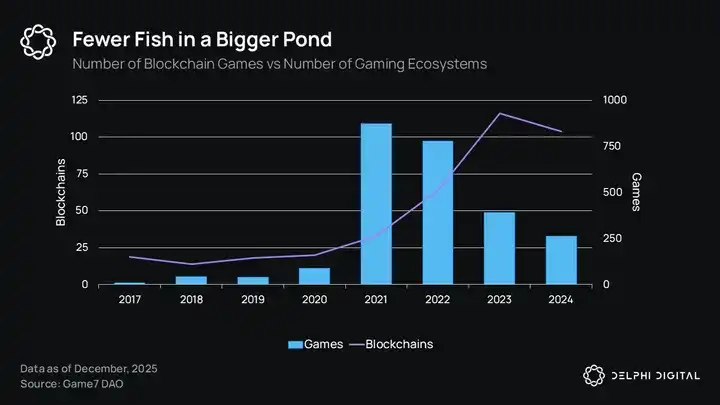
The issue lies in the fact that most of these emerging networks have failed to attract new players successfully. All of these problems ultimately lead to a phenomenon we have detailed in multiple reports—the battle for player liquidity. As the competition in the gaming market intensifies, Web3 projects are competing around the same limited pool of wallet users, and they have little effective means to break through this limitation and achieve scalable growth.
Facing significant challenges, a group of Web3 companies are exploring a new user acquisition (UA) model based on blockchain. Innovative incentive mechanisms and on-chain reputation systems are becoming potential pathways for these companies to gain a competitive advantage through Web3 integration.
Many Web3 companies have demonstrated significant Product-Market Fit (PMF) in emerging markets. Compared to the increasingly saturated T1 market dominated by Web2 giants, those able to leverage a global payment network enabled by blockchain to truly tap into emerging markets may have huge growth opportunities.
Among numerous regions, one that has shown sustained above-average growth rates and a high degree of acceptance of blockchain applications is the Global South.
3. Global South
The Global South is a term used to describe countries and regions with a relatively lower level of economic development, typically located south of industrialized nations. Due to rapid improvements in internet infrastructure, high smartphone penetration rates, and income growth, this vast region is often seen as an underdeveloped yet potentially enormous gaming market.
Key characteristics of the gaming market in the Global South include: a massive player base, heavy reliance on mobile devices for gaming, and a generally lower willingness to pay. Historically, these markets have been used by game publishers for soft-launch user acquisition testing and front-end data optimization.
However, the youth in these regions are the first generation to grow up with smartphones, and they have a strong preference for gaming content (including games, video content, and esports). As this generation ages and benefits from economic development and increased income, many believe they will become the next generation of paying players, propelling the gaming industry to new heights.
The following are characteristics of key markets in the Global South to demonstrate their importance in the future of the gaming industry.
India
Despite a relatively slow start, India is rapidly emerging as the largest gaming market in the Global South. In 2017, the country had only 44.9 million gamers, and now that number has grown to around 466 million, expected to exceed 640 million by 2027.
Market revenue is expected to grow by 13.6% in 2024 (reaching $9.43 billion) and surpass $10 billion in 2025, projected to reach $14 billion by 2028 with a 5-year Compound Annual Growth Rate (CAGR) of 11.1%. This growth is mainly driven by the improvement in user in-app purchase habits and the growth in Average Revenue Per User (ARPU) due to the increasing national disposable income.
The Indian market has a strong preference for mobile gaming, largely due to being one of the world's fastest-growing 5G markets and having a robust digital payment infrastructure—the Unified Payments Interface (UPI). UPI transaction volume has grown from 10.78 billion transactions in 2019 to 83.75 billion transactions in 2023, showcasing the rapid rise of the digital economy. Additionally, internet penetration has significantly increased from 14% in 2015 to the current 52%, though still lower than other major global southern gaming markets, indicating significant potential for future growth.
These technological advancements are supported by strong macroeconomic fundamentals, including an average annual economic growth rate of 7-9% over the past three years and the rising income levels of a young and expanding middle class.
India's gaming preferences exhibit a unique pattern compared to other major markets:
· Mobile gaming dominates, contributing 77.9% of total revenue;
· PC gaming and console gaming only account for 14.5% and 7.7%, respectively.
In terms of revenue composition, the income distribution of different game types is as follows:
· Real Money Gaming (RMG) is the largest segment market, with an annual revenue of $2 billion;
· Casual and Hyper-Casual gaming follow closely behind, with total revenue of $700 million;
· The market size of other game categories is approximately $400 million.
Southeast Asia (SEA)
Southeast Asia (SEA) consists of Indonesia, Malaysia, the Philippines, Singapore, Thailand, and Vietnam, and is one of the most mature gaming markets in the global south. According to Niko Partners data, the region's gaming revenue reached $5.1 billion in 2023, an 8.8% year-on-year growth, and is projected to reach $7.1 billion by 2028, with a 5-year compound annual growth rate (CAGR) of 6.7%. In 2023, Southeast Asia had 277 million gamers, expected to grow to 332 million by 2028, with a 5-year CAGR of 3.7%.
According to Sensor Tower's H1 2024 report:
· Indonesia had the highest mobile game downloads, reaching 2.4 billion times (41% of the region's total downloads);
· Thailand had the highest In-App Purchase (IAP) revenue, reaching $400 million, closely followed by Indonesia at $300 million.
Despite differences among countries in the region, community and a culture of competition are common features. Word of mouth is the primary source of information, and top-performing games usually have social features.
Similar to most countries in the global South, the penetration of smartphones and the development of broadband infrastructure are key drivers of market growth. Southeast Asia is particularly notable:
· By 2022, the smartphone penetration rate in all major countries exceeded 80%;
· It is projected that by 2026, the average penetration rate will reach 90.1%.
Latin America (LATAM)
Latin America (LATAM) is another significant market to watch, with a large population and a strong gaming culture, especially in the esports sector. In 2022, the region is estimated to have 316 million gamers, with a concentration of players in Brazil, which had 101 million players that year, generating $27 billion in game revenue.
The Brazilian market shows a strong preference for mobile games:
· 60% of players have played a mobile game at least once in the past six months;
· Smartphone penetration is expected to reach 83% by 2025, indicating significant growth potential in the mobile gaming market.
In terms of monetization, the Brazilian market exhibits a strong payment habit: 43% of players have made in-game purchases, with main motivations including unlocking exclusive content (39%), character customization (35%), and game progress (30%). This indicates a maturing market that is moving beyond basic monetization models. These spending patterns suggest that the market is maturing, gradually evolving from basic monetization models to more complex game economies.
The Brazilian market is poised to continue leading the growth of the Latin American gaming industry in the future, benefiting mainly from: 140 universities nationwide offering over 4,000 game-related courses, with 1,042 game studios across Brazil generating around $251.6 million in total revenue. The recent legal framework passed officially recognizes game development as a profession and provides incentives such as tax breaks.
Africa
The African gaming market is at a critical development stage, with revenue expected to surpass $1 billion in 2024, showing steady growth from $863 million in 2022. The core driver of this market is mobile gaming, holding nearly 90% market share, reflecting both the reality of infrastructure and consumer preferences.
A domestic study shows that 92% of African gamers play games on their mobile phones, while the prevalence of computers (51%) and game consoles (31%) is relatively low. This mobile-first approach has been partially validated; however, the research sample size was only 2588, making it difficult to comprehensively represent the entire continent's market situation.
Main Challenges: High data costs (42%) are the biggest obstacle, followed by hardware prices (31%) and network connectivity issues (31%).
Payment systems are both a challenge and an opportunity: Although 63% of players engage in in-game purchases, payment methods vary by region. Kenya leads in mobile payments, with 67% of players using mobile wallets for game expenditure. Credit cards (45%) and mobile payments (40%) are the most common payment methods across Africa.
Middle East and North Africa (MENA)
The MENA (Middle East and North Africa) region is the fastest-growing game market globally, with revenue set to grow by 4.7% in 2023, reaching $7.1 billion, far surpassing the global market's 0.6% growth rate. High-speed growth is expected to continue in the future, with a projected Compound Annual Growth Rate (CAGR) of 9.4% from 2024 to 2030.
By 2027, the MENA-3 (Saudi Arabia, United Arab Emirates, Egypt) core market revenue in the region is expected to reach $2.9 billion, with a CAGR of 8.3%; market drivers include a high proportion of young population driving gaming market activity, significant increases in internet penetration in Qatar and the UAE, and wide adoption of new technologies.
The gaming landscape in this region is dominated by three strong markets—Saudi Arabia, UAE, and Egypt—collectively known as the MENA-3, showing outstanding performance, with a 7.8% year-over-year growth to $1.92 billion by 2023, and forecasted to reach $2.9 billion by 2028, with a five-year CAGR of 8.3%. Saudi Arabia leads the pack, accounting for 60.6% of total gaming revenue and 30.3% of the total number of gamers in the Middle East and North Africa, demonstrating the country's dominant position in the regional ecosystem.
4. What is KGeN
KGeN is a blockchain-powered gaming network that leverages on-chain and off-chain data, an incentive-based task platform, and a decentralized reputation system to drive user engagement across different games. Unlike other user acquisition (UA) platforms and networks, KGeN returns publishers' funds to users, propelling its growth flywheel.
At the core of KGeN is a decentralized player data network covering millions of micro-game communities (KGeN Tribes). This network adopts a novel data model called Proof of Gamer (PoG) engine, creating a cross-chain player reputation layer and providing publishers with a highly engaged target user base at a cost much lower than many existing networks.
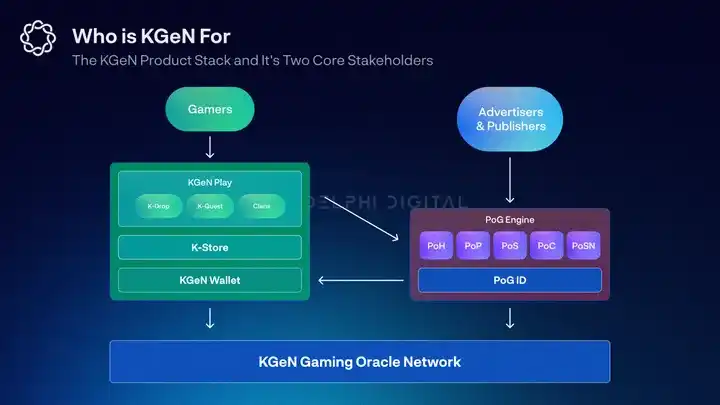
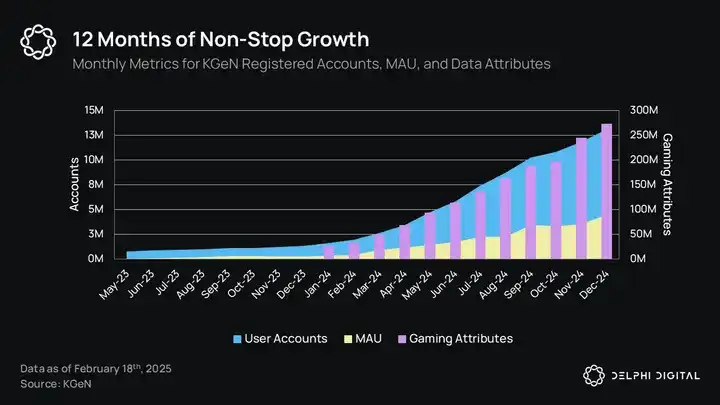
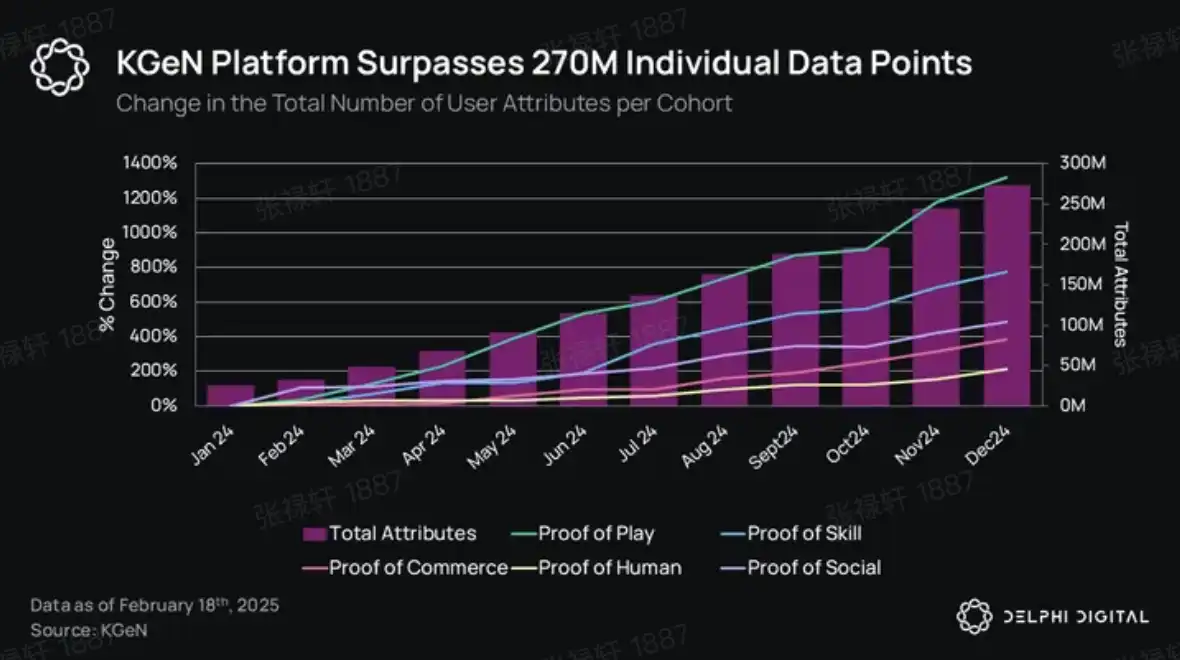
As more players join KGeN and the PoG dataset grows, more game studios and publishers have been able to establish partnership relationships. This has further driven ecosystem rewards, increasing the value of participating players. Since January 2024, this growth flywheel has shown significant effects, with a total of registered accounts growing by over 700%, Monthly Active Users (MAU) growing by 1333%, and total data attributes growing by 992%. This has made KGeN the most active Web3 task and player reputation network in the market.
The KGeN ecosystem is currently undergoing gradual decentralization, protecting the PoG engine through a distributed oracle network and providing greater transparency to all core stakeholders. This oracle network and the KGeN Store are both powered by the KGEN token.
4.1 Grassroots Growth
At the core of KGeN's growth is its grassroots tribes and tribal leader network, which is also key to its continued expansion in the Global South. Tribes represent thousands of micro-communities that have joined the KGeN ecosystem, such as colleagues, esports organizations, influencers, and game-centric social groups. As of December 2024, KGeN self-reported a total of 2,525 tribes, with 152 tribes having over 100 members.
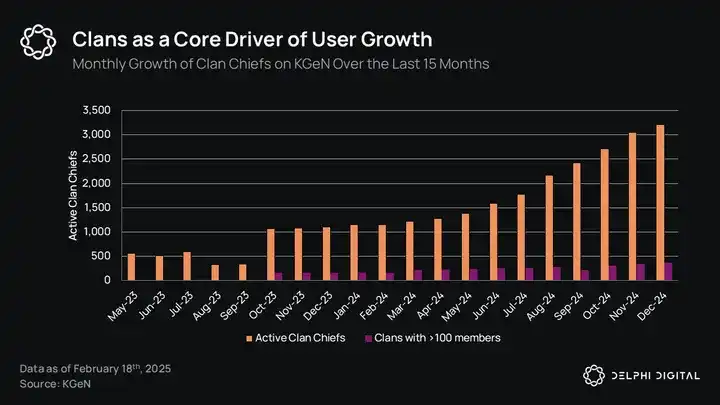
Tribes are a core way KGeN drives referral-based user acquisition. When creating a tribe, tribal leaders invite up to five tribe members and have them complete at least one task to earn points. These points contribute to the KGeN leaderboard, which is one of KGeN's primary reward systems (further detailed below). This incentive-driven funnel mechanism has proven to be highly effective, with approximately 1.7 million KYC-verified KGeN accounts (39% of MAU, 13% of registered accounts) acquired through tribes.
Tribal leaders are incentivized not only to onboard new members but also to coordinate tribe activities and maintain community engagement if they wish to maximize their earning potential. This is because a portion of the tribe's total earnings is redistributed to tribal leaders, becoming a key growth incentive mechanism for the ecosystem.
KGeN's largest current market is India, benefiting from the company's origins and its strong influence in the region's micro-game communities. However, over 30% of independent active wallets and transactions occur on Kaia, which is LINE's proprietary blockchain for the LINE messaging app. LINE's biggest markets are Japan (86 million users), Thailand (47 million users), Taiwan (21 million users), and Indonesia (13 million users), indicating strong growth potential for KGeN in Asia.
In order to replicate the success in other markets in the Global South, KGeN is encouraged to adopt a similar grassroots growth strategy. Collaborating with local gaming micro-communities such as schools, internet cafes, small-scale esports organizations, and online communities will gradually expand its reach while creating opportunities to deepen social dynamics, further driving user engagement and retention.
Another potential issue is the relative lack of community social features in the KGeN PC portal and mobile app. As we will discuss in detail in the report, enhancing social features is one way to increase ecosystem engagement. The more time users spend engaging with the ecosystem, the richer the user data, the more opportunities for interaction with the K-Quest and K-Drop features, and the greater the monetization potential.
4.2 Encouraging Participation through KGeN Play
KGeN Play serves as the front-end interface for most player participation in the ecosystem, where all reward tasks are posted. This typically marks the beginning of the user journey and will become the primary gateway for users to interact with the KGen network while also building their own PoG reputation score.
KGeN Play can be accessed through the PC portal or mobile app. Users will have the best experience via the PC portal, but the mobile app provides a quick solution for users on the go and will play a crucial role in the Global South expansion.
Upon creating an account, a blockchain wallet is automatically generated in the background, storing all user assets and the non-transferable Player Reputation NFT. Once the minimum withdrawal threshold is reached, users will be prompted to verify their phone number via OTP and take full control of their wallet—a crucial step directly feeding into the PoG engine. The KGeN wallet is basic in functionality but offers a seamless onboarding process, supports multi-chain and gasless transactions, and executes its three primary functions (checking balance, viewing transaction history, and withdrawals) with low friction.
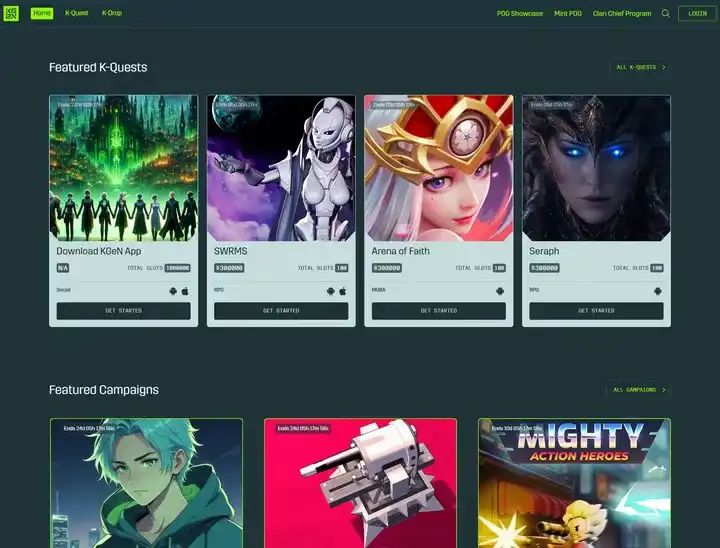
Before users realize they have a blockchain wallet, they first need to start earning rewards. To do so, users need to engage in various activities posted on the KGeN Play portal. Task activities are divided into K-Drops and K-Quests.
Both K-Drops and K-Quests are time-limited, limited-quantity activities that reward participants with K-Points, leaderboard-based achievements, K-Cash, or tokens. The core difference between the two is that K-Drops provide automatic real-time validation via endpoint API integration, while K-Quests rely on a manual verification process.
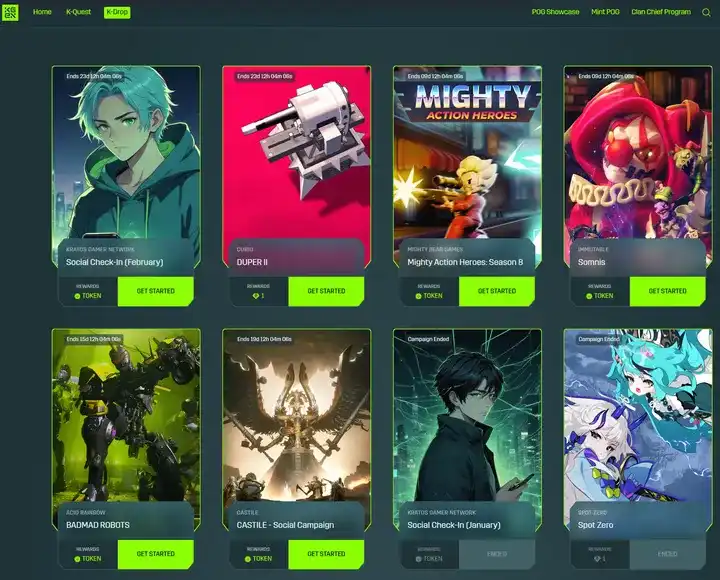
Unsurprisingly, the completion rate of task platforms leveraging real-world financial incentives, especially those targeting a global Southern audience, is higher than average. What sets KGeN apart is its integration of KGeN Play with the PoG Engine, providing high conversion rate target activities.
4.3 PoG Engine
The PoG Engine is a decentralized player ranking system hosted by a distributed node network. PoG consists of five core pillars, each pillar containing five to ten attributes. These data points track player skills, "humanness," engagement, wealth, and social networks to build a multifaceted cross-chain reputation system.
This ultimately forms a PoG vanity score, leveraging the composability inherent in blockchain technology, allowing players to showcase their player ID across different ecosystems. Meanwhile, publishers and advertisers can leverage the PoG Engine to access a globally Southern-priced, highly engaged player base.
The five core pillars are divided into Proof of Humanness (PoH), Proof of Play (PoP), Proof of Skill (PoS), Proof of Commerce (PoC), and Proof of Social Network (PoSN).
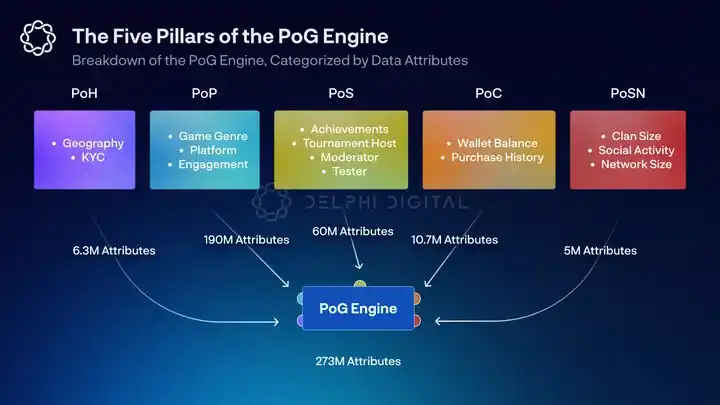
PoH lives up to its name—it tracks various data points to reduce the likelihood of users being bots. This may include KYC status or the number of connected social apps and is one of the most valuable attributes in the eyes of publishers. In addition to tracking "humanness," PoH further segments user groups based on platform preferences and geographical location. This pillar not only aids user targeting but also enhances trust in user quality and the entire network.
PoP determines a player's engagement with the KGeN network and the types of games they have played. It tracks metrics related to retention, gameplay patterns, preferences, and user habits. This pillar improves targeting by further segmenting different user types, earning high praise from publishers as another set of attributes.
PoS recognizes a player's abilities, competitiveness, engagement, and evolving achievements over time. It gathers data from in-game achievements, tournaments, and ecosystem activities to rank players. This pillar highlights the most active players and provides them with social capital.
PoC identifies users' monetization potential, which may come from direct purchases, on-chain transactions, on-chain history, or net assets. This not only enhances the efficiency of targeting and user acquisition activities but also showcases the various ways users add value. Aside from early activities like game testing, PoC will eventually become the most valuable dataset for publishers in the post-IDFA era.
The PoSN scales users' social profiles and establishes their social graph within the KGeN network. This pillar filters out non-gaming data, tracks social accounts, clan activities, and network size to understand their social preferences, influence, and impact within the gaming community.
The PoG Engine currently consists of over 270 million data attributes, sourced from over 13 million registered accounts and 4.4 million MAU. Since January 2024, the PoH, PoP, PoS, PoC, and PoSN cohorts have grown by approximately 214%, 1320%, 777%, 384%, and 487%, respectively. The significant growth in PoP and PoS-related data particularly highlights how ecosystem engagement has steadily increased over time.
Utilizing the PoG Engine, KGeN is leading an alternative UA framework called "effective Cost per Acquisition" (eCAC). KGeN does not charge for simple impressions or top-of-the-funnel installs but only for active users reaching the middle or bottom of the user funnel.
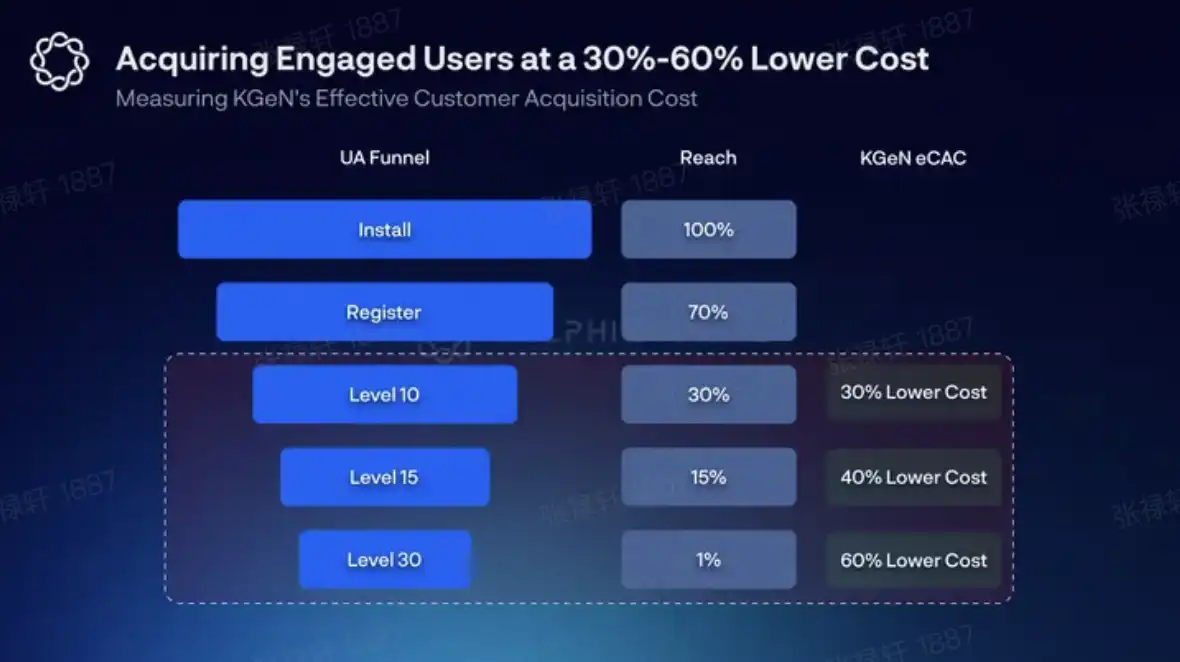
For instance, during an event with Karate Combat, KGeN reported almost a 40% reduction in eCAC, while charging no fees for top-of-the-funnel installs and achieving a 5% conversion rate at the bottom of the funnel. In a four-week mission event with Game7, KGeN stated they introduced 50,000 PoH-verified users, with an eCAC 55% lower than competitors. User registrations, wallet connections, and avatar creations are all free, meaning customers only pay for users who complete at least four tasks and mint an SBT (estimated conversion rate of 20%).
The PoH and PoP cohorts are particularly valuable as these data points offer relatively higher engagement ROI for commercial clients. This is especially crucial for Web3 projects leveraging financial incentives, which often face challenges from bad actors and bots. However, these data points are not flawless, and even KYC could be manipulated.
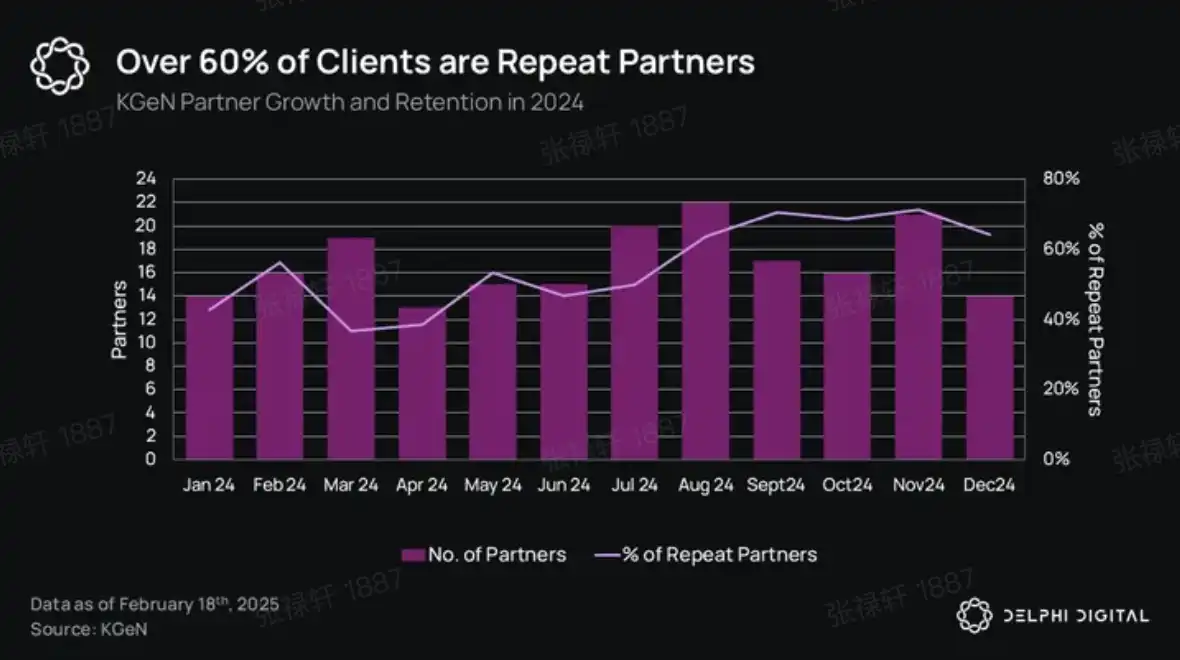
Nevertheless, KGeN's ability to highly ascertain user quality has brought significant added value to its partners. As we will detail in the report, ad fraud has led to around $840 billion in wasted digital ad spend. This is also a key reason why over 60% of KGeN partners have become repeat customers since August 2024.
Over time, the growth flywheel that is crucial for KGeN's future expansion will gain momentum. As long as there is demand for a positive PoG score, engagement with KGeN Play will increase (this can be further accelerated through financial incentives based on the PoG score). This activity will drive the PoG engine, increase the total number of attributes, and enrich KGeN's user database. Subsequently, more publishers will be attracted to the ecosystem, increasing the variety of products on KGeN Play and KGeN Store, thereby attracting more users.
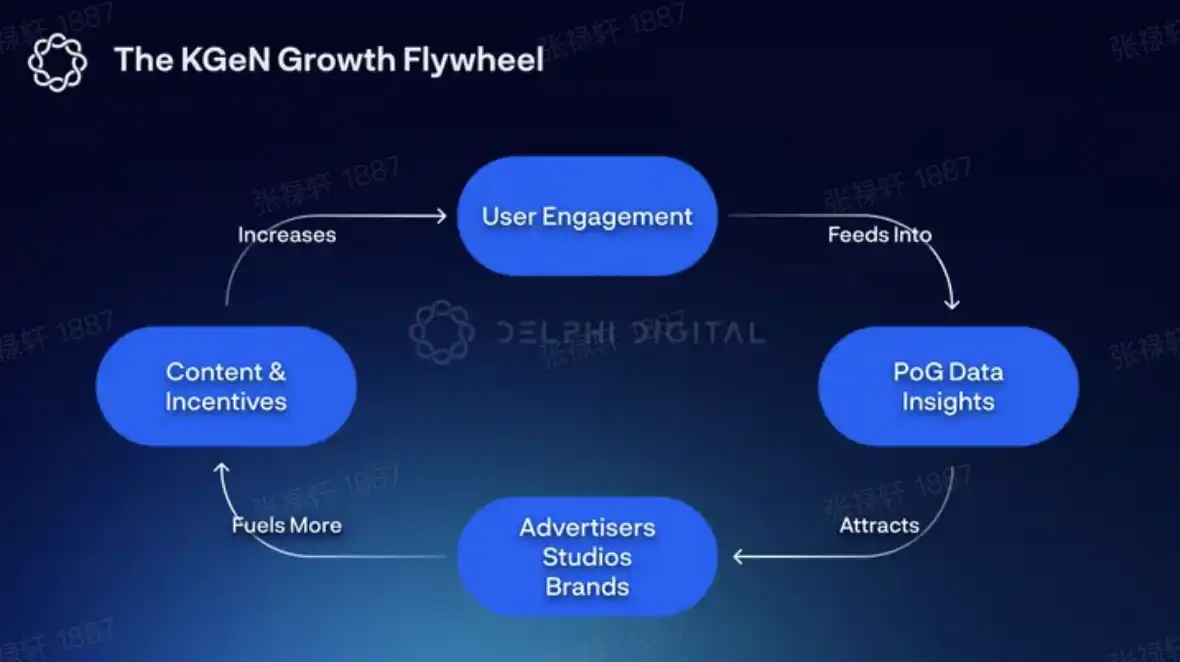
The PoG score is at the core of KGeN's business model and is key to its ability to offer customers competitive low-cost eCAC. A key question is, what drives this user behavior?
As long as the incentive is financial in nature, the platform will undoubtedly demonstrate promising results. However, this creates an external motivational force that dictates how users engage with the platform and its partners.
Users driven by external motivation are less likely to continue playing the games they were initially attracted to because of rewards. Furthermore, research suggests that providing external rewards for behavior that was originally intrinsically rewarding diminishes intrinsic motivation—a phenomenon known as the overjustification effect.
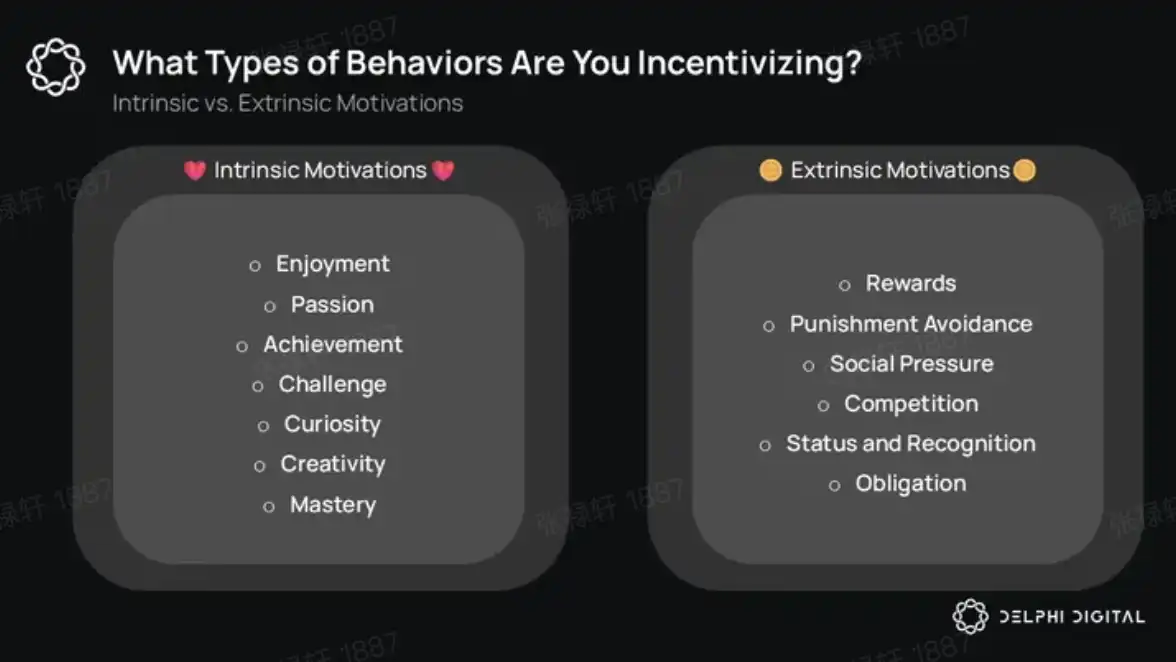
Users with intrinsic motivation seek value in things they enjoy, such as social interaction, recognition and respect, progress, and fun. If powerful network effects over time can transform the core value proposition of the PoG score into something rooted in social capital and enjoyment, motivation will gradually internalize, thereby increasing the potential value provided to partner publishers.
4.4 KGeN Tokenomics
KGeN's economy will consist of two core assets: KCash and KGEN tokens. KCash has been live for some time, primarily serving as an off-chain reward currency, but it can also be purchased directly with fiat. KCash's primary use case is in the KStore, where it can be used to purchase in-app purchases (IAP), gift cards, or participate in VIP tournaments and missions.
Driving the growth flywheel of the KGeN ecosystem is the KGEN token. This is a utility token, with 40% allocated to the community (8% of which unlocks at the Token Generation Event (TGE)), with a four-year lockup for the team and investors. 12.6% of the total token supply will unlock at the TGE, excluding the circulating supply locked with liquidity providers or exchanges.
Recently announced, ahead of the TGE, KGeN will conduct a K-Points -> rKGEN airdrop event. rKGEN distribution is based on users' total K-Points, time on KGeN, and engagement. Once the token is live, rKGEN can be converted to KGEN tokens at a 1:1 ratio. However, some users will be able to start staking rKGEN for additional token rewards before the TGE.
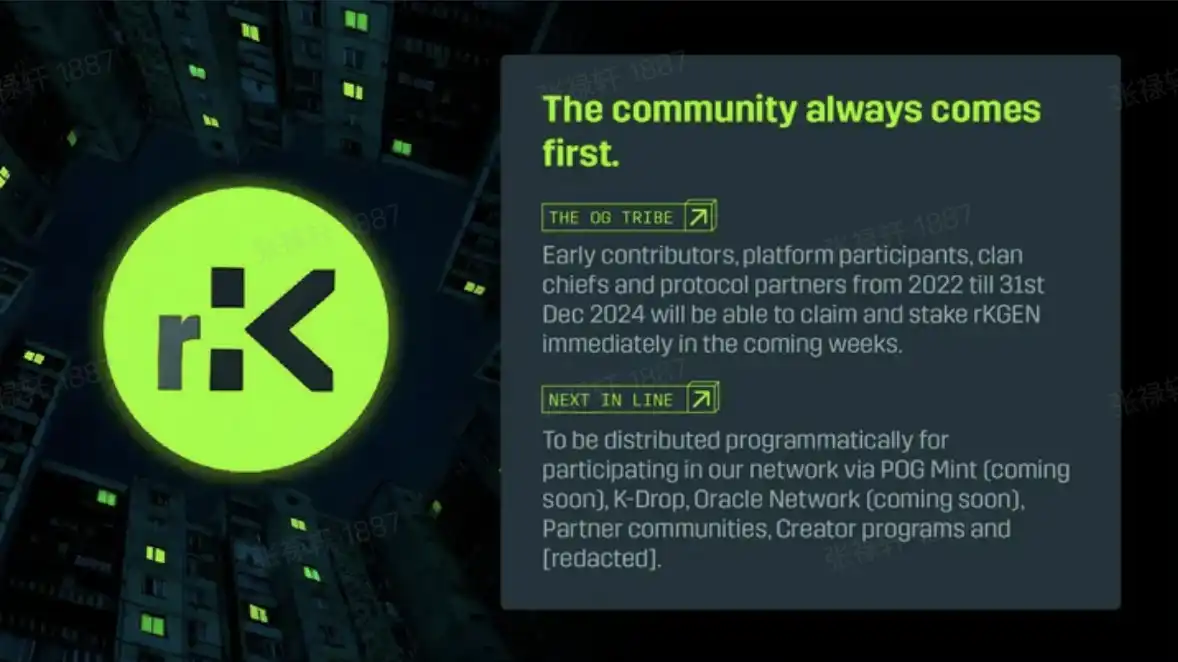
K-Points -> rKGEN Airdrop model prioritizes transparency and clear communication to maximize community sentiment and token distribution before the TGE. If executed successfully, this may help build momentum at launch and ensure additional CEX listings, but comes with its own set of risks.
A fuzzy reward system has been proven to increase engagement in various domains. While pure point-based airdrop events offer lower transparency, they provide teams with greater flexibility in token airdrop distribution. This design concept raises a question: post-TGE, will the KGeN Play activities leverage the K-Points -> KGEN reward system, or opt for direct token payments?
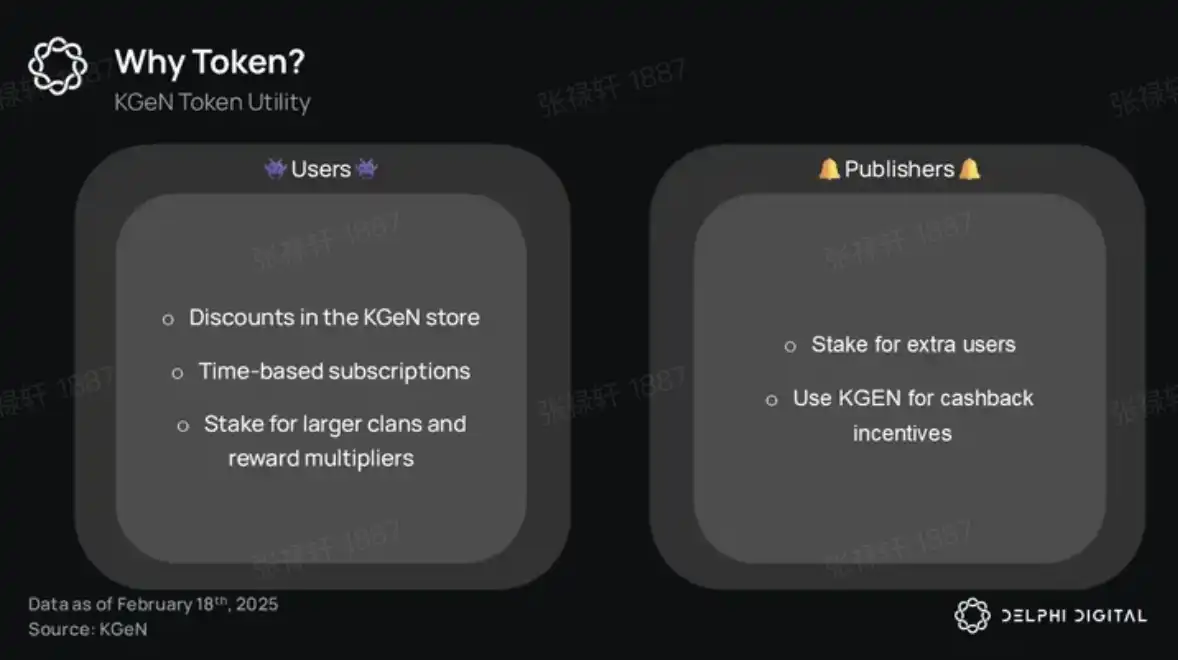
At launch, we assume the KGEN token will primarily be used for incentives. However, over time and as the network matures, we anticipate more users will use the token in the KGeN Store to enjoy discounts more favorable than fiat purchases.
Another potential form of token consumption could be subscription fees. As users increasingly rely on the network to host their reputation scores, game achievements, and social touchpoints, KGeN may decide to limit the number of tasks available to free users. This would effectively curb much of the revenue potential on the network and serve as an additional bot protection measure.
Nevertheless, unless non-financial rewards hold significant intrinsic value for users, many will not spend tokens unless they can realize a positive return on investment. To prevent this from becoming an inflationary consumption (i.e., more tokens are released than removed), KGeN should provide third-party token, KCash, or NFT. Ultimately, the most sustainable consumption is that driven by internal motivations such as entertainment and social capital.
In addition to direct token consumption, there will also be token staking. Apart from users seeking simple staking rewards, tribe leaders can stake tokens to increase their member cap and gain additional platform tools. Issuers can also participate in tiered staking programs to acquire more free top-of-funnel users in their UA campaigns—we anticipate this feature will receive more attention as the platform continues on its current growth trajectory.
A typical token staking is an inflationary model that will ultimately dilute the token supply in exchange for alleviating sell pressures in the future. While there are potential short-term benefits, it's encouraging to see KGeN incentivizing non-inflationary staking for tribe leaders and issuers.
4.5 Oracle Network
The KGeN Oracle Network is a distributed network consisting of permissioned nodes that together form the backbone of the PoG Engine. Each oracle's task is to store PoG data, calculate PoG scores (and collectively verify their accuracy), and submit these scores to the Aptos blockchain for settlement. As a reward for providing this service, oracle operators will receive a fixed amount of KGEN tokens income based on revenue prediction, as well as stablecoin income related to the amount invested in the oracle.
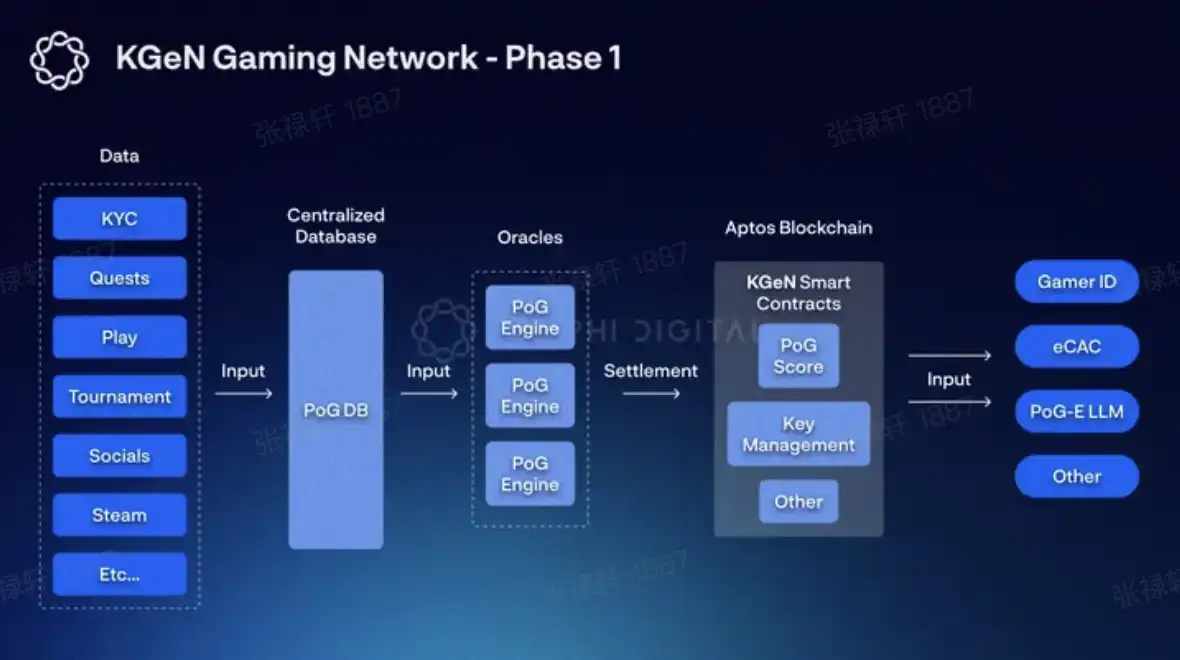
The Oracle Network will eventually decentralize a process that is typically done in a centralized manner. This will be a gradual process expected to take at least three years. In the initial stage, oracles will primarily retrieve PoG data from centralized servers and participate in computation, validation, and settlement—decentralized storage of PoG data will begin in the second stage.
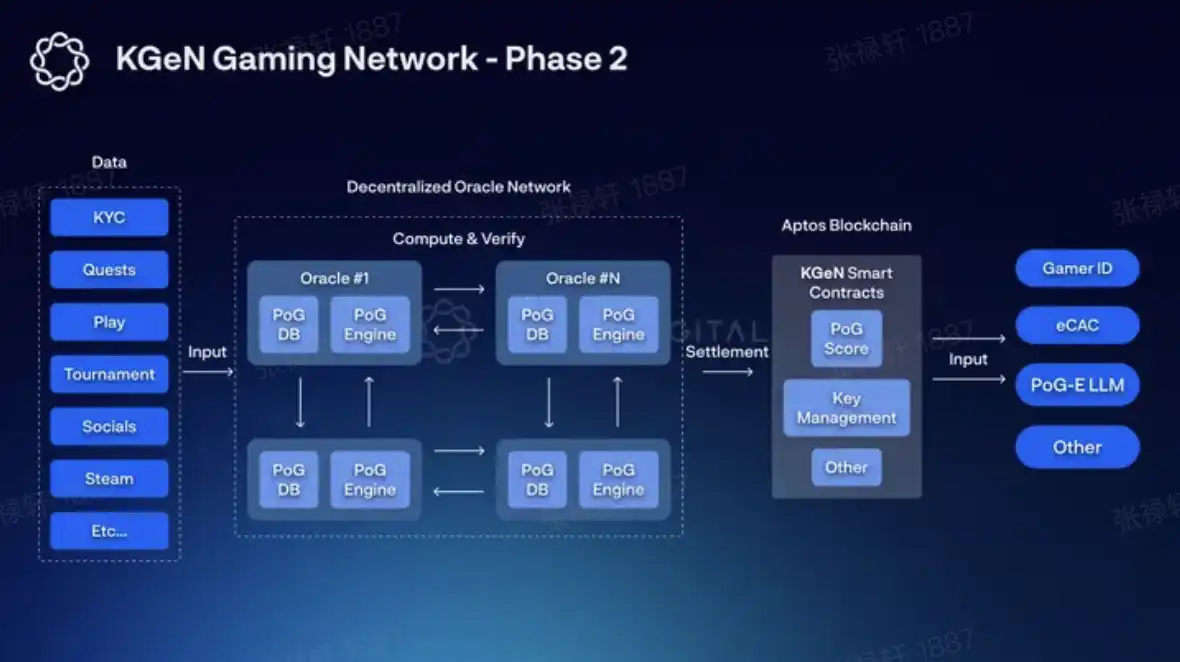
Another core component of the Oracle Network is the Oracle Key. The key is an NFT required to participate in the network. The more an oracle operator spends on their Oracle License, the more keys they receive. KGeN also indicates that additional key sales to the public may be available in the future.
Oracle Keys will remain locked in an account until the network transitions to the second stage, at which point they will become tradable, and key holders can delegate their keys to oracle operators. Key delegation is similar to a typical staking mechanism, temporarily locking the key NFT in exchange for KGEN token rewards from the key reward pool.
The weight of oracles in the key reward pool is calculated based on three variables: the number of keys staked to the oracle, the protocol's base reward, and the oracle's performance. Performance is only relevant when KGeN transitions to the second stage, and the specific calculation method is yet to be determined. The base reward is emission-based and serves as an indicator of the overall network health. While specific details are still to be confirmed, the goal is for the base reward for all oracles to increase as the network's value grows.
The Oracle Network combines aspects of both node and delegated proof of stake (DPoS) frameworks to decentralize the PoG Engine. In a fully centralized framework, KGeN's centralized data center represents a single point of failure for data corruption or deletion. Furthermore, core stakeholders (i.e., players and publishers) hold some trust assumptions, namely that these PoG scores have not been manipulated.
In this scenario, the benefits of decentralization are quite subjective to users. In some circles, it may be challenging to find a player who would actively complain about the centralized nature of their Xbox Gamerscore or Steam account. Similarly, publishers are primarily concerned with scalable UA rather than decentralization.
However, this overlooks the potential network effects and aligned incentives that the token model can help achieve. By providing stakeholders with a way to benefit from KGeN's growth, you can create brand advocates who support the project. Assuming that KGeN's growth flywheel translates into positive token price action, more stakeholders will be attracted to the ecosystem, further accelerating network effects.
5. Competitive Landscape
KGeN is not the only company with this ambition. As we discussed earlier, issuance is seen by many as one of the biggest challenges facing the current gaming industry. Whether expanding user acquisition (UA) activities profitably or optimizing core engagement metrics by increasing player liquidity, multiple industry participants are addressing these issues with varying degrees of success.
Next, we will focus on analyzing some companies operating in the Web2 and Web3 markets, comparing their business models, uncovering potential opportunities, and highlighting some key considerations.
5.1 Ad Tech Titans: Past and Present
In the Web2 market, there are two typical cases that have many synergies with KGeN's current business model and also reveal key opportunities for future growth. The first is Facebook, whose core competency lies in deep mining of user profiles and behavioral analysis. The second is Applovin, an ad tech company that spans the mobile ad ecosystem and has captured a substantial market share in mobile user acquisition (UA) with its powerful AI-enabled tools.
Facebook:
After experimenting with various ad formats, Facebook found its footing in the twilight of the web games era and the rise of mobile.
Companies like King ("Candy Crush Saga"), Playtika ("Slotomania"), and Zynga ("Farmville") successfully built games on Facebook's web platform and then sought ways to break through natural traffic growth. These gaming companies poured unprecedented levels of investment into Facebook ads, to the extent that in the first half of 2011, Zynga contributed 12% of Facebook's revenue.
From 2013 to 2016, Facebook gradually shifted its focus to mobile ads and in 2014 held almost 30% of the mobile ad market share, a figure that was 0% just two years earlier, making it the industry's second-largest player behind Google.
The success of Facebook's advertising business lies in the precise tracking of user behavior, game engagement, and spending patterns to optimize targeting and ad delivery. The platform's core value is its ability to identify and reach high-value users accurately—those players with higher game engagement and willingness to pay, for whom developers are willing to pay a higher price for targeted advertising.
By integrating with game SDKs, Facebook further strengthens this capability, allowing it to track post-install user behavior and optimize downstream metrics such as ROAS (Return on Ad Spend). Additionally, Facebook's social features provide game developers with additional organic growth channels.
To some extent, KGeN has adopted a similar strategy to Facebook, focusing on player data as a core value. However, Facebook's target users are mainly in the casual gaming space, covering hundreds of millions of users, while KGeN is more focused on the mid-core and hardcore gaming categories, with its user base consisting entirely of gamers.
To further solidify its position as a decentralized Facebook ad network, KGeN can increase its investment in its own product's social features (they plan to gradually introduce new messaging and tournament features). This will not only help KGeN gather more data on user journeys, preferences, and behaviors but also provide developers with additional distribution channels.
Applovin:
Applovin is a highly mature advertising technology platform whose business model relies on optimizing ad delivery and enhancing delivery effectiveness, while using its Supply-Side Platform (SSP) data for pricing analysis. The company has a presence at both ends of the mobile advertising market:
Its Supply-Side Platform (SSP) MAX, through acquisitions like MoPub, Machine Zone, and its in-house game studio Lion Studios, has accumulated a vast amount of data to help developers sell ad inventory at the best prices.
Its Demand-Side Platform (DSP) AppDiscovery helps advertisers buy ad inventory based on user acquisition (UA) goals and cost metrics.
Following Apple's introduction of the App Tracking Transparency (ATT) privacy policy, traditional user-level tracking has been disrupted. However, leveraging its end-to-end data integration advantage, Applovin can provide user valuation to developers within compliance, thus maintaining ad targeting accuracy.
At the core of the Applovin ecosystem is its machine learning engine AXON, which combines mobile app user behavior data with platform bidding data to predict the apps that users are most likely to download and engage with.
This bidirectional data flow model gives Applovin a competitive edge, allowing it to not only acquire data from ad demand sources but also understand the supply side's market dynamics and pricing information, enabling industry-leading data insights and ad optimization capabilities.
Undeniably, Applovin's ad tech platform surpasses KGeN in maturity and scalability. However, similar to Applovin, KGeN also has the opportunity to collaborate directly with partners to drive integration of its own SDK or to loop game data back into the PoG engine.
This not only significantly enriches the PoG database but also enhances tracking capabilities. Moreover, this more comprehensive data ecosystem will support KGeN's latest offering, POG-E LLM (Large Language Model enhanced through KGeN's proprietary data training), enabling it to recommend more suitable missions to players who are easier to convert to paying users, similar to AXON.
Mystplay:
Mystplay is one of the fastest-growing reward-based UA platforms in the Web2 space. Its core product is a standalone game discovery app where users can earn points by trying out games on the platform, which can be exchanged for gift cards.
Reward-based UA platforms are rapidly gaining prominence in the gaming industry, with 68% of developers believing that compared to other UA channels, reward-based marketing delivers higher ROAS. These platforms commonly claim that users acquired through them exhibit superior retention and revenue performance compared to industry averages. For instance, some cases of Mystplay show that rewarded users can achieve a 20%-50% increase in 7-day retention rates or ROAS. Currently, other well-known reward-based UA platforms include Adjoe, Almedia (Freecash), Tapjoy, MyAppFree (MAF), among others.
Mystplay's unique strengths lie in its rich social features (such as chat, weekly competitions, and leaderboards) and its AI-driven recommendation engine, which can match players with games that best suit them, enhancing user stickiness and gameplay duration. Mystplay follows a quality-driven UA strategy, leading to rapid growth over the past 24 months.
As of 2022, Mystplay has around 16 million registered users, with over 2 million monthly active users (MAU) in 2023 and partnerships with over 400 games. It is frequently ranked as one of the top 10 performing Android distribution platforms. The annual revenue is estimated to be around $55 million, with a team size that has grown by approximately 43% in the past year and achieved a 445% growth in four years, successfully making it to the Deloitte Tech Fast 50 in 2024.
At first glance, Mystplay's value proposition is very similar to KGeN's. However, Mystplay mainly targets the European and American primary markets and, constrained by the lack of globally accepted blockchain payment channels, has had to adopt a "quality over quantity" strategy. Therefore, Mystplay relies on AI for precise matching to improve conversion rates and retention rates, which is a key direction that KGeN can learn from.
5.2 Web3 Competitive Landscape:
In the Web3 market, competitors are mainly divided into two categories: publisher ecosystems and task platforms. The ultimate goal of both is to drive user growth through collaborative projects.
Web3 Publisher Ecosystems:
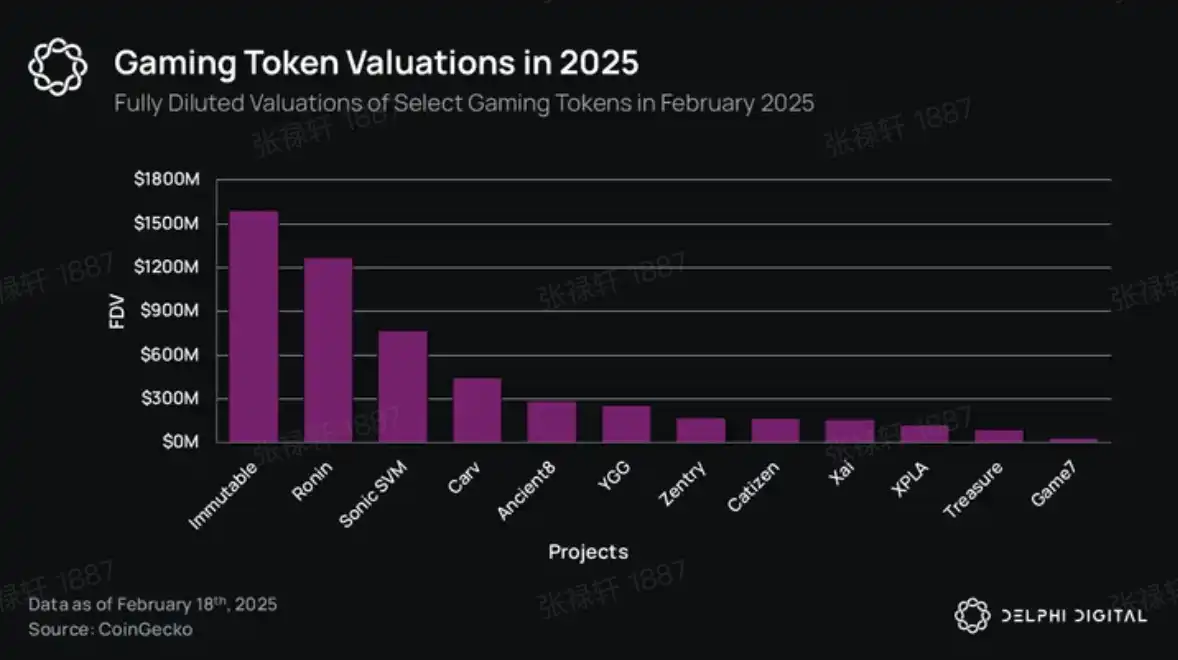
Publisher ecosystems typically provide Web3 User Acquisition (UA) optimization support to partners through various means: offering tokens for UA spending, using ecosystem token inflation for UA incentives, and more. Representative ecosystems employing these models include Ronin, Immutable, Xai, and Catizens, with their fully diluted valuations standing at $16.5 billion, $23.4 billion, $2.882 billion, and $2.616 billion, respectively.
Due to some fundamental differences, there is no direct competition between publisher ecosystems and KGeN. The revenue model of publisher ecosystems is primarily based on the fee structure of developer activities, while KGeN's core lies in "controlling" the user journey and being able to operate freely across different blockchains and games. This lack of direct competition allows KGeN to avoid being trapped in zero-sum exclusive protocol competition, thereby expanding its Total Addressable Market (TAM).
However, as mentioned in the Applovin section, KGeN often struggles to obtain many key data points after users reach the target location (in-game or in-app). Publisher ecosystems like Ronin, which have end-to-end user data (especially on-chain data and wallet profiles), have a greater advantage in user behavior visibility. Additionally, publisher ecosystems deepen their competitive moat by providing funds and infrastructure support to applications.
Task Platforms:
Reward tasks are widely used by Web3 projects in various fields to increase market awareness and distribute assets to stakeholders. This is particularly evident for game projects that look to accelerate growth through UA incentives, enhance user retention through reward mechanisms, and maximize protocol activity.
The core advantage of task platforms is their ability to aggregate tasks from multiple projects, providing users with a one-stop task participation experience while enabling issuers to reach a broader audience.
Currently, KGeN is also a task discovery platform competing for user attention with other Web3 task platforms. Its strong community base in India and Brazil has given it a first-mover advantage in these markets. However, this does not guarantee its continued success in the future. The following analysis will delve into the success factors of blockchain-driven task platforms and assess the strengths and weaknesses of KGeN's current model.
5.3 Competitive Analysis
Essentially, all task platforms offer "quest-to-earn" services, with the differences mainly seen in scale and their ability to deliver value-driven results for issuers.
The market demand for high-quality User Acquisition (UA) results has grown exponentially. As traffic distribution becomes increasingly challenging, a significant amount of UA budgets are wasted on low-quality interactions annually. It is estimated that in 2023 alone, digital advertising's wasted spending due to bot traffic will amount to a staggering $840 billion.
While fraud issues are less prevalent in Owned Inventory (SRN) platforms (such as TikTok, Snapchat, and Instagram), malicious actors persist in large-scale UA campaigns using last-click attribution. Some industry leaders (such as Applovin) have partnered with third-party anti-fraud tech solutions to reduce criticism from gamers and issuers. However, publishers and advertisers using programmatic ads still need to establish trust in ad platforms.
For KGeN, its Proof of Growth (PoG) engine (especially PoH and PoP scores) constitutes a key competitive advantage for the platform in the high bot traffic market. By gradually decentralizing the PoG engine, KGeN seeks to reduce remaining trust assumptions. The market's demand for these verifiable high-interaction users is strong, as evidenced by KGeN's continued revenue growth and high rate of repeat customers.
That being said, when measuring the success of UA activities, merely looking at effective Customer Acquisition Cost (eCAC) is not sufficient. KGeN needs to effectively monetize users, gather more data on the user journey (especially PoC-related data), and utilize this data to provide partners with precise targeting and optimization to ensure profitability.
When examining the key factors that allow a Web3 task platform to succeed in a scalable competition, we can make the following assumptions:
As long as the switching cost is low and there is sufficient economic incentive between platforms, the same group of users will attempt to participate in tasks across all platforms.
When time becomes a primary limiting factor, users will focus their energy on the activities with the highest ROI.
Based on this assumption, and excluding the narrative fluctuations in the Web3 space, we can use two key metrics to measure the scalability competitiveness and user retention capability of a Web3 task platform: Total Potential Rewards (TPR) and Locked Platform Value (LPV).
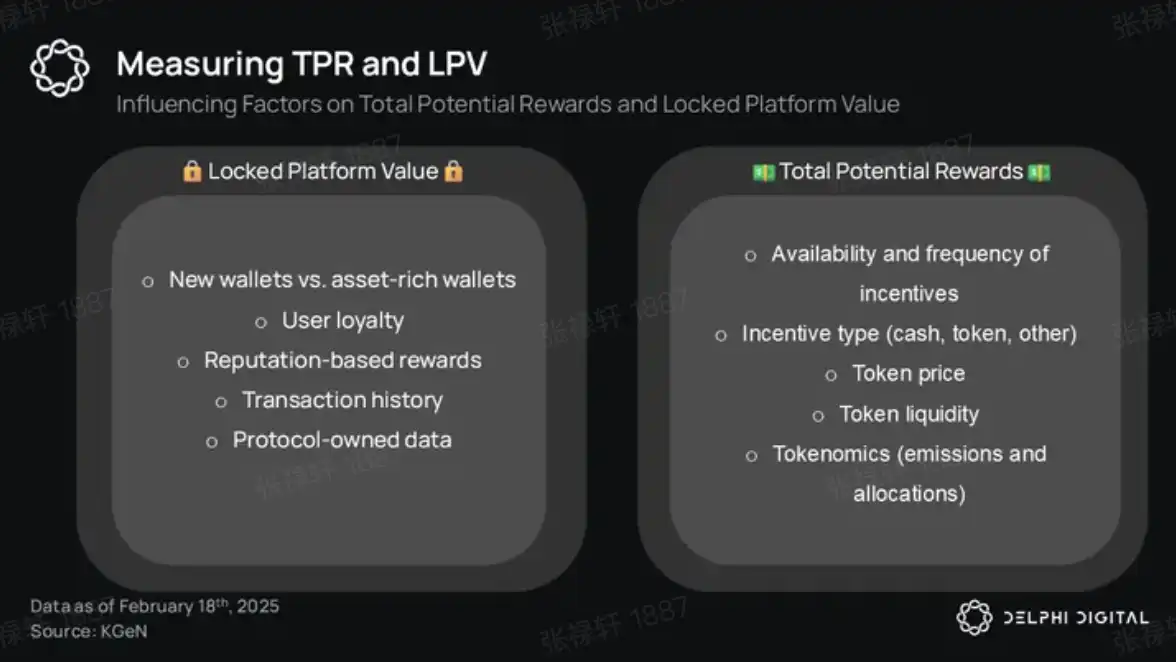
TPR (Total Potential Rewards) refers to the total financial rewards users can receive throughout the platform's lifecycle. TPR is mainly influenced by the tokenomics (such as allocation ratio, inflation mechanism, etc.), the number of available incentive mechanisms, the ratio of cash rewards to token rewards, the frequency of task rewards, and is also constrained by some external factors, such as token price and liquidity.
LPV (Locked Platform Value) measures the level of "control" the protocol has over users and the perceived level of user quality. Factors influencing LPV include the ratio of new wallets to high-asset wallets in associated wallets, user loyalty, reputation-based reward systems (more favorable towards long-term active users), on-chain and off-chain transaction history, and the user data held by the protocol (which also feeds back into TPR as more precise user data can increase the protocol's ad revenue, further enhancing the user reward pool).
Regarding TPR, we can assume that, in the absence of monopoly pricing power, over time, the UA incentive rewards between different platforms will gradually converge.
For LPV, the most valuable platforms for advertisers are those with the largest user base and those with the deepest user data (enhancing targeted advertising and monetization capabilities).
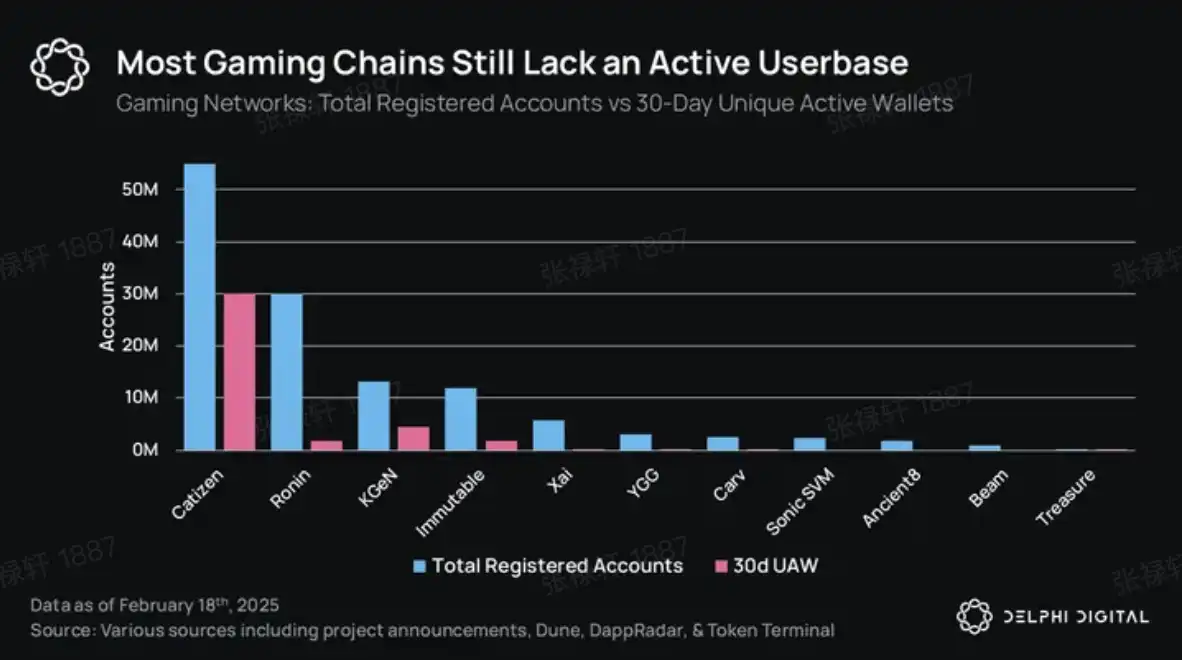
KGeN currently has the highest number of registered accounts and the highest number of 30-day active wallets among all task platforms. Additionally, as mentioned earlier, PoH (Proof of Humanity) and PoP (Proof of Participation) are crucial metrics that many other platforms lack. These two factors give KGeN a significant competitive advantage in terms of LPV, and this advantage will continue to grow as PoC (Proof of Contribution) data is further refined.
In contrast, the comparison on the TPR side is not as straightforward. One key factor is the number of active tasks at any given time and the frequency of new task launches. Some platforms may artificially boost these numbers through unsustainable high inflation token issuance, but for the purpose of this comparison, it is assumed that all rewards are calculated in USD to allow for a more objective comparison.
As mentioned earlier, KGeN is leading in both total registered accounts and monthly active users (MAU), both of which are important benchmarks for issuers to assess market demand. Additionally, KGeN has officially stated that the company has never subsidized any UA activity on KGeN Play, hence it can be inferred that the market demand for its services is at least on par with, if not higher than, Web3 competitors.
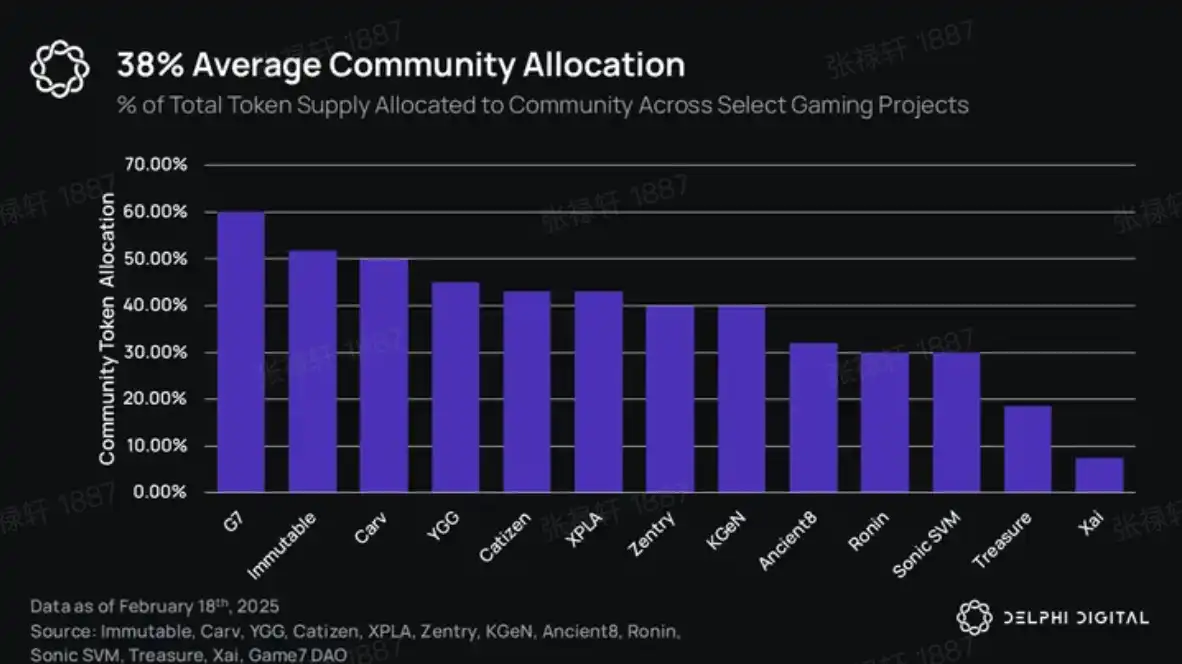
Post TGE (Token Generation Event), other key factors affecting TPR include token price, token reward distribution mechanism, and overall reward allocation. The specific issuance rates of the latter two are currently unpredictable, but it is noteworthy that KGeN's community reward allocation stands at as high as 40%, placing it at the upper end of industry reward allocations.
Regarding token price, assuming the reward for a single task remains constant, in order to establish a competitive position in the market, the market capitalization of the KGeN token would need to reach at least $140 million at launch to compete with Zentry ($138 million market cap) and YGG ($132 million market cap). In terms of FDV (Fully Diluted Valuation), the current most valuable task platform is Carv, exceeding $600 million (although Carv seems to be transitioning from a task platform to a multi-chain data infrastructure provider).
In order to have global competitiveness in both the Web3 and Web2 markets, KGeN needs to continue expanding into the Global South market to achieve market coverage comparable to giants like Applovin. At the same time, KGeN needs to maintain its eCAC cost advantage at this scale and prove the monetizable value of these users through attributes like PoC (Proof of Contribution).
6. Future Opportunities
KGeN has built a strong core growth flywheel, but currently relies to a large extent on external incentives during the user acquisition phase. However, as the network scale continues to grow, KGeN has the opportunity to evolve into a key distribution layer in the Web3 ecosystem, going beyond early financial incentives to truly unlock the massive potential of network effects.
External incentive (such as a reward mechanism) can be used not only for initial growth but also to effectively guide users to develop new skills or acquire new knowledge, gradually transforming into the user's internal drive. Therefore, in the future expansion stages, KGeN should strategically utilize external rewards to guide user participation in non-active tasks such as friend referrals, marketing, user feedback, community governance, bug bounty programs, among others. At the same time, the platform should avoid predictable fixed financial returns (ROI) and instead prioritize in-game items, privileges, social benefits, or other non-monetary reward methods to increase user stickiness and community loyalty.
More importantly, KGeN has the opportunity to significantly enhance the data value of the PoC (Proof of Consumption) dimension through on-chain transactions and behavioral data, combining user wallet activities with user behavior, consumption preferences, social interactions, and other data to build a unique, deep, and widely applicable data ecosystem. This data-driven capability will significantly surpass traditional Web2 UA platforms, providing unprecedented user behavior insights to optimize advertisement placement and user value discovery.
As the PoG (Proof of Gamer) engine matures, it will gradually evolve into a standardized reputation and identity system for Web3. As a composable reputation layer, PoG will be widely adopted by more projects, supporting game publishers to launch more SKUs and expand on-chain transaction volumes. It will also become the underlying infrastructure for various applications including decentralized finance (DeFi), esports events, community governance, AI model training, among others. This widespread adoption across projects will further enhance KGeN's network effects, establishing an irreversible market leadership advantage.
Simultaneously, KGeN should implement flexible incentive and monetization mechanisms, reduce arbitrage behavior, optimize user structures, and nurture high-value user groups through blurred rewards and set income payment thresholds. This will drive the healthy growth of the network, further consolidating KGeN's strategic position in the Web3 ecosystem.
Data capability is the core competitive advantage of KGeN. The network not only provides a high-quality player pool in the early stages (such as a gold user group) but can also perfect attribution models by building bidirectional data flows during the scaling phase and optimizing in real-time through AI technology. In the future, KGeN should rapidly develop a data-sharing mechanism between advertisers and publishers, build highly differentiated AI data tools such as personalized recommendation engines, real-time user matching algorithms, and dynamic optimization tools. This will establish an irreplicable data barrier and strengthen the gaming network's competitive advantage in global south and other emerging markets.
7. Conclusion
KGeN has become one of the largest Web3 gaming networks, with over 270 million data attributes covering more than 13 million registered accounts. Leveraging its unique growth flywheel, KGeN not only effectively reduces the publisher's eCAC cost but also significantly increases the long-term value of users.
KGeN has established a first-mover advantage in the global Southern market, giving it significant market dominance and strategic depth. With 4.4 million MAU active users and strong community operation capabilities, KGeN has become the ideal partner for entering emerging markets and the preferred Web3 UA Distribution Layer.
As a composable Reputation Layer, the PoG Engine has been successfully used to generate users' on-chain reputation scores and has gained widespread recognition. Its decentralized design enhances the network's trustworthiness and resilience, reducing manipulation risks. In the future, KGeN will further expand the application scope of the PoG Engine, build a deeper data ecosystem, and support various scenarios, including precise UA optimization, user reputation evaluation, and AI large-scale data training.
Looking ahead, KGeN is committed to becoming the core distribution network (Distribution Layer) of the Web3 ecosystem, continuously improving monetization capabilities, enhancing the ROAS calculation system, accelerating the development and application of AI and data tools, and solidifying its strategic position in the next generation of the Internet era.
猜你喜歡

穩定幣驅動全球B2B支付革新,如何打破工作流程瓶頸釋放兆市場潛力?
這些新創公司正在無需資料中心的情況下建立先進AI模型
科學平權運動:DeSci的萬億美元知識經濟重建革命
Sentient深度研報:獲8,500萬美元融資,建置去中心化AGI新範式
專訪Virtuals聯創empty:AI 創業不需要大量資金,Crypto是答案之一
今年 2 月,Base 生態中的 AI 協議 Virtuals 宣布跨鏈至 Solana,然而加密市場隨後進入流動性緊縮期,AI Agent 板塊從人聲鼎沸轉為低迷,Virtuals 生態也陷入一段蟄伏期。
三月初,BlockBeats 對 Virtuals 共同創辦人 empty 進行了一次專訪。彼時,團隊尚未推出如今被廣泛討論的 Genesis Launch 機制,但已在內部持續探索如何透過機制設計激活舊資產、提高用戶參與度,並重構代幣發行與融資路徑。那是一個市場尚未復甦、生態尚處冷啟動階段的時間點,Virtuals 團隊卻沒有停下腳步,而是在努力尋找新的產品方向和敘事突破口。
兩個月過去,AI Agent 板塊重新升溫,Virtuals 代幣反彈超 150%,Genesis 機製成為帶動生態回暖的重要觸發器。從積分獲取規則的動態調整,到專案參與熱度的持續上升,再到「新代幣帶老代幣」的機制閉環,Virtuals 逐漸走出寒冬,並再次站上討論焦點。
值得注意的是,Virtuals 的 Genesis 機制與近期 Binance 推出的 Alpha 積分系統有一些相似之處,評估用戶在 Alpha 和幣安錢包生態系統內的參與度,決定用戶 Alpha 代幣空投的資格。用戶可透過持倉、交易等方式獲得積分,積分越高,參與新項目的機會越大。透過積分系統篩選使用者、分配資源,專案方能夠更有效地激勵社群參與,提升專案的公平性和透明度。 Virtuals 和 Binance 的探索,或許預示著加密融資的新趨勢正在形成。
回看這次對話,empty 在專訪中所展現出的思路與判斷,正在一步步顯現其前瞻性,這不僅是一場圍繞打新機制的訪談,更是一次關於“資產驅動型 AI 協議”的路徑構建與底層邏輯的深度討論。
BlockBeats:可以簡單分享一下最近團隊主要在忙些什麼?
empty:目前我們的工作重點主要有兩個部分。第一部分,我們希望將 Virtuals 打造成一個類似「華爾街」的代理人(Agent)服務平台。設想一下,如果你是專注於 Agent 或 Agent 團隊建立的創業者,從融資、發幣到流動性退出,整個流程都需要係統性的支援。我們希望為真正專注於 Agent 和 AI 研發的團隊,提供這一整套服務體系,讓他們可以把精力集中在底層能力的開發上,而不用為其他環節分心。這一塊的工作其實也包括了與散戶買賣相關的內容,後面可以再詳細展開。
第二部分,我們正在深入推進 AI 相關的佈局。我們的願景是建立一個 AI 社會,希望每個 Agent 都能聚焦自身優勢,同時透過彼此之間的協作,實現更大的價值。因此,最近我們發布了一個新的標準——ACP(Agent Communication Protocol),目的是讓不同的 Agent 能夠相互互動、協作,共同推動各自的業務目標。這是目前我們主要在推進的兩大方向。
BlockBeats:可以再展開說說嗎?
empty:在我看來,其實我們面對的客戶群可以分為三類:第一類是專注於開發 Agent 的團隊;第二類是投資者,包括散戶、基金等各種投資機構;第三類則是 C 端用戶,也就是最終使用 Agent 產品的個人用戶。
不過,我們主要的精力其實是放在前兩大類──也就是團隊和投資人。對於 C 端用戶這一塊,我們並不打算直接介入,而是希望各個 Agent 團隊能夠自己解決 C 端市場的拓展問題。
此外,我們也認為,Agent 與 Agent 之間的交互作用應該成為一個核心模式。簡單來說,就是未來的服務更多應該是由一個 Agent 銷售或提供給另一個 Agent,而不是單純賣給人類使用者。因此,在團隊的 BD 工作中,我們也積極幫助現有的 AI 團隊尋找這樣的客戶和合作機會。
BlockBeats:大概有一些什麼具體案例呢?
empty:「華爾街」說白了就是圍繞資本運作體系的建設,假設你是一個技術團隊,想要融資,傳統路徑是去找 VC 募資,拿到資金後開始發展。如果專案做得不錯,接下來可能會考慮進入二級市場,例如在紐約證券交易所上市,或是在 Binance 這樣的交易所上幣,實現流動性退出。
我們希望把這一整套流程打通-從早期融資,到專案開發過程中對資金的靈活使用需求,再到最終二級市場的流動性退出,全部覆蓋和完善,這是我們希望補齊的一條完整鏈條。
而這一部分的工作和 ACP(Agent Communication Protocol)是不同的,ACP 更多是關於 Agent 與 Agent 之間交互標準的製定,不直接涉及資本運作系統。
BlockBeats:它和現在 Virtuals 的這個 Launchpad 有什麼差別呢?資金也是從 C 端來是嗎?
empty:其實現在你在 Virtuals 上發幣,如果沒有真正融到資金,那就只是發了一個幣而已,實際是融不到錢的。我們目前能提供的服務,是透過設定買賣時的交易稅機制,從中提取一部分稅收回饋給創業者,希望這部分能成為他們的現金流來源。
不過,問題其實還分成兩塊。第一是如何真正幫助團隊完成融資,這個問題目前我們還沒有徹底解決。第二是關於目前專案發行模式本身存在的結構性問題。簡單來說,現在的版本有點像過去 Pumpfun 那種模式——也就是當專案剛上線時,部分籌碼就被外賣給了外部投資人。但現實是,目前整個市場上存在著太多機構集團和「狙擊手」。
當一個真正優秀的專案一發幣,還沒真正觸達普通散戶,就已經被機構在極高估值時搶購了。等到散戶能夠接觸到時,往往價格已經偏高,專案品質也可能變差,整個價值發行體係被扭曲。
針對這個問題,我們希望探索一種新的發幣和融資模式,目的是讓專案方的籌碼既不是死死握在自己手裡,也不是優先流向英文圈的大機構,而是能夠真正留給那些相信專案、願意長期支持專案的普通投資者手中。我們正在思考該如何設計這樣一個新的發行機制,來解決這個根本問題。
BlockBeats:新模式的具體想法會是什麼樣子呢?
empty:關於資金這一塊,其實我們目前還沒有完全想透。現階段來看,最直接的方式還是去找 VC 融資,或是採取公開預售等形式進行資金募集。不過說實話,我個人對傳統的公開預售模式並不是特別認同。
在「公平發售」這件事上,我們正在嘗試換一個角度來思考-希望能從「reputation」出發,重新設計機制。
具體來說,就是如果你對整個 Virtuals 生態有貢獻,例如早期參與、提供支持或建設,那麼你就可以在後續購買優質代幣時享有更高的優先權。透過這種方式,我們希望把資源更多留給真正支持生態發展的用戶,而不是由短期套利的人主導。
BlockBeats:您會不會考慮採用類似之前 Fjord Foundry 推出的 LBP 模式,或者像 Daos.fun 那種採用白名單機制的模式。這些模式在某種程度上,和您剛才提到的「對生態有貢獻的人享有優先權」的想法是有些相似的。不過,這類做法後來也引發了一些爭議,例如白名單內部操作、分配不公等問題。 Virtuals 在設計時會考慮借鏡這些模式的優點,或有針對性地規避類似的問題嗎?
empty:我認為白名單機制最大的問題在於,白名單的選擇權掌握在專案方手中。這和「老鼠倉」行為非常相似。專案方可以選擇將白名單名額分配給自己人或身邊的朋友,導致最終的籌碼仍然掌握在少數人手中。
我們希望做的,依然是類似白名單的機制,但不同的是,白名單的獲取權應基於一個公開透明的規則體系,而不是由項目方單方面決定。只有這樣,才能真正做到公平分配,避免內幕操作的問題。
我認為在今天這個 AI 時代,很多時候創業並不需要大量資金。我常跟團隊強調,你們應該優先考慮自力更生,例如透過組成社區,而不是一開始就想著去融資。因為一旦融資,實際上就等於背負了負債。
我們更希望從 Training Fee的角度去看待早期發展路徑。也就是說,專案可以選擇直接發幣,透過交易稅所帶來的現金流,支持日常營運。這樣一來,專案可以在公開建設的過程中獲得初步資金,而不是依賴外部投資。如果專案做大了,自然也會有機會透過二級市場流動性退出。
當然最理想的情況是,專案本身能夠有穩定的現金流來源,這樣甚至連自己的幣都無需拋售,這才是真正健康可持續的狀態。
我自己也常在和團隊交流時分享這種思路,很有意思的是,那些真正抱著「搞快錢」心態的項目,一聽到這種機制就失去了興趣。他們會覺得,在這種模式下,既無法操作老鼠倉,也很難短期套利,於是很快就選擇離開。
但從我們的角度來看,這其實反而是個很好的篩選機制。透過這種方式,理念不同的專案自然會被過濾出去,最後留下的,都是那些願意真正建立、和我們價值觀契合的團隊,一起把事情做起來。
BlockBeats:這個理念可以發展出一些能夠創造收益的 AI agent。
empty:我覺得這是很有必要的。坦白說,放眼今天的市場,真正擁有穩定現金流的產品幾乎鳳毛麟角,但我認為這並不意味著我們應該停止嘗試。事實上,我們每天在對接的團隊中,有至少一半以上的人依然懷抱著長遠的願景。很多時候,他們甚至已經提前向我們提供了 VC 階段的資金支持,或表達了強烈的合作意願。
其實對他們來說想要去收穫一個很好的社區,因為社區可以給他們的產品做更好的回饋,這才是他們真正的目的。這樣聽起來有一點匪夷所思,但其實真的有很多這樣的團隊,而那種團隊的是我們真的想扶持的團隊。
BlockBeats:您剛才提到的這套「AI 華爾街」的產品體系-從融資、發行到退出,建構的是一整套完整的流程。這套機制是否更多是為了激勵那些有意願發幣的團隊?還是說,它在設計上也考慮瞭如何更好地支持那些希望透過產品本身的現金流來發展的團隊?這兩類團隊在您這套體系中會不會被區別對待,或者說有什麼機制設計能讓不同路徑的創業者都能被合理支持?
empty:是的,我們 BD 的核心職責其實就是去鼓勵團隊發幣。說得直接一點,就是引導他們思考發幣的可能性和意義。所以團隊最常問的問題就是:「為什麼要發幣?」這時我們需要採取不同的方式和角度,去幫助他們理解背後的價值邏輯。當然如果最終判斷不適合,我們也不會強迫他們推進。
不過我們觀察到一個非常明顯的趨勢,傳統的融資路徑已經越來越難走通了。過去那種融資做大,發幣上所的模式已經逐漸失效。面對這樣的現實,很多團隊都陷入了尷尬的境地。而我們希望能從鏈上和加密的視角,提供一套不同的解決方案,讓他們找到新的發展路徑。
BlockBeats:明白,我剛才其實想表達的是,您剛剛也提到,傳統的 AI 模式在很大程度上仍然依賴「燒錢」競爭。但在 DeepSeek 出現之後,市場上一些資金體積較小的團隊或投資人開始重新燃起了信心,躍躍欲試地進入這個領域。您怎麼看待這種現象?這會不會對目前正在做 AI 基礎研發,或是 AI 應用層開發的團隊產生一定的影響?
empty:對,我覺得先不談 DeepSeek,從傳統角度來看,其實到目前為止,AI 領域真正賺錢的只有英偉達,其他幾乎所有玩家都還沒有實現盈利。所以其實沒有人真正享受了這個商業模式的成果,大家也仍在探索如何面對 C 端打造真正有產出的應用。
沒有哪個領域像幣圈一樣能如此快速獲得社群回饋。你一發幣,用戶就會主動去讀白皮書的每一個字,試試你產品的每個功能。
當然,這套機制並不適合所有人。例如有些 Agent 產品偏 Web2,對於幣圈用戶而言,可能感知不到其價值。因此,我也會鼓勵做 Agent 的團隊在 Virtuals 生態中認真思考,如何真正將 Crypto 作為自身產品的差異化要素加以運用與設計。
BlockBeats:這點我特別認同,在 Crypto 這個領域 AI 的迭代速度確實非常快,但這群用戶給予的回饋,真的是代表真實的市場需求嗎?或者說這些回饋是否真的符合更大眾化、更具規模性的需求?
empty:我覺得很多時候產品本身不應該是強行推廣給不適合的使用者群體。例如 AIXBT 最成功的一點就在於,它的用戶本身就是那群炒作他人內容的人,所以他們的使用行為是非常自然的,並不覺得是在被迫使用一個無聊的產品。 mass adoption 這個概念已經講了很多年,大家可能早就該放棄這個執念了。我們不如就認了,把東西賣給幣圈的人就好了。
BlockBeats:AI Agent 與 AI Agent 所對應的代幣之間,究竟應該是什麼樣的動態關係?
empty:對,我覺得這裡可以分成兩個核心點。首先其實不是在投資某個具體的 AI Agent,而是在投資背後經營這個 Agent 的團隊。你應該把它理解為一種更接近創投的思路:你投的是這個人,而不是他目前正在做的產品。因為產品本身是可以快速變化的,可能一個月後團隊會發現方向不對,立即調整。所以,這裡的「幣」本質上代表的是對團隊的信任,而不是某個特定 Agent 本身。
第二則是期望一旦某個 Agent 產品做出來後,未來它能真正產生現金流,或者有實際的使用場景(utility),從而讓對應的代幣具備賦能效應。
BlockBeats:您覺得有哪些賦能方式是目前還沒看到的,但未來可能出現、值得期待的?
empty:其實主要有兩塊,第一是比較常見的那種你要使用我的產品,就必須付費,或者使用代幣支付,從而間接實現對代幣的「軟銷毀」或消耗。
但我覺得更有趣的賦能方式,其實是在獲客成本的角度思考。也就是說,你希望你的用戶同時也是你的投資者,這樣他們就有動機去主動幫你推廣、吸引更多用戶。
BlockBeats:那基於這些觀點,您怎麼看 ai16z,在專案設計和代幣機制方面,似乎整體表現並不太樂觀?
empty:從一個很純粹的投資角度來看,撇開我們與他們之間的關係,其實很簡單。他們現在做的事情,對代幣本身沒有任何賦能。從開源的角度來看,一個開源模型本身是無法直接賦能代幣的。
但它仍然有價值的原因在於,它像一個期權(call option),也就是說,如果有一天他們突然決定要做一些事情,比如推出一個 launchpad,那麼那些提前知道、提前參與的人,可能會因此受益。
開發者未來確實有可能會使用他們的 Launchpad,只有在那一刻,代幣才會真正產生賦能。這是目前最大的一個問號——如果這個模式真的跑得通,我認為確實會非常強大,因為他們的確觸達了大量開發者。
但我個人還是有很多疑問。例如即使我是使用 Eliza 的開發者,也不代表我一定會選擇在他們的 Launchpad 上發幣。我會貨比三家,會比較。而且,做一個 Launchpad 和做一個開源框架,所需的產品能力和社群運作能力是完全不同的,這是另一個重要的不確定性。
BlockBeats:這種不同是體現在什麼地方呢?
empty:在 Virtuals 上我們幾乎每天都在處理客服相關的問題,只要有任何一個團隊在我們平台上發生 rug,即使與我們沒有直接關係,用戶也會第一時間來找我們投訴。
這時我們就必須出面安撫用戶,並思考如何降低 rug 的整體風險。一旦有團隊因為自己的代幣設計錯誤或技術失誤而被駭客攻擊、資產被盜,我們往往需要自掏腰包,確保他們的社群至少能拿回一點資金,以便專案能夠重新開始。這些項目方可能在技術上很強,但未必擅長代幣發行,結果因操作失誤被攻擊導致資產損失。只要涉及「被欺騙」相關的問題,對我們來說就已經是非常麻煩的事了,做這些工作跟做交易所的客服沒有太大差別。
另一方面,做 BD 也非常困難。優秀的團隊手上有很多選擇,他們可以選擇在 Pumpfun 或交易所上發幣,為什麼他們要來找我們,那這背後必須要有一整套支援體系,包括融資支援、技術協助、市場推廣等,每個環節都不能出問題。
BlockBeats:那我們就繼續沿著這個話題聊聊 Virtuals 目前的 Launchpad 業務。有一些社群成員在 Twitter 上統計了 Virtuals Launchpad 的整體獲利狀況,確實目前看起來獲利的項目比較少。接下來 Launchpad 還會是 Virtuals 的主要業務區嗎?還是說,未來的重心會逐漸轉向您剛才提到的「AI 華爾街」這條路徑?
empty:其實這兩塊本質上是一件事,是一整套體系的一部分,所以我們必須繼續推進。市場的波動是很正常的,我們始終要堅持的一點是:非常清楚地認識到我們的核心客戶是誰。我一直強調我們的客戶只有兩類——團隊。所以市場行情的好壞對我們來說並不是最重要的,關鍵是在每一個關鍵節點上,對於一個團隊來說,發幣的最佳選擇是否依然是我們 Virtuals。
BlockBeats:您會不會擔心「Crypto + AI」或「Crypto AI Agent」這一類敘事已經過去了?如果未來還有一輪多頭市場,您是否認為市場炒作的焦點可能已經不再是這些方向了?
empty:有可能啊,我覺得 it is what it is,這確實是有可能發生的,但這也屬於我們無法控制的範圍。不過如果你問我,在所有可能的趨勢中,哪個賽道更有機會長期保持領先,我仍然認為是 AI。從一個打德撲的角度來看,它仍然是最優選擇。
而且我們團隊的技術架構和底層能力其實早已搭建完成了,現在只是順勢而為而已。更重要的是,我們本身真的熱愛這件事,帶著好奇心去做這件事。每天早上醒來就有驅動力去研究最新的技術,這種狀態本身就挺讓人滿足的,對吧?
很多時候,大家不應該只看產品本身。實際上很多優秀的團隊,他們的基因決定了他們有在規則中勝出的能力——他們可能過去在做派盤交易時,每筆規模就是上百萬的操作,而這些團隊的 CEO,一年的薪資可能就有 100 萬美金。如果他們願意出來單幹項目,從天使投資或 VC 的視角來看,這本質上是用一個很划算的價格買到一個高品質的團隊。
更何況這些資產是 liquid 的,不是鎖倉狀態。如果你當下不急著用錢,完全可以在早期階段買進一些優秀團隊的代幣,靜靜等待他們去創造一些奇蹟,基本上就是這樣一個邏輯。
a16z領投2500萬美元,0xMiden要在你手機裡跑一條隱私鏈
Sui Q1進階報告:BTCfi基建崛起、借貸協議爆發與執行分片未來
盤點10大新興Launchpad平台,誰能完成Pump.fun的顛覆?
4月29日市場關鍵情報,你錯過了多少?
「打新帶老」:Genesis Launch如何用積分制重建AI Agent打新邏輯?
專訪AllianceDAO合夥人qw:Crypto創業家正逃向AI,90%的Crypto+AI都是偽命題
AI賽道重拾熱度,全面整理潛力專案與市場炒作邏輯
穩定幣爭霸戰:六路新銳殺出,市場格局生變?
以太坊基金會「三文宣言」:從核心願景到放權改革,Vitalik重申使命
4月28日市場關鍵情報,你錯過了多少?
為什麼貝萊德全面佈局並宣稱代幣化就是民主化?
深入挖掘杜拜的加密夢:幻覺、資本與去中心化帝國
這是VC的冬天,卻也是KOL Agency的春天
穩定幣驅動全球B2B支付革新,如何打破工作流程瓶頸釋放兆市場潛力?
這些新創公司正在無需資料中心的情況下建立先進AI模型
科學平權運動:DeSci的萬億美元知識經濟重建革命
Sentient深度研報:獲8,500萬美元融資,建置去中心化AGI新範式
專訪Virtuals聯創empty:AI 創業不需要大量資金,Crypto是答案之一
今年 2 月,Base 生態中的 AI 協議 Virtuals 宣布跨鏈至 Solana,然而加密市場隨後進入流動性緊縮期,AI Agent 板塊從人聲鼎沸轉為低迷,Virtuals 生態也陷入一段蟄伏期。
三月初,BlockBeats 對 Virtuals 共同創辦人 empty 進行了一次專訪。彼時,團隊尚未推出如今被廣泛討論的 Genesis Launch 機制,但已在內部持續探索如何透過機制設計激活舊資產、提高用戶參與度,並重構代幣發行與融資路徑。那是一個市場尚未復甦、生態尚處冷啟動階段的時間點,Virtuals 團隊卻沒有停下腳步,而是在努力尋找新的產品方向和敘事突破口。
兩個月過去,AI Agent 板塊重新升溫,Virtuals 代幣反彈超 150%,Genesis 機製成為帶動生態回暖的重要觸發器。從積分獲取規則的動態調整,到專案參與熱度的持續上升,再到「新代幣帶老代幣」的機制閉環,Virtuals 逐漸走出寒冬,並再次站上討論焦點。
值得注意的是,Virtuals 的 Genesis 機制與近期 Binance 推出的 Alpha 積分系統有一些相似之處,評估用戶在 Alpha 和幣安錢包生態系統內的參與度,決定用戶 Alpha 代幣空投的資格。用戶可透過持倉、交易等方式獲得積分,積分越高,參與新項目的機會越大。透過積分系統篩選使用者、分配資源,專案方能夠更有效地激勵社群參與,提升專案的公平性和透明度。 Virtuals 和 Binance 的探索,或許預示著加密融資的新趨勢正在形成。
回看這次對話,empty 在專訪中所展現出的思路與判斷,正在一步步顯現其前瞻性,這不僅是一場圍繞打新機制的訪談,更是一次關於“資產驅動型 AI 協議”的路徑構建與底層邏輯的深度討論。
BlockBeats:可以簡單分享一下最近團隊主要在忙些什麼?
empty:目前我們的工作重點主要有兩個部分。第一部分,我們希望將 Virtuals 打造成一個類似「華爾街」的代理人(Agent)服務平台。設想一下,如果你是專注於 Agent 或 Agent 團隊建立的創業者,從融資、發幣到流動性退出,整個流程都需要係統性的支援。我們希望為真正專注於 Agent 和 AI 研發的團隊,提供這一整套服務體系,讓他們可以把精力集中在底層能力的開發上,而不用為其他環節分心。這一塊的工作其實也包括了與散戶買賣相關的內容,後面可以再詳細展開。
第二部分,我們正在深入推進 AI 相關的佈局。我們的願景是建立一個 AI 社會,希望每個 Agent 都能聚焦自身優勢,同時透過彼此之間的協作,實現更大的價值。因此,最近我們發布了一個新的標準——ACP(Agent Communication Protocol),目的是讓不同的 Agent 能夠相互互動、協作,共同推動各自的業務目標。這是目前我們主要在推進的兩大方向。
BlockBeats:可以再展開說說嗎?
empty:在我看來,其實我們面對的客戶群可以分為三類:第一類是專注於開發 Agent 的團隊;第二類是投資者,包括散戶、基金等各種投資機構;第三類則是 C 端用戶,也就是最終使用 Agent 產品的個人用戶。
不過,我們主要的精力其實是放在前兩大類──也就是團隊和投資人。對於 C 端用戶這一塊,我們並不打算直接介入,而是希望各個 Agent 團隊能夠自己解決 C 端市場的拓展問題。
此外,我們也認為,Agent 與 Agent 之間的交互作用應該成為一個核心模式。簡單來說,就是未來的服務更多應該是由一個 Agent 銷售或提供給另一個 Agent,而不是單純賣給人類使用者。因此,在團隊的 BD 工作中,我們也積極幫助現有的 AI 團隊尋找這樣的客戶和合作機會。
BlockBeats:大概有一些什麼具體案例呢?
empty:「華爾街」說白了就是圍繞資本運作體系的建設,假設你是一個技術團隊,想要融資,傳統路徑是去找 VC 募資,拿到資金後開始發展。如果專案做得不錯,接下來可能會考慮進入二級市場,例如在紐約證券交易所上市,或是在 Binance 這樣的交易所上幣,實現流動性退出。
我們希望把這一整套流程打通-從早期融資,到專案開發過程中對資金的靈活使用需求,再到最終二級市場的流動性退出,全部覆蓋和完善,這是我們希望補齊的一條完整鏈條。
而這一部分的工作和 ACP(Agent Communication Protocol)是不同的,ACP 更多是關於 Agent 與 Agent 之間交互標準的製定,不直接涉及資本運作系統。
BlockBeats:它和現在 Virtuals 的這個 Launchpad 有什麼差別呢?資金也是從 C 端來是嗎?
empty:其實現在你在 Virtuals 上發幣,如果沒有真正融到資金,那就只是發了一個幣而已,實際是融不到錢的。我們目前能提供的服務,是透過設定買賣時的交易稅機制,從中提取一部分稅收回饋給創業者,希望這部分能成為他們的現金流來源。
不過,問題其實還分成兩塊。第一是如何真正幫助團隊完成融資,這個問題目前我們還沒有徹底解決。第二是關於目前專案發行模式本身存在的結構性問題。簡單來說,現在的版本有點像過去 Pumpfun 那種模式——也就是當專案剛上線時,部分籌碼就被外賣給了外部投資人。但現實是,目前整個市場上存在著太多機構集團和「狙擊手」。
當一個真正優秀的專案一發幣,還沒真正觸達普通散戶,就已經被機構在極高估值時搶購了。等到散戶能夠接觸到時,往往價格已經偏高,專案品質也可能變差,整個價值發行體係被扭曲。
針對這個問題,我們希望探索一種新的發幣和融資模式,目的是讓專案方的籌碼既不是死死握在自己手裡,也不是優先流向英文圈的大機構,而是能夠真正留給那些相信專案、願意長期支持專案的普通投資者手中。我們正在思考該如何設計這樣一個新的發行機制,來解決這個根本問題。
BlockBeats:新模式的具體想法會是什麼樣子呢?
empty:關於資金這一塊,其實我們目前還沒有完全想透。現階段來看,最直接的方式還是去找 VC 融資,或是採取公開預售等形式進行資金募集。不過說實話,我個人對傳統的公開預售模式並不是特別認同。
在「公平發售」這件事上,我們正在嘗試換一個角度來思考-希望能從「reputation」出發,重新設計機制。
具體來說,就是如果你對整個 Virtuals 生態有貢獻,例如早期參與、提供支持或建設,那麼你就可以在後續購買優質代幣時享有更高的優先權。透過這種方式,我們希望把資源更多留給真正支持生態發展的用戶,而不是由短期套利的人主導。
BlockBeats:您會不會考慮採用類似之前 Fjord Foundry 推出的 LBP 模式,或者像 Daos.fun 那種採用白名單機制的模式。這些模式在某種程度上,和您剛才提到的「對生態有貢獻的人享有優先權」的想法是有些相似的。不過,這類做法後來也引發了一些爭議,例如白名單內部操作、分配不公等問題。 Virtuals 在設計時會考慮借鏡這些模式的優點,或有針對性地規避類似的問題嗎?
empty:我認為白名單機制最大的問題在於,白名單的選擇權掌握在專案方手中。這和「老鼠倉」行為非常相似。專案方可以選擇將白名單名額分配給自己人或身邊的朋友,導致最終的籌碼仍然掌握在少數人手中。
我們希望做的,依然是類似白名單的機制,但不同的是,白名單的獲取權應基於一個公開透明的規則體系,而不是由項目方單方面決定。只有這樣,才能真正做到公平分配,避免內幕操作的問題。
我認為在今天這個 AI 時代,很多時候創業並不需要大量資金。我常跟團隊強調,你們應該優先考慮自力更生,例如透過組成社區,而不是一開始就想著去融資。因為一旦融資,實際上就等於背負了負債。
我們更希望從 Training Fee的角度去看待早期發展路徑。也就是說,專案可以選擇直接發幣,透過交易稅所帶來的現金流,支持日常營運。這樣一來,專案可以在公開建設的過程中獲得初步資金,而不是依賴外部投資。如果專案做大了,自然也會有機會透過二級市場流動性退出。
當然最理想的情況是,專案本身能夠有穩定的現金流來源,這樣甚至連自己的幣都無需拋售,這才是真正健康可持續的狀態。
我自己也常在和團隊交流時分享這種思路,很有意思的是,那些真正抱著「搞快錢」心態的項目,一聽到這種機制就失去了興趣。他們會覺得,在這種模式下,既無法操作老鼠倉,也很難短期套利,於是很快就選擇離開。
但從我們的角度來看,這其實反而是個很好的篩選機制。透過這種方式,理念不同的專案自然會被過濾出去,最後留下的,都是那些願意真正建立、和我們價值觀契合的團隊,一起把事情做起來。
BlockBeats:這個理念可以發展出一些能夠創造收益的 AI agent。
empty:我覺得這是很有必要的。坦白說,放眼今天的市場,真正擁有穩定現金流的產品幾乎鳳毛麟角,但我認為這並不意味著我們應該停止嘗試。事實上,我們每天在對接的團隊中,有至少一半以上的人依然懷抱著長遠的願景。很多時候,他們甚至已經提前向我們提供了 VC 階段的資金支持,或表達了強烈的合作意願。
其實對他們來說想要去收穫一個很好的社區,因為社區可以給他們的產品做更好的回饋,這才是他們真正的目的。這樣聽起來有一點匪夷所思,但其實真的有很多這樣的團隊,而那種團隊的是我們真的想扶持的團隊。
BlockBeats:您剛才提到的這套「AI 華爾街」的產品體系-從融資、發行到退出,建構的是一整套完整的流程。這套機制是否更多是為了激勵那些有意願發幣的團隊?還是說,它在設計上也考慮瞭如何更好地支持那些希望透過產品本身的現金流來發展的團隊?這兩類團隊在您這套體系中會不會被區別對待,或者說有什麼機制設計能讓不同路徑的創業者都能被合理支持?
empty:是的,我們 BD 的核心職責其實就是去鼓勵團隊發幣。說得直接一點,就是引導他們思考發幣的可能性和意義。所以團隊最常問的問題就是:「為什麼要發幣?」這時我們需要採取不同的方式和角度,去幫助他們理解背後的價值邏輯。當然如果最終判斷不適合,我們也不會強迫他們推進。
不過我們觀察到一個非常明顯的趨勢,傳統的融資路徑已經越來越難走通了。過去那種融資做大,發幣上所的模式已經逐漸失效。面對這樣的現實,很多團隊都陷入了尷尬的境地。而我們希望能從鏈上和加密的視角,提供一套不同的解決方案,讓他們找到新的發展路徑。
BlockBeats:明白,我剛才其實想表達的是,您剛剛也提到,傳統的 AI 模式在很大程度上仍然依賴「燒錢」競爭。但在 DeepSeek 出現之後,市場上一些資金體積較小的團隊或投資人開始重新燃起了信心,躍躍欲試地進入這個領域。您怎麼看待這種現象?這會不會對目前正在做 AI 基礎研發,或是 AI 應用層開發的團隊產生一定的影響?
empty:對,我覺得先不談 DeepSeek,從傳統角度來看,其實到目前為止,AI 領域真正賺錢的只有英偉達,其他幾乎所有玩家都還沒有實現盈利。所以其實沒有人真正享受了這個商業模式的成果,大家也仍在探索如何面對 C 端打造真正有產出的應用。
沒有哪個領域像幣圈一樣能如此快速獲得社群回饋。你一發幣,用戶就會主動去讀白皮書的每一個字,試試你產品的每個功能。
當然,這套機制並不適合所有人。例如有些 Agent 產品偏 Web2,對於幣圈用戶而言,可能感知不到其價值。因此,我也會鼓勵做 Agent 的團隊在 Virtuals 生態中認真思考,如何真正將 Crypto 作為自身產品的差異化要素加以運用與設計。
BlockBeats:這點我特別認同,在 Crypto 這個領域 AI 的迭代速度確實非常快,但這群用戶給予的回饋,真的是代表真實的市場需求嗎?或者說這些回饋是否真的符合更大眾化、更具規模性的需求?
empty:我覺得很多時候產品本身不應該是強行推廣給不適合的使用者群體。例如 AIXBT 最成功的一點就在於,它的用戶本身就是那群炒作他人內容的人,所以他們的使用行為是非常自然的,並不覺得是在被迫使用一個無聊的產品。 mass adoption 這個概念已經講了很多年,大家可能早就該放棄這個執念了。我們不如就認了,把東西賣給幣圈的人就好了。
BlockBeats:AI Agent 與 AI Agent 所對應的代幣之間,究竟應該是什麼樣的動態關係?
empty:對,我覺得這裡可以分成兩個核心點。首先其實不是在投資某個具體的 AI Agent,而是在投資背後經營這個 Agent 的團隊。你應該把它理解為一種更接近創投的思路:你投的是這個人,而不是他目前正在做的產品。因為產品本身是可以快速變化的,可能一個月後團隊會發現方向不對,立即調整。所以,這裡的「幣」本質上代表的是對團隊的信任,而不是某個特定 Agent 本身。
第二則是期望一旦某個 Agent 產品做出來後,未來它能真正產生現金流,或者有實際的使用場景(utility),從而讓對應的代幣具備賦能效應。
BlockBeats:您覺得有哪些賦能方式是目前還沒看到的,但未來可能出現、值得期待的?
empty:其實主要有兩塊,第一是比較常見的那種你要使用我的產品,就必須付費,或者使用代幣支付,從而間接實現對代幣的「軟銷毀」或消耗。
但我覺得更有趣的賦能方式,其實是在獲客成本的角度思考。也就是說,你希望你的用戶同時也是你的投資者,這樣他們就有動機去主動幫你推廣、吸引更多用戶。
BlockBeats:那基於這些觀點,您怎麼看 ai16z,在專案設計和代幣機制方面,似乎整體表現並不太樂觀?
empty:從一個很純粹的投資角度來看,撇開我們與他們之間的關係,其實很簡單。他們現在做的事情,對代幣本身沒有任何賦能。從開源的角度來看,一個開源模型本身是無法直接賦能代幣的。
但它仍然有價值的原因在於,它像一個期權(call option),也就是說,如果有一天他們突然決定要做一些事情,比如推出一個 launchpad,那麼那些提前知道、提前參與的人,可能會因此受益。
開發者未來確實有可能會使用他們的 Launchpad,只有在那一刻,代幣才會真正產生賦能。這是目前最大的一個問號——如果這個模式真的跑得通,我認為確實會非常強大,因為他們的確觸達了大量開發者。
但我個人還是有很多疑問。例如即使我是使用 Eliza 的開發者,也不代表我一定會選擇在他們的 Launchpad 上發幣。我會貨比三家,會比較。而且,做一個 Launchpad 和做一個開源框架,所需的產品能力和社群運作能力是完全不同的,這是另一個重要的不確定性。
BlockBeats:這種不同是體現在什麼地方呢?
empty:在 Virtuals 上我們幾乎每天都在處理客服相關的問題,只要有任何一個團隊在我們平台上發生 rug,即使與我們沒有直接關係,用戶也會第一時間來找我們投訴。
這時我們就必須出面安撫用戶,並思考如何降低 rug 的整體風險。一旦有團隊因為自己的代幣設計錯誤或技術失誤而被駭客攻擊、資產被盜,我們往往需要自掏腰包,確保他們的社群至少能拿回一點資金,以便專案能夠重新開始。這些項目方可能在技術上很強,但未必擅長代幣發行,結果因操作失誤被攻擊導致資產損失。只要涉及「被欺騙」相關的問題,對我們來說就已經是非常麻煩的事了,做這些工作跟做交易所的客服沒有太大差別。
另一方面,做 BD 也非常困難。優秀的團隊手上有很多選擇,他們可以選擇在 Pumpfun 或交易所上發幣,為什麼他們要來找我們,那這背後必須要有一整套支援體系,包括融資支援、技術協助、市場推廣等,每個環節都不能出問題。
BlockBeats:那我們就繼續沿著這個話題聊聊 Virtuals 目前的 Launchpad 業務。有一些社群成員在 Twitter 上統計了 Virtuals Launchpad 的整體獲利狀況,確實目前看起來獲利的項目比較少。接下來 Launchpad 還會是 Virtuals 的主要業務區嗎?還是說,未來的重心會逐漸轉向您剛才提到的「AI 華爾街」這條路徑?
empty:其實這兩塊本質上是一件事,是一整套體系的一部分,所以我們必須繼續推進。市場的波動是很正常的,我們始終要堅持的一點是:非常清楚地認識到我們的核心客戶是誰。我一直強調我們的客戶只有兩類——團隊。所以市場行情的好壞對我們來說並不是最重要的,關鍵是在每一個關鍵節點上,對於一個團隊來說,發幣的最佳選擇是否依然是我們 Virtuals。
BlockBeats:您會不會擔心「Crypto + AI」或「Crypto AI Agent」這一類敘事已經過去了?如果未來還有一輪多頭市場,您是否認為市場炒作的焦點可能已經不再是這些方向了?
empty:有可能啊,我覺得 it is what it is,這確實是有可能發生的,但這也屬於我們無法控制的範圍。不過如果你問我,在所有可能的趨勢中,哪個賽道更有機會長期保持領先,我仍然認為是 AI。從一個打德撲的角度來看,它仍然是最優選擇。
而且我們團隊的技術架構和底層能力其實早已搭建完成了,現在只是順勢而為而已。更重要的是,我們本身真的熱愛這件事,帶著好奇心去做這件事。每天早上醒來就有驅動力去研究最新的技術,這種狀態本身就挺讓人滿足的,對吧?
很多時候,大家不應該只看產品本身。實際上很多優秀的團隊,他們的基因決定了他們有在規則中勝出的能力——他們可能過去在做派盤交易時,每筆規模就是上百萬的操作,而這些團隊的 CEO,一年的薪資可能就有 100 萬美金。如果他們願意出來單幹項目,從天使投資或 VC 的視角來看,這本質上是用一個很划算的價格買到一個高品質的團隊。
更何況這些資產是 liquid 的,不是鎖倉狀態。如果你當下不急著用錢,完全可以在早期階段買進一些優秀團隊的代幣,靜靜等待他們去創造一些奇蹟,基本上就是這樣一個邏輯。


 App
App