

Arthur Hayes New Article: Bitcoin to Return to “Gold Tier” Safe Haven, Altseason to Potentially Follow

Original Title: Ski Cut
Original Author: Arthur Hayes, BitMEX Founder
Original Translation: AIMan, Golden Finance
For me, the Hokkaido ski season ended in mid-March this year. However, the lessons learned from the mountain are still applicable to President Trump's "Tariff Tantrum." Every day is different, with too many variables interacting—no one knows which snowflake or which turn of the ski will trigger an avalanche. The best we can do is estimate the probability of triggering an avalanche. One technique for more accurately assessing slope instability is a ski cut.
Before heading downhill, one skier in the team will traverse the starting zone, performing up-and-down jumps to try to trigger an avalanche. If successful, the way the avalanche propagates on the slope will determine if the guide deems the slope safe for skiing. Even if an avalanche is triggered, we can still ski, but we must carefully choose our ski direction to avoid triggering consequences worse than loose powder slides. If we see cracks or large sheets of snow fracturing, it's time to get out.
The key is to try to quantify the worst-case scenario based on current conditions and take appropriate action. President Trump's self-proclaimed April 2nd "Day of Liberation" was a ski-cut-like reduction on the steep and dangerous side of the global financial markets. Trump's tariff policy team drew inspiration from a trade economics book titled "Balanced Trade: The Unbearable Cost of America's Trade Deficits" and took an extreme stance. The announced tariff rates were worse than even the worst-case estimates of mainstream economists and financial analysts. In avalanche terms, Trump triggered a sustained weak layer avalanche, threatening to destroy the entire fugazi (derived from the Vietnam War-era U.S. military, meaning something fake) portion of the dirty fiat financial system.
The initial tariff policy represented the worst outcome as both the U.S. and China took extreme stances, pitting each other against. Despite the severe turbulence in financial asset markets, leading to trillions of dollars in global losses, the real issue was the rise in U.S. bond market volatility (measured by the MOVE index). The index surged to a historical high of 172 points intraday, after which the Trump team retreated from the danger zone. Within a week of announcing the tariff policy, Trump softened his plans and halted the additional tariffs on all countries except China for 90 days.
Subsequently, Boston Fed Governor Susan Collins wrote in the Financial Times that the Fed was ready to do everything possible to ensure market functioning. However, volatility remained stubbornly high. Finally, U.S. Treasury Secretary Scott spoke to Bloomberg and declared to the world that his department was massive, especially as it could significantly increase the speed and scale of debt repurchases (see Golden Finance's previous report "Arthur Hayes: I Believe BTC Could Reach $250,000 by Year End Due to U.S. Treasury Dominance of the Fed"). I describe this series of events as policymakers shifting from "everything is fine" to "everything is terrible, we need to act," the market surges, and most importantly, Bitcoin finds a bottom. Yes, everyone, I predict $74,500 is a local low.
Whether you describe Trump's policy changes as a retreat or a shrewd negotiation strategy, the result is the government deliberately triggering a financial market collapse, and the situation is so serious that they adjusted the policy a week later. Now, as a market, we know some things. We understand what will happen in the worst-case scenario bond market turmoil, we recognize the level of volatility that triggers behavioral changes, and we also know what currency levers will be used to mitigate this situation. Leveraging this information, we as Bitcoin holders and cryptocurrency investors know that the bottom has been reached because the next time Trump amplifies tariff rhetoric or refuses to reduce tariffs on China, Bitcoin will rise as people anticipate monetary officials running the printing press at full tilt to ensure bond market volatility remains low.
This article will explore why taking an extreme stance on tariffs leads to dysfunction in the bond market (measured by the MOVE index). Then, I will discuss the solution proposed by U.S. Treasury Secretary Bessent—bond repurchases—and how it will inject a significant amount of USD liquidity into the system, even though technically buying old bonds with newly issued bonds does not increase USD liquidity in the system. Lastly, I will discuss why the current state of Bitcoin and the macroeconomic environment is similar to the situation in the third quarter of 2022 when Yellen, Bessent's predecessor, raised bond issuance levels to deplete the Reverse Repurchase Plan (RRP). Bitcoin hit a local low after touching FTX in the third quarter of 2022, and now, following Bessent's introduction of his "non-quantitative easing" quantitative easing policy, Bitcoin hit a local low in the second quarter of 2025 amid this bull market cycle.
The Greatest Pain
I want to reiterate that Trump's goal is to reduce the U.S. current account deficit to zero. Rapidly achieving this goal requires a painful adjustment, and tariffs are his government's usual trick. I don't care whether you think this is good or not, nor do I care if Americans are ready to work over 8 hours in an iPhone factory. Part of the reason Trump was elected is because his supporters believed that globalization had hurt them. His team was single-minded about fulfilling their campaign promise, saying they would prioritize "Main Street" over "Wall Street." All of this was predicated on those around Trump being able to secure re-election through this path, but that's not a done deal.
The reason the financial markets crashed on Liberation Day is that if foreign exporters earn fewer or no USD, they cannot buy as many or any U.S. stocks and bonds. Additionally, if exporters have to change their supply chains or even rebuild them domestically in the United States, they must fund part of the rebuilding by selling their liquid assets, such as U.S. bonds and stocks. That's why the U.S. market and any market overly reliant on U.S. export income collapsed.
At least in the initial stages, the primary hope was that fear-driven traders and investors would flock to the U.S. Treasury market. Treasury prices would rise, yields would fall. The 10-year Treasury yield saw a significant drop, which was good news for Bessent as it helped him push more bonds into the market. However, the sharp price swings in bonds and stocks exacerbated market volatility, spelling doom for certain types of hedge funds.
Hedge funds, hedging... sometimes, but always with a heavy dose of leverage. Relative Value (RV) traders typically identify relationships or spreads between two assets, and if the spread widens, they use leverage to buy one asset and sell another, expecting mean reversion. In general, most hedge fund strategies implicitly or explicitly bet against market volatility at a macro level. When volatility decreases, mean reversion occurs. When volatility rises, things go haywire, and the stable "relationship" between assets breaks down. That's why risk managers at banks or trading platforms offering leverage to hedge funds increase margin requirements when market volatility rises. When hedge funds receive a margin call, they must close out positions immediately, or else face liquidation. Some investment banks are happy to bankrupt clients during periods of high market volatility through margin calls, take over the bankrupt clients' positions, and profit when policymakers inevitably print money to suppress volatility.
What we're really concerned about is the relationship between stocks and bonds. Since U.S. Treasuries are nominally risk-free assets and also global reserve assets, when worldwide investors flee the stock market, U.S. Treasury prices rise. This makes sense because fiat must be present to earn a return, and the U.S. government, thanks to its ability to effortlessly print money, will never willingly default in dollar terms. The actual value of Treasuries may decline, and indeed it does, but policymakers aren't concerned with the actual value of all the junk fiat assets flooding in from around the globe.
In the days following the "day of liberation," the stock market fell, and bond prices rose/yields fell. Then, something happened: bond prices and the stock market simultaneously dropped. The 10-year Treasury yield experienced unprecedented back-and-forth swings not seen since the early 1980s. The question is, why? The answer, or at least what policymakers believe the answer to be, is of utmost importance. Is there a structural issue in the market that must be fixed by the Fed and/or Treasury through some form of money printing?
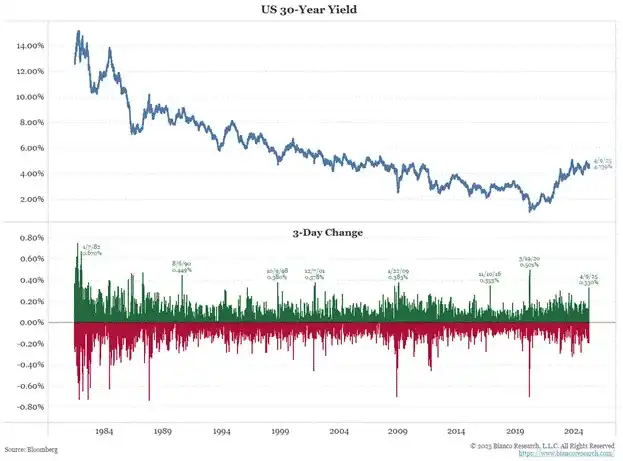
From Bianco Research, the bottom shows the abnormality of the 3-day change in the 30-year bond yield. The extent of the change triggered by tariff panic is akin to market volatility during financial crises such as the 2020 COVID-19 pandemic, the 2008 global financial crisis, and the 1998 Asian financial crisis. This is not a good sign.
The RV Fund's Treasury Bond Basis Trade position may be liquidated, which is a concern. What is the size of this trade?
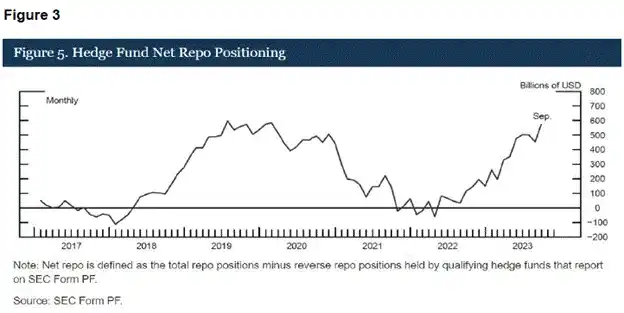
February 2022 is crucial for the U.S. Treasury market as President Biden has decided to freeze the holdings of Treasury bonds by Russia, the world's largest commodity-producing country. This effectively signifies that property rights are no longer a right for anyone but a privilege. As a result, overseas demand continues to wane, but the RV Fund, as a marginal buyer of U.S. Treasuries, has filled this gap. The chart above clearly shows the increase in repo positions, which can be seen as a representation of the scale of basis trades within the market.
· Basis Trade Overview:
A Treasury Bond Basis Trade involves buying a cash bond and simultaneously selling a bond futures contract. The margin impact from banks and trading platforms is crucial. The RV Fund's position size is limited by the cash amount required as margin. Margin requirements will vary based on market volatility and liquidity factors.
· Bank Margin:
To obtain the cash needed to purchase bonds, the fund engages in repurchase agreement (repo) trades. Banks agree to pay a small fee, provide upfront cash, awaiting settlement with purchased bonds as collateral. Banks will require a certain amount of cash margin as collateral for the repo.
The greater the bond price fluctuation, the higher the margin required by banks.
The poorer the bond's liquidity, the more margin banks will need. Liquidity is always concentrated at certain tenors of the yield curve. For the global market, the 10-year Treasury bond is most crucial and also the most liquid. When the latest 10-year Treasury is auctioned, it becomes the "on-the-run" 10-year bond, the most liquid bond. Over time, it moves further away from the liquidity center, becoming "off-the-run." As time progresses, the on-the-run naturally becomes off-the-run, increasing the cash amount needed for repo trades while awaiting basis collapse.
Essentially, in periods of high market volatility, banks are concerned that if they need to liquidate bonds, prices will fall too quickly, and liquidity will not be enough to absorb their market sell orders. Therefore, they will increase margin requirements.
· Futures Trading Platform Margin:
Each bond futures contract is set at an initial margin level that determines the cash margin amount required per contract. This initial margin level will fluctuate with market volatility.
The focus of a trading platform is its ability to close out positions before exhausting its initial margin. The faster the price fluctuates, the more challenging it is to maintain solvency; therefore, when market volatility intensifies, margin requirements also increase.
· Fear Elimination:
The impact of basis trading on the bond market and the financing methods of major participants have always been hot topics in the bond market. The Treasury Borrowing Advisory Committee (TBAC) in its Quarterly Refunding Announcement (QRA) has provided data confirming the following statement: Starting in 2022, the marginal buyers of U.S. Treasuries have consistently been RV hedge funds engaging in such basis trading. Below is a link to a detailed paper submitted to the Commodity Futures Trading Commission (CFTC) based on data provided by the TBAC since April 2024.
A recursive market event chain amplifies in a terrifying manner in each cycle, as outlined below:
1. As bond market volatility increases, RV hedge funds will need to deposit more cash with banks and trading platforms.
2. At a certain point, these funds will be unable to meet additional margin call requirements and must liquidate positions simultaneously. This involves selling spot bonds and repurchasing bond futures contracts.
3. As market makers reduce the size of their quoted spreads to protect themselves from the impact of adverse one-way flows, liquidity in the spot market decreases.
4. As liquidity and prices both decline, market volatility further increases.
Traders are well aware of this market phenomenon, and both regulators themselves and their financial journalist lackeys have been issuing warning signals about it. Therefore, as bond market volatility escalates, traders front-run forced selling by buying ahead, exacerbating downward pressure and causing the market to collapse faster.
If this is a known source of market stress, what policies could the U.S. Treasury Department implement internally to maintain funding (i.e., leverage) flowing to these RV funds?
Treasury Repo
Several years ago, the U.S. Treasury Department initiated a bond repurchase program. Many analysts speculate about the future, considering how this may nurture or incentivize certain money-printing behaviors. I will outline my theory on the impact of repos on the money supply. But first, let's understand how the program operates.
The Treasury Department issues new bonds and uses the proceeds to repurchase off-the-run bonds with lower liquidity. This causes the value of off-the-run bonds to rise, potentially even exceeding fair value, as the Treasury Department becomes the largest buyer in the illiquid market. RV funds will see a narrowing of the basis between off-the-run bonds and bond futures contracts.
Basis Trading = Long Cash Bond + Short Bond Futures
Due to the expectation that the Treasury will buy bonds, the long cash bond price will rise along with the old bond price.
Therefore, the RV fund will lock in profits by selling higher-priced old bonds and closing out its short bond futures contracts. This frees up valuable funding for banks and trading platforms. Since the RV funds are profitable, they will directly engage in basis trading at the next government bond auction. With price and liquidity increasing, the volatility of the bond market will decrease. This reduces the fund's margin requirement and allows it to hold larger positions. This is the best embodiment of pro-cyclical reflexivity.
Knowing that the Treasury is providing more leverage to the financial system, the market will now relax. Bond prices rise; all is well.
US Treasury Secretary Besset boasted about his new tool in an interview because theoretically, the Treasury can engage in unlimited repo operations. Without congressional approval of spending bills, the Treasury cannot issue bonds at will. However, the essence of repo is that the Treasury issues new bonds to pay off old debt, and the Treasury has already issued new bonds to repay the principal of maturing bonds. As the Treasury buys and sells bonds with a primary dealer bank in the same name, the cash flow of this transaction is neutral, so it does not need to borrow from the Fed to conduct repos. Therefore, if reaching the repo level can alleviate market concerns about a collapse in the bond market and lead to the market accepting lower yields on bonds not yet issued, the Treasury will wholeheartedly engage in repos. It can't stop and won't stop.
Explanation of Treasury Bond Supply
Besset is well aware that the debt ceiling will be raised at some point this year, and the government will continue to spend more recklessly. He also knows that Elon Musk's pace of cutting expenses through his Department of Government Efficiency (DOGE) is not fast enough due to various structural and legal reasons. Specifically, Musk's estimate of spending cuts for this year has dropped from an expected $1 trillion per year to a negligible $150 billion (taking into account the massive scale of the deficit). This leads to an obvious conclusion: the deficit may actually widen, forcing Besset to issue more government bonds.
Currently, as of March in the 25 fiscal year, the deficit exceeds the 24 fiscal year's deficit for the same period by 22%. Let's believe Musk for now—I know some of you would rather burn a Tesla while listening to Grimes' song than believe—the effort has only been two months. More worrisome is the uncertainty surrounding the intensity and impact of tariffs on businesses, coupled with the stock market decline, which will lead to a significant drop in tax revenue. This will point to a structural reason that even if DOGE succeeds in cutting more government spending, the deficit will continue to expand.
Deep inside, Besset is worried that, due to these factors, he will have to revise upward his borrowing expectations for the remainder of the year. With the upcoming deluge of government bond supply, market participants will demand a substantial increase in yields. Besset needs the RV fund to increase its exposure, utilize maximum leverage, and completely corner the bond market. Therefore, a repo is imperative.
The positive impact of a repo on USD liquidity is not as direct as central bank money printing. Repos are neutral for both the budget and supply, allowing the treasury to repo unlimitedly to create massive RV purchasing power. Ultimately, this enables the government to fund itself at sustainable rates. The more debt is issued, the more that debt is not purchased with private savings but with leverage funds created through the banking system, the greater the expansion of the money supply. And as we know, when the fiat supply expands, the only asset we want to own is Bitcoin. Let's go!
Obviously, this is not an infinite source of USD liquidity. The amount of unissued government debt available for purchase is limited. However, repos are a tool that can help Besset alleviate short-term market fluctuations and provide funding for the government at sustainable levels. This is the reason for the decline in the MOVE index. As the government bond market stabilizes, concerns about the collapse of the entire system also arise.
Same Scenario
I liken this trading strategy to the strategy of the third quarter of 2022. In the third quarter of 2022, a "righteous" white boy like Sam Bankman-Fried (SBF) went bankrupt; the Fed was still hiking rates, bond prices were falling, yields were rising. Yellen needed to find a way to stimulate the market so she could use a red-soled stiletto to open the market's throat and excrete the bonds without inducing vomiting. In short, just like now—due to the transition of the global monetary system, increased market volatility—this is a terrible time to increase bond issuance.
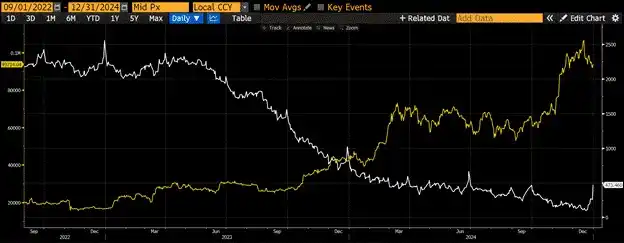
RRP Balance (White) vs. Bitcoin (Gold)
Like today, but for different reasons, Yellen couldn't count on the Fed to ease monetary policy, as Powell was busy participating in his Paul Volcker-inspired teetotaler juggling act. Yellen, or some clever aide, correctly deduced that the excess funds in RRP held by money market funds could be attracted into the leveraged financial system by issuing more U.S. treasuries, which these funds are happy to hold as the yields are slightly higher than RRP. This allowed her to inject $2.5 trillion of liquidity into the market from the third quarter of 2022 to early 2025. During this period, the price of Bitcoin surged nearly 6x.
This sounds like a rather optimistic scenario, but people are panicking. They know that high tariffs and the Chi-Merica divorce are not good for stock prices. They see Bitcoin as nothing but a high-beta version of the Nasdaq 100 index. They are bearish, not believing that a seemingly harmless buyback plan can increase future dollar liquidity. They are standing by, waiting for Powell to ease policy. He cannot directly ease policy or implement quantitative easing like his predecessors as Fed chairs from 2008 to 2019. Times have changed, and the burden of Treasury printing has grown heavier. If Powell truly cares about inflation and the long-term strength of the dollar, he would eliminate the effect of the actions taken by the Treasury under Yellen and now under Benson. But he did not do so then, and he won't do it now; he will be scrambling in the chair's seat, being manipulated.
Just like in the third quarter of 2022, people believe that after hitting a cyclical low around $15,000, Bitcoin may fall below $10,000 due to a series of unfavorable market factors stacking up. Some now believe that the Bitcoin price will drop below $74,500, falling below $60,000, signaling the end of the bull market. Yellen and Benson are not messing around. They will ensure the government gets funds at tolerable rates and suppress volatility in the bond market. Short-term Treasury issuance by Yellen exceeds long-term issuance, injecting limited RRP liquidity into the system; Benson will repurchase old debt with new debt issuance and maximize the RV fund's ability to absorb the increased bond supply. Neither of these is a quantitative easing policy that most investors are familiar with or endorse. Therefore, they turn a blind eye to it and will have to chase the price once Bitcoin confirms the breakout.
Verification
For a repurchase to have a net stimulative effect, the deficit must continue to rise. On May 1, we will learn about the upcoming borrowing plans and how they compare to previous estimates through the U.S. Treasury's Quarterly Refunding Announcement (QRA). If Benson needs to borrow more or is expected to borrow more, it means that tax revenue is expected to decline; thus, with spending remaining constant, this will result in an expanded deficit.
Then, in mid-May, we will receive the official deficit or surplus data for April from the Treasury, including actual data on tax receipts from April 15. We can compare the year-over-year change to date in FY25 and observe whether the deficit is widening. If the deficit increases, bond issuance will increase, and Benson must do everything possible to ensure the risk mitigation fund can increase its basis trade position.
Trading Strategy
When Trump was skiing, the steep slope suddenly dropped, triggering an avalanche. Now, we finally know the pain or fluctuation level (MOVE Index) that the Trump administration can withstand before implementing any policy to alleviate any market perception that would negatively impact the fiat financial system cornerstone. This will trigger a policy response, the effects of which will increase the USD fiat supply available to purchase U.S. Treasuries.
If the increase in repo frequency and scale is not sufficient to calm the market, then the Fed will eventually find a path to easing. They have already said they would. Most importantly, they reduced the rate of quantitative tightening (QT) at the recent March meeting, which is favorable for USD liquidity prospectively. However, besides quantitative easing, the Fed can do more. Here is a brief list of procedural policies that are not quantitative easing but can enhance market absorption of new Treasury issuances; one of which may be announced at the May 6-7 Fed meeting:
Exempting U.S. Treasuries from the supplementary leverage ratio (SLR) requirement for banks. This allows banks to use unlimited leverage to purchase Treasuries.
Implementing 'QT Reversal,' which involves reinvesting funds from maturing Mortgage-Backed Securities (MBS) into newly issued Treasuries. The Fed's balance sheet remains the same size, but this will bring $35 billion of monthly marginal buying pressure to the Treasury market for the next few years until all MBS outstanding expires.
The next time Trump presses the tariff button — and he will to ensure other countries respect his authority — he will be able to demand more concessions, and Bitcoin will not suffer as much as some stocks. Bitcoin knows that given the current and future insane levels of indebtedness required to keep the dirty fiat financial system running, a deflationary policy cannot be maintained in the long run.
The collapse of Sharp Mountain World (referring to the financial markets) ski resort triggered a secondary market avalanche, which could have quickly escalated to a five-level, the highest level. But the Trump team quickly responded, changed the course, and pushed the empire to another extreme. The foundation of the avalanche was crystallized U.S. dollar bills provided by U.S. Treasury repo, solidified by the driest, wettest 'pow pow.' Now is the time to climb difficultly from a backpack full of uncertainties to transitioning to jumping off a powdery pillow, cheering on how high Bitcoin will soar.
As you can see, I am very bullish on Bitcoin. At Maelstrom, we have already maximized our cryptocurrency exposure. Now, it's all about accumulating Bitcoin by trading different cryptocurrencies. During the downturn when the Bitcoin price dropped from $110k to $74.5k, the highest buying volume was for Bitcoin. Bitcoin will continue to lead the market as it is a direct beneficiary of more USD circulation brought in for mitigating the impacts of the U.S.-China decoupling in the future. Today, the international community sees Trump as a madman wildly wielding tariff weapons, and any investors holding U.S. stocks and bonds are looking for something counter-systemic. Tangibly, that's gold. Digitally, that's Bitcoin.
Gold has never been seen as a high-beta version of U.S. tech stocks; therefore, as the overall market crashed, it performed well as the oldest anti-establishment financial hedge tool. Bitcoin will break free from its association with U.S. tech stocks and rejoin gold in the "only goes up" camp.
What about the Shitcoins, though?
Once Bitcoin breaks its previous all-time high of $110,000, it is likely to surge, further solidifying its dominance. Maybe it won't reach $200,000. Then, Bitcoin starts to rotate into shitcoins. The rise of shitcoins (AltSzn: Chikun), let's go!
Aside from those shiny new shitcoin metadata, the best-performing tokens are those that both earn profits and give back profits to stakers. Such projects are few and far between. Maelstrom has been working diligently to accumulate positions in some qualified tokens and has not yet completed purchases of these gems. They are gems because they, like all other shitcoins in the recent sell-off, have been hit hard, but unlike 99% of shit projects, these gems actually have paying customers.
With a large token supply and the token launched on CEX in Down Only mode, convincing the market to give your project another chance is impossible. Shitcoin divers are looking for higher staking APYs where rewards come from actual profits since these cash flows are sustainable. To market our product, I will write a comprehensive article introducing some of these projects and why we believe their cash flows will continue to grow in the near future. So before that, turn the truck around and buy everything!
猜你喜歡

揭秘Movement做市商拋售醜聞:秘密合約、影子顧問和隱藏的中間人
RWA永續產品危機:為什麼GLP模式註定撐不住RWA永續?
第16週鏈上數據:結構性供需失衡加劇,數據揭⽰下⼀輪上漲的堅實藍圖?
Sui Q1進階報告:BTCfi基建崛起、借貸協議爆發與執行分片未來
川普次子的加密生意經
SignalPlus宏觀分析:關稅撕裂的M2敘事與TradFi式FOMO的回歸
懂王簽字後,美國哪些州在「乖乖」推進比特幣戰略儲備法案?
PENGU觸底反彈發拉漲360%,胖企鵝如何靠IP行銷迎第二春?
Arthur Hayes最新訪談:漲勢能否持續?誰能跑贏BTC?選幣邏輯是什麼?
專訪AllianceDAO合夥人qw:Crypto創業家正逃向AI,90%的Crypto+AI都是偽命題
穩定幣爭霸戰:六路新銳殺出,市場格局生變?
深入挖掘杜拜的加密夢:幻覺、資本與去中心化帝國
「年份」效應下的暗潮:加密基金迎來黎明前的沉默
WLFI持倉代幣解析:川普家族的加密投資獲利了嗎?
RTFKT「圖片遺失」事件之後Nike遭500萬美元集體訴訟,NFT的未來將何去何從?
4 月 24 日,有人發現曾經的頂級藍籌 NFT 工作室 RTFKT 旗下項目 CloneX 的圖片數據在各大交易平台上都無法顯示,取而代之的是一條標語“此內容已被限制,以這種方式使用 Cloudflare 的基礎服務違反了服務條款”,此事在社區引起熱議。
而在一天之後的 4 月 25 日其母公司 Nike 便被起訴,以澳大利亞居民 Jagdeep Cheema 為首的 RTFKT NFT 購買者在紐約布魯克林聯邦法院提起的一項擬議集體訴訟中表示,在 Nike 突然關閉了這些業務後給他們帶來了重大損失。曾經被 Nike 收購的最強 NFT 潮流 IP 專案為何淪落至此呢?
這個名字因為與人造物的英文“artifact”發音相似而來,同時這個名字也代表著其品牌理念。一開始只是一個以打造「元宇宙的 Nike」為目標的數位運動品牌,而當時隨著越來越多的傳統品牌選擇與 NFT 項目合作,adidas 與 BAYC、PUNKSComic 的聯動也驅使了 RTFKT 和村上隆聯合發行了 CloneX。
而正是這個契機讓加密圈更熟悉這個品牌,而後真正的 Nike 也收購了這個「元宇宙的 Nike」。高達 40 個以上的聯名項目獨霸榜首,從村上隆到 Jeff Staple,從 RIMOWA 到 Nike,幾乎是最炙手可熱的加密圈中的最頂級潮流 IP 之一,
RRTFKT Studio
RTFKT 聯創 Benoit Pagotto 曾經在接受采訪時談到 RTFKT 與傳統行業巨頭相比有哪些優勢時說道:“我們有他們沒有的資源,也就是我們有他們沒有的文化——加密文化。他們不可能會花大量時間、每一天都去學習這些知識。”而加密 KOL 對此諷刺道,Clone 每一天都去學習這些知識。” Cloudflare「儲存小圖片」和手排的荷蘭拍賺到了 1 億美元的銷售額。
而正當以為在 4 年後這個諷刺得到了應驗,無數 Holder 盯著 OpenSea 和 Blur 上可能自己高的“Yhby Clonep.”曾提到的加密文化,即使專案方「Rug」了,只要「Token」還在就有社區自治的可能性。而連圖片本身都消失後,這套邏輯似乎再難自洽。
這場風暴中幾乎是只有一個團隊成員站了出來承擔責任,Samuel Cardillo 宣稱自 4 月初以來,團隊就將 NFT 都去中心化,因此並未選擇與 Cloudflare 而搞錯,超過了!萬美元的合約的到期日,原定 4 月 30 日到期的合約被提前了好幾天。
而事情發生的當下雖然 RTFKT 被高強度“FUD”,但 Samuel 高強度的對線網友以及解決問題的態度贏得了社區的尊重,被稱為“最後一個站著的人”,與之形成鮮明對比的是許諾已久在 X 上發文的
在 RTFKT“丟失圖像”的後一日 Nike 便被提起集體訴訟,事實上在 Crypto 世界“被 Rug”已經屢見不鮮了,但能夠追回屬於自己的資產的卻寥寥無路,而這次集體訴訟主要有幾兩個指控,一號未揭露相關監管風險,違反了美國的證券法。雖然關於 NFT 是否能判定為證券目前還不明朗,但類似關於 NFT 的消費者獲得賠償的案例在此前確有發生。
此前奧尼爾與其兒子邁爾斯·奧尼爾“Myles O'Neal”共同創立並推廣了基於 Solana 區塊鏈的 Astrals NFT 項目,包含 10,000 個 3D 頭像 NFT 設計 Damien Guien。計畫承諾打造一個虛擬世界「Astralverse」,用戶可透過 NFT 進行社交、遊戲等活動,而歐尼爾以「DJ Diesel」的身份在社群以及社群媒體上推廣計畫。
就如同許多 NFT 專案一樣,Astrals 在 FTX 崩盤後價值暴跌。直至 2023 年 5 月,投資者 Daniel Harper 等人提起集體訴訟,指控奧尼爾推廣未註冊證券“Astrals NFT”違反美國證券法,原告稱奧尼爾的明星效應誘導投資。 2024 年 8 月,佛羅裡達聯邦法官 Federico Moreno 裁定,原告合理指控 Astrals NFT 為證券,且奧尼爾作為賣方透過推廣行為吸引投資。 11 月,歐尼爾同意支付 1,100 萬美元和解金,結束訴訟,其中 290 萬美元用於律師費用,其餘賠償 2022 年 5 月至 2024 年 1 月 15 日購買 Astrals NFT 的投資者。
但一些專業人士認為,與奧尼爾「個人」這類項目方不同。因為 NFT 的法律地位仍不明,此次 Nike 的案例可能並不會由違反證券法作為突破口,也可能不會有 500 萬美元的賠償,但無論如何 Nike 公司很有可能會「付點錢」平息眾怒。
儲存 NFT 資料最糟糕的選擇是在 Cloudflare 或亞馬遜這類中心化的伺服器上。如果一個 NFT 專案的元資料和媒體檔案儲存在一個伺服器上,而創建者停止維護該伺服器,那麼該資料將永遠消失,最終使 NFT 成為白板。因此大部分的 NFT 項目會兼顧圖片品質和營運成本選擇 IPFS 和上文中提到的 Arweave。
大部分的項目方最常用的是 IPFS“InterPlanetary File System”,這是一種基於內容尋址的去中心化儲存協議,IPFS 透過檔案本身產生的雜湊值作為唯一,使用者只需憑藉此一串串連內容,即可任意符號。這種方式讓資料不再依賴單一伺服器,天生具備抗審查、抗故障的特性,像水流一樣在全球節點間自由流動。但缺點也很明顯 IPFS 並不自動保證文件的持久存儲,內容是否存在,取決於是否有節點持續保存。因此,許多專案方需要主動「Pin 釘住」文件,或藉助專業服務,確保資料長期可用。
而 RTFKT 團隊宣稱透過 ArDrive 將圖片資料上傳到 Arweave,這是一個去中心化的檔案儲存網絡,和 IPFS 相比它可以保證檔案儲存的持久性。用戶支付一次性費用來支付 200 年「或更久」的儲存成本。 Arweave 網路中的礦工被激勵使用 AR 代幣來複製和儲存其他礦工很少儲存的資料副本。這確保了檔案不會隨著時間的推移而遺失,不需要原始上傳者的持續維護。
Arweave 在 BlockWeave 的結構中儲存數據,每個新的資料區塊都與前一個區塊相連。礦工必須證明他們有機會接觸到這些隨機選擇的歷史區塊,從而挖出新的區塊並獲得獎勵,這確保了較早的區塊被保留下來。
使用 IPFS 或 Arweave 比依靠中心化儲存要好得多,但它仍然需要指向鏈下。將 NFT 元資料和媒體儲存在與 NFT 相同的鏈上是最抗脆弱的方法,但在鏈上儲存資料的成本很高,因此保持元資料在鏈上而媒體資料在鏈下的 NFT 專案方是比較流行的趨勢,但是對加密文化來說,純鏈上的 NFT 社群是必缺的,他們的社群往往也更加強大。
像 Nouns 和 Loot 這樣的 NFT 項目在 SVG 上的以太坊圖像上很早就實現了以太坊圖像。以 Nouns 為例,專案使用自訂的遊程編碼「RLE」對每個影像部分進行無損壓縮,並將壓縮資料直接儲存在鏈上,透過這種方式無需依賴外部指標「如 IPFS 等」。隨後,這些壓縮資料被解碼為中間格式,並透過鏈上批次字串拼接產生 SVG 矩形集合,最終構成完整的 SVG 影像,再進行 base64 編碼。
儘管相當複雜,並且此類 SVG 的圖像上傳 Azuki 或 CloneX 這類高精度的 NFT 比較不現實,但這並不影響“鏈上”NFT 的魅力,他們往往超過了 NFT 本身,而是代表了某種文化或者社區力量,像是 Nouns DAO 致力於構建身份、社區
而 Loot 的創始人 Dom Hofmann 曾是 Vine 的聯創,他的一個副業中是創建一個基於文本的冒險遊戲,它也叫 Loot。而開發過程中他編寫了一個隨機物品產生器,一個可以返回各種武器、盔甲和配件名稱的軟體,這便是 Loot 的誕生。
在 Loot 專案中,影像以 SVG 格式直接嵌入智能合約,透過 tokenURI 返回,且可以根據鏈上資料動態變化,同樣實現了完全鏈上、動態生成的特性。
他的呈現模式也許十分十分簡單,僅是文字和簡單的圖形,但他背後的意義卻更有深度。 Dom 曾經被問道,為建立一個世界,誰會無償做出多少貢獻呢?他回答「歸根結底,這些只是清單上的項目。這只是人們如何看待它、如何賦予它價值。而價值不一定是一個用美元計量的金額,它可以是許多東西。」如他所說 Loot 概念影響到了 NFT 與 Crypto Game,現在還在活躍的 Smol 背後的 Treasure DAO 便是從這個概念應運而生的。
在此次 RTFKT 事件發生時,社區內出現最多的聲音便是,這件事利好 Ordinals。 Ordinals 被認為不同於大部分以太坊的 NFT,是完全上鍊的。
比特幣上的 Ordinals 協定透過 Taproot 腳本路徑,將圖像、文字等資料直接寫入交易中,將資料「銘刻 Inscription」進「聰 Satoshi」裡,並透過對 Satoshi 單位進行編號,使每一個 Satoshi 都具備獨一無二的身份。透過這種方式讓 Ordinals 的資料完全儲存在比特幣區塊鏈上,不過這同時也帶來了高昂的儲存成本和資料大小受限的問題。
也因為儲存成本的高昂以及儲存資料受限,BTC 的 NFT 生態更加獨具一格,相比於以太坊功能性或 DAO 組織的模式,BTCNFT 中的「生存者」,是依靠更深度的「文化」傳承。不管是前陣子以 0.2 BTC 的超高髮售價發行的 Taproot Wizard 背後傳承的自 2013 年的比特幣社區廣告《Magic Internet Money Wizard》,還是 NodeMonkes 作為第一個原始 10K 比特幣 NFT。
延伸閱讀:《一文解析比特幣 memeNFT,光頭巫師 Taproot Wizard 在致敬和表達什麼? 》
在這個時代還在堅持做 NFT 的專案方幾乎寥寥無幾,而也沒有人知道下個時代 NFT 會變成何種形式。他會是「證券」?所有權證明?亦或獨立的 AI Agent?有別於 Memecoin,只需要合約在鏈上可供交易社群便能「肆意發展」。對非同質化貨幣來說,無論他僅僅是一張圖片 IP 還是功能性「收據」,元資料的所有權都無比重要。這次的事件是個警鐘,不論對專案方或參與者而言皆是如此。
對話Vitalik:探索以太坊2025願景,POS、L2、密碼學與AI的整合創新
本週回顧 | 川普將為TRUMP持有者舉辦晚宴;馬斯克與美國財政部長在白宮爆發激烈爭吵


 App
App