

Bitcoin Breaks $94,000: Reversal or Rebound? | Trader's Insight

Under the dual catalyst of a signal of easing tensions in U.S.-China trade and temporary relief in uncertainty surrounding the Fed's policies, Bitcoin has surged above $94,000 in the short term, once again igniting the market's enthusiasm for the "digital gold."
Related Reading: "Bitcoin Soars 7%, Is the 'Digital Gold' Narrative Back?"
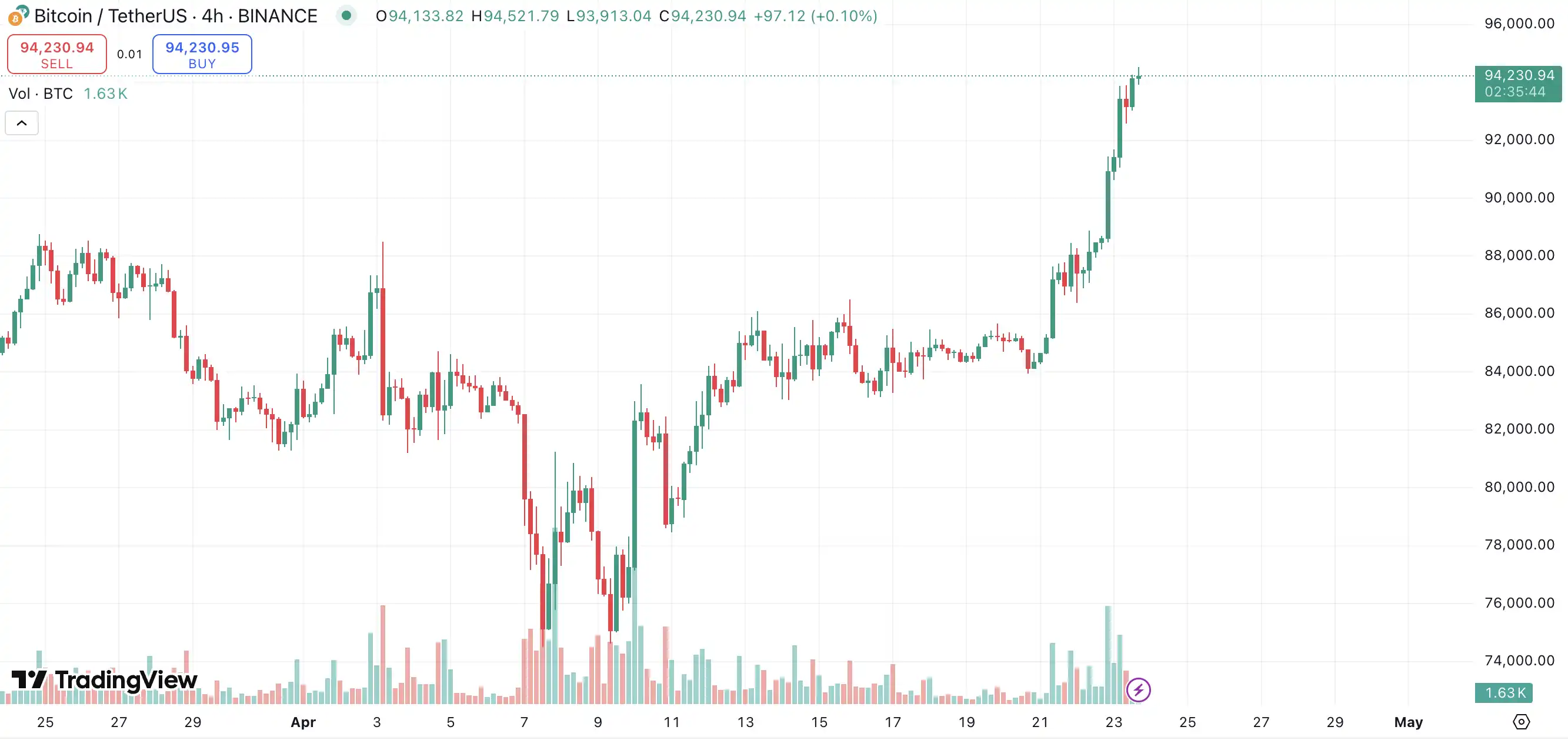
This rally is not only a short-term response of the market to the warming of U.S.-China trade relations but more like a risk repricing under the superimposition of multiple macro signals. In this storm where policy games and hedging demands are intertwined, Bitcoin is once again seen as a capital "safe haven," with its price surge perhaps being a market's preemptive response to future inflation, U.S. dollar credit, and global geopolitical changes.
However, whether this round of price surge is the starting point of a structural reversal or a stage rebound driven by policy games remains a subject of significant market divergence.
On the one hand, both the funding and policy side have released positive signals of "risk repricing." The Trump administration's softened stance on tariff policies, the temporary "hands-off" approach to Powell, and Wall Street's high-profile participation in Bitcoin funds are all seen as the manifestation of the shifting roles between traditional safe-haven assets and digital assets. Institutions like QCP and Matrixport view Bitcoin's recent rise as an active price adjustment under a macro trend change, pointing out that funds are flowing from traditional assets like gold into the crypto market.
On the other hand, some technical analysts and seasoned traders remain cautious, believing that the current rally has not yet provided the structural confirmation needed for a trend reversal. From wave patterns, RSI indicators to liquidity-heavy areas, the signals of long and short positions are complexly intertwined, and the current market situation is closer to a strong rebound rather than a trend reversal. Consistent technical judgments emphasize that only if Bitcoin effectively breaks above $95,000 and stabilizes, a new round of bullish trend may be initiated.
Institutional Analysis
QCP Capital released its daily market analysis, stating that Cantor, SoftBank, Tether, and Bitfinex have jointly launched a bold Bitcoin acquisition fund named 21 Capital (tentative name). This move comes at a time when there is a decisive change in the U.S. policy stance, with the Trump administration leaning towards supporting the "digital gold" narrative, providing momentum to the cryptocurrency market.
Bitcoin has successfully surpassed the $90,000 psychological barrier. Meanwhile, gold has slipped by 6%, highlighting investors' renewed interest in risk assets and clearly showing a flow of funds into digital assets.
Institutional investors are no longer just testing the waters of cryptocurrency but diving in headfirst. As the Strategy strategy gradually fades away, 21 Capital is poised to become a new benchmark of cryptocurrency belief.
Macro risks still exist, but a key uncertainty seems to have been alleviated. Trump stated that there are currently no plans to replace Federal Reserve Chairman Powell, helping the U.S. long-term bond yields to slightly rebound and reducing a significant tail risk.
While the bond market remains stable, the U.S. stock market continues to hold at record highs, reflecting a more moderate and cautious market response. However, the overall outlook is far from simple. Trade frictions, geopolitical tensions, and regulatory uncertainties continue to cast a shadow over the market. Investors navigate in a rapidly changing environment, remaining highly sensitive to the next possible turning point.
Due to the recent warming of the market, speculative trading activity has increased, and open futures contracts have grown. Although Bitcoin has not yet broken through the key level of $95,000, as concerns about Trump's tariff comments diminish, the likelihood of this level being surpassed in the future is increasing. Bitcoin's current trend shows a certain upward trajectory.
CICC: High tariffs may trigger a "recession-style" rate cut by the Federal Reserve
Consider two scenarios: one where negotiations between the U.S. and its trade partners lack substantial progress, and 90 days later, the effective U.S. tariff rate remains high, with the income effect prevailing, leading to weakened economic demand prompting the Fed to cut rates starting from July, with a cumulative rate cut of up to 100 basis points for the year.
The other scenario is where negotiations are successful, tariffs are reduced, demand shocks under substitution effects are relatively mild, but inflation pressures are more sustainable, and the Fed may delay its easing pace, only making a slight rate cut once in December. For the market, even though monetary easing comes earlier in the first scenario, this "recession-style" rate cut reflects deteriorating economic fundamentals and may actually suppress risk assets.
Macro Insight
Last night, the market saw a significant surge, accompanied by three relaxations from the Trump administration:
1. At 11:59 PM; Bessent spoke at a closed-door meeting with J.P. Morgan investors, stating that the current situation is unsustainable and a de-escalation with China will happen soon, allowing the market to "breathe a sigh of relief." Chinese concept stocks soared, gold dipped slightly, and the Nasdaq rose. The Treasury Secretary deliberately chose to make a "private" statement to investors within a Wall Street investment bank like J.P. Morgan, demonstrating a high level of attention to market sentiment, allowing the most sensitive capital market participants to digest and position themselves before the formal announcement.
2. Around 1 AM, Politico reported that completing the negotiation may take several months. At this time, the White House laid the groundwork: White House Press Secretary Levitt said in a press conference that Trump is laying the foundation for a trade agreement with China, and the relationship with China is moving in the right direction. Levitt also stated that Trump "has the right to express dissatisfaction with the Fed" and its chairman Powell, believing that some of the Fed's actions are politically motivated.
3. At 5 AM, Trump said U.S. tariffs on China will be "substantially" reduced from the current 145% level, and tariffs will not drop to zero. China will be very pleased with the final tariff rate. Trump also said he has no intention of firing Powell and hopes to see him more proactive on the rate-cutting issue.
The three relaxations gradually pushed the market upwards. As discussed the day before yesterday, looking ahead, in the next week or two, the market will most likely continue to oscillate upwards as in the past two weeks. Because Trump and Bessent are still pushing for negotiations, the market still has expectations for a new trade agreement. At the same time, there are signs of desensitization to tariffs, so short-term sentiment recovery is also a driving force for the upside.
Sure enough, when Trump eases up, the market can't hold back. Although many friends are calling for a bullish return, I'm not sure if my perception is correct. Even now, I still feel that we are not quite at the point of a "bull return." Especially for the overall risk market, liquidity constraints still exist. I still believe that this is a rebound rather than a reversal. Of course, I may not be right.
Additionally, I don't think it's the right time to go short at the moment. Even though I believe it's just a rebound, I won't open a position during non-U.S. stock trading hours. I'll wait to see the reaction of U.S. investors after the U.S. stock market opens.
Furthermore, I want to reiterate that the trading difficulty in April is still significant. A high trading difficulty does not necessarily mean a price drop. It indicates that the long and short game is more complex, and many of the reasons for this game stem from event-driven sources, especially the biggest uncertainty of Trump.
An increase in difficulty does not equate to a bearish view. I am concerned that some friends may not understand this. I have explained this issue multiple times. If you have poor reading comprehension, don't blame me. Whether the difficulty in the second quarter is high or not no longer needs me to say. The volatility due to Trump's remarks is self-evident, not to mention the GDP data at the end of the month.
Technical Analysis
1. Qualitative: Before breaking through the previous high and forming an obvious continuous five-wave upward impulse wave, any uptrend should be considered a rebound rather than a reversal;
2. Waves: Currently, Bitcoin has completed three upward segments, with the first segment from 74508 to 86496, the second segment from 86496 to 83950, and the third segment from 83950 to the current level. The third segment is approaching a 1:1 ratio compared to the first segment, and it has reached the lower boundary of the M-shaped top formation;
3. Indicators: On the daily and sub-daily levels (12H-1H), the RSI indicator is overbought.
Regarding Bitcoin's price movement, even though there was a temporary signal of topping out around 7 a.m. on the 1-hour timeframe, it was quickly broken by subsequent strong bullish momentum. The price retraced without breaking below the 1-hour MA7, showing strength, and the overall range contracted upward without any divergence correction demand.
There was no sign of a topping-out signal even on the 4-hour chart. The hourly trend is overall strong, considering the current risk market conditions, there is likely to be a wave of upward movement after the U.S. stock market opens tonight. In the short term, there is temporarily no significant resistance nearby on the upside, so one must closely monitor short-term topping-out signals.
A topping-out signal on the upside and a bottoming-out signal on the downside follow the same logic. A rapid breakthrough accompanied by a long shadow, the second candle lower than the previous high but higher than the previous low, then first confirm the 1-hour topping-out/bottoming-out signal, and so on for the 4-hour and daily levels. For example, in the current market situation, there was an initial topping-out signal around 7 a.m., but the subsequent market continued to fluctuate upward, breaking the topping-out signal. There was no such signal on the 4-hour chart. Therefore, assuming the macro trend remains unchanged, the technical outlook still favors an oscillating uptrend.
The expected oscillating uptrend path was quickly invalidated, as the accelerated rally came sooner than anticipated! BTC directly nailed the orange line at the 4h average pressure level, wiping out almost all liquidity in the current range in the futures market...
Now, the key supply area is the range of 93k to 95k.
Since the price entered the orange average pressure zone, it's not quite realistic to attempt large-scale long positions in the short term, as that would be lifting the sedan chair for my trend-long positions.
However, short-term long positions can still be made with confidence. Unlike bear markets, uptrends often see a V-shaped rebound after acceleration. After acceleration, uptrends tend to establish a high-level range, continuously testing new highs upward until demand weakens, leading to a pullback.
In the short term, with the rapid rise of the channel, the upper boundary of the oscillation channel represented by the yellow line may become a potential retracement target (89k to 90k). In subsequent pullbacks, as long as the price does not fall below the yellow line and returns to within the oscillation channel, there will always be hope to break through 95,000.
As for the scenario where the retracement falls below the yellow line, let's wait until it actually happens.
The current market situation may have exceeded many people's expectations, but if you observe the price rebound from the bottom, followed by a consolidation phase with shrinking volume, and today's accelerated surge, this is a clear 2-stage ABC pattern, where the rise of A is approximately equal to the increase of C.
Therefore, subjectively, when the orange line coincides with the supply area, the price faces significant pressure and is unlikely to shoot up all at once. A moderate retracement and oscillation to absorb short-side liquidity, gradually grinding upwards, and absorbing supply could potentially lead to the final breakthrough.
Again, emphasize that the current market trend, in my view, is still a rebound, not a reversal. The price action more closely resembles oscillation within the 95k to 78k range;
So, when the price approaches the upper boundary of the range, try to refrain from chasing long positions in the long term. Only when the price definitively consolidates above the orange line and 95,000, could it be deemed the start of a stronger uptrend.
Although I have been tricked by such a false breakout before, I certainly won't preconceive that it will definitely fake out at 95k and then tumble; it's always best to take it step by step and see how it plays out!
$BTC Technical Analysis Bullish Signal: Am I Bullish Again?
Technically speaking, or more precisely: from a trend structure perspective, BTC has shown a clear bullish signal on the daily chart.
Since I started operating on Twitter last December, I have been bearish all the way until now. As a dedicated bear, I feel it is necessary to come out and write an analysis,
to discuss my views on the upcoming market.
Previously, I shared my views on the S&P 500, and I introduced the "123 Rule" in the article. Interested readers can refer to it. At this moment, on the BTC daily chart, during yesterday's surge, it completed the "1." According to the 123 Rule, a trend reversal needs to meet 1, 2, 3, and the current BTC price has broken the previous Lower High (88.8K) to set a Higher High.
Next, if it can meet: "2: pullback without breaking the previous low, setting a Higher Low" + "3: set a new Higher High," then from the perspective of the 123 Rule, the trend reversal can be basically confirmed.
However, it must be emphasized that the above arguments are all based on the "technical" perspective.
As mentioned in the weekly reports I share, STH-RP has always been a major checkpoint to return to a bullish trend. The analytical logic of STH-RP can be referenced in this article.
Currently, the position of STH-RP is around 92,571. The current price has slightly surpassed STH-RP, and whether it can firmly hold this position will be the focus in the coming days. In addition, as mentioned in last week's report, from the perspective of URPD, it can also resonate with the viewpoint of STH-RP:
Currently, the information provided by URPD is as follows:
➡️ An accumulation of approximately 1.35 million BTC in the 81K to 85K range
➡️ 93 K still has a large amount of trapped chips above (detailed data can be seen in the weekly report)
Among them, the chips from 81 K to 85 K, are at least for now, mostly bought by relatively indecisive "short-term holders."
Therefore, when the price moves away from this range, these short-term holders will have a willingness to sell; at the same time, if the future price reaches the upper STH-RP position,
in addition to facing the suppression effect of STH-RP itself, there may also be a "deleveraging demand" for the trapped chips at 93 K.
Based on the above, the conclusions are as follows:
1️⃣ The position of STH-RP is the dividing line of the long and short trends, resonating with the perspective of URPD
2️⃣ If a strong breakthrough is not possible, it may create a disadvantageous situation for the bulls
3️⃣ If a strong breakthrough occurs, the bulls may take a leading position
In addition, if a real breakthrough is achieved, the accumulation range of 81-85 K, if not quickly consumed, may become a strong support for the bulls.
猜你喜歡

RWA永續產品危機:為什麼GLP模式註定撐不住RWA永續?
第16週鏈上數據:結構性供需失衡加劇,數據揭⽰下⼀輪上漲的堅實藍圖?
Sui Q1進階報告:BTCfi基建崛起、借貸協議爆發與執行分片未來
川普次子的加密生意經
SignalPlus宏觀分析:關稅撕裂的M2敘事與TradFi式FOMO的回歸
懂王簽字後,美國哪些州在「乖乖」推進比特幣戰略儲備法案?
PENGU觸底反彈發拉漲360%,胖企鵝如何靠IP行銷迎第二春?
Arthur Hayes最新訪談:漲勢能否持續?誰能跑贏BTC?選幣邏輯是什麼?
專訪AllianceDAO合夥人qw:Crypto創業家正逃向AI,90%的Crypto+AI都是偽命題
穩定幣爭霸戰:六路新銳殺出,市場格局生變?
深入挖掘杜拜的加密夢:幻覺、資本與去中心化帝國
「年份」效應下的暗潮:加密基金迎來黎明前的沉默
WLFI持倉代幣解析:川普家族的加密投資獲利了嗎?
RTFKT「圖片遺失」事件之後Nike遭500萬美元集體訴訟,NFT的未來將何去何從?
4 月 24 日,有人發現曾經的頂級藍籌 NFT 工作室 RTFKT 旗下項目 CloneX 的圖片數據在各大交易平台上都無法顯示,取而代之的是一條標語“此內容已被限制,以這種方式使用 Cloudflare 的基礎服務違反了服務條款”,此事在社區引起熱議。
而在一天之後的 4 月 25 日其母公司 Nike 便被起訴,以澳大利亞居民 Jagdeep Cheema 為首的 RTFKT NFT 購買者在紐約布魯克林聯邦法院提起的一項擬議集體訴訟中表示,在 Nike 突然關閉了這些業務後給他們帶來了重大損失。曾經被 Nike 收購的最強 NFT 潮流 IP 專案為何淪落至此呢?
這個名字因為與人造物的英文“artifact”發音相似而來,同時這個名字也代表著其品牌理念。一開始只是一個以打造「元宇宙的 Nike」為目標的數位運動品牌,而當時隨著越來越多的傳統品牌選擇與 NFT 項目合作,adidas 與 BAYC、PUNKSComic 的聯動也驅使了 RTFKT 和村上隆聯合發行了 CloneX。
而正是這個契機讓加密圈更熟悉這個品牌,而後真正的 Nike 也收購了這個「元宇宙的 Nike」。高達 40 個以上的聯名項目獨霸榜首,從村上隆到 Jeff Staple,從 RIMOWA 到 Nike,幾乎是最炙手可熱的加密圈中的最頂級潮流 IP 之一,
RRTFKT Studio
RTFKT 聯創 Benoit Pagotto 曾經在接受采訪時談到 RTFKT 與傳統行業巨頭相比有哪些優勢時說道:“我們有他們沒有的資源,也就是我們有他們沒有的文化——加密文化。他們不可能會花大量時間、每一天都去學習這些知識。”而加密 KOL 對此諷刺道,Clone 每一天都去學習這些知識。” Cloudflare「儲存小圖片」和手排的荷蘭拍賺到了 1 億美元的銷售額。
而正當以為在 4 年後這個諷刺得到了應驗,無數 Holder 盯著 OpenSea 和 Blur 上可能自己高的“Yhby Clonep.”曾提到的加密文化,即使專案方「Rug」了,只要「Token」還在就有社區自治的可能性。而連圖片本身都消失後,這套邏輯似乎再難自洽。
這場風暴中幾乎是只有一個團隊成員站了出來承擔責任,Samuel Cardillo 宣稱自 4 月初以來,團隊就將 NFT 都去中心化,因此並未選擇與 Cloudflare 而搞錯,超過了!萬美元的合約的到期日,原定 4 月 30 日到期的合約被提前了好幾天。
而事情發生的當下雖然 RTFKT 被高強度“FUD”,但 Samuel 高強度的對線網友以及解決問題的態度贏得了社區的尊重,被稱為“最後一個站著的人”,與之形成鮮明對比的是許諾已久在 X 上發文的
在 RTFKT“丟失圖像”的後一日 Nike 便被提起集體訴訟,事實上在 Crypto 世界“被 Rug”已經屢見不鮮了,但能夠追回屬於自己的資產的卻寥寥無路,而這次集體訴訟主要有幾兩個指控,一號未揭露相關監管風險,違反了美國的證券法。雖然關於 NFT 是否能判定為證券目前還不明朗,但類似關於 NFT 的消費者獲得賠償的案例在此前確有發生。
此前奧尼爾與其兒子邁爾斯·奧尼爾“Myles O'Neal”共同創立並推廣了基於 Solana 區塊鏈的 Astrals NFT 項目,包含 10,000 個 3D 頭像 NFT 設計 Damien Guien。計畫承諾打造一個虛擬世界「Astralverse」,用戶可透過 NFT 進行社交、遊戲等活動,而歐尼爾以「DJ Diesel」的身份在社群以及社群媒體上推廣計畫。
就如同許多 NFT 專案一樣,Astrals 在 FTX 崩盤後價值暴跌。直至 2023 年 5 月,投資者 Daniel Harper 等人提起集體訴訟,指控奧尼爾推廣未註冊證券“Astrals NFT”違反美國證券法,原告稱奧尼爾的明星效應誘導投資。 2024 年 8 月,佛羅裡達聯邦法官 Federico Moreno 裁定,原告合理指控 Astrals NFT 為證券,且奧尼爾作為賣方透過推廣行為吸引投資。 11 月,歐尼爾同意支付 1,100 萬美元和解金,結束訴訟,其中 290 萬美元用於律師費用,其餘賠償 2022 年 5 月至 2024 年 1 月 15 日購買 Astrals NFT 的投資者。
但一些專業人士認為,與奧尼爾「個人」這類項目方不同。因為 NFT 的法律地位仍不明,此次 Nike 的案例可能並不會由違反證券法作為突破口,也可能不會有 500 萬美元的賠償,但無論如何 Nike 公司很有可能會「付點錢」平息眾怒。
儲存 NFT 資料最糟糕的選擇是在 Cloudflare 或亞馬遜這類中心化的伺服器上。如果一個 NFT 專案的元資料和媒體檔案儲存在一個伺服器上,而創建者停止維護該伺服器,那麼該資料將永遠消失,最終使 NFT 成為白板。因此大部分的 NFT 項目會兼顧圖片品質和營運成本選擇 IPFS 和上文中提到的 Arweave。
大部分的項目方最常用的是 IPFS“InterPlanetary File System”,這是一種基於內容尋址的去中心化儲存協議,IPFS 透過檔案本身產生的雜湊值作為唯一,使用者只需憑藉此一串串連內容,即可任意符號。這種方式讓資料不再依賴單一伺服器,天生具備抗審查、抗故障的特性,像水流一樣在全球節點間自由流動。但缺點也很明顯 IPFS 並不自動保證文件的持久存儲,內容是否存在,取決於是否有節點持續保存。因此,許多專案方需要主動「Pin 釘住」文件,或藉助專業服務,確保資料長期可用。
而 RTFKT 團隊宣稱透過 ArDrive 將圖片資料上傳到 Arweave,這是一個去中心化的檔案儲存網絡,和 IPFS 相比它可以保證檔案儲存的持久性。用戶支付一次性費用來支付 200 年「或更久」的儲存成本。 Arweave 網路中的礦工被激勵使用 AR 代幣來複製和儲存其他礦工很少儲存的資料副本。這確保了檔案不會隨著時間的推移而遺失,不需要原始上傳者的持續維護。
Arweave 在 BlockWeave 的結構中儲存數據,每個新的資料區塊都與前一個區塊相連。礦工必須證明他們有機會接觸到這些隨機選擇的歷史區塊,從而挖出新的區塊並獲得獎勵,這確保了較早的區塊被保留下來。
使用 IPFS 或 Arweave 比依靠中心化儲存要好得多,但它仍然需要指向鏈下。將 NFT 元資料和媒體儲存在與 NFT 相同的鏈上是最抗脆弱的方法,但在鏈上儲存資料的成本很高,因此保持元資料在鏈上而媒體資料在鏈下的 NFT 專案方是比較流行的趨勢,但是對加密文化來說,純鏈上的 NFT 社群是必缺的,他們的社群往往也更加強大。
像 Nouns 和 Loot 這樣的 NFT 項目在 SVG 上的以太坊圖像上很早就實現了以太坊圖像。以 Nouns 為例,專案使用自訂的遊程編碼「RLE」對每個影像部分進行無損壓縮,並將壓縮資料直接儲存在鏈上,透過這種方式無需依賴外部指標「如 IPFS 等」。隨後,這些壓縮資料被解碼為中間格式,並透過鏈上批次字串拼接產生 SVG 矩形集合,最終構成完整的 SVG 影像,再進行 base64 編碼。
儘管相當複雜,並且此類 SVG 的圖像上傳 Azuki 或 CloneX 這類高精度的 NFT 比較不現實,但這並不影響“鏈上”NFT 的魅力,他們往往超過了 NFT 本身,而是代表了某種文化或者社區力量,像是 Nouns DAO 致力於構建身份、社區
而 Loot 的創始人 Dom Hofmann 曾是 Vine 的聯創,他的一個副業中是創建一個基於文本的冒險遊戲,它也叫 Loot。而開發過程中他編寫了一個隨機物品產生器,一個可以返回各種武器、盔甲和配件名稱的軟體,這便是 Loot 的誕生。
在 Loot 專案中,影像以 SVG 格式直接嵌入智能合約,透過 tokenURI 返回,且可以根據鏈上資料動態變化,同樣實現了完全鏈上、動態生成的特性。
他的呈現模式也許十分十分簡單,僅是文字和簡單的圖形,但他背後的意義卻更有深度。 Dom 曾經被問道,為建立一個世界,誰會無償做出多少貢獻呢?他回答「歸根結底,這些只是清單上的項目。這只是人們如何看待它、如何賦予它價值。而價值不一定是一個用美元計量的金額,它可以是許多東西。」如他所說 Loot 概念影響到了 NFT 與 Crypto Game,現在還在活躍的 Smol 背後的 Treasure DAO 便是從這個概念應運而生的。
在此次 RTFKT 事件發生時,社區內出現最多的聲音便是,這件事利好 Ordinals。 Ordinals 被認為不同於大部分以太坊的 NFT,是完全上鍊的。
比特幣上的 Ordinals 協定透過 Taproot 腳本路徑,將圖像、文字等資料直接寫入交易中,將資料「銘刻 Inscription」進「聰 Satoshi」裡,並透過對 Satoshi 單位進行編號,使每一個 Satoshi 都具備獨一無二的身份。透過這種方式讓 Ordinals 的資料完全儲存在比特幣區塊鏈上,不過這同時也帶來了高昂的儲存成本和資料大小受限的問題。
也因為儲存成本的高昂以及儲存資料受限,BTC 的 NFT 生態更加獨具一格,相比於以太坊功能性或 DAO 組織的模式,BTCNFT 中的「生存者」,是依靠更深度的「文化」傳承。不管是前陣子以 0.2 BTC 的超高髮售價發行的 Taproot Wizard 背後傳承的自 2013 年的比特幣社區廣告《Magic Internet Money Wizard》,還是 NodeMonkes 作為第一個原始 10K 比特幣 NFT。
延伸閱讀:《一文解析比特幣 memeNFT,光頭巫師 Taproot Wizard 在致敬和表達什麼? 》
在這個時代還在堅持做 NFT 的專案方幾乎寥寥無幾,而也沒有人知道下個時代 NFT 會變成何種形式。他會是「證券」?所有權證明?亦或獨立的 AI Agent?有別於 Memecoin,只需要合約在鏈上可供交易社群便能「肆意發展」。對非同質化貨幣來說,無論他僅僅是一張圖片 IP 還是功能性「收據」,元資料的所有權都無比重要。這次的事件是個警鐘,不論對專案方或參與者而言皆是如此。
對話Vitalik:探索以太坊2025願景,POS、L2、密碼學與AI的整合創新
本週回顧 | 川普將為TRUMP持有者舉辦晚宴;馬斯克與美國財政部長在白宮爆發激烈爭吵
加密市場情緒回暖,MCP成為AI賽道新標向


 App
App