

Cryptocurrency Giant Tether: Doctor Switches to Cryptocurrency, Billions in Profit Fuel Investment Craze

Original Article Title: "Global Per Capita Most Profitable Company Tether: CEO's Background as Plastic Surgeon, Accelerates Multi-Billion-Dollar Profit Diversification"
Original Article Author: Nancy, PANews
Relying solely on a team of a hundred people serving hundreds of millions of users worldwide and leveraging billions of dollars in profits, Tether, this "money printing machine," is operating with astonishing efficiency.
In the crypto world, a "money printing machine" is operating with astonishing efficiency: the stablecoin giant Tether. This team of only a hundred people serves hundreds of millions of users globally, leveraging billions of dollars in profits. And behind all of this is Giancarlo Devasini, the mastermind, who has not only transitioned from a plastic surgeon to a heavyweight in crypto finance but has also led Tether from the fringes of innovation to the center stage of the global financial arena through strategic positioning.
Today, Tether not only firmly holds the stablecoin hegemony but has also extended its reach into diversified fields such as mining, media, agriculture, and more through massive investments, embarking on an ambitious global expansion.
A Hundred-Person Team Earning Billions in Profits, Seventh Largest Buyer of US Treasury Bonds
As the world's largest stablecoin issuer, Tether has transformed from its humble beginnings as a niche financial experiment into a behemoth in the crypto industry, demonstrating astonishing profitability and market influence.
Over the past decade, Tether's publicly disclosed net profit has reached billions of dollars. Although Tether lacked detailed financial data disclosure in its early development stages, starting from 2022, the company began to fully disclose financial reports to enhance transparency. According to comprehensive public data, in just over two years from the fourth quarter of 2022 to the end of 2024, Tether's cumulative net profit reached at least $19.9 billion.
Especially in 2024, with only a streamlined team of about 150 employees, Tether achieved a total profit of over $13 billion, equivalent to an average profit of approximately $93 million per employee, making it one of the most profitable companies per capita globally, far surpassing traditional financial giants like BlackRock and even rivaling Visa in transaction volume.
In terms of profit composition, US Treasury bonds are undoubtedly Tether's core profit engine. Since the Fed began raising interest rates in 2022, Tether has invested a large amount of reserve funds in US Treasury bonds, gradually becoming one of the major buyers of US Treasury bonds. In 2024 alone, Tether purchased $33.1 billion in US Treasury bonds, making it the seventh largest buyer of US Treasury bonds, surpassing countries such as Canada, Mexico, Norway, South Korea, Germany, and Saudi Arabia. As of the end of December last year, the quarterly reserve report showed that Tether's total holdings of US Treasury bonds were valued at $94 billion.
In addition to asset allocation, the widespread adoption of the USDT stablecoin is also a key pillar of Tether's profit capture. As a USD-pegged digital asset, USDT not only surpasses the limitations of traditional financial instruments in functionality but also plays multiple roles in global financial transactions: in high inflation countries such as Venezuela and Turkey, USDT has become the preferred tool for residents to hedge against local currency depreciation and circumvent capital controls, providing an avenue for economic turmoil regions' inhabitants to seek refuge. In restricted markets and gray areas, USDT serves as a flexible and hard-to-trace financial medium.
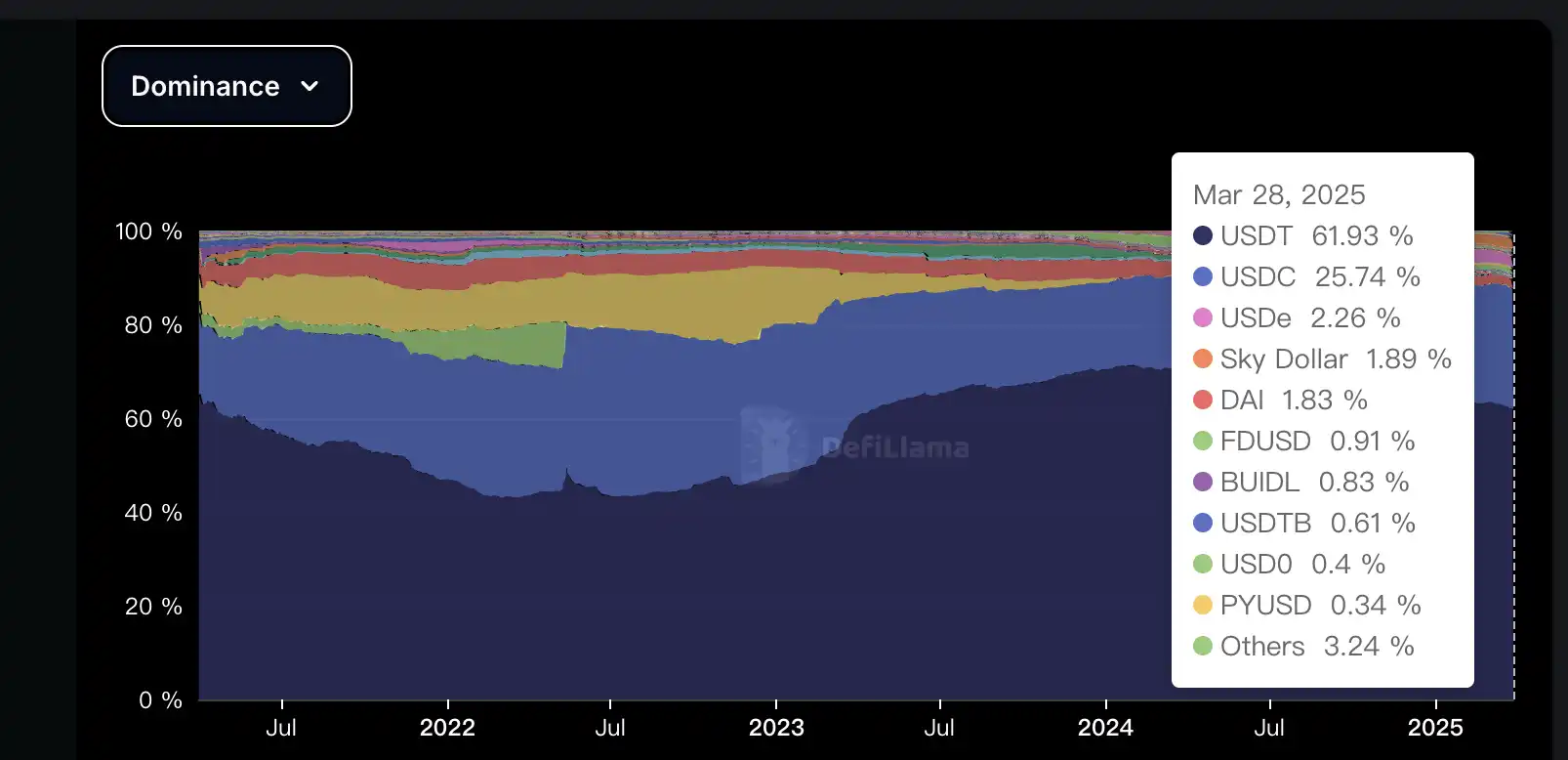
Today, USDT is leading the global stablecoin market, becoming the most widely used stablecoin. According to DeFiLlama data, as of March 28, 2025, the circulating supply of USDT has exceeded $143.7 billion, with a market cap over $144.8 billion, capturing approximately 61.9% of the stablecoin market share. Furthermore, Tether's CEO, Paolo Ardoino, revealed that the conservative estimate of USDT's global user base has surpassed 400 million, with a rapid growth trajectory, and he expects it to soon reach 1 billion.
Behind the Scenes to the Forefront, the Actual Helmsman Once an Italian Plastic Surgeon
The mastermind and actual helmsman behind this largest crypto printer are widely recognized as Tether's former CFO Devasini. According to Forbes estimates, Devasini holds 47% of the shares, making him Tether's largest shareholder with a net worth of up to $9.2 billion. However, this core figure in Tether maintains a low-key lifestyle in Lugano, Switzerland, known as a Bitcoin hub, rarely granting interviews, and even having his business card read "No title, no job, nothing."

Devasini's journey is quite legendary. According to a previous report by The Wall Street Journal, Giancarlo Devasini, born in Turin, Italy, started as a plastic surgeon and later engaged in electronics import business in Hong Kong. In 1995, Italian prosecutors accused him of involvement in operating a software piracy group, committing fraud. Subsequently, Devasini founded the tech company Solo in Italy, with annual revenue once exceeding 1 billion euros, before selling it before the 2008 financial crisis. Now, this around 60-year-old Italian has become one of the key figures in crypto finance.
It all starts in 2012 when the Bitcoin whitepaper ignited Devasini's interest in cryptocurrency. He once posted on a Bitcoin forum inquiring if anyone would be willing to buy DVDs or CDs at a price of 0.01 BTC each (about 11 cents at the time) and promised free delivery for bulk orders.
It was during that time that Devasini also met Bitfinex founder Raphael Nicolle. Leveraging his extensive business experience and network, he established key banking relationships for Bitfinex, driving the platform's internationalization, including relocating its jurisdiction to the British Virgin Islands, with headquarters in Hong Kong, gradually becoming a key figure at Bitfinex. In 2014, he co-founded Tether with Bitfinex executives and launched USDT.
Devasini was deeply involved in Tether's issuance decisions and fund management, particularly playing a key role in partnerships with major clients. For example, Alameda Research once applied for and received billions of USDT in support from Tether, with Devasini seen as the driving force behind the scenes. Bloomberg cited chat records submitted by Alameda's former CEO Caroline Ellison, showing that Devasini had told Alameda traders, "We are one big family...we will conquer the world." FTX founder SBF also publicly supported Devasini, stating, "Devasini is very proud of what he has built in Bitfinex and Tether. He is always on, not just reacting to crises or incredible opportunities, but also reacting to day-to-day operations. The criticisms of Tether that are 'without basis' seem frivolous."
Furthermore, reports have indicated that Devasini actively sought political allies to secure a regulatory "umbrella" for Tether. The Wall Street Journal previously reported that Devasini had privately indicated last year that Cantor Fitzgerald's Chairman and U.S. Secretary of Commerce Howard Lutnick would use his political influence to address the threats facing Tether. U.S. Senator Elizabeth Warren also pressured Howard Lutnick during his nomination, demanding an explanation of his relationship with Tether. It is noteworthy that Cantor manages part of Tether's reserves and holds a 5% ownership. However, Tether denied the market's claim that Lutnick's influence affects regulatory actions.
Today, as Tether expands at an astonishing pace, Devasini has also moved from behind the scenes to the strategic forefront, assuming the role of Group Chairman, focusing on macroeconomic strategies aimed at deepening USDT's global digital asset applications.
Diversification Strategy Accelerates, Mining and Media Receive Major Investments
Amid increasing regulatory scrutiny and intensified market competition, Tether is weaving a cross-industry business network through diversified investments.
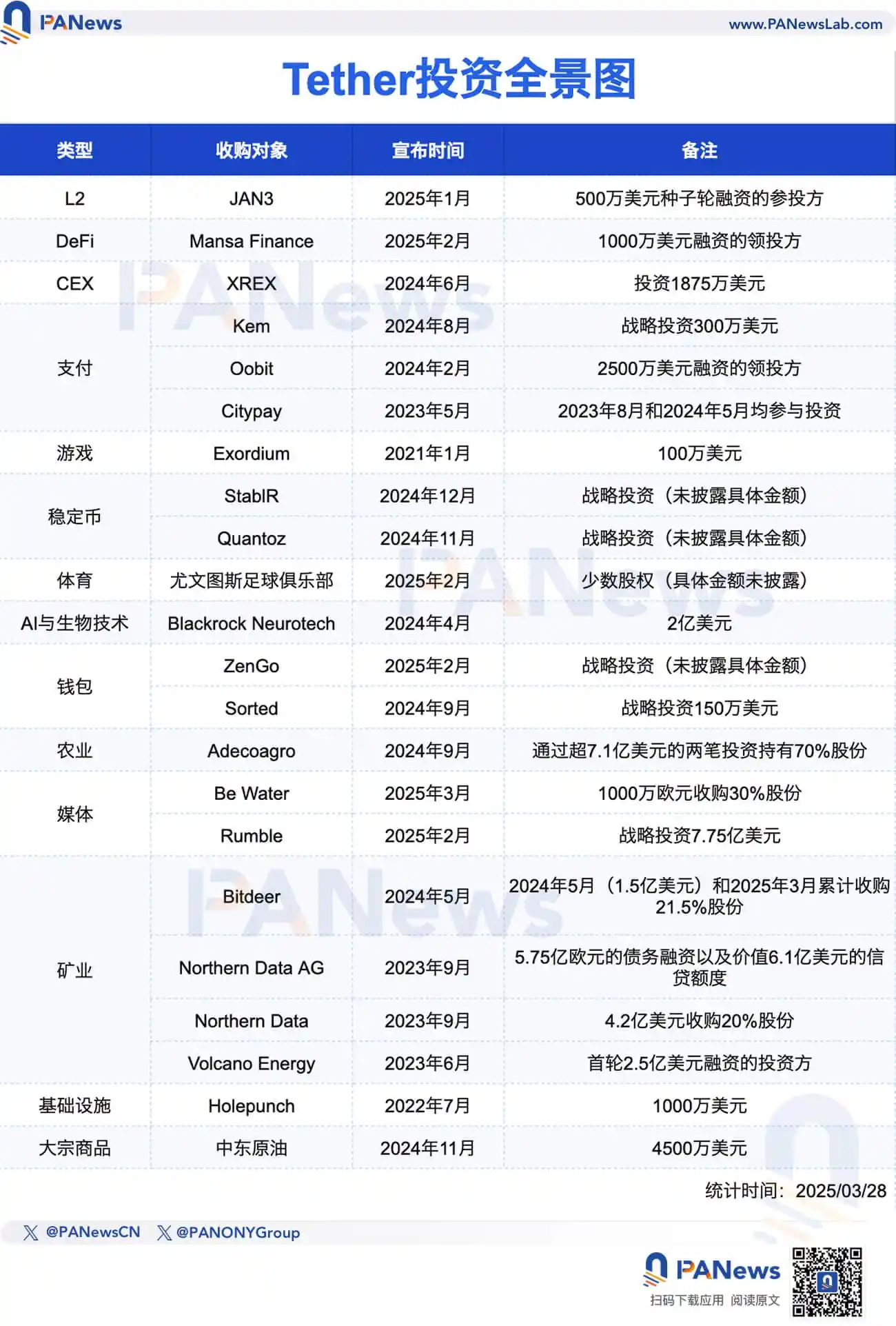
According to PANews' incomplete statistics, since 2021, Tether has publicly disclosed a total of 22 investment projects spanning various fields such as crypto, media, sports, agriculture, commodities, biotechnology, among others. Among these, the crypto sector is Tether's most core investment focus, especially in mining, payments, stablecoins, wallets, with actions being particularly frequent, accounting for over half of the overall investment count.
In terms of funding size, Tether's investment in mining is the most generous, with a cumulative investment amount exceeding $2.1 billion, far surpassing other sectors. The largest of these is the investment in the German mining company Northern Data AG, where Tether provided $575 million in debt financing and a $610 million credit line. Volcano Energy, Northern Data, and Bitdeer also received investments in the hundreds of millions. Following mining is the media industry, with Tether's total investment reaching $780 million, the majority of which went to Rumble ($775 million).
PANews previously reported that this substantial investment carries strong political undertones and resembles more of a business strategy tied to the Trump circle. Rumble has deep connections with former U.S. President Trump, often referred to as the "Trump concept stock," and even the investment fund Narya Capital Management of U.S. Vice President J.D. Vance has participated in Rumble's investments. In the agricultural sector, Tether holds up to 70% of Argentine agricultural giant Adecoagro through two investments, totaling over $710 million. Additionally, Tether acquired a majority stake in the biotechnology company Blackrock Neurotech for $200 million, with a valuation of $3.5 billion.
From a temporal perspective, between 2021 and September 2024, Tether primarily focused on crypto development, especially in mining and payment directions. Subsequently, its investment pace has markedly accelerated, and the strategic direction has become increasingly diversified, expanding from a single sector to a global layout spanning multiple industries.
Despite Tether's establishment of a robust crypto business empire through diversified investments and its dominant position in the stablecoin market, as the crypto market matures and the regulatory environment continues to evolve, Tether will face increasingly complex challenges in the future. This will depend on how it balances innovation, compliance, and expansion in the ever-changing global stage.
猜你喜歡
RWA永續產品危機:為什麼GLP模式註定撐不住RWA永續?
第16週鏈上數據:結構性供需失衡加劇,數據揭⽰下⼀輪上漲的堅實藍圖?
Sui Q1進階報告:BTCfi基建崛起、借貸協議爆發與執行分片未來
川普次子的加密生意經
SignalPlus宏觀分析:關稅撕裂的M2敘事與TradFi式FOMO的回歸
懂王簽字後,美國哪些州在「乖乖」推進比特幣戰略儲備法案?
PENGU觸底反彈發拉漲360%,胖企鵝如何靠IP行銷迎第二春?
Arthur Hayes最新訪談:漲勢能否持續?誰能跑贏BTC?選幣邏輯是什麼?
專訪AllianceDAO合夥人qw:Crypto創業家正逃向AI,90%的Crypto+AI都是偽命題
穩定幣爭霸戰:六路新銳殺出,市場格局生變?
深入挖掘杜拜的加密夢:幻覺、資本與去中心化帝國
「年份」效應下的暗潮:加密基金迎來黎明前的沉默
WLFI持倉代幣解析:川普家族的加密投資獲利了嗎?
RTFKT「圖片遺失」事件之後Nike遭500萬美元集體訴訟,NFT的未來將何去何從?
4 月 24 日,有人發現曾經的頂級藍籌 NFT 工作室 RTFKT 旗下項目 CloneX 的圖片數據在各大交易平台上都無法顯示,取而代之的是一條標語“此內容已被限制,以這種方式使用 Cloudflare 的基礎服務違反了服務條款”,此事在社區引起熱議。
而在一天之後的 4 月 25 日其母公司 Nike 便被起訴,以澳大利亞居民 Jagdeep Cheema 為首的 RTFKT NFT 購買者在紐約布魯克林聯邦法院提起的一項擬議集體訴訟中表示,在 Nike 突然關閉了這些業務後給他們帶來了重大損失。曾經被 Nike 收購的最強 NFT 潮流 IP 專案為何淪落至此呢?
這個名字因為與人造物的英文“artifact”發音相似而來,同時這個名字也代表著其品牌理念。一開始只是一個以打造「元宇宙的 Nike」為目標的數位運動品牌,而當時隨著越來越多的傳統品牌選擇與 NFT 項目合作,adidas 與 BAYC、PUNKSComic 的聯動也驅使了 RTFKT 和村上隆聯合發行了 CloneX。
而正是這個契機讓加密圈更熟悉這個品牌,而後真正的 Nike 也收購了這個「元宇宙的 Nike」。高達 40 個以上的聯名項目獨霸榜首,從村上隆到 Jeff Staple,從 RIMOWA 到 Nike,幾乎是最炙手可熱的加密圈中的最頂級潮流 IP 之一,
RRTFKT Studio
RTFKT 聯創 Benoit Pagotto 曾經在接受采訪時談到 RTFKT 與傳統行業巨頭相比有哪些優勢時說道:“我們有他們沒有的資源,也就是我們有他們沒有的文化——加密文化。他們不可能會花大量時間、每一天都去學習這些知識。”而加密 KOL 對此諷刺道,Clone 每一天都去學習這些知識。” Cloudflare「儲存小圖片」和手排的荷蘭拍賺到了 1 億美元的銷售額。
而正當以為在 4 年後這個諷刺得到了應驗,無數 Holder 盯著 OpenSea 和 Blur 上可能自己高的“Yhby Clonep.”曾提到的加密文化,即使專案方「Rug」了,只要「Token」還在就有社區自治的可能性。而連圖片本身都消失後,這套邏輯似乎再難自洽。
這場風暴中幾乎是只有一個團隊成員站了出來承擔責任,Samuel Cardillo 宣稱自 4 月初以來,團隊就將 NFT 都去中心化,因此並未選擇與 Cloudflare 而搞錯,超過了!萬美元的合約的到期日,原定 4 月 30 日到期的合約被提前了好幾天。
而事情發生的當下雖然 RTFKT 被高強度“FUD”,但 Samuel 高強度的對線網友以及解決問題的態度贏得了社區的尊重,被稱為“最後一個站著的人”,與之形成鮮明對比的是許諾已久在 X 上發文的
在 RTFKT“丟失圖像”的後一日 Nike 便被提起集體訴訟,事實上在 Crypto 世界“被 Rug”已經屢見不鮮了,但能夠追回屬於自己的資產的卻寥寥無路,而這次集體訴訟主要有幾兩個指控,一號未揭露相關監管風險,違反了美國的證券法。雖然關於 NFT 是否能判定為證券目前還不明朗,但類似關於 NFT 的消費者獲得賠償的案例在此前確有發生。
此前奧尼爾與其兒子邁爾斯·奧尼爾“Myles O'Neal”共同創立並推廣了基於 Solana 區塊鏈的 Astrals NFT 項目,包含 10,000 個 3D 頭像 NFT 設計 Damien Guien。計畫承諾打造一個虛擬世界「Astralverse」,用戶可透過 NFT 進行社交、遊戲等活動,而歐尼爾以「DJ Diesel」的身份在社群以及社群媒體上推廣計畫。
就如同許多 NFT 專案一樣,Astrals 在 FTX 崩盤後價值暴跌。直至 2023 年 5 月,投資者 Daniel Harper 等人提起集體訴訟,指控奧尼爾推廣未註冊證券“Astrals NFT”違反美國證券法,原告稱奧尼爾的明星效應誘導投資。 2024 年 8 月,佛羅裡達聯邦法官 Federico Moreno 裁定,原告合理指控 Astrals NFT 為證券,且奧尼爾作為賣方透過推廣行為吸引投資。 11 月,歐尼爾同意支付 1,100 萬美元和解金,結束訴訟,其中 290 萬美元用於律師費用,其餘賠償 2022 年 5 月至 2024 年 1 月 15 日購買 Astrals NFT 的投資者。
但一些專業人士認為,與奧尼爾「個人」這類項目方不同。因為 NFT 的法律地位仍不明,此次 Nike 的案例可能並不會由違反證券法作為突破口,也可能不會有 500 萬美元的賠償,但無論如何 Nike 公司很有可能會「付點錢」平息眾怒。
儲存 NFT 資料最糟糕的選擇是在 Cloudflare 或亞馬遜這類中心化的伺服器上。如果一個 NFT 專案的元資料和媒體檔案儲存在一個伺服器上,而創建者停止維護該伺服器,那麼該資料將永遠消失,最終使 NFT 成為白板。因此大部分的 NFT 項目會兼顧圖片品質和營運成本選擇 IPFS 和上文中提到的 Arweave。
大部分的項目方最常用的是 IPFS“InterPlanetary File System”,這是一種基於內容尋址的去中心化儲存協議,IPFS 透過檔案本身產生的雜湊值作為唯一,使用者只需憑藉此一串串連內容,即可任意符號。這種方式讓資料不再依賴單一伺服器,天生具備抗審查、抗故障的特性,像水流一樣在全球節點間自由流動。但缺點也很明顯 IPFS 並不自動保證文件的持久存儲,內容是否存在,取決於是否有節點持續保存。因此,許多專案方需要主動「Pin 釘住」文件,或藉助專業服務,確保資料長期可用。
而 RTFKT 團隊宣稱透過 ArDrive 將圖片資料上傳到 Arweave,這是一個去中心化的檔案儲存網絡,和 IPFS 相比它可以保證檔案儲存的持久性。用戶支付一次性費用來支付 200 年「或更久」的儲存成本。 Arweave 網路中的礦工被激勵使用 AR 代幣來複製和儲存其他礦工很少儲存的資料副本。這確保了檔案不會隨著時間的推移而遺失,不需要原始上傳者的持續維護。
Arweave 在 BlockWeave 的結構中儲存數據,每個新的資料區塊都與前一個區塊相連。礦工必須證明他們有機會接觸到這些隨機選擇的歷史區塊,從而挖出新的區塊並獲得獎勵,這確保了較早的區塊被保留下來。
使用 IPFS 或 Arweave 比依靠中心化儲存要好得多,但它仍然需要指向鏈下。將 NFT 元資料和媒體儲存在與 NFT 相同的鏈上是最抗脆弱的方法,但在鏈上儲存資料的成本很高,因此保持元資料在鏈上而媒體資料在鏈下的 NFT 專案方是比較流行的趨勢,但是對加密文化來說,純鏈上的 NFT 社群是必缺的,他們的社群往往也更加強大。
像 Nouns 和 Loot 這樣的 NFT 項目在 SVG 上的以太坊圖像上很早就實現了以太坊圖像。以 Nouns 為例,專案使用自訂的遊程編碼「RLE」對每個影像部分進行無損壓縮,並將壓縮資料直接儲存在鏈上,透過這種方式無需依賴外部指標「如 IPFS 等」。隨後,這些壓縮資料被解碼為中間格式,並透過鏈上批次字串拼接產生 SVG 矩形集合,最終構成完整的 SVG 影像,再進行 base64 編碼。
儘管相當複雜,並且此類 SVG 的圖像上傳 Azuki 或 CloneX 這類高精度的 NFT 比較不現實,但這並不影響“鏈上”NFT 的魅力,他們往往超過了 NFT 本身,而是代表了某種文化或者社區力量,像是 Nouns DAO 致力於構建身份、社區
而 Loot 的創始人 Dom Hofmann 曾是 Vine 的聯創,他的一個副業中是創建一個基於文本的冒險遊戲,它也叫 Loot。而開發過程中他編寫了一個隨機物品產生器,一個可以返回各種武器、盔甲和配件名稱的軟體,這便是 Loot 的誕生。
在 Loot 專案中,影像以 SVG 格式直接嵌入智能合約,透過 tokenURI 返回,且可以根據鏈上資料動態變化,同樣實現了完全鏈上、動態生成的特性。
他的呈現模式也許十分十分簡單,僅是文字和簡單的圖形,但他背後的意義卻更有深度。 Dom 曾經被問道,為建立一個世界,誰會無償做出多少貢獻呢?他回答「歸根結底,這些只是清單上的項目。這只是人們如何看待它、如何賦予它價值。而價值不一定是一個用美元計量的金額,它可以是許多東西。」如他所說 Loot 概念影響到了 NFT 與 Crypto Game,現在還在活躍的 Smol 背後的 Treasure DAO 便是從這個概念應運而生的。
在此次 RTFKT 事件發生時,社區內出現最多的聲音便是,這件事利好 Ordinals。 Ordinals 被認為不同於大部分以太坊的 NFT,是完全上鍊的。
比特幣上的 Ordinals 協定透過 Taproot 腳本路徑,將圖像、文字等資料直接寫入交易中,將資料「銘刻 Inscription」進「聰 Satoshi」裡,並透過對 Satoshi 單位進行編號,使每一個 Satoshi 都具備獨一無二的身份。透過這種方式讓 Ordinals 的資料完全儲存在比特幣區塊鏈上,不過這同時也帶來了高昂的儲存成本和資料大小受限的問題。
也因為儲存成本的高昂以及儲存資料受限,BTC 的 NFT 生態更加獨具一格,相比於以太坊功能性或 DAO 組織的模式,BTCNFT 中的「生存者」,是依靠更深度的「文化」傳承。不管是前陣子以 0.2 BTC 的超高髮售價發行的 Taproot Wizard 背後傳承的自 2013 年的比特幣社區廣告《Magic Internet Money Wizard》,還是 NodeMonkes 作為第一個原始 10K 比特幣 NFT。
延伸閱讀:《一文解析比特幣 memeNFT,光頭巫師 Taproot Wizard 在致敬和表達什麼? 》
在這個時代還在堅持做 NFT 的專案方幾乎寥寥無幾,而也沒有人知道下個時代 NFT 會變成何種形式。他會是「證券」?所有權證明?亦或獨立的 AI Agent?有別於 Memecoin,只需要合約在鏈上可供交易社群便能「肆意發展」。對非同質化貨幣來說,無論他僅僅是一張圖片 IP 還是功能性「收據」,元資料的所有權都無比重要。這次的事件是個警鐘,不論對專案方或參與者而言皆是如此。
對話Vitalik:探索以太坊2025願景,POS、L2、密碼學與AI的整合創新
本週回顧 | 川普將為TRUMP持有者舉辦晚宴;馬斯克與美國財政部長在白宮爆發激烈爭吵
加密市場情緒回暖,MCP成為AI賽道新標向


 App
App