

Market Maker Insider: The Industry is Wild, "Order Book" Spread and Options are Key Profit Drivers

Original Article Title: "About Market Maker | Project Team's Dark Forest Self-Rescue Guide"
Original Article Author: Maxxx, Head of Metalpha Ecosystem
A confession from a frontline Market Maker, a dark forest self-rescue guide for project teams, hoping to be of some help to you :)
Allow me to introduce myself: I'm Max, a post-00s who feels very old, originally a struggling finance student in Hong Kong, but has been in the crypto world since 2021 (thanks for saving the industry). Although my time in the industry is not long, I initially entered as part of a project team, then later started my own ventures in developer communities and accelerators, always in close proximity to frontline entrepreneurs. Now, I am in charge of our Market Maker business line at @MetalphaPro, thanks to the boss for the opportunity, giving me the title of Head of Ecosystem, but in reality, I handle BD and sales. Over the past year or so, I have worked with @binance, @okx, @Bybit_Official, and second-tier exchanges, handling listings and market-making for a dozen or so coins in total, gaining some shallow experience.
Recently, amidst a tumultuous spring, the topic of Market Makers is in the spotlight. I have always wanted to systematically discuss the unique role of Market Makers in the industry, and I took the opportunity to organize some thoughts. I may not be an expert in this field, so I ask for forgiveness for any oversight. This article only represents my own views and is 100% from my own hands. If you find it helpful, please consider liking and sharing to help this laborer meet their KPIs. Thank you.
Starting from the GPS "Observation Tag"...
I heard that Binance had placed a "watch tag" on GPS. At that time, I was chatting with a project founder whom I had known for over a year and who planned to list in Q2. This young and capable founder appeared tired during our conversation. The project had raised a few million, achieved some good results, everything seemed to be going smoothly, but the funds raised by the founder were actually debt. After more than a year of continuous pivoting, amidst the tough market conditions, they were trying to close a new round of funding while struggling to negotiate with mainstream exchanges, watching as tokens one after another plummeted in price, worrying about how to explain to investors. Only friends who have gone through a project can understand the bitterness, worry, and confusion. Just as we were deep in conversation, Binance's notice suddenly caught our eye. Although we had not cooperated with the project on market making, coincidentally, we had been in contact with some team members for the past two years. In an instant, we were filled with emotion.
Regarding this matter, I will not analyze or comment too much. Gossip is annoying, so let's wait for Binance and the project team's official notification and announcement. However, over the past two years, I have indeed seen too many project teams and retail investors being pitifully rug pulled by market makers. It just so happened that I took this opportunity to write this article, hoping to help project teams and industry friends. Alright, enough chit-chat, let's get to the point.
Market Maker Business Model: Not as Magical as Rumored, Just a "Order placer"
Market maker is not a new term in crypto. It also exists in the traditional financial industry, but this service has a more straightforward name, called Greenshoe (because in 1963, the Green Shoe Company in Boston, USA, used this mechanism for the first time during an IPO). Although the mechanism is slightly different, the responsibilities are generally the same, which is to make both buy and sell orders during an IPO to maintain market liquidity and relatively stable prices. However, due to strict compliance regulations, the Greenshoe business is a set of very standard trading desk sideline services with not much room for maneuvering, and not a single major exchange would proudly announce that they are conducting this particular business. Paradoxically, this standard business has become a godlike entity for many in the crypto industry, seen as a scythe that controls the market.
However, if market makers really adhere to industry norms and provide liquidity in a regulatory manner, there is no need to talk about any "scythe." The so-called liquidity provision mainly involves making bids on both sides of the order book. Of course, in the broader sense, market makers in the crypto industry have other categories and business models, but today we will only focus on the most relevant one that serves project tokens. This narrower category can be broadly categorized into several business models:
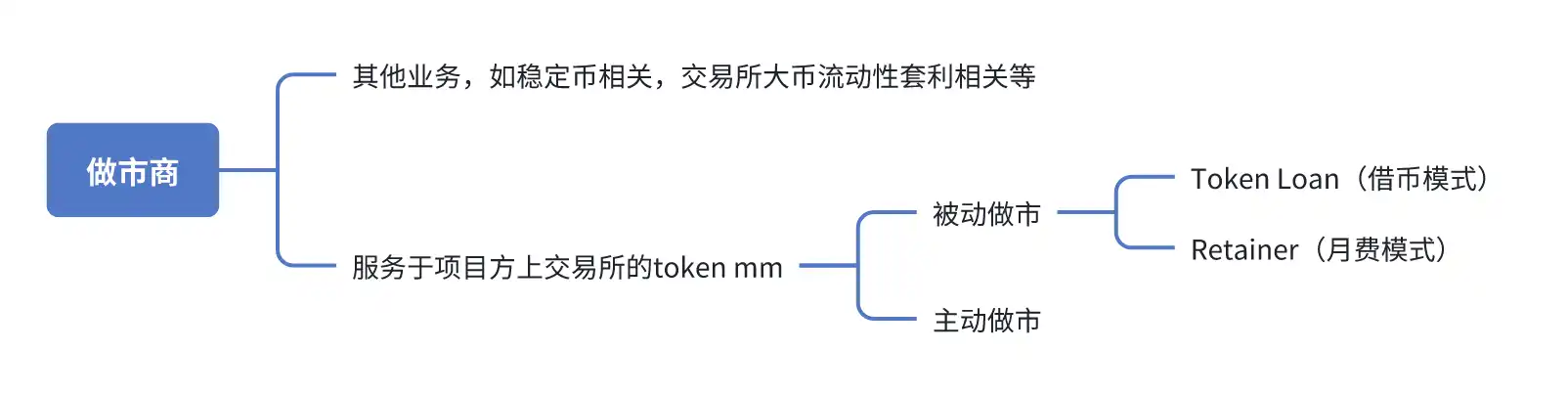
Active Market Maker
In fact, much of the demonization of market makers in the industry comes largely from the presence and actions of active market makers in the early days of the industry. There is a Cantonese saying "doing the kitchen," or in Mandarin "running the bank," active market makers fulfill the market's every fantasy about market makers. Generally, active market makers cooperate with projects to directly manipulate market prices, pump and dump, and profit from it, harvesting retail investors, and sharing the gains with the project. The terms of their cooperation vary, involving borrowing coins, accessing APIs, leveraging, profit-sharing, and other models. There are even rogue market makers who do not communicate with the project team, directly use their own funds to rush into the market, manipulate the market after accumulating enough chips.
Which active market makers are in the market?
Actually, the market's active market makers who are active in PR, event organization, and relatively well-known are all passive market makers, or at least they must claim to be, to avoid compliance issues, let alone flaunting their marketing activities (but it cannot be ruled out that some market makers may have engaged in some active cases in the early days of the industry or are currently engaging in secret activities).
Most active market makers are very low-key and do not have a public presence because they are not compliant. As the industry gradually standardizes, previously high-profile entities like ZMQ and Gotbit have been named by the FBI and faced serious compliance issues. The remaining active market makers have become more secretive, with some of the larger ones having participated in so-called "successful cases" and thus having a certain "reputation." Most deals are also made through referrals from acquaintances.
Passive Market Makers
Passive market makers, including ourselves and many other peers, fall into this category. They mainly engage in providing liquidity to the market by placing maker orders on both sides of the order book on centralized exchanges. The business model is mainly divided into two types:
· Token Loan
· Retainer (Monthly Fee)
Token Loan Model
This is currently the mainstream and most widely adopted partnership model. In essence, it involves lending coins to market makers for a certain period, who in turn provide market-making services.
A typical token loan deal consists of several aspects:
· Loaned Amount x%: Usually a percentage of the total token supply
· Loan Term x Months: The duration of the loan, with services ending upon maturity, and settlement based on a pre-negotiated option
· Option Structure: The market price at which the service ends
· Liquidity KPI: The depth of the market maker's order book, potentially across different exchanges and price ranges
How do market makers make money in this model?
Market makers earn money in two main ways: firstly, from the spread between buy and sell orders during order book placement, which is generally a small portion; secondly, from the options granted by the project team, which typically represent a larger portion.
If you are familiar with finance, you may know that the value of an option on the day it is signed is significant. This value is a percentage of the borrowed coin's value. For instance, if I borrowed a total of 1 million units of a coin, and the option's initial value is 3%, then strictly following an algorithm (delta hedge) to place orders would potentially result in a relatively certain profit of $30,000. Under normal circumstances (extreme market movements such as a skyrocketing or crashing price where efficient delta hedging is not possible), the revenue from this collaboration would be $30,000 plus some profits from the spread during order placement.
Do you feel like liquidity providers are not making as much profit as you thought? But in reality, the profit margin I mentioned is not completely detached from reality. Liquidity providers are currently also very active, and competitive option prices are increasingly transparent.
Retainer (Monthly Fee Model)
This is currently the second relatively mainstream model, which refers to the project side not lending the token to the liquidity provider but keeping it in their own trading account, and the liquidity provider provides liquidity through API access. The advantage of this model is that the token remains in the project side's hands, and all operations in the trading account are transparent to the project side. In theory, the project side can withdraw funds from the account at any time, so there is no need to worry about the risk of the liquidity provider acting maliciously. However, in this model, the project side needs to prepare tokens and U in the account for two-sided liquidity provisioning, and generally, they need to pay the liquidity provider's service fee monthly.
In this case, the liquidity provider provides liquidity based on the client's liquidity KPI, earning the service fee each month. The funds in the account are unrelated to the liquidity provider. In extreme cases of poor liquidity or front-running, the liquidity provision may result in losses, and these losses are borne by the project side.
I believe that Token Loan and Retainer each have their own advantages and disadvantages. Some exchanges only focus on one of them, while others, like us, can do both. The project side should choose according to their needs and the project's situation.
Several Common Misconceptions
Liquidity providers are responsible for "pumping," "price manipulation," and "wash trading."
A qualified passive liquidity provider is neutral and does not actively participate in pumping, market manipulation, or exploitation.
Liquidity providers providing liquidity is synonymous with "volume faking."
Exchange order books have two types of orders: maker orders and taker orders. Passive liquidity providers mainly place maker orders, and the taker order proportion is minimal. Even with deep maker orders on the order book, if there are no takers from the counterparty to match, it does not directly increase the trading volume. However, if a participant trades against their own maker order, known as "self-trading," there are compliance risks. Leading exchanges also closely monitor such behavior, and if the self-trade proportion is too high, both the liquidity provider's account and the token could face warnings and actions from the exchange.
So, it sounds like passive liquidity providers are useless?
Not directly responsible for the coin price, not directly responsible for the trading volume, it sounds like it, but it's useless. However, good liquidity is the foundation of everything. Small-volume money cares about the coin price trend, while large capital wants to enter, the first thing they look at is the trading volume and depth. An actively traded token with a healthy price and the project's product strength and marketing ability are closely related and indeed require close cooperation with market makers. Stepping back, even top-tier exchanges rarely list a project without a professional MM; otherwise, the opening will most likely be a mess. MMs need to register in advance, so at this stage, cooperation with passive market makers is still a step that every project listing on a top-tier CEX must go through.
It sounds like market-making is just placing orders, and the threshold is not high, so can projects do it themselves?
Yes and no. If you do have a proprietary trading team, and the project is relatively large, some second-tier exchanges may allow you to do it yourself. But if you don't have one, or need to build a team from scratch, I suggest leaving the professional work to the professionals. On the one hand, the cost and risk of building a team are not as good as finding a reliable market maker; on the other hand, if you are not familiar with MM, placing orders yourself can really lose a lot of money in the face of various extreme market conditions.
Market Maker's Ecological Position: Opening liquidity is the most valuable resource
After explaining the business model, let's talk about the current situation, which may help you understand better.
What will the crypto space look like in 2024-2025?
From a liquidity perspective, this is how I see it:
· BTC has an independent market trend, rising all the way, with sufficient top-tier liquidity. There has been a recent pullback, but it does not shake the foundation. Miners are happy as mining costs are in the 5 to 6 digits, and traditional institutions entering the space are also happy.
· Fierce battle in the tail end, liquidity was once relatively sufficient. @pumpdotfun, @gmgnai, @solana, @base, and @BNBCHAIN have seen young traders losing money addictively (I have also contributed a bit, damn it), outliers and insiders have also made money happily.
· Drying up of liquidity in the mid-range, reaching its peak with trump and libra, sucking almost dry the liquidity and buying interest of the mid-range, and structurally irreversibly moving from inside the circle to outside. Tokens with market caps of hundreds of millions to tens of billions are in an awkward position. Tokens newly listed on first and second-tier exchanges have no buyers, and within two months of listing, trading volume drops sharply. Most of the trading volume and depth occur at the opening, quickly dropping below the VCs' primary price. When VCs unlock, they will most likely lose money, and when team tokens unlock, they will most likely go to zero.
This cycle, these mid-cap tokens seem to be having the worst time. But another harsh reality is that over 90% of the so-called "web3 native" professionals in our industry, who are truly the ones receiving and spending wages, attending meetings, conducting business on a daily basis, including VCs, project teams, accelerators, business development, marketing, developers, and so on, everyone is doing business with mid-cap tokens. If you look at fundraising, product development, marketing, community engagement, and listing on exchanges, this series of activities actually revolves around these mid-cap project teams listed on centralized exchanges. Therefore, in this cycle, many professionals have not made money, and times have been tough for everyone.
Only market makers, in my opinion, hold the scarcest resource of mid-cap tokens: "Listing Liquidity." Yes, having liquidity alone is not enough; liquidity needs to be there early, right at listing, because once the project goes to zero, having more tokens on hand is useless. A project with, for example, a 15% circulating supply at listing offers 1 to 2 percentage points, or even more, to market makers. This liquidity, unlocked right at listing, is an extremely valuable resource in the current market conditions. Therefore, not only are market makers becoming more crowded, but many VCs and project teams are also stepping in to temporarily form teams and start market making. Some teams may not even have basic trading abilities, but they take the tokens first, as they will end up at zero anyway and are not afraid of being unable to cash out.
The Dark Forest of Gresham's Law: Honest Contribution-Based Character Can't Beat the "Scoundrel"
In the evolution of this market scenario, we have formed a very unique ecosystem for market makers today:
On one hand, market makers are increasing, and quoting has become absurdly competitive. On the other hand, there is a huge disparity in service quality and professional capabilities, often resulting in various after-sales issues, with the most common being draining liquidity and defaulting to dump the price. Firstly, it should be clear that market makers are not prohibited from selling tokens. In fact, if a token skyrockets, following the algorithm to place sell orders is necessary because the borrowed tokens need to be returned, and the settlement with the project team is in USD (for those who do not understand, please review the section on token loan options again). However, a qualified passive market maker should place orders normally according to the algorithm, rather than aggressively taking liquidity from the order book. Such actions are extremely harmful to the project.
Why do market makers do this?
Going back to the part we just talked about regarding options, a market maker who has received a token loan can place orders according to the algorithm. If the market remains stagnant, he should successfully realize the value of the option and earn 3%. However, if he believes that the project will go to zero at settlement, he can achieve a 100% return by aggressively dumping at listing, which is essentially 33 times the return of normal market making. Of course, this is the most direct and extreme example, and most real-world operations will be much more complex. However, the underlying logic is to short the token, sell during high prices and good liquidity, and buy back on settlement.
Of course, aside from being unethical and non-compliant, there are additional risks to this approach. On one hand, the market maker is completely unable to provide liquidity according to the KPI within the contract period because they lack a healthy inventory. On the other hand, if the token takes a wrong turn, a lot of money can be lost with no way to cash out.
Why is this behavior so common?
In the end, the industry's compliance is still in its early stages. Regarding the token loan model, although the market maker will report to the project party on the service situation through daily reports, weekly reports, dashboards, and other means, there are third-party supervisory organizations and tools in the market. However, what the coin does in the market maker's account is ultimately a black box, and the market lacks effective regulatory measures. After all, the only conclusive evidence that can see each trade made by the market maker is the centralized exchange itself. However, many market makers are clients of centralized exchanges' V8 and V9, bringing in hundreds of millions of dollars in fees and liquidity to the exchange each year. The exchanges also have an obligation to protect the privacy of their clients, so how could they possibly disclose the details of their trades to help the project party enforce their rights?
At this point, one cannot help but admire @heyibinance and @cz_binance for their swift actions. In my impression, this is the first time the complete trading details of a market maker have been publicly disclosed, including precise times, operational details, and cash-out amounts. Whether such behavior should be done is worth considering, but the original intention must be good.
Both the project party and the entire industry need to strengthen their understanding of market makers. Actually, I am very surprised that I have talked to many top-tier investors, founders of projects that have raised tens of millions of dollars, and even industry practitioners, and they do not have much understanding of the market maker profession. This is also a significant reason why I wrote this content. Because most project parties are actually experiencing this for the "first time," while market makers are battle-hardened "bad boys."
As a frontline practitioner, sometimes when I see the project party choosing the so-called "better terms," I also ask myself if I am matching the outrageous terms offered by competitors to secure the deal first. In this dark forest of market makers, it is difficult to hold the bottom line. Therefore, pretending to be a profound bad boy will always be more attractive than being an honest person. Only when everyone's understanding of the industry aligns can we avoid the continued occurrence of bad money driving out good.
How to Choose Your Market Maker
There are several important questions and tips that I believe are key:
Is Passivity Always the Wrong Choice?
Actually, when the project party asks me this question, I will not outrightly say that passive market makers should not be chosen. If we set aside compliance, I believe this is a debatable issue. Some projects have indeed achieved a better-looking chart, more trading volume, and more cashouts through close collaboration with passive market makers, with countless instances of overspending. At this point, I only express one viewpoint: you need to realize that those who can really bring you tangible benefits will also definitely cut you mercilessly. And there is only so much liquidity in the market. At the end of the day, you are on opposing sides, and the market's money will either be earned by you or by your passive market maker.
Which Collaboration Method to Choose: Token Loan or Retainer?
Currently, the token loan model is still more mainstream, but the market share of retainers is gradually increasing. This is a matter of project team preference and needs. For example, a project team with strict fundraising controls may be unwilling to have uncontrollable large-scale liquidity from external sources. Additionally:
Try Not to Choose Only One Passive Market Maker
Don't put all your eggs in one basket. You can choose 2-4 market makers, compare terms with each other, and have backups in case one goes down. Furthermore, market makers usually propose various additional value-adds to win the deal. Selecting multiple market makers can get you help from more people. However, to avoid the "three monks have no water to drink" problem, it is recommended to allocate different exchanges to different market makers, as monitoring them together can significantly increase the complexity.
Don't Choose Your Market Maker Solely Based on Investment
You can accept investments from market makers, and having more runway is always good. However, you also need to understand that market maker investments and VC investments are not playing the same game. As market makers control a considerable portion of the opening liquidity, they can lock prices, hedge, and perform other operations on the tokens they have yet to unlock from their investments. Therefore, for the project team, it may not always be a good thing that a market maker holding a token loan also has a significant portion of their token investment position.
Don't Choose Your Market Maker Solely Based on Liquidity KPIs
It is challenging to thoroughly verify liquidity KPIs in practice, so do not select a market maker solely based on liquidity KPIs. Terms may look good on paper, but if they cannot be delivered, they are useless. Before lending the tokens, you are in control, but once you lend them to the market maker, you become dependent on them. They have many ways to deceive you.
Change Your Mindset: Be a "Scumbag" Yourself
Remember, you are the first party. Before signing any agreements, compare terms thoroughly and discuss extensively how to monitor and prevent market maker defaults. Choose a solution that suits your project's development. You can use one party's terms to pressure the other, compare back and forth, ensure there is no ambiguity in the terms, and if something is unclear, don't speculate, ask directly.
A Little Reflection
I am a newcomer to the industry and I deeply cherish the opportunity to perceive and engage with the industry at this level. I often feel the industry's dirtiness and chaos, but I also constantly sense its vitality and energy. I never consider myself the smartest in the bunch; many of my peers in the industry are excellent, quickly finding their own position. However, more young people are actually lost without the web3 industry, making it hard to find a path to success.
I also have a boss with extremely positive values and a highly skilled trading team working in the background. Our stable asset management business allows us to support the team without relying on market-making business, using the market-making business to make friends instead. I have always followed my own pace, using the logic of making friends with the project teams, missing out on some deals, but also proud of a few deals I've closed. Although some projects didn't turn into business deals, I have also become friends with the project teams.
I have rambled on a lot. I was very conflicted about posting this article. On one hand, I'm afraid of not being knowledgeable enough about the business or not expressing myself well, potentially misleading the project teams and readers. On the other hand, market makers have always been elusive in the industry, and I'm afraid of not handling the disclosure properly and intruding on someone's territory.
However, I truly believe that as the industry evolves, compliance will gradually become mainstream, and one day, the role of market makers will no longer be demonized. They will return to the spotlight. I hope this article can have a small impact.
猜你喜歡

RWA永續產品危機:為什麼GLP模式註定撐不住RWA永續?
第16週鏈上數據:結構性供需失衡加劇,數據揭⽰下⼀輪上漲的堅實藍圖?
Sui Q1進階報告:BTCfi基建崛起、借貸協議爆發與執行分片未來
川普次子的加密生意經
SignalPlus宏觀分析:關稅撕裂的M2敘事與TradFi式FOMO的回歸
懂王簽字後,美國哪些州在「乖乖」推進比特幣戰略儲備法案?
PENGU觸底反彈發拉漲360%,胖企鵝如何靠IP行銷迎第二春?
Arthur Hayes最新訪談:漲勢能否持續?誰能跑贏BTC?選幣邏輯是什麼?
專訪AllianceDAO合夥人qw:Crypto創業家正逃向AI,90%的Crypto+AI都是偽命題
穩定幣爭霸戰:六路新銳殺出,市場格局生變?
深入挖掘杜拜的加密夢:幻覺、資本與去中心化帝國
「年份」效應下的暗潮:加密基金迎來黎明前的沉默
WLFI持倉代幣解析:川普家族的加密投資獲利了嗎?
RTFKT「圖片遺失」事件之後Nike遭500萬美元集體訴訟,NFT的未來將何去何從?
4 月 24 日,有人發現曾經的頂級藍籌 NFT 工作室 RTFKT 旗下項目 CloneX 的圖片數據在各大交易平台上都無法顯示,取而代之的是一條標語“此內容已被限制,以這種方式使用 Cloudflare 的基礎服務違反了服務條款”,此事在社區引起熱議。
而在一天之後的 4 月 25 日其母公司 Nike 便被起訴,以澳大利亞居民 Jagdeep Cheema 為首的 RTFKT NFT 購買者在紐約布魯克林聯邦法院提起的一項擬議集體訴訟中表示,在 Nike 突然關閉了這些業務後給他們帶來了重大損失。曾經被 Nike 收購的最強 NFT 潮流 IP 專案為何淪落至此呢?
這個名字因為與人造物的英文“artifact”發音相似而來,同時這個名字也代表著其品牌理念。一開始只是一個以打造「元宇宙的 Nike」為目標的數位運動品牌,而當時隨著越來越多的傳統品牌選擇與 NFT 項目合作,adidas 與 BAYC、PUNKSComic 的聯動也驅使了 RTFKT 和村上隆聯合發行了 CloneX。
而正是這個契機讓加密圈更熟悉這個品牌,而後真正的 Nike 也收購了這個「元宇宙的 Nike」。高達 40 個以上的聯名項目獨霸榜首,從村上隆到 Jeff Staple,從 RIMOWA 到 Nike,幾乎是最炙手可熱的加密圈中的最頂級潮流 IP 之一,
RRTFKT Studio
RTFKT 聯創 Benoit Pagotto 曾經在接受采訪時談到 RTFKT 與傳統行業巨頭相比有哪些優勢時說道:“我們有他們沒有的資源,也就是我們有他們沒有的文化——加密文化。他們不可能會花大量時間、每一天都去學習這些知識。”而加密 KOL 對此諷刺道,Clone 每一天都去學習這些知識。” Cloudflare「儲存小圖片」和手排的荷蘭拍賺到了 1 億美元的銷售額。
而正當以為在 4 年後這個諷刺得到了應驗,無數 Holder 盯著 OpenSea 和 Blur 上可能自己高的“Yhby Clonep.”曾提到的加密文化,即使專案方「Rug」了,只要「Token」還在就有社區自治的可能性。而連圖片本身都消失後,這套邏輯似乎再難自洽。
這場風暴中幾乎是只有一個團隊成員站了出來承擔責任,Samuel Cardillo 宣稱自 4 月初以來,團隊就將 NFT 都去中心化,因此並未選擇與 Cloudflare 而搞錯,超過了!萬美元的合約的到期日,原定 4 月 30 日到期的合約被提前了好幾天。
而事情發生的當下雖然 RTFKT 被高強度“FUD”,但 Samuel 高強度的對線網友以及解決問題的態度贏得了社區的尊重,被稱為“最後一個站著的人”,與之形成鮮明對比的是許諾已久在 X 上發文的
在 RTFKT“丟失圖像”的後一日 Nike 便被提起集體訴訟,事實上在 Crypto 世界“被 Rug”已經屢見不鮮了,但能夠追回屬於自己的資產的卻寥寥無路,而這次集體訴訟主要有幾兩個指控,一號未揭露相關監管風險,違反了美國的證券法。雖然關於 NFT 是否能判定為證券目前還不明朗,但類似關於 NFT 的消費者獲得賠償的案例在此前確有發生。
此前奧尼爾與其兒子邁爾斯·奧尼爾“Myles O'Neal”共同創立並推廣了基於 Solana 區塊鏈的 Astrals NFT 項目,包含 10,000 個 3D 頭像 NFT 設計 Damien Guien。計畫承諾打造一個虛擬世界「Astralverse」,用戶可透過 NFT 進行社交、遊戲等活動,而歐尼爾以「DJ Diesel」的身份在社群以及社群媒體上推廣計畫。
就如同許多 NFT 專案一樣,Astrals 在 FTX 崩盤後價值暴跌。直至 2023 年 5 月,投資者 Daniel Harper 等人提起集體訴訟,指控奧尼爾推廣未註冊證券“Astrals NFT”違反美國證券法,原告稱奧尼爾的明星效應誘導投資。 2024 年 8 月,佛羅裡達聯邦法官 Federico Moreno 裁定,原告合理指控 Astrals NFT 為證券,且奧尼爾作為賣方透過推廣行為吸引投資。 11 月,歐尼爾同意支付 1,100 萬美元和解金,結束訴訟,其中 290 萬美元用於律師費用,其餘賠償 2022 年 5 月至 2024 年 1 月 15 日購買 Astrals NFT 的投資者。
但一些專業人士認為,與奧尼爾「個人」這類項目方不同。因為 NFT 的法律地位仍不明,此次 Nike 的案例可能並不會由違反證券法作為突破口,也可能不會有 500 萬美元的賠償,但無論如何 Nike 公司很有可能會「付點錢」平息眾怒。
儲存 NFT 資料最糟糕的選擇是在 Cloudflare 或亞馬遜這類中心化的伺服器上。如果一個 NFT 專案的元資料和媒體檔案儲存在一個伺服器上,而創建者停止維護該伺服器,那麼該資料將永遠消失,最終使 NFT 成為白板。因此大部分的 NFT 項目會兼顧圖片品質和營運成本選擇 IPFS 和上文中提到的 Arweave。
大部分的項目方最常用的是 IPFS“InterPlanetary File System”,這是一種基於內容尋址的去中心化儲存協議,IPFS 透過檔案本身產生的雜湊值作為唯一,使用者只需憑藉此一串串連內容,即可任意符號。這種方式讓資料不再依賴單一伺服器,天生具備抗審查、抗故障的特性,像水流一樣在全球節點間自由流動。但缺點也很明顯 IPFS 並不自動保證文件的持久存儲,內容是否存在,取決於是否有節點持續保存。因此,許多專案方需要主動「Pin 釘住」文件,或藉助專業服務,確保資料長期可用。
而 RTFKT 團隊宣稱透過 ArDrive 將圖片資料上傳到 Arweave,這是一個去中心化的檔案儲存網絡,和 IPFS 相比它可以保證檔案儲存的持久性。用戶支付一次性費用來支付 200 年「或更久」的儲存成本。 Arweave 網路中的礦工被激勵使用 AR 代幣來複製和儲存其他礦工很少儲存的資料副本。這確保了檔案不會隨著時間的推移而遺失,不需要原始上傳者的持續維護。
Arweave 在 BlockWeave 的結構中儲存數據,每個新的資料區塊都與前一個區塊相連。礦工必須證明他們有機會接觸到這些隨機選擇的歷史區塊,從而挖出新的區塊並獲得獎勵,這確保了較早的區塊被保留下來。
使用 IPFS 或 Arweave 比依靠中心化儲存要好得多,但它仍然需要指向鏈下。將 NFT 元資料和媒體儲存在與 NFT 相同的鏈上是最抗脆弱的方法,但在鏈上儲存資料的成本很高,因此保持元資料在鏈上而媒體資料在鏈下的 NFT 專案方是比較流行的趨勢,但是對加密文化來說,純鏈上的 NFT 社群是必缺的,他們的社群往往也更加強大。
像 Nouns 和 Loot 這樣的 NFT 項目在 SVG 上的以太坊圖像上很早就實現了以太坊圖像。以 Nouns 為例,專案使用自訂的遊程編碼「RLE」對每個影像部分進行無損壓縮,並將壓縮資料直接儲存在鏈上,透過這種方式無需依賴外部指標「如 IPFS 等」。隨後,這些壓縮資料被解碼為中間格式,並透過鏈上批次字串拼接產生 SVG 矩形集合,最終構成完整的 SVG 影像,再進行 base64 編碼。
儘管相當複雜,並且此類 SVG 的圖像上傳 Azuki 或 CloneX 這類高精度的 NFT 比較不現實,但這並不影響“鏈上”NFT 的魅力,他們往往超過了 NFT 本身,而是代表了某種文化或者社區力量,像是 Nouns DAO 致力於構建身份、社區
而 Loot 的創始人 Dom Hofmann 曾是 Vine 的聯創,他的一個副業中是創建一個基於文本的冒險遊戲,它也叫 Loot。而開發過程中他編寫了一個隨機物品產生器,一個可以返回各種武器、盔甲和配件名稱的軟體,這便是 Loot 的誕生。
在 Loot 專案中,影像以 SVG 格式直接嵌入智能合約,透過 tokenURI 返回,且可以根據鏈上資料動態變化,同樣實現了完全鏈上、動態生成的特性。
他的呈現模式也許十分十分簡單,僅是文字和簡單的圖形,但他背後的意義卻更有深度。 Dom 曾經被問道,為建立一個世界,誰會無償做出多少貢獻呢?他回答「歸根結底,這些只是清單上的項目。這只是人們如何看待它、如何賦予它價值。而價值不一定是一個用美元計量的金額,它可以是許多東西。」如他所說 Loot 概念影響到了 NFT 與 Crypto Game,現在還在活躍的 Smol 背後的 Treasure DAO 便是從這個概念應運而生的。
在此次 RTFKT 事件發生時,社區內出現最多的聲音便是,這件事利好 Ordinals。 Ordinals 被認為不同於大部分以太坊的 NFT,是完全上鍊的。
比特幣上的 Ordinals 協定透過 Taproot 腳本路徑,將圖像、文字等資料直接寫入交易中,將資料「銘刻 Inscription」進「聰 Satoshi」裡,並透過對 Satoshi 單位進行編號,使每一個 Satoshi 都具備獨一無二的身份。透過這種方式讓 Ordinals 的資料完全儲存在比特幣區塊鏈上,不過這同時也帶來了高昂的儲存成本和資料大小受限的問題。
也因為儲存成本的高昂以及儲存資料受限,BTC 的 NFT 生態更加獨具一格,相比於以太坊功能性或 DAO 組織的模式,BTCNFT 中的「生存者」,是依靠更深度的「文化」傳承。不管是前陣子以 0.2 BTC 的超高髮售價發行的 Taproot Wizard 背後傳承的自 2013 年的比特幣社區廣告《Magic Internet Money Wizard》,還是 NodeMonkes 作為第一個原始 10K 比特幣 NFT。
延伸閱讀:《一文解析比特幣 memeNFT,光頭巫師 Taproot Wizard 在致敬和表達什麼? 》
在這個時代還在堅持做 NFT 的專案方幾乎寥寥無幾,而也沒有人知道下個時代 NFT 會變成何種形式。他會是「證券」?所有權證明?亦或獨立的 AI Agent?有別於 Memecoin,只需要合約在鏈上可供交易社群便能「肆意發展」。對非同質化貨幣來說,無論他僅僅是一張圖片 IP 還是功能性「收據」,元資料的所有權都無比重要。這次的事件是個警鐘,不論對專案方或參與者而言皆是如此。
對話Vitalik:探索以太坊2025願景,POS、L2、密碼學與AI的整合創新
本週回顧 | 川普將為TRUMP持有者舉辦晚宴;馬斯克與美國財政部長在白宮爆發激烈爭吵
加密市場情緒回暖,MCP成為AI賽道新標向


 App
App